
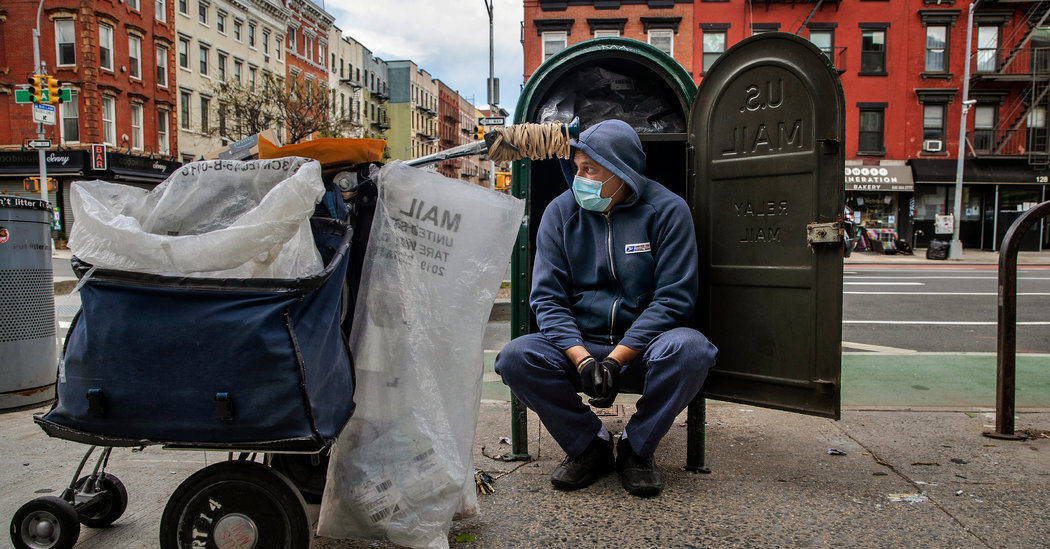
For this week’s roundup of student comments on our writing prompts, we asked teenagers to share stories about their current lives using numbers, explain what their regional accent means to them and share their thoughts on protesting during a pandemic.
We’d like to give a warm welcome to the new students who joined the conversation this week from: Belgium; Bloomfield, N.J.; Cary, N.C.; Clarence High School; Clinton, Utah; Oak Harbor High School; Rome, Italy; Santo Domingo; St. Catharines, Ontario and Versailles, Ind.
Please note: Student comments have been lightly edited for length, but otherwise appear as they were originally submitted.
Using the piece as inspiration, we asked students to use numbers to illustrate what their transformed lives look like right now. They showed us, with data, how things big and small have changed over these last several weeks.
Quarantine, by the numbers
9 hours of sleep
7 wake up time
15 minute meditation
3 things for breakfast
1 New York Times prompt
2 online classes
1 hour of homework
15 minute snack
1 walk
45 minute lunch
1 art project
1 call with aunt
30 minutes of reading
6 hours of free time
6 feet apart people have to stand
12 hours I spent on my phone
42 times I facetimed with friends
11 online classes
13 hours I slept
Millions of nurses, doctors risking their lives to keep us safe.
0: This is the number of times I’ve seen my friends in person. This has definitely been one of the hardest part of quarantine.
1: The amount of times we’ve run out of toilet paper.
2: Amount of books that I have read.
3: Times I’ve checked the news on coronavirus. I’ve been trying to avoid it because I want to sty positive, and it’s so hard with the barrage of overwhelming facts and statistics.
4: Amount of pies that I have bakes
5: Amount of hours I spent on online school today
6: New recipes that I have tried.
7: The amounts of times I’ve chilled in the Jacuzzi
8: the number of movies I’ve watch with my family
9: the number of new exercise I found that I actually like doing
10: the amount of love I have on a scale of 1-10 for all my fellow teachers, friends, family, healthcare workers, and all of those affected by corona.
24/7 of always being with my sister since she is home from college.
0 hugs from friends since we are social distancing.
2 walks a day because I have so time on my hands to do that.
4 FaceTime calls a day to catch up with people and say hello.
7+ hours of screen time due to everything being online now and having extra time to play mindless games and scroll endlessly on my phone.
3 books completed since I now have the time to read.
4 times baking something from scratch during quarantine.
The sum of schedule changes
My daily schedule has changed drastically. I try to stay busy to keep my mind away from negative thoughts, so this is the numbers of an average week:
5: the number of meals I cook each week. It’s been fun to have some time to experiment with new dishes that I wouldn’t before.
1: the number of games my family plays each week. For some reason, we’ve been watching more movies and shows than we have been playing games … I suppose it’s nice to get a reprieve from thinking, so it’s much easier to settle down and watch TV.
10: the number of times I exercise each week. I have been really relying on exercise to keep my spirits high and have something fun to look forward to each day.
2: the number of times I wash my hair each week. It used to be a daily affair, but now, when no one sees me or cares, why bother?
2: the number of times per day that I FaceTime my best friend. Quite possibly the only thing that keeps me sane. 🙂
9: the number of positive interactions with my brother daily … a surprisingly large increase from the amount I’d have on a regular basis. It makes these months so much more enjoyable.
1: the number of times per week I that I update myself on world news. I get small updates each day, but I only focus on it once a week, so it doesn’t seem so crushingly overwhelming.
10: the number of times per day that I long to be somewhere else … preferably the mountains. This semblance of a schedule is a nice anchor to keep me grounded while everything else is in chaos.
My life before quarantine was 4 hours of sleep, 2 hours driving, 8 hours of school. That was it. The days did not change much and there was little room for anything besides just getting through each day without falling asleep in my classes.
Now my numbers look like 11 hours of sleep, 4 hours with family, 3 hours of school, 1 hour working out, and maybe 30 minutes driving. I have more freedom now than ever before to choose what to do with my numbers. I have gotten to read, have family movie night every night, and still have time to binge watch shows or play games. I would not change my new numbers for the world.
More sleep and more video games
My life has changed drastically since the coronavirus pandemic. I would usually soar past 15,000 steps each day due to my soccer and my long walks to classes. However, now I barely average more than 5,000 steps a day. In addition I barely play as much soccer as I used to only around once or twice a week, nothing compared to my full week schedule of soccer before. I have also average more time playing video games; I average around 2 – 3 hours of video games a day. Almost triple the amount before this pandemic. However I have been able to get significantly more sleep. Due to no specific school start time, I can sleep in late and acquire more sleep. I also spend a lot more time on my screens, I used to spend only around 1 -2 hours. Now I spend close to the whole day on my screens.
10, the number of times I’ve been running since COVID-19. Due to medical issues I haven’t been able to run in about 3 years. Now I finally am in a better place and have the time to run. I love running, it is such a mindful activity and I feel myself improving ever time I run.
27, my estimate of how many tree roots I have dug up in our garden. Every time I think I have uprooted the last one, another one appears. Crepe myrtles are vicious survivors.
7:30 am, the average time I wake up everyday even with school being out. I like to keep my schedule consistent and waking up around the same time everyday keeps me energized and organized.
Before quarantine I would get around 6 hours of sleep, would have dance class 6 times a week, would watch around 2 episodes of my favorite show a day and would work out once or twice a week. Now, I sleep for way longer, although I go to sleep very late, I have dance classes 4 times a week, binge watch a show in two days and work out every day. In some aspects I’m more proactive but sometimes I can live an unhealthy lifestyle by eating junk food, watching tv a lot more and not practicing for ballet enough.
The obvious, the unexpected and the wonderful
The Obvious: 7 hours, 13 minutes of screen time, up 18% from last week. 5: the number of Google Classroom assignments due at midnight tonight. 4: The number of loads of laundry done thus far.
The Unexpected: 9: The amount of smoothies I’ve made. Making good use of the extra time in the morning. 5: The amount of seconds I shaved off of my Rubik’s cube solve time!
The Wonderful: 6: The amount of people who volunteer with my nonprofit organization, LexGen. We teach civics to underserved groups and have been working on online resources for teachers to use in their virtual classrooms. The amount of support we have received during quarantine has been incredible! 4: The number of times I’ve FaceTimed my grandparents this week. I normally don’t get to talk with them often, but quarantine has brought us closer!
“The New York accent, as it were, is both music and ideology, instantly recognizable as sound and almost physically palpable, too,” Jon Caramanica writes in “How Does a New Yawker Tawk?” about a recent Instagram challenge to find the #BestNYAccent.
We asked students about their own accents — if they think they have them, where they come from and what they say about who they are. They expressed pride in the different ways they talk and found beauty in the diversity of language in their own communities and around the world.
What accents say about who we are
I was born in St. Mary, Jamaica and it wasn’t until I moved to America that I began receiving compliments and questions in regards to my accent, an accent might I add that I didn’t believe I had. At first it was quite flattering not only would people compliment my “beautiful accent” but they would also compliment my “exotic facial features” and I loved it.
It wasn’t until my accent became the topic of every conversation that I began to get overwhelmed and tried my best to sound like the “typical American.” Jamaican slang is completely different from American slang for example ‘eat’ becomes ‘nyam’ and ‘child’ becomes ‘pitney’ and even to this day I catch myself saying the Jamaican term for an english word in the middle of a conversation and find myself getting slightly embarrassed.
However, I love my accent as it serves as a constant reminder of my parents who worked day and night to ensure that I had the best opportunity to achieve success and access to the best education. I think it’s important that people embrace their accents, in my opinion accents make everything sound ten times better.
While living in America I have continued to learn my first language, polish. When I visit Poland to see my family I always get strange looks or comments about my “American accent.” When I pronounce polish words I do so differently than everyone who lives there which leads me to getting looks from people at the store or people around me. Even though some may frown upon it, I am proud of my accent … It helps me show others who I am and where I’ve learned my morals and values. I think everyone should be proud of their accents because it is an interesting and fitting part of their identity.
I never thought I talked different than everyone else until I moved to Georgia. I was born in Ohio, lived there for a few months, and Oklahoma for 3 years. I then moved to Georgia and stayed in Oklahoma with my tia every summer and Christmas break. Growing up primarily here, I’ve heard the southern drawl that almost everyone has. I’ve tended to pick up more of the Oklahoman side of the lingo rather than the Georgian. I’ve found it more comforting to keep the slight accent in common with my family rather than trying to change my lingo to match the cookie cutter southern fit. It gives me a sense of connection to my family that nobody else here can have.
What my accent says about me is that I’m a foreigner, it’s something I’m proud of. It also says that I’ve been in America a long time, as my accent has started to change. My accent is a big part of my identity as that’s what most people notice me by. What it doesn’t say about me is that I come from hispanic background. So most people don’t expect me to know Spanish. My accent tells people my homeland. A place I’m proud to be from. And a place that I love.
In America, I don’t have an accent. But in India I do. I try my best to speak Gujarati with a native accent but they can still tell that I am not from India. My family visits India every 4-5 years to either visit family or attend a marriage. My sister and I always get stares whether it’s our clothes or the way we talk. Nevertheless, my American accent is vital to my identity as a first-generation American.
Since India is full of diverse languages, people can often tell what part of the state you live in based on your accent. When trying my best, people can often identify that I live by Surat in India or that I belong to a certain group of Gujaratis. It’s amazing how so many languages can have so many different dialects. My accent in India makes me unique and describes who I am.
Shifting language based on location
I was born in Jamaica in which the people speak with heavy accents. Though I am fully Jamaican people in the United States don’t know it unless I tell them because I have learned to adapt to the type of speech spoken in the United States, New York specifically. However I speak in my native tongue around my family who also possess a Jamaican accent. I am able to effortlessly switch other accents when I encounter different people.
I believe accents are a firm part of our identity, and, though we may not realize it, we shift between different accents everyday. In other words, code-switching. The article mentions the infamous “New York accent,” and how it has a certain personality to it that is recognizable through its delivery and catchphrases. We tend to associate said accent with a certain stereotype of people. Loud, energetic, “bristly,” and likely many other characteristics of the typical New Yorker. In order to avoid stereotypes like this, we change the way we speak, the words we use.
I use casual language, often shortened sentences, and maybe a curse here and there when speaking with my friends. Yet, when talking with a teacher, so as not to be perceived as uncaring and undignified, I express myself in a much more articulate manner. I’m doing it right now — answering a student opinion question utilizing language far more formal than when I am texting with a friend. Accents not only represent our background, but our perception of a situation and the language it requires.
As an Asian Immigrant from the Philippines, I have a distinct accent that I personally try to avoid. In other words, I dislike my accent and tend to shift it because I believe it sounds weird. A lot of people say I don’t have an accent or share an accent with them because I tend to mimic their way of speaking in order for them to understand me. The only times my accent tends to slip is when I’m around people I am comfortable with; who may or may not share the same accent as me.
While an individual’s accent is indicative of their heritage, it can be manipulated without changing with their personal values… I, for example, have a Trinidadian accent when I interact with my family. I use words that seem unintelligible to my classmates. Therefore, once I step foot into my school, I abandon my natural sing-song accent and employ an American accent. Despite this change, my thought process and my moral compass remain the same. I am still capable of loving my friends as I do my family, and I reserve the ability to think as the first-generation American with Trinidadian values that I am. Many individuals adjust their accents simply to make it easier on those around them. They free others of potential confusion and misunderstanding. However, no substance is added or subtracted by the abandonment of an accent.
When others make fun of the way you speak
Having an accent reveals your identity. Part of having one is owning pride as well. I have no special accent but my family does. They have a Chinese accent that is mimicked all the time. It’s common for an Asian to say they’ve been made fun of for their language. It’s true. I’ve had many negative experiences concerning other students trying to make fun of. But, over time I built some pretty tough skin. To think about it, I don’t think my accent or my family’s accent has ever been put in a positive light. Often, most times people mock a certain accent or language to hurt the other person … It shoots their pride and wounds their spirit. It makes them believe deep down that they are not accepted. People who are able to consider other people’s accents make more friends. They don’t mock their Asian pals and push them away. They don’t mimic their close Boston friend who says car weird. They don’t punish their Pittsburg mates that say sodapop instead of soda.
Appreciating the nuances of accents
Despite most of my family being Latino, half of us have little to no accent when speaking English; by that I mean my father’s side who mostly live in the states. Puerto Ricans, because we are a territory of the US are often taught basic English skills in school, so most of the population knows English, but often prefer to speak Spanish …
Funny enough, it’s my Spanish that has an accent, despite it being the first language I spoke. I’ve lived in the states for seven years now and I barely speak Spanish outside my house, so I guess I’m rusty. Every time I have to call my mom in front of my Latina friends, they have to cover their mouths so that they don’t laugh out loud. My Latina friends are all of Mexican descent, so my Puerto Rican accent is apparently hilarious to them. Puerto Ricans also have a strange vocabulary; being part of the US has turned some of our words into Spanish/ English hybrids.
Even my parents sometimes make fun of Spanish, saying I sound like a “Gringa” a derogatory word for white people who try to speak Spanish. I’ve improved over the years, but I still say a lot of nonsense.
Personally I have a mom who’s from Cleveland, Ohio, and a dad who was born and raised in North Carolina. I’ve lived in North Carolina my whole life, but every summer my mom and my younger sister would travel to Cleveland and visit her side of the family. One of my favorite things to do while I was in Cleveland was to chuckle at the differences between the distinct, nasally vowel sounds that the Cleveland accent is defined by. Word’s like “bag” became a nasally two-syllable word pronounced “bey-ag,” or sad as “sey-ad,” and applies any other word with a vowel typically pronounced as “ah” in a “standard” American accent. I’ve found that comparing and breaking down accents is a fun way to bond with people of similar, or different backgrounds as we start to notice and learn what an accent is defined by, and appreciate the differences that make up both of them.
I think accents are really cool. each accent shows the specific person’s life experiences in a way. my uncle was born in Togo Africa, and even though he grew up speaking a blend of his town’s native language and English, now he has no accent that I can hear. my grandparents are originally from Oklahoma; you can tell by the way they pronounce many words. they both speak french however and can pretty easily swap accents. my aunt is German and grew up in a small town in Germany. she speaks fluent German and English and has a pretty heavy accent. I think it’s interesting how sometimes her accent is heavier than others, and she often switches to german in the middle of talking to my cousins. my cousins are also fluent in German and English and they have very distinct voices because they grew up speaking two languages.
Slang and social media
Being from the Boston area, I have some Bostonian distinctions in how I talk. I use the word “wicked” to replace “really.” Also use phrases like “Dunks,” “Bubbla,” and “frappe,” that people out of New England don’t know or rarely use. Additionally, I am a teen living in the 21st century with Tik Tok, Instagram, Snapchat, and rap music. Everyday there is new slang that is created on social media, and it goes viral in a matter of hours. Sometimes I find myself saying things I saw on Instagram without even trying. I like using the slang of our young generation, it’s something that helps young people connect to each other. Also, a lot of it is very funny and makes me laugh because half the time it’s complete nonsense. Therefore, I do like my accent it expresses where I come from and the things I am into!!
“How does this image relate to or comment on society or current events?” we asked students in our Picture Prompt “Protesting.” “What is your opinion of its message?”
They weighed in with their thoughts about the protesters across the country who have gathered to oppose the stay-at-home orders states have imposed to slow the spread of coronavirus. Here’s what they saw in the photo:
Self-centeredness
This image portrays a scene that I’ve seen in my own town, a bunch of people gathered together, holding signs that say things such as “Open Our County!” and similar things like that. Some of these people aren’t even wearing protective gear. I personally find these people incredibly selfish and illogical. First, this protest has at least two hundred people standing in close proximity to each other, so they clearly don’t seem to care about the safety of others. If we opened back up all businesses, there would be a second outbreak in no time. 4% of the students infected in my school would die, which I personally find unacceptable. I would refuse to go to school if we opened up, it’s just a bad idea all around. As hard as it is, we need to wait until it’s safe to open back up, I just wish these people would realize that.
I have seen images like this now multiple times and find it quite ludicrous. These people are protesting against the quarantine stating that they have the right to go into the stores as much as they want and whatever store in that matter and they feel like they should feel welcomed to leave their houses whenever. I find these people selfish and unbearable. You should stay inside because doing so you are saving lives. Frankly I don’t care if you want to have your store opened back up so you can go shopping if it means you risk making others sick. I feel like the people who are protesting this should take a step back and look at the risk factor. People can die from this if they are too old or already have a weakened immune system.
Ignorance and misinformation
To me, this image represents how clueless and uneducated our country can be. While staying at home during quarantine is boring and taking away daily routines for everyone, it is necessary to get our country back to some type of normal. If everyone goes back to the way life used to be and states are re-opened, the virus will only infect more people, this will not do any good. We’ve barely been quarantined for a month, it is absolutely not time yet to re-open our country and anyone who thinks so is not educated enough on the topic. Protesting in a large group where everyone is obviously not 6 feet away from each other and they have no forms of protection on is not only extremely unsafe for them, but everyone they interact with who could potentially get the virus from them. If and when these people get the virus, hospital workers will care for them like anyone else, because they chose to rise above their level of ignorance and danger, unlike these people.
This image is a represent of the ignorance and misinformation that has become so widespread throughout our country. The protesters shown in the photo claim that the government is taking away their rights by forcing them to stay home. Not only is this false, it is also dangerous. By failing to follow the proper social distancing guidelines, these people have become threats to society. The question is why are there people who believe the exact opposite of what every credible source has said on the topic of the current pandemic. In my opinion, it is the underlying distrust of science, government, and media that have resulted in situations like these protests or the burning of 5G towers. Some peoples’ mindsets have become so ingrained into conspiracies, that they will dismiss any evidence against them as part of a plot.
A government infringing on citizens’ rights and freedoms
The image presented is most likely talking about the most recent virus that has spread from China, and how everyone is being forced to quarantine within their homes. I can imagine why people would be upset about this, everyone has to stop what they’re doing, which means they can lose their job, lose their hobby, and maybe even lose their loved ones from the virus. In other words, the government is removing some freedoms, which people do not like. If you allow the government to take away some freedoms, they’ll continue to keep taking away until there is nothing left, and that is what people are most worried about. I agree with these people, as the government shouldn’t be withholding peoples’ rights, but I recommend people to take necessary steps to distance themselves from other people to avoid getting the virus.
This image is saying that Americans in Michigan are sick of the way their state is being run. Although Americans should stay inside in order to be safe, it is immoral on how left extremists are taking it to prove their point. They are all out to prove a point that what their governor is shutting down is wrong. There are more cases in the state of Massachusetts (about 43,000) than in Michigan (almost 42,000), but they are taking more precautions, which does not make sense. Prevention is top priority, but at what cost? In my state, I am not allowed to go to church and worship God on a weekly basis, much like many other Americans. However, the nearest abortion clinic to me is open for business. This is wrong …
It is wrong to take away rights in such a strict and harmful way. They are even forcing these people who are protesting off of Facebook to prevent them from their right to the first amendment, free speech, and this occurs in other socialist countries like China. I thought that this country was a democracy of the people.
A threat to us all
Humans, just like any other animal, do not like to be confined to an area. It makes us restless, and those who didn’t have the willpower to power through this situation decided to protest against this. The virus will not end with most social distancing and some congregating; we need to work together. All of us need to adhere to the recommendations of the social distancing so that we may be out even earlier.
Claiming that the stay at home orders makes the United States a “tyranny” makes me worry for me and others who are complying to the order. I understand that we want to get back to work or school, but if we do not stay at home, this virus will never stop. If you have a home, stay there. If not, contact a local shelter. If you need food, contact a local food bank. When the entirety of America feels repercussions of this virus, there will always be someone willing to help. Go find them.


