
Students in U.S. high schools can get free digital access to The New York Times until Sept. 1, 2021.
Lesson Overview
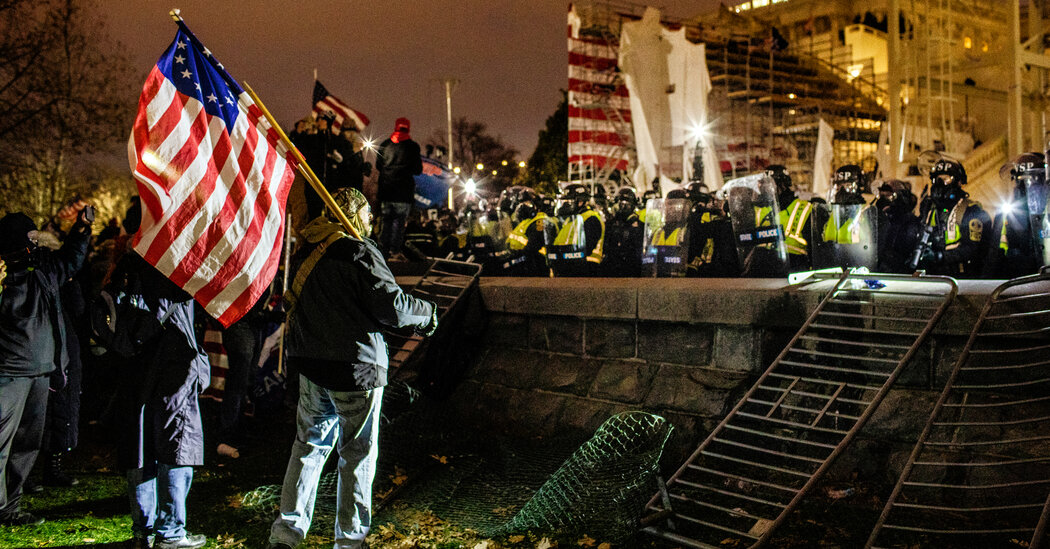
Featured Article: “Capitol Riot Puts Spotlight on ‘Apocalyptically Minded’ Global Far Right” by Katrin Bennhold and Michael Schwirtz
Leaderless but united by racist ideology that has been supercharged by social media, far-right extremists have built a web of real and online connections that worries officials.
In this lesson, you will read about these connections between white nationalists in the United States and Europe, and you will learn about their responses to the Capitol riot on Jan. 6. In a Going Further activity, you will consider how communities and governments should address far-right extremism.
Teachers: A classroom contract can be a useful tool in facilitating a range of difficult discussions; Facing History has a guide for in-person and remote contracting. Additionally, this Teaching Tolerance article from 2019, this explainer on white nationalism by Facing History, and this educator tool kit by the Western States Center can provide helpful background and strategies for engaging in this topic.
Warm Up
Take a moment to consider the following words and phrases: white supremacy, white nationalism and the far right.
What feelings, thoughts or words arise when you hear those words? Have you heard or read these words — or seen ideology connected to them — at school, at home or in the media?
Note: If you are in a classroom, write your responses on sticky notes. You do not need to write in complete sentences and you can share your responses anonymously. Then, post your sticky notes on the white board alongside your classmates’ notes. If you are learning online, you can use sticky notes on Google Slides or annotations on the Zoom whiteboard feature. What do you notice about what your classmates wrote in response to those three terms?
Before reading the featured article, read this excerpt from the Western States Center on the history and definition of white nationalism:
White nationalism is a term that originated among white supremacists in the post-1960s Civil Rights era. While initially used as a euphemism for white supremacy, by the late 1990s, white nationalism emerged as its own distinct ideology with an emphasis on antisemitism and the creation of all-white ethnostates through violence and policies that increase the vulnerability, criminalization and removal of minorities and other targeted communities.
Is this definition similar to how you understood white nationalism? If not, spend some time noting and reacting to any differences before reading the article.
Questions for Writing and Discussion
Read the article, then answer the following questions:
1. The article is divided into three sections: “Meeting online and in person,” “Gaining traction in Germany” and “Differing expectations.” For each section, choose:
One quote that stood out to you
A word or phrase that you found upsetting, confusing or interesting
One question that you had after reading the section
2. How did far-right extremists around the world react to the events on Jan. 6 at the U.S. Capitol? What about intelligence officials in various countries?
3. What are some of the — unfounded — fears and ideologies that unite far-right extremists around the globe? How do they connect, recruit and organize?
4. What do white nationalist groups in the U.S. and around the world think about former President Donald J. Trump and the Trump era?
5. What role do conspiracy theories and disinformation play in connecting far-right movements and ideologies internationally?
6. What do experts on far-right extremism think about the potential of an organized international far-right movement? What do far-right followers think about such potential?
7. Has your understanding of white supremacy, white nationalism and the far right changed after reading the article? If so, how?
Going Further | What Should Happen Now?
Increasingly, white nationalists are recruiting teenagers online, which has led to white nationalist symbolism and rhetoric in schools. Have you ever witnessed racist or anti-Semitic symbols at school, or in memes shared by peers online? How does your school community address these issues? What do you think of their response?
Now, consider the government’s role: How do you think the president, lawmakers and law enforcement officials should address white nationalism and white nationalist violence?
Farhad Manjoo, a Times Opinion columnist, says that even though intelligence officials saw far-right organizing online, they failed to act leading up to the Capitol riot. He believes that lessons should be learned from counterterrorism officials who investigated Islamic terrorism. Some of these ideas include anti-radicalization programs, the federal investigation of hate crimes, shutting down right-wing agitators on mainstream media, and international cooperation to prevent attacks and white nationalist recruitment globally.
In an Op-Ed, Colin P. Clarke, director at an intelligence and security consultancy, argues that lawmakers should declare domestic terrorism a federal crime and pass a bill to rigorously assess the threat of violent white-supremacist groups operating internationally.
However, not all people agree that a counterterrorism model should be used. In a Times Op-Doc, Adama Bah talks about when she was wrongly accused of terrorism as a 16-year-old. Today, when she hears politicians pushing for more laws to stop domestic terrorism, she does not agree. Ms. Bah says:
I want to call these white supremacists who stormed the Capitol terrorists. But calling them terrorists just gives law enforcement and other elected officials the ammunition to call peaceful protesters terrorists. People that look like me, who are brown, Muslim, Black, those are the ones who are going to actually be punished. We don’t need new laws to deal with white terrorists. The laws are there. It’s whether you want to apply it to certain people or not.
What is your reaction to these different positions about government policies to address white nationalism? Do you agree with one of the positions more than the others? Why?
About Lesson of the Day
• Find all our Lessons of the Day in this column.
• Teachers, watch our on-demand webinar to learn how to use this feature in your classroom.

