
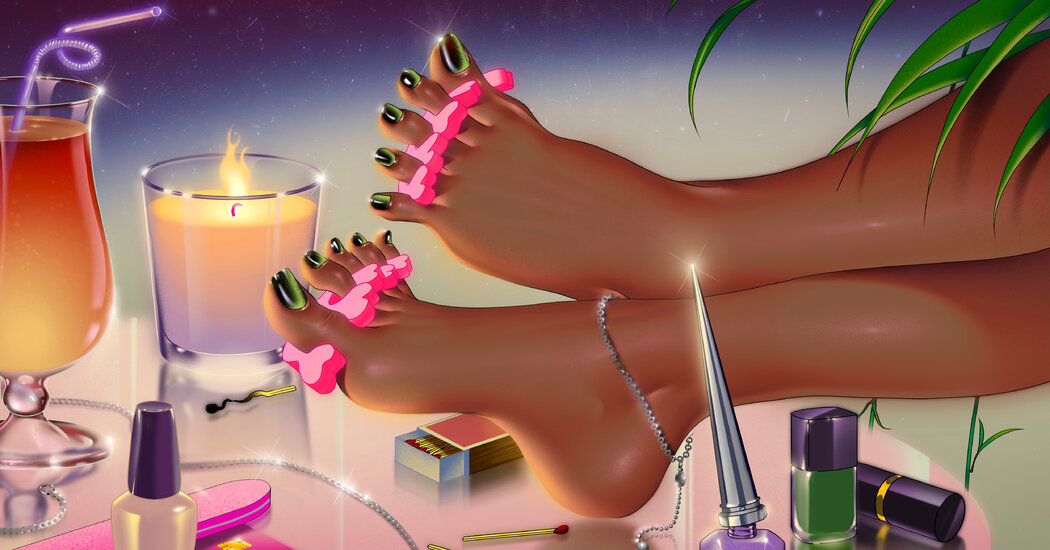
Treat yourself! What comes to mind when you read these words? (If you think of the show “Parks and Recreation,” you’re certainly not alone.)
Do you have any habits or rituals that help you feel better? That help remind you that you are a special, worthy person? That get you through difficult moments? What are they?
In “Yes, You Do Deserve a Little Treat,” Julia Carmel writes about the practice of “making time for simple joys.” The article begins:
These days, whenever Jules Zucker has to run an errand, she throws a Reese’s Fast Break candy bar into her bag.
“We’re living in an era where security and ‘the big joys,’ if you will, are not guaranteed at all,” she said. “So all we have to fall back on are small comforts. It’s almost like a poor man’s hedonism.”
“It’s about giving ourselves tiny wins,” she added. “Like a tiny symbol of resistance against systems that are sucking us dry and then telling us we’re failing.”
Ms. Zucker, a 26-year-old music coordinator living in Brooklyn, is just one of the many people who have been reimagining their lives to include more small pleasures after two years of canceled plans and lowered expectations throughout the pandemic.
Tracy Llanera, 35, a philosophy professor at the University of Connecticut who studies nihilism, said that this treat-forward approach is one way people are reclaiming some of the freedom and stability that has been lost since early 2020.
“In the Covid pandemic, the thing that confirms that you’re suffering from existential nihilism is the lack of control,” Ms. Llanera said.
Amid these feelings of ongoing helplessness and grief, she said, people try to find consistent and reliable pleasures.
“Something about treat culture is that you’re always regularly going to get the treat,” she added. “You can depend on that, at least. There’s a guarantee that this small little ritual that you have every week will at least satiate something in you.”
The article points out that while spending money is a common part of “treat culture,” it’s not required. It also explains that creating these breaks can be just a function of one’s mind-set:
Bettina Makalintal, a 29-year-old reporter at Eater, said she has always been treat-inclined, but working from home has made it easier for her to take the time and space to care for herself.
“A big shift in this idea of treats is approaching mundane, everyday tasks and seeing it in a way that makes it feel like a treat,” she said.
“If I go for a walk to get coffee, then it’s not just a walk; it’s an outing,” Ms. Makalintal added. “Sort of just re-shifting how I’m seeing everything so it feels like something I want to do as opposed to something I have to do.”
Students, read the entire article, then tell us:
What are some ideas you might add to your list after reading this article?
What would you do if you had a “Treat Yourself” day? Would you bring someone else along with you? If so, who, and why?
How is treating yourself different from receiving a gift from someone else? How are they similar?
What are some ways people can be kind to themselves without spending much, if any, money?
What role, if any, do you think the pandemic has played in people’s desire for “small comforts” and “tiny wins” in daily life? Is there anyone in the article with an opinion similar to yours?
Want more writing prompts? You can find all of our questions in our Student Opinion column. Teachers, check out this guide to learn how you can incorporate them into your classroom.
Students 13 and older in the United States and Britain, and 16 and older elsewhere, are invited to comment. All comments are moderated by the Learning Network staff, but please keep in mind that once your comment is accepted, it will be made public.

