
How frequently do you recycle? Are you conscious about what, or how much, you put in the garbage?
Are you sure you know which trash goes into the recycling bin and which goes into the garbage can? If so, play the game at the top of this article to prove it.
How did you do?
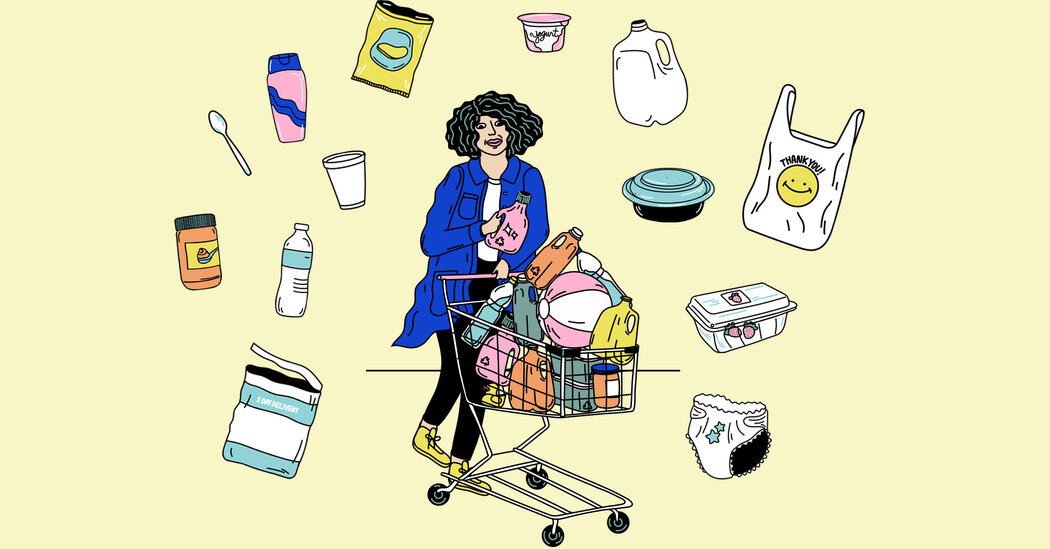
In “Trash or Recycling? Why Plastic Keeps Us Guessing,” the Times journalists Winston Choi-Schagrin and Hiroko Tabuchi, along with the illustrator Rinee Shah, delve into the complexities of waste disposal as it relates to recycling, specifically the recycling of plastics.
The piece explains why recycling can be so difficult. For instance, the ♻ symbol, known as the “chasing arrows” logo, is stamped on many things, including items that may not, in fact, be recyclable:
The unhelpful symbol is just one aspect of a recycling system that is far too confusing to be broadly effective. It puts the burden on individuals to decode a secret language — to figure out not only whether a thing is recyclable, but also if their local recycling program actually accepts it.
For reasons like these, only a small proportion of recyclable plastics actually get recycled.
This system largely leans on us consumers to do the right thing. But it’s easy to get tripped up by the details. Take those numbers, for example, the ones in the center of the symbol. There are seven types (here’s the full list).
Items marked 1 and 2 are widely recyclable in the United States, and about 30 percent ends up being recycled, according to the Environmental Protection Agency. Type 5 is also accepted by a growing number of curbside recycling programs. But other numbers — particularly for soft plastics like shopping bags, snack bags or resealable sandwich bags, generally labeled 4 — are not accepted in curbside programs. And category 7 is a catchall for various plastics, so it’s almost never recycled.
Even if you sort everything perfectly, but then put the sorted plastics in an opaque bag to be picked up, you may have just wasted the effort. That’s because using opaque bags (which make it difficult to see what’s inside) can result in entire bags being thrown out instead of recycled.
Overall, only an estimated 9 percent of all plastics ever manufactured has been recycled, according to the United Nations Environment Program. The rest? Nearly 80 percent has ended up in landfills or dumps, or in the natural environment, with the remainder being burned, releasing emissions that contribute to pollution and global warming.
However, the article concludes with a few tips for how individuals can make a difference:
Keep recycling category 1 and 2 plastics, as well as paper, cardboard and metals. Depending on where you live, it might also be possible to recycle the ones marked 5.
Consider switching to different products or brands (ones with more recyclable packaging), or making fewer purchases online given that bubble mailers aren’t accepted by most curbside recycling programs.
Buying fewer consumer goods in general, to the extent possible, can reduce the plastics waste stream. Getting involved in local efforts to improve recycling or reduce local plastic use is another option.
Students, read the entire article, then tell us:
Did you learn anything from the trash-sorting game? How much do you feel like you know about recycling in general?
Is recycling important to you and your family? Why or why not? How often do you repurpose or reuse things?
Are you vigilant about not putting recyclable items into the garbage? In a typical week, what kinds of things do you throw away? Do you ever feel guilty about what, or how much, you toss out?
The article says that recycling, because it works differently in different parts of the United States, “puts the burden on individuals to decode a secret language.” How much responsibility should fall on an individual to understand that language? Is the complexity of the rules a fair excuse for not properly recycling?
A growing number of states and cities have banned single-use plastic bags. Some cities and counties have set up curbside recycling programs. Others have banned plastic foam products, which can’t be recycled. Has your hometown taken similar steps? Has it tried a different strategy? What else do you think your community can do collectively to cut back on plastic waste?
What can you do? Can even small efforts made by individuals truly make a difference?
Want more writing prompts? You can find all of our questions in our Student Opinion column. Teachers, check out this guide to learn how you can incorporate them into your classroom.
Students 13 and older in the United States and Britain, and 16 and older elsewhere, are invited to comment. All comments are moderated by the Learning Network staff, but please keep in mind that once your comment is accepted, it will be made public.
