Note to Teachers: The film includes difficult and disturbing themes. Please preview it to make sure it is appropriate for your students.
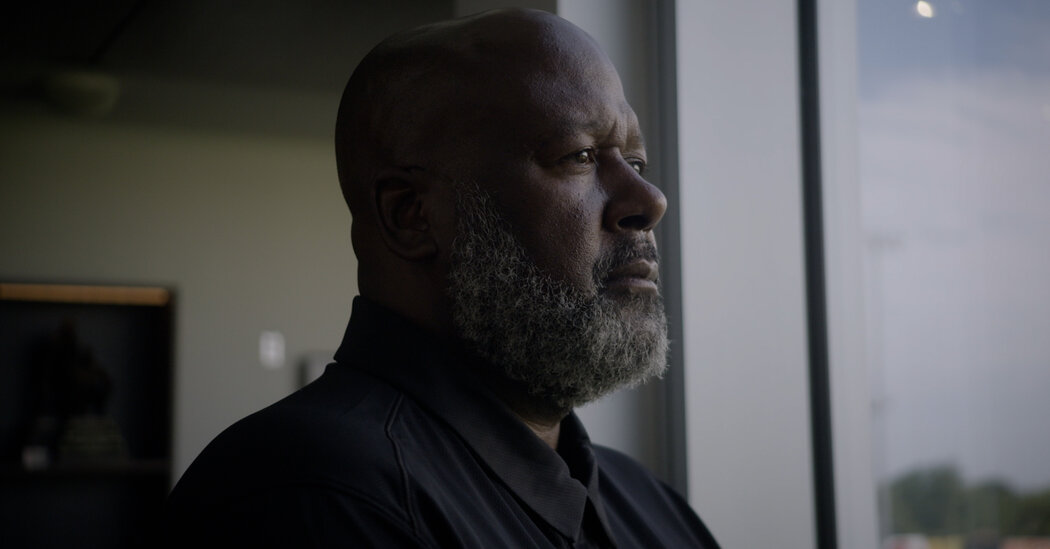
“A Football Coach Walks the Line on C.T.E.” is a six-minute film looking at the dangers of the popular sport for the young people who play it — and their families. Meiko Locksley, a standout high-school football player, was shot and killed in 2017 at age 25. After his death, a brain scan showed that he had chronic traumatic encephalopathy (C.T.E.). His father, Michael, the head coach at Maryland, is still reckoning with the implications: “The game of football gave me a degree. I met my wife. I had a family because of it. It was my way out. But I also think that it’s important for me to walk the line between being a football coach while also being parent to a son diagnosed with C.T.E.”
The brain of Meiko Locksley is one of 152 belonging to contact-sport athletes under the age of 30 that were donated between 2008 and 2022 to the UNITE Brain Bank and studied by researchers at Boston University.
In a paper published in August in JAMA Neurology, the researchers reported that 63 of the athletes, or 41.4 percent of them, had C.T.E. Most were football players who never played past college, sometimes not past high school. One was 17.
What is your reaction to the poignant and tragic story? Should children be allowed to play tackle football now that we know that even the young can get C.T.E.?
Students
1. Watch the short film above. While you watch, you might take notes using our Film Club Double-Entry Journal (PDF) to help you remember specific moments.
2. After watching, think about these questions:
What questions do you still have?
What connections can you make between this film and your own life or experience? Why? Does this film remind you of anything else you’ve read or seen? If so, how and why?
3. An additional challenge | Respond to the essential question at the top of this post: Should children be allowed to play tackle football now that we know that even the young can get C.T.E.?
4. Next, join the conversation by clicking on the comment button and posting in the box that opens on the right. (Students 13 and older are invited to comment, although teachers of younger students are welcome to post what their students have to say.)
5. After you have posted, try reading back to see what others have said, then respond to someone else by posting another comment. Use the “Reply” button or the @ symbol to address that student directly.
6. To learn more, read “After the Loss of a Son, a Football Coach Confronts a Terrible Truth.” John Branch writes:
Michael Locksley was helping coach Alabama to a national championship in 2017 when his 25-year-old son, Meiko, was shot and killed.
Meiko was a standout high-school football player who bounced between college programs as his mind and life slipped into darkness in his early 20s.
His father is now the head coach at the University of Maryland. Michael Locksley has mourned Meiko’s loss, in part, by leading discussions about mental health and trying to destigmatize it among the young men he coaches.
One thing he has not said publicly, until now: Meiko had chronic traumatic encephalopathy, or C.T.E., the degenerative brain disease caused by repeated blows to the head and often associated with football.
C.T.E. can only be diagnosed, with certainty, posthumously.
Want more student-friendly videos? Visit our Film Club column.
Students 13 and older in the United States and Britain, and 16 and older elsewhere, are invited to comment. All comments are moderated by the Learning Network staff, but please keep in mind that once your comment is accepted, it will be made public.