
Despite current economic conditions, vendors (plenty of them) have apparently been sent back to the days pre-inflation, and restructuring – employees being laid off, and as a result, have strategies that are either old school or testing the waters.
The issues that come with either are that you often do not realize it – unless the vendor makes it clear upfront.
Thus, you spend a lot of time wasted, which could be better spent elsewhere.
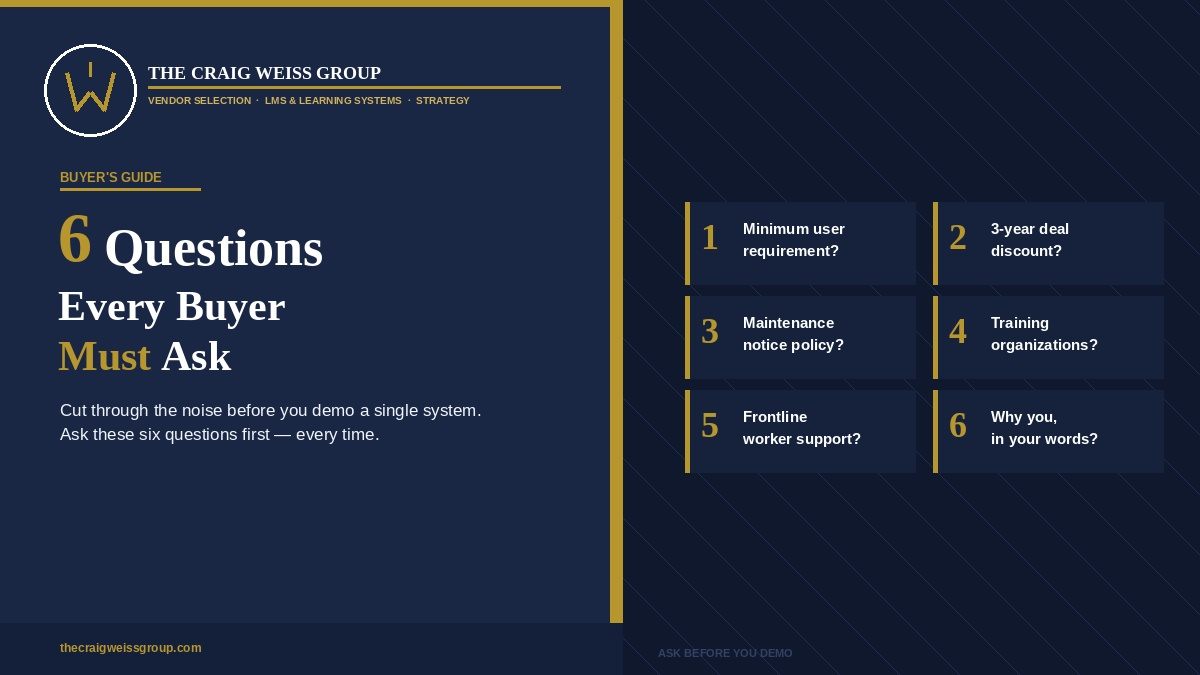
Here are six questions you should ASK every vendor. (To Download a shorter version with data point – click here.)
There are ones you need to ask upfront, before you start the entire process, such as qualifications from the vendor, and so forth.
Before I forget, say something like, “We are looking at a lot of systems (you choose the kind/type) and as such, I have a set of questions I need to ask before we start any discussions.”
If a vendor wants your business, they will respond.
I mean, they do it at a trade show, so what’s the difference?
1. Do you have a minimum number of learners (end-users that you accept)? – THIS IS A MUST-ASK question to ask before you start having any conversation. Seriously, this is a MUST.
Relevancy
Some vendors require a minimum number of end users; those that do set their starting line at 5,000. A few go at 10,000, but the usual start is 5,000.
If you have, say, 2,500, they will remove themselves from consideration early on. The problem here is that they are either upfront about it – but only after they start inquiring, or they fail to note it, in any materials, which is the common.
Two vendors that stand out among the minimum are Thought Industries and Intellum.
Honestly, it doesn’t make sense because it falls into the old-school thinking that fewer end users mean a lower budget.
This is a misnomer, as it depends on the company.
I’ve had clients with a F500 big name, several thousand users, and a very low budget.
Just as I know of a company slightly over 2,000 whose budget was near 1M USD.
On top of this, some folks are one human and have clients who use their content. These individuals are really a training organization.
Ask yourself – as a vendor – would you take that client or demur because of the number base.
2. Do you offer a discount for a three-year deal?
Relevancy
Let’s get to the nitty-gritty upfront. At the end of it all, it always comes down to budget.
Vendors (see above) seem to forget that, or assume that if the system hits everything the client needs, the client will find a way to pay extra to have it.
For every one client such as this, more than 20 won’t.
Great odds.
Anyway, the industry standard discount is 15% on a three-year deal with auto-renewal (a vendor may or may not mention this).
Anything less, and they are ripping you off.
Because the majority of the market requires paying up front on your deal (there are exceptions, such as Eurekos, which, which bills monthly, so you truly only pay for those folks in the system that month – ideal for customer training,, mind you), that 15% discount is big.
A vendor will often try to side-step this question because they want to know more about you, and blah blah blah.
But, if they fail to stipulate any pricing deals upfront – as you would see in a car ad (online these days) or whatever product you plan to buy, wouldn’t it make business sense to find out upfront if they offer one?
If they do, let’s start the conversation. If not, thank you for your time.
I always toss in something like, I understand you are quite busy, as I am, so it doesn’t make sense to continue this conversation.
Just as you would expect when buying or renting a car, a hard sell can show up early on; I’m not looking at a timeshare here.
3. When you have to do maintenance on your system, are we notified ahead of time – and if yes, how many days beforehand?
Relevancy
Vendors nowadays do updates far more frequently than before, some say daily – but that is a stretch.
Anyway, there are times when the system has to be down for maintenance, such as when bugs are found (as a result of the last update) or when the update just needs to keep your system offline.
In the old days, vendors would be upfront telling the client that if there was maintenance to be done, the admin would be notified X number of days ahead of time – so that when the system goes offline, or a fix needs to be made (hence maintenance), your learners are not going bananas and start complaining to you.
I always have an issue when a vendor hides the maintenance details in their SLA, like someone is going to read this document, two months ,after they receive it.
I suspect the same number of people who use the vendor’s FAQ for help.
4. If you are a training organization, ask upfront if the vendor accepts training organizations.
Relevancy
The majority will say they will, but a TO is someone or an entity that sells content, which means the system must have e-commerce functionality and data to show business-relevant revenue.
For me, a training organization slides under customer training/education.
On another point,, it is extremely common for the TO not to know their user base up front upfront, so if you are a vendor, understand that and reflect your pricing accordingly.
Vendors use block/package pricing (behind the scenes), so you start with X buckets of users, and as you grow, the vendor makes more money.
However, so many vendors are out of the loop on this, and will brush you off, like a fly.
They want that higher user base, even if you never get there.
5. If your main audience – i.e., learner base – frontline workers, ask the vendor early on, what capabilities do they offer to enable your frontline workers to succeed. The same question can be applied, for plant workers, welders, construction (i.e., blue-collar) – you just switch out the worker base.
Relevancy
Everyone says ‘onboarding’ capabilities and ‘compliance’ to get you to think, ‘great’. The problem is that what one vendor references as compliance may be underwhelming (assuming that compliance is high on your list, if it isn’t, the compliance component is a necessary push upfront).
What you want for either work base is:
a. Mobile app, with on/off sync – If a vendor doesn’t offer this, or they have a mobile, but lack on/off sync, how is that going to help those folks in the field, who may not have, or they have limited net access.
Ever been on a plant floor? I am asking the vendor here.
Frontline isn’t necessarily better – retail stores are notorious for poor internet.
b. Digital signature – huge if you are doing any type of safety, or something that requires read and check off. This feature can exist in the system, on mobile, or both.
A vendor might say they offer integrations for digital signatures.
Ok – what vendors do you have integrations with, and what capabilities can be captured in the system?
Some vendors have built-in digital signature capabilities, usually in their mobile app.
Always ask.
6. Salesperson’s Perspective
I find this is rarely asked, but if you think about it, it makes, okay, requires the vendor – in this case, the salesperson – to provide a detailed response.
What qualifies you as the ideal vendor for us for our audience – let’s say, frontline workers? Or let’s say you want to mainly use the system for leadership or maybe onboarding as the primary.
Relevancy
While it is of interest to know what clients or how many clients the vendor has that use their system primarily for onboarding (if that is your main reason), leadership, compliance, or specific audiences, blue-collar, frontline, and so on, that is the basic response you may get.
You want more –
What makes you – the vendor and your system – from your perspective (key – you are talking to the salesperson, who is the person, you assume, responsible here – as the face/voice of the vendor), explain why we would be of value to you, and why we should consider you and your system?
If the person sidesteps or tells you they have to get back to you, move on.
This salesperson should know why they, as a company, are relevant for you, ideal for you, and why they think this way – again, you want it from the salesperson’s perspective, not the standard lines from the company.
I’ve asked this type of question at AWS, not about the value of their product, etc., but based on their statements or whatever they note they follow, what that one person’s perspective was on those statements.
I did so to get a better understanding of the company’s culture (based on what I read and heard) and to see if it would align well with the reason I was there (and it wasn’t for me).
Cultural fit is everything, but you need to dive into that culture beyond the vendor’s taglines.
As for that person’s perspective.
Yes, you are putting them on the spot, but they work at the company and thus have opinions beyond the standard stuff they feed them.
You truly want to know – because it will tell you far more than you realize, and far more than they do as well.
Bottom Line
Six Questions.
One that should be right out of the gate. Not a hold back, not a wait, and let’s chat, rather right now.
One that requires deep thinking, honesty, and insight, not from the vendor’s usual spiel, but from the person who is the face/voice of the vendor, trying to get you to explore more, gain more, and hopefully get you to buy the system.
Six questions.
Think of it as a quiz, not for your learners, not to see if it is right or not, but rather to see and understand – to really gain insight far more than you will realize.
Realization comes at a price.
Whether it is your gut, your inner voice, or even your budget.
Never go down the path just checking off the boxes to get where you need to go.
Otherwise, that yellow brick road may not take you to the Wizard.
rather
The dumpster.
E-Learning 24/7

