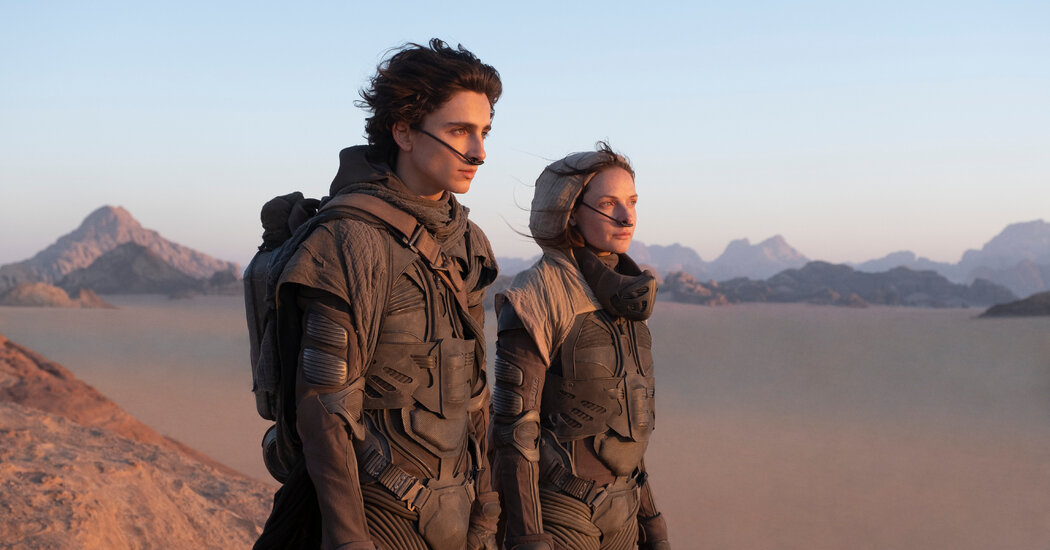
That impulse to linger is understandable given the monumentality of Villeneuve’s world building (and its price tag). But the movie’s spectacular scale combined with Herbert’s complex mythmaking also creates a not entirely productive tension between stasis and movement. Not long after he lands on Dune, Paul is ushered into the new world of its tribal people, the Fremen, a transitional passage leading from dark rooms to bright desert, from heavy machinery and vaulted spaces with friezes to gauzy robes and the meringue peaks of the dunes. Paul is on a journey filled with heavy deeds and thoughts, but en route he can seem caught in all this beauty, like a fly in fast-hardening sap.
There are moments in “Dune” and in Villeneuve’s other movies when his truer talent is for production design rather than as a director of moving pictures.
Chalamet looks young enough for the role (Paul is 15 when the novel opens) and can certainly strike a Byronic pose, complete with black coat and anguished hair. The actor has his moments in “Dune,” including in an early scene with Rampling’s Reverend Mother, who puts Paul through a painful test; Chalamet excels at imparting a sense of confused woundedness, psychic and physical. But he doesn’t move with the coiled grace of the warrior that Paul is meant to be, which undermines both his training sessions with the family “warmaster” (Josh Brolin) and in his later role as a messianic figure, one who is considerably less complicated and conflicted onscreen than he is on the page.
As I was thinking about Timothée Chalamet’s acting, I realized that he has effectively become the new Leonardo DiCaprio, a.k.a. Hollywood’s latest bankable white male heartthrob. That means that, like the young DiCaprio, Chalamet is now famous enough to be cast in a big movie whether he makes sense in it or not. I didn’t have the space or inclination to drag DiCaprio into this graph — but that’s what I was thinking.
Written by Villeneuve, Jon Spaihts and Eric Roth, the screenplay has taken predictable liberties. The movie retains the overall arc of the book despite having jettisoned characters and swaths of plot. There have been felicitous changes, as with the character Dr. Liet Kynes, an ecologist who’s a man in the book but is now a woman. Played by a formidably striking Sharon Duncan-Brewster, the character doesn’t receive nearly enough screen time, particularly given Kynes’s weighty patrimony and narrative function. But Duncan-Brewster — like so many of the other well-cast supporting performers — makes enough of an impression that she helps fill in the script’s ellipses.
Dr. Liet Kynes is a great character; in the book, he is also a man. I love that the movie makes the character a woman, even if one who’s been whittled down in importance. But Sharon Duncan-Brewster is one of those actors who, through their talent and presence, can make even a smallish role seem big. She’s terrific. And, of course, her casting adds some gender and racial diversity. I would love to see an entire movie or series centered on her as Liet Kynes.
Throughout “Dune,” you can feel Villeneuve caught and sometimes struggling between his fidelity to the source material and the demands of big-ticket mainstream moviemaking and selling. It’s easy to imagine that he owns several copies of the novel, each copiously dog-eared and heavily outlined. (The movie is relatively free of holiday-ready merch opportunities, outside of a cute desert mouse with saucer-sized ears.) At the same time, Villeneuve is making a movie in a Marvel-dominated industry that foregrounds obviousness and blunt action sequences over ambiguity and introspection. There’s talk and stillness here, true, but also plenty of fights, explosions and hardware.
The fact that Villeneuve directed a sober, serious and beautiful movie from a sober, serious and smart book at this point in American mainstream movie history is impressive enough to mention and celebrate. Whatever you think of Marvel, its crushing domination is terrible for the movie industry simply because it has led to less and less narrative and genre diversity in bigger movies. It’s bleak.
The trickiest challenge is presented by the movie’s commercial imperatives and, by extension, the entire historical thrust of Hollywood with its demand for heroes and happy endings. This presents a problem that Villeneuve can’t or won’t solve. Paul is burdened by prophetic visions he doesn’t yet fully understand, and while he’s an appealing figure in the novel, he is also menacing. Herbert was interested in problematizing the figure of the classic champion, including the superhero, and he weaves his critique into the very fabric of his multilayered tale. “No more terrible disaster could befall your people,” a character warns, “than for them to fall into the hands of a Hero.”
Frank Herbert, the author of the original novel, complicates Paul’s role in interesting ways that are fundamentally anathema to Hollywood’s frustrating, often maddeningly simplistic love for unambiguous heroes. Villeneuve’s conception of the character isn’t as complex as Herbert’s, and his Paul is more classically heroic or at least seems like the usual hero-in-the-making. But the movie only adapts the first half of the first book, so maybe — if Villeneuve directs a sequel — he will go against Hollywood’s heroic grain. Here’s hoping.