Find all our Student Opinion questions here.
Does your school try hard to make students from different backgrounds feel welcome and included?
Do your teachers provide space for students to thoughtfully tackle complex issues related to race, ethnicity, gender and sexuality?
Do you feel that you’re able to bring your whole self to school?
In “Bringing a New Vibe to the Classroom,” Kerry Hannon writes about teachers across the country who are trying to honor the diversity of their students’ identities:
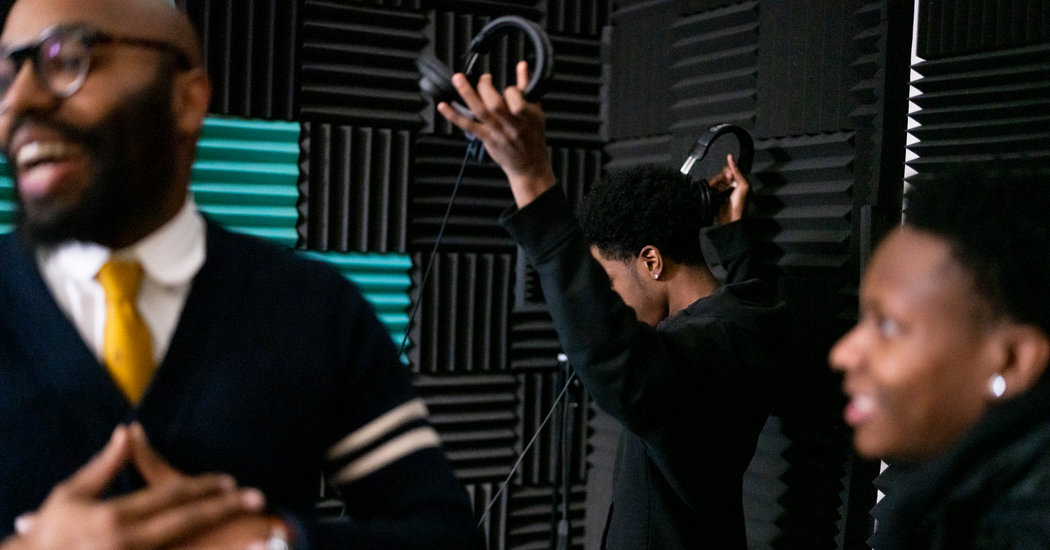
At the forefront are teachers like Christopher Emdin, 40, a science educator and the author of “For White Folks Who Teach in the Hood … and the Rest of Y’all Too.” He has been a leader in the #HipHopEd initiative, which integrates urban youth culture with learning. The Science Genius program, for example, uses hip-hop music and rhymes in teaching science.
Mr. Emdin — who said he did not like school growing up — co-founded an initiative in 2012 with the rapper GZA to use hip-hop to teach science in 10 New York City public schools. It is about “remixing education,” he said.
Today, he advises educators on ways to incorporate these techniques into their classrooms. “Writing these raps, poems over beats, is a way of giving students’ voice,” he said.
Louis Tavares, 17, a senior at Brooklyn Prep, said hip-hop motivated him to learn. “Before hip-hop, I would go to school and not really look forward to learning,” he said. But now with hip-hop, he said, “It brings a certain type of vibe to the classroom.”
Teaching Tolerance, the education arm of the Southern Poverty Law Center, has produced social justice teaching standards that many teachers are using, from kindergarten through high school, to guide curriculum development.
“We are beginning to address race and racism explicitly in the classroom,” said Lecia Brooks, a former teacher and a member of the senior leadership team of the Southern Poverty Law Center. “We are letting go of the false notion that it is too heavy, too much for children to talk about it head on.”
The article features several other teachers who are doing similar work:
Another powerhouse behind the transformation of teaching is the National Council of Teachers of English, with more than 25,000 members and subscribers worldwide. Lorena Germán, an immigrant from the Dominican Republic, is the chair of the council’s Committee Against Racism and Bias in the Teaching of English.
Ms. Germán, who came to the United States as a child, teaches at the Headwaters School in Austin, Tex. She said she experienced classroom racism as a child in Lawrence, Mass. “They wanted to bring us into a classroom that required us to dismiss our way of being in order to assimilate — as if ours had no value,” she said.
She rebelled. “I was a menace,” she said. “My chemistry teacher, for instance, would not speak to me or respond when I raised my hand.”
Today, after nearly two decades as an educator, she practices “activism every day in the classroom,” she said. “This is not about politics. This is about working toward social justice. I am constantly asking myself how I can model that thoughtfully in my classroom.”
Ms. Germán’s ninth-grade students, for example, study graffiti and debate questions such as: Is it vandalism? Where does it come from? What does it mean? What does it contribute to society? Does it count as text? Is there a message there?
The students read Gene Luen Yang’s “American Born Chinese,” a graphic novel that centers on issues of conformity, issues of identity, particularly around race, she explained. “The discussions get pretty heavy.”
“My students are really engaged with the content,” Ms. Germán said. “Over and over, they comment on how modern it is. What they are saying is that it’s very relevant to their lives.”
Students, read the entire article, then tell us:
Are you reading texts in school that are written by authors from diverse backgrounds and who represent different perspectives? Do you see your own identity represented in the content you’re studying in school?
Do your teachers provide space in class for students to speak openly about issues related to culture, identity and differences? Do you feel comfortable speaking about these topics in school?
One student, Louis Tavares, says that using hip-hop in the classroom “brings a certain type of vibe to the classroom.” What does vibe or atmosphere mean to you? Do you think that teachers should try to create a vibe in their classroom? Can it help students learn more and perform better in school? Do you think that the atmosphere of classes can make them more relevant or meaningful to students in general — and to you as a learner?
Christopher Emdin, a science educator and author, says, “Writing these raps, poems over beats, is a way of giving students’ voice.” Do you feel your teachers let you express your voice through your projects and assignments? In what ways?
In general, do you feel engaged by what you are studying in school? Do your classes feel relevant to your life? Please share.
In the comments section of the article, Times readers expressed a range of opinions about the teaching strategies and approaches shared in the article. Choose one comment and respond to it here. Do you agree or disagree with the comment, and why?
Students 13 and older are invited to comment. All comments are moderated by the Learning Network staff, but please keep in mind that once your comment is accepted, it will be made public.