
Look closely at this image, stripped of its caption, and join the moderated conversation about what you and other students see.
Using technology in favor of brick
We know. We belong to a generation, where the possibility of having your own home is more a dream than a reality.
Property prices are skyrocketing, making disappear the idea of owning a home where a family can grow.
Although there are many factors that favor high brick prices, thanks to technology, a new option has emerged that would allow those with regular incomes to afford the opportunity to purchase a home, which is a basic need of every human being.

Alquist 3D is the company in charge of this new opportunity. Recently, the company announced the Largest 3D-Printed Home Building Project in the World.
The project for 200 new houses has a place in Pulaski, Virginia, and under the values of Community, Affordability, Sustaintabililty, and Thechnolgy; on their website Alquist states “meets this challenge by using 3D printing technology to create exceptional design while lowering the cost of housing and infrastructure in economically distressed and under-served communities” with this project.
On their website, we can find more details about this beautiful project. Alquist has agreed to the following:
Construct 200 units over 3-years beginning in the summer of 2022
Create at least 4 different designs of the homes
Work with Atlas Community Studios, a planning group, to design the communities
Partner with Virginia Tech, space to teach a 3DCP curriculum, the first of its kind in the nation
Home specs for the project:

As a Fun Fact, you can learn that one 3D home was printed in 28 hours.

Image: www.freethink.com
The Black Buffalo 3D site explains the benefits of 3D houses:
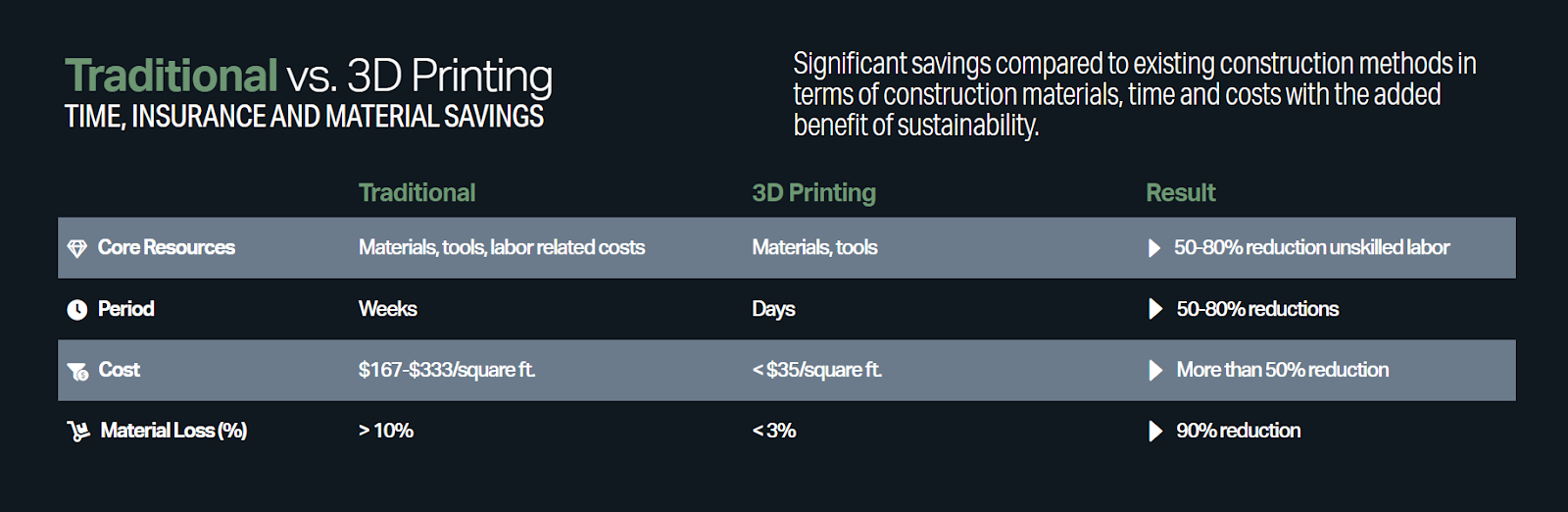
Print Versatility: Ability to print onsite and custom designs.
Material Versatility: With a wide variety of “ink” materials, Black Buffalo 3D’s cement-based “printer ink” is formulated to withstand harsh climates, is recyclable, and is stronger than a block wall.
Cost Versatility: By reducing material and labor costs by more than 50%, extruded exterior walls provide energy efficiency, and printing affordable housing onsite cuts freight and logistics costs.
How is the 3D house printing process?
The site www.freethink.com in its article: “Virginia launches world’s biggest 3D-printed housing project”, explains it easily: “At its core, the process of 3D printing houses is the same as 3D printing anything else.
First, a model of the object is created in a computer program. A 3D printer then extrudes a liquid building material from its nozzle to build the object from the ground up, adding layer on top of layer, sometimes with pauses for the material to dry, until construction is complete.
The difference is that, with desktop 3D printers, the building material is usually a type of plastic, and the surface is a small glass plate. When 3D printing houses, the building material is typically concrete, and the surface is a house-sized plot of land.

Nexcon 3D printer
The printer needs to be massive to build something as large as a house — for Project Virginia, Alquist will use ??Black Buffalo 3D’s NEXCON printer, which weighs 19 tons and can print structures up to 3 stories high, thanks to its gantry and track system”.
Learn more about the project in the following video:
Thanks to technology, ingenuity, and research, life is evolving, especially to help our planet and communities. If you want to investigate more on the subject, you can also read:
Coursera partners with state university and workforce systems to prepare Louisiana’s workforce for jobs of the future


By Kevin Mills, Global Head of Government
The modern workplace requires new skills, and students and underemployed workers need access to flexible, affordable, and fast-tracked learning and career pathways to enter well-paying jobs in the new digital economy. In a recent Coursera survey, 53% of U.S. employers said finding applicants with the specific skills needed for the job was the biggest challenge they face when hiring recent graduates.
State higher education and workforce development systems will be crucial to addressing skilled talent shortages amid economic uncertainty, and new university and government-led initiatives in Louisiana offer an innovative model for states to provide learning pathways to in-demand jobs and remove barriers to career development.
Louisiana Tech and the University of Louisiana System: Creating college prep and professional development pathways for students, faculty, and staff
In 2021, Louisiana Tech University launched LA GEAR UP, an initiative administered by the Louisiana Office of Student Financial Assistance (LOSFA) via the Louisiana Board of Regents that aims to increase the number of low-income high school students and graduates who succeed in post-secondary education. In partnership with 37 schools and 15 school districts, LA GEAR UP is offering free entry-level professional certificates from Google on Coursera to prepare students for college and career paths related to in-demand fields including IT Support, Data Analytics, and UX Design.
Now, Louisiana Tech University and the University of Louisiana System (ULS) are expanding access to Coursera certificates to all ULS faculty and staff as an extension of the ULS Bridging the Divide Professional Development Series.
“Through our partnership with Coursera and Google, we are able to provide support and opportunity for learners at multiple levels,” said Louisiana Tech Provost, Dr. Terry McConathy. “We are able to leverage the resource to recruit future students, provide added value for current students, and supplement professional development for our colleagues across the UL System interested in critical needs areas such as UX Design and Data Analytics.”
“Technology provides access to an overwhelming number of opportunities for personal and professional growth,” said ULS President, Jim Henderson. “We value lifelong learning and this partnership with Coursera opens the door to high quality professional development opportunities for the faculty and staff across our nine member institutions.”
The Louisiana Workforce Commission: Removing barriers to economic opportunity with broadband access and career training for underemployed workers
The Louisiana Workforce Commission (LWC), a state government agency that administers programs designed to enhance workforce growth and provide family-sustaining jobs for Louisiana residents, is offering lifelong learning opportunities to Louisianians across the state. LWC is partnering with Coursera to launch “Tech Ready Louisiana,” a new statewide workforce development initiative providing free career training to thousands of Louisianans.
“Tech Ready Louisiana will take people from courses to careers,” said LWC Secretary Ava Cates, “Everything from learning Microsoft Office, to skills in the IT or healthcare industries. This is about giving Louisianians the opportunity to learn new, marketable skills to advance in their current job or get the career they’ve always wanted.”
The program includes Career Academy from Coursera, which prepares workers – even those without a college degree or prior work experience – for over 30 in-demand digital careers in roughly six to eight months when studying part-time. Louisianans can explore careers, develop key skills and competencies, build a portfolio of hands-on projects using actual workplace tools, and earn industry-recognized credentials from Google, IBM, Meta, Salesforce, Hubspot, and Intuit to help them land good jobs. Many of these credentials have ACE Credit Recommendation, which makes it easier for learners to earn credit towards a local degree program for the eligible certificates they complete.
In addition, LWC is opening up its American Job Centers (AJC) for people to access the online training if reliable internet access at home is an issue. According to a recent study, more than half of all Louisianians either don’t have access to or can’t afford high-speed internet, a challenge many Americans face keeping many out of the running for a growing number of remote work opportunities.
“We know Louisiana struggles when it comes to making broadband available and affordable for our people,” said Cates, “We have almost 60 American Job Centers and affiliate sites across the state available for people to come in and use reliable internet to complete these courses.”
Given the pace of digital transformation, many traditional university degree and workforce development programs often lack a strong connection to today’s in-demand jobs, the fast-changing skills landscape, and evolving employer expectations. By building stronger relationships between their college and career development programs and top companies, higher education and government systems can unlock new career opportunities for students and workers, diversify and expand talent pipelines for employers, and build a competitive state workforce to support the local economy.
To learn more about Coursera for Campus and Coursera for Government, visit coursera.org/campus or coursera.org/government.
How To Analyze Taylor Swift Lyrics & Find “Midnights” Clues Using Machine Learning


Midnight on October 21, 2022 was either just another hour of your life, or an incredibly significant moment that you’d been counting down to for months, maybe even years. ICYMI, Taylor Swift dropped a new album, called Midnights, at midnight on the 21st.
Leading up to the release, eagle-eyed Swifties have been clocking the tiniest details — the way Taylor styles her hair, the number of words in an Instagram caption, the color of a phone in a split-second clip — and using them to craft convincing theories about the upcoming music.
The citizen detectives of #Swifttok know all too well that there’s meaning behind every little thing that Taylor does or says — and we can use data science to uncover deeper meaning behind her words.
Data science is a combination of probability, statistics, software engineering, and business knowledge. A Data Scientist is someone who takes large amounts of information and translates it into something actionable. Using programming languages and other coding tools, Data Scientists can meticulously analyze huge amounts of data and find trends and patterns that humans would miss.
So what’s this got to do with a mega pop star’s music? Well, we know that Taylor intentionally plants Easter eggs about new music years in advance for fans to find.
Taylor described this new album Midnights as “the stories of 13 sleepless nights scattered throughout my life.” One major Midnights clue was that Taylor had sung about “midnight” and “middle of the night” in the lyrics of lots of her songs. When you think about her 18-year music career, there’s a lot of data that could be sprinkled with surprises.
In the new Codecademy case study Analyze Taylor Swift Lyrics with Python, you’ll get to analyze the lyrics of every song in Taylor’s discography leading up to Midnights to look for clues. You’ll use Python and Jupyter Notebooks to take a deep dive into her robust catalog of music, and conduct natural language processing (NLP), a machine learning technique that enables you to process verbal and written language using artificial intelligence, to scour her lyrics.
Using code, you’ll make data visualizations like line charts, rug plots, wordclouds, and pie charts with your findings. Here’s an example of a line chart you’ll make that looks at “night” mentions in lyrics over time:

Curious if Taylor Swift songs mention “night” more than “day”? Look at this graph:

And using sentiment analysis, we can see whether her lyrics tend to be positive or negative. This chart looks at positive sentiment over time:

In this case study, you’ll turn to data to answer other pressing questions like:
- Do Taylor’s albums follow a pattern of mentioning midnight?
- Do the songs that mention “nights” in the lyrics have a positive or negative sentiment?
- What words, overall, does Taylor use the most in her song lyrics?
Before you jump in, you’ll need to have a grasp on Python and NLP. Check out the path Apply Natural Language Processing with Python to learn about the exciting field that combines linguistics, AI, and computer science.
Want to take your TSwift fandom to the next level, but don’t know how to code yet? This is a fun excuse to learn (or begin again)! You can start with any of our Code Foundations courses to get introduced to programming concepts that lay the groundwork for more advanced skills. We also have lots of beginner-friendly data science courses that you can take for free, plus a guide that helps you choose a data science language to learn first. If you’re ready to start learning Python, consider taking our popular course Learn Python 3.
You might be learning these techniques to participate in the Midnights mayhem, but coding skills can help your career and life for evermore. (Just ask Taylor’s erstwhile bestie, Karlie Kloss.)
If it’s in your wildest dreams to have a career as a Data Scientist, we can help you get there. The path Data Science Foundations will teach you how to clean and analyze data, and get you ready for a career in data science. Or you could take the Career Path Data Scientist: Natural Language Processing Specialist to learn how to think about, visualize, and analyze data and get started with AI.
The new Codecademy case study Analyze Taylor Swift Lyrics with Python is just one example of how data science can be applied to our interests and daily lives. For more real-world practice using data to forecast outcomes, check out our Practice Projects in Python. If you tuned into the NFL on Thursday night to catch the Midnights Teaser trailer, you might also want to try our case study Analyze NFL Stats with Python — you’ll build a machine learning model that predicts the winners of NFL games.
Throughout your coding journey, remember that you’re not on your own, kid: You can connect with other people who are learning to code on Codecademy’s forums, or join a local Codecademy chapter.
It feels like a perfect night for coding at midnight. Ready to get started? Check out Analyze Taylor Swift Lyrics with Python.
Data Science Courses & Tutorials | Codecademy
Data Scientists try to make sense of the data that’s all around us. Taking a data science course can help you make informed decisions, create beautiful visualizations, and even try to predict future events through Machine Learning. If you’re curious about what you can learn about the world using the…
How Young Is Too Young for an Apple Watch?
Do smart watches work as training wheels for a smartphone? Or do they just hook children on technology at an even earlier age?
Scream
Tell us a story, real or made up, that is inspired by this photo.
Word of the Day: scant
This word has appeared in 266 articles on NYTimes.com in the past year. Can you use it in a sentence?
When Revising, Read Out Loud

Why disfluency?
There has been some research looking into whether reading something disfluent, like sans forgetica font, could improve learning via desirable difficulties. That is, when learning is more effortful, it often results in better long-term retention. Most recently, a meta-analysis (2) showed that disfluent font doesn’t lead to much better learning, but the hypothesis still might make sense for proofreading or revising. See, when font is disfluent you have to slow down to read it, which means that we can’t use those automatic processes that usually help us jump right over errors.
How did they test this?
At this point we have three groups: participants who are reading passages silently, aloud, or in disfluent font. While there were two experiments in the full study, I’m describing the second experiment here as the results are a bit easier to understand. While there are lots of different types of errors in real writing, the researchers narrowed in on errors that are less likely for a standard spelling and grammar check to find. These were some grammatical errors and some word choice errors.
Each text that was read had only one to five errors, so for the most part readers could read along without many errors.
And here is what they found:
What’s Going On in This Graph? | Oct. 26, 2022
A new book compares the income trajectories of immigrants’ children with those of people whose parents were born in the United States. What do the results show?
