
This word has appeared in 250 articles on NYTimes.com in the past year. Can you use it in a sentence?
How to choose the perfect website or blog design?
You often ask me how to choose a design for your blog or website. At first glance, it may seem easy – you pick what you like. However, once you start browsing possible options, you quickly realize that there are many possibilities, and you aren’t sure which one will be perfect for you. In this short guide, I will walk you through the most common choices to help you choose a design for your blog or website.
Pick a Platform
Before you can even pick a design, you need to have a blog or website or at least a plan for one. You can’t skip this step because not only do you need a place to install your new design, but you also need to know your blogging platform. Each design is built differently, and designers usually create themes only for specific platforms. For example, we only work with Blogger & WordPress.
Always make sure you are buying a design for the platform you use!
LEARN MORE: Difference between Blogger & WordPress
How to choose a design for a blog or website
No matter which platform you use, there are two main categories of designs that you should consider: premade and custom designs.
Premade Design
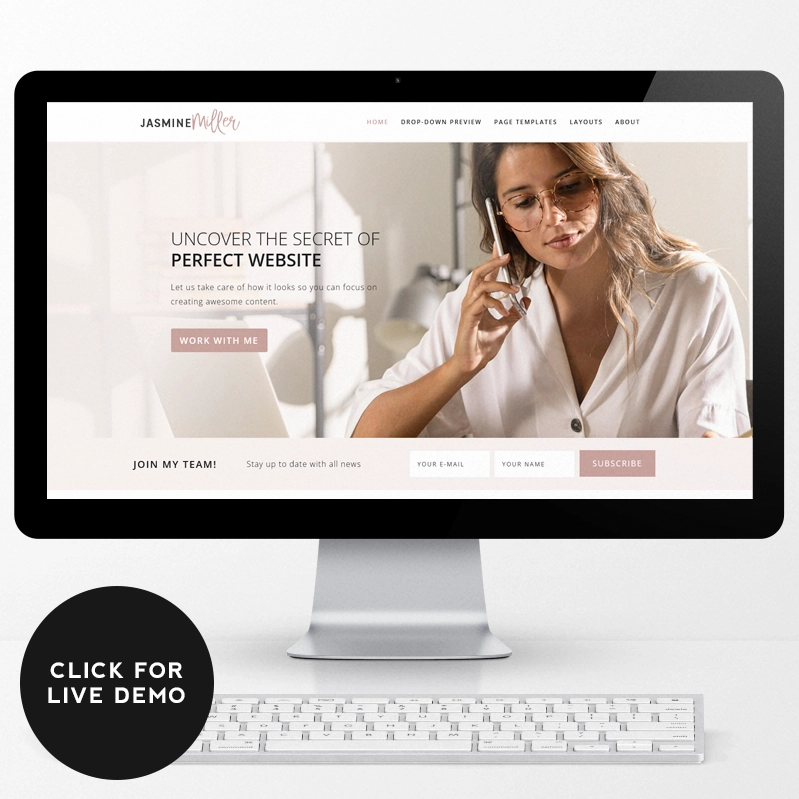
Premade design is a theme already created once you visit a design shop. It can be easily compared to clothes. You can find cheaper, lower-quality clothes from fast fashion stores and expensive designer pieces sold only in one copy. Same with premade designs. However, it doesn’t mean that the more affordable themes are worse. If you buy a premade theme, there is a higher chance that other bloggers will also use the design you pick. Because of that, you may find two websites that look similar or even the same. There is nothing wrong with that; however, if you build an online brand, you may want your site to be unique.
What should you check when buying a premade design:
- Is the design installation included with the design price?
- What additional features premade design offer?
- Will you be able to get support from the theme authors if you mess something up?
- Is this design-build for my current platform?
Don’t hesitate to contact design authors first! If they do not respond, it is definitely a red flag!
What budget should I prepare?
It depends on the platform you use. Our Blogger premade designs are just $15 each, and WordPress themes are $99 (and that includes installation and set-up!)
How fast can I get it done?
Again, it depends on the platform and your requests. For example, buying a theme and asking a designer to recolor it for you will make the process a little longer. The general waiting time is 1-7 days.
Pros and cons of premade designs:
- affordable
- quick
- great for beginners
- not unique
- may not fit all your needs
Custom Design
If you are looking for something truly unique, you may consider getting a custom design made. It is a great experience where you get a theme made just for you based on your instructions and needs. It may be pricy, so you should have a budget of at least $1500-2500 ready however the result will be worth it.
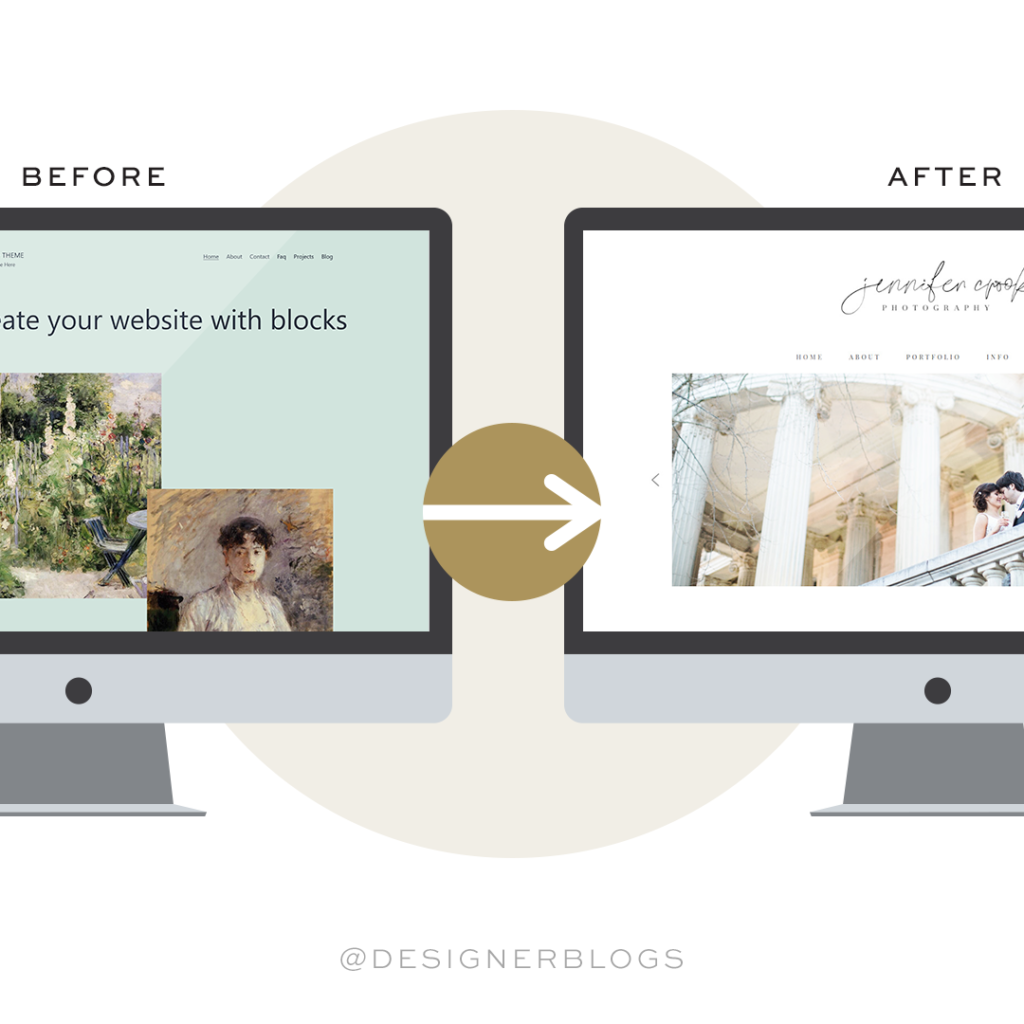
We can not speak for every company; however, here at Designer Blogs, we do our best to make our client’s vision live. You can read highlights of some of our custom design stories by visiting posts about La Cooquette, Chew Chew Mama, and more!
What should you check when buying a custom design:
- What is included in the design price?
- Are there any extra costs you should be aware of?
- Will you get a custom logo, or will it cost extra?
- Is this design-build for my current platform?
Always talk with the designer before purchasing to ensure you have answers to all those questions.
What budget should I prepare?
Custom design prices can be extremely different. Our custom designs usually cost around $2000, but we try to adjust the prices depending on the customer’s request. I strongly believe there is no need to pay for things you will not use, so what’s the point of charging you for creating a shop if you plan to have a blog only 🙂 It is also why we do not have custom design prices listed on our site. If you would like to get a quote, fill out the form on the customs service page. Such design consultations are 100% free on our site.
How fast can I get it done?
It can take from two weeks to a few months to create a custom design. Since it is built just for you, all the additional requests or changes will make the process longer. Usually, we have the website ready within a month, with all the revisions and design installation on your website.
Pros and cons of custom designs:
- unique
- build to work for you
- fits all your needs
- may be expensive
- waiting time is longer
So, which one is better?
The main factors will be your budget and needs. If you are starting, I would recommend a premade design as, at that point, you do not really know what you may need for your site (and it is entirely normal!). Start with something cheap, and later, when your brand will grow, get yourself a custom design that checks all the boxes.
If you already have a brand and know what it needs, and your budget is high enough – get a custom. It should last years, and if done well – it will work for you and help you grow.
You may also like:

I hope this guide explains how to choose the design for your blog. We offer free website consultations and are always here to help! If you are still unsure and have any questions feel free to drop them in the comments or contact us via our contact form.
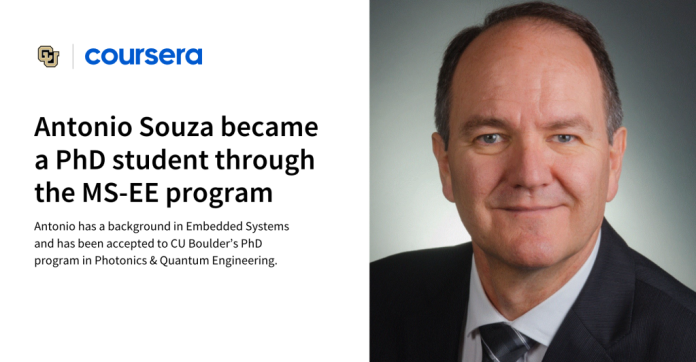
Antonio Souza opened the door to being a PhD student through the MS-EE program

When did you enroll in the MS-EE on Coursera program?
Mid – 2019
Were you in the non-credit version prior to enrolling in the for-credit version?
I took some not for credit courses then I transfer to for credit when I am sure I can finish in 8 weeks. This is a good thing because then if you find out in the middle that you cannot finish, then you do not have to withdraw. The first class I took was in the Sensors specialization.
What was your educational and work experience background before you enrolled in this program?
Before enrolling, I was a supply chain manager at Pratt and Whitney, an aircraft engine manufacturer. I worked in a facility that made maintenance for those and I was responsible for bringing in the materials, planning the production, and making sure the supply chain worked.
I had some technical experience in the beginning of my career because I was an aerospace engineer. For the first 5 years, my work was more technical but then there were some financial incentives to veer towards supervision and management positions.
What attracted you to this program in the first place (e.g. faculty, curriculum, performance-based admission, Coursera platform)?
I was interested in enrolling in the MS EE program because I wanted to get back to the more technical side.
I picked this program over the others because I liked the performance-based admission.
How did you learn/hear about CU Boulder’s MS-EE on Coursera program?
I think it was on Google, I was looking at Universities that had similar programs and decided on this one.
Can you tell me how the MS-EE on Coursera program fits into your life?
It is tough when you are working to adjust your schedule, and when you have kids, it is even more challenging, but I left my previous job and focused on this. I was looking for other jobs and then the opportunity for a PhD came up and for me I think it is the best time to do it. All my kids are grown up and moved out, so I do not have to take care of kids and our financial situation is better. I have a lot of life left to live and I do not agree with the concept of retirement. I think if you do not challenge your mind your brain shrinks. My brother retired and he is bored. You meet a lot of interesting people and learn a lot while working. If you stay at home, you lose a lot of this interaction and learning.
What are your favorite parts of the program (e.g. Favorite classes, projects, faculty members, etc.)?
The field programmable gate arrays part was really interesting, it was a new concept on how to do stuff. Programming hardware instead of software is interesting and you use the device to do that.
Power electronics was very well organized. I like that the professor follows his textbook, so you have a good reference and don’t have a patchwork of different stuff that you have to work hard to connect. I like the textbooks because there is a beginning, development, and end and can connect everything.
What do you hope to do with your MS-EE degree?
I hoped to get the full knowledge and a deep understanding of electronics and then find a job. Now that I have chosen to continue to a PhD this might change, I will see how research is and how academic life is and compare and decide to get a job or go the university way.
What benefits have you seen?
You learn a bunch of technical things and I got a job teaching at a Community College here because I have taken these MSEE courses. Now I am leaving the teaching because of the PhD program but I will keep going once a week to help with the students in the robotics club that is a part of the CU space grant as they are simulating a rover that would go to Mars.
Would you recommend this program to others? Why or why not?
I would recommend this program, but they would have to work hard because many answers they would have to find by themselves because the professors, lectures, and material give you a direction, but you have to go after it yourself. It takes time and it takes effort.
What’s 1 tip you have for students who are starting?
I interacted mostly with course facilitators. I think students do not take advantage of the office hours. You save a lot of time, sometimes you get stuck in something on your own and they can clarify stuff in minutes.
Expect it to take more time than the website says to complete the homework and studying on your own.
Is there anything else you would like to add?
I saw a lot of older people in the program which is a good thing. Even some people who have kids out of the house and I think this program was a good thing for these people because it is easier to balance.
What made you interested in getting a PhD?
A lot has to do with the challenge. Now, during the summer, I am doing some work here in the lab and studying some stuff my advisor has given me to hit the ground running in the fall.
What was your study style for the classes?
I watch the video, then review the slides, then do the homework, and watch it again. Usually, I think I watch it once or twice. I will go back and forth between the homework and slides. I also sit and focus just on that, if you try to multitask while doing it, it will take 3 times longer to do.
Alison Publisher Spotlight: Graham Van Brunt
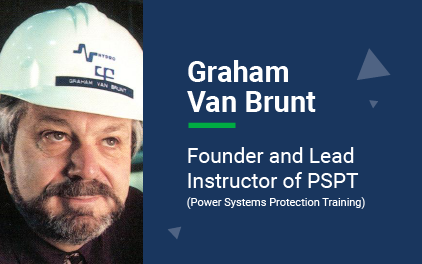
Engineering is a vast discipline with many streams you can follow. The engineering field is where critical thinkers and problem-solvers unite to explore how things work and find practical solutions to science’s discoveries. This month, we’re shining our Alison Publisher Spotlight on Graham Van Brunt. He spoke to us about his engineering experience and how he has taken his Power Systems Protection Training from the floor and into the virtual space.
Please share with our learners a bit about your background.
I graduated from Queen’s University as an electrical engineer specializing in power. I spent the first 25 years of my career as a protection and control engineer with Ontario Hydro. Subsequently as a Director of operations and maintenance with Churchill Falls Labrador corporation. I then worked for then retired from Siemens Canada.
How did you get into teaching?
I started teaching early in my career as a continuing education instructor for Confederation College in Thunder Bay Ontario. I spent two years establishing a training school for technologists and engineers in protection and control in Tarbela Pakistan, set up by CIDA (Canadian International Development Agency). I also worked for Georgian College, in Barrie Ontario as an electrical instructor.
For those just learning about you, please tell us more about Power Systems Protection Training.
I am an electrical engineer with over 35 years of experience in the field, included in that as an instructor. My forte is related to electrical power. Although retired, I keep in contact by providing a series of modules that I am in the process of delivering via streaming videos on over 21 platforms internationally.
What’s your take on online learning when looking at the future?
Online learning has been available for quite some time, but as of late, there has been an exponential pick up of online training. It definitely is the way of the future for training.
How has being a self-publisher on Alison changed or impacted your life?
Being a self-publisher has allowed me to reach an international student volume. I have switched from in person training which reaches at most only a couple of dozen students at a time to streaming my courses online and reaching thousands of students continuously.
How should learner’s approach remote video tutoring and learning?
Students should search specifically the courses that they are interested in and if seeking accreditation should pick a platform that provides certification for completed courses.
The engineering sub-discipline is widespread. Can you share with our prospective learners what the potential for growth and longevity is in this field?
Technology today is changing at a very rapid pace. The sub-discipline of engineering is no different, especially in the field of electrical engineering. Regardless of what type of engineering you intend to learn. It is important to get a solid foundation in the basics. This you can find in my remote video courses.
Who should take your courses?
My courses are structured to fit a wide variety of students. Entry-level students will find my basic courses as well as the advanced courses easy to understand and succinctly laid out. They are also structured for the advanced engineers that want to take more advanced subjects or do a quick review of the basics.
How would you advise learners to master precision throughout their studies online?
Learners are poised to proceed slowly through the videos, and it would be a good idea to halt the video and back up and review any difficult areas. It is also advisable to jot down notes as you go along.
Please share with our readers about your courses on Alison.
My courses are primarily about electrical power. They range in difficulty from the simple entry level topics such as DC circuits to the more advanced subject matter such as three phase fault analysis.
What feedback have you received from learners about your course? What do people enjoy most about your courses?
The feedback from students has been almost 100% positive, putting my evaluation of my courses between 4.5 and 5 stars out of 5.
How will your courses help enrich the lives of those who take them?
My courses are designed to bridge the gap between book learning and the experience the student will obtain once in the field. They are predicated on the challenges that I experienced while learning to become an electrical engineer.
For individuals interested in taking one of your courses, what can they expect to get from it?
Students can expect to get a good foundation in the fundamentals of what is needed to become proficient in the power electrical field.
What words of advice would you give someone who would like to become a publisher on Alison?
Select a niche that you are proficient and excited to work in. Build courses related to that niche using PowerPoint (Windows) or Keynote (Mac). Both allow voiceover then convert the presentation to a video.
What has been your most important lesson or discovery when it comes to online education programmes?
The world is your institution of teaching.
What career paths are available for someone interested in pursuing your courses?
Electrical/mechanical maintenance, electrician, electrical/mechanical technologist, electrical/mechanical engineer.
How would your courses enrich the professional lives of those who take them?
These courses act as reference books or material for any professional.
Students learn from their teachers/tutors. Any lessons you have learned from your students?
Absolutely I have learned from my students, in fact I look forward to interacting with them, learning new approaches. However, most of that opportunity comes from standing in front of the student live and in-person.
What can Alison and its learners look forward to from you in the coming year to two?
I am continuing to develop new courses as time goes on and these courses are going to be made available to the Alison students.
Any last words, advice, or wisdom you’d like to share with our learners?
Keep on learning always.
16 Common IT Interview Questions (Plus Answers) to Practice


If you’ve ever wanted to create new software, help protect businesses from a cyber attack, support users as they learn new technology, or collect and process data, then a career as an Information Technology (IT) professional could be a good fit for you.
And the good news is, IT jobs are a hot commodity in the United States — the U.S. Bureau of Labor Statistics expects overall employment in this field to grow 15% through 2031.
But when a certain field shows strong job growth, it can often mean an influx of qualified applications, making the job-hunting process more competitive. This means you need to be on your A-game at each step of your job search. If you’ve already applied to IT jobs and you’re starting your interview prep, you’ve come to the right place. We’ve rounded up some of the most common IT interview questions, along with answers and tips on how to ace your interview.
1. Can you tell us about a project you’ve been working on in your spare time?
This is a great icebreaker, and you might be asked to answer this question early on in your interview. It can kickstart a great conversation and help you ease into the interview. When you’re describing your project, be sure to explain why it’s important to you, any interesting facts or lessons you’ve learned so far, and any challenges you’ve faced. For the challenges, explain how you’re dealing with them. Hiring managers love to hear how candidates approach and solve problems.
2. What attracted you to this position?
Your answer to this question should include details about your future employer’s products/services that excite you, as well as the company’s mission. Here’s an example:
“My mom learned how to code through online courses when I was in middle school, and she’s been working in web development for years now. So I know first-hand how important access to online education is. I’d be proud to build a career with Codecademy and help others follow their career dreams. Also, I’m drawn to the culture here and how it supports learning and development on the job. I also share these values and feel I could be a great fit for Codecademy.”
You could include how you’re looking forward to growing in the role, learning new professional skills, and working with a strong team.
3. How do you make sure your technology skills are up-to-date?
The key to answering this question is to show that you’re engaged in your field and open to learning new tech skills. Some of the ways you might be doing this include:
- Taking online courses
- Participating in hack-a-thons
- Engaging in personal IT projects
- Reading peer-reviewed journals about new tech developments
- Joining IT-focused online communities
4. What kinds of online resources do you use at work?
GitHub or StackExchange are popular resources for IT professionals. If you subscribe to any tech newsletters, blogs, or social media feeds, you can also talk about these.
5. Can you describe a time when you had to deal with a significant professional obstacle?
With this question, the interviewer is interested in hearing how you approach difficult work scenarios and how you solve them. They’re also likely looking to hear how you incorporate any lessons learned from this experience in your future work. In your reply, don’t forget to include any plot twists that increased the difficulty of the situation and how you approached/solved those issues, how you enlisted the help of others, and what you learned from the experience. You can also mention how those lessons are helping you be a better professional today.
6. What do you think are the most important qualities for someone in your position to have?
Ideally, you should answer this question both honestly and by including some traits you can prove or demonstrate you have during the interview. Four important qualities for IT professionals are collaboration, communication, thoroughness, and reliability.
You can tie in some of your soft skills, like your ability to give informative presentations or problem-solve complex issues, here as well.
7. What do you want to accomplish within your first six months with us?
You can use the information listed in the job description to help you answer this question since the job description will give you some insight into what your employer is expecting from you. Your answer could include a combination of goals you’d like to accomplish personally and ones you’d like to help your team meet.
8. How do you handle working under pressure?
As an IT professional, there will be times when you’ll need to manage tight deadlines and challenging problems. And this question is your chance to show the steps you take to alleviate work-related stress. Whether this is reaching out to others for help or using time management techniques, like the Pomodoro Technique, let the interviewer know that you have the skills to work well under pressure.
9. How do you manage tight deadlines?
When answering this question you can talk about your time management approach and skills, and how you delegate tasks that still need to get done but aren’t related to the deadline you’re trying to meet. You can also go into detail about how you break down a large project into smaller tasks in order to complete the project as a whole.
10. What’s your biggest weakness?
This is a classic interview question, and although not every interviewer likes this one, it’s a good idea to have an answer ready in case you’re asked. Be honest here and talk about something you want to improve. You can state your area of weakness and then follow up with techniques you use to help you overcome your weakness.
Here’s an example:
“Memorization isn’t one of my strong suits. This is why I always try to take detailed notes. I’ve been known to carry around a pocket notebook everywhere I go or pull out my phone to take quick notes.”
11. What’s the biggest professional mistake you’ve made?
This is similar to the question above. The best way to answer this question is to use an 80/20 approach: 80% of your answer should be about what you learned from the mistake, and 20% should be about the mistake itself.
12. What are the advantages and disadvantages of working in an Agile environment?
Since much of the tech industry has adopted Agile, it’s a good idea to speak confidently about the method. This is your chance to show you understand the Agile approach.
A couple advantages to bring up:
- Collaboration
- Lower risk of issues with the end product
A disadvantage to point out:
- It’s more demanding on the Scrum Master or other team lead
13. What does “working remotely” actually look like for you?
If you’re applying for a remote role, you’ll probably be asked a question or two about your experience working remotely. Ideally, your future employer wants to hear that you have a track record of working successfully in a remote environment and that you’re comfortable with this style of work.
Be sure to mention how you structure your day so you can stay focused, what communication tools you have experience with (Slack, Microsoft Teams, Google Chat), and you can even describe your home office setup if you’d like.
14. What would you do if you had to fill in for a manager last minute?
This question is a test to see how you deal with stress, assume a leadership role, and whether or not you’re a flexible team member. You can talk about the immediate steps you’d take like reaching out to the manager you’re filling in for to get info about expectations and reaching out to key team members for support or input. How you communicate with the team is also really important during scenarios like this, so you could explain how you’d hold a brief huddle to let everyone know what’s going on and that you’re there to support them.
15. Which of our technologies do you think will give you the biggest challenge?
This is another “have you done your research?” question because, in order to answer it, you’ll need to know the different technologies the company uses. Feel free to answer this question using language that shows you’re still in the learning process but that you’re getting more comfortable with the technology each day. Recognizing that you can improve in an area is a good quality to have in the workplace.
16. Do you have any questions for us?
It’s always a good idea to have a few questions teed up to ask at the end of the interview. Here are some options:
- What benchmarks will be used to evaluate this person’s work?
- What will be the biggest measure of success for this person in the first six months of the job?
- What’s something I should know about the company culture?
- What’s something you’ve found to be really rewarding while working here?
- What’s something you’ve found to be challenging while working here?
- Do you have any advice to offer to someone in my position?
Get ready to interview
Need to brush up on any of the concepts mentioned above? We have courses and Skill Paths that cover a variety of IT topics, including Fundamentals of Operating Systems, Fundamentals of Cybersecurity, Introduction to Linux, and more.
We also offer the free course Introduction to IT where you’ll get an overview of software development basics, operating systems and applications, databases, and cybersecurity all in one course. You can also check out our course catalog for classes on other subjects to help you grow in your professional journey.
Our Career Center is another great resource that’s full of interview tips, resume writing advice, and more.
Cybersecurity Courses & Tutorials | Codecademy
Cybersecurity is a fast-growing field that addresses the security risks of our increasingly connected digital world. Learn cybersecurity, and you will learn how users, companies, and even governments protect themselves and recover from cyber threats and attacks. Start defending yourself or your orga…
Teaching and Learning About Abortion Laws in the United States After Roe
In this teaching resource, we provide resources and activities so students can explore key questions related to abortion laws and rights.
Film Club: ‘48 Hours in a Kansas Abortion Clinic: Longer Wait Times, Growing Fears’
How has the growing number of state abortion bans affected women and health providers across the country?
Have You Ever Felt as if You Didn’t Belong?
Tell us about a time when you felt like an outsider. How did you cope?
Lesson Plan: What Does a Photo Editor Do?
In this lesson, students will play the role of photo editor to learn how the images they see in The New York Times make their way from the camera to the paper.
Parkour for a Purpose
What is your reaction to these young athletes’ campaign?
