fbpx
Home Blog Page 105

Why the Future of Learning Starts with Building

0

Coding has always served two purposes: the intrinsic drive to build something, and the practical path to a lucrative career. Even the most passionate code aficionados don’t dream of variables or syntax — they want to make a website, a tool, a game. For years, the career upside was impossible to ignore. You could land a stable SWE job, bootstrap your own app, or join a buzzy startup as a first hire.  

Generative AI flipped the script. AI now handles the repetitive tasks that used to define entry-level developer roles. At the same time, the barrier to entry for coding and building is lower than ever — you can spin up a working prototype with just an idea and a natural language prompt.  

This shift hasn’t eliminated the desire to code, but it’s changed what and who coding is for. If you’re not learning to land a junior dev role, you’re learning to build the thing you’ve been imagining, to add a technical skill to your existing career, or to understand the tools you’re already using at work. And here’s the catch: those goals all require understanding your code, not just having code that works. 

At Codecademy, all of these changes excite us about the future of learning to code. We’re introducing the AI Builder, a new project-based learning tool that flips the script by teaching you how to work with AI-generated code from the start. Our approach brings together the immediacy of modern AI tools and the rigor of real instructional design.

Why we created the AI Builder 

AI’s speed and efficiency often come with a tradeoff; you can get working code immediately, but you don’t really know what it’s giving you or why it’s built a certain way. Developers use the term “vibe coding” to describe this phenomenon — it’s fast, fun, but shallow; great for demos, less great for long-term skill-building.  

If your goal is to understand what you’re building, generic AI output alone won’t get you there. And the more you push these tools into real-world complexity, “the harder it is for them to give you exactly what you want,” says Zoe Bachman, Head of Learning at Codecademy.  

Switch to Learn for behind-the-scenes insights and your personalized roadmap.

With the AI Builder you get an education along with the AI output. In the workspace, you can toggle between two tabs: Build, where you work directly with a project and can modify and change code in real time; and Learn, where you get a personalized learning roadmap that’s based on your project.  

“We pair the experience of having a working app with a learning path that allows you to reverse engineer how it’s built, so you can deeply understand it and modify it confidently,” Zoe says. We’re calling our hybrid approach to learning-driven development “vibe learning” — it’s powered by AI guidance but rooted in learning science.  

Build first; learn continuously 

With AI Builder, you start with what you want to do: build the thing in your head. Whether that’s a habit tracker, a portfolio site, or the seed of a bigger idea, you don’t need to have prior coding knowledge to learn and build with the AI Builder. In other words, there are no pre-requisites for creation.  

You create a prototype by typing what you’d like to create in natural language. The AI chatbot will ask a few clarifying questions about your needs and overall goal before generating the project. Once the project is created, you can use the chat function to continue describing what you want. (You’re also welcome to go right into the code and start making changes if you already know your way around!)  

“It was fun to build something so quickly and be able to see the code and a learning plan for it,” says Grace Krishna, a Code Crew member who beta tested the AI Builder.   

When you need clarity on what’s going on behind the scenes in your code, or you hit a wall with AI, that’s a great time to flip over to the Learn tab.  

We’re calling our hybrid approach to learning-driven development ‘vibe learning’ — it’s powered by AI guidance but rooted in learning science.

Your project becomes the curriculum 

Rather than teaching concepts in the abstract and hoping learners translate them later, AI Builder removes that translation tax entirely. “We’re showing you specifically your code from your project and helping you understand it,” Zoe says.  

Rework your prototype in real time with the help of AI.

To build that personalized curriculum, the AI Builder breaks your project’s code into clear milestones and tasks. For each task, it generates an interactive learning loop, which is an activity designed to help you form a mental model of what your specific code is doing.  

These loops help you understand the logic behind each part of your project, so you can confidently apply the same thinking to other sections, or even future projects. This approach also ensures everything you learn is directly relevant to what you’re making — so you don’t have to guess when you’ll ever use this. 

Why this is vibe learning (not vibe coding) 

A key misconception about AI‑assisted development is that it makes learning superficial. AI Builder challenges that by grounding the entire experience in learning science rather than simple code generation. Our entire system is intentionally designed for you to retain knowledge. So, while it might not feel like you’re taking a course, you’re absorbing key concepts just by interacting with AI-generated code.  

A Socratic AI, not an answer-spitting chatbot 

Our educational AI chatbot is designed to guide you toward an answer through an in-depth questioning approach that’s based on the Socratic method of teaching. Instead of spitting out shortcuts or answers like AI typically does, you get strategic nudges, hints, and questions that build durable mental models.  

Research on AI in education shows that just providing an answer makes it harder for learners to retain the information on their own. Zoe compares the Socratic AI to “a personalized tutor, facilitating you acquiring more knowledge, so you’re not totally left on your own.” Our method encourages you to think critically so you really grasp the concepts and can continue to use them in the real world.  

Learning loops with real instructional design 

Behind the scenes, every learning loop in the Learn tab is built on proven frameworks like inductive learning and the 5E model, a popular STEM teaching framework that’s shorthand for engage, explore, explain, elaborate, and evaluate.

You’ll notice that the questions and exercises in the Learn tab feel different than the rest of our courses and paths, and that’s intentional. “The learning loops are designed very well — they get you there inductively,” Zoe says. They’re exploratory without being overwhelming, and evaluative without feeling like tests.  

Negar Vahid, a beta tester for the AI Builder appreciated the AI’s interactive question format. “The question-based learning feels engaging, and the starter project it builds is simple but useful,” she says.  

This structure ensures you don’t develop the wrong mental models — a known risk in fully constructivist or student-centered environments — while still giving you the freedom to explore.

Why learn when AI can build? 

There are some projects that are well-suited for simply vibe coding, like making a personal HTML website or a single-use script to automate a one-time task. Tools like Lovable and v0 are suited exactly for these types of projects.  

The longer your code needs to live, and the more complex your project becomes, the more you need to actually understand what you’re building. Joe Holmes, Codecademy Curriculum Developer in the AI and machine learning domain, uses the term “ignorance debt” to describe what happens when you don’t: 

“It’s like tech debt squared. It’s much, much worse,” Joe says. “You don’t know what kind of code is coming out. You just are only looking at: Does this kind of generally appear to be what I asked for? You don’t know if there are security flaws. You don’t know if there are performance flaws. You don’t know if you’re leaking sensitive information. You don’t know how to fix anything.” 

The tipping point comes down to two factors: complexity and time. If you’re developing software professionally, you’re legally responsible for the code you output. If you’re building something that will serve actual users, you need to be accountable for security, performance, and maintainability. And if your project will need updates or fixes over time (which most do) understanding your codebase becomes essential, not optional. 

The good news? Learning doesn’t have to feel like eating your vegetables. “Kids hate veggies and broccoli because we don’t cook it well enough to make it tasty when we first introduce it to them,” says Nhi Pham, Codecademy Curriculum Developer. The same is true for teaching AI: “If you do it well, you’re inspiring people to have these very hygienic practices when working with AI,” she says.  

That’s exactly what AI Builder is designed to do — make learning feel as immediate and rewarding as building, so you develop good habits from the start rather than building a lifelong aversion to understanding your own code. 

Get started with the AI Builder 

AI isn’t a replacement for learning, it’s a tool — and a powerful one when it comes to education. Our new AI Builder allows for “just‑in‑time learning that’s highly personalized,” Zoe says. Even the best teachers or bootcamps can’t deliver that for every learner, on every project, instantly. Perhaps the most exciting vision is how AI changes what a learning environment can be. 

Zoe described it beautifully: “I imagine the AI Builder as a workspace… like having all your resources around you and an AI tutor in the background.” 

That’s the shift: from learning before you build to learning while you build. We can’t wait to see what you create. 
Announcing Coursera’s 2026 Outstanding Achievement Award winners

0
Announcing Coursera’s 2026 Outstanding Achievement Award winners

AI is changing how organizations learn, work, and create value. New tools can extend what teams can do. Critical thinking, leadership, and sound decision-making help people apply those tools with purpose.

That focus is at the center of FWD Virtual 2026, our global event for leaders across learning, business, government, and technology. This is the first FWD since Coursera and Udemy are now one company. The combined strengths of both platforms can give learners and organizations greater choice, flexibility, and opportunities to build skills.

The virtual event launches a global program that will continue through regional events later this year. Across the program, leaders will explore how human capabilities and proven AI skills can help teams perform.

Each platform is presenting its own 2026 customer awards. Here, we recognize the global and regional winners of the Coursera Outstanding Achievement Awards. Their work shows what thoughtful learning programs can achieve across businesses, campuses, and public institutions.

See the full list of global and regional award winners here.

Meet the 2026 Coursera award winners

Learning Excellence Award

This award recognizes organizations across business, higher education, and government  that embed high-quality, industry-relevant learning across the academic or workforce experience and deliver results at scale.

Global winner: iPeople Inc.

iPeople Inc. has embedded Coursera across six institutions in its education network. They are Mapúa University, Mapúa Malayan Colleges Laguna, Mapúa Malayan Colleges Mindanao, Mapúa Malayan Digital College, National Teachers College, and the University of Nueva Caceres. Students combine their degrees with globally recognized, industry-relevant learning. At Mapúa University, more than 80% of the curriculum incorporates Coursera. Students can earn 20% to 30% of their academic credits through the platform.

Across the network, access has grown from 15,000 to 45,000 learners. Learners have earned more than 170,000 Coursera certificates. At National Teachers College, the program reached 99.4% license utilization and more than 50,000 verified certificates. The college also expanded digital upskilling for faculty.

At network scale, iPeople connects academic study, global credentials, and future-ready skills to prepare students and educators for a lifetime of learning.

Regional winners: SRM IST Kattankulathur; Telekom Malaysia; Fondation Marocaine pour la Promotion de l’Enseignement Préscolaire; Ministry of Science and Higher Education (Kazakhstan); Instituto Mexicano del Petróleo

AI Pioneer Award

This award recognizes organizations across business, higher education, and government that turn AI learning into adoption, applied innovation, and measurable outcomes.

Global winner: Bausch + Lomb

Bausch + Lomb has made AI a practical enterprise capability by embedding AI learning into how colleagues develop, innovate, and work. Through the Bausch + Lomb AI Academy, powered by Coursera, colleagues build foundational skills. Company-wide platforms and initiatives then help them apply those skills to business priorities.

These programs have contributed to more than 200 AI-driven business solutions and 94% Microsoft Copilot utilization. AI-enabled workflows now save more than 30,000 work hours each year. Bausch + Lomb connects learning, experimentation, and business application so colleagues can turn AI capability into meaningful innovation and impact across the business.

Regional winners: Walmart Inc.; BMW TechWorks India; Mahidol University; MEF Üniversitesi; UBS; TP México

Maximizing Impact Award

This award recognizes organizations across business, higher education, and government that use Coursera to deliver broad, measurable benefits for people and organizational performance.

Global winner: Ernst & Young

EY has made learning a measurable driver of talent and business performance through its global EY Badges program. Coursera content supports pathways that connect future-focused learning with demonstrated, real-world application.

Available to nearly 400,000 employees worldwide, the program has awarded more than 780,000 badges. Thirty-eight percent of EY professionals have voluntarily earned at least one credential. Professionals who earn multiple badges are 83% more likely to be promoted and 79% more likely to receive high-performance ratings. These outcomes contribute to a 9% increase in retention among top talent.

The program also supports recruiting. Seventy-four percent of new joiners said EY Badges greatly influenced their decision to join. EY combines Coursera learning with rigorous skill application and validation to support career growth, talent outcomes, and organizational performance.

Regional winners: Texas State University; Karmayogi Bharat; FPT; Deutsche Telekom; MTN Group; Grupo Energía Bogotá (GEB)

Engagement Excellence Award

This award recognizes organizations across business, higher education, and government that sustain learner participation and connect learning with academic, professional, and community goals.

Global winner: Chandigarh University

Chandigarh University, ranked India’s No. 1 private university in the QS Asia University Rankings 2026, has embedded Coursera throughout the student and faculty experience. The university uses a Coursera ambassador network, multidisciplinary learning communities, personalized pathways, peer mentoring, recognition programs, and a project gap learning model. These elements make continuous learning purposeful and social.

More than 23,500 students have used targeted learning to close skill gaps in real-world projects across artificial intelligence, data science, and cybersecurity. More than 1,500 faculty members have completed personalized development pathways that support teaching, research, and innovation.

Chandigarh University connects Coursera learning to academic credits, projects, internships, and career goals. The program keeps learners engaged beyond course completion as they share knowledge, apply new skills, and contribute to a culture of continuous growth.

Regional winners: The University of Southern Mississippi; Myntra Designs Pvt Ltd; Carelon Global Solutions Philippines, Inc.; Qatar University; Schneider Electric; Universidad del Valle de México

This award recognizes organizations across business, higher education, and government that align learning with changing roles and priorities to build stronger workforce capabilities.

Global winner: The Department of Government Enablement – Abu Dhabi

Abu Dhabi Government is strengthening how its workforce builds capabilities for a digital and AI-enabled future. Tomouh is the Department of Government Enablement’s unified learning and capability development platform. Through Tomouh, DGE has created a skills ecosystem for more than 70 government and semi-government entities. Coursera is a partner in the initiative.

Coursera Professional Certificates, Skills Tracks, and role-based learning pathways help employees develop AI, data, cybersecurity, digital transformation, and leadership capabilities tailored to their roles. More than 214 workshops, roadshows, webinars, and activation sessions support adoption.

Employees use new AI and digital skills to automate routine tasks, accelerate analysis and reporting, improve decisions, and increase productivity. Coursera learning and credentials work alongside Tomouh’s AI-powered personalization and workforce insights. The combination supports a skilled, agile, and future-ready Abu Dhabi Government workforce.

Regional winners: Coast Capital Savings; RV University; AirAsia; WJ Towell; Aptiv; Universidad Nacional Abierta y a Distancia (UNAD)

Congratulations to every global and regional winner. Thank you to the businesses, universities, and government organizations that make learning a priority and help people build skills for a changing world.

To the 300+ million learners across Coursera and Udemy who make this global learning community possible, thank you. Your curiosity, effort, and ambition give this work its purpose.

Why the Future of Learning Starts with Building

0

Coding has always served two purposes: the intrinsic drive to build something, and the practical path to a lucrative career. Even the most passionate code aficionados don’t dream of variables or syntax — they want to make a website, a tool, a game. For years, the career upside was impossible to ignore. You could land a stable SWE job, bootstrap your own app, or join a buzzy startup as a first hire.  

Generative AI flipped the script. AI now handles the repetitive tasks that used to define entry-level developer roles. At the same time, the barrier to entry for coding and building is lower than ever — you can spin up a working prototype with just an idea and a natural language prompt.  

This shift hasn’t eliminated the desire to code, but it’s changed what and who coding is for. If you’re not learning to land a junior dev role, you’re learning to build the thing you’ve been imagining, to add a technical skill to your existing career, or to understand the tools you’re already using at work. And here’s the catch: those goals all require understanding your code, not just having code that works. 

At Codecademy, all of these changes excite us about the future of learning to code. We’re introducing the AI Builder, a new project-based learning tool that flips the script by teaching you how to work with AI-generated code from the start. Our approach brings together the immediacy of modern AI tools and the rigor of real instructional design.

Why we created the AI Builder 

AI’s speed and efficiency often come with a tradeoff; you can get working code immediately, but you don’t really know what it’s giving you or why it’s built a certain way. Developers use the term “vibe coding” to describe this phenomenon — it’s fast, fun, but shallow; great for demos, less great for long-term skill-building.  

If your goal is to understand what you’re building, generic AI output alone won’t get you there. And the more you push these tools into real-world complexity, “the harder it is for them to give you exactly what you want,” says Zoe Bachman, Head of Learning at Codecademy.  

Switch to Learn for behind-the-scenes insights and your personalized roadmap.

With the AI Builder you get an education along with the AI output. In the workspace, you can toggle between two tabs: Build, where you work directly with a project and can modify and change code in real time; and Learn, where you get a personalized learning roadmap that’s based on your project.  

“We pair the experience of having a working app with a learning path that allows you to reverse engineer how it’s built, so you can deeply understand it and modify it confidently,” Zoe says. We’re calling our hybrid approach to learning-driven development “vibe learning” — it’s powered by AI guidance but rooted in learning science.  

Build first; learn continuously 

With AI Builder, you start with what you want to do: build the thing in your head. Whether that’s a habit tracker, a portfolio site, or the seed of a bigger idea, you don’t need to have prior coding knowledge to learn and build with the AI Builder. In other words, there are no pre-requisites for creation.  

You create a prototype by typing what you’d like to create in natural language. The AI chatbot will ask a few clarifying questions about your needs and overall goal before generating the project. Once the project is created, you can use the chat function to continue describing what you want. (You’re also welcome to go right into the code and start making changes if you already know your way around!)  

“It was fun to build something so quickly and be able to see the code and a learning plan for it,” says Grace Krishna, a Code Crew member who beta tested the AI Builder.   

When you need clarity on what’s going on behind the scenes in your code, or you hit a wall with AI, that’s a great time to flip over to the Learn tab.  

We’re calling our hybrid approach to learning-driven development ‘vibe learning’ — it’s powered by AI guidance but rooted in learning science.

Your project becomes the curriculum 

Rather than teaching concepts in the abstract and hoping learners translate them later, AI Builder removes that translation tax entirely. “We’re showing you specifically your code from your project and helping you understand it,” Zoe says.  

Rework your prototype in real time with the help of AI.

To build that personalized curriculum, the AI Builder breaks your project’s code into clear milestones and tasks. For each task, it generates an interactive learning loop, which is an activity designed to help you form a mental model of what your specific code is doing.  

These loops help you understand the logic behind each part of your project, so you can confidently apply the same thinking to other sections, or even future projects. This approach also ensures everything you learn is directly relevant to what you’re making — so you don’t have to guess when you’ll ever use this. 

Why this is vibe learning (not vibe coding) 

A key misconception about AI‑assisted development is that it makes learning superficial. AI Builder challenges that by grounding the entire experience in learning science rather than simple code generation. Our entire system is intentionally designed for you to retain knowledge. So, while it might not feel like you’re taking a course, you’re absorbing key concepts just by interacting with AI-generated code.  

A Socratic AI, not an answer-spitting chatbot 

Our educational AI chatbot is designed to guide you toward an answer through an in-depth questioning approach that’s based on the Socratic method of teaching. Instead of spitting out shortcuts or answers like AI typically does, you get strategic nudges, hints, and questions that build durable mental models.  

Research on AI in education shows that just providing an answer makes it harder for learners to retain the information on their own. Zoe compares the Socratic AI to “a personalized tutor, facilitating you acquiring more knowledge, so you’re not totally left on your own.” Our method encourages you to think critically so you really grasp the concepts and can continue to use them in the real world.  

Learning loops with real instructional design 

Behind the scenes, every learning loop in the Learn tab is built on proven frameworks like inductive learning and the 5E model, a popular STEM teaching framework that’s shorthand for engage, explore, explain, elaborate, and evaluate.

You’ll notice that the questions and exercises in the Learn tab feel different than the rest of our courses and paths, and that’s intentional. “The learning loops are designed very well — they get you there inductively,” Zoe says. They’re exploratory without being overwhelming, and evaluative without feeling like tests.  

Negar Vahid, a beta tester for the AI Builder appreciated the AI’s interactive question format. “The question-based learning feels engaging, and the starter project it builds is simple but useful,” she says.  

This structure ensures you don’t develop the wrong mental models — a known risk in fully constructivist or student-centered environments — while still giving you the freedom to explore.

Why learn when AI can build? 

There are some projects that are well-suited for simply vibe coding, like making a personal HTML website or a single-use script to automate a one-time task. Tools like Lovable and v0 are suited exactly for these types of projects.  

The longer your code needs to live, and the more complex your project becomes, the more you need to actually understand what you’re building. Joe Holmes, Codecademy Curriculum Developer in the AI and machine learning domain, uses the term “ignorance debt” to describe what happens when you don’t: 

“It’s like tech debt squared. It’s much, much worse,” Joe says. “You don’t know what kind of code is coming out. You just are only looking at: Does this kind of generally appear to be what I asked for? You don’t know if there are security flaws. You don’t know if there are performance flaws. You don’t know if you’re leaking sensitive information. You don’t know how to fix anything.” 

The tipping point comes down to two factors: complexity and time. If you’re developing software professionally, you’re legally responsible for the code you output. If you’re building something that will serve actual users, you need to be accountable for security, performance, and maintainability. And if your project will need updates or fixes over time (which most do) understanding your codebase becomes essential, not optional. 

The good news? Learning doesn’t have to feel like eating your vegetables. “Kids hate veggies and broccoli because we don’t cook it well enough to make it tasty when we first introduce it to them,” says Nhi Pham, Codecademy Curriculum Developer. The same is true for teaching AI: “If you do it well, you’re inspiring people to have these very hygienic practices when working with AI,” she says.  

That’s exactly what AI Builder is designed to do — make learning feel as immediate and rewarding as building, so you develop good habits from the start rather than building a lifelong aversion to understanding your own code. 

Get started with the AI Builder 

AI isn’t a replacement for learning, it’s a tool — and a powerful one when it comes to education. Our new AI Builder allows for “just‑in‑time learning that’s highly personalized,” Zoe says. Even the best teachers or bootcamps can’t deliver that for every learner, on every project, instantly. Perhaps the most exciting vision is how AI changes what a learning environment can be. 

Zoe described it beautifully: “I imagine the AI Builder as a workspace… like having all your resources around you and an AI tutor in the background.” 

That’s the shift: from learning before you build to learning while you build. We can’t wait to see what you create. 

Why the Future of Learning Starts with Building

0

Coding has always served two purposes: the intrinsic drive to build something, and the practical path to a lucrative career. Even the most passionate code aficionados don’t dream of variables or syntax — they want to make a website, a tool, a game. For years, the career upside was impossible to ignore. You could land a stable SWE job, bootstrap your own app, or join a buzzy startup as a first hire.  

Generative AI flipped the script. AI now handles the repetitive tasks that used to define entry-level developer roles. At the same time, the barrier to entry for coding and building is lower than ever — you can spin up a working prototype with just an idea and a natural language prompt.  

This shift hasn’t eliminated the desire to code, but it’s changed what and who coding is for. If you’re not learning to land a junior dev role, you’re learning to build the thing you’ve been imagining, to add a technical skill to your existing career, or to understand the tools you’re already using at work. And here’s the catch: those goals all require understanding your code, not just having code that works. 

At Codecademy, all of these changes excite us about the future of learning to code. We’re introducing the AI Builder, a new project-based learning tool that flips the script by teaching you how to work with AI-generated code from the start. Our approach brings together the immediacy of modern AI tools and the rigor of real instructional design.

Why we created the AI Builder 

AI’s speed and efficiency often come with a tradeoff; you can get working code immediately, but you don’t really know what it’s giving you or why it’s built a certain way. Developers use the term “vibe coding” to describe this phenomenon — it’s fast, fun, but shallow; great for demos, less great for long-term skill-building.  

If your goal is to understand what you’re building, generic AI output alone won’t get you there. And the more you push these tools into real-world complexity, “the harder it is for them to give you exactly what you want,” says Zoe Bachman, Head of Learning at Codecademy.  

Switch to Learn for behind-the-scenes insights and your personalized roadmap.

With the AI Builder you get an education along with the AI output. In the workspace, you can toggle between two tabs: Build, where you work directly with a project and can modify and change code in real time; and Learn, where you get a personalized learning roadmap that’s based on your project.  

“We pair the experience of having a working app with a learning path that allows you to reverse engineer how it’s built, so you can deeply understand it and modify it confidently,” Zoe says. We’re calling our hybrid approach to learning-driven development “vibe learning” — it’s powered by AI guidance but rooted in learning science.  

Build first; learn continuously 

With AI Builder, you start with what you want to do: build the thing in your head. Whether that’s a habit tracker, a portfolio site, or the seed of a bigger idea, you don’t need to have prior coding knowledge to learn and build with the AI Builder. In other words, there are no pre-requisites for creation.  

You create a prototype by typing what you’d like to create in natural language. The AI chatbot will ask a few clarifying questions about your needs and overall goal before generating the project. Once the project is created, you can use the chat function to continue describing what you want. (You’re also welcome to go right into the code and start making changes if you already know your way around!)  

“It was fun to build something so quickly and be able to see the code and a learning plan for it,” says Grace Krishna, a Code Crew member who beta tested the AI Builder.   

When you need clarity on what’s going on behind the scenes in your code, or you hit a wall with AI, that’s a great time to flip over to the Learn tab.  

We’re calling our hybrid approach to learning-driven development ‘vibe learning’ — it’s powered by AI guidance but rooted in learning science.

Your project becomes the curriculum 

Rather than teaching concepts in the abstract and hoping learners translate them later, AI Builder removes that translation tax entirely. “We’re showing you specifically your code from your project and helping you understand it,” Zoe says.  

Rework your prototype in real time with the help of AI.

To build that personalized curriculum, the AI Builder breaks your project’s code into clear milestones and tasks. For each task, it generates an interactive learning loop, which is an activity designed to help you form a mental model of what your specific code is doing.  

These loops help you understand the logic behind each part of your project, so you can confidently apply the same thinking to other sections, or even future projects. This approach also ensures everything you learn is directly relevant to what you’re making — so you don’t have to guess when you’ll ever use this. 

Why this is vibe learning (not vibe coding) 

A key misconception about AI‑assisted development is that it makes learning superficial. AI Builder challenges that by grounding the entire experience in learning science rather than simple code generation. Our entire system is intentionally designed for you to retain knowledge. So, while it might not feel like you’re taking a course, you’re absorbing key concepts just by interacting with AI-generated code.  

A Socratic AI, not an answer-spitting chatbot 

Our educational AI chatbot is designed to guide you toward an answer through an in-depth questioning approach that’s based on the Socratic method of teaching. Instead of spitting out shortcuts or answers like AI typically does, you get strategic nudges, hints, and questions that build durable mental models.  

Research on AI in education shows that just providing an answer makes it harder for learners to retain the information on their own. Zoe compares the Socratic AI to “a personalized tutor, facilitating you acquiring more knowledge, so you’re not totally left on your own.” Our method encourages you to think critically so you really grasp the concepts and can continue to use them in the real world.  

Learning loops with real instructional design 

Behind the scenes, every learning loop in the Learn tab is built on proven frameworks like inductive learning and the 5E model, a popular STEM teaching framework that’s shorthand for engage, explore, explain, elaborate, and evaluate.

You’ll notice that the questions and exercises in the Learn tab feel different than the rest of our courses and paths, and that’s intentional. “The learning loops are designed very well — they get you there inductively,” Zoe says. They’re exploratory without being overwhelming, and evaluative without feeling like tests.  

Negar Vahid, a beta tester for the AI Builder appreciated the AI’s interactive question format. “The question-based learning feels engaging, and the starter project it builds is simple but useful,” she says.  

This structure ensures you don’t develop the wrong mental models — a known risk in fully constructivist or student-centered environments — while still giving you the freedom to explore.

Why learn when AI can build? 

There are some projects that are well-suited for simply vibe coding, like making a personal HTML website or a single-use script to automate a one-time task. Tools like Lovable and v0 are suited exactly for these types of projects.  

The longer your code needs to live, and the more complex your project becomes, the more you need to actually understand what you’re building. Joe Holmes, Codecademy Curriculum Developer in the AI and machine learning domain, uses the term “ignorance debt” to describe what happens when you don’t: 

“It’s like tech debt squared. It’s much, much worse,” Joe says. “You don’t know what kind of code is coming out. You just are only looking at: Does this kind of generally appear to be what I asked for? You don’t know if there are security flaws. You don’t know if there are performance flaws. You don’t know if you’re leaking sensitive information. You don’t know how to fix anything.” 

The tipping point comes down to two factors: complexity and time. If you’re developing software professionally, you’re legally responsible for the code you output. If you’re building something that will serve actual users, you need to be accountable for security, performance, and maintainability. And if your project will need updates or fixes over time (which most do) understanding your codebase becomes essential, not optional. 

The good news? Learning doesn’t have to feel like eating your vegetables. “Kids hate veggies and broccoli because we don’t cook it well enough to make it tasty when we first introduce it to them,” says Nhi Pham, Codecademy Curriculum Developer. The same is true for teaching AI: “If you do it well, you’re inspiring people to have these very hygienic practices when working with AI,” she says.  

That’s exactly what AI Builder is designed to do — make learning feel as immediate and rewarding as building, so you develop good habits from the start rather than building a lifelong aversion to understanding your own code. 

Get started with the AI Builder 

AI isn’t a replacement for learning, it’s a tool — and a powerful one when it comes to education. Our new AI Builder allows for “just‑in‑time learning that’s highly personalized,” Zoe says. Even the best teachers or bootcamps can’t deliver that for every learner, on every project, instantly. Perhaps the most exciting vision is how AI changes what a learning environment can be. 

Zoe described it beautifully: “I imagine the AI Builder as a workspace… like having all your resources around you and an AI tutor in the background.” 

That’s the shift: from learning before you build to learning while you build. We can’t wait to see what you create. 
Announcing 16 new partners and 25 new Professional Certificates for the age of AI

0
Announcing 16 new partners and 25 new Professional Certificates for the age of AI

Today at our annual FWD customer event, we announced a major expansion of our partner and instructor ecosystem, helping learners worldwide gain and advance their skills for the AI era. We welcomed 16 leading universities and industry educators to Coursera, thousands of new instructors on Udemy, and introduced 25 new Professional Certificates, alongside new Specializations and courses.

When Coursera and Udemy came together earlier this year, we set out to combine the depth and rigor of leading universities and companies with the speed and breadth of a global instructor community. Today’s announcements show how that vision is taking shape. 

Welcoming new university and industry partners
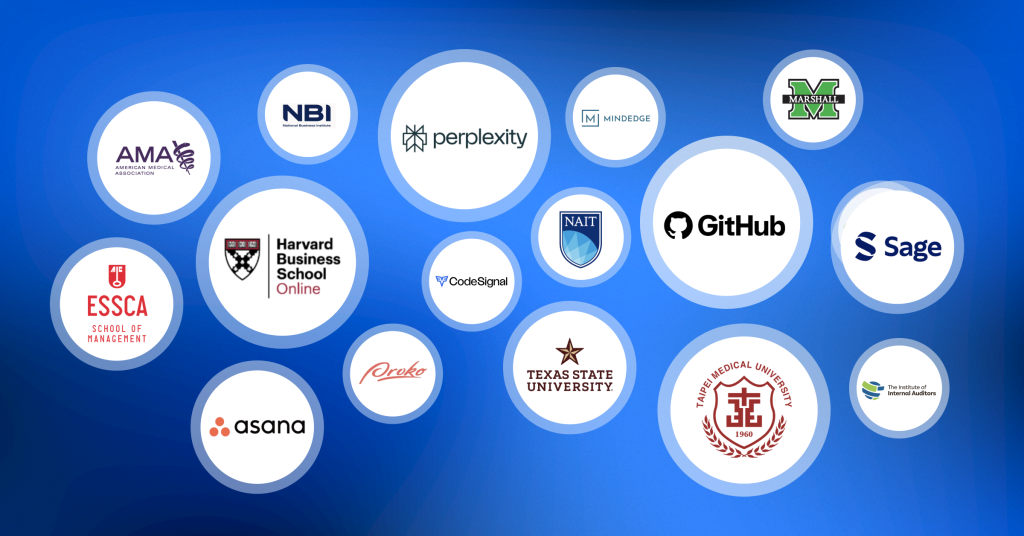
We’re thrilled to welcome several new university and industry leaders to Coursera, growing our unique ecosystem of over 400 partners, and bringing their trusted expertise to learners and organizations around the world:

  • American Medical Association: The largest physician organization in the US, will offer content across health, well-being, and the evolving healthcare landscape.
  • Asana: A leader in work management, creating new learning on applying AI across business operations and workflows.
  • CodeSignal: Known for technical skills assessments, with future courses spanning AI literacy and technical capabilities across roles.
  • ESSCA School of Management: Among the fewer than 1% of business schools with Triple Crown accreditation, plans to launch programs in AI-powered innovation, branding, and customer experience.
  • GitHub: Used by more than 225 million developers, creating new learning in agentic AI and modern software development.
  • Harvard Business School Online: Part of Harvard Business School, creating programs in leadership, teamwork, and business strategy.
  • Marshall University: A public research university founded in 1837, developing content focused on leadership and professional development. 
  • MindEdge: Founded by Harvard and MIT educators, plans to introduce learning across leadership, management, finance, and innovation.
  • National Business Institute: A nonprofit legal education provider trusted by more than one million professionals, creating content across law, risk, compliance, and AI.
  • NAIT (Northern Alberta Institute of Technology): A leading Canadian polytechnic producing applied learning across technology, health, business, and the skilled trades.
  • Perplexity: An AI company known for its answer engine, developing new programs focused on AI-powered research and analysis. 
  • Proko: Known for high-quality art instruction, planning to create new content across drawing and the visual arts. 
  • Sage: The Independent Publishers Guild’s 2025 Academic Publisher of the Year, with upcoming courses in business, management, and marketing.
  • Taipei Medical University: Home to Taiwan’s top-ranked nursing program, will launch new courses across medicine, healthcare and the life sciences. 
  • Texas State University: A public research university in Texas, creating new programs spanning public health, science, and communications.
  • The Institute of Internal Auditors: A global leader for internal audit, with plans to launch programs across audit, governance, and cybersecurity.

Building the human and technical capabilities to lead through change
As AI becomes embedded across roles and industries, technical fluency and human capabilities are becoming increasingly inter connected. People need the skills to use new technology, alongside the judgement, creativity, and leadership to apply them effectively. These new Specializations on Coursera help learners build both, preparing them to work with AI and lead through change. 

Responding rapidly to emerging skill demand
Udemy instructors can quickly turn emerging demand into relevant learning — and that speed matters as technologies evolve so rapidly. When a new model or update launches, our instructors can launch relevant courses within days, helping learners keep pace with a changing landscape.

We’re excited to share that Udemy has added more than 5,000 new instructors over the past year, expanding the catalog across AI, IT, project management, and many in-demand fields. Courses across trending topics include: 

Creating job-ready pathways with 25 new Professional Certificates
Micro-credentials such as Professional Certificates give learners a flexible way to build job-ready skills, demonstrate proficiency, and prepare for new opportunities. Demand is growing: micro-credential enrollments on Coursera have grown 33% year over year, while our catalog has expanded by 90% to more than 3,000 programs including Professional Certificates and Specializations.

To meet this growing demand, our partners are introducing 25 new Professional Certificates: 

Together, these new partners, instructors, and programs reflect the strength of a skills ecosystem that can respond quickly to what learners need next. We’re excited to continue expanding our offerings across Coursera and Udemy, helping more people learn from the world’s best educators, experts, and practitioners. 

*coming soon

Read more about Coursera’s new product announcements at FWD here.

Register ahead of FWD Virtual on September 9 to receive the on-demand recording directly in your inbox, or look out for the on-demand experience on the Coursera and Udemy resource hubs beginning September 17.

Why the Future of Learning Starts with Building

0

Coding has always served two purposes: the intrinsic drive to build something, and the practical path to a lucrative career. Even the most passionate code aficionados don’t dream of variables or syntax — they want to make a website, a tool, a game. For years, the career upside was impossible to ignore. You could land a stable SWE job, bootstrap your own app, or join a buzzy startup as a first hire.  

Generative AI flipped the script. AI now handles the repetitive tasks that used to define entry-level developer roles. At the same time, the barrier to entry for coding and building is lower than ever — you can spin up a working prototype with just an idea and a natural language prompt.  

This shift hasn’t eliminated the desire to code, but it’s changed what and who coding is for. If you’re not learning to land a junior dev role, you’re learning to build the thing you’ve been imagining, to add a technical skill to your existing career, or to understand the tools you’re already using at work. And here’s the catch: those goals all require understanding your code, not just having code that works. 

At Codecademy, all of these changes excite us about the future of learning to code. We’re introducing the AI Builder, a new project-based learning tool that flips the script by teaching you how to work with AI-generated code from the start. Our approach brings together the immediacy of modern AI tools and the rigor of real instructional design.

Why we created the AI Builder 

AI’s speed and efficiency often come with a tradeoff; you can get working code immediately, but you don’t really know what it’s giving you or why it’s built a certain way. Developers use the term “vibe coding” to describe this phenomenon — it’s fast, fun, but shallow; great for demos, less great for long-term skill-building.  

If your goal is to understand what you’re building, generic AI output alone won’t get you there. And the more you push these tools into real-world complexity, “the harder it is for them to give you exactly what you want,” says Zoe Bachman, Head of Learning at Codecademy.  

Switch to Learn for behind-the-scenes insights and your personalized roadmap.

With the AI Builder you get an education along with the AI output. In the workspace, you can toggle between two tabs: Build, where you work directly with a project and can modify and change code in real time; and Learn, where you get a personalized learning roadmap that’s based on your project.  

“We pair the experience of having a working app with a learning path that allows you to reverse engineer how it’s built, so you can deeply understand it and modify it confidently,” Zoe says. We’re calling our hybrid approach to learning-driven development “vibe learning” — it’s powered by AI guidance but rooted in learning science.  

Build first; learn continuously 

With AI Builder, you start with what you want to do: build the thing in your head. Whether that’s a habit tracker, a portfolio site, or the seed of a bigger idea, you don’t need to have prior coding knowledge to learn and build with the AI Builder. In other words, there are no pre-requisites for creation.  

You create a prototype by typing what you’d like to create in natural language. The AI chatbot will ask a few clarifying questions about your needs and overall goal before generating the project. Once the project is created, you can use the chat function to continue describing what you want. (You’re also welcome to go right into the code and start making changes if you already know your way around!)  

“It was fun to build something so quickly and be able to see the code and a learning plan for it,” says Grace Krishna, a Code Crew member who beta tested the AI Builder.   

When you need clarity on what’s going on behind the scenes in your code, or you hit a wall with AI, that’s a great time to flip over to the Learn tab.  

We’re calling our hybrid approach to learning-driven development ‘vibe learning’ — it’s powered by AI guidance but rooted in learning science.

Your project becomes the curriculum 

Rather than teaching concepts in the abstract and hoping learners translate them later, AI Builder removes that translation tax entirely. “We’re showing you specifically your code from your project and helping you understand it,” Zoe says.  

Rework your prototype in real time with the help of AI.

To build that personalized curriculum, the AI Builder breaks your project’s code into clear milestones and tasks. For each task, it generates an interactive learning loop, which is an activity designed to help you form a mental model of what your specific code is doing.  

These loops help you understand the logic behind each part of your project, so you can confidently apply the same thinking to other sections, or even future projects. This approach also ensures everything you learn is directly relevant to what you’re making — so you don’t have to guess when you’ll ever use this. 

Why this is vibe learning (not vibe coding) 

A key misconception about AI‑assisted development is that it makes learning superficial. AI Builder challenges that by grounding the entire experience in learning science rather than simple code generation. Our entire system is intentionally designed for you to retain knowledge. So, while it might not feel like you’re taking a course, you’re absorbing key concepts just by interacting with AI-generated code.  

A Socratic AI, not an answer-spitting chatbot 

Our educational AI chatbot is designed to guide you toward an answer through an in-depth questioning approach that’s based on the Socratic method of teaching. Instead of spitting out shortcuts or answers like AI typically does, you get strategic nudges, hints, and questions that build durable mental models.  

Research on AI in education shows that just providing an answer makes it harder for learners to retain the information on their own. Zoe compares the Socratic AI to “a personalized tutor, facilitating you acquiring more knowledge, so you’re not totally left on your own.” Our method encourages you to think critically so you really grasp the concepts and can continue to use them in the real world.  

Learning loops with real instructional design 

Behind the scenes, every learning loop in the Learn tab is built on proven frameworks like inductive learning and the 5E model, a popular STEM teaching framework that’s shorthand for engage, explore, explain, elaborate, and evaluate.

You’ll notice that the questions and exercises in the Learn tab feel different than the rest of our courses and paths, and that’s intentional. “The learning loops are designed very well — they get you there inductively,” Zoe says. They’re exploratory without being overwhelming, and evaluative without feeling like tests.  

Negar Vahid, a beta tester for the AI Builder appreciated the AI’s interactive question format. “The question-based learning feels engaging, and the starter project it builds is simple but useful,” she says.  

This structure ensures you don’t develop the wrong mental models — a known risk in fully constructivist or student-centered environments — while still giving you the freedom to explore.

Why learn when AI can build? 

There are some projects that are well-suited for simply vibe coding, like making a personal HTML website or a single-use script to automate a one-time task. Tools like Lovable and v0 are suited exactly for these types of projects.  

The longer your code needs to live, and the more complex your project becomes, the more you need to actually understand what you’re building. Joe Holmes, Codecademy Curriculum Developer in the AI and machine learning domain, uses the term “ignorance debt” to describe what happens when you don’t: 

“It’s like tech debt squared. It’s much, much worse,” Joe says. “You don’t know what kind of code is coming out. You just are only looking at: Does this kind of generally appear to be what I asked for? You don’t know if there are security flaws. You don’t know if there are performance flaws. You don’t know if you’re leaking sensitive information. You don’t know how to fix anything.” 

The tipping point comes down to two factors: complexity and time. If you’re developing software professionally, you’re legally responsible for the code you output. If you’re building something that will serve actual users, you need to be accountable for security, performance, and maintainability. And if your project will need updates or fixes over time (which most do) understanding your codebase becomes essential, not optional. 

The good news? Learning doesn’t have to feel like eating your vegetables. “Kids hate veggies and broccoli because we don’t cook it well enough to make it tasty when we first introduce it to them,” says Nhi Pham, Codecademy Curriculum Developer. The same is true for teaching AI: “If you do it well, you’re inspiring people to have these very hygienic practices when working with AI,” she says.  

That’s exactly what AI Builder is designed to do — make learning feel as immediate and rewarding as building, so you develop good habits from the start rather than building a lifelong aversion to understanding your own code. 

Get started with the AI Builder 

AI isn’t a replacement for learning, it’s a tool — and a powerful one when it comes to education. Our new AI Builder allows for “just‑in‑time learning that’s highly personalized,” Zoe says. Even the best teachers or bootcamps can’t deliver that for every learner, on every project, instantly. Perhaps the most exciting vision is how AI changes what a learning environment can be. 

Zoe described it beautifully: “I imagine the AI Builder as a workspace… like having all your resources around you and an AI tutor in the background.” 

That’s the shift: from learning before you build to learning while you build. We can’t wait to see what you create. 
Announcing Project Helix: A skills platform for the AI era

0
Announcing Project Helix: A skills platform for the AI era

Also introducing new AI-powered capabilities across Coursera and Udemy that help organizations integrate learning into everyday workflows, validate skills with confidence, and turn workforce data into action

Today, at Coursera and Udemy’s first global FWD customer event as a combined company, we previewed Project Helix, our new AI-native skills platform. Built from the ground up, Project Helix (code name) will help organizations identify critical skills, personalize learning for every employee, verify their ability to apply what they’ve learned, and link workforce progress to measurable business outcomes — all in one connected experience.

See Project Helix in action

AI is creating extraordinary opportunities for organizations, but capturing that value will depend on people. Companies are investing heavily in AI tools and infrastructure, but many are still working through how to help their teams build the skills, confidence, and practical capability to use AI effectively in ‌real workflows.

BCG’s 70-20-10 rule reinforces this shift toward upskilling today’s workforce: 70% of your company’s strategic focus should be on people and process, 20% on technology, and 10% on algorithms. Our customers need to rapidly reduce the lag between ‘knowing’ and ‘doing,’ ensuring their employees can actively develop and apply skills aligned to changing business priorities.

That is the problem Project Helix is designed to solve.

Introducing Project Helix

Project Helix is our answer to a fundamental question we hear from leaders every day: “How do I build skills that actually drive my business?” It’s our vision for an adaptive skills platform that moves beyond a content library and delivers on this promise in four key ways:

  • Building skills aligned to business priorities: Most of our customers have an AI strategy, so when it comes to skills development, they don’t want a generic, one-size-fits-all tool that guesses what employees need to deliver on those objectives. What is needed is a platform that is grounded in your organization’s real-world context and easy to customize. With Project Helix, leaders and learners will be able to articulate business and career development goals in natural language to instantly generate adaptive learning paths that map to the actual skills, functions, roles, and data of your organization. These paths then continuously adapt based on learner growth and performance and as your goals shift.
  • Accelerating application with personalization: Our busy customers don’t just want access to the world’s best learning content — they want a relevant, efficient pathway through that content that feels like it was built just for them. Informed by the latest labor market signals and your organization’s own data and skill definitions, Project Helix will suggest tailored learning experiences for each learner across a variety of learning modalities, drawn from the expertise of top universities, industry-leading institutions, and real-world practitioners across our combined content ecosystem. Continuous, personalized feedback and adaptive practice engage and progress learners more rapidly from basic comprehension to mastery.
  • Bringing learning into one, integrated skills stack and embedding it in everyday work: Today’s learning platforms are often separate from where the work gets done, whereas your teams and employees want learning in the flow of work. Our agentic platform is designed to integrate seamlessly, bringing learning, credentials, and skills intelligence directly into the tools your employees use every day. Project Helix complements and elevates the systems you’ve already invested in — or works just as well on its own.
  • Proving skills growth and workforce readiness: Completion and learning hours are easy to report. Validated skills are not. Project Helix combines hands-on, graded assessments, practical observation, and recognized credentials, providing a trusted signal that a skill is real. Our goal is to help ensure that earned proof flows into a portable skills record — a trusted, interoperable portfolio of capabilities that tracks skills freshness, informs talent decisions, and draws a direct line from employees’ skills to your business outcomes.

We’re taking a phased, customer-centric approach, working closely from the earliest stage with a select group of participating partners and customers to help shape the product experience, verified capability model, and enterprise workflows, while also equipping instructors with new modalities and expanded reach. Project Helix is expected to be broadly available to enterprise customers in the first half of 2027.

To view Project Helix in action and how it’s applied to solve customer problems, click here.

Continuing platform innovation across Coursera and Udemy

Project Helix complements the innovation already underway across Coursera and Udemy. As we build toward a new, unified experience for our global customers, we’re continuing to introduce new capabilities on both platforms that better integrate learning into the flow of work, validate skills through real-world application, and turn static data into decisive action.

Available now:

  • Create Role Plays with AI Connectors (Udemy)  —  Your AI tools can help you identify skill gaps, but turning those insights into targeted development can require significant time and effort. Udemy connects with the tools your teams already use, including Claude, Copilot, ChatGPT, Gemini, and Gong, to translate insights into practice. For example, when Gong identifies that a sales representative needs more coaching, it can send that insight to Udemy to automatically create a ready-to-use Role Play with the scenario, goals, and setup already configured. This helps you move quickly from identifying a skill gap to fixing it. These capabilities are available to Udemy customers with our AI Connectors and Role Play add-on.
  • Graded Role Play (Coursera and Udemy) — Human skills, like communication and strategic thinking, are critical to your workforce, yet they can be difficult to assess at scale. Graded Role Play immerses learners in realistic, on-the-job scenarios, like a tough negotiation, with an AI persona. Each learner is evaluated against goals set by the author, such as navigating resistance or leading with empathy, and verifies whether the standard has been met. You gain a clearer view of whether your programs are building the skills needed, and employees are moving beyond completion to evidence of skill. Graded Role Play is available for Udemy customers with the AI Role Play Enhanced add-on. The Coursera offering is coming to enterprise customers later this month.

  • Conversational Analytics with Admin AI (Coursera) — Your learning data may contain valuable insights, but finding the most important trends and determining what to do next can be time-consuming. Admin AI allows you to ask questions in plain language and instantly receive clear answers that surface key trends and recommended next steps. Improve engagement with targeted interventions and drive skill development. Learn how this works here.
  • AI Browser Deterrence (Coursera) — As learners gain access to increasingly capable AI tools, you need greater visibility into potential misuse during graded assessments. This behavioral detection system uses machine learning to spot suspicious patterns such as impossible completion times or bot-like typing. A simple, evidence-based flag is added to the Enterprise Gradebook, helping protect the integrity and value of credentials earned on Coursera.

Coming soon:

  • Graded Labs (Coursera and Udemy) — Course completion data alone cannot tell you whether a learner can apply technical skills in a real-world environment. Graded Labs turn hands-on exercises into high-integrity assessments that evaluate how learners complete tasks in a live, sandboxed environment, such as a developer proving they can deploy a web application. Their work is then evaluated against a rubric defined by the author, reviewing correctness, approach, and execution. The result is a win-win for both: your learners get personalized, constructive feedback, and you gain credible, scalable evidence of their applied technical skills. Graded Labs will be available for both Coursera and Udemy customers, included as part of the Udemy Business Pro add-on, later this month.
  • Enhanced LLM Integrations (Coursera) — Employees increasingly turn to AI tools for answers in the flow of work, but generic responses may not connect them with trusted learning resources or opportunities to practice. Building on Coursera’s launch as the first learning partner with an app in ChatGPT, enhanced integrations turn ChatGPT, Claude, and Copilot into a true coaching and practice workspace. When a learner asks @coursera a question through these tools, the LLM recognizes it as a learning moment and recommends a relevant course, video, or even an AI-guided Dialogue or Role Play, grounded in trusted, world-class content. This enhanced Coursera experience will be available later this month to all customers with our MCP connectors and active ChatGPT, Claude, or Copilot enterprise licenses. Learn how this works here.
  • Skills Insights Hub (Udemy) — Customers tell us they need a clearer way to understand whether their learning programs are building the skills their organizations require, but the data needed to answer that question is often fragmented across engagement, skills growth, and learning outcomes. Skills Insights Hub brings these signals together into one AI-powered view to answer the question: ‘Are we building the skills we need?’ You can measure your organization’s progress, benchmark learning against top trending topics, track assessment completion, and more. But it doesn’t just show data, it provides AI-generated recommendations that help identify opportunities to increase participation, strengthen skill development, and improve learning programs. Udemy’s Skills Insights Hub will be available in October.

Looking ahead

The future of workforce development won’t be defined by access to more content alone. It will be defined by helping people identify the right skills, build them through personalized learning, demonstrate evidence of proficiency, and connect that progress to meaningful workforce and business outcomes.

Project Helix and several innovations that we announced today represent an important step toward that future. It brings together the unique strengths of Coursera and Udemy — and the extraordinary expertise of our combined ecosystem — to help create a new model for building measurable skills in the AI era.

View the FWD Virtual on-demand experience on the Coursera and Udemy resource hubs beginning September 17.

Click here to learn more about our content announcements.

This blog post contains forward-looking statements within the meaning of applicable securities laws, including statements regarding the development, capabilities and expected availability of Project Helix and the anticipated benefits of the Coursera-Udemy combination. These statements involve risks and uncertainties that could cause actual results to differ materially, including risks relating to the development, timely launch and market adoption of Project Helix; the integration of Coursera and Udemy and realization of anticipated benefits and synergies; and the other risks described in Coursera’s most recent Annual Report on Form 10-K, Quarterly Reports on Form 10-Q and other filings with the Securities and Exchange Commission (SEC). Coursera undertakes no obligation to update forward-looking statements except as required by law.

Why the Future of Learning Starts with Building

0

Coding has always served two purposes: the intrinsic drive to build something, and the practical path to a lucrative career. Even the most passionate code aficionados don’t dream of variables or syntax — they want to make a website, a tool, a game. For years, the career upside was impossible to ignore. You could land a stable SWE job, bootstrap your own app, or join a buzzy startup as a first hire.  

Generative AI flipped the script. AI now handles the repetitive tasks that used to define entry-level developer roles. At the same time, the barrier to entry for coding and building is lower than ever — you can spin up a working prototype with just an idea and a natural language prompt.  

This shift hasn’t eliminated the desire to code, but it’s changed what and who coding is for. If you’re not learning to land a junior dev role, you’re learning to build the thing you’ve been imagining, to add a technical skill to your existing career, or to understand the tools you’re already using at work. And here’s the catch: those goals all require understanding your code, not just having code that works. 

At Codecademy, all of these changes excite us about the future of learning to code. We’re introducing the AI Builder, a new project-based learning tool that flips the script by teaching you how to work with AI-generated code from the start. Our approach brings together the immediacy of modern AI tools and the rigor of real instructional design.

Why we created the AI Builder 

AI’s speed and efficiency often come with a tradeoff; you can get working code immediately, but you don’t really know what it’s giving you or why it’s built a certain way. Developers use the term “vibe coding” to describe this phenomenon — it’s fast, fun, but shallow; great for demos, less great for long-term skill-building.  

If your goal is to understand what you’re building, generic AI output alone won’t get you there. And the more you push these tools into real-world complexity, “the harder it is for them to give you exactly what you want,” says Zoe Bachman, Head of Learning at Codecademy.  

Switch to Learn for behind-the-scenes insights and your personalized roadmap.

With the AI Builder you get an education along with the AI output. In the workspace, you can toggle between two tabs: Build, where you work directly with a project and can modify and change code in real time; and Learn, where you get a personalized learning roadmap that’s based on your project.  

“We pair the experience of having a working app with a learning path that allows you to reverse engineer how it’s built, so you can deeply understand it and modify it confidently,” Zoe says. We’re calling our hybrid approach to learning-driven development “vibe learning” — it’s powered by AI guidance but rooted in learning science.  

Build first; learn continuously 

With AI Builder, you start with what you want to do: build the thing in your head. Whether that’s a habit tracker, a portfolio site, or the seed of a bigger idea, you don’t need to have prior coding knowledge to learn and build with the AI Builder. In other words, there are no pre-requisites for creation.  

You create a prototype by typing what you’d like to create in natural language. The AI chatbot will ask a few clarifying questions about your needs and overall goal before generating the project. Once the project is created, you can use the chat function to continue describing what you want. (You’re also welcome to go right into the code and start making changes if you already know your way around!)  

“It was fun to build something so quickly and be able to see the code and a learning plan for it,” says Grace Krishna, a Code Crew member who beta tested the AI Builder.   

When you need clarity on what’s going on behind the scenes in your code, or you hit a wall with AI, that’s a great time to flip over to the Learn tab.  

We’re calling our hybrid approach to learning-driven development ‘vibe learning’ — it’s powered by AI guidance but rooted in learning science.

Your project becomes the curriculum 

Rather than teaching concepts in the abstract and hoping learners translate them later, AI Builder removes that translation tax entirely. “We’re showing you specifically your code from your project and helping you understand it,” Zoe says.  

Rework your prototype in real time with the help of AI.

To build that personalized curriculum, the AI Builder breaks your project’s code into clear milestones and tasks. For each task, it generates an interactive learning loop, which is an activity designed to help you form a mental model of what your specific code is doing.  

These loops help you understand the logic behind each part of your project, so you can confidently apply the same thinking to other sections, or even future projects. This approach also ensures everything you learn is directly relevant to what you’re making — so you don’t have to guess when you’ll ever use this. 

Why this is vibe learning (not vibe coding) 

A key misconception about AI‑assisted development is that it makes learning superficial. AI Builder challenges that by grounding the entire experience in learning science rather than simple code generation. Our entire system is intentionally designed for you to retain knowledge. So, while it might not feel like you’re taking a course, you’re absorbing key concepts just by interacting with AI-generated code.  

A Socratic AI, not an answer-spitting chatbot 

Our educational AI chatbot is designed to guide you toward an answer through an in-depth questioning approach that’s based on the Socratic method of teaching. Instead of spitting out shortcuts or answers like AI typically does, you get strategic nudges, hints, and questions that build durable mental models.  

Research on AI in education shows that just providing an answer makes it harder for learners to retain the information on their own. Zoe compares the Socratic AI to “a personalized tutor, facilitating you acquiring more knowledge, so you’re not totally left on your own.” Our method encourages you to think critically so you really grasp the concepts and can continue to use them in the real world.  

Learning loops with real instructional design 

Behind the scenes, every learning loop in the Learn tab is built on proven frameworks like inductive learning and the 5E model, a popular STEM teaching framework that’s shorthand for engage, explore, explain, elaborate, and evaluate.

You’ll notice that the questions and exercises in the Learn tab feel different than the rest of our courses and paths, and that’s intentional. “The learning loops are designed very well — they get you there inductively,” Zoe says. They’re exploratory without being overwhelming, and evaluative without feeling like tests.  

Negar Vahid, a beta tester for the AI Builder appreciated the AI’s interactive question format. “The question-based learning feels engaging, and the starter project it builds is simple but useful,” she says.  

This structure ensures you don’t develop the wrong mental models — a known risk in fully constructivist or student-centered environments — while still giving you the freedom to explore.

Why learn when AI can build? 

There are some projects that are well-suited for simply vibe coding, like making a personal HTML website or a single-use script to automate a one-time task. Tools like Lovable and v0 are suited exactly for these types of projects.  

The longer your code needs to live, and the more complex your project becomes, the more you need to actually understand what you’re building. Joe Holmes, Codecademy Curriculum Developer in the AI and machine learning domain, uses the term “ignorance debt” to describe what happens when you don’t: 

“It’s like tech debt squared. It’s much, much worse,” Joe says. “You don’t know what kind of code is coming out. You just are only looking at: Does this kind of generally appear to be what I asked for? You don’t know if there are security flaws. You don’t know if there are performance flaws. You don’t know if you’re leaking sensitive information. You don’t know how to fix anything.” 

The tipping point comes down to two factors: complexity and time. If you’re developing software professionally, you’re legally responsible for the code you output. If you’re building something that will serve actual users, you need to be accountable for security, performance, and maintainability. And if your project will need updates or fixes over time (which most do) understanding your codebase becomes essential, not optional. 

The good news? Learning doesn’t have to feel like eating your vegetables. “Kids hate veggies and broccoli because we don’t cook it well enough to make it tasty when we first introduce it to them,” says Nhi Pham, Codecademy Curriculum Developer. The same is true for teaching AI: “If you do it well, you’re inspiring people to have these very hygienic practices when working with AI,” she says.  

That’s exactly what AI Builder is designed to do — make learning feel as immediate and rewarding as building, so you develop good habits from the start rather than building a lifelong aversion to understanding your own code. 

Get started with the AI Builder 

AI isn’t a replacement for learning, it’s a tool — and a powerful one when it comes to education. Our new AI Builder allows for “just‑in‑time learning that’s highly personalized,” Zoe says. Even the best teachers or bootcamps can’t deliver that for every learner, on every project, instantly. Perhaps the most exciting vision is how AI changes what a learning environment can be. 

Zoe described it beautifully: “I imagine the AI Builder as a workspace… like having all your resources around you and an AI tutor in the background.” 

That’s the shift: from learning before you build to learning while you build. We can’t wait to see what you create. 

Why the Future of Learning Starts with Building

0

Coding has always served two purposes: the intrinsic drive to build something, and the practical path to a lucrative career. Even the most passionate code aficionados don’t dream of variables or syntax — they want to make a website, a tool, a game. For years, the career upside was impossible to ignore. You could land a stable SWE job, bootstrap your own app, or join a buzzy startup as a first hire.  

Generative AI flipped the script. AI now handles the repetitive tasks that used to define entry-level developer roles. At the same time, the barrier to entry for coding and building is lower than ever — you can spin up a working prototype with just an idea and a natural language prompt.  

This shift hasn’t eliminated the desire to code, but it’s changed what and who coding is for. If you’re not learning to land a junior dev role, you’re learning to build the thing you’ve been imagining, to add a technical skill to your existing career, or to understand the tools you’re already using at work. And here’s the catch: those goals all require understanding your code, not just having code that works. 

At Codecademy, all of these changes excite us about the future of learning to code. We’re introducing the AI Builder, a new project-based learning tool that flips the script by teaching you how to work with AI-generated code from the start. Our approach brings together the immediacy of modern AI tools and the rigor of real instructional design.

Why we created the AI Builder 

AI’s speed and efficiency often come with a tradeoff; you can get working code immediately, but you don’t really know what it’s giving you or why it’s built a certain way. Developers use the term “vibe coding” to describe this phenomenon — it’s fast, fun, but shallow; great for demos, less great for long-term skill-building.  

If your goal is to understand what you’re building, generic AI output alone won’t get you there. And the more you push these tools into real-world complexity, “the harder it is for them to give you exactly what you want,” says Zoe Bachman, Head of Learning at Codecademy.  

Switch to Learn for behind-the-scenes insights and your personalized roadmap.

With the AI Builder you get an education along with the AI output. In the workspace, you can toggle between two tabs: Build, where you work directly with a project and can modify and change code in real time; and Learn, where you get a personalized learning roadmap that’s based on your project.  

“We pair the experience of having a working app with a learning path that allows you to reverse engineer how it’s built, so you can deeply understand it and modify it confidently,” Zoe says. We’re calling our hybrid approach to learning-driven development “vibe learning” — it’s powered by AI guidance but rooted in learning science.  

Build first; learn continuously 

With AI Builder, you start with what you want to do: build the thing in your head. Whether that’s a habit tracker, a portfolio site, or the seed of a bigger idea, you don’t need to have prior coding knowledge to learn and build with the AI Builder. In other words, there are no pre-requisites for creation.  

You create a prototype by typing what you’d like to create in natural language. The AI chatbot will ask a few clarifying questions about your needs and overall goal before generating the project. Once the project is created, you can use the chat function to continue describing what you want. (You’re also welcome to go right into the code and start making changes if you already know your way around!)  

“It was fun to build something so quickly and be able to see the code and a learning plan for it,” says Grace Krishna, a Code Crew member who beta tested the AI Builder.   

When you need clarity on what’s going on behind the scenes in your code, or you hit a wall with AI, that’s a great time to flip over to the Learn tab.  

We’re calling our hybrid approach to learning-driven development ‘vibe learning’ — it’s powered by AI guidance but rooted in learning science.

Your project becomes the curriculum 

Rather than teaching concepts in the abstract and hoping learners translate them later, AI Builder removes that translation tax entirely. “We’re showing you specifically your code from your project and helping you understand it,” Zoe says.  

Rework your prototype in real time with the help of AI.

To build that personalized curriculum, the AI Builder breaks your project’s code into clear milestones and tasks. For each task, it generates an interactive learning loop, which is an activity designed to help you form a mental model of what your specific code is doing.  

These loops help you understand the logic behind each part of your project, so you can confidently apply the same thinking to other sections, or even future projects. This approach also ensures everything you learn is directly relevant to what you’re making — so you don’t have to guess when you’ll ever use this. 

Why this is vibe learning (not vibe coding) 

A key misconception about AI‑assisted development is that it makes learning superficial. AI Builder challenges that by grounding the entire experience in learning science rather than simple code generation. Our entire system is intentionally designed for you to retain knowledge. So, while it might not feel like you’re taking a course, you’re absorbing key concepts just by interacting with AI-generated code.  

A Socratic AI, not an answer-spitting chatbot 

Our educational AI chatbot is designed to guide you toward an answer through an in-depth questioning approach that’s based on the Socratic method of teaching. Instead of spitting out shortcuts or answers like AI typically does, you get strategic nudges, hints, and questions that build durable mental models.  

Research on AI in education shows that just providing an answer makes it harder for learners to retain the information on their own. Zoe compares the Socratic AI to “a personalized tutor, facilitating you acquiring more knowledge, so you’re not totally left on your own.” Our method encourages you to think critically so you really grasp the concepts and can continue to use them in the real world.  

Learning loops with real instructional design 

Behind the scenes, every learning loop in the Learn tab is built on proven frameworks like inductive learning and the 5E model, a popular STEM teaching framework that’s shorthand for engage, explore, explain, elaborate, and evaluate.

You’ll notice that the questions and exercises in the Learn tab feel different than the rest of our courses and paths, and that’s intentional. “The learning loops are designed very well — they get you there inductively,” Zoe says. They’re exploratory without being overwhelming, and evaluative without feeling like tests.  

Negar Vahid, a beta tester for the AI Builder appreciated the AI’s interactive question format. “The question-based learning feels engaging, and the starter project it builds is simple but useful,” she says.  

This structure ensures you don’t develop the wrong mental models — a known risk in fully constructivist or student-centered environments — while still giving you the freedom to explore.

Why learn when AI can build? 

There are some projects that are well-suited for simply vibe coding, like making a personal HTML website or a single-use script to automate a one-time task. Tools like Lovable and v0 are suited exactly for these types of projects.  

The longer your code needs to live, and the more complex your project becomes, the more you need to actually understand what you’re building. Joe Holmes, Codecademy Curriculum Developer in the AI and machine learning domain, uses the term “ignorance debt” to describe what happens when you don’t: 

“It’s like tech debt squared. It’s much, much worse,” Joe says. “You don’t know what kind of code is coming out. You just are only looking at: Does this kind of generally appear to be what I asked for? You don’t know if there are security flaws. You don’t know if there are performance flaws. You don’t know if you’re leaking sensitive information. You don’t know how to fix anything.” 

The tipping point comes down to two factors: complexity and time. If you’re developing software professionally, you’re legally responsible for the code you output. If you’re building something that will serve actual users, you need to be accountable for security, performance, and maintainability. And if your project will need updates or fixes over time (which most do) understanding your codebase becomes essential, not optional. 

The good news? Learning doesn’t have to feel like eating your vegetables. “Kids hate veggies and broccoli because we don’t cook it well enough to make it tasty when we first introduce it to them,” says Nhi Pham, Codecademy Curriculum Developer. The same is true for teaching AI: “If you do it well, you’re inspiring people to have these very hygienic practices when working with AI,” she says.  

That’s exactly what AI Builder is designed to do — make learning feel as immediate and rewarding as building, so you develop good habits from the start rather than building a lifelong aversion to understanding your own code. 

Get started with the AI Builder 

AI isn’t a replacement for learning, it’s a tool — and a powerful one when it comes to education. Our new AI Builder allows for “just‑in‑time learning that’s highly personalized,” Zoe says. Even the best teachers or bootcamps can’t deliver that for every learner, on every project, instantly. Perhaps the most exciting vision is how AI changes what a learning environment can be. 

Zoe described it beautifully: “I imagine the AI Builder as a workspace… like having all your resources around you and an AI tutor in the background.” 

That’s the shift: from learning before you build to learning while you build. We can’t wait to see what you create.