“My name is Dr Meenu Poonia. I’m an international gold medalist in ju jitsu and I also play cricket at the national level. I work as an assistant manager at the Jaipur Central Co Operative Bank in Jaipur, Rajasthan, India. I am also a writer and I have written almost ten books in Hindi. I have four postgraduate degrees from Rajasthan University.”
How did you learn about Alison?
Through the Alison Facebook page.
What was your first course on Alison, and why did you choose it?
To relax, I like reading books. Books are my best friend.
Where are you working/what are you studying now?
I am working as an assistant manager in the Jaipur Central Co Operative Bank. I am also in my final year of studying my fourth postgraduate degree (in Public Administration) I have already completed three postgraduate degrees in English literature, Hindi literature and Sociology.
What’s next for you, in terms of education or work?
I plan to keep studying on a regular basis and to eventually complete 200 Alison courses. I have already completed 138 Alison courses!
What would you say to someone if they asked you about Alison? Would you recommend it and why?
Absolutely, I recommend Alison because it’s a very important platform for online study.
My name is Joseph Adonu. I come from Ghana in west Africa. I have both Plumbing Craft and Advanced Plumbing Craft Certificates. I was a Plumbing Instructor at both Accra Technical Training Center and the National Vocational Training Institute from 2009-2010 and 2010-2012 respectively. I learned about Alison on the internet and the first course I took with Alison was the Diploma in Plumbing Studies.
What’s your favourite way to relax from studying?
Sleeping and watching football.
Where are you working and what are you studying now?
I’m currently working at the Ghana Cocoa Board and I’m not studying anything at the moment.
What’s next for you, in terms of education or work?
I would like to continue studying Plumbing up to master’s level.
What would you say to someone if they asked you about Alison? Would you recommend it and why?
Alison courses are practical and build you up your professional experience so that, in the end, it’s not just a certificate that you take away. Alison trains you practically and I would recommend it without hesitation.
“My name is Anish Rifa. I’m currently studying for my undergraduate degree in Food Science and Nutrition in Avinashilingam University, Coimbatore, Tamil Nadu, India. I have two siblings and I’m the first graduate from my family.”
What was your first course on Alison, and why did you choose it?
My first course on Alison was the Diploma in Food Safety. I chose this Food Safety course because it related to the subject I’m currently studying in university and I needed some additional information on food.
What’s your favourite way to relax from studying?
Listening to music.
If you could learn absolutely anything in the world from an Alison course, what would it be?
What would you say to someone if they asked you about Alison? Would you recommend it and why?
Absolutely, I would recommend Alison because it offers vast knowledge and is very informative. The course syllabuses are excellent. With Alison, you can always gain more knowledge on your preferred subject.
Interested in learning more about what software engineers do? By definition, software engineers build digital products, database programs, and computer systems for businesses by applying different kinds of programming languages to user-focused applications.
But to give you a better picture of what it’s like to work as a software engineer, we spoke with Xavier, a Senior Software Engineer here at Codecademy. Xavier works on our Conversion team, which is responsible for improving the experience for learners that visit the Codecademy site for the first time.
In our interview, Xavier talks about some of the common misconceptions about working as a software engineer, and the difference between programmers, developers, and engineers. Plus, he shares what he loves most about his job in software engineering. Check out the video interview below and then read on to learn more.
What do software engineers do?
Many people believe that software engineers just sit in front of a computer and write lines of code for eight hours every day. In reality, nothing could be further from the truth. Xavier tells us:
Most developers create applications with the user experience in mind. Behind the scenes, they have to juggle multiple software projects and consult with their coworkers on how things should be done instead of just coding the entire time.
Software engineers work in collaboration with designers, data scientists, and project managers to figure out how to best create and support their processes and projects. They’re also generally in charge of reviewing other people’s code, meeting with team members, and doing a healthy amount of research.
Another important part of the job is identifying what the client needs, designing a prototype of the product, and developing a functional piece of software. After that, they have to run tests on the software to see if there are any existing bugs to remove. The final product is then released and made available to end-users.
You could say it’s a group effort — software engineers collaborate with project managers, UI/UX designers, data scientists, and subject-matter experts every step of the way. Of course, we can’t overlook the interpersonal aspects, either, such as training developers to debug software or asking users to test apps for them.
What is the difference between a software engineer, programmer, and web developer?
If you’re thinking about a job in coding, you’ve likely seen a variety of titles for roles in the field — software engineer, programmer, web developer. There’s definitely a lot of overlap between these roles.
As Xavier mentions, you may find, during your job search and throughout your career journey, that some companies will use different names to refer to the same roles. For instance, some companies will refer to their programmers as web developers or front-end engineers, while others prefer to call them software or UI engineers.
There are a few ways to spot the differences among software engineer, web developer, and programmer roles.
Web developers are focused on creating browser apps with a combination of client-side and server-side programming languages. Generally speaking, they are involved in designing interactive websites and building user-facing applications.
Software engineers are more likely to work on computer systems as a whole. They develop standalone programs and apps to help users perform various activities. For the most part, they program, document, test, and maintain software by utilizing the best practices in DevOps.
Although their job descriptions may slightly differ, they do still fall under the same development umbrella.
The only real distinction you have to make is the one between front-end and back-end programming — whether you’re designing surface-level UI and user-centric applications or running hidden processes inside a database server.
But no matter what your title, Xavier says, “At the end of the day, we’re all trying to solve business problems with code.” Software engineers, programmers, and web developers are all solving challenging, real-world problems using programming languages.
Why being a software engineer is rewarding
We asked Xavier about what he loves about his job as a software engineer and about coding. He shared three things — the flow state he gets into when coding, the way that code helps to solve real-world problems, and fact that there’s a lot of demand for software engineers.
The flow state
Xavier shared that one of his favorite things is the flow state he gets into while coding. “When you’re coding, you’re thinking of very abstract, hard problems and you don’t have time to think about other things. You become hyper-focused on the task at hand, and it’s just a very empowering, very creative pursuit.”
You’re improving the world
“By writing code, you’re actually solving real problems in the world,” says Xavier.
It’s hard to see when you’re in the code — you’re just in that flow state, having fun. But as soon as you’re done, you’re putting that code out there and you’re solving a very complicated business problem for millions of people. There’s a lot you can do with tech, and code in particular, when it comes to having an impact on the world.
There’s a ton of demand for it
Finally, Xavier shares that he likes that there’s a lot of demand for software. “I can support myself and my family for years to come, based on the skills that I’ve learned.”
The job outlook for software engineers is quite promising, due to an increasing demand for technology solutions. They are highly sought after by companies for their systematic approach to software development, where every product must fulfill the needs of the client.
Advice for budding software engineers
Considering a career in software engineering? We asked Xavier if he had any advice for those that are just starting out. His biggest piece of advice is to take initiative:
In school you learn to do things the way your teacher might tell you how to do them. But, in business, there’s no one telling you how to do things.
I would encourage people to take initiative in finding solutions to problems they’re not even asked to find; to take initiative in reaching out to people; to feel confident in asking a lot of questions. Try to take initiative in everything you do. The opportunities will find you if you reach out and try to solve different problems for different people.
If Xavier’s interview was inspiring to you, a career in software engineering may be in your future! Our Web Development Career Path is designed to give you all the skills you need to get started. Learn more and get started here.
Good news! We’re updating our Web Development offerings with the creation of three new Career Paths.
Why?
The world of web development is constantly changing and it can often feel daunting to understand what one should learn. The good news is that Codecademy is updating our offerings to match best practices and industry-favorite technologies!
We will be adding three brand new Paths to our catalog: Full-Stack Engineer, Front-End Engineer, and Back-End Engineer. These new Paths will replace the existing Web Development Career Path and usher in a new approach to learning in the Web Development domain.
These paths are full of brand new projects, articles, and curated resources — including books and documentation — to introduce and scaffold important concepts in web development. We’re releasing a brand-new content type: the Portfolio Project, which can help you move off the Codecademy platform and develop a portfolio that will make you stand out to prospective employers. Additionally, we’ve added new interview preparation material to make sure you’re ready for when you start applying to jobs. Finally, we’ve integrated contextual items to clarify what you’re covering in each unit and how it relates to your overall Career Path journey.
How does this impact you?
If you’ve already started or completed the Web Development Path, you will still be able to access the path from the ‘My Courses’ tab on the dashboard. However, it will no longer be accessible from the Catalog. You won’t lose progress on the coursework that you’ve completed and will be able to continue and finish the Path.
If you’re interested in enrolling in one of our new Paths, you’ll find that any progress you had in the Web Development Path will be carried over — no need to start from scratch! However, you may notice that your overall progress percentage has decreased, as there is more content included in the new Paths.
When?
The Full-Stack Engineer and Front-End Engineer Paths will be added to the catalog on Tuesday, October 20, 2020. Around this time the Web Development Path will be taken off the catalog, but will continue to be available to learners who have already started it.
The Back-End Engineer Path will be added to the catalog on Friday, October 23, 2020.
Take a look below to get an overview of the updates.
New Content in the Career Paths
New content covering:
Semantic HTML and Semantic CSS
Deploying websites with GitHub Pages
CSS animations
CSS Flexbox
React Hooks
Redux
Deploying web apps to Netlify
PostgreSQL databases
Relational database design
Database optimization, performance, and monitoring
Connecting a front-end to back-end
Sequelize ORM
Overview of operating systems
Design and development principles
Software architecture
Web security practices
OAuth
Cookies and JWTs
Enterprise software development
Agile Methodologies
Caching & CDNs
CI/CD
Containerization
Deploying full-stack applications with Heroku
Advanced test-driven development with Selenium
Data structures and algorithms (JavaScript implementations)
Interview Skills
Open-ended Portfolio Projects:
Mixed Messages (JavaScript, Node.js)
Personal Portfolio Website (HTML, CSS, JavaScript)
Reddit Clone (React, Redux)
E-Commerce Site (Node.js, Express.js, React, PostgreSQL)
Personal Budgeting App (Node.js, Express.js, PostgreSQL)
Curated resources throughout:
Books
Documentation
Videos
Tutorials
Articles
Recap
We’re adding three new Career Paths in the Web Development Domain and removing the old Web Development Career Path. The new Paths now include new content, cover additional important topics, and make sure to reinforce all of that learning with engaging cumulative projects.
Good news! We’re updating the Data Science Career Path to a new and improved Data Scientist Career Path.
Why?
Data science is all about using data to identify pathways to improvement — and our data science content is no exception! We took a hard look at our Data Science Career Path and identified several ways we could make the new Data Scientist Career Path a better experience for you.
We’re adding several projects, articles, and curated resources — including books and documentation — to introduce and scaffold important concepts in data science. The Python unit has all-new projects focused on real-world data science problems. We’re releasing a brand-new content type: the Portfolio Project, which can help you move off the Codecademy platform and develop a portfolio that will make you stand out to prospective employers. Additionally, we’ve rearranged some of the content so that it better reflects the data science workflow. Finally, we’ve integrated connective tissue to clarify what you’re covering in each unit and how it relates to your overall Data Scientist Career Path journey.
How does this impact you?
If you’ve already started or completed the Data Science Path, you will see some new content added to the Path.
You won’t lose progress on the coursework that you’ve already completed; however, you may notice that your overall progress percentage has decreased, as there is a greater amount of content included in the improved Path.
When?
The Path will be added to the catalog on Tuesday, October 14, 2020.
Take a look below to get an overview of the updates.
Updates in the Data Scientist Career Path
New content covering:
Introduction to Data Science
The Data Science Process
Data Science Applications
Introducing Jupyter Notebook
Setting up Jupyter Notebook
Getting Started with Jupyter
Getting More out of Jupyter Notebook
Getting Started with Git and GitHub Desktop
Python Strings
Python Classes
Python Modules
Python Files
Data Acquisition
Relational Databases for Data Science/Analysis
Python with Databases
What Are NumPy and Pandas
Introduction to Data Wrangling and Tidying
The Central Limit Theorem
Introduction To Hypothesis Testing
Best Practices for Data Visualization
Communicating Data Science Findings
Text Preprocessing
Tf-idf
Word Embeddings
Principal Component Analysis
What Is Deep Learning?
The Dangers of the Black Box
Python projects focused on real-world medical insurance data:
Python Syntax
Python Functions
Python Control Flow
Python Lists
Python Loops
Python Strings
Python Dictionaries
Python Classes
Open-ended Portfolio Projects:
Python
Data Visualization
Data Analysis
Machine Learning
Final Portfolio Project
Curated resources throughout:
Books
Documentation
Videos
Tutorials
Articles
Removing some less relevant and repetitive content:
Note: Although this content is being removed from our Data Scientist Path, it will still be available in other Paths and courses at the following links.
Recap
We’re updating our Data Scientist Career Path so that it’s an even better learning experience. Starting on October 20, 2020, it will cover additional important topics and makes sure to reinforce all of that learning with engaging cumulative projects.
Employees will still want to go into the office, Ms. Pinkham said, only less frequently and for more specific reasons. To adapt, the company plans to schedule certain teams for the same shifts so they can see their colleagues and whiteboard ideas together, she said, albeit while wearing masks in more sparsely populated conference rooms.
“It may become more of an intentional behavior,” Ms. Pinkham said of going to the office, “versus an ‘I just wake up and go to the office because that’s what I do’ behavior.”
It is an idea that will make the tech office, once the ersatz home away from home, more like a hotel.
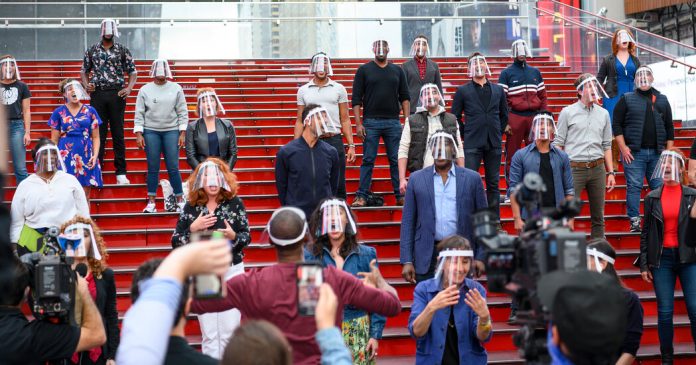
Last week, the Broadway League announced that its theaters would be closed until at least May 30. But on Sunday, two dozen shielded performers, including Bernadette Peters and Andrew Rannells, surprised passers-by in Times Square with a rendition of Stephen Sondheim’s “Sunday” — an effort to create a “moment of joy” to counteract the effects of the coronavirus pandemic.
What does Broadway mean to you? Have you ever seen a show there? What was the experience like? If you haven’t, tell us about another live-performance experience you have had that was memorable. How have you been getting your theater fix during the pandemic?
Let us know in the comments, then read the related article to learn more.
Students 13 and older in the United States and the United Kingdom, and 16 and older elsewhere, are invited to comment. All comments are moderated by the Learning Network staff, but please keep in mind that once your comment is accepted, it will be made public.
NEW DELHI — India’s Supreme Court on Monday handed down a symbolic sentence — a fine of about 1 cent — to a prominent lawyer who posted tweets critical of the court and its chief justice.
… Though the two tweets consisted of just 478 characters, the court issued a 108-page judgment that found Mr. Bhushan in contempt of court. It said that Mr. Bhushan’s tweets were “scurrilous” and “malicious,” and a “calculated attack on the very foundation of the institution of the judiciary.”
In one of the two tweets he posted, Mr. Bhushan wrote that the court played a role in “how democracy has been destroyed in India” during Mr. Modi’s time in office.
“Let the show begin.” “Homecoming at a historically Black college and university is everything.” “Homecoming itself — it’s like being baptized in Blackness.” “It’s almost a ritual. It’s almost like church.” “It was a culture shock for me, personally, because I haven’t really been to school with so many Black kids. And then to see them just doing all of these great things, I was just like, ‘Yeah, this is it.’” “Homecoming is a definite pick-me-up.” “Homecoming is literally what the word is.” “Going back.” “You go back every year.” “Even go back to how you were in college, and no one’s going to judge you.” “There is a buzz in the atmosphere.” “The vibe.” “The vibes were unmatched.” “It is just the absolute best thing ever.” “So not being able to do that, especially during such a difficult year —” “We actually won’t get to physically see each other in person, but Tuskegee’s doing a virtual homecoming. So we don’t know what that’s going to entail, but I’m excited.” “Five, six, seven, eight — one, two, three, four, five, six, grab seven, up eight — yeah, so anybody has any questions for the routine?” “This is the only area I could get internet reception. Do you want me just to type it in the chat?” “Yes, type it, because your service is still kind of going in and out.” “I think it’s a lot tougher than in person. It looks totally different, it feels totally different. And that is hard, doing it virtually, but I believe something epic will come out of it. Just give us a little bit of distance between your bell and the microphone, OK?” “Good, good, good, approach, good steady articulation. And I don’t know if you saw me out of the corner of your eye —” “They call me the Old Man, the Grandpa. Technology was a struggle. So I had to move out the way and, hey, OK, let’s set up the Zoom meeting. OK, I’ll make you a host, I’ll make you a host. We don’t want to sit and waste the time of the students while I’m struggling in there. I started at the university in 1995, so this is year 26. So I would imagine 26 homecomings — pray my math is right.” [singing] “I did a little research and discovered that the tradition of homecoming has its origins in alumni football games since the 19th century. From that, many of the traditions that we are familiar with evolved.” “Every day of the week leading up to homecoming, there’s always some event at an H.B.C.U.” “So you have pep rallies, step shows.” “Bands, cheerleaders —” “Like a gospel brunch or something —” “There’s the homecoming fashion show, which is always a very hot commodity.” “Coronation, the homecoming parade on Saturday morning — you also have, of course, the game, the halftime show.” “We really, really love to party.” “Passing out Jell-O shots at 10 o’clock in the morning.” “People say they don’t remember the week at the end of the week.” “Sunday, you’re like.” “Your outfit has to be just so.” “We tend to have outfits that match.” “You’ve got to come, and you better come correct. I tell all the chicks, every now and then, ‘Look, if it wasn’t for me, you wouldn’t be walking around with that little bikini on.’ So we were flag girls, and we wore full uniforms. So I said, you know what? We’d get a whole lot more attention if we had our legs out. So one night, we slipped into the band hall, got some old band uniform, and made hot pants. And on Homecoming Day, we marched in front of the infamous Marching 101 Band with our legs out. And we did it in fine style.” “So for me, it represents the opportunity for women to try to own who they are. When we started out in 1983, we didn’t really know what we were doing. And so we really created our own genre — some ballet foundations, and you’re doing some lyrical and jazz. And you’re incorporating some hip-hop. If you ever see any of the dance squads, it is a separate genre. It kind of bothers me when people downplay the importance of women expressing themselves through dance, because it’s just so much more than that.” “At all H.B.C.U.s, we are very family-like.” “It was like having a second family.” “I thought I had sisters that I just never met before. I thought I had brothers that I just never met before.” “Anyone who goes to Howard is my cousin. Somewhere down the line, like, ‘Oh, you went to Howard?’ Like, ‘Hey.’” “So Kamala Harris being the V.P. nominee is very exciting.” “And the Howard community — when that was announced, oh, my friends were so annoyed with me, because they will never hear the end of that.” “Homecoming is actually a very contested topic in my house, because my dad went to A&T, so, you know, they have ‘G.H.O.E.’ — the ‘Greatest Homecoming on Earth — so they say.” “Oh, no — whoa — I’ll be honest with you. I do believe that every homecoming brings something different to the table.” “But I know that ours is the best.” “Virginia State University has the best homecoming.” “So when you go to homecoming, it’s all about F.A.M.U.” “I don’t know about F.A.M.U., but I know Hampton and Howard — we have this ongoing rivalry with each other.” “We go back and forth with, who’s the real H.U.?” “Ludacris said, ‘I’ll never miss a homecoming at Howard … so.” “You know, it’s so hard for me because, you know, people know that my daughter went to Howard.” “I get excited. I get turned on, because if you think yours is better, come to the table. Let’s do this. Let’s do it. Let’s duke it out.” “Yeah man, see like, this right here, this says, ‘Morehouse changed my life.’ Man, that’s for real.” “If I had not gone to South Carolina State University, which is a H.B.C.U., I would not be as bold as I am.” “We hear a lot that H.B.C.U.s do not prepare you for the real world, because it’s not realistic. And you’re never really going to be somewhere where it’s going to be majority Black people. And I fully 100 percent agree with that, but —” “You have to maintain a connection to your history, because if you lose that connection, it’s hard to rebuild.” “There was a time we couldn’t attend other schools, period.” “You really get to be judged on your character. You don’t walk in the room and people are like, ‘Who’s that Black girl?’ Because everybody in the room is Black, so.” “Once I graduated from Hampton University, my entire work career was me being in the minority.” “If I’m sitting at the conference table, it’s usually me, one Black female, OK?” “They instilled in me that you need to go above and beyond what others do, because you’re going to be viewed a different way, right?” “But when we go home to homecoming, we can express what has occurred to us in corporate America. And corporate America doesn’t always listen.” “You don’t feel like you have to code switch. You feel like you can be yourself.” “It is family.” “Family reunion — that’s exactly the vibe.” “Just think of it like a yearly family reunion of the family that you really like, right?” “So it’s bigger than the party.” “And to bring all Black people back to one place, because, you know, we go through a lot, as it is. So to have that one weekend to just, like, have fun, it’s really a beautiful event. And I think that’s why it means so much.” “But I think everybody is already geared up for 2021.” “Please let us be able to — I don’t know if we can do two years, I don’t know.” “The comeback is going to be real.” “You know, it’s just an opportunity to up the ante.” “And that’s what we do at the H.B.C.U.”