fbpx
Home Blog Page 1451

Alison’s Coronavirus Course Translators: Modjadji Scholastica Letsoalo

0

To help the world combat the Covid-19 pandemic, Alison launched the course Coronavirus – What you need to know. In order to make sure that no one was excluded from accessing possibly life-saving information, Alison committed to translating the course into as many languages as possible. To achieve this ambitious goal, Alison reached out to its community of Learners, seeking volunteers willing to use their language skills to help translate the course and spread important information on coronavirus. Modjadji Scholastica Letsoalo translated the course into Sotho and played her part in spreading free learning that has helped save lives.


Modjadji, tell us a bit about yourself and your background.

I am Professor Bishop Modjadji Scholastica Letsoalo. I am based in Tzaneen, Limpopo in South Africa. I am the founder of the Faith Church Of All Nations and I am the rector of the Faith Church Of All Nations Trinity Centre. I am a board member of the Trinity International Bible University. I am also the author of six books and a gospel artist with four albums. I have a Bachelor’s Degree in Theology and a Masters of Philosophy in Counselling.

How did you learn that Alison was looking for translators for its coronavirus course?

I received the invitation through an email.

What was your experience of Alison before volunteering to translate? Had you studied with Alison before?

I have studied several courses with Alison. I have obtained, among others, certificates in Coronavirus – What you need to know, Motivating Students to Learn, Stress Management, HIV/AIDS Awareness & Prevention and Mental Health Studies. I have obtained Diplomas in Social Work Studies, Psychology and Educational Psychology. Since I started to study with Alison, I have found that the service and the experience is good

Why did you offer to translate our coronavirus course?

Volunteering is my life because volunteering is something which is pleasing to God. I am a full time Pastor, so I take it as my calling to help others.

Why is it important that everyone has access to important information on coronavirus?

People perish because of a lack of knowledge. Some people are illiterate, while others only speak their native language and lack an understanding of English.

Tell us a little about your method when translating.

I worked through Google Translate and by consulting Sotho Teachers and comparing with a Sotho dictionary. Besides Sotho is my native language.


Why is free learning so important and why is it important to translate it into many languages?

Free learning is important for those who wish to study but lack the finance. During these times, free learning guarantees that information reaches all people so that no one will perish because of a lack of knowledge. Translating also benefits those who have the passion for helping and volunteering.

What would you say to people who might be interested in translating for Alison?

Let love lead. It is good to help others by volunteering and not expecting anything in return. God is the Rewarder.

If you’d like to play your part in overcoming the coronavirus pandemic by helping Alison give people access to the information necessary to keep themselves and their loved ones safe, please get in touch.
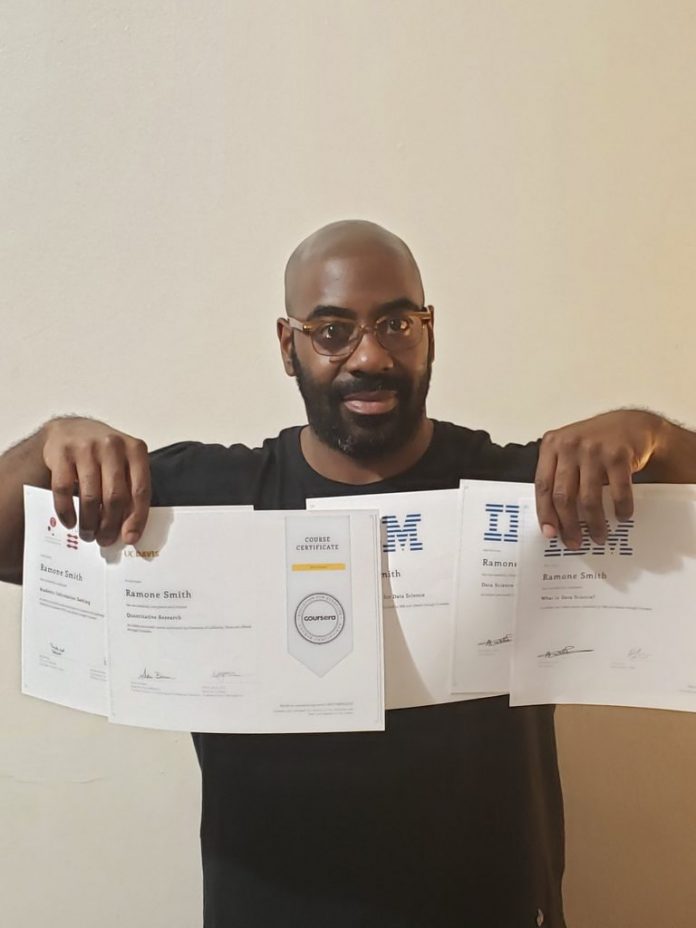
See how Ramone used online learning to supplement his academic and career pursuits

0
See how Ramone used online learning to supplement his academic and career pursuits

Meet Ramone, a learner in New York who’s taking courses on Coursera to supplement his PhD program, and to improve his career coaching skills. He shares his story below.

Enhancing my knowledge 

My goal for learning on Coursera was to access additional resources to complete my course work for my PhD. I am a Doctoral Candidate attending Long Island University, studying Information Studies. I recently and successfully completed the course curriculum for the Information Studies program at LIU and am presently writing my dissertation. 

I use Coursera as an additional resource for course materials, and to enhance my knowledge and help me complete my assignments. Each semester after enrolling in my classes at LIU, I would then check Coursera’s catalog to look for matching and corresponding courses. I would enroll in the Coursera courses and cross-pollinate the ideas. This form of synthesis allowed me to conceptualize more unique ideas to apply to my work. 

Courses with both academic and career benefits

As I mentioned, I took courses from Coursera that matched or corresponded with the course curriculum from LIU’s Information Studies PhD program, including:

● Qualitative Research from UC Davis

● Academic Information Seeking from the University of Copenhagen

● What is Data Science? from IBM

● Tools for Data Science from IBM 

● Data Science Methodology from IBM

I also work a full-time position with an IT training institution as a career coach. Taking career development courses helped me become more knowledgeable and perform my job better. I was able to teach my students how to better prepare for the job market and plan out their career paths. By making these improvements, I earned acknowledgment from my supervisors at work. These were the courses I took:

● Foundations for Learning: Being a Professional from the Commonwealth Education Trust

● Learning to Teach Online from the University of New South Wales

● Getting Started with Google Sheets from Google Cloud

● Successful Career Development from the University System of Georgia

Expanding my perspectives   

I would describe learning on Coursera as an exciting intellectual engagement, with knowledgeable instructors and a plethora of resources—most of which I never knew existed, which is what made it interesting. 

What surprised me was how well-designed each course was. In addition to online support, learners could also engage in chat discussions related to the course topic, and make new professional connections. These are also a great source of idea diffusion and cross-pollination. Every online course is very well thought out, and planned out. 

What made me happiest about learning on Coursera was the video lectures, and the exposure to a vast array of new academic ideas and pedagogy—particularly from the international-based courses teaching the subjects I selected. The knowledgeable professors, along with the resource links, make each class an absolute pleasure of an academic adventure. 


Summer Reading Contest Week 2: What Got Your Attention in The Times This Week?

0
Summer Reading Contest Week 2: What Got Your Attention in The Times This Week?

Welcome to Week Two of our 11th Annual Summer Reading Contest.

This contest is open to students 13-19 from anywhere in the world. To participate, submit a response by 9 a.m. Eastern on June 26 that answers the questions “What got your attention in The Times this week? Why?”

If you are 13 or older and live in the United States, or 16 or older from anywhere else in the world, post your response in the comment section. If you are 13-15 and live in another country, see the bottom of this post for details on how to submit.

Responses must be 1500 characters or fewer.

What should you choose? Well, as you know from the rules we’ve posted, you can pick anything published on NYTimes.com in 2019 or 2020, including articles, essays, Op-Eds, videos, photos, podcasts or infographics.

So what did you read, watch or listen to this week?

We hope you’ll click around NYTimes.com and find your own great articles, features and multimedia. But we also know that not everyone who participates has a Times subscription. Because all links to Times content from the student features on our site are free, every week we’ll try to help by posting interesting pieces from a variety of sections.

Why Weren’t We Video Calling All Along?

Op-Art: A Surviving Instrument

I’m a Critical Care Doctor. I’m Tired, I’m Mourning, I’m Bracing for More.

Rich Kids Are Eating Up the Financial Aid Pot

Why the Supreme Court Ruling on L.G.B.T.Q. Rights Is Such a Big Deal

The Rape Kit’s Secret History

The Unstoppable Class of 2020


Whatever caught your eye, tell us about it.

Need more details? The contest rules are all here, and you can read the work of last year’s winners here. A quick overview, though:

  • You can choose from anything published in the print paper or on NYTimes.com in 2019 or 2020, including videos, podcasts, graphics and photographs. (In your response, please include the URL or headline of the piece you pick.)

  • We’ll post this question each Friday from today through Aug. 14, and you’ll have until the next Friday morning to respond with your picks. Then we’ll close that post and open a new one with the same question.

  • We’ll choose at least one favorite answer to feature on our site each week. Winners from this week will be announced on July 7.

  • Feel free to participate each week, but we allow only one submission per person per week.

  • The contest is open to students ages 13 to 19 from anywhere in the world. If you are 16 or older from anywhere in the world, you can post your response in the comments section. If you are between the ages of 13 and 15 and live outside the United States, use the form below to submit your entry. All entries from the comments section and the form below will be judged together.

Color Love | Pink & Gold

0
Color Love | Pink & Gold

When I came across this picture, I went completely ga-ga over the pink gold color palette used for the decor at this fabulous party.  Pairing a glamorous gold with an innocent soft pink creates the most romantic color combination.

Pink Gold Color Palette

Below I have created for you a simple mood board featuring today’s color combination. It is in perfect Pinterest format, so feel free to pin it for later.

Pink and gold color palette inspirations

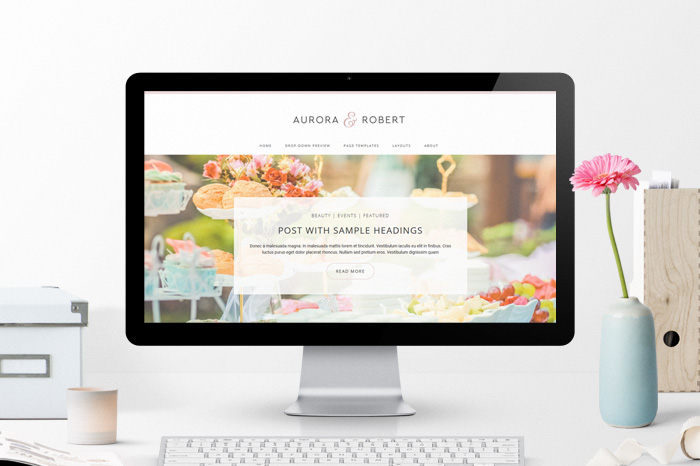
These colors also make for a stunning blog design.

Below you will find a sample of pink designs from our WordPress Theme shop.

Pink WordPress Theme

See our collection of other gorgeous color palettes by visiting our color palette section.


What do you think about our pink and gold color palette? Do you like this combination? Where would you use it? We would love to hear your thoughts, so make sure to share them in the comments below.

Lastly, learn about the power of color in blog design in our blog post to see how important colors are in all the projects you create.

Retrieval Practice and Stress

0
Retrieval Practice and Stress

School can be stressful, and 2020 has been a particularly stressful year for many of us. So, for this week’s blog, I thought I would write about retrieval practice and stress. Fortunately, I get to share some good news! 

Prior research has shown that acute stress can hinder our ability to retrieve information. Acute stress is stress that comes from a specific event.

(Note: Acute stress is different from chronic stress, where our exposure to stress hormones is repeated and relatively constant. For more information on acute and chronic stress, see this page through the Centre for Studies on Human Stress. I also really like this 3-minute video with Robert Sapolsky on psychology and stress. And, if you really want to commit to learning more about stress and health, Robert Sapolsky has a book called Why Zebras Don’t Get Ulcers: Stress and Health, and a 90-minute lecture on YouTube about the topic. He is extremely knowledgeable, engaging, and funny!)

Acute stress getting in the way of retrieving information can be pretty bad for student learning. If we are experiencing stress before an important test, either due to the test or because of something else, we might be less likely to be able to retrieve what we have learned thus decreasing our performance on the important test! 

Fortunately, there is some evidence to suggest that retrieval practice might be able to protect against memory inhibition that we might experience while stressed (1). In a study published in Science, a very high-profile peer-reviewed publication, Amy Smith and colleagues (2016) investigated retrieval practice and stress. They had four groups of participants:

  1. retrieval practice plus not stressful activity

  2. retrieval practice plus a stressful activity

  3. restudying plus a not stressful activity

  4. restudying plus a stressful activity

To start, they had all participants study nouns and images. While these are considered basic materials, they help the researchers determine cause and effect relationships in the lab to classroom model (2). Then, some of the participants engaged in retrieval practice where they recalled as many as they could remember across a couple of trials, while the other participants restudied the items across a couple of trials. (There was some nuance to the way they had participants study and either restudy or practice retrieval, but it is not central to the main point here.) After this learning phase, they left the lab.

Twenty-four hours later, everyone returned. The participants that were assigned to the stressful activity conditions were asked to give speeches and solve math problems in front of two judges and three of their peers. This sounds incredibly stressful to me, and a lot of other research confirms people find this stressful. Smith and colleagues took some physiological measures to confirm that the participants were stressed. The other participants just completed a simple not stressful activity instead. The participants’ memory was tested immediately after the start of activities, and after 25 minutes.

Here are the main takeaways from the results:

  1. Overall, retrieval practice led to greater performance than restudying.

  2. For the group that restudied, stress did reduce memory performance. The acute stress did not affect the participants’ ability to retrieve what they learned instantaneously. However, within 25 minutes their performance declined if they were stressed compared to when they were not stressed.

  3. For the group that practiced retrieval, stress did not reduce memory performance, even 25 minutes later.

Education and Coronavirus: Lessons From Emergency Remote Teaching

0
Education and Coronavirus: Lessons From Emergency Remote Teaching

By Matthew Rascoff

In recent months, almost every university in the world has shifted to emergency remote teaching—a kind of “first aid” for higher education in a pandemic.

When the Chinese government closed all higher education institutions in early February, Duke Kunshan University (DKU) in Kunshan, China, was among the first universities to make this switch. 

A sister to Duke University in North Carolina, DKU is a startup institution with about 600 undergraduates in two classes. A joint venture with Wuhan University, DKU faced an enormous challenge in its crisis response. 

How Duke Kunshan University adapted 

Under normal circumstances, our Online Duke team would spend months building an online course using the principles of backward design. In the midst of a public health crisis, though, we didn’t have time to do this. 

Over three weeks in February, we managed to transfer Duke Kunshan’s courses to remote delivery. That turned out to be an early drill for an even greater challenge that Duke and thousands of other educational institutions would face the following month, as the Covid-19 epidemic spread to the United States. In support of this effort, Duke’s Learning Innovation team and DKU’s Center for Teaching and Learning quickly partnered with Coursera to implement the Coursera for Campus platform for DKU.

Emergency remote teaching—not online learning 

We call what we’ve been doing the past few months “emergency remote teaching” because it doesn’t represent the full potential of online learning. We accelerated processes that would usually be more deliberate and collaborative. 

As we continue to adapt, university leaders should be careful about how we frame this work for our communities. We don’t want to set the online learning world back and risk a backlash by letting faculty think this is what online learning really is.   

Five lessons from transitioning to emergency remote teaching

Still, this massive worldwide challenge can help pave the way for more robust, flexible teaching models. We should all be taking notes as we go through this transition together. 

Here are five things we have learned so far at Duke that may help colleagues facing similar crises. 

  1. Over-communicate with stakeholders. We built three websites—one each for faculty, students, and staff—to provide information about Duke’s transition. We wanted each group to have a place where they could get the information they needed.  
  1. Give clear guidance. Our usual mode of engaging with instructors is consultative. In this case, we were more prescriptive. There wasn’t time to develop collaborative solutions, and instructors were under so much stress that they appreciated straightforward steps.
  1. Help instructors curate content. At Duke Kunshan, we’re using the Coursera for Campus platform to accelerate the development of courses and to offer co-curricular learning experiences that complement courses. We encourage faculty to repurpose modular content—sometimes called “courseware”—from trusted sources such as Coursera for Campus.
  1. Give students opportunities for self-directed learning. At Duke Kunshan, we’ve opened the whole Coursera for Campus catalog, which consists of 3,800 courses, and we’re seeing a lot of self-motivated learning across the disciplines. At Duke, thousands of students have signed up for Coursera for Duke, with access to Duke faculty-created courses. 
  1. Mix synchronous and asynchronous learning experiences. Because our students are located all over the world, we can’t rely entirely on live sessions. We record live sessions and share them with students who can’t participate. 

These approaches got our faculty and us through the spring. Over the coming months, though, higher education must move beyond emergency remote teaching. We have to figure out how to scale learning design to offer better learning experiences than what was possible this spring. And we have to do this for millions of students worldwide. 

The Duke Learning Innovation team is hard at work on this project, which we are calling Flexible Teaching. We look forward to sharing what we develop with the Coursera community and the wider world. 

The occurrence of a public health crisis, even those of this magnitude, is predictable. We don’t know how this one will end and what form the next one may take. But there are surely more challenges coming for higher education. To be better prepared, and to make our institutions more resilient to inevitable shocks, colleges and universities need to be technologically adept, agile, and resourceful.

For more lessons from Duke’s transition to remote teaching, like how to motivate your team or the importance of triage and feedback loops, tune into this on-demand webinar: Education and coronavirus: Practical steps for taking learning online.

Matthew Rascoff is Associate Vice Provost for Digital Education and Innovation at Duke University. 

1

Be The Good | Free Printable Poster

0
Be The Good | Free Printable Poster

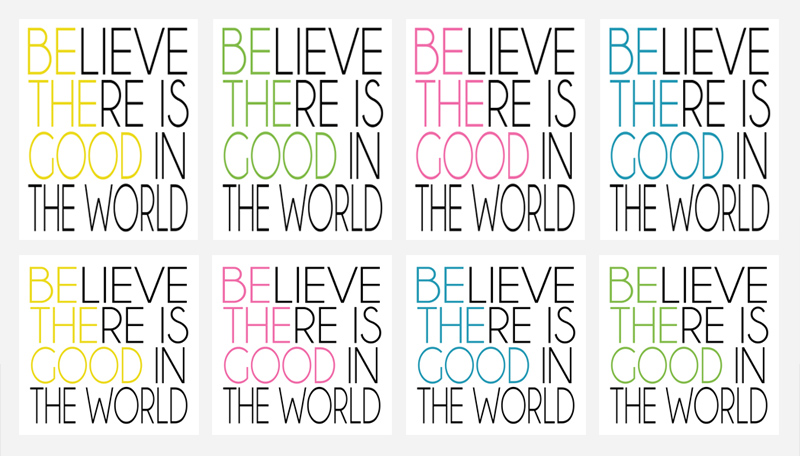
If you are looking for subtle office decoration, our ‘Be the Good’ free printable poster will be perfect! Spread the positive vibes and remind yourself to always believe there is good in the world. Simple text printable posters are great because they are so easy to incorporate in any room type. No matter if you place it in your living room, office, or kid’s room, it will fit! In other words, such printable is always worth downloading.

It’s available as an 8 x 10 or as a 12 x 12. In addition, it came in four different colors (blue, pink, green, yellow), so ya got a lot of options. It gives a total of eight printable files in one download.

See all versions included in the download package below:

Download ‘Be the Good’ Free Printable Poster

For Personal Use Only.


If you are looking for more printables, make sure to check our free printables library


We would appreciate it if you can share this printable because it helps us a lot! Just click on the buttons below. It is entirely free for you and above all, it helps us grow and produce even more content.

Share and help us grow. Thanks!


Looking for something specific?

Lastly, if you have an idea for printable, let us know in the comments! We are always looking for inspiration. If you decide to print today’s free printable poster, make sure to share photos of your decorated room with us via Instagram or Twitter because we love to see it.

P.S This post includes affiliate links. By clicking them, you are supporting us. Thanks!

Sydney’s Career Story: Turning a Setback into a Step Forward

0
Sydney’s Career Story: Turning a Setback into a Step Forward

Being laid off from a job is never easy, and it’s become an all-too-common experience for so many during COVID-19. When it happened to Sydney, she used it as an opportunity to pursue her passion for learning more about marketing. She gained new skills, and began volunteering for a non-profit. Seven weeks later, she’d landed her dream job. She shares her story below:

A little bit about me

I have a Bachelor’s Degree in Communications from the University of Pittsburgh. The truth is, I had very little idea of what I wanted to do when I got out of school. I fell into recruiting by accident, which led to HR, which then turned into community management, which was what allowed me the opportunity to learn more about marketing. Mostly, I’ve been at the right place at the right time, and hungry to learn, not climb a ladder. I had the opportunity at my last job to learn about marketing, but I didn’t actually do much of it myself because of my lack of experience. Being able to take classes has helped me enormously.

How I found Coursera

Just before I got laid off in response to COVID-19, someone shared an article on Facebook titled, “Here are 450 Ivy League courses you can take online right now for free.” I remember thinking, “wow, this is amazing,” and I reposted it thinking, “One day, I may use this. I don’t have time right now, but maybe someone else can find some value.” 

Fast forward a few weeks, and I was without a job, and I had a lot of time on my hands. As someone who thrives on having a schedule, I immediately thought back to this article and dove in to see what classes were available, and if any of them would help me advance my marketing career. That’s how I found Coursera. I liked the platform from a UX perspective, so I decided to consolidate and use this tool for all of my classes. I originally signed up for the free version but ended up purchasing the certificates to boost my credibility and LinkedIn profile.

What I learned

I signed up for three courses:

I took the brand management course out of a desire to learn more, but not a need or requirement. It’s been challenging, but I’ve learned a lot. A few weeks into the course, I found an opportunity through LinkedIn to volunteer my time on a marketing committee for a local non-profit. Within a week, they asked me to put together a global marketing strategy, and guess what knowledge I’m using? Everything I learned in the brand management course! 

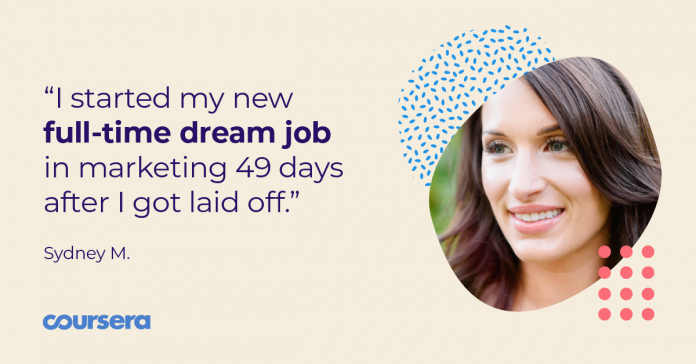
It was so awesome to immediately see the fruits of that labor. I went back to my notes, rewatched some of the videos, and put together an entire deck for them using my newly established skills. Fast forward a few more weeks, and someone I connected with on Linkedin saw my background and asked if I wanted to talk because she thought I would be a great fit for their team. I started my new full-time dream job 49 days after I got laid off. And I can say with absolute certainty the skills I learned in courses on Coursera helped me get this job.

What’s next

I want to establish myself in the marketing field for a company that is trying to leave the world a bit better than they found it. I’m not chasing a title, just looking to get my foot in the door and continue learning and empowering others. I really love to make other people shine.

1

Our commitment to address racial inequality through education

0
Our commitment to address racial inequality through education

This is the first time, as a company, we’ve spoken about the Black Lives Matter movement – for this we can only apologise. The reason we’ve taken our time is intentional because we know our house isn’t in order, and we want to deliver action, not just words. As Chief Executive, speaking on behalf of the company, I’m going to explain what we’ve done in the last three weeks and what we are committed to doing beyond that. 

Everyone at FutureLearn abhors racial discrimination. We were all sickened by the murder of George Floyd and the awful acts of violence against black people that preceded and have followed it. We’ve also been greatly moved by the protests these recent incidents have catalysed and by the unlocking of discussion about racism that has been prompted. Indeed, this has led to a greater awareness for all of us that racism is something that has been talked about (and not acted against enough) for a very long time. 

I would not normally comment in this way myself, but I have witnessed and heard the strength of feeling within FutureLearn itself on this issue and I recognise the hurt and distress it is bringing to our black community, as well as to many others who feel deeply that they want to see change. The black community within FutureLearn has fed back to me that we should stand more visibly with our black colleagues and indeed our community of black learners around the world and I now understand the importance of this. 

FutureLearn is an education company whose purpose is to transform access to education, and that is the contribution I believe our public response can make – to help people find and access high-quality education that will help them understand, react, and respond to what they are encountering in traditional and social media. 

However, when we examined our portfolio, we did not find as many courses relevant to black history, black culture, or anti-racism as we hoped to see. Over the years, we have not prioritised these courses and our partners have not prioritised developing them. 

 We have decided therefore that it is time to act, to do more as an education platform, as a global partnership of educators and as an organisation ourselves.  


Financial support for courses on black history & culture and anti-racism

We have launched an access fund to help initiate a response from existing and new partners, to help them produce courses in important areas where currently we have gaps that relate directly to black history, systemic racism and racial inequality. The value of the fund is £50,000. We also plan to waive fees for new partners who can create relevant content or bring new perspectives to our output. 

 We’ve already reached out to over 25 potential partners; and while we’re not in a position to make any announcements yet, conversations are going well and we will have courses on our platform soon. Ideally, we’d like some of these courses to be aimed at teachers, schoolkids, and employees because we feel these are key areas where education can make a serious difference. 


Diversity and inclusivity on our courses 

We’re also updating our course guidelines to ensure our partners deliver more diversity and inclusivity within the courses on our platform. The whole education industry has a huge opportunity here to lead by example and we call on all of our partners to consider who their lead educators are on courses and if they are representative of all our learners. 

 We are proud of the impact we have already had in opening up access to the world’s leading universities for people who could not otherwise have dreamt of studying there; and we would like to do more to help people take the next step, beyond short courses, and gain access to study undergraduate or postgraduate qualifications. We believe we can do more to widen access to the world’s top universities and can work with our partners to help grow the number of black students studying and succeeding with them. 


FutureLearn itself

We are also reviewing our people initiatives with a view to identifying and addressing gaps in current policies, being transparent about the progress we are (or aren’t) making, and setting out our commitments more clearly. This must include improving the lack of representation at the most senior levels of our company. But immediately, we are doing our very best to ensure the wellbeing of our black staff. 

Thank you for reading this. I’m fully aware that, as a company, we haven’t got this right. But we’re now working hard to change that. We hope to have more news on new partners and courses soon, but in the meantime, I’d like to direct you to this blogpost which includes educational resources from and for the black community that could be invaluable in the effort we must all make to educate ourselves.

Simon Nelson


Category Black Lives Matter

Black Lives Matter – Resources

0
Black Lives Matter – Resources

In recent weeks, protests have erupted across the globe in response to the killing of George Floyd by four police officers in Minneapolis, USA. The death of Floyd acted as a tipping point for centuries of pent-up anger at systemic injustice and racism to boil over, not just in America but across the world.

What started as a movement protesting police brutality in the States has evolved into a global reckoning with white privilege, racism, and colonialism.

FutureLearn stands with our black colleagues and learners. We are striving to make ourselves more inclusive and diverse, as well as to host more courses on black liberation, and improve black access to education. Read our CEO Simon Nelson’s statement.

For black people globally, this has been yet another emotional and traumatic time – both due to systemic oppression finally being surfaced and seeing institutions and colleagues trying (and often failing) to belatedly grapple with the issue.

There are resources out there that can help black learners feel supported – and non-black learners to become better allies. We’ve collected some of the most useful below.


 Support your mental health

According to the Mental Health Foundation, black people are more likely to suffer mental health issues than their white counterparts, and also more likely to face discrimination in mental health services. 

This is largely due to a legacy of institutional racism and oppression that leaves many black people not only locked out of economic systems – but also adequate healthcare.

Donate

Donating to causes fighting to help improve the lives of black people in the community – as well as in the penal system – is a good way to contribute. 

Sign petitions

If you’re unable to donate, signing a petition might be the next best thing. We’ve highlighted petitions calling for justice for George Floyd, Breonna Taylor (murdered by a police officer in her sleep in Louisville), and Belly Mujinga, a transport worker who died of COVID-19 after being spat at in London.

Black Lives Matter also collect new petitions on their site. Read the BLM statement on George Floyd and why black people have a right to not live in fear.

Educate yourself

Whether you want to learn more about the rich history and culture of black people, or you’re looking to learn more about the history of oppression black people have suffered – and the inspirational opposition to it through the ages – there’s a wealth of books, films, and courses that can expand your understanding. 

Books

Why I’m No Longer Talking to White People About Race by Reni Eddo-Lodge

This book on the reality of structural racism in Britain has shot to the top of the best-seller charts  – making Eddo-Lodge the first black author to top the charts in the UK. 

Natives: Race and Class in the Ruins of Empire by Akala

Musician, activist, and academic Akala charts the historical legacy of British racism and colonial oppression.

Between The World And Me by Ta-Nehisi Coates

Author Coates explores American racism in the form of a letter to his 14-year-old son.

Women, Race & Class by Angela Davis

A groundbreaking exploration of the intersection of related oppressions – how the system works to keep down women, blacks, and workers, all at once.

Unapologetic: A Black, Queer, and Feminist Mandate for Radical Movements by Charlene Carruthers

Exploring the history of black liberation back to the Haitian Revolution, Carruthers appeals to her readers to make black liberation more queer, more feminist, and more radical.

Films

13th by Ava DuVernay

In this documentary, director DuVernay contends that slavery in the United States was replaced by systemic oppression of black people – through the prison system, the war on drugs, and longstanding police and public violence.

The Black Power Mixtape 1967–1975 by Göran Olsson

A collection of news footage – shot in the late 1960s and early 70s by Swedish national television – that acts as a unique portrait of the black activists at the forefront of the radical civil rights movement. Featuring interviews with Angela Davis, Stokely Carmichael, and Huey P. Newton.

I Am Not Your Negro by Raoul Peck

This documentary collects author James Baldwin’s observations on American history and racial injustice, including his thoughts on civil rights leaders Medgar Evers, Malcolm X, and Martin Luther King Jr.

Courses

Understanding Diversity and Inclusion from Purdue University

Unconscious bias is as much a factor in discrimination as overt racism. On this course, you can learn to tackle ethnocentric mindsets and create inclusive environments.

Cultural Diversity and the City from the European University Institute

This course explores the importance of racial and cultural diversity in shaping the identity of a thriving city.

Empire: the Controversies of British Imperialism from the University of Exeter

The University of Exeter’s short, free course examines the British Empire, including how it exploited race, religion, and propaganda to hold sway over a third of the Earth’s population.


Category Black Lives Matter