fbpx
Home Blog Page 1547

How to make $29K more with your feelings

0
How to make $29K more with your feelings

Emotions aren’t something we generally deem as money-makers. Sure, they’re part of our day-to-day, but they’re usually a result of circumstances – not drivers of value. But what if your emotions were something that could earn you more money? It’s possible. Keep reading to find out how. 

You might’ve heard of emotional intelligence (EQ) before but dismissed it as new age fluff. But, it’s a little more substantial than that. In fact it’s got some real monetary value behind it. USD$29,000 to be precise. 

So what is EQ and how can you use it to make it rain? 

What is EQ?  

While IQ is your ability to process information, EQ is your ability to process emotions – both your own and others. Luckily, you can strengthen your EQ fairly easily. Your IQ? That’s a lot more difficult. 

EQ is more than just a buzzword, it’s a tangible asset which Psychologist Daniel Goleman breaks down into five parts: 

  1. Self-Awareness 
  2. Self-Management 
  3. Motivation
  4. Empathy 
  5. Social Communication 

Self-awareness is the ability to understand your effect on others, knowing your strengths, and identifying your weaknesses. Self-management is controlling your emotions and mediating how you act. Social communication is your power to manage relationships positively.  And motivation and empathy? They’re self explanatory. 

Now consider your role in the workforce. Do you use these skills regularly? The answer is most likely ‘yes’. Now we’re getting somewhere. 

How much money can emotions make? 

A study of college students in the U.S found that of those who scored highly on emotional intelligence earned more across all industries over a course of 10 years. 

This study points to the networking skills of the participants with high EQ. Think of people who embed themselves in the social structure of company – keeping themselves well connected and placed. 

EQ skills make these successful individuals good at accepting and actioning feedback and improving their performance.

Travis Bradberry, co-author of Emotional Intelligence 2.0, recently helped conduct a survey with staggering results that hold true for employees in all industries, at all levels, in all regions of the world. He found that not only are 90 percent of top performers high in emotional intelligence, but they average a salary of USD$29,000 (which is around AUD$42,800!) more per year than people with a lower degree of emotional intelligence. 

Bradberry explains that every point on the EQ scale equates to an extra USD$1300 in salary. 

Alright, how do I increase my EQ?

Increasing your EQ isn’t so much about becoming more emotional. It’s about becoming more emotionally aware.

  1. Know yourself
    Practice self-awareness and notice when you’re stressed or annoyed. What triggers these emotions for you?
  2. Include others in decision making
    It may take some getting used to, but once you’ve learned to listen internally and externally, you’ll be surprised what you pick up.
  3. Try not to be offended when criticism is offered
    Instead harness what others are saying and take it on board. Ask from the situation, ‘what can I learn?’. 

By implementing these skills during your day-to-day working environment, you can maneuver yourself into a respected position. And when it comes to salary negotiations, that’s half the battle. This is the true value of EQ. 

What Topics Do You Wish You Could Learn About in School?

0
What Topics Do You Wish You Could Learn About in School?

What about the arts and athletics? Can you learn to play the guitar or tap dance, make films or rock climb at your school?

What would you like to learn in school if you could learn anything? What additional courses do you wish your school offered? Why?

Schools at all levels regularly tinker with their curriculums to be more relevant and interesting to students. Here are a few articles that give examples of some trends:

From “How ‘Makers’ Make the Classroom More Inclusive”:

… a growing group of students who haven’t responded to traditional textbook-and-work sheet learning are excited and inspired about making, teachers say. There are more than 400 active spaces for hacking and making in North America.

Carolyn Barnhart, a science teacher at Fredericton High School in New Brunswick, Canada, was about two decades into her teaching career when she heard about making, and cautiously began to apply it to her classroom. She had been accustomed to airtight lesson plans and scripted lectures.

From “Video Games Are a Waste of Time? Not for Those With E-Sports Scholarships”:

Multiplayer video games played competitively, often with spectators, are known as e-sports, and they have become a gateway to college scholarship money. Over the past two years, the National Association of Collegiate Esports, which is engaged with 98 varsity programs across the United States and Canada, has helped to facilitate $16 million in scholarships, according to the executive director, Michael Brooks.

In higher education, e-sports live in various departments. Sometimes they are part of student affairs; some schools place them within an engineering or design program; and, more rarely, they have their place in athletics.

At Robert Morris University Illinois, e-sports is part of the athletics department. Team members have access to athletic trainers and are put through light fitness training. Players attend practice Monday through Thursday, from 4:30 to 9 p.m., with an hour break for dinner. They analyze film, participate in team-building activities, sit for communication sessions.

And finally, from “Stylish Learning”:

The perfect gift for any high schooler who has designs on Virgil Abloh’s job?

Parsons Paris, a nonprofit school that is a division of the New School of New York City, is suggesting its new online program, “Inside the Business of Fashion and Luxury.”

“We give students access to leaders in the world of French design and luxury that even people who go to the défilé don’t have,” said Peter Price, the school’s chairman of the board.

And Florence Leclerc-Dickler, the school’s dean, added: “Not everyone can come to Paris to study.”

Sharing their views in video lectures will be several well-known fashion executives, including Nicole Weiss, global head of client relations and client experience for Louis Vuitton, talking about the increasing importance of providing value to consumers, and Olivier Bialobos, senior vice president of global communications at Christian Dior, on how digital marketing has changed the business.

Students, read the entire article, then tell us:

  • What course or courses do you wish your school would offer? Why? Give us as much detail about your proposed course(s) as you can.

  • How would you convince your school to offer this course? That is, what case could you make that it was worth offering in a school setting? What would students learn and be able to do as a result, and why is that worthwhile?

  • To what extent is your school already doing a good job, whether through traditional courses or extracurricular activities, of offering a range of interesting options for learning?

  • Our annual Connections Contest asks students to link something they’re studying in school with something happening in the world today. How connected with real-world issues, needs or ideas is your proposed course or courses? Why?


Students 13 and older are invited to comment. All comments are moderated by the Learning Network staff, but please keep in mind that once your comment is accepted, it will be made public.

How Is What You Are Studying in School Relevant to Your Life and the Larger World?

0
How Is What You Are Studying in School Relevant to Your Life and the Larger World?

Or maybe your school offers courses that teach skills, like computer coding, wood shop, music or photography, that build on interests you have always had and like to explore beyond the school day.

If so, what have these classes taught you? How have you connected what you learned in them with your real life?

If it’s not so easy to answer this question, think about why. What are you studying? How could it be better connected to who you are, the things you care about and the things you’d like to know more about?

In 2018 we asked teachers how they made the content they teach relevant, and you can find over 40 examples in “When School Gets Real: Teachers Connect Classroom Lessons to Current Events.” Here are a few.

Jeff Baird, Brooklyn, N.Y., Middle School

Every year, my eighth-grade students choose a modern-day issue of injustice that they would like to learn about, and take action toward solving. This has resulted in everything from Instagram accounts about our society’s racist beauty standards, to Musical.ly fund-raisers for L.G.B.T.Q.+ rights groups, to creative writing pieces, artwork and political letters that urge others to help victims of police brutality, mass incarceration and the school-to-prison pipeline.

Kristen Kalenowicz, Milwaukee, High School

Two years ago I introduced the lens of mental health to discuss “The Catcher in the Rye” and “The Bell Jar.”

Part of me wondered if this was overstepping, if mental illness should be saved for health class. Yet over the past year, my belief that young people need to explore mental health across all disciplines has been reaffirmed. With the recent suicides of public figures, the bullying of L.G.B.T.Q.+ individuals, and society’s discussion surrounding school shooters and mental illness, this is a topic that we cannot afford to leave out.

Kellyn McNamara, Charlotte, N.C., Middle and High School

I am designing an Earth and environmental science class in which students will connect a current event or issue to each unit’s content. For instance, for Unit 1, Earth as a Planet, students will explore the history of space exploration (and its funding), and prepare for a Lincoln-Douglas-style debate in which they will argue either for federal funding of space exploration, or for privatized space exploration.

Students, read the entire article, then tell us:

  • Do any of the projects described here appeal to you? Which do you wish you could take part in? Why?

  • What is something you have studied in school that has felt especially connected to your life in some way, or to important issues in the world outside school? How? How much, in general, do you see the communities and issues you care about reflected in what you learn?

  • Should school try to make these connections more often? If so, how do you think that might be done? In general, do you think it should be the job of teachers to make the curriculum relevant to their students, or do you think that’s beyond the scope of their jobs?


Students 13 and older are invited to comment. All comments are moderated by the Learning Network staff, but please keep in mind that once your comment is accepted, it will be made public.

Project management: More than meets the eye

0
Project management: More than meets the eye

Project managers are the superheroes of every organisation. They’re the wing-men and women of all office-goers, helping manage projects from get-go through to execution. But what is it that they actually do?

“The idea that project management is a needless overhead is surprisingly common,” says Kerrin D’Arcy, who is a renowned professional in the media industry.

She believes there’s a mentality that this position is not required until something goes wrong.

In reality, the role of a project manager isn’t just about avoiding disasters. These professionals should be engaged from the beginning of any new initiative, so that they can plan and oversee development to deliver the best outcome for all.

More than schedules and cost

Sure, this line of work carries the responsibility of managing budgets, costs, scope and deadlines. But it’s about so much more. Project management is about handling the overall life-cycle of a project.

As part of this, project managers should be tasked with ensuring each element of a project is carefully assessed for risks and issues, as well addressing resources that may be required.

“Project managers take a great idea and makes it happen,” says Cassandra Naccarella, an award-winning project manager with construction giant Stockland.

“[They] make delivery more efficient through careful planning, attention to detail and clear communication.”

As project management professionals are generally the only people with a full view of the entire team, they’re key to “pulling it all together”.

The ultimate problem-solving profession

It isn’t the role of the project manager to know how to code, to construct or to write. But it’s often up to them to know who to reach to get it done.

“A project manager should be able to guide and direct conversations or provide a different viewpoint and participate in a collaborative way to resolve the problem,” says D’Arcy.

These professionals are proactive in engaging the team in frequent discussions, as well as knowing when it’s appropriate to escalate an issue to higher management if a resolution can’t be found.

Man putting post-it notes on whiteboard.

A role that’s always evolving

“Different industries move at different speeds – and the customers of these industries are often more savvy than ever,” says D’Arcy.

“Therefore, project managers need to constantly adapt and evolve along with a changing landscape.”

For D’Arcy, being part of the media industry during the digital age, her biggest challenge is to keep up with trends.

“Those who succeed should be able to moderate their management style to suit the program, project and business unit or team delivery,” she says.


Consider yourself the ultimate organiser? Love the challenge of solving problems? You might just make a goal-kicking project manager. With skills to work across a variety of industries, project managers are open to a range of career opportunities.

Through Open Universities Australia (OUA), you can explore, choose and enrol in a range of courses in project management with leading Australian universities. Better yet, you can complete your qualification online without sacrificing your existing work commitments or family life.

To learn more about how to study through OUA – fill out the form on this page, and a friendly student advisor will get in contact. You can also chat to them on OUA’s website Messenger service, Facebook Messenger, WhatsApp or SMS. They’ll help you find the right course for your project management career.

Related courses

Master of Applied Project Management – University of South Australia

Graduate Diploma in Project Management – Southern Cross University

Master of Science (Project Management) – Curtin University

Around the World in 5 Kids’ Games

0
Around the World in 5 Kids’ Games

On every schoolyard across the world you will find games invented by children. Hand-clapping routines, rhyming stanzas and intricate rules for tiny competitions; games born of the creativity, insight and idiosyncrasy of children’s minds.

In New York City’s diverse playgrounds, kids play games in Haitian Creole, Korean, Spanish, Arabic and Polish, just to name a few.


Girls playing a game from Yemen at a middle school in Borough Park, Brooklyn.


Students at P.S. 34, a Polish-language school in Greenpoint, Brooklyn.


A group from the Flanbwayan Haitian Literacy Project in Flatbush, Brooklyn.

Unlike nursery rhymes, lullabies, or children’s songs these games are conceived of, built upon and passed along by kids, largely by girls. Irene Chagal, who researched the history and spread of hand-clapping games for her documentary “Let’s Get the Rhythm: The Life and Times of Miss Mary Mack,” describes these games as “playground lore,” a rich body of folk literature that is just outside the attention of most adults. Some will be familiar to most people in the United States — like the story of Miss Mary Mack and her silver buttons or Miss Suzie and her steamboat — and some are specific to a single community or neighborhood.

In New York City, home to people and languages from all over the globe, the Endangered Language Alliance recently mapped 637 languages and dialects to the New York Metropolitan Area. Within the diversity of playground pastimes, each game reflects the history and unique identity of the community it comes from, while at the same time highlighting the shared imagination of New York’s schoolchildren.


Haitian Creole

Flanbwayan Haitian Literacy Project

Flatbush, Brooklyn

Pepsi, Pepsi ColaPepsi, Pepsi Kola

Cola, Cola OrangeKola, Kola Oranj

Orange, OriginalOranj, Orijinal

Lime, LimeadeJinal, Sitwonal

Count from one to tenKonte de en jiska dis

Darnell Benoit, 49, founded the Flanbwayan Haitian Literacy Project to help serve and bring together New York’s Haitian immigrant population. “We have students that have been here for five years and students that just arrived yesterday,” she said. “The thing that unifies us is being here as an immigrant, not speaking English, and feeling isolated.”

One popular game among the students at Flanbwayan is Pepsi Cola, a four-person clapping game that ends in a litany of insults and deflections: You never put socks on! You poop a lot!


Stacy Jean-Louis, 15, studying at Flanbwayan.


On the way to a nearby park in Flatbush.


Playing another game, Lalin ak Solèy (Sun and Moon) at Winthrop Playground.

Buried among the childish jabs, one line makes reference to the AIDS epidemic, a topic with deep cultural significance to Haiti and Haitian-Americans. Benoit recalls the aftermath of a divisive F.D.A. recommendation to exclude Haitians from donating blood in the United States. “It was a nightmare for us, there was so much stigma against Haitians in the city.” She added, “You were afraid to say you were from Haiti, kids were beat up in school, it was a nightmare.”


One, fool / No, I’m not a foolEn, enbesil / Mwen pa enbesil

Two, landfill / I’m not a landfillDe, depotwa / Mwen pa depotwa

Three, slaughterhouse / I’m not a slaughterhouseTwa, labatwa / Mwen pa labatwa

Four, someone who poops a lot / I’m not a person that poops on myselfKat, yon moun ki kaka anpil / Mwen pa yon moun ki kaka sou tèt mwen

Five, 50 cents / I’m not 50 centsSenk, 50 santim / mwen pa 50 santim

Six, AIDS / I don’t have AIDSSix, sida / Mwen pa gin sida

Seven, you never put on socksSèt, ou pa konn met chosèt

Kyra Gaunt, an ethnomusicologist who writes extensively on hand-clapping games in her book “The Games Black Girls Play,” said that these games often find kids incorporating the topics and conversations they overhear in their community. “When their parents share the latest news, or talk about how they are being treated, kids are overhearing that discourse,” Gaunt explained. “One way to alleviate the anxiety from these topics is to make games about them.”


In Lalin ak Solèy, one player is a djab or “devil” who is trying to find out who disturbed their fire. The other players have to avoid the djab’s revenge.


“It’s not the devil that we think of in America,” Benoit said. “It’s more like a zombie or a demon, people who are living but not living. Our stories and myths are full of these kinds of demons that scare kids, usually to make them do things they don’t want to do.”

That an irreverent, semi-sensical children’s game would touch on deeply meaningful and tragic topics is actually quite common, Gaunt said.

“In these games, girls are learning black culture, they’re learning the codes, the way you joke about things, the way you hide the things that are really painful,” she said. “Boys are socialized to suppress emotions and suppress processing emotions through verbal means, through anything but aggression. Girls don’t have that as an option. We’re not allowed to be angry. And because we are relegated to a kind of silence, embodied communication and non-verbal communication becomes a primary outlet.”


Eight, V8 You never drink V8Uit, ou pa konn bwè V8

Nine, You never put on new socksNèf, ou pa konn met chosèt nèf

Ten, Go kiss Gadi’s big butt for ten centsDis, al bo bouda Gladis pou dis kòb


Korean

P.S. 32

Murray Hill, Queens

In a white canoe on the milky way far beyond the blue sky푸른하늘 은하수 하얀쪽배엔

sits a lonely bunny beneath a Cassia tree.계수나무 한나무 토끼 한 마리

According to Seulgi Park, 10, SeSeSe is about a “a bunny who is sailing across the sky on a boat, but there is nothing there on the boat.” The white canoe in the lyrics likely refers to the crescent moon — several East Asian legends and traditional tales feature a bunny and a Cassia tree on the moon making rice cakes, pounding an elixir of immortality, or just keeping the Moon Goddess company.


Playing a round of Kai, Bai, Bo (Rock, Paper, Scissors) at P.S. 32 in Murray Hill, Queens.


Goals for the fifth-grade class are written in English and Korean.

Keumju Shin, 62, remembers playing SeSeSe when she was a child in Seoul, over 50 years ago. She is also one of the people who helped to found the Korean dual language program at P.S. 32 in Murray Hill, Queens, home to a bustling Korean community.

“Now we have a lot of second-generation mommies sending their students here, where years ago it was more first-generation parents,” Shin said. Lessons in Korean can be daunting for students who are not used to speaking the language at home, so Shin tries to ease students in everyday: “We start the day in English, and then it’s all Korean after lunch.”


Sunna Kim, 10, takes a cooling break.


In a game for more players, Uri Jibe Wae Wanni (Why Did You Come To My House), two teams take turns trying to steal players (flowers) from each other’s teams (houses) by winning rounds of Rock, Paper, Scissors.

It’s not unusual for students in the program to outpace their parents. “One of my parents recently said their child found out their Korean was very bad,” Shin said. “They were helping with homework and the child said, ‘Ma, you don’t know Korean!’ That’s happening a lot recently.”


Without a sail, without a barge pole,돛대도 아니달고 삿대도 없이

glides away smoothly to the land of the west.가기도 잘도 간다 서쪽나라로


Spanish

I.S. 145

Jackson Heights, Queens

Mariquita, Mariquita, the abuser MariquitaMariquita, Mariquita, Mariquita, abusadora

The man I want, I’ll take him from his wifeEl hombre que yo quiero se lo quito a su señora

I’ll take him from her, I’ll take him from her, I’ll take him from her sideSe lo quito, se lo quito, se lo quito de la vera

Her, I’ll make her a maid and a cookA ella yo la pongo de sirvienta y cocinera

At one I was born, at two I was baptizedA la una yo nací, a las dos me bautizaron

At three I knew of love, at four I was married.A las tres supe de amor, a las cuatro me casaron

Mariquita seems to be a mash-up of two games that were heard as early as the 1940s in the Dominican Republic: Isabellita, about a woman who steals away someone’s husband, and A Las Una, about a woman who has a child who dies.


Students in the hall at I.S. 145 in Jackson Heights, Queens.


Ashly Tejeda, 11, and Larismar Canela, 12, play a different game called Pepsi Cola.


On the handball court outside I.S. 145.

A “mariquita” is a dressable paper doll popular in the Caribbean country. The phrase is also used as a derogatory slur. But according to Lissette Acosta Corniel, who teachers Dominican history at the Borough of Manhattan Community College, the name of the game could also be wordplay. “If you separate the words — mari and quita — and invert them, you get quita mari, like quita marido, which translates to ‘steal husband,’ or ‘husband-stealer,’ which is what the song is about.” According to the students (at least what they were willing to tell an adult reporter) it just means “ladybug.”


At five I had a son, at six he died on meA las cinco tuve un hijo, a las seis se me murió

At seven was the burial and at eight it endedA las siete fue el entierro y a las ocho se acabó

When my husband arrives, the first thing I tell himCuando llegue mi marido lo primero que le digo

Is to take off his shoes and wash his feet, feet, feetQue se quite los zapatos y se lave los pies, pies, pies

Ashly Tejeda, 11, played the game in the Dominican Republic. When she came to New York City six months ago, she enrolled in I.S. 145’s dual-language program and met other girls from the Dominican Republic who knew the same games.


I love you, I adore you, I’ll put you in the toiletTe quiero, te adoro, te meto al inodoro

I hit the little handle and goodbye, heart of goldLe doy a la palanquita y adios corazón de oro


Arabic

Urban Assembly School for Criminal Justice

Borough Park, Brooklyn

The mouse fell on his tail… On his tail… And his children laughed at him.سقط الفأر على ذيله…على ذيله. ضحك عليه أولاده…أولاده.

The mouse said, ‘I am not a mouse, because then the cat could eat me.’قال الفأر، ما أنا بفأر، لان القط سيأكلني

The cat said, ‘I am not a cat, because then the dog could eat me.’قال القط، ما أنا بقط، لان الكلب سيأكلني

The dog said, ‘I am not a dog, because then the stick could beat me.’قال الكلب، ما أنا بكلب، لان العصا ستضربني

Doa’a Nasser, 13, learned Sa Sa Sa back in Yemen, before she came to the United States when she was 9. “I learned it from my parents, they used to play it when they were young,” she said.

“The lyrics are silly but funny because, like, everyone is afraid of another person, and it’s kind of random.” The game ends with a “not hard” punch in the stomach from whoever is fastest. “You get excited when you play it, like nervous,” Doa’a said.


Doa’a and her classmates play a game in which whoever is “it” has a certain number of tries to stomp another player’s foot to get them out.


If they run out of stomps, they wink at another player to make them “it.”


Doa’a and Khloud Ghanem, 14, check to see whose arm is longer.

Like many songs in the canon of children’s folk games, Sa Sa Sa touches on some darker topics. “When it got to the beating and the punishment, I was shocked,” said Debbie Almontaser, a prominent voice on Yemeni issues in America and author of “Leading While Muslim.” “It plays right into the stereotypes we would want to dispel.”

Since the start of the war in Yemen, Almontaser says that more and more refugee families have arrived in New York City in search of safe harbor. As a result, schools like Urban Assembly School for Criminal Justice have seen a growing number of Yemeni children enrolling (though Urban Assembly doesn’t offer a dual-language program in Arabic).


The stick said, ‘I am not a stick, because the fire could burn me.’قال العصا، ما أنا بعصا، لان النار ستحرقني

The fire said, ‘I am not a fire, because then the water could extinguish me.’قال النار، ما أنا بنار، لان الماء سيطفئني

The water said, ‘I am not water, because the child could drink me.’قال الماء، ما أنا بماء، لان الطفل سيشربني

Sarah Alsilwi, 20, who grew up in Yemeni and Yemeni-American communities in New York, chalked up the tone of the song to a kind of gallows humor and a difference between recent Yemeni immigrants and Yemenis like herself who were born here in the United States. “Sometimes the humor back home is a little different,” said Alsilwi, meaning Yemen. “Kids grow up a little faster, because of the circumstances and what’s happening there. Since they have seen so much already, a simple song like this, it’s not that serious, you know?”

As for the girls themselves, Doa’a thought the lesson of the game was more in line with the Golden Rule, saying, “If you hurt someone, the same could happen to you.”


The child said, ‘I am not a child, because then my mother could beat me.’قال الطفل، ما أنا بطفل، لان أمي ستضربني

The mother said, ‘I am not a mother, because then my husband could beat me.’قال الأم، ما أنا بأم، لان زوجي سيضربني

The husband said, ‘I am not a husband, because then God could punish me.’قال الزوج، ما أنا بزوج، لان ربي سيعاقبني


Polish

P.S. 34

Greenpoint, Brooklyn

Pika do góry i na dółPika up and down

Located in the historically Polish neighborhood of Greenpoint, P.S. 34 is home to one of the city’s two public Polish dual language programs. These days more and more of the kids studying Polish are second or third generation, whose parents hope they will stay connected to the language, tradition, and culture of Poland.

Kids at the school play games that are popular with kids all over the city (“Tic tac toe, Johnny got hit by a U.F.O.”; “Quack a dilly oso, quack quack qua-ack, señorita your mama smells like pizza”; etc). But, they can play many of them in both English and Polish.

Pikachu is played in many neighborhoods in English, but in the Polish version, the sound “pika” takes on a double meaning. In addition to the sound a Pikachu makes, “pikać” is a colloquial verb in Polish used to describe a fast, rhythmic beeping like a cell phone, a smoke detector when it’s low on battery or someone’s heart.


Fourth-graders Otylia Skoczek, Victoria Chrzanowski and Julia Tylutki in the playground at P.S. 34.


Pi-ka…chu?


Julia defeats Nicola Szaczkowski to be the “winner winner chicken dinner” of Koncentracja 64.

The students particularly like Concentration 64 (Koncentracja 64), a contest to see who can name, on rhythm and without hesitating, the most items in a given category. During a round focused on food, the girls mixed more common favorites like apples (jabłka) and strawberries (truskawki) with Polish specialties like pierogi and mielone (pan-fried meatballs).


That’s how it goes, you can do that.

The girls have also dabbled in creating their own games, though they are pretty esoteric. “I made a game called Jestem Polska (I am Polish),” recalled 9-year-old Julia Tylutki, “but nobody knows it.”

Her friend Otylia Skoczek, also 9, has gained a little more traction with her game Queen of Hearts. Players take turns naming colors in a certain order, trying to find out what color the Queen’s lost diamond was. Though the exact rules were a little unclear to this reporter, the game ends with the winner giving a karate chop to the loser’s neck while yelling “Off with your head!”

Aaron Reiss is a multimedia journalist and mapmaker whose work focuses on the lives of immigrants in the United States.

Produced by Raillan Brooks, Alicia DeSantis, Gabriel Gianordoli, Jolie Ruben and Josephine Sedgwick.

Surfacing is a weekly column that explores the intersection of art and life.

Car-free Travel

0
Car-free Travel

“Getting there is half the fun” — or so the idiom claims.

Has this ever been true for you when taking a trip? Do you enjoy riding the rails or flying the friendly skies? Have you ever taken a dune buggy for a spin, set sail on a catamaran, hopped on a pogo stick, or enjoyed any unconventional means of transport?

What about your everyday journeys? Do you enjoy meditative walks, exhilarating bike rides, performing stunts on a skateboard, or other forms of wayfaring?

If you could take any mode of transportation on your next trip, what would it be and why?

Tell us in the comments, then read the related article to learn more about car-free travel.


Find many more ways to use our Picture Prompt feature in this lesson plan. You can find all our Picture Prompts in this column.

What’s Going On in This Graph? | Dec. 11, 2019

0
What’s Going On in This Graph? | Dec. 11, 2019

These graphs about what we eat for protein and about what we waste by throwing out food appeared elsewhere on NYTimes.com.

By Friday morning, Dec. 13, we will provide the “Reveal” — the graphs’ free online link, additional background and questions, shout outs highlighting student comments and headlines, and Stat Nuggets.

After looking closely at the graphs above (or at this full-size image), think about these three questions:

  • What do you notice? If you make a claim, tell us what you noticed that supports your claim.

  • What do you wonder? What are you curious about that comes from what you notice in the graphs?

The questions are intended to build on one another, so try to answer them in order. Start with “I notice,” then “I wonder,” and end with a catchy headline.

2. Next, join the conversation by clicking on the comment button and posting in the box that opens on the right. (Students 13 and older are invited to comment online. Teachers of younger students are welcome to post what their students’ comments.)

3. After you have posted, read what others have said, then respond to someone else by posting a comment. Use the “Reply” button or the @ symbol to address that student directly.

On Wednesday, Dec. 11, our collaborator, the American Statistical Association, will facilitate this discussion from 9 a.m. to 2 p.m. Eastern time to help students’ understanding go deeper. You might use their responses as models for your own.

4. By Friday morning, we will reveal more information about the graphs at the bottom of this post. Students, we encourage you to post an additional comment after reading the reveal. How does the original article and the moderators’ comments help you see the graphs differently? Try to incorporate the statistical terms defined in the Stat Nuggets in your response.


  • Read our 2019-20 introductory post, which includes the archives of past releases by topic and graph type.

  • Learn more about the “Notice and Wonder” teaching strategy and how and why other teachers are using this feature from our on-demand webinar.

  • Sign up for our free weekly newsletter so you never miss a graph, and add our 2019-20 “What’s Going On in This Graph?” live-moderated discussion Wednesdays to your Google calendar (1/8, 1/15, 1/22, 1/29, 2/5, 2/12, 2/26, 3/4, 3/11, 3/18, 3/25, 4/1, 4/8). Graphs are always released by the Friday before to give teachers time to plan ahead.

  • Go to the A.S.A. K-12 website, which includes This is Statistics, resources, professional development, student competitions, curriculum, courses and careers.

Under the Ice

0
Under the Ice

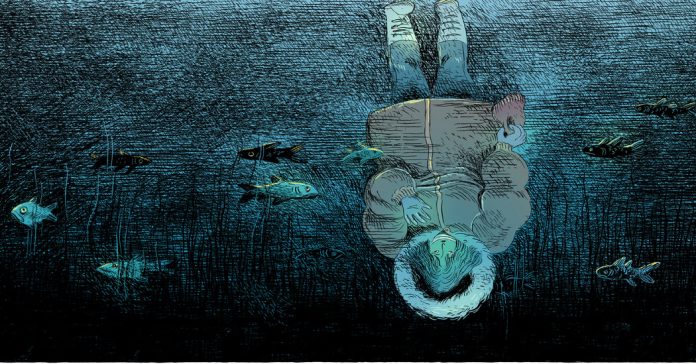
What story does this image inspire for you?

Use your imagination to write the opening of a short story or poem based on what you see. Or, tell us about a memory from your own life that this picture makes you think of.

Post it in the comments, then read the related article to find out the real story behind this image.


Find many more ways to use our Picture Prompt feature in this lesson plan. You can find all our Picture Prompts in this column.

Writing Comparative Essays: Making Connections to Illuminate Ideas

0
Writing Comparative Essays: Making Connections to Illuminate Ideas

Notice how this student focuses. Instead of starting with a broad thesis like “We can see many parallels between the themes of ‘The Odyssey’ and our world today,” he looks only at how the Greek concept of xenia echoes today — and does so by examining just one article about Uganda. Below are the first two paragraphs, but we suggest you read the entire essay, paying close attention to how he describes both texts solely through this lens.

Try this: Once you choose a manageable focus, make sure all your details and examples support it.

Example: Alex Iyer, Geneva School of Boerne, San Antonio: Homer’s “The Odyssey” and “As Rich Nations Close the Door on Refugees, Uganda Welcomes Them”

In literature, we learned that in Homer’s epic poem “The Odyssey,” Homer uses the tribulations of the hero Odysseus to illustrate the Ancient Grecian custom of xenia. This custom focused on extending hospitality to those who found themselves far from home. As Odysseus navigates the treacherous path back to his own home, he encounters both morally upstanding and malevolent individuals. They range from a charitable princess who offers food and clothing, to an evil Cyclops who attempts to murder the hero and his fellow men. In class, we agreed that Homer employs these contrasting characters to exemplify not only proper, but also poor forms of xenia.

For the people of its time, “The Odyssey” cemented the idea that xenia was fundamental for good character, resulting in hospitality becoming ingrained in the fabric of Ancient Grecian society. I saw a parallel to this in a New York Times article called “As Rich Nations Close the Door on Refugees, Uganda Welcomes Them” published on October 28, 2018. Similar to the prevalent custom of xenia in Ancient Greece, Uganda has made hosting refugees a national policy. The country is now occupied by up to 1.25 million refugees, many of whom are fleeing the violent unrest of South Sudan.

We know it’s tempting to resort to a generic statement like, “In this essay I will compare and contrast _________ and _________ to show that …”

Not only is that deadly dull, but if you are participating in our contest, you also don’t want to waste any of your 450 words on a sentence that doesn’t say much.

Consider, instead, four more powerful ways to introduce the two things you’ll be connecting, and show right away how they work together.

Try this: Pose a question or questions that both texts are asking.

Example: Connor Stevens, Sunset High School, Portland, Ore.: Comparing “Fahrenheit 451” by Ray Bradbury and “How Egypt Crowdsources Censorship” (Read the full student essay.)

How can you control ideas? In today’s world, you scroll through feeds, finding any information available: government trade deals, local restaurants, movies, and TV shows. We are in an age where the power to find any fact, answer or piece of information that floats into question is available anywhere. If this privilege was stripped by a bodying government, how would freedom of information change?

Try this: Make a statement that is true for both, and then explain why briefly.

Example: Jack Magner, Flint Hill School, Oakton, Va.: Comparing biological feedback loops and homeostasis with “After #MeToo, the Ripple Effect” (Read the full student essay.)

All it takes is a single action to spark innumerable reactions. In the case of Jessica Bennett’s “After #MeToo, the Ripple Effect,” it is the publishing of a 2017 article in the Times that launches a revolution, changing the treatment and recognition of women for the better. In the case of AP Biology, it is the connection of a ligand to a receptor protein or a drastic change to an organism’s environment that sends millions of signals that protect the organism from harm.

Try this: Explain how or why you’ll look at a classic work through a new lens.

Example: Zaria Roller, Verona Area High School, Wis.: Comparing “Things Fall Apart” by Chinua Achebe and “The Boys Are Not All Right” (Read the full student essay.)

Colonial-age Nigeria and modern day Western society have more in common than one would think. Although the buzz phrase “toxic masculinity” did not exist at the time Chinua Achebe’s “Things Fall Apart” was written, its protagonist, Okonkwo, might as well be the poster boy for it.

Try this: Trace your thinking about how you came to connect the two things. Please note: For this contest, use of the word “I” is not only permitted but also encouraged if it helps you explore your ideas.

Educator spotlight: Using online learning to improve mental health

0
Educator spotlight: Using online learning to improve mental health

Deakin is one of Australia’s largest universities, rapidly rising in the international rankings and currently featuring in the top 2% of the world’s universities. A quarter of their students study predominantly online and they offer 9 degrees, 1 program and 41 short courses on the FutureLearn platform. They recently launched a new 3-week course on Food and Mood: Improving Mental Health Through Diet and Nutrition. One of the course educators, Tetyana Rocks, answered our questions on how she found the process of creating a course on FutureLearn and why she feels it’s important to spread the word about the impact our daily diet has on our mental health:

“Creating and developing Food and Mood: Improving Mental Health Through Diet and Nutrition has been one of the most enjoyable and challenging experiences of my career as an educator. Right from the earliest stages, this course provided endless opportunities for me to learn and grow myself while crafting an engaging and informative social learning experience. The main challenge has been to design inclusive and accessible opportunities that are interesting and useful for a broad global audience on FutureLearn. I tried to develop a knowledge springboard for learners to recognise and identify the latest evidence, and to deliver a scaffold for them to carry out sustainable changes to an essential human behaviour – eating. I also endeavoured to create a culturally appropriate as well as open content that encourages learners to reflect on potentially sensitive content around mental health with hope and positivity. Our vision at the Food & Mood Centre is a world in which nutrition is recognised as fundamental to mental and brain health. FutureLearn provided us with an essential platform to translate the current evidence on the topic, disseminating our research and knowledge to reach a global audience, and I look forward to more learnings from facilitating the course over the coming weeks.”

Category Research insights