fbpx
Home Blog Page 1556

Try This: 16 Real-World Models for DIY Writing Projects

0
Try This: 16 Real-World Models for DIY Writing Projects

If teachers need a model for inexpensive, authentic and game-changing writing instruction, they should look no further than the big box Swedish household goods and furniture company Ikea.

Ingvar Kamprad, the company’s founder, created a brilliant formula: Take your average homeowners, invite them into a vast and winding labyrinth of well-designed and appointed model rooms, then make recreating those rooms simple, affordable and satisfying.

Even the most design-challenged seeker of the latest in home fashion comes away from the experience a little more Kelly Wearstler and a little less Edith Bunker.

Kamprad’s genius? He understood not only the power of mentors but also the ways in which humans instinctively and intuitively seek them out. His billion-dollar corporation, then, is a mentor for décor.

In fact, there are few aspects of our lives in which we don’t naturally seek out mentors. Fashion magazines help us choose the five “must-have” seasonal wardrobe pieces and teach us how to mix and match them; delicious restaurant meals turn us into weekend-warrior cooks seeking to make that perfect soufflé (and chefs cash in on this penchant when they publish “Sunday Suppers at Lucques” or “Chez Panisse Café Cookbook”); home and garden stores line their aisles with enviable planter boxes exploding with thrillers, fillers and spillers — shade or sun, you decide.

The formula is the same every time: Provide a well-crafted mentor, give people the time and opportunity to observe and study, then offer up the tools and materials for DIY.

And that’s exactly what mentor texts drawn from real-world sources can provide our students. I only wish I’d figured that out sooner.

I spent years, probably the first 20 of my 27 in the classroom, dutifully ticking the boxes of my school district’s writing scope-and-sequence.

Informational-writing assignments were research papers on topics ancillary to the novel I was teaching. Personal writing was the college essay. Argument writing was a researched piece following the classical model. And let’s not forget the grand crus of ELA — the literary analysis. This writing assignment, the English teacher’s gold standard, concluded nearly every literature unit I taught, serving as the capstone writing and reading experience.

I do not think I was alone.

In districts that heard the writing-across-the-curriculum call and answered earnestly, as ours has tried, students might be treated additionally to writing letters to a congressperson in social studies, cutting and pasting together an STD brochure in health, or doing a research report on Marie Curie in science.

But students rarely experience being allowed to write with voice, choice and authenticity in school because we rarely ask them to compose that way.

My motivation to rethink how I interpreted our scope-and-sequence came when I realized my students were bored with what they were writing and so was I. But at the same time, our reading choices were more vital and varied than ever before. From new sources of global fiction to experimental, cross-genre forms of nonfiction to the explosion of online publishing venues — whether casual daily personal blogs or erudite poetry journals — I realized there was a lot more out there than we were taking advantage of.

My classroom of writers was looking tired and worn. I knew I had to offer them more.

I have come to understand that when we ignore the fruitful bounty of mentor texts we not only rob our students of their natural human instinct to seek out texts that matter to them, but we also disassociate their writing experiences from the one of the chief reasons writers write — to communicate with others in the real world.

The writing scope-and-sequence in my classroom, then, transformed from a traditional curriculum map into a mentor map, and the source I’ve turned to most often has been The Times. With its well-crafted articles on high-interest, timely and wide-ranging topics and genres, it is a regular source of inspiration.

My colleagues Jennifer Tannous, William Melvin and I have used The Times to create writing experiences in our 10th grade, 11th grade and AP English classrooms that allow students to practice and master the required writing skills — but now via texts that are much more diverse, authentic and exciting.

Here are 16 examples, but by the time you read this we may have experimented with many more.

  • “Letter of Recommendation” in The Times Magazine
    Letter of Recommendation celebrates “the overlooked and the unappreciated.” Students write their own after reading models on everything from dog tricks to washing dishes, stuffed animals and Old English.

  • “What _______ Can’t Travel Without” from the Travel section
    Students can use this column, about what well-known people like Janelle Monáe, Bill Nye, RuPaul and Megan Rapinoe take with them while traveling, to write their own; interview another student and write about his or her travel needs; or even write one for a character in a novel they are reading.

  • The “Sunday Routine” column in the Metropolitan section
    Students write about their own “Sunday routine,” using examples like “How 50 Cent, Rapper and Actor, Spends His Sundays.” (Note: For an example of how another teacher uses this column, check out this Learning Network Reader Idea.)

  • “Modern Love” from the Times Style section
    Students write their own “Modern Love” piece by telling the story of an important relationship, romantic or otherwise, in their own lives. They can also learn from the “Tiny Love Stories” feature, which is “Modern Love in miniature, featuring reader-submitted stories of no more than 100 words.”

While the list above represents writing experiences students have had in my classroom and in some of my colleagues’ classrooms in the English department at Central Bucks High School South, the possibilities for mentor texts from The Times, as well as from other real-world sources, are limitless.

For example, another of my colleagues, Ken Bui, spent some time this semester with his AP Language and Composition students studying the Trader Joe’s weekly circular Fearless Flyer for interesting syntax patterns and other inventive uses of words and language to create a desired tone and voice. (See? Shopping can be a professional development tool.)

In fact, once students begin digging into real-world mentor texts, they start to see that the writing categories they learn in school are artificial and limited. For example, the infographic-writing experience I’ve slotted into the opinion section above could just as easily be in the informative category, depending on the particular skill or skills the teacher is hoping to foreground. Likewise, the review assignment could certainly fulfill skills in the opinion category depending on what the teacher would like to emphasize.

But regardless of the mentor text or the targeted skills, the methodology stays the same. Students study a mentor carefully, taking it apart to see how it works. They identify, examine and discuss numerous examples from the text, noting everything from organization and structure to content elements specific to the genre, to stylistic and rhetorical tools aligned with the voice and tone, to myriad other writerly features that link with the desired scope-and-sequence skills.

To do this, students might annotate texts, imitate smaller sections of texts over a series of days, or analyze specific writing skills — such as studying a particular type of punctuation mark or looking at purpose statements — using the mentor texts as samples. Then, students get to work, making choices about what their own texts will include and what featured elements from the mentors they want to imitate.

Sound familiar?

You bet. We’re back at Ikea.

Imagine the writing-class version of your students spread out in their living rooms, parts scattered in an organized way around them, photos and instructions taped to a nearby wall, wrench in hand.

Soon, you will have thrown away the 30 literary analysis papers on “The House of Mirth” and will have entered a house where each room brings a new and different surprise — and lots of stylish comfort.

Weekly News Quiz for Students: School Shooting, E.P.A., Taylor Swift

0
Weekly News Quiz for Students: School Shooting, E.P.A., Taylor Swift

Above is an image related to one of the news stories we followed over the past week. Do you know what it shows? At the bottom of this quiz, you’ll find the answer.

Have you been paying attention to the news recently? See how many of these 10 questions you can get right.

Lesson of the Day: ‘For 16 Transgender Hockey Players, a Groundbreaking Weekend’

0
Lesson of the Day: ‘For 16 Transgender Hockey Players, a Groundbreaking Weekend’

Find all our Lessons of the Day here.

Featured Article: “For 16 Transgender Hockey Players, a Groundbreaking Weekend”

Team Trans, believed to be the only entirely transgender sports squad in the United States, recently played together for the first time. In this lesson, students learn about what it was like for the hockey team to play together for a weekend this month. They also learn about challenges many trans athletes face in playing team sports.

You are about to read an article about what is believed to be the only entirely transgender sports squad in the United States. Why do you think the experience of being part of this team might be such a big deal for those involved?

Read the article, then answer the following questions:

1. Brynn Toohey played hockey from the time she could walk. Describe her story of how she came to play forward for Team Trans.

2. How did the idea for Team Trans come about?

3. What are some of the challenges that Team Trans players had encountered playing hockey on other teams in the past?

4. The article describes how the home team, Boston Pride, held a pregame meeting during which they reviewed a few dos and don’ts for interacting with Team Trans. The meeting was led by Jack Henderson, one of three Team Trans members who also play for Boston Pride. Why do you think this review was important?

5. Who are Harrison Browne and Jessica Platt? How did their being on the team affect their teammates?

The author, Danielle Allentuck, ended the article with this anecdote:

Sitting a few rows behind the bench was a transgender boy from the Boston area who plays youth hockey. His mother asked not to identify either of them by name, because children at his school pick on him.

As the team walked off the ice, she and her son were waiting by the exit. One of the players handed the boy a signed puck and promised to send a jersey in the mail. They said they looked forward to the day when he would join them on Team Trans.

Why do you think the author decided to end the article this way?

How Much Do You Know About Germany?

0
How Much Do You Know About Germany?

Can you find Germany on a map? What else do you know about this European nation with about 83 million people?

4 health careers in hot demand

0
4 health careers in hot demand

With expenditure on health projected to double in the next 40 years, it’s no wonder health has become one of the fastest growing industries. But which careers are in highest demand? Keep reading to find out. 

1. Aged care worker

Topping every list in the country, communities are crying out for aged care workers. If you want job security, this is it. The Australian population is getting older. And as a result, the demand for aged care workers shows no sign of slowing down.  

Not only are job opportunities abundant, but there are a range of jobs in the field. You could consider hands-on nursing support in an aged care facility, or working with private organisations visiting elderly members of the community. 

With a number of higher education courses in dementia studies launching in Australia, there’s never been a better time to start a career in this field. 

Elderly woman smiling at camera.

2. Registered nurse

While many registered nurses work in hospitals, job opportunities for those in this field extend beyond the walls of wards. These days, nurses are in need in medical clinics, care facilities, correctional facilities, schools, within the military and even in patients’ homes. 

If there’s one area of healthcare you’re more interested in than others, nursing allows a range of specialities. Through Open Universities Australia (OUA), registered nurses can specialise by studying with leading Australian universities online. Why not take a look at the Graduate Certificate in Emergency Nursing with Griffith University, the Master of Clinical Nursing with Australian Catholic University, or the Master of Mental Health Nursing with Southern Cross University? All of these courses are available to study through OUA.

3. Social worker

As the unsung heroes of the healthcare system, social workers are facing a desperate shortage of trained professionals. In fact, most states of Australia are seeing an increasing demand. 

Social workers help individuals in times of crisis. They advocate for people who are experiencing social disadvantage by linking them to critical health services. 

Working with people of all ages and from all walks of life, social workers can specialise in treating children and adolescents, working in clinical settings or in family dispute resolution. 

If you consider yourself a good communicator who can listen and resolve conflict, you’d be well suited to this field. And considering the shortage, it’s an ideal time to explore your options in the profession through OUA. You could look into the Diploma in Community Welfare and Wellbeing with the University of New England or the Master in Social Work with Griffith University.

4. Dental hygienist or hygiene assistant

An ageing population goes beyond the mobility of people – teeth are affected too. With so many Australians reaching old age, we need dental hygienists and assistants to take care of senior smiles. 

Elderly patients aside, the boom in dental and orthodontic treatments has added pressure to the industry – with predictions that these roles will become some of the fastest growing in healthcare. 

Think of a dental hygienist, and you may conjure up an image of the person who passes you a plastic cup to spit in. But the truth is, hygienists do so much more.

Hygienists help dentists treat patients, assist with teeth cleaning, fluoride treatments, scaling and removing stains. What’s more, they play a key role in educating patients on good dental hygiene and preventative care.

Dentist and assistant cleaning man's teeth.

Considering launching, or shifting your career to align with the health boom? Wise move. Through OUA, you can study health online with leading Australian universities. 

Browse and compare a range of health courses right now. Need help deciding on the right one for you? Fill out the form on this page, and a friendly student advisor will get in contact. You can also reach them on Messenger, Facebook Messenger, WhatsApp or SMS. They’re here to help with your future health career.

From the Kitchen to the Help Desk: Arthur’s Story

0
From the Kitchen to the Help Desk: Arthur’s Story

My name is Arthur and I’m from the state of Massachusetts. I completed the Google IT Support Professional Certificate, and today I work in IT as a level 1 Systems Engineer. I spent the last 12 years in restaurant management and did not have any professional IT experience before I was offered my new job. 

I’ve been interested in IT for about 20 years. I was always the person people called to fix hardware, software, and networking issues, but I wasn’t able to get a job doing these things because I had no professional experience. In the fall of 2018, I heard radio commercials for the Google program while I was at work. I was intrigued, so I signed up and by December I had finished the whole program. I enjoyed working on the labs and logging into virtual machines to do the coursework. The instructors were thorough, and I felt like I was set up for success. 

I decided to switch from restaurant management to a career in IT for several reasons. My wife and I were expecting our first child while I was taking the classes, so I decided to move into a career that I was passionate about. I was an excellent restaurant manager, but I excelled at it without any passion. It was just a job. I was on call around the clock, and I could never take time for myself at home. I wanted to be able to provide a better life for my family while giving myself a better life, too. I thought if I could be great at something I don’t care about, imagine how I might do at something that truly interests me!

I began talking to an IT recruiter and ended up landing the first job I interviewed for! 

When I started to apply for jobs, I listed the Google IT Support Professional Certificate on my resume. The recruiter I was working with helped me fine tune it to emphasize the most important skills I learned. I highly recommend someone changing fields to work with a recruiter.

I enjoy my new job because I get to help people with their technical issues. I can now leave work at the office and enjoy time with my son!

When I worked for the restaurant, I had to work during the holidays. Today, I don’t have to miss spending time with my family anymore. 


Do You Seek Out New Experiences? Or Stick With the Things You Know and Love?

0
Do You Seek Out New Experiences? Or Stick With the Things You Know and Love?

Find all our Student Opinion questions here.

Imagine it’s a Saturday night and you’re picking out a movie to watch. Do you choose one that you’ve never seen before? Or do you turn on one of your tried-and-true favorites?

In general, when given the chance, do you like to try new music, foods, movies, video games, places and other experiences? Or do you tend to stick with the things you know and love?

In “The Unexpected Joy of Repeat Experiences,” Leah Fessler writes about why novelty might be overrated:

Scrolling through Instagram can quickly convince you that everyone’s life is more interesting than yours. During a particularly adventurous week on Instagram Stories recently, I saw water skiing in Maui, hiking in Yosemite and swimming with wild pigs in Bermuda. Wild pigs!

Impulsively, I started Googling flights to new places. Then I ordered pho from the same Vietnamese place I eat at every week and … felt bad about not trying somewhere new.

This fear of missing out is rooted in a common psychological tic: Evolutionarily, we’re disposed to find novel experiences more exciting and attention-grabbing than repeat experiences, according to research published in the Journal of Experimental Biology. It’s basically fight or flight psychology — our brains can’t process all the stimuli around us, so we evolved to pay attention to new, flashy and potentially dangerous things more intently than familiar things, which we’ve seen enough to know they’re not dangerous. What’s more, words like “repetition” and “repetitiveness” — unlike “novelty” — tend to be associated with more negative emotions, said Michael Norton, a professor at Harvard Business School.

“Classic research shows that when we think about upcoming experiences, we think about variety,” said Mr. Norton, who specializes in consumer behavior. “If I ask you right now to select a yogurt for each day next week, you’ll pick your favorite flavor — say, blueberry — a few times, but you’ll mix in some strawberry and peach. Because who wants to eat that much blueberry yogurt? Over the longer term, though, as the original experience fades in time and memory, repetition can become more pleasurable.”

He added: “We’re simply more boring than we’d like to admit.”

The article continues:

Some previous research has painted a negative picture of repeat experiences, citing that doing the same thing twice can feel inherently less valuable. But Ed O’Brien, a professor of behavioral science at the University of Chicago Booth School of Business, wondered whether behavioral science misconstrued hedonic adaptation, and people actually underestimate how positively they react to repeat experiences. Many of us happily listen to our favorite song on repeat, he noted, or rewatch favorite movies and TV shows. This repetition was the whole point of purchasing music or film before the age of Spotify and Netflix. This conflict is why Mr. O’Brien launched a series of studies on the topic.

“There’s a general belief that if you want to seem like an interesting, cultured person, the best thing you can do is to showcase that you’re open to new experiences,” he said. “That may be true, but I think we take for granted the other value of really digging deep into one domain.”

To test this hypothesis, Mr. O’Brien and his team exposed all participants to the same stimulus once in full (various stimuli were tested, including museum visits, movies and video games). Next, some participants were asked to imagine repeating the experience, while others actually did repeat the experience.

Counter to previous research, Mr. O’Brien found that across the board, repeat experiences were far more enjoyable than participants predicted.

“Doing something once may engender an inflated sense that one has now seen ‘it,’ leaving people naïve to the missed nuances remaining to enjoy,” he wrote in the study.

In other words: You’re far more likely to enjoy something the second time around than you think.

Students, read the entire article, then tell us:

  • Do you tend to seek out novel experiences — like reading new books, trying new foods or listening to new music? Or do you prefer to stick with the things you know and love? Why?

  • If you like repeat experiences, what is one thing — whether it’s a song, movie, food, place or anything else — that you have experienced over and over again? What have you gotten out of repeating this experience?

  • If you like new experiences, has this article convinced you that repeat experiences could be enjoyable? If so, what is one experience that you would like to have again and why?

  • Which do you think is more valuable: trying something new, or digging deep into one experience by doing it over and over again? Why?


Students 13 and older are invited to comment. All comments are moderated by the Learning Network staff, but please keep in mind that once your comment is accepted, it will be made public.

Lesson of the Day: ‘Fed Up With Deaths, Native Americans Want to Run Their Own Health Care’

0
Lesson of the Day: ‘Fed Up With Deaths, Native Americans Want to Run Their Own Health Care’

Find all our Lessons of the Day here.

Featured Article: “Fed Up With Deaths, Native Americans Want to Run Their Own Health Care”

The Indian Health Service, which provides government medical care to 2.2 million American Indians and Alaska Natives, is widely judged to provide substandard care. Some tribes have tried models of self-determination and are creating and controlling their own hospitals.

In this lesson, students will learn about the history of the Indian Health Service and the many problems it faces. Then they will further investigate an alternative model of care in Alaska based on self-determination.

Look at the statistics below, detailing life expectancy in the United States by race and ethnicity. What do you notice? What do you wonder? What story do you think these statistics tell?

57 years — Native Americans in South Dakota
75.4 — African-Americans
76.9 — Native Americans
78.9 — Whites
83.3 — Latinos
87.1 — Asian-Americans

Sources: Geography of Opportunities Report (PDF) and The New York Times

Read the article, then answer the following questions:

1. What happened in 2016 when 6-month-old James Ladeaux’s mother took him to Sioux San Indian Health Service Hospital? What does this experience reveal about the issues that patients have faced at Indian Health Service hospitals nationwide?

2. Who took over Sioux San hospital’s operations over the summer? What are some of the positive outcomes of this change? What are some of the difficulties that have arisen?

3. The article cites several studies that relate to Native American health care and the Indian Health Service: vacancies of medical positions, death rates for preventable diseases, health care spending per patient and life expectancy. Which of the findings from these four studies did you find the most striking or interesting? Why?

4. What are the origins of the Sioux San hospital? What purpose was it built for and how did that change over time? How have longtime patients reacted to recent attention to the conditions within the hospital?

5. What has happened to tribal members who have sought health care services outside of the Indian Health Service? What did Dr. Brook Eide, an emergency room doctor, say about his experience treating patients who went outside of I.H.S. for health care?

6. Representative Tom Cole, Republican of Oklahoma and a member of the Chickasaw Nation, said, “My personal feeling is that if you are a tribe it is better to run your own health care system.” In the article, what are some examples of tribes running their own health care systems?

7. Charmaine White Face, a member of the Oglala Sioux Tribe, is not certain that the change in management is a good idea. What are some of her concerns?

Watch this seven-minute promotional video from the Alaska Native Tribal Health Consortium that shows the history of its health care system and how its programs try to respond to community needs.

Do any of the services offered through the Alaska Native Tribal Health Consortium feel as though they respond to needs or concerns that were raised in the article? In the video, the consortium gives specific reasons it offers certain food, preventive care and education services. What values seem to be important to its health care system?

Did you notice anything in the video that you think might be relevant to other tribal communities considering whether to create their own approach to health care services?

What opportunities and challenges do tribes face when considering whether to take over their own health care systems?

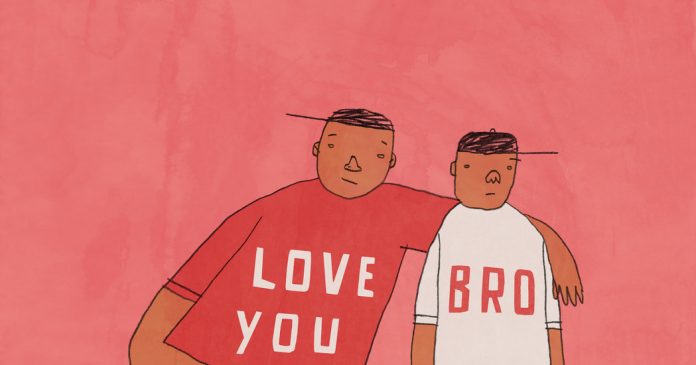
Love You, Bro

0
Love You, Bro

What do you think this image is saying? How does it relate to or comment on society or the world today? Can you relate to it personally? What is your opinion of its message?

Tell us in the comments, then read the related essay to learn the story behind this illustration.


Find many more ways to use our Picture Prompt feature in this lesson plan. You can find all our Picture Prompts in this column.

Word + Quiz: hanker

0
Word + Quiz: hanker

: desire strongly or persistently

_________

The word hanker has appeared in five articles on NYTimes.com in the past year, including on Feb. 1 in “A Canadian Preacher Who Doesn’t Believe in God” by Catherine Porter:

The thrice-married reverend has also driven a deep rift into a progressive church considered as Canadian as maple syrup. In 2015, a public letter she wrote sparked so much ire, the local jurisdiction of the church launched a review committee to examine her beliefs.

… For years, Ms. Vosper seemed to hanker for a “heresy trial” in her op-eds, public statements and books. But the church, which has made “inclusivity” a core principle, would not be goaded, even after Ms. Vosper publicly announced she was an atheist in 2013.

_________