While errors can be beneficial for learning, true guesses are not terribly useful. As the confidence in an error increases, learning from the error also increases (called the hypercorrection effect). There is quite a bit of research to support the idea that participants have heightened attention or perhaps surprise when they believe an answer is correct and are told that they are wrong. That research includes behavioral laboratory research in addition to neuroscience research that shows activity in an area of the brain that is used when we have heightened attention.
There are a few exceptions to the hypercorrection effect. Individuals with amnesia obviously have a difficult time learning and have been shown to be able to learn some without errors instead. Older adults learn from errors, but they learn about equally from errors with low and high confidence. They seem to have the same amount of attention to errors made with different levels of confidence.
One possible explanation for why we learn from errors has to do with what cognitive psychologists call “reconsolidation”. Each time we bring something to mind, we create a new memory trace, allowing us to change the memory. So, when we retrieve an incorrect piece of information and are corrected, we are able to lay down a new trace to incorporate the new information.
Having the title of “low income” for the majority of my childhood altered almost everything, allowance being one of them. In school I would often hear about it, kids always bragged about how much they got, or how much they made for doing certain chores. It quickly became something I fantasized considering the fact that I never got paid to do things like dishes or take out the trash.
I really disliked the fact that I was far less privileged than others, but as I grew older I started to fully understand and appreciate the setting I was put into. The lack of allowance essentially taught me about money, but also how to manage it. It pushed me start generating income on my own, and manage it to the point that I’d never feel less privileged.
I don’t think that kids should be given an allowance unless they do chores to earn it. Just as praising your children too much can lead to issues later in life, praising children too much monetarily can lead to problems when the child gets older. By giving kids money without them having to do anything to earn it, you’re telling them things are going to be handed to them, which will foster an attitude of laziness and a feeling of being entitled.
Having known people who do get an allowance, they almost always use it all before the weekends, on food, outings, and other unnecessary things. It also raises a sense of entitlement, and the belief that they deserve monetary compensation for every deed they enact. I was raised being taught what I was responsible for, and had to do on my own without the thought of how much I was to be paid for it, and that has made it easier for me to complete tasks that help me and others without raising a question.
I don’t think kids should receive an allowance. I believe that rather than teaching them a lesson on the value of money, it encourages entitlement. In my opinion, the concept of allowance is parallel to the concept of “handouts”. Even if the allowance is given for chores or for a specific task, children need to understand that they have responsibilities that need to be completed whether or not there is a money incentive.
How children can learn the value of money — with or without an allowance
My parents at a very young age taught me the value of money and that it should never be tossed around. They have always said, and they have stood by this, I should work for what I want. They don’t, however, make me pay for everything but the majority of the things I want, I have to provide my own money. This has helped me become more independent and appreciate the things that I buy.
My mother is the breadwinner in the household. So we heavily budget our money every week. I get an allowance every 2-3 weeks depending on our financial situation. I would usually receive a $20 allowance, which is $10 less than the weekly average.
5. After you have posted, try reading back to see what others have said, then respond to someone else by posting another comment. Use the “Reply” button or the @ symbol to address that student directly.
Elmo and Abby Cadabby came to the New York Times studio recently to talk about the alphabet song. It’s a tune that, in its 50 years on the air, “Sesame Street” has covered a lot — with Muppets and celebrities, in dance numbers and ear-wormy songs, like Usher’s “ABCs of Moving You,” which has nearly 115 million YouTube views.
Music has been a part of the “Sesame Street” DNA since the show was developed in the late ’60s, and its legacy with artists is remarkable: It counts Stevie Wonder, Katy Perry, Nina Simone and Romeo Santos among its alums, and continues inspiring audiences and musicians, of many ages, today.
As curriculum-driven programming, the show also has a mission, to teach children and get them ready for school. Singing the traditional alphabet song wasn’t enough. To really promote reading readiness, said Rosemarie Truglio, vice president of education and curriculum at Sesame Workshop, kids need to focus on individual letters: “So that’s why we created the ‘letter of the day.’”
Now “Sesame Street” has a library’s worth of pop song parodies about the alphabet, with A and C songs (as in “C is for Cookie”) among the most popular. And they’ve done dozens of original versions of the whole ABCs too. But just how do you reinvent a tune that’s as elemental as language? And how do you do it, over and over again, for a half-century?
• Read our list of practical teaching ideas, along with responses from students and teachers, for how you can use these documentaries in the classroom.
• Want to make sure you never miss a film? Add Film Club to your Google calendarto receive weekly reminders and see our full publishing schedule for the 2019-20 school year.
This graph originally appeared elsewhere on NYTimes.com. Dallas Animal Services operates a city shelter and has an “open admissions” policy, which means the agency is required to take in any animal, regardless of its health or behavior. Animals that are “adopted” are adopted directly from the shelter. “Transferred to rescue” means the animal has been transferred to an independent rescue agency.
By Friday morning, October 24, we will provide the “Reveal” — the graph’s free online link, additional background and questions, shout outs highlighting student comments and headlines, and Stat Nuggets.
After looking closely at the graph above (or at this full-size image), think about these three questions:
What do you notice? If you make a claim, tell us what you noticed that supports your claim.
What do you wonder? What are you curious about that comes from what you notice in the graph?
The questions are intended to build on one another, so try to answer them in order. Start with “I notice,” then “I wonder,” and end with a catchy headline.
For comparison purposes. here are graphs representing shelter outcomes for 21 other cities.
2. Next, join the conversation by clicking on the comment button and posting in the box that opens on the right. (Students 13 and older are invited to comment online. Teachers of younger students are welcome to post what their students’ comments.)
3. After you have posted, read what others have said, then respond to someone else by posting a comment. Use the “Reply” button or the @ symbol to address that student directly.
On Wednesday, Oct. 23, our collaborator, the American Statistical Association, will facilitate this discussion from 9 a.m. to 2 p.m. Eastern time to help students’ understanding go deeper. You might use their responses as models for your own.
4. By Friday morning, we will reveal more information about the graph at the bottom of this post. Students, we encourage you to post an additional comment after reading the reveal. How does the original article and the moderators’ comments help you see the graph differently? Try to incorporate the statistical terms defined in the Stat Nuggets in your response.
In early to work a daytime dress rehearsal last month, Tshombe Selby walked briskly down a backstage hallway to the staff cafeteria for a quick bite. A North Carolina native, the 34-year-old has been an usher for five years, and on this day he had already turned on the charm. He navigated nimbly past other distinct tribes of opera staff — stagehands in their rugged work clothes, chorus members in period costume, square-jawed security guards — with smiles for all.
When he speaks, he tilts his head back and looks down regally, his huge frame stuffed snugly into his tuxedo. Though his voice is mellifluous and his movements gentle, it’s no surprise he has worked as a bouncer. “My aunt has a saying,” he said with a grin. “Don’t let the smooth taste fool you.”
TikTok is an app that many teenagers are already likely familiar with — adults, less so. In this feature, five critics of The New York Times with different specialties and varying familiarity with the app go down the TikTok rabbit hole and share what they found.
This lesson uses critical media literacy as a framework for examining TikTok. Students consider who created the app, how it gets their attention and how a user’s point of view influences his or her interpretation of it.
Warm Up
Do you use TikTok? What are your favorite videos? Do you ever post your own? What do you love — or hate — about the app?
Take a few minutes to scroll through the videos in the featured article and think critically about what you see. (Note: You can click on the users’ screen names to view the videos with sound.)
Then, discuss the following questions:
What do you think the purpose of TikTok is? To inform, persuade, entertain or a combination of the three? How do you know?
What techniques does the app use to engage users?
Who do you think the target audience is? Why do you think this?
What do you think about TikTok? Why?
Questions for Writing and Discussion
Read the article, then answer the following questions. (Note to teachers: If you’re doing this in a classroom context, you might jigsaw this article, assigning individuals or small groups to read each of the five essays and answer the corresponding questions.)
1. Where did TikTok come from? Why do the writers describe it as a “cultural force”?
2. James Poniewozik, a TV critic, sees TikTok as a form of entertainment. How does he feel when he’s on the app and why?
3. Amanda Hess, a critic-at-large who writes about internet culture for The Times, compares TikTok to other social networks, like Facebook, Twitter and Instagram. In what ways does she see TikTok as similar to and different from these social media sites?
4. Jon Caramanica, pop music critic, analyzes the music in TikTok videos. What role does he see music playing on the platform and why?
5. Gia Kourlas, a dance critic, looks at TikTok users’ dance moves. According to her, what makes dancing videos on the platform so magnetic?
6. Finally, Wesley Morris, a critic-at-large, is more critical of the app. What about TikTok does he find unsatisfying or irritating and why?
7. Which essay resonates with you and your experiences on the app the most? Which one resonates the least? Why?
Going Further
Imagine The Times wants to add one more essay to this collection — this one from a teenager’s perspective — and you have been asked to write it.
Compose your own short piece with your take on TikTok. Like the essays above you have read, you might choose to do one or more of the following:
Choose one of your favorite TikTok videos (or create your own) and break it down. What happens in it? What makes it special, interesting or otherwise culturally significant? What does it demonstrate about the platform as a whole?
Dive deep into one aspect of TikTok — the music, the dance challenges, the theatricality, the memes. Do you find this element entertaining or obnoxious? Why?
Compare TikTok to other forms of social media. What makes it unique? Do you find it more entertaining than television, movies or other video platforms? Why or why not?
Give an honest review. What do you think of TikTok? How does your point of view as a teenager influence your interpretation of it?
Explain what you think TikTok as a whole says about our society, culture or the world today. Why do you think the app has become such a “cultural force”?
There’s no doubt about it. Accounting is the language of business. Study a Bachelor of Accounting with University of South Australia through Open Universities Australia (OUA), and you’ll develop business acumen you can take anywhere in your career.
“When you study accounting, you’ll learn basic business functions, day-to-day transactions, understanding statements and the bottom line,” says Heather Prider, coordinator for ACG11 Accounting for Business with University of South Australia.
If you think this sounds like a career that will confine you to corporate cubicles, think again.
Heather’s career in accounting took her all the way to Russia. There, she worked on fraud, and in film production – proving that accountants can take their skills to exciting and unexpected places.
Every business needs accounting information and know-how. And it isn’t about numbers.
Half of what any accountant will do involves written and verbal communication – interpreting what’s going right and wrong, and explaining exactly what the numbers mean to their business.
More than numbers
Choose to study the Bachelor of Accounting, and you’ll get under the hood of decision-making in business.
Learn about debits, credits, journal entries, and ledger – all the basic elements that build basic statements.
You’ll also come to understand what’s involved in analysing statements (from income statements, to balance sheets and cash flow statements). What’s more, you’ll develop the skills to examine what the information in front of you shows, and how you can use it to make better financial decisions.
Then there’s management accounting. That’s how to manage a budget, plan ahead, audit, work through insurance, taxation, consulting, insolvency, recovery and more.
You’ll also cover subjects in economics, law and marketing. These will give you a big picture understanding of business and how accounting can support all of these functions.
A career that spans industries
Accounting opens doors in many businesses or industries. Nail numbers, and you could run the financial side of film production companies, law firms, not-for-profit organisations and more. Put simply, accounting lets you use your skills in an environment that speaks to you.
When it comes to the roles you could find yourself in, they’re just as varied. You could start out in Accounts Payable, work your way up to Chief Financial Officer, and even progress to CEO.
Make it happen through OUA
Through OUA you can study the Bachelor of Accounting online, at your own pace, from wherever you are. What’s more, you’ll graduate with exactly the same degree as on-campus students.
To learn more about how to study through OUA – fill out the form on this page, and a friendly student advisor will get in contact.
Having a way for your readers to contact you is extremely important. Your blog should have an easy-to-find contact page that implements a contact form. You can learn how to add a contact page to your blog using this tutorial (Blogger) or this tutorial (WordPress). Then follow the tutorial below to get a contact form added to your contact page.
There are countless ways to add a contact form to your site, but today I’m going to share with you a method that works well on both Blogger and WordPress blogs. Blogger does have a new Contact Form gadget which allows you to easily add a contact box to the sidebar of your blog. Unfortunately, the contact form gadget does not allow the form to be added to a page, which is the ideal location for a contact form. In WordPress, there are a variety of great plugins like Contact Form 7 or Fast Secure Contact Form which are easy to install and use–however, they require the use of a plugin and having too many plugins installed to your site can slow it down.
Today’s tutorial will show you how to add a contact form to your WordPress or Blogger blog without the use of a plugin or gadget by using a service called Wufoo. Wufoo is a fabulous online form building service that is super easy to use. It is hosted on a cloud so it doesn’t require you to install anything to your server. Their interface is really fun to use and is extremely user friendly. They also have a great help section with tutorials for just about anything you may find you need help with. A free account plan from Wufoo includes all the basic form features to quickly accept forms now. The free plan includes 5 free forms and 100 form entries per month.
Step 1: Create the Form
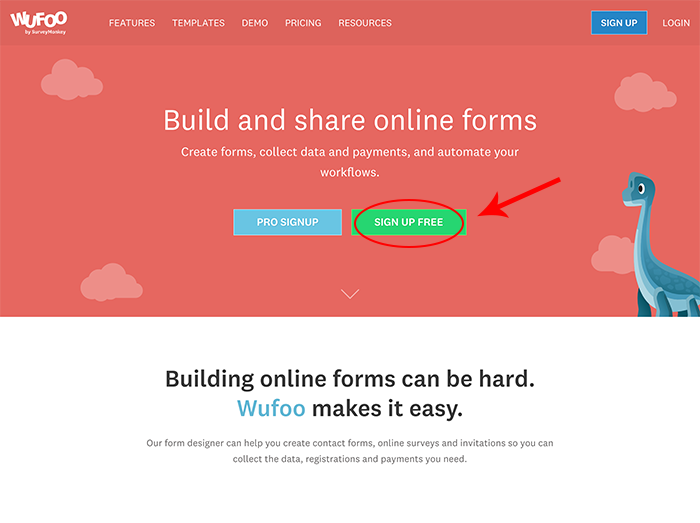
To begin, head on over to Wufoo and click the “Sign Up Free” button. Then enter in the info to create a free account.
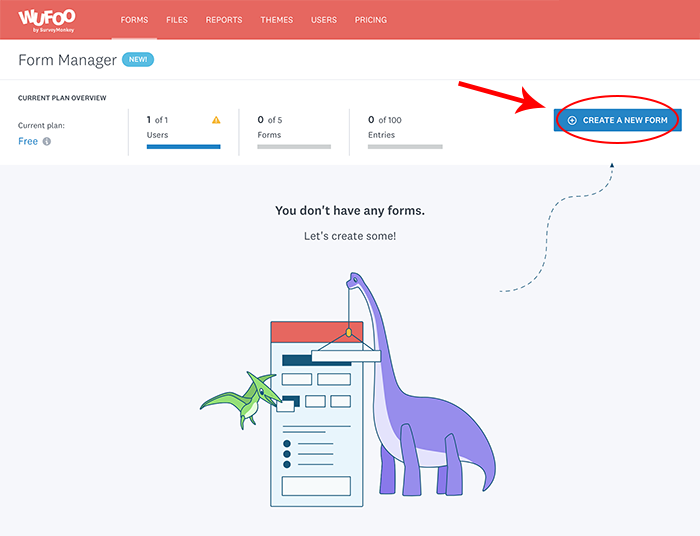
Once your account is created, click on the “create a new form” link.
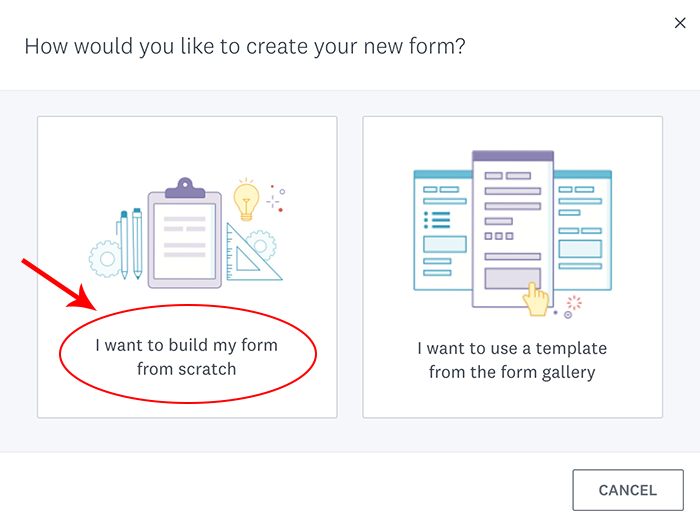
A pop-up window will pop up with two options. Let’s select the “I want to build my form from scratch” box to create a custom form.
The “I want to use a template from the form gallery” is great if you would like to use a premade form. Wufoo offers a variety of form templates that cover topics such as invitations, sign-ups, order forms, registrations, surveys, and more.
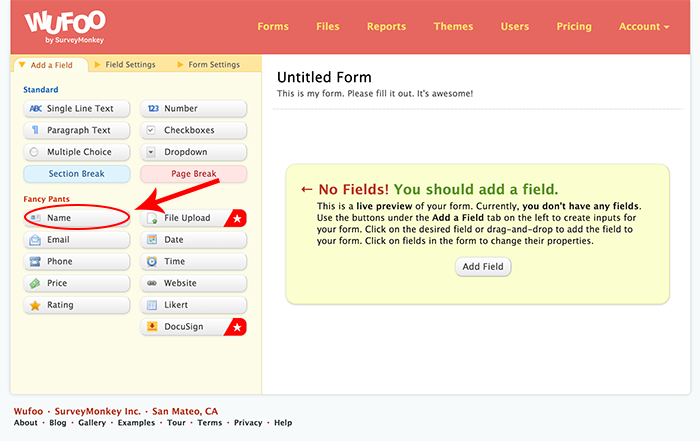
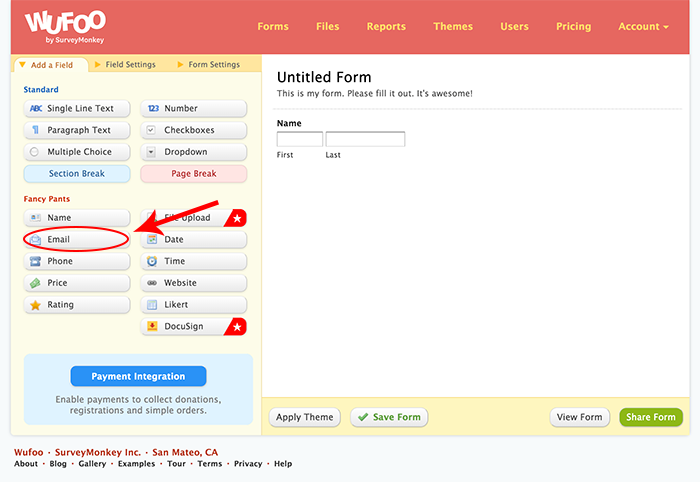
Once on the page to create your form, you’ll definitely want to know the names of the people contacting you, so let’s start by adding a name field. Click on the “Name” button and voilà — the name field will be added. Simple, right?
Next let’s add a place for people to leave their email address, so you’ll have a way to reply. Click on the “Email” button to get the email field added.
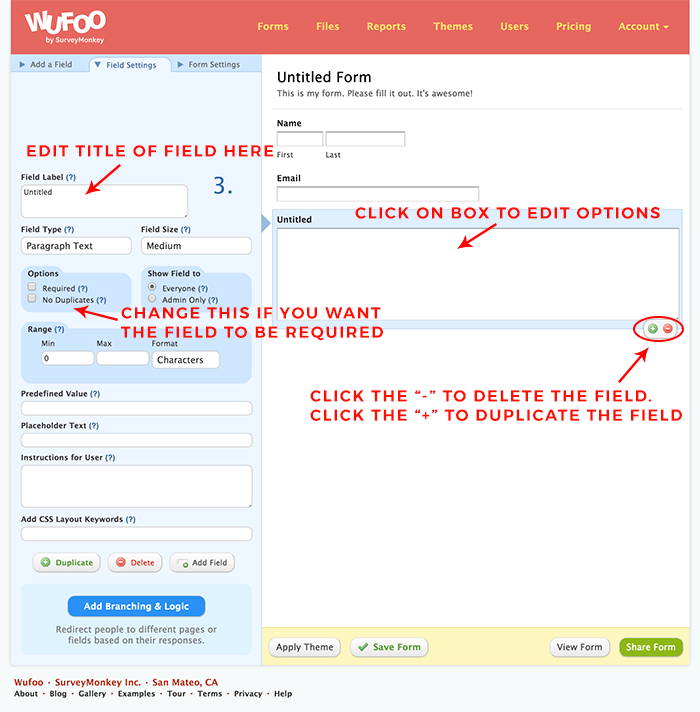
Now you’ll want a place for people to leave you a message, so click on the “Paragraph Text” button to get that added. You’ll notice that this field appears with the title “Untitled.” To title it, click on that field or you can also click on the “Field Settings” tab to edit the options . Give it a title under “Field Label.” You can also select whether or not you want the field to be required. I recommend setting each of the three fields we’ve added to “Required.” You can play around with the different options for each field until you get it looking right. Also, feel free to add any additional fields your form might need.
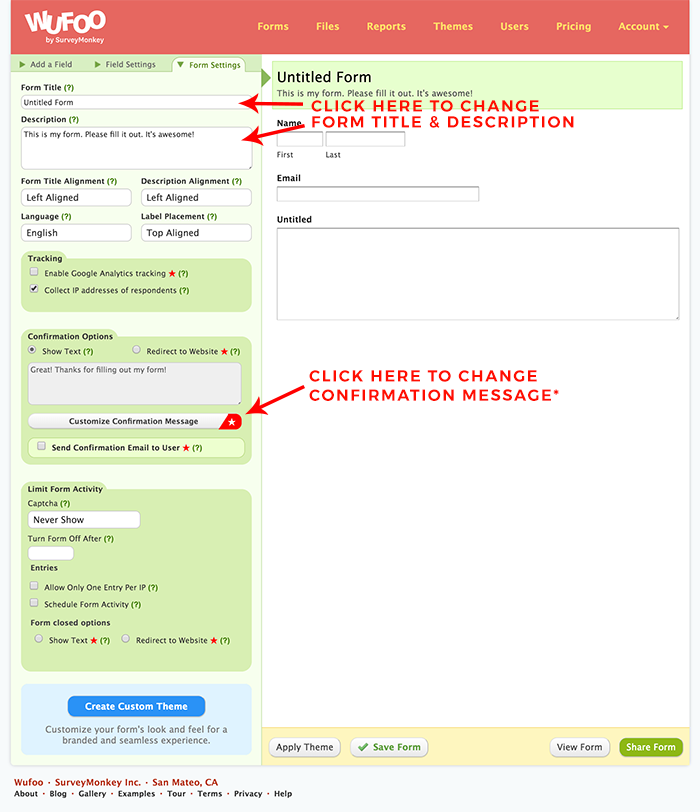
Now you’ll want to title the form, so click on the “Untitled Form” field or click on the “Form Settings” tab to edit the form settings. Change the title to something like “Contact Form.” You can leave the description blank or customize it with whatever you’d like it to say.
*If you have a paid plan, you’ll want to click on “Customize Confirmation Message” to change the message people receive when they submit the form. The field options with a white star on a red background are premium features for paid plans.
Then click the “Save Form” button at the bottom of the page to save the form.
Step 2: Set up Email Notifications
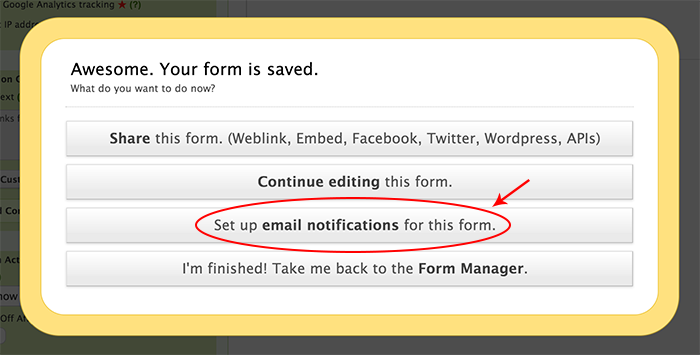
Now we need to set up the email notifications for the form, so click on the “Setup email notifications for this form” button.
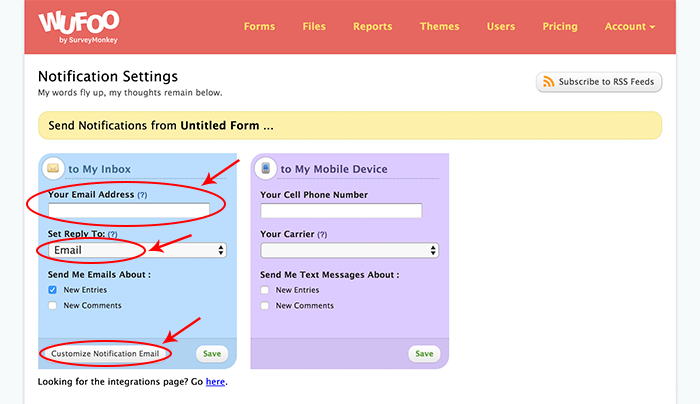
Enter in the email address where you want to receive the forms. Also, make sure to set “Set Reply To” to “Email.” This will allow you to simply hit reply in your email account to reply to each contact form submission.
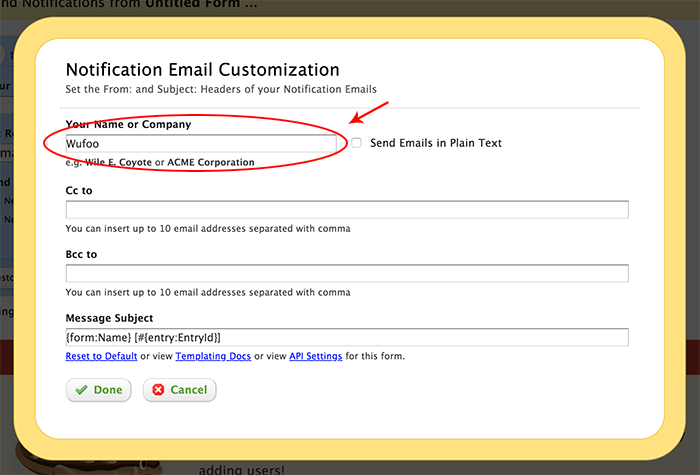
Then click the “Customize Notification Email” and in the pop-up window, under “Your Name or Company” type in your blog/company name.
Then hit the “Done” button. You can also set it to send notifications to your mobile device if wanted. When you are done hit “Save.”
Step 3: Embed Form to Site
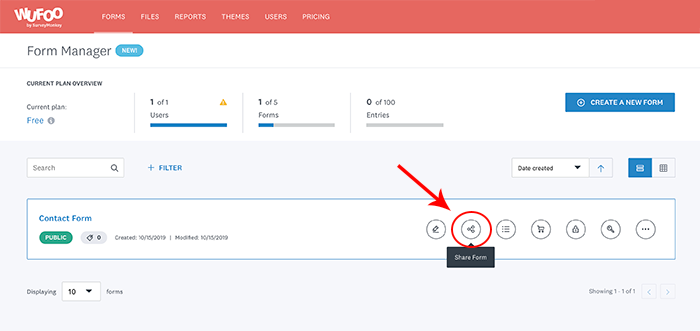
Now click on the “Forms” tab at the top of the page and it will take you to a list of the forms you’ve created. On the Contact Form that you just created, click on the form to show the “Share” button. Click on the “Share” button.
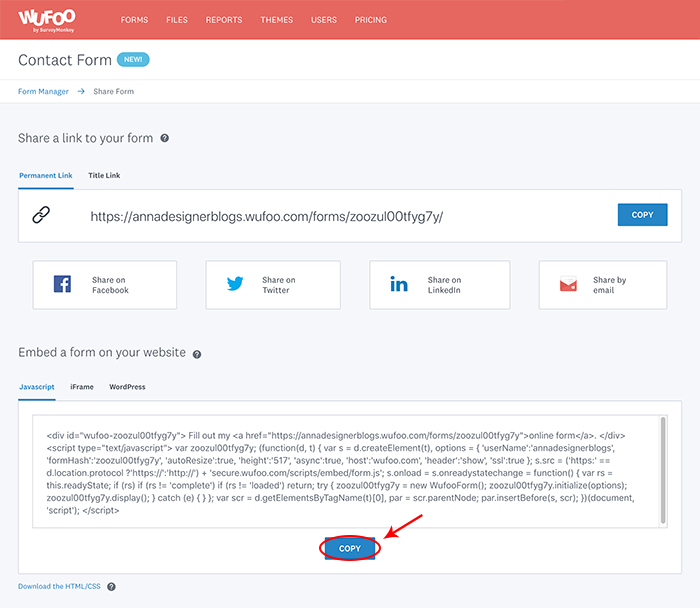
On the share page, scroll down to the “Embed a form on your website” section. Copy all of the code.
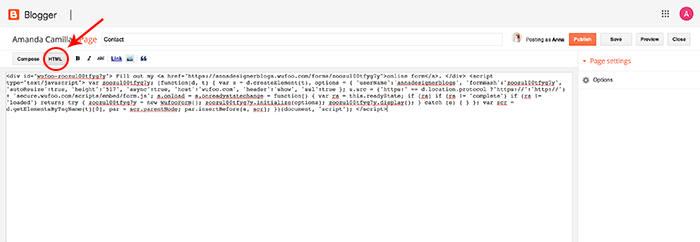
In Blogger, find your contact page and then paste the code into the html of that page.
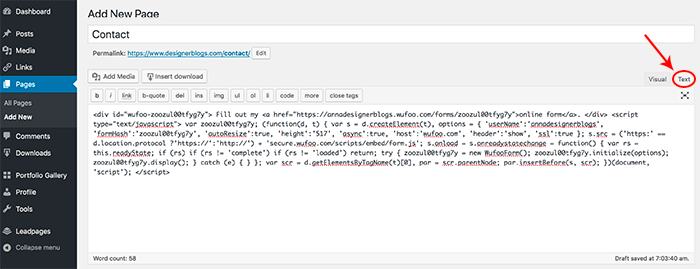
In WordPress, find the contact page and paste the code into the Text editor of that page. You can also install the Wufoo Shortcode Plugin and then paste in the shortcode rather than the html code.
Hit “Update”/”Publish” and then view your page to see your new contact form! Be sure to test it to make sure that it works.
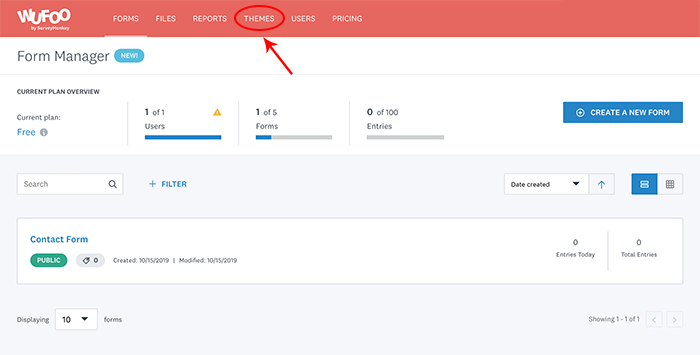
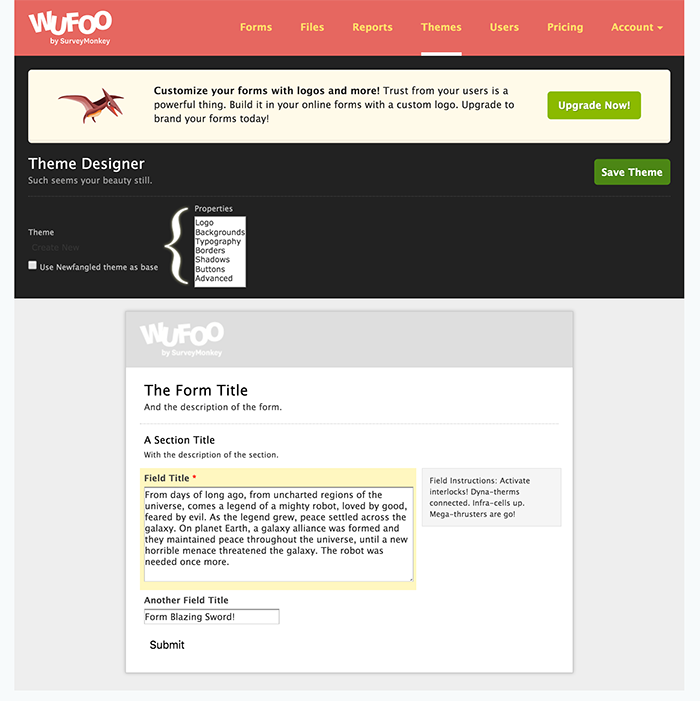
If you want to change the design of the form to coordinate with the design of your site, go to the “Themes” tab in Wufoo.
On this page, you can adjust the colors, fonts, borders, etc.
Please let us know if you have any questions about this tutorial or run into any issues!
A former member of the United States national team, Bedoya had scored the opening goal in the Union’s 5-1 win over D.C. United and then peeled off toward the sideline, where he celebrated with his teammates. But as the gathering broke up, Bedoya headed toward a television microphone placed on the grass, leaned down to grab it and shouted: “Congress, do something now. End gun violence. Let’s go.”
… His sentiment was vague, which was understandable given its brevity. But Bedoya’s social media account already had made clear what kind of action he was seeking. Bedoya, the Union’s captain, had posted on Twitter earlier in the day about the weekend mass shootings that killed 29 people in El Paso and Dayton, Ohio, saying, “We can start with stricter background checks, red flag laws, making a registry for gun purchases, closing gun show loopholes, and taxing ammunition.”
Have you noticed when YouTube suggested videos that promoted a certain ideology? Have you ever encountered racist or extremist content online? Did you ever feel that someone or some group on the internet was trying to persuade you to believe a certain way?
In the Opinion essay “Racists Are Recruiting. Watch Your White Sons,” Joanna Schroeder writes about her experiences watching her teenage children being drawn to the kind of online content that right-wing extremists use to recruit young men. She writes:
A favorite activity for many boys is to watch gamers playing video games on YouTube. According to John Duffy, author of “Parenting the New Teen in the Age of Anxiety,” the problems come with advertisements that may appear during the videos. Kids can be exposed to dozens of ads in a sitting. They might hear about the border, or “Crooked Hillary” or a conspiracy theory on how the left works, Dr. Duffy said. Many of these spots are created and promoted byorganizationslike PragerU, which, Dr. Duffy notes, is not an accredited university but a propaganda machine that introduces viewers to extremist views via video. And YouTube’srecommendation algorithm offers videos that become more and more extreme as viewers watch them.
“There is a sophisticated psychology at play,” Dr. Duffy warns, noting that today’s teenagers have been using smartphones and tablets their whole lives. They like to dive deeper into topics that pique their curiosity, which is a great thing. The problem is they often turn to the internet before their parents for answers. Recommended videos and comments left on YouTube can lead them to threads full of racism and conspiracy theories on forums like 4chan. Google may lead them to white nationalist outlets like The Daily Stormer, where hate and harassment are normalized. Often, they have no idea which sources are reputable.
The Op-Ed continues:
Inevitably, kids who have encountered these messages will mimic extremist talking points, and those of us who find these views repulsive may be tempted to yell at them, ground them or take away their devices in a futile attempt to keep them away from this propaganda.
The problem is, punitive responses often create a sense of shame that can feed a growing sense of anger — an anger the alt-right is eager to exploit.
What really hooks many white teenagers is the alt-right’s insistence that white men are under attack in America, the true victims of oppression. If your child has already been punished for his opinions, this message is especially resonant. They find a home for their rage, a brotherhood of guys like them, and that oh-so-alluring heroic struggle — and that’s how an extremist is born.
Later she writes:
Perhaps the best tool is prevention. Kids need to understand — before they encounter their first alt-right memes — what white supremacy looks like. It’s not just a person in a K.K.K. hood but also the smooth-talking YouTuber in the suit or the seemingly friendly voice in the video game forum.
If we avoid talking about our values about race and the experiences of marginalized people, strangers on the internet will be happy to share theirs.
Students, read the entire article, then tell us:
To what degree, if at all, do you identify with the details Ms. Schroeder shares about her sons’ experiences online? Have you ever encountered racist or extremist videos or memes online?
Do you talk to your parents about what you watch online? Should your parents be worried about the messages you’re receiving on the internet?
Ms. Schroeder shared an anecdote about her son “liking” a meme about Hitler, and then saying he didn’t like it “on purpose.” Do you think indiscriminate “liking” is a common experience teenagers have? Does it ever lead to problems?
Ms. Schroeder writes, “It also seems to me, as a mom, that these groups prey upon the natural awkwardness of adolescence.” She continues, “Many kids feel out of place, frustrated and misunderstood, and are vulnerable to the idea that someone else is responsible for their discontent.” Does that analysis resonate with you? Do you agree that tweens and teens are particularly vulnerable to this kind of “blame someone else” messaging?
What do you think of the parenting strategies that Ms. Schroeder recommends? What advice would you give to parents concerned about the online messaging their children are seeing?
The headline of the Opinion essay and much of its content is about white teenage boys. In your experience, do teenage girls — or teenagers of other races and ethnicities — also encounter hate speech and extremist ideologies online? Please share.
Students 13 and older are invited to comment. All comments are moderated by the Learning Network staff, but please keep in mind that once your comment is accepted, it will be made public.