fbpx
Home Blog Page 1630

Types of Corporations and the Rise of the Tax Accountant

0
Types of Corporations and the Rise of the Tax Accountant

Tax accountants are increasingly relied upon for organizational strategy as technology helps them step away from data entry

The accounting field is changing quickly. As you can read in our article about the future of accounting, accounting “grunt work” and data entry are on the decline. Accountants today need to be ready with a new set of skills compared to accountants of the past.

The role of a tax accountant, for example, is undergoing a fundamental shift in focus due to the rise of cloud computing and the ability to process massive amounts of data with less effort. These technological advancements are helping distinguish the role of the tax accountant as a lead business strategist within an organization.

“Tax accounting will continue to shift more toward an advisory role in a business, says Michael Donohoe, an associate professor of accounting in the online MS in accounting program (iMSA) and PwC Faculty Fellow at the University of Illinois’ Gies College of Business, “Data entry work will likely become more of a thing of the past with clients entering data themselves through a cloud-based service. We’ll also see tax accounting and data analytics merge in a way that allow accountants to focus more on planning, efficiency, and organizational structure.”

Donohoe is a leading expert on tax accounting strategy, including how competition affects firms’ decision to become an S-corp vs. a C-corp (for example). With their time freeing up thanks to from more automated processes, tax accountants can spend their time considering strategies associated with answers to questions like these.

Donohoe and fellow colleagues have pioneered research on how competition from tax-advantaged firms influences the behavior of tax-disadvantaged firms, specifically when it comes to organizational form choice. This research is important to the fundamentals of a firm’s strategy. With their time freeing up thanks to automated processes, tax accountants can spend their time considering the strategies associated with these types of issues.

Donohoe posits that tax accountants can and should be more focused on advising organizational-level strategy, like helping advise on organizational form choice. If you plan on becoming an accountant, CPA, or leading a business — or you already are doing one of these things — Michael’s research on organizational form is well worth your time.

It’s part of the reason that continued learning is important in the field of accounting. Degrees like the online masters in accounting (iMSA) are important for professionals to consider. Below, we’ve included the answers to some basic questions you might have, particularly if you haven’t heard Professor Donohoe discuss the topic:

Should your firm be an Scorporation or a C-corporation?

Before making a decision like this, it is important to understand the basics. What’s the difference between an S-corp and a C-corp?

What is an S-Corporation?

S-corps are pass-through tax entities. They file an informational federal return (Form 1120S), but no income tax is paid at the entity level. The profits and losses of the business instead “pass-through” the business and are reported on the owners’ personal tax returns. Any tax due is paid at the individual level by the owners.

What is a C-Corporation?

C-corps are separately taxable entities. They file a corporate tax return (Form 1120) and pay taxes at the corporate level. They also face the possibility of double taxation if corporate income is distributed to business owners as dividends (which are considered personal income). Tax on corporate income is paid first at the corporate level and again at the individual level on dividends.

What should you consider as an accountant deciding organizational form?

Donohoe has plenty of thoughts on this, but he is informed by his research on how competition affects the entity’s choices within an industry. As a tax accountant or business leader, this is another way of getting into the mind of your competitors to understand their current or future behavior.

Donohoe has clear, simple advice for anyone deciding on whether their firm should be an S Corp or a C Corp.

“Tax is not the only thing that matters in organizational form. When I talk to my students in the online masters in accounting program, we talk about tax factors — sure — but we also spend a lot of time discussing non-tax factors related to this decision. Things like a future IPO can dramatically change the approach a business should take regarding organizational form choice.”

These are the sorts of topics that are important for today’s tax accounting classes. Tax accountants, and accountancy in general, will continue to become important strategic advisors within business organizations. Organizational form is just one example of this foray into strategic decision making for accountants. So long, data entry!


5 Innovative Techniques for Creating Online Video Lectures

0
5 Innovative Techniques for Creating Online Video Lectures

by Adam Hodges, Ph.D., Sr. Teaching & Learning Specialist

Video lectures are a central component of the online learning experience. But creating effective videos can be time-consuming and challenging. Online video production typically involves writing scripts and learning how to speak comfortably in front of a camera, tasks that differ considerably from delivering lectures to a live classroom.

How can course teams help busy instructors develop online video lectures in a way that minimizes the time requirements and plays upon the strengths and preferences of instructors accustomed to teaching in live classrooms?

This month’s Educator Community Webinar explored different video production techniques beyond the traditional model of writing a video script from scratch.

Tara Kramling and Heather Hans from the Learning Experience Design team at Duke University shared several methods they have used to help faculty transform existing course materials into effective online videos.

John C. Hart, Director of Online and Professional Programs for the Computer Science Department at the University of Illinois, shared his team’s use of a “late night talk show model” where course instructors directly address online learners while filming in front of a live studio audience.

Here are some of the ideas they discussed during the session.

Instructors often have an existing slide deck for material they want to teach online. Using that slide deck as a starting point, review the slides for consistency and flow–chunking them up into the short video segments you will be recording.

Duke’s Heather Hans and Tara Kramling note that you will need to make sure the slides are focused on the online learner. This may require adding clear, learner-focused learning objectives to the beginning of each video segment you will be recording.

Once the slides are organized for the online learning flow, have the instructor deliver the lectures from the slides–just as they would do in a live classroom. Make sure the slides are positioned next to the camera so the instructor can see them while still looking into the camera to address the online audience.

After filming, the slides can be stylized and interspersed with the talking head in post-production editing.

Since online videos need to be focused, succinct, and short, writing out a script can ensure these criteria are met. But some instructors prefer to work from an outline rather than a full script.

When creating an outline, Hans and Kramling suggest including at least the main topics–and possibly also the sub-topics. It’s also a good idea for instructors to do a practice run as they finalize the outline before filming.

Simply recording a lecture in front of a live classroom and using that video in an online course has many drawbacks. Live classroom lectures are much longer than the short videos designed for online learning experiences; and, when delivering a live classroom lecture, the primary audience are the learners in the live classroom, which can make online learners feel like mere bystanders. Effective video lectures need to engage directly with the online learner.

To overcome these pitfalls, John Hart’s team at the University of Illinois has adopted a “late night talk show” model for recording video lectures during regular on-campus lectures. The lecturer speaks directly into a camera with a green screen behind them and lecture slides superimposed. Learners in the live audience watch the lecture on a big video screen, similar to the experience of an audience at a live taping of a late night talk show.

Hart notes that this method is “instructor-centric” in that instructors can go about teaching to a live audience in the way they normally do. This saves time for busy faculty who often have little extra time to create online videos on top of their campus teaching duties.

Since a green screen is used during filming, slides can be edited or updated during post-production editing.

Even without adopting the full “late night talk show” model, there are other ways to turn a lecture delivered in a live classroom into short online videos.

Hans and Kramling note that live classroom lectures recorded using Panopto can be chunked into short online videos with some extra work. The key is to have the instructor take a first pass at chunking the full classroom lecture into segments appropriate for the online learning sequence.

The instructional design team can then work with a media producer to fill in gaps, add transitions, and stylize the original slide deck for video presentation. Kramling notes that a good video documentation system is important to help keep track of the content as you cut it down and rearrange it for the online videos.

Online lecture videos often make use of clearly written scripts to ensure the right content is delivered to online learners in the most efficient and effective way possible. But this doesn’t necessarily mean you always need to start writing from scratch.

The Duke team sometimes starts with the transcript of a live classroom lecture. They then work from the transcript to storyboard or write scripts for the online videos.This approach works well for instructors who prefer speaking their lectures rather than writing them out.

Kramling notes that her team uses Rev, a human transcription service, which provides transcripts of recorded lectures with a one-day turnaround. You might also consider transcription software to help with this process. The transcriptions do not need to be perfect since they merely represent a rough draft that will need to be further organized and revised into online-specific video scripts.

Although online lecture videos need to be short, engaging, and tailored specifically to the online audience (e.g., Guo et al. 2014; Brame & Perez 2017), there are many ways to achieve this without letting, as Hart says, “the perfect become the enemy of the good.” Don’t be afraid to explore different approaches as you experiment with finding the techniques that work best for your instructors and course teams.

1

Coursera Expands Internationally with New Engineering Office in Toronto

0
Coursera Expands Internationally with New Engineering Office in Toronto

By Richard Wong, Vice President of Engineering at Coursera

Today, we’re excited to announce that the Coursera footprint has further expanded internationally to Toronto, Ontario with our first engineering office outside of the U.S. The new office will be staffed with engineers to accelerate innovation for the company’s enterprise and partner products. The team will support other business initiatives over time.

Canada is an emerging global technology leader and Toronto’s tech industry, in particular, has seen rapid expansion. It was recently ranked as the city with the highest growth in tech-related jobs in Canada and the U.S. As a global platform with more than 80% of our learners coming from outside of the U.S., it is also important for us to diversify our talent sourcing and build a presence in new tech hubs to enrich our own product thinking and engineering best practices.    

The vast job opportunities combined with world-class research institutions and universities have made Toronto an epicenter for tech talent, and this new office presents an opportunity for Coursera to welcome some of the best and brightest talents to our growing team of engineers.

This new office is yet another milestone in our efforts to create new possibilities for our 40 million learners, 1,800 businesses, and 190 university and industry partners.

Want to join our team and help transform lives through education? We’re growing fast, so check out our open roles and become one of the founding engineers of our new Toronto office.

3

How to Configure the Profile Gadget

0
How to Configure the Profile Gadget

How to Configure the Profile Gadget in Blogger

Our $15 Blogger templates are a great way to get a stylish blog look in less than a few minutes. One of the customizations included with our blog templates is a styled profile area. Styled means that we code the default Blogger profile gadget so it looks more custom and pretty.

defaultvsstyledWe’ve been getting a lot of questions lately from our $15 template clients about how to configure the about me gadget, so we thought we’d explain how to configure the profile gadget in a tutorial today.


Step 1: Add Profile Gadget

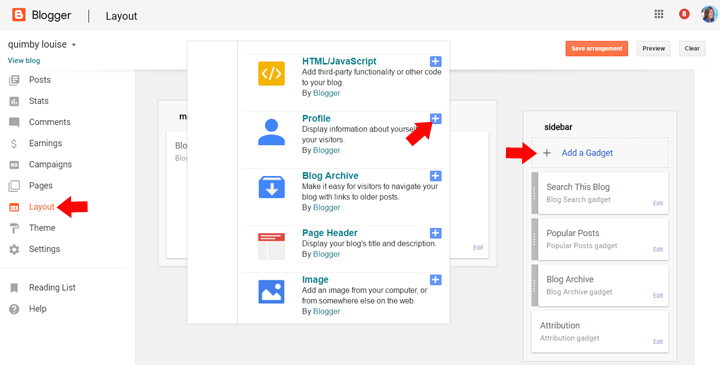
First, you need to add the profile gadget to your sidebar. You do this by going to Layout and then clicking  Add a Gadget. Then scroll down until you find the Profile gadget. Click the + to add.

RELATED POST: How to Add Gadgets to a Blogger Sidebar


Step 2: Add about photo and text

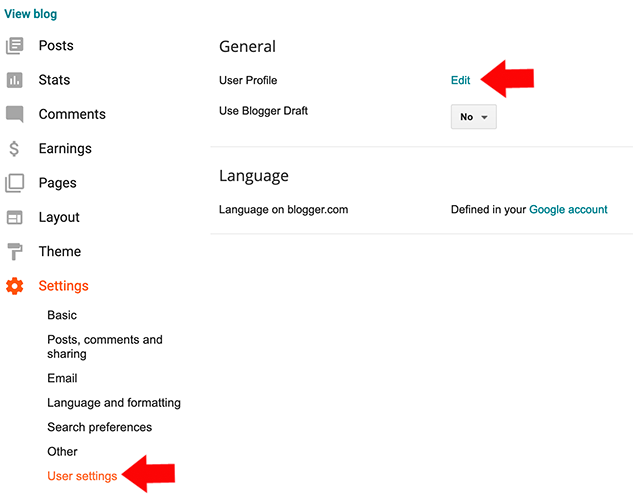
To add your profile photo and bio info, go to Settings > User Settings > User Profile > Edit. The page that opens will show an overview of your profile.

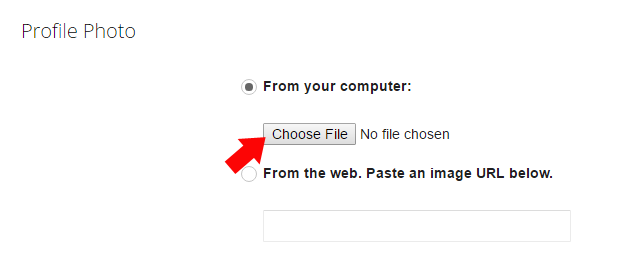
To change/add your profile photo, scroll down to the Profile Photo section. This will allow you to upload a photo from your computer or you can insert the url to your image if hosted somewhere on the web. If you are not currently using a photo, click the Choose File button. If you are currently using a photo and want to change it, click the Remove image button and then click the Choose File button to find your new photo.

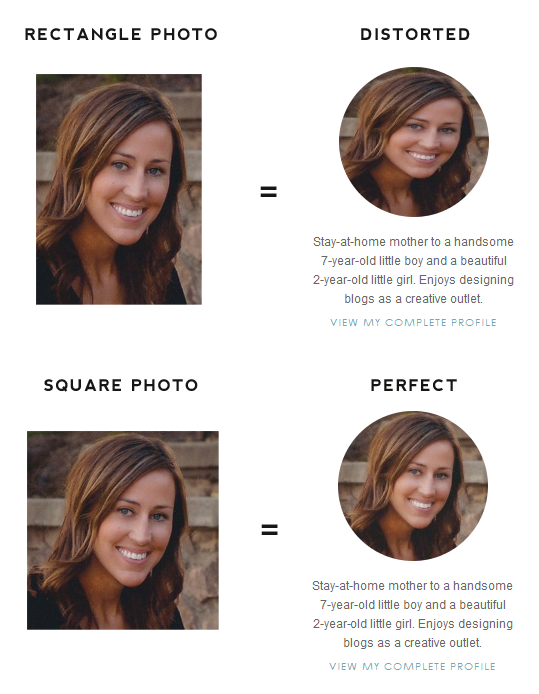
IMPORTANT: Make sure the image you upload has been cropped to a perfect square or it will appear distorted. We recommend making sure your photo is at least 500 x 500px.

PHOTO-SIZE

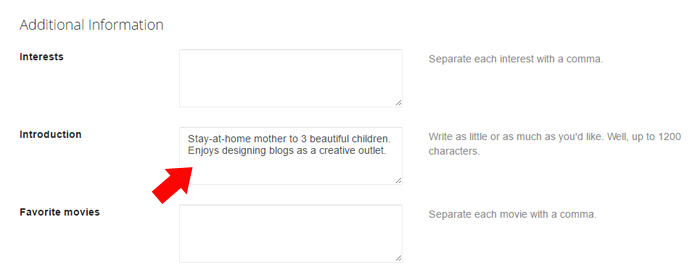
To add the text that will appear under your profile photo, scroll down to the Additional Information section and edit the Introduction area.

Save Settings button to save your settings. Then view your live blog to see your beautiful new styled profile area!

RELATED POST: How to Resize Blogger Photos Automatically


1. Blogger Profile is not showing after following all of these steps.

2. You’ve followed all of the steps and your photo is blurry.

All of our current Blogger templates have coding that will prevent blurry profile photos, but if you have an older template installed, Blogger may resize your profile photo automatically to 80×80 pixels. It then blows the picture up and pixelates it. There is a fix. Go to Template > Edit Html. Click your cursor anywhere in the code box and hit Ctrl/Command + F to open a search box. Search for this:

Now paste the following code directly BEFORE that closing  tag:

Hit “Save template” and the blurriness should be fixed. If not, let us know!


What’s Your Favorite Word?

0
What’s Your Favorite Word?

Do you love words?

Not just speaking them. Or the pleasure of listening to or reading them. But the actual words themselves?

Do you delight in certain words? Think others are ugly? Do you believe that words have the power to thrill, wound, move — even to heal?

In “The Sacred Spell of Words,” N. Scott Momaday, an author, poet and playwright, writes:

Words are powerful. As a writer, my experience tells me that nothing is more powerful. Language, after all, is made of words.

Words are conceptual symbols; they have denotative and connotative properties. The word “power” denotes force, physical strength, resistance. But it connotes something more subtle: persuasion, suggestion, inspiration, security.

Consider the words of Mark Antony in Shakespeare’s “Julius Caesar”:

Cry “Havoc!” and let slip the dogs of war;
That this foul deed shall smell above the earth
With carrion men, groaning for burial.

We might be hard pressed to find words more charged with power to incite, to inflame, to affect violence and destruction. But there are, of course, other expressions of power in words.

They can be especially personal. They can touch our sensibilities in different and individual ways, perhaps because they have different associations for us. The word “Holocaust” frightens me because survivors of the Nazi death camps have told me of their suffering. Notwithstanding, the word is intrinsically powerful and disturbing.

The word “child” delights me; the word “love” confounds me; the word “God” mystifies me. I have lived my life under the spell of words; they have empowered my mind.

Words are sacred. I believe they are more sacred to children than they are to most of us. When I was first able to make my way in language, my Native American father, a member of the Kiowa tribe, told me stories from the Kiowa oral tradition. They transported me. They fascinated and thrilled me. They nourished my imagination. They nourished my soul. Indeed, nothing has meant more to me in fashioning my view of the world. I came to understand that story is the engine of language, and that words are the marrow of language.

Several years ago I was on a stage with the Kenyan paleoanthropologist Richard Leakey in Chicago. We were speaking on the subject of origins, specifically the origin of humans. Mr. Leakey argued that we became human when we became bipedal, and his argument was convincing. But I begged to differ: Surely we became human when we acquired language, a point of view I continue to hold.

Students, read the entire article, then tell us:

— What power do words hold for you? What has shaped your connection to words, whether you are drawn to them or not?

— Do you feel you are able to articulate your thoughts and feelings effectively or eloquently in words? How do you best communicate to others?

— Do you find Mr. Momaday‘s argument, that words are power, to be persuasive? When have you experienced the power of words? Do you agree with the writer that “language is what separates our species from all others?”

— Mr. Momaday ends the article with a Navajo formula to make an enemy peaceful:

Put your feet down with pollen.

Put your hands down with pollen.

Put your head down with pollen.

Then your feet are pollen;

Your hands are pollen;

Your body is pollen;

Your mind is pollen;

Your voice is pollen.

The trail is beautiful.

Be still.

Why do you think he chose this Navajo formula to illustrate the power of words? If you had to convince someone else about the power of words, what line, phrase or quote would you choose and why? Feel free to use a song, poem, speech or story for your illustration.

— Finally, give us your personal take on words:

• What’s your favorite word?

• What word do you think is the funniest?

• What’s the ugliest?

• What word makes you feel smart?

• What word do you find intimidating?

Breakfast

0
Breakfast

What do you eat for breakfast? What influences your choices? Health? Taste? Time and effort?

How healthy would you say your breakfast usually is?

Tell us in the comments, then read the related article about how to create a healthier breakfast routine.

Find many more ways to use our Picture Prompt feature in this lesson plan.

Word + Quiz: efface

0
Word + Quiz: efface

1. remove by or as if by rubbing or erasing

2. remove completely from recognition or memory

3. make inconspicuous

_________

The word efface has appeared in three articles on NYTimes.com in the past year, including on March 8 in the book review “A First Novel Explores Zimbabwe’s Troubled History” by Dinaw Mengestu:

Zamani, the narrator of Novuyo Rosa Tshuma’s remarkable first novel, “House of Stone,” has a troubled relationship with the past. For him there is history, and then there is “hi-story,” a subtle but important distinction for a man who wants more than the incomplete, fragmentary tale his uncle passed on to him before dying.

… It’s a remarkable feat. Through Zamani, Tshuma shows us how much work it takes to efface the past, and, through “House of Stone,” she proves that those efforts are no match for a novel as ambitious and ingenious as this one.

_________

Do You Like Your First Name? Would You Change It if You Could?

0
Do You Like Your First Name? Would You Change It if You Could?

What’s your favorite first name? Is it the name you have? Would you like it to be?

Have you ever used a name that is different from the one your family gave you? Or experimented with the spelling or pronunciation of your name?

In “Why Not Let Children Choose Their Own Names?” Danielle Braff writes:

J. Martin Griffith, 36, who works for a clean energy company in Philadelphia, had the option to choose his own name from birth and beyond, but he still can’t make that big decision.

Mr. Griffith’s mother named him J, which doesn’t officially stand for anything.

“My mother always told me growing up that I could choose a new name,” he said. “I batted around 1,000 names but could never settle on any one name.”

He tried lots of J names and also considered non-J names, but nothing stuck. When he was growing up, some people called him Martin, while a few called him J or “J-the-letter.” Today, the vast majority call him Marty or Martin, as he still hasn’t settled. Mr. Griffith isn’t the biggest fan of letting children choose their names.

“It is hard enough naming someone else, let alone naming yourself, and a name has surprising weight out in the world, I think,” he said.

Students, read the entire article, then tell us:

— What do you think about the idea of giving children a temporary name, knowing they will choose their own later?

— What do you think is a good age for settling on a name? Why?

— Do you think it’s necessary to legally change a name when a person wants to go by something else? Why or why not?

— How important is a first name, anyway?

— Do you think you will always use the first name you have now? What about your last name? Why or why not?

— Have you ever gone by one name at home and another at school or elsewhere? Was it fun? Confusing? Something else?

Students 13 and older are invited to comment. All comments are moderated by the Learning Network staff, but please keep in mind that once your comment is accepted, it will be made public.

How Much Do You Know About Lithuania?

0
How Much Do You Know About Lithuania?

Can you find Lithuania on a map? What else do you know about this Baltic nation with 2.8 million people?