fbpx
Home Blog Page 683

Best in Show

0
Best in Show

At the Westminster Kennel Club Dog Show this week, over 2,500 canine contestants tried to measure up to a set of exacting breed standards and competed for the coveted best in show award. Did you watch?

What do you think of the winner, Monty, a dignified giant schnauzer, who beat out a whippet, a Skye terrier and the fan-favorite German shepherd for top honors?

Have you ever thought about entering your own pet into a similar competition? Why or why not? If so, which talents, abilities or skills — such as agility, obedience or adorability — would you want to showcase?

Do you think your pet would enjoy all the primping, pampering and attention that often goes with competing?

How would you feel if your pet won? What about if they didn’t?

Tell us in the comments, and then look at these behind the scenes photos to learn more about what it takes to compete for best in show at Westminster.


Students 13 and older in the United States and Britain, and 16 and older elsewhere, are invited to comment. All comments are moderated by the Learning Network staff, but please keep in mind that once your comment is accepted, it will be made public and may appear in print.

Find more Picture Prompts here.

What Is One Skill You Can Do Really Well? What Is One You’d Like to Learn?

0
What Is One Skill You Can Do Really Well? What Is One You’d Like to Learn?

Have you heard of the “Super Bowl for Excel Nerds”?

Watch the video above about the Microsoft Excel World Championship, where 12 participants vied this past December to be crowned the world’s best spreadsheeter.

What do you think of this competition? How would you do if you were competing in it?

Is there a skill or talent you are so good at that you could win a contest?

In “Twelve Dudes and a Hype Tunnel: Scenes from the ‘Super Bowl for Excel Nerds,’” Yan Zhuang tells us more about the tournament:

Like soccer players taking the field in a giant stadium, the 12 finalists ran through a glowing “hype tunnel,” some wearing jerseys with sponsorship logos. As an announcer bellowed introductions and cameras captured their every move, they approached a neon-lit stage to raucous cheers.

Then the men sat down at desktop computers, opened their Microsoft Excel spreadsheets and began to type.

Excel, a program that does complex math on a human’s behalf, is often associated, rightly, with corporate drudgery. But last month, in a Las Vegas e-sports arena that typically hosts Fortnite and League of Legends tournaments, finance professionals fluent in spreadsheets were treated like minor celebrities as they gathered to solve devilishly complex Excel puzzles in front of an audience of about 400 people, and more watching an ESPN3 livestream.

Organizers call the event the Microsoft Excel World Championship. “Yes, it is a thing,” the official website says.

Maybe you can’t picture yourself winning this competition, but is there another skill or talent that you would like to learn or get better at?

In another article, “The Magic of Swimming Lessons in Middle Age,” Erik Vance writes about learning to swim as an adult:

I’ve never been a good swimmer.

I mean, I can swim. But what I do in a pool feels more like a battle for survival than a workout — especially after the first few laps. My legs are too long, my stroke is uneven and I constantly struggle to get a decent breath.

It’s not fun, which is why I rarely swim for fitness. Plus, swimming culture is intimidating, with its caps and goggles and rules about lane splitting.

But it’s great winter exercise, if you have access to an indoor pool. So I recently set out to become a better swimmer, with the help of my first lessons since grade school.

It turns out that you can get a lot better with just few lessons. And once you do, you suddenly have another option for an aerobic workout that’s easy on the joints.

Students, read one or both articles, and then tell us:

  • What is one skill you can do really well — something, for example, you might win a competition for if there were such a thing? How did you discover you had a talent for it?

  • How did you get so good at this skill? What expert tips could you share with someone who wanted to start or to improve?

  • What is a skill you’d like to learn or get better at? Why do you want to know how to do it? Who is someone who might be able to help you?

  • In general, do you like trying new things? Or, do you tend to stick with what you already know and do well? Why?

  • What is rewarding about getting good at something? What is challenging about it? Do either of these articles inspire you to want to try something new or to push yourself harder?


Students 13 and older in the United States and Britain, and 16 and older elsewhere, are invited to comment. All comments are moderated by the Learning Network staff, but please keep in mind that once your comment is accepted, it will be made public and may appear in print.

Find more Student Opinion questions here. Teachers, check out this guide to learn how you can incorporate these prompts into your classroom.

Future of Jobs Report 2025: Top Skills & Roles in Demand

0
Future of Jobs Report 2025: Top Skills & Roles in Demand

The World Economic Forum’s Future of Jobs Report 2025 examines anticipated challenges and opportunities facing economies from 2025-2030. It harvested the views of more than 1,000 who represent some 14 million workers worldwide.  

While the ascendency of AI, the cost of living and climate change are the top three trends impacting economies, WEF also analyses other phenomena likely to affect the jobs market for 2025-2030. 

Introducing the report, Saadia Zahidi, WEF Managing Director, commented that technological advances  are “converging with a broader array of challenges, including economic volatility, geoeconomic realignments, environmental challenges and evolving societal expectations.”

The increasing cost of living is a key contributor to economic volatility. With over 5,500+ free online courses, Alison has equipped more than 45 million learners across 193 countries to compete in the job market, increase their skills, and achieve career growth and development. 

Read on to discover how, as a trusted empowerment platform, we fully support WEF’s ambition to equip employers and individuals to meet the challenges ahead. 

Demographic Shifts

Two demographic shifts are impacting global economies and labour markets: the ageing and shrinking workforce in higher-income economies, and conversely, the expanding workforce in lower-income economies. 

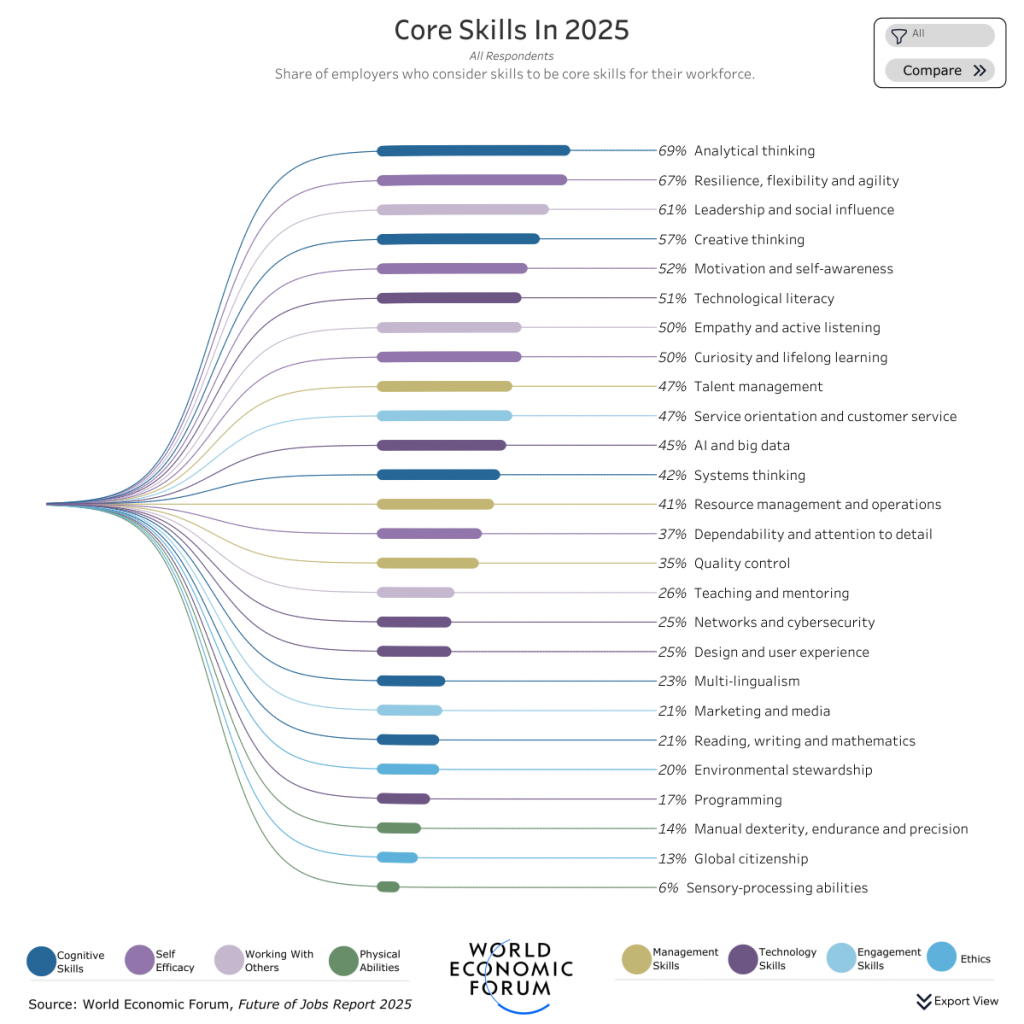
As a result, WEF foresees an increase in demand for skills in talent management, mentoring, and motivation and self-awareness.

Young, Growing Workforce

Employers and trainers can equip staff to succeed through online learning. Online empowerment platform Alison offers training for apprentices in everything from caregiving to carpentry, providing theory teaching to complement on-the-job training.

Newcomers to the workplace can also develop soft skills like motivation and self-awareness through online self-improvement training.

With Alison, learners can master skills such as: 

Ageing, Shrinking Workforce

In higher-income economies, ageing populations are driving growth in healthcare, nursing and adult education. Ongoing skills training is vital for professions such as nursing, where continued professional development is required to maintain registration.  Alison’s teaching and adult education courses also support continuing professional development all over the world.

Alison Graduate Autumn D. commented on completing the certificate course, Facilitating Adult Learning Groups: “I really enjoyed this course! I am interviewing for a training manager position and this helped me skill myself to prepare for the interview!”

Click on the links for courses for: 

Diversity, Equity and Inclusion

Cultural shifts and demographics have nudged equality issues up the agenda, particularly in higher-income economies. As a result, DEI training is highlighted by 47% of employers in The Future of Jobs Survey. WEF reports that 83% of employers have a DEI initiative in place, compared to 67% in 2023, rising to 96% in the USA.

Alison’s Human Resource Management courses, including Diversity, Equity and Inclusion (DEI) training, can equip employers to manage and mentor talent and put professional systems in place. 

Employee Wellbeing

Supporting employee health and well-being is expected to be a top focus for talent attraction, with 64% of employers surveyed identifying it as a key strategy to increase talent availability. 

Individuals can take Alison’s free Workplace Wellbeing psychometric test to ascertain how they are doing and attain actionable insights. 

Among the many testimonials about the benefits of the test is this from Luricelle P: “The assessment helped me become more emotionally resilient and it is a valuable tool for promoting self-awareness and proactive mindfulness. I highly recommend it as it is beneficial to an individual’s mental state.”

Political and Economic Turmoil

A third (34%) of surveyed organisations cited geoeconomic fragmentation and geopolitical tensions as issues driving business model transformation. Companies trading with the USA and China are expected to be most affected by restrictions on trade and investment, subsidies and industrial policies. They may consider relocating operations offshore or end previous offshore arrangements. 

Jobs for the Future

The Industrial Revolution transformed the Western world in the late 19th and early 20th centuries. The ongoing Technological Revolution is moving farther and faster and will continue to alter the jobs landscape.

According to the Future of Jobs Survey the labour-market transformation is likely to generate 170 million jobs (14% of today’s total employment). An estimated 92 million (8% of current jobs) are expected to be displaced, “resulting in net growth of 7% of total employment, or 78 million jobs”.

Along with the technology and care economy sector mentioned above, frontline workers will continue to be in demand, WEF finds, and are predicted to see the largest growth in absolute terms of volume. Individuals and organisations wishing to upskill in these in-demand jobs can find free online courses on Alison.

Click on the links for courses for:

Jobs in Decline
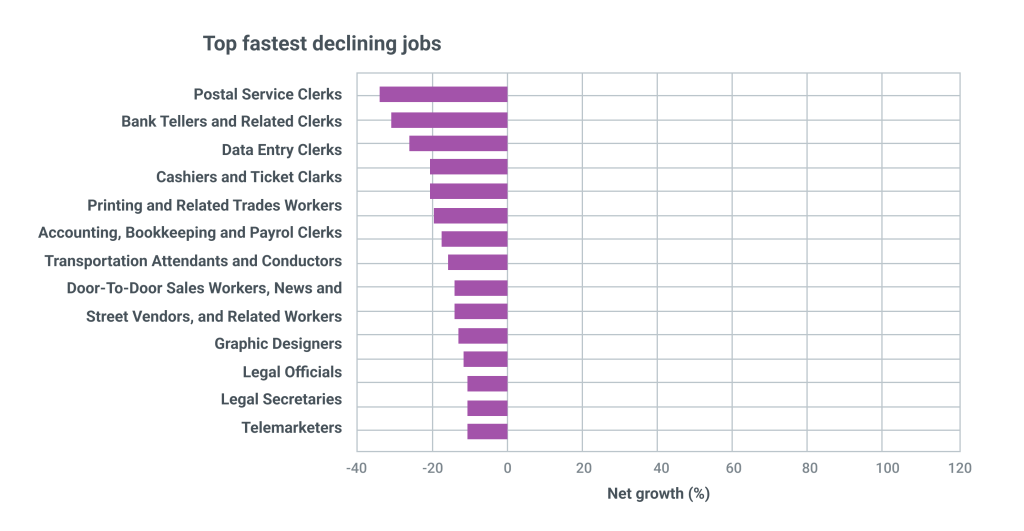
The jobs facing the fastest net decline (%), projected by employers surveyed by WEF

Clerical and Secretarial Workers

Automation and AI are impacting the future prospects of many in administrative and secretarial roles. According to WEF, the largest decline in absolute numbers is set to impact Cashiers and Ticket Clerks, Administrative Assistants and Executive Secretaries, Postal Service Clerks, Bank Tellers and Data Entry Clerks. 

“On average, workers can expect that two-fifths (39%) of their existing skill sets will be transformed or become outdated over the 2025-2030 period,” WEF comments. “However, this measure of “skill instability” has slowed compared to previous editions of the report, from 44% in 2023 and a high point of 57% in 2020 in the wake of the pandemic. This finding could potentially be due to an increasing share of workers (50%) having completed training, reskilling or upskilling measures, compared to 41% in the report’s 2023 edition.”

Support for Job Seekers

Alison’s free resources extend far beyond direct training and include:

  • A comprehensive Career Guide to facilitate those who find they are forced to migrate from one role to another. Once an individual has selected a career, they are then directed to the steps required to make the switch, including recommended courses. 
  • For those in need of more guidance, Alison’s Aptitude Test provides assessments in verbal, numerical and abstract reasoning. These not only help the candidate identify their abilities but can also prove their capacity to potential employers by printing their report. On completing the aptitude tests, candidates are directed to courses that will help them improve where necessary.
  • Individuals can also take the Workplace Personality Test to ascertain what type of role they are most likely to succeed in.
  • Job-seekers can also avail of the free Resume Builder to create a professional looking CV.
  • Finally, they can prepare for the next stage of the recruitment process with comprehensive Interview Skills training.

Identifying Skills Gaps

If the world’s workforce was made up of 100 people, 59 would need training by 2030.” WEF Future of Jobs Report 2025

The differences between growing and declining job roles are expected to exacerbate the existing skills gaps, WEF warns. Along with resilience, flexibility and agility, programming and technological literacy mentioned above, other prominent skills gaps are anticipated to include resource management and operations, and quality control.

“Given these evolving skill demands, the scale of workforce upskilling and reskilling expected to be needed remains significant: if the world’s workforce was made up of 100 people, 59 would need training by 2030. 

“Of these, employers foresee that 29 could be upskilled in their current roles and 19 could be upskilled and redeployed elsewhere within their organisation. However, 11 would be unlikely to receive the reskilling or upskilling needed, leaving their employment prospects increasingly at risk.”

The report continues: “Skill gaps are categorically considered the biggest barrier to business transformation by Future of Jobs Survey respondents, with 63% of employers identifying them as a major barrier over the 2025-2030 period. Accordingly, 85% of employers surveyed plan to prioritise upskilling their workforce, with 70% of employers expecting to hire staff with new skills, 40% planning to reduce staff as their skills become less relevant, and 50% planning to transition staff from declining to growing roles.” 
 

Helping Employers Upskill Staff

Funding for – and provision of – reskilling and upskilling are seen as the two most welcomed public policies to boost talent availability. Alison is ideally placed to meet that need.

The platform’s groundbreaking Learning Management System empowers employers to tailor training to individual needs and to track learners’ progress.
Employers can:

  • Avail of 5,500+ courses for flexible & efficient learning
  • Enjoy an easy setup process in under 5 minutes
  • Assign certificates with CPD accreditation
  • Access pre-curated learning paths
  • Create their own learning paths
  • Get real-time analytics in comprehensive reports.

Chart Your Course to 2030

In conclusion, the WEF Future of Jobs Report 2025 provides a crucial roadmap for navigating the evolving world of work. By embracing lifelong learning, developing in-demand skills, and adapting to new technologies, individuals can thrive in this dynamic environment. Alison is committed to empowering learners worldwide with the knowledge and skills they need to succeed in the future of work. Its free online courses, combined with valuable resources like career guidance and aptitude assessments, provide a pathway to a brighter future for everyone.

Finally, the report predicts that curiosity and lifelong learning, are also expected to continue to rise in importance over the 2025-2030 period. Why not register for a free account with Alison today and get ahead of the (learning) curve!

*The World Economic Forum (WEF) Future of Jobs Report 2025 project team is Till Leopold, Attilio Di Battista, Ximena Játiva, Shuvasish Sharma, Ricky Li and Sam Grayling, alongside the wider team at the Centre for the New Economy and Society.
Read the full report or the report digest.

Frequently Asked Questions

Q. What are some of the top skills and roles that are expected to be in demand in the coming years?

A. The report predicts growth in roles related to technology, the care economy, and frontline work.  Specific skills in demand include talent management, mentoring, self-awareness, digital literacy, programming, resource management, and quality control.  Frontline roles like farmworkers, delivery drivers, construction workers, salespersons, and food processing workers are also expected to see growth.  Additionally, soft skills like resilience, flexibility, agility, curiosity, and a commitment to lifelong learning are becoming increasingly important.

Q. How can individuals and employers prepare for the changing job market, and how does Alison support this?

A. Individuals can prepare by focusing on lifelong learning, developing in-demand skills, and adapting to new technologies.  Alison offers a wide range of free online courses covering many of the skills and roles highlighted in the report, including courses in technology, caregiving, and professional development.  Alison also provides resources like career guides, aptitude tests, resume builders, and interview skills training to help individuals navigate the job market.  For employers, Alison offers a Learning Management System that allows them to tailor training to individual needs, track learner progress, and manage upskilling and reskilling initiatives within their organizations.  This helps employers address skill gaps and ensure their workforce is prepared for the future of work.

Q. What are some of the job roles that are projected to decline in the coming years?

A. The Future of Jobs Report 2025 identifies clerical and secretarial roles as facing the fastest net decline.  Specifically, the report highlights Cashiers and Ticket Clerks, Administrative Assistants and Executive Secretaries, Postal Service Clerks, Bank Tellers, and Data Entry Clerks as being significantly impacted by automation and AI.  This emphasizes the need for workers in these areas to consider upskilling or reskilling to transition to more in-demand roles.


 

Word of the Day: obliquely

0
Word of the Day: obliquely

The word obliquely has appeared in 47 articles on NYTimes.com in the past year, including on July 30 in Rebecca Makkai’s review of the novel “I Have Some Questions for You,” by Dinaw Mengestu:

To appreciate Mengestu’s work, you have to be ready to live in uncertainty, to find any truths obliquely, if at all. If you can accomplish that, the journey is well worth the discomfort.

Can you correctly use the word obliquely in a sentence?

Based on the definition and example provided, write a sentence using today’s Word of the Day and share it as a comment on this article. It is most important that your sentence makes sense and demonstrates that you understand the word’s definition, but we also encourage you to be creative and have fun.

If you want a better idea of how obliquely can be used in a sentence, read these usage examples on Vocabulary.com. You can also visit this guide to learn how to use IPA symbols to show how different words are pronounced.

If you enjoy this daily challenge, try our vocabulary quizzes.


Students ages 13 and older in the United States and the United Kingdom, and 16 and older elsewhere, can comment. All comments are moderated by the Learning Network staff.

The Word of the Day is provided by Vocabulary.com. Learn more and see usage examples across a range of subjects in the Vocabulary.com Dictionary. See every Word of the Day in this column.

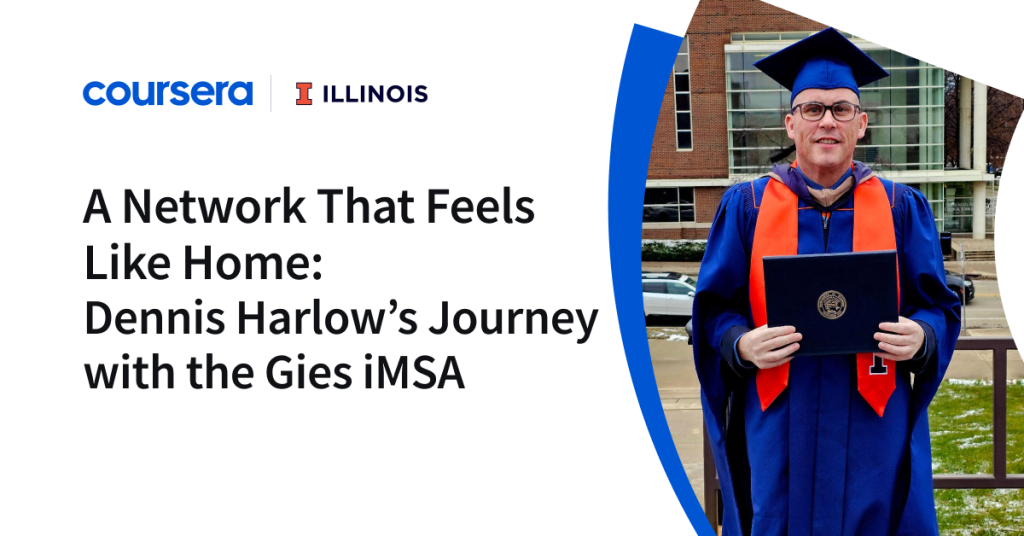
A Network that Feels like Home: Dennis Harlow’s Journey with the Gies iMSA

0
A Network that Feels like Home: Dennis Harlow’s Journey with the Gies iMSA

For Dennis Harlow, higher education wasn’t just about earning a degree—it was about transforming his career, expanding his professional network, and immersing himself in a program that aligned with his life. From his early days as a high school bank teller to his extensive experience as a commercial banker, Dennis always had a keen interest in finance and helping his clients succeed. But it wasn’t until he started working alongside CPAs—analyzing financial statements, helping business owners allocate assets, and navigating post-acquisition strategies—that he realized he wanted to dive deeper into the field of accounting. That’s when he discovered the Master’s of Accounting (iMSA) at the University of Illinois Gies College of Business.

The Journey to Gies: A Perfect Fit

Dennis initially took online classes during COVID-19 to get back into the rhythm of school, having been out of the academic world for over 20 years. His first experience with online education was with his undergraduate alma mater, but he found the experience lacking—no interaction, no group work, no flexibility, and only pre-recorded lectures.

Despite already being accepted into his former undergraduate school’s master program master’s program, he was determined to find something better. He explored several options but the requirement for in-person presence was a dealbreaker, given his full-time job and other personal commitments. In Spring of 2023, just weeks before he was due to return as a full-time online student to his alma mater, he decided to continue his research for other online business programs, noting Gies consistently ranked among the best. With a strong reputation—including being a top-three accounting program in the U.S.—networking opportunities, and a robust online experience for master’s students, Gies stood out above all. Dennis quickly pivoted his plan, left his alma mater, and instead enrolled in the online iMSA.  

A Dynamic, Engaging Learning Experience

From the start, Dennis found the recruitment and admissions team at Gies to be incredibly helpful. They explained the possibility of stacking course progress into the degree, the interactive live sessions, and the extensive networking opportunities. Unlike his previous experience, Gies provided a truly engaging environment. His classmates were diverse, coming from all over the world, and his professors included impressive leaders like tax attorneys or PhDs involved in writing tax laws.

“The professors were hilarious and engaging,” Dennis recalled. “They made even the driest material dynamic and exciting.” He specifically praised professors Matthew Hutchens and Danielle Green and their ability to bring real-world experience into the classroom.

He also appreciated the program’s structure, which allowed him to balance work and school. He created his own schedule, working intensively on weekends and completing projects during the week. The flexibility of the program enabled him to maintain a high GPA straight through to graduation. 

Networking and Community: The Gies Difference

One of the primary standout aspects of Dennis’ experience at Gies was the strong sense of community and networking opportunities. He was blown away by iConverge, an annual event that brings online students together in person. “The sheer awesomeness of it all—the phenomenal speakers, the alumni connections, and the history of the school—was incredible,” he said.

Despite being an online student, Dennis felt deeply connected to his peers and the Gies network. He actively participated in iGBA networking opportunities, Chicago meetup groups, and even attended Cubs games with fellow students.  Dennis noted, “The wonderful thing about the University of Illinois and the Gies program is that they try to keep you together and connected with the school,” he said. “We help each other. It’s a very cohesive community.”

The ability to connect with other professionals across industries and locations made the experience feel like more than just an online program. In fact, as Dennis noted, “it felt like family.”

Preparing for the Future: CPA Exam and Beyond

The iMSA program at Gies not only prepared Dennis for a career shift but also equipped him for the CPA exam, which he is scheduled to take in April. He appreciated that the program didn’t require an accounting background and that it was designed to ensure students were well-prepared for the CPA and real-world applications.

Beyond the CPA, Dennis is already looking ahead—he plans to return and complete the online iMBA program at Gies, further expanding his expertise in business and finance. He was namely excited about his ability to stack 24 credits from the iMSA toward the iMBA and complete a second credential even faster than his first one.  His passion for working with clients, analyzing financial strategies, and helping businesses succeed has only grown stronger.

A Proud Graduate

Graduating in December 2024, Dennis celebrated this milestone by purchasing a commemorative brick at Illinois Memorial Stadium, marking both his journey and his family’s legacy. With his brother being a 2004 Illinois graduate, and with Dennis graduating from the same school 20 years later, he was excited to cement this lasting familial bond that he and his brother now share at the University of Illinois. Reflecting on his experience, he is grateful not just for the education but for the relationships, mentorship, and professional growth he gained through Gies.

With 15 years at his current firm and a deep passion for tax and advisory services, Dennis is eager to continue helping clients navigate financial decisions. His mantra remains the same: “How can we get you there?”—a perfect reflection of his dedication to guiding others toward financial success, and his dedication to bettering himself through higher education. 

For anyone considering an online business or accounting program, Dennis’ journey is proof that Gies College of Business provides not just a top-tier education, but an experience that is flexible, engaging, and deeply connected to a thriving professional network.

Weekly Student News Quiz: Super Bowl, Trump’s Actions, Eggs

0
Weekly Student News Quiz: Super Bowl, Trump’s Actions, Eggs

Above is an image related to one of the news stories we followed this past week. Do you know what it shows? At the bottom of this quiz, you’ll find the answer.

Have you been paying attention to current events recently? See how many of these 10 questions you can get right.

Kendrick Lamar’s Halftime Show

0
Kendrick Lamar’s Halftime Show

Kendrick Lamar’s performance at Super Bowl LIX made him the first rapper to headline the N.F.L.’s biggest stage solo.

Did you watch the show? Were you already a Kendrick Lamar fan? What did you think of the performance? What specific aspects — whether the music, the staging, the dancing, the costumes, the symbolism or anything else — were most or least successful, in your opinion? Why?

Lamar made his Drake diss track “Not Like Us” the centerpiece of his set. What do you think of the ongoing beef between Lamar and Drake? Was the Super Bowl the appropriate stage to try to settle a vendetta?

Tell us in the comments, and then read the related review to learn what a New York Times critic thought.


Students 13 and older in the United States and Britain, and 16 and older elsewhere, are invited to comment. All comments are moderated by the Learning Network staff, but please keep in mind that once your comment is accepted, it will be made public and may appear in print.

Find more Picture Prompts here.

Word of the Day: juggernaut

0
Word of the Day: juggernaut

The word juggernaut has appeared in 438 articles on NYTimes.com in the past year, including on Dec. 11 in “‘The Texas Chain Saw Massacre’ Score, a Noisy Gem, Will Arrive at Last” by Christopher R. Weingarten:

“The Texas Chain Saw Massacre” changed the horror business when it splattered out in 1974, turning a spartan budget into a $30 million juggernaut and laying groundwork for the blood-soaked slasher genre that dominated the 1980s. Among its many innovations was its unconventional score, an abstract suite of bone-chilling scrapes, metallic clanks, ominous drones and mysterious stingers.

Can you correctly use the word juggernaut in a sentence?

Based on the definition and example provided, write a sentence using today’s Word of the Day and share it as a comment on this article. It is most important that your sentence makes sense and demonstrates that you understand the word’s definition, but we also encourage you to be creative and have fun.

If you want a better idea of how juggernaut can be used in a sentence, read these usage examples on Vocabulary.com. You can also visit this guide to learn how to use IPA symbols to show how different words are pronounced.

If you enjoy this daily challenge, try our vocabulary quizzes.


Students ages 13 and older in the United States and the United Kingdom, and 16 and older elsewhere, can comment. All comments are moderated by the Learning Network staff.

The Word of the Day is provided by Vocabulary.com. Learn more and see usage examples across a range of subjects in the Vocabulary.com Dictionary. See every Word of the Day in this column.

Lesson Plan: Trump Administration Checks and Balances

0
Lesson Plan: Trump Administration Checks and Balances

Mr. Trump’s actions raise serious constitutional questions. As a reminder, the Constitution created three branches of government:

  • The legislative branch, Congress, makes the laws.

  • The judicial branch, the federal courts, interprets the laws.

  • The executive branch, the president, carries out those laws.

The Constitution also created a system of checks and balances, enabling each branch to check the power of the other two branches so no single branch becomes too powerful. (The framers didn’t want another king.)

But what happens if one of those branches steps beyond its legal authority?

In “A Constitutional Crisis?” German Lopez writes:

In the United States, Congress, the president and the courts are supposed to keep an eye on one another — to stop any one branch of government from becoming too powerful. President Trump is showing us what happens when those checks and balances break down.

The president can’t shut down agencies that Congress has funded, yet that’s what Trump did, with Elon Musk’s help, to the U.S. Agency for International Development. The president can’t fire inspectors general without giving lawmakers 30 days’ notice, but Trump dismissed 17 of them anyway. Congress passed a law forcing TikTok to sell or close, and the courts upheld it, but Trump declined to enforce it. “The president is openly violating the law and Constitution on a daily basis,” said Brendan Nyhan, a political scientist at Dartmouth College.

In doing so, Trump has called the bluff of our constitutional system: It works best when each branch does its job with alacrity. Trump’s opponents are filing lawsuits, but courts are slow and deliberative. They can’t keep up with the changes the White House has already implemented. Congress could fight back, but the Republican lawmakers in charge have shrugged, as my colleague Carl Hulse reported. Senator Thom Tillis of North Carolina conceded that what the administration is doing “runs afoul of the Constitution in the strictest sense.” But, he said, “nobody should bellyache about that.”

Congress, which is currently controlled by the Republican Party (the same party the president belongs to), has largely stayed quiet about Mr. Trump’s actions. That means the federal courts are left with the responsibility to decide if or when the president has exceeded his legal authority. But since Mr. Trump and his administration have seemingly defied so many laws so quickly, will the federal courts be able to keep up?

Are you worried that our system of checks and balances might fail?

In “Why Federal Courts May Be the Last Bulwark Against Trump,” Mattathias Schwartz writes:

More than 40 lawsuits filed in recent days by state attorneys general, unions and nonprofits seek to erect a bulwark in the federal courts against President Trump’s blitzkrieg of executive actions that have upended much of the federal government and challenged the Constitution’s system of checks and balances.

Unlike the opening of Mr. Trump’s first term in 2017, little significant resistance to his second term has arisen in the streets, the halls of Congress or within his own Republican Party. For now at least, lawyers say, the judicial branch may be it.

“The courts really are the front line,” said Skye Perryman, the chief executive of Democracy Forward, which has filed nine lawsuits and won four court orders against the Trump administration.

The multipronged legal pushback has already yielded quick — if potentially fleeting — results. Judicial orders in nine federal court cases will, for a time, partially bind the administration’s hands on its goals. Those include ending automatic citizenship for babies born to undocumented immigrants on U.S. soil; transferring transgender female inmates to male-only prisons; potentially exposing the identities of F.B.I. personnel who investigated the Jan. 6, 2021, attack on the Capitol; coaxing federal workers to accept “deferred resignation” under a tight deadline; and freezing as much as $3 trillion in domestic spending.

The article continues:

But while the executive branch is entrusted with the capacity for swift, decisive action, the judiciary is slow by design, and the legal opposition to Mr. Trump’s opening moves may struggle to keep up with his fire hose of disruption.

Students, read one or both articles and then tell us:

  • Have you been following the new Trump administration closely? What’s your reaction to the president’s first few weeks back in office? Have you or your community been affected by any of these actions — and, if so, in what ways? Has Mr. Trump done anything so far that you either support or oppose? Why?

  • What is your reaction to the way Mr. Trump and his administration have grabbed powers that the executive branch has never had before, and the way they’ve taken multiple actions that appear to ignore or violate existing laws?

  • Are you worried that our system of checks and balances might fail in the face of Mr. Trump’s “fire hose of disruption”? Are you troubled that Congress is neglecting its responsibility to check the power of the president? Are you concerned that the judicial branch won’t be able to provide a sufficient check on the president? Or would you argue that the system is working as it should? Why or why not?

  • Whether or not you agree with some of Mr. Trump’s policies, do you think there is cause for concern about his methods of defying existing law? Are constitutional questions about the limits of presidential powers something members of all political parties should be concerned about? Or do you agree with Senator Thom Tillis, Republican of North Carolina, who said that “nobody should bellyache” if what the administration is doing “runs afoul of the Constitution in the strictest sense”? Why?

  • Choose one of the examples of Mr. Trump’s actions that seem to defy legal limits and analyze it. What is the action that the Trump administration took? Why might this action be violating U.S. law? Then imagine you are a lawyer representing either the president or the people opposed to this action. What would you argue in court to defend your position?

  • A recent Times article reports that law professors believe we are “in the midst of a constitutional crisis.” Do you agree? What do you think it will mean for the country if the Trump administration keeps operating the way it has been for the past several weeks?

  • Our system of checks and balances is based on the three branches of government, but ultimately, all three branches serve the American people. What role do everyday Americans have in this moment? For example, demonstrators gathered in cities across the country last week to protest the Trump administration’s flurry of actions, and millions of calls have poured in to members of Congress. What power do these actions have? Whether you support or oppose what is happening in the U.S. government right now, what can you do to voice your opinion?


Students 13 and older in the United States and Britain, and 16 and older elsewhere, are invited to comment. All comments are moderated by the Learning Network staff, but please keep in mind that once your comment is accepted, it will be made public and may appear in print.

Find more Student Opinion questions here. Teachers, check out this guide to learn how you can incorporate these prompts into your classroom.

Writing Prompts on Love, Dating and Relationships

0
Writing Prompts on Love, Dating and Relationships

Want to find out what it’s like to write about love and weddings for The New York Times? Join our online conversation with the Vows writer Rosalie R. Radomsky through Feb. 19.


Do you love love? Is Valentine’s Day your favorite holiday? Are you a hopeless romantic at heart?

If so, then these 10 questions all about love, dating and relationships are for you.

But even if not, we bet you’ll still find plenty to respond to.

Love — whether it’s for a romantic partner, a friend, a family member or a pet — is part of all of our lives. In these prompts, we invite you to tell us about the role it plays in yours. For example, what are the small ways you show love to those you care about? Have you ever experienced heartbreak? And what lessons have you learned from your relationships?

Each of the questions below links to a related writing prompt that we’ve asked students over the years, and they are all inspired by New York Times articles or images. Teenagers 13 and older can post their responses in the comments.

Do you believe in true love and soul mates? Do you like grand romantic gestures, like lavish gifts and love letters? Do you enjoy watching romantic comedies or reading romance books?

Or do you generally not give a second thought to love and romance in your everyday life?

Tell us your feelings on the prompt “How Much of a Romantic Are You?

“Taking out the trash before my mom asks.”
“Writing my friends notes that put smiles on their faces.”
“Always giving my boyfriend the last bite.”

These are some of the little acts teenagers told us they use to express their love.

And, what makes them feel cared for?

“When teachers remember your name.”
“My mom waiting for me when I come home from school.”
“Someone noticing I’m upset and giving me a hug.”

Share the tiny gestures that help you feel and show love in our prompt, “What Are the Small Ways You Show Love to Those You Care About?

Do you love Valentine’s Day? Hate it? Usually forget it exists at all?

Whatever your feelings, we invite you to post something inspired by this day on our Picture Prompt, “Valentines.” You might describe a memory from your own life, or use your imagination to write the opening of a short story or poem based on the image above.

Green, red, yellow, beige. The dating world today is filled with flags, each of which might give you a different clue about a potential relationship.

What behaviors are green flags, or signals that tell you to “go ahead” with a romantic prospect? Which are yellow, signs that make you think twice about continuing a relationship? Which are red, actions that cause you to hit the breaks immediately? Share them on our prompt, “What Green, Yellow and Red Flags Do You Look For When It Comes to Dating?

And what about “beige flags,” that TikTok term used to describe a partner’s quirks that are less than a deal breaker, but not exactly a plus? Do you have any? Tell us on “What’s Your Take on Beige Flags in Relationships?

Do you ever go on dates? Do your friends? If so, are there any unspoken rules that you and your peers follow? For example, who pays? How do you decide?

A Times article reports that even though young people today like to emphasize equity and equality, when it comes to courtship (specifically women and men in heterosexual relationships) they seem to be following the same dating rules their parents and older generations grew up learning.

“Men tend to foot the bill more than women do on dates,” the article says. “And there seems to be an expectation that they should.”

Where do you stand on this tradition and other dating norms? Weigh in on “Who Should Pay for Dates?

“I do believe parents should be aware of their child’s dating history and have at least some control over it,” one student told us, “especially if their child is still a young teenager and doesn’t always make the best decisions.”

Another wrote, “Parents should stay out of their child’s dating life and relationships to allow them to figure things out on their own.”

What do you think? Tell us on “Should Parents Weigh in on Their Kids’ Dating Lives?

Have you ever told another person “I love you”? Do you ever want to say those words but find them too hard to express?

The novelist Viet Thanh Nguyen wrote an essay about his experience as an Asian American, and how his culture and upbringing made it harder for him to say those three words. “Struggle and sacrifice was how Asian parents say ‘I love you’ without having to say it,” he wrote.

What do the words “I love you” mean to you? Share your thoughts on “Do You Find It Hard to Say ‘I Love You’?

After their relationship failed, a couple in Croatia decided to start a museum that displays objects from heartbroken lovers all around the world. It’s called the Museum of Broken Relationships.

Have you ever had your heart broken? Perhaps from the end of a romance or friendship, or from a different kind of loss, like the death of a pet or loved one.

What was that experience like for you? How did you cope with your feelings of grief? If you were to send an object to the museum, what would it be?

Share your story on “Have You Ever Experienced Heartbreak?

Love is in your actions.
Love can’t be one-sided.
Love can come in many different forms.
You can’t “win” someone else’s love.

These are just a few of the many lessons teenagers told us they have learned from their friendships, romantic relationships and familial bonds. What would you add to the list?

Tell us on the prompt, “What Is One Lesson About Love You Have Learned?

Want to flex your creative writing muscles? Use these images about love and relationships from our Picture Prompt collection to pen a short story, poem or personal narrative on the topic.

Or, see if you can write a love story in only 100 words, like readers do for Modern Love’s Tiny Love Stories. Inspired by this series, our Picture Prompt “Friendship and Love” invites you to write a tiny tale of romance, friendship, family or any other kind of bonding, and then post it for others to read.


Students 13 and older in the United States and Britain, and 16 and older elsewhere, are invited to comment. All comments are moderated by the Learning Network staff, but please keep in mind that once your comment is accepted, it will be made public and may appear in print.

Find more Student Opinion questions here. Teachers, check out this guide to learn how you can incorporate these prompts into your classroom.