fbpx
Home Blog Page 877

Should Schools Ban Cellphones?

0
Should Schools Ban Cellphones?

In “This Florida School District Banned Cellphones. Here’s What Happened,” Natasha Singer writes that in the wake of Orlando’s new policy, which bars students from using cellphones during the entire school day, student engagement increased, but so did the hunt for contraband phones:

One afternoon last month, hundreds of students at Timber Creek High School in Orlando poured into the campus’s sprawling central courtyard to hang out and eat lunch. For members of an extremely online generation, their activities were decidedly analog.

Dozens sat in small groups, animatedly talking with one another. Others played pickleball on makeshift lunchtime courts. There was not a cellphone in sight — and that was no accident.

In May, Florida passed a law requiring public school districts to impose rules barring student cellphone use during class time. This fall, Orange County Public Schools — which includes Timber Creek High — went even further, barring students from using cellphones during the entire school day.

In interviews, a dozen Orange County parents and students all said they supported the no-phone rules during class. But they objected to their district’s stricter, daylong ban.

Parents said their children should be able to contact them directly during free periods, while students described the all-day ban as unfair and infantilizing.

“They expect us to take responsibility for our own choices,” said Sophia Ferrara, a 12th grader at Timber Creek who needs to use mobile devices during free periods to take online college classes. “But then they are taking away the ability for us to make a choice and to learn responsibility.”

Like many exasperated parents, public schools across the United States are adopting increasingly drastic measures to try to pry young people away from their cellphones. Tougher constraints are needed, lawmakers and district leaders argue, because rampant social media use during school is threatening students’ education, well-being and physical safety.

Ms. Singer discusses some of the benefits of a phone-free environment:

In September, on the first day the ban took effect, Timber Creek administrators confiscated more than 100 phones from students, Mr. Wasko said. After that, the confiscations quickly dropped. Phone-related school incidents, like bullying, have also decreased, he said.

The ban has made the atmosphere at Timber Creek both more pastoral and more carceral.

Mr. Wasko said students now make eye contact and respond when he greets them. Teachers said students seemed more engaged in class.

“Oh, I love it,” said Nikita McCaskill, a government teacher at Timber Creek. “Students are more talkative and more collaborative.”

Some students said the ban had made interacting with their classmates more authentic.

“Now people can’t really be like: ‘Oh, look at me on Instagram. This is who I am,’” said Peyton Stanley, a 12th grader at Timber Creek. “It has helped people be who they are — instead of who they are online — in school.”

The article also addresses some of the downsides of cellphone restrictions:

Other students said school seemed more prisonlike. To call their parents, they noted, students must now go to the front office and ask permission to use the phone.

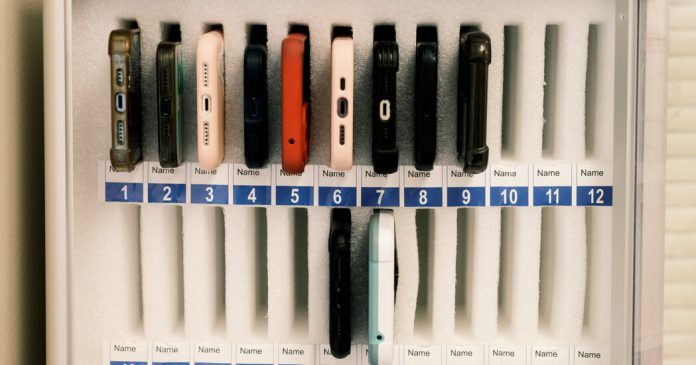
Surveillance has also intensified. To enforce the ban, Lyle Lake, a Timber Creek security officer, now patrols lunch period on a golf cart, nabbing students violating the ban and driving them to the front office, where they must place their phones in a locked cabinet for the rest of the school day.

“I usually end up with a cart full of students,” Mr. Lake said as he sat behind the wheel of a black Yamaha golf cart during lunch period, “because I pick up more on the way to the office.”

Mr. Lake said he also monitored school security camera feeds for students using cellphones in hallways and other spaces. Students who are caught may be taken out of class. Repeat violators can be suspended.

Whether the potential benefits of banning cellphones outweigh the costs of curbing students’ limited freedom is not yet known. What is clear is that such bans are upending the academic and social norms of a generation reared on cellphones.

Students, read the entire article and then tell us:

  • Should schools ban cellphones? Would you welcome a ban in your school? Why or why not? Did anything in the article change your thoughts on the growing trend?

  • How widespread is cellphone use at your school? How much do you use your phone during the school day? Do you think that phones interfere with your, or your peers’, academic learning, quality of social interactions and overall engagement in school?

  • Nikita McCaskill, a government teacher at Timber Creek High School who loves the new policy, stated, “Students are more talkative and more collaborative.” Which of the benefits of a cellphone ban discussed in the article do you find most appealing?

  • Many students, however, said the new rules made school more prisonlike. Others argued that the ban was infantilizing. Sophia Ferrara, a 12th grader at Timber Creek, noted: “They expect us to take responsibility for our own choices. But then they are taking away the ability for us to make a choice and to learn responsibility.” Which downsides described in the article concern you most?

  • What rules, if any, does your school have about cellphone use? How are they enforced? Do you think they are effective? What changes would you recommend to the current policy?

  • What, if anything, do you think is missing from this conversation? What do you think teachers, educators and parents may not understand about cellphones, especially how young people use them?

Time Change

0
Time Change

Sunday marked the end of Daylight Saving Time, where, in some parts of the world, including the United States, people set their clocks back an hour.

Do you look forward to this time of year, when it gets lighter earlier in the morning and darker earlier in the evening? Or do you dread it?

Do you have any rituals or practices that help you embrace the morning light? What about the evening darkness?

Tell us in the comments, then read the related article about people who love the end of Daylight Saving Time or one about how to make the most of the morning light.


Students 13 and older in the United States and Britain, and 16 and older elsewhere, are invited to comment. All comments are moderated by the Learning Network staff, but please keep in mind that once your comment is accepted, it will be made public and may appear in print.

Find more Picture Prompts here.

Word of the Day: onus

0
Word of the Day: onus

The word onus has appeared in 83 articles on NYTimes.com in the past year, including on Sept. 23 in the Opinion essay “We’re Teaching Music to Kids All Wrong” by Sammy Miller:

In my 15 years as a musical educator, talking to countless teachers, I’ve learned one thing: There is no magical fix. Making music education more successful doesn’t need to involve expensive digital accessories or fancy educational platforms (and I say that as someone who developed an online educational platform). There’s no technological or financial program that will convert children into lifelong music lovers.

Instead, we need to start by rethinking how we teach music from the ground up, both at home and in the classroom. The onus is on parents and educators to raise the next generation of lifelong musicians — not just for music’s sake but to build richer, more vibrant inner personal lives for our children and a more beautiful and expressive world.

Can you correctly use the word onus in a sentence?

Based on the definition and example provided, write a sentence using today’s Word of the Day and share it as a comment on this article. It is most important that your sentence makes sense and demonstrates that you understand the word’s definition, but we also encourage you to be creative and have fun.

Then, read some of the other sentences students have submitted and use the “Recommend” button to vote for two original sentences that stand out to you.

If you want a better idea of how onus can be used in a sentence, read these usage examples on Vocabulary.com.


Students ages 13 and older in the United States and the United Kingdom, and 16 and older elsewhere, can comment. All comments are moderated by the Learning Network staff.

The Word of the Day is provided by Vocabulary.com. Learn more and see usage examples across a range of subjects in the Vocabulary.com Dictionary. See every Word of the Day in this column.

Cybersecurity Career Spotlight: What it is and how to get started

0
Cybersecurity Career Spotlight: What it is and how to get started

Welcome to another special issue and our first Career Spotlight. This week, we’re exploring cybersecurity in celebration of the upcoming launch of the Microsoft Cybersecurity Analyst Professional Certificate.

Cybersecurity professionals protect data and computer networks from cyber attacks. There are several cybersecurity career paths, each of which is responsible for a different aspect of cybersecurity, like identifying threats, building secure systems, or responding to incidents. Cybersecurity analysts, and the closely related information security analysts, are typically the first line of defense against cybercrime, and these roles tend to be nice entry points for people looking to get into cybersecurity.

Since their expertise is important to any company that uses digital technologies, cybersecurity professionals are in demand. According to a 2022 study by the cybersecurity professional organization (ISC)², there are over 3.4 million unfilled cybersecurity positions worldwide. (That’s a 26.2 percent increase from the previous year.) According to a recent study from the National Initiative for Cybersecurity Education at NIST, CompTIA, and Lightcast, in the US, there are only 68 cybersecurity workers for every 100 open roles!

In fact, these professionals are in such high demand that employers may offer advanced training opportunities for entry- and mid-level employees in this field. Even better: cybersecurity salaries tend to be high.

If you’re thinking about transitioning into a cybersecurity role, IT, software engineering, software development, or computer science experience can help you stand out since you’ll be working within similar computer systems. But regardless of your past experience, you can start learning cybersecurity today.

Where to begin

Pre-enroll in the Microsoft Cybersecurity Analyst Professional Certificate to be among the first people to explore this new program. As a bonus, the first 2,500 learners who complete all courses in the series will receive 100% off the Microsoft SC-900 Certification Exam.

While you wait for the Microsoft program to launch, check out the University of Maryland’s crash course, Cybersecurity for Everyone, or revisit the equally exciting and highly-rated Cybersecurity Professional Certificates from Google and IBM.

Keep learning about careers in cybersecurity

If you want to know more about cybersecurity careers, these are our top three most popular guides:

  1. 10 Popular Cybersecurity Certifications
  2. 10 Cybersecurity Jobs: Entry-Level and Beyond
  3. 5 Cybersecurity Career Paths (and How to Get Started)

If you already have experience with software engineering, software development, or computer science, you may want to explore our guides on ethical hacking, security engineers, and security architects.

That’s all for this week. We’ll be back next week with a fresh series. Until then, which career would you like us to explore in our next career spotlight? Let us know in the comments!

What To Look For When Reading a Tech Job Description

0
What To Look For When Reading a Tech Job Description

When applying to jobs, how often do you read the job descriptions line by line?

Many people skim through them, reading just enough to make sure they qualify for the position before applying. We get it. Reading each and every job description can feel like a waste of time.

But, job descriptions actually hold a great deal of information. If you know what to look for, you can find insights into the company’s culture, your potential role, and even what to include in your resume to boost your chances of being called in for an interview.

Below, we’ll show you how to read a job description and use it to optimize your resume. Then, we’ll show you how to prepare for the next steps of the job-hunting process.

How to read a tech job description

The first step in reading a job description is discerning what’s required from what’s desired. Anything listed as a requirement is a must-have — especially when it comes to technical skills.

For example, if a company has knowledge of C++ as a requirement, they’re specifically looking for candidates who are comfortable with that language. The same goes for JavaScript and other languages. In many cases, they may already have some applications written in that language, and for you to help maintain or improve them, you’ll need to be familiar with it.

Still, not having certain skills isn’t always a deal-breaker, especially if they’re listed as “preferred” or as “a plus.”

Say a job description lists Java as a requirement and JavaScript as preferred. Even if you’re only familiar with the former, you might still be an eligible candidate for the position.

Also, remember that skill requirements are usually listed in order of priority. So, you may want to focus on job descriptions with your stronger skills listed towards the top of the qualifications section.

Insights into the role

Job descriptions can also give you some insight into what you can expect while working at the company. For example:

  • Look for how the word “team” is used. In some positions, you fly solo most of the time — but if you see the word team incorporated into the lists of daily duties, you’ll likely be working in a highly team-oriented atmosphere.
  • Pay attention to the technologies they list. They’ll often give you some insight into what you’ll be doing on the job. If SQL is listed, you may be working with databases. If Swift is listed, you’ll most likely be developing for Apple devices.
  • Check to see who you’ll be reporting to. Working on solutions is only part of the job. Your work has to be approved, and knowing how many people have to give you the thumbs up may help you get a good grasp on your workflow. For example, if you’re reporting to a director, and the company is under 50 people, you can assume that there are likely only 1-3 stakeholders when it comes to your daily work.

Insights into the company culture

A job description is typically a wide-open window into the company’s culture. It may even include things that you can’t find on its website or in articles about the organization. Human resources or other managers who write job descriptions may include interesting details such as:

  • Annual company retreats
  • Volunteer work employees do in the community
  • Happy hours with complimentary food and beverages
  • Info about rec rooms with pool, ping pong, or other games
  • A gym
  • On-site cafeteria
  • Food delivery services

As you read through the job description, keep an eye out for requirements like “thrive in a fast-paced environment” or “must be able to juggle multiple projects at once.” Phrases like this might indicate a growth mindset at the company, and if you prefer work environments that are a little less hectic, you might want to consider another role.

Insights into the interview process

One of the key insights into the interview process you can get from the job description is who you’ll be reporting to. You may not know how many interviews you’ll have, but you can rest assured that until you sit down with the person you’ll be reporting to, there’ll be at least one more face-to-face or phone interview before they pick you for the job.

Some companies will outline the interview process, step-by-step, right on the job description. They may also list who your primary point of contact will be.

How to know if you should apply

According to Madison Olson, Codecademy’s Manager of Technical Recruiting, you don’t have to have all of the listed skills on a job description to apply. As she put it:

“Most job descriptions are split into ‘must-haves’ and ‘nice to haves.’ If you meet some of the key must-haves along with some of the nice to haves, it doesn’t hurt to apply.”

Similarly, you also don’t have to meet the exact experience requirements outlined in the job description. This doesn’t mean you should apply for a senior position if you’re just starting out. But, if you have the same general amount of experience or you’re only a year or two shy, consider throwing your hat in the ring.

Applicant tracking systems and resume optimization

Job descriptions are also a valuable resource for optimizing your resume. Companies often receive dozens (if not hundreds) of applications for open positions, and recruiters just don’t have the time to go through each one. So, many rely on applicant tracking systems (ATS).

According to Jobscan, 99% of Fortune 500 companies use ATS because they help streamline the recruiting process by screening job applications and resumes.

Many ATS use natural language processing, machine learning, and AI to analyze and rank candidates by how well their resumes match the job description. If your resume doesn’t include the keywords the ATS is looking for, there’s a good chance that the recruiter won’t even see it.

This is why you should tailor your resume for every position you apply to — or at least the jobs you’re really excited about. It might seem tedious, but taking the time to make sure your resume reflects the skills and requirements outlined in the job description will help maximize your chances of being called in for an interview.

Having the right keywords in your resume will also show recruiters that you’re serious about your application and not just applying to anything that might be a good fit. If you’re applying for a job as a Mobile Developer but Kotlin and Swift aren’t listed in your resume — how will they know you’ve got the right skills?

While sharing tips for improving your developer resume, Jovanay Carter, an Associate Recruiter with Codecademy, recommends:

“[Being] prepared for and intentional about the roles you’re applying for. You have to somehow demonstrate in your experiences, cover letter, or resume, that this is actually what you want.”

Preparing for the next steps

While knowing how to read a job description is important, applying is just the first step toward getting the job. Once you hear back from the company, it’s time to start preparing for the interview process.

Depending on the role you’re applying for, the interview process might consist of two parts: behavioral and technical interviews. Behavioral interviews are those you’re probably familiar with, in which your interviewer asks questions about your past roles and experiences.

Technical interviews, on the other hand, assess your proficiency with some of the technical skills outlined in the job posting. You might be given a coding problem to solve or asked about the inner workings of various programming languages and other tools. Technical interviews are your chance to showcase your skills and problem-solving ability and ultimately prove you’re the best choice for the role.

So, it goes without saying that you’ll want to bring your A-game. We offer several resources that’ll help you prepare for your upcoming technical interviews, including courses like:

  1. Pass the technical interview with Java
  2. Pass the technical interview with Python
  3. Pass the technical interview with JavaScript

On our Interview Prep page, you’ll also find tips and insights from professional developers, a complete guide to acing technical interviews, and more.

Or, if you need a little more help with the overall job-hunting process, check out our Career Center. You’ll find helpful resources that’ll help propel you along every step of the way, such as:

  • Tips from recruiters about what they’re looking for in candidates in your field.
  • Workspaces, which you can use to code independently and build your own mini-projects.
  • Code Challenges — real technical interview assessments pulled from top companies to help you prepare.

Ready to get started? Sign up now! For students, click here.

6 High-Paying Jobs You Can Get Without a Degree

0
6 High-Paying Jobs You Can Get Without a Degree

The days of needing a degree to make a decent salary in tech are coming to an end. Modern employers are often more interested in the skills and experience someone has than the school they graduated from. In other words, you can launch your career in development after taking a couple of online programming courses.

But how do you know which path to take? Which programming languages do you need to learn? To help you figure it out, we’ll explore six high-paying jobs you can get without a degree, what each job entails, and the skills you need to get started.

Learn something new for free

1. Front-End Web Developer

A Front-End Web Developer focuses on creating the interfaces users use to interact with an application. This often includes designing the layout and specific functions that users will engage with regularly. To do so, Front-End Developers need to have a strong understanding of user needs. They also understand basic design principles and the programming languages needed to build websites, like HTML, JavaScript, and CSS.

Even though a Front-End Developer may not use the languages involved in back-end programming, they still need to understand the capabilities of back-end structures and the essentials of how their technologies work. On average, Front-End Developers can expect an annual salary of $112,550 in the U.S. You can get started learning all the technical skills you need to pursue this career in our Front-End Engineer path.

2. Back-End Web Developer

A Back-End Web Developer uses tools like SQL and Node.js to design and implement the systems and resources that support the front end of an application. While much of their work may go “unseen,” effective back-end development is crucial to an optimal user experience.

Back-End Developers work on systems that enable parsing, scraping, processing, visualizing, and analyzing data. They also develop the databases that store an application’s information. In the U.S., the average salary for an experienced Back-End Developer is $160,139.

3. Full-Stack Web Developer

A Full-Stack Web Developer takes care of all elements of the development process. They have to be well-versed in both front-end and back-end development principles and tools. Clients or companies may call on Full-Stack Developers to design apps from scratch, either with the help of a team or on their own. Or, they may be asked to troubleshoot or improve an existing application.

At times, Full-Stack Developers help address vulnerabilities in web apps after a Cybersecurity Specialist discovers an issue. Like Front-End and Back-End Developers, experienced Full-Stack Developers can expect a six-figure salary, with an average of $128,023 in the U.S.

4. IT Manager

An IT Manager earns about $94,886 per year in the U.S. and performs various tasks, all of which involve ensuring the IT team accomplishes the organization’s goals. An IT Manager may report to the CIO of a company, and, as a result, they need to be able to keep high-level concepts clearly in mind as they manage their teams.

To fulfill their responsibilities, an IT Manager needs a solid background in the technologies and tools that drive the IT process. This allows them to develop actionable solutions to any issues that may come up.

5. Computer Software Engineer

A Computer Software Engineer makes around $117,840 a year in the U.S. and develops, builds, implements, and maintains software solutions for organizations. Unlike Web Developers, they’re often involved in the first phases of an application’s ideation, connecting the technologies available to the problems they have to solve. As a result, a Computer Software Engineer has to be comfortable interacting with management and other executives and working with a team in the development process.

Along with conceiving and managing projects, a Computer Software Engineer has to code solutions, ensuring they contribute to the project’s objectives or the organization’s goals. This requires knowledge of multiple coding languages and testing.

6. Cybersecurity Specialist

In the U.S., a Cybersecurity Specialist earns around $111,678 a year. They’re in charge of ensuring the safety of a company’s digital assets, including everything connected to its network, both on-premises and remotely.

A Cybersecurity Specialist needs to use multiple tools designed to bolster an organization’s defenses. Some of these tools include firewalls and anti-malware software. You can learn the basics in our course Introduction to Cybersecurity.

Firewalls inspect the data coming into and flowing out of a network or device to see if it contains threats. Anti-malware software can detect and discard data packets and files that have malware. Along with the other tools in a Cybersecurity Specialist’s toolkit, firewalls and anti-malware help Cybersecurity Specialist’s keep their digital assets secure.

While a college degree can be helpful, finding high-paying jobs without a degree is no longer as hard as it once was. In any of the positions above, you can expect a decent income and exciting challenges.

If you find yourself drawn to web development after reading this article, check out our career paths. Each path is designed to teach you the skills and knowledge you’ll need to land an entry-level position. We’ll even guide you through your job search by helping you build a portfolio, providing a certificate you can feature in your resume, and sharing tips for your future interviews.

But what if you’d rather be an IT Manager or Computer Software Engineer? Both roles require a solid understanding of programming, so our Computer Science path might be right for you. We’ll teach you the fundamental concepts of programming, and you’ll also learn how to use Python — one of the most popular and versatile programming languages.

Lastly, if you love the idea of helping people and businesses protect their data, learn more about the field with our introduction to cybersecurity course.

This blog was originally published in July 2021 and has been updated to include the most recent salary data.

Weekly Student News Quiz: Gaza Strip, Matthew Perry, World Series

0
Weekly Student News Quiz: Gaza Strip, Matthew Perry, World Series

Have you been paying attention to the news recently? See how many of these 10 questions you can get right.

Would You Take Mental Health Advice From TikTok?

0
Would You Take Mental Health Advice From TikTok?

Think about the advice you have seen on TikTok or other social media platforms. How often do you find these tips — whether they are about health, relationships, skin care, fashion, fitness or anything else — helpful? How often do you question if they are based on fact? How much do you care about whether the people creating the content identify as experts, or at least have a background in what they’re talking about?

Are there instances in which an influencer’s credentials matter more than others? For example, do you think it matters if someone talking about depression or anxiety is a mental health professional? Or is it just as valid to be speaking from one’s lived experience?

Earlier this year, a group of researchers from the T.H. Chan School of Public Health at Harvard University assembled a group of mental health influencers who collectively had an audience of 10 million followers. They attended lectures and received tool kits on mental health as part of an experiment to determine whether influencers could be persuaded to disseminate more evidence-based information on social media.

In “Harvard Cozies Up to #MentalHealth TikTok,” Ellen Barry explains the thinking behind the study:

The surgeon general has described the mental health of young people in America as “the defining public health crisis of our time.” For this vulnerable, hard-to-reach population, social media serves as a primary source of information. And so, for a few months this spring, the influencers became part of a field experiment, in which social scientists attempted to inject evidence-based content into their feeds.

“People are looking for information, and the things that they are watching are TikTok and Instagram and YouTube,” said Amanda Yarnell, senior director of the Chan School’s Center for Health Communication. “Who are the media gatekeepers in those areas? Those are these creators. So we were looking at, how do we map onto that new reality?”

The article continues:

Many academics take a dim view of mental health TikTok, viewing it as a Wild West of unscientific advice and overgeneralization. Social media, researchers have found, often undermines established medical guidelines, warning viewers off evidence-based treatments like cognitive behavioral therapy or antidepressants, while boosting interest in risky, untested approaches like semen retention.

TikTok, which has grappled with how to moderate such content, said recently that it would direct users searching for a range of conditions like depression or anxiety to information from the National Institute of Mental Health and the Cleveland Clinic.

At their worst, researchers said, social media feeds can serve as a dark echo chamber, barraging vulnerable young people with messages about self-harm or eating disorders.

“Your heart just sinks,” said Corey H. Basch, a professor of public health from William Paterson University who led a 2022 study analyzing 100 TikTok videos with the hashtag #mentalhealth.

“If you’re feeling low and you have a dismal outlook, and for some reason that’s what you are drawn to, you will go down this rabbit hole,” she said. “And you could just sit there for hours watching videos of people who just want to die.”

Ms. Basch doubted that content creators could prove to be useful partners for public health. “Influencers are in the business of making money for their content,” she said.

Ms. Yarnell does not share this opinion. A chemist who pivoted to journalism, she found TikTok “a rich and exciting place” for scientists. She views influencers — she prefers the more respectful term “creators” — not as click-hungry amateurs but as independent media companies, making careful choices about partnerships and, at times, being motivated by altruism.

In addition, she said, they are good at what they do. “They understand what their audience needs,” Ms. Yarnell said. “They’ve done a huge amount of storytelling that has allowed stigma to fall away. They have been a huge part of convincing people to talk about different mental health concerns. They are a perfect translation partner.”

Students, read the entire article and then tell us:

  • Have you encountered mental health information on TikTok or other social media platforms? If so, what has been your experience? Have you found the information and advice there helpful? Or have you ever found yourself down an unsettling, perhaps even dangerous, rabbit hole?

  • Do you ever struggle to separate good mental health advice from bad online? What would make you trust someone who is sharing mental health information on social media? What would make you not trust that person?

  • What is your reaction to Harvard’s experiment? Do you think attempting to “inject evidence-based content” into young people’s social media feeds is a good way to address the youth mental health crisis? Why or why not?

  • Did the scientists’ reasons for doing this work reflect your experiences with social media? Do you think that people more often look to influencers for information, instead of approaching professionals, like licensed therapists? Why do you think that is?

  • Do you think that if mental health experts began posting videos on TikTok, they would soon have large audiences? What would they need to do, or perhaps not do, to reach the people they want to help?


Students 13 and older in the United States and Britain, and 16 and older elsewhere, are invited to comment. All comments are moderated by the Learning Network staff, but please keep in mind that once your comment is accepted, it will be made public and may appear in print.

Find more Student Opinion questions here. Teachers, check out this guide to learn how you can incorporate these prompts into your classroom.

Word of the Day: bafflement

0
Word of the Day: bafflement

The word bafflement has appeared in 25 articles on NYTimes.com in the past year, including on Oct. 24 in “Is Roz Chast ‘Terrible at Decorating’? You Decide” by Joanne Kaufman:

Soon after the couple moved in, Ms. Chast’s mother-in-law, a kitchen planner, drew up designs to take down a wall and combine the kitchen and dining room. New glass-fronted cabinets, painted a pale lilac, were installed. Later, a computer room replaced the screened porch. “It just wasn’t us,” Ms. Chast said. “Not the porch. Not the screens. None of that was us.”

Each to her own, of course. Despite the existence of an actual living room, the previous owners, to Ms. Chast’s endless bafflement, routinely gathered in a small, unprepossessing space off the kitchen. It is now home to parrots Eli, an African gray, and Jacky, a Caique.

Can you correctly use the word bafflement in a sentence?

Based on the definition and example provided, write a sentence using today’s Word of the Day and share it as a comment on this article. It is most important that your sentence makes sense and demonstrates that you understand the word’s definition, but we also encourage you to be creative and have fun.

Then, read some of the other sentences students have submitted and use the “Recommend” button to vote for two original sentences that stand out to you.

If you want a better idea of how bafflement can be used in a sentence, read these usage examples on Vocabulary.com.


Students ages 13 and older in the United States and the United Kingdom, and 16 and older elsewhere, can comment. All comments are moderated by the Learning Network staff.

The Word of the Day is provided by Vocabulary.com. Learn more and see usage examples across a range of subjects in the Vocabulary.com Dictionary. See every Word of the Day in this column.

What’s Going On in This Picture? | Nov. 6, 2023

0
What’s Going On in This Picture? | Nov. 6, 2023

1. After looking closely at the image above (or at the full-size image), think about these three questions:

2. Next, join the conversation by clicking on the comment button and posting in the box that opens on the right. (Students 13 and older are invited to comment, although teachers of younger students are welcome to post what their students have to say.)

3. After you have posted, try reading back to see what others have said, then respond to someone else by posting another comment. Use the “Reply” button or the @ symbol to address that student directly.

Each Monday, our collaborator, Visual Thinking Strategies, will facilitate a discussion from 9 a.m. to 2 p.m. Eastern time by paraphrasing comments and linking to responses to help students’ understanding go deeper. You might use their responses as models for your own.

4. On Thursday afternoons, we will reveal at the bottom of this post more information about the photo. How does reading the caption and learning its back story help you see the image differently?

We’ll post more information here on Thursday afternoon. Stay tuned!


More?

• See all images in this series or slide shows of 40 of our favorite images — or 40 more.

• Learn more about this feature in this video, and discover how and why other teachers are using it in their classrooms in our on-demand webinar.

• Find out how teachers can be trained in the Visual Thinking Strategies facilitation method.

Students 13 and older in the United States and the Britain, and 16 and older elsewhere, are invited to comment. All comments are moderated by the Learning Network staff, but please keep in mind that once your comment is accepted, it will be made public.