It took a while to process, but I slowly accepted it, and came to a realization. I may not get the role this year, or on this stage, but there are hundreds of stages. This is not the stage where I will play my dream role, but there are thousands of roles, even more opportunities. I won’t let one year get to me, and use this as time to encourage myself to audition more, to continue improving, and overall, to keep moving forward.
“If you’re playing hard, you’re prone to making mistakes.”
I am a part of the Science Hill volleyball team, and sadly the season ended recently due to a sub-state loss. It was a hard game, knowing it would be the last game of the season if we couldn’t pull out a win. The intensity of the match made the atmosphere feel as though failure was not an option. Anything to a hitting error, blocking error, or serving error: it felt as if it wasn’t allowed. I made a few mistakes that game, and it hurt to know that those mistakes impacted a crucial game. Coach Cook, our volleyball coach, will always say, “If you’re playing hard, you’re prone to making mistakes.” I take this with me when it comes to playing on the court, and life lessons in general. The power of that sentence drives me to keep playing hard, even when I am experiencing a tough game. I feel as though it helped everyone on the court, because no matter what, our foot was on the petal.
Criticism “will help you become better in the long run.”
I have learned many valuable lessons from failure and the most important one is that you need to be open to others’ criticism and opinions because they will help you become better in the long run. Last year I had to write an argumentative essay for English and I remember finishing it and thinking it was the best essay I had ever written. So I showed it to my teacher and I was sure it was going to be the best thing they had ever read. I was very wrong. My teacher spent about 30 minutes ripping my essay apart and I had to rewrite the entire thing. I was very frustrated with my teacher and wished I hadn’t shown them at the time. Looking back now, if I hadn’t shown my teacher my essay my grade would have suffered and it wouldn’t have pushed me to strengthen my argument and improve my writing skills. This experience has made me more open to people’s criticism and allowed them to help me improve.
Failure is “not as big of a deal I believed it to be.”
I have majorly failed a test before, when I set out to get a 90-100, meanwhile I got less than a 60. I was extremely embarrassed and upset about this fail. Looking back, I realize that it was not as big of a deal I believed it to be, and I learned to be kinder about not doing as well as I wanted. I also learned how to study better from this failure and did much better on the next test. The strategy listed that helps the most is putting my failure into context, and realizing in the grand scheme failing a test is not irrevocable.
From a sports perspective, sometimes you try your absolute best, give it your all, and you still fail simply because someone else is better. The same can be true for everyday life. However, getting second, third, or even last place is only failing if you view it in that way. If you know for certain that you did the best you possibly could, then you’re had a personal win. Failure only has the power that you give it.
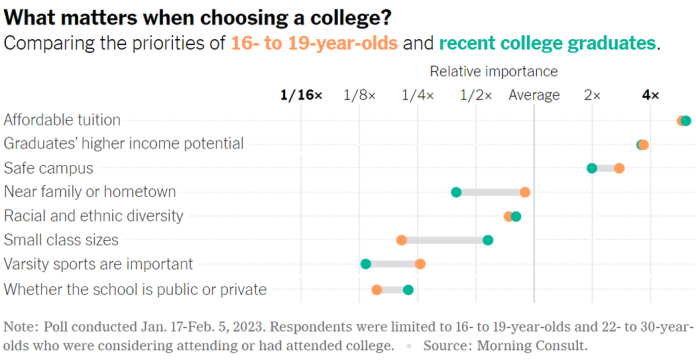
Note: A live moderated discussion of this graph will take place on Nov. 8.
The New York Times and Morning Consult surveyed 2,000 young people between the ages of 16 and 19 and another 2,000 college graduates between the ages of 22 and 30 earlier this year. They asked about the importance of 22 criteria for selecting a college. The results of the poll for eight of these criteria are displayed in the graph.
1. After looking closely at the graph above (or at this full-size image), answer these four questions:
The questions are intended to build on one another, so try to answer them in order.
2. Next, join the conversation online by clicking on the comment button and posting in the box. (Teachers of students younger than 13 are welcome to post their students’ responses.)
3. Below the response box, there is an option to click on “Email me when my comment is published.” This sends the link to your response which you can share with your teacher.
4. After you have posted, read what others have said, then respond to someone else by posting a comment. Use the “Reply” button to address that student directly.
On Wednesday, Nov. 8, teachers from our collaborator, the American Statistical Association, will facilitate this discussion from 9 a.m. to 2 p.m. Eastern time.
5. By Friday morning, Nov. 10, we will reveal more information about the graph, including a free link to the article that includes this graph, at the bottom of this post. We encourage you to post additional comments based on the article, possibly using statistical terms defined in the Stat Nuggets.
Reveal
We’ll post more information here on Thursday afternoon. Stay tuned!
• Learn more about the notice and wonder teaching strategy from this 5-minute video and how and why other teachers are using this strategy from our on-demand webinar.
• Sign up for our free weekly Learning Network newsletter so you never miss a graph. Graphs are always released by the Friday before the Wednesday live moderation to give teachers time to plan ahead.
• Go to the American Statistical Association K-12 website, which includes teacher statistics resources, Census in the Schools student-generated data, professional development opportunities, and more.
Students 13 and older in the United States and the Britain, and 16 and older elsewhere, are invited to comment. All comments are moderated by the Learning Network staff, but please keep in mind that once your comment is accepted, it will be made public.
If you’ve ever worked on a project that was led by a project manager, you might’ve marveled at how they stay so organized, maintain calm in high-pressure situations, and keep everyone on schedule. Project managers use a variety of skills and processes to plan and oversee a project’s many moving pieces and keep things running smoothly. And while some people have a natural inclination towards organization and structure, these are also skills that you can learn and develop on your own.
No matter your role or experience, honing project management skills can help you work more effectively. “Knowing how to break a project down into the steps that need to get done and who needs to do those steps — even if it’s just yourself and one other person — is transferrable to almost anything anyone needs to do,” says Maygen Keller, Senior Project Manager at Codecademy.
Before joining Codecademy, Maygen worked as a Stage Manager for theaters in Illinois, Wisconsin, and Minnesota. Theater work lends itself well to most other industries since it involves collaborating with many other people, she says. The skills she developed as a Stage Manager translated directly into her current role in tech. Ahead, Maygen highlights three project management skills that will help you keep your assignments on track, be a standout contributor, and maintain motivation to reach your individual goals.
Learn something new for free
Communication
Project managers need to synthesize tons of information for different audiences and stakeholders. For example, Maygen regularly meets with our curriculum developers, the experts who create lessons and content for courses and paths, and our marketing team that promotes the content. “I have to be involved in conversations where various experts are coming together to strategize,” she says. “But I also have to be the expert on the project as I’m talking to stakeholders who aren’t experts and don’t really need all of the information.”
Knowing how to diversify your messaging according to your audience is a key skill in any job, and it’s crucial as you start taking on more leadership roles. Here are a few examples of how this might look in different tech roles:
A lead designer providing features and layouts to be built for a website to the design team and explaining how these choices will influence conversion rates to the wider company.
A content marketer providing assignments to a team of freelancers and explaining to their manager how the resulting articles will help them appeal to audiences with relevant interests.
A product manager making a case for developing a new app feature and proposing a budget and timeline to the CEO.
Problem-solving
Managing one person’s workload is a full-time job, let alone multiple people’s responsibilities, which is why project managers need strong critical thinking and problem-solving skills. These skills help with breaking a project down into specific tasks, allocating resources, setting timelines, and removing barriers so team members can fulfill their requirements. “People often find that administrative things distract them from the work they actually do,” Maygen says. “I like to look at it as getting things out of the way so people can focus on what they’re there to do.”
Want to learn effective problem-solving strategies? Sign up for our upcoming soft skills session on November 9. A management and leadership expert will break down the essentials of creative problem solving and show you how to present your ideas and information with impact.
Empathy
At the core of all the deadlines and moving pieces are real people with emotions, external stressors, and lives outside of work. “You have to find risks and blockers, and it’s all very analytical and tactical so it’s easy to lose the humanity of it,” Maygen says. “The classic example is that human beings are often referred to as resources in the project management world, which is so dehumanizing.”
Of course, the group of people involved in a project are much more than just resources, which is why humanity and empathy are crucial to effective project management, Maygen says. Effective project managers assign people to the work that suits them best, and they’re also mindful of the human element and remain conscientious of their team’s needs.
For example, a big part of a project manager’s job is to identify blockers and come up with solutions. “A blocker doesn’t have to be technical,” Maygen says. “You could be really sick, or have trouble context switching, or just have too much on your plate. Those are all very real reasons why a project could be delayed.”
Build your project management skills
If you want a full sense of a project manager’s responsibilities and the methods they use to fulfill them, Maygen suggests talking to (or shadowing) a project manager you know. Even if they’re not in your industry, you can learn a lot about the career and what it takes to succeed. You can also seek out opportunities to take on project manager responsibilities without the official title of project manager. For example, volunteer to formalize a process for your team or introduce a new way to manage calendars and deadlines. Start learning the ins and outs of project management in our free course Introduction to Project Management.
And if you need help building your communication, problem-solving, and empathy skills, don’t forget to sign up for our upcoming three-part soft skills series. We’ll explore the most important soft skills you need for a tech career and teach you how to start building and practicing them. In the second session on November 9, we’ll show you how to effectively plan and prioritize tasks for the next project you participate in or manage.
As sea levels rise and storms worsen, threatening the planet’s coastlines, some architects and developers are looking to “push cities into the water” by creating floating homes and other structures.
Would you live in a floating home? What do you imagine it would be like? What do you think about a future of cities built offshore, complete with floating houses, offices and parks?
What could be the benefits, both for you personally and for society, of living on the water? What could be the drawbacks?
Tell us in the comments, then read the related article to learn more about the developers who are eyeing the water as the next frontier.
Students 13 and older in the United States and Britain, and 16 and older elsewhere, are invited to comment. All comments are moderated by the Learning Network staff, but please keep in mind that once your comment is accepted, it will be made public and may appear in print.
Meet Ousmane: The Government Worker with a Thirst for Knowledge
Ousmane Dienne lives in Senegal and works for the government. He was introduced to Alison by his brother while studying English at university.
Learning on Alison has helped him polish his English skills, especially in listening, reading, and speaking. He believes that the knowledge he gained from our courses went well beyond what he was learning in his university classes.
The World at Your Fingertips: Ousmane’s View on Alison’s Offerings
Before long, Ousmane discovered that our courses go beyond language learning; our platform has loads of different subjects. From IT to Health and Business to Engineering, we have something for everyone.
Ousmane wants everyone to embrace online learning and to check out our free online courses. In his eyes, it’s a golden chance to learn something new.
Watch the video below to see how Alison empowered Ousmane:
If you, like Ousmane, are looking to learn new skills or polish the ones you already have, join Alison and get access to thousands of free courses and professional tools.
Do you make wishes on stars? Or celebrate tiny milestones, such as finishing your homework for the night or completing a workout? Or say or do the same thing in the same way every time you greet a particular friend or family member?
If you do, you shouldn’t be embarrassed. According to experts, little rituals like this add richness to our lives and are good for our mental health.
My husband and I have developed a little ritual over the years. When one of us takes a trip, the other will make enchiladas when we’re reunited.
We’ve been making “Welcome Home Enchiladas” for so long that we can’t remember how it started (or why they must be chicken and green chile). But I look forward to them every time I go away.
Rituals, large and small, have existed throughout human history, said Dimitris Xygalatas, a professor of anthropology at the University of Connecticut and author of “Ritual: How Seemingly Senseless Acts Make Life Worth Living.” From handshakes to wishes on a star, he said, rituals are acts regularly repeated in a specific manner (unlike traditions, which are customs or beliefs passed from one generation to the next).
Rituals can be religious or secular; they can range from traditional to offbeat. But even the small ones add richness to our lives, said Michael Norton, a professor of business administration at Harvard and author of the upcoming book “The Ritual Effect: From Habit to Ritual, Harness the Surprising Power of Everyday Actions.”
The beauty of establishing a ritual is that it’s easy. You simply decide to do it. Here’s how.
She then goes on to suggest several ways to create your own meaningful rituals by being creative and considering overlooked milestones and events.
Students, read the entire article and then tell us:
Do you have a few “oddball rituals” you already observe, either on your own or with others? What are they, and why and when do you practice them?
What do they do for you? For instance, do they deepen your relationships or help you feel more in control? Why do you think you value them?
Where did your favorite rituals come from? Did you grow up observing them with your parents or siblings? Have you invented any with friends or with a significant other? As part of a team or club? Do any of the rituals you observe have an interesting origin story?
This article invites you to be creative and create new rituals. What ritual might you start practicing, whether to mark a tiny milestone, to celebrate something tiny you think needs attention, to strengthen a relationship or for any other reason? If you don’t have ideas yet, you might take a look at what others have posted. Might one of those ideas work for you? Why?
Students 13 and older in the United States and Britain, and 16 and older elsewhere, are invited to comment. All comments are moderated by the Learning Network staff, but please keep in mind that once your comment is accepted, it will be made public and may appear in print.
What do you think this image is saying? How does it relate to or comment on society or current events? Can you relate to it personally? What is your opinion of its message?
Tell us in the comments, then read the related essay to learn more.
Students 13 and older in the United States and Britain, and 16 and older elsewhere, are invited to comment. All comments are moderated by the Learning Network staff, but please keep in mind that once your comment is accepted, it will be made public and may appear in print.
The word reproof has appeared in five articles on NYTimes.com in the past year, including on Sept. 23 in the Opinion essay “What Thoreau Heard in the Song of the Crickets” by Lewis Hyde:
In the last few years I’ve been working on a book about hunting for butterflies and, for companionship, I’ve been reading the classic nature writers, especially the 19th-century philosopher Henry David Thoreau. The author of “Walden,” it turns out, has little to say about butterflies but, to my surprise, lots to say about crickets and their song, so much so that when I gathered his journal’s many scattered remarks about them what emerged was a sort of modern, American fable.
… It all seems quite hurried, the way each season must fall forward into the next until the final freeze. In May 1854, when Thoreau hears the year’s first cricket, it makes him think not of new birth but of “lateness.” That entry in his journal comes a few months before “Walden” was to be published and Thoreau was a man trying to finish a job. “What have we done with our talent?” reads an entry from the previous August. “The sound of the crickets, even in the spring, makes our hearts beat with its awful reproof … The year is full of warnings of its shortness, as is life.”
Daily Word Challenge
Can you correctly use the word reproof in a sentence?
Based on the definition and example provided, write a sentence using today’s Word of the Day and share it as a comment on this article. It is most important that your sentence makes sense and demonstrates that you understand the word’s definition, but we also encourage you to be creative and have fun.
Then, read some of the other sentences students have submitted and use the “Recommend” button to vote for two original sentences that stand out to you.
If you want a better idea of how reproof can be used in a sentence, read these usage examples on Vocabulary.com.
Students ages 13 and older in the United States and the United Kingdom, and 16 and older elsewhere, can comment. All comments are moderated by the Learning Network staff.
Learning to code so that you can land a job in tech can feel daunting. That’s why we’re sharing inspiring stories from Codecademy’s community — to show how people like you (yes, you!) can embark on a learning journey and end up with a totally new career. We hope these stories serve as a reminder that there’s no single path to a more fulfilling work life.
Today’s story is from Bobby Velasco, a 39-year-old Senior Front-End Engineer at the technology consulting company ICF, living in San Diego, California. Read more stories from Codecademy learners here — and be sure to share your story here.
Why I chose to learn to code
“I started off in my coding journey back in the day when Objective-C was used for iOS development. I tried learning to code from a book, and it got hard really quick, so I gave up. In 2014, a friend of mine told me about Codecademy. He said: ‘You should learn web development. You can start slow, work at your own pace, and they have free lessons so you can teach yourself.’
I was working in the restaurant industry at the time and looking for something new to do. I never thought it would be coding because I didn’t think I had the right personality for coding. As soon as I jumped on Codecademy and started learning the basics of web development I realized it’s pretty approachable. One of the biggest challenges at first is sucking and learning how to get yourself unstuck or where to find resources to keep pushing forward.”
Learn something new for free
How I made time to learn
“I would do some lessons in the morning when I got up, and then if I wasn’t too tired, I would go back at it after work. With Codecademy, I wanted to have a foundation in order to feel confident enough to start applying to a web development JavaScript bootcamp. Codecademy was there to facilitate that whole process. I really leveraged the JavaScript lessons because you had to have already taught yourself a foundation of the language to apply.
Codecademy used to have something called Codecademy Labs, which was in-person Saturday meetups. I was part of the beta in Los Angeles in 2015, and it was what gave me confidence to keep going. Doing the Codecademy lessons on your own, there’s a community if you get stuck or need help, but meeting people who are like-minded, who are either just curious or want to make a career change, is very positive. I still keep in contact with some of those classmates on LinkedIn who have moved on to bigger and better things and changed their lives because of that program.”
Want to meet other learners and connect with the Codecademy community?
“I had been applying to jobs online and trying to leverage my network on LinkedIn. Finally, somebody in my network got me an introduction with the CTO of a startup called Soothe. They needed somebody to come in and help their marketing team and they were willing to take me on as a three-month ‘contract to hire.’ I got hired within two months just because I worked my tail off.
I got a title of Product Marketing Engineer, and I started doing anything I could get my hands on to get more experience. I just kept on learning and more opportunities kept getting thrown at me to do front-end engineering work, and some back-end tasks. I was hungry to get experience, and they allowed me to build the confidence and the skill set. I was there for five years, and when I left, I was in charge of the entire web front end.”
How long it took me to land a job
“After Soothe, I worked for a company called Backer for two years. Unfortunately, they weren’t able to raise funding this past winter, so some people got laid off. It was a pretty crappy thing to get laid off — I wasn’t expecting it. But I told myself: You have to see this as an opportunity.Sulk for a day or whatever but move on because you can make it a positive experience.
I got maybe three or four referrals, but I was on LinkedIn seven days a week. There’d be a job posted an hour ago and it has like 500 applicants. How do you compete with that? I was using every resource possible. I was kind of resistant at the beginning, but now I use AI to search for jobs and to help with my interview prep.
I would just try to tell myself: Everybody starts somewhere, and everybody has knowledge gaps. You have to humble yourself to either ask for help or figure out the way to get over that hurdle.
Bobby Velasco
Senior Front-End Engineer at ICF
Lots of people were in the same boat as me, but it still can be mentally taxing because there’s so much competition in the job market. I’ve had two or three final round interviews and thought I had it — and just it didn’t pan out. I told myself very early on to not get so excited about too many opportunities, because you never know what’s going to happen. You can even get the job and then have it taken away because they lose funding or need to downsize. I try to see it more as a marathon than a sprint.”
Some great news!
In late September, six months after being laid off, Bobby accepted an offer as a Senior Front-End Engineer at ICF.
How I nailed the interview
“The first couple of jobs I applied for when I was starting my career, I was really focusing a lot on learning algorithms and data structures as a first-layer barrier to get to the next interview. Now that I’m more mid-to-senior level, I get asked more architectural and systems designs questions. [Hiring managers] can tell immediately by just talking to you whether you’re competent in what you’re doing just by the way you speak. It’s definitely a relief that I don’t have to sit there and grind on algorithms, because that’s my least favorite part of the whole job hunt.”
Do you struggle with communication and public speaking?
We just launched soft skills training courses for Codecademy Pro and Plus members where you’ll learn problem-solving strategies, organizational techniques, and communication hacks. Register for the exclusive livestream soft skills series taking place in November.
How day one and beyond went
“After getting the written offer and accepting, I didn’t allow myself to celebrate. I was in the middle of interviewing with two other companies. One ended up canceling the final round and halting hiring for the position. I didn’t get to the final round for the other company.
Only at the end of my first week at ICF when I was signing up for benefits did it seem real. I finally let myself relax and celebrate. My wife was a tremendous strength throughout my time on the job hunt! I’m immensely grateful for all of her love and support.”
What I wish I knew before I started learning
“Don’t try to memorize everything; the internet is your resource. My first year on the job, I had tremendous impostor syndrome. I would just try to tell myself: Everybody starts somewhere, and everybody has knowledge gaps. You have to humble yourself to either ask for help or figure out the way to get over that hurdle. You’re never going to know everything because the technologies are always evolving. Be comfortable with being uncomfortable.”
Not sure where to start? Check out our personality quiz! We’ll help you find the best programming language to learn based on your strengths and interests.
Want to share your Codecademy learner story? Drop us a line here. And don’t forget to join the discussions in our community.
By Marni Baker Stein, Chief Content Officer at Coursera
The demand to earn degrees online is here to stay. University leaders say, on average, 60% of students are more interested in online learning this year than last year.
To better serve learners, we’ve expanded our degree portfolio by over 40% since last year and now offer degrees from leading universities, including Dartmouth College, Indian Institute of Technology Guwahati, and the University of California, Berkeley.
This year, we also pioneered a new degree model to make degrees on Coursera more accessible, equitable, and job-relevant, which eight programs adopted. These degrees are under $20,000, provide credit pathways, require no application, offer flexibility, and prepare learners for fast-growing jobs.
Today, I’m pleased to announce two new degrees from Northeastern University that require no application and provide pathways for learners from non-technical backgrounds and a new degree from Universidad de los Andes, which now offers four degrees on the platform.
This new program from Northeastern University, ranked among the top U.S. engineering schools, can unlock data engineering career opportunities and prepare students for advanced roles such as predictive modeling analyst, data integration engineer, and database architect. The program’s comprehensive curriculum covers modern data structures, data management, data mining, data visualization, deterministic models, and elective courses. Designed to be inclusive and built for working professionals, this $24,000 degree requires no tech background or traditional application. Instead, students who earn a B or better in two degree courses will join the full master’s program, with 25% of the program completed. To begin classes in January, enroll between November 1st and December 15, 2023.
This innovative Northeastern engineering program will be a gateway for anyone, including those without a background in tech, to gain the digital, human, and business skills needed to become a digital leader. Students will study UX design, business analytics, data science, and systems development electives. This degree offers performance-based admissions and pathways to prepare students without STEM experience for success in the program. Past graduates have secured jobs at leading tech companies which include Amazon, IBM, Microsoft, and Oracle. Enrollment will open on November 1 and close December 15 for classes beginning in January 2024.
“Northeastern University, a leader in experiential learning, is introducing two online engineering programs designed to be gateways into highly-desired careers. Our programs feature performance-based pathways and cater to professional learners with or without technical backgrounds. We understand the need for learners to acquire these skills through a distinct experiential approach, ensuring they remain competitive in today’s market and prepare for the evolving landscape of the future of work,” said Arshad Saiyed, Associate Vice President for Digital Education and Innovation at Northeastern University.
This Spanish-language program from the best university in Colombia transforms engineering professionals into influential leaders who can leverage cutting-edge skills such as AI, data analytics, or automation to drive business transformation. The 16-course curriculum covers engineering fundamentals, essential business and leadership skills, product and process management, and several electives. Students apply their learning in rigorous capstone projects, guided by expert professors from both engineering and management schools. At the end of this two-year interdisciplinary program, graduates can solve complex problems in ever-changing environments, identify business opportunities, and develop disruptive products. Apply by November 22 to start classes in April 2024. Students who complete Uniandes’ Specialized Program in Complex Project Management Specializationmay receive credit toward the degree.
“In light of this reality, both industry and governments need leaders who are aware of technological trends and who can guide their teams to achieve business goals from a strategic perspective. MAGI presents itself as the solution to train these cutting-edge technology leaders,” said Andrés Gómez Uribe, Program Director and Professor at the Faculty of Engineering of the Universidad de los Andes.
Learn more about these programs by filling out the form below.