



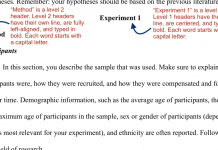
Teaching APA Style: 7th Edition Template Papers
Note, APA now has two separate title page formats: one for students and one for professionals. These templates reflect the format for students. For professional papers, a running head needs to be added (though the first page does not need to say “Running head” anymore… thank goodness!) as well as an author note.When creating the…

Can We Boost Elaboration with Retrieval Practice?
The other interesting thing they did was changing up the conditions of retrieval practice. Some students took an open-book test, where they literally had the text sitting in front of them while they answered the questions. Some took a closed-book test (no text available), but some were in a closed/open switch task. Essentially, students could…

GUEST POST: An Interview with an Elementary School Teacher and Doctoral Student
Quincey Farmer is an elementary teacher and administrator who has taught both domestically and abroad. He is an advocate of data-based instruction and evidence-based approaches. Quincey finds data particularly important as he transitions to a specialized role focused on identifying and nurturing academically and intellectually gifted learners in grades 3-5 and talent development in grades…

Moving Towards Online Teaching: A Reflection
By Carolina Kuepper-TetzelWith online teaching becoming a reality for many educational institutions in the coming semester/year due to COVID-19, the questions are what the key challenges in education will be and how to overcome them. An obvious challenge is the transformation of teaching material and delivery to accommodate the online format. However, in today’s post…

Multitasking and Selective Attention
by Althea Need KaminskeWhen I got married, I had no idea that my husband would become my office mate. COVID19 has affected our lives in a number of ways, one of them being that we now both work from home in the same home office. For most of my career I’ve been lucky enough to…

Digest #147: Making Your Material Digitally Accessible
Dr Helena Paterson is a Lecturer in Psychology at the University of Glasgow. She is the Technology-Enhanced Teaching and Learning Lead for the School of Psychology. Her expertise lies in digital education and her research is about children and adults’ perception of difference as it pertains so first impressions and person perception. Dr Paterson was…

Warming up the Room: Icebreakers and Cold-Calling to Increase Partcipation
by Althea Need KaminskeAs school is starting this fall, teachers and students are participating in a time honored first day of class ritual: the awkward icebreaker. While students might think they’re a bit cheesy, icebreakers serve several very important roles in class and are an excellent way to start a class. An obvious reason to use…
VLOG: Bite size research – Learning Strategy Intervention
References(1) Biwer, F., oude Egbrink, M. G., Aalten, P., & de Bruin, A. B. (2020). Fostering effective learning strategies in higher education—A mixed-methods study. Journal of Applied Research in Memory and Cognition.(2) Dunlosky, J., Rawson, K. A., Marsh, E. J., Nathan, M. J., & Willingham, D. T. (2013). Improving students’ learning with effective learning techniques:…

GUEST POST: Using Evidence Based Strategies to Improve the Distance Learning Experience
Alison Stone teaches Human Anatomy and Physiology and AP Biology at Central Bucks High School – West in Doylestown, PA. She is a National Board Certified Teacher and the 2015 recipient of the Outstanding Educator Award from Stephenson University. Alison has a passion for using evidence-based practice to improve student outcomes in her classroom. She…

Digest #146: The Psychology of “Zoom Fatigue”
In the world of COVID-19, video conferencing has become commonplace. Many of us spend our days on back to back video calls and find ourselves exhausted by the end. This phenomenon has been dubbed “zoom fatigue” but applies to any type of video conferencing. At its foundation, zoom fatigue is a cognitive issue, which presumably…
