
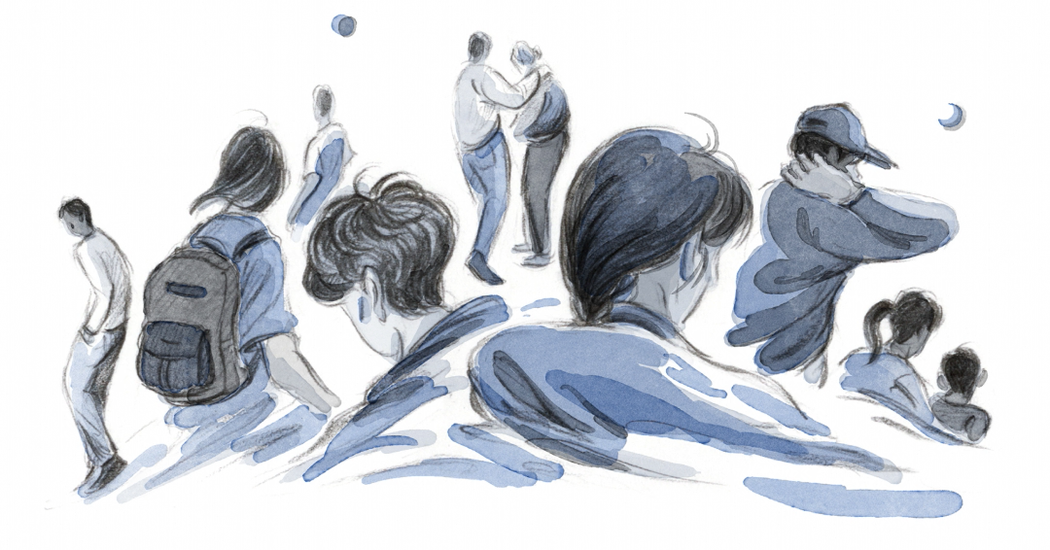
No term encompassing people of over 50 ethnicities can be culturally meaningful. Instead, proponents frame “Asian Americans” as a politically convenient coalition. This sentiment is what originally inspired the term, when graduate students in 1968 used it to organize against the Vietnam War. Today, though, Asians in this country are far more numerous and diverse than they were decades ago. Continuing to describe them as a single demographic means that the statistics of certain populations overshadow the pressing needs of millions.
You may have heard, for example, that Asian Americans are better-off than the average American. In reality, 12 out of 19 Asian ethnic populations surveyed by Pew Research Center in 2022 had poverty rates at or above the American average. But those individuals are consistently underserved because they get lumped with Indian Americans, who make six figures on average, into an Asian demographic that is increasingly described as “white-adjacent,” a group that has “made it” and does not need additional support.
This trend extends to nearly every policy field. Take immigration. The recent flood of highly-skilled Asian workers obscures the thousands of Hmong and Cambodian Americans who sought asylum in the face of genocide, as well as the more than 1.5 million Asians who are undocumented. These groups need interventions regarding refugee resettlement, mental health care, rehabilitation and family reunification, but they are hidden by the “Asian American” umbrella. Political talking points about Asian immigration continue to focus on work visas, leaving other needs unacknowledged, unaddressed.
Ironically, the term’s limitations hinder progress just as much as its breadth. Western and Southwestern Asians are not, according to the federal government, “Asian American,” they are Middle Eastern whites. This classification ignores that many South Asians have significantly stronger cultural ties to those “Middle Eastern” communities than East Asian ones, and that they face similar challenges in America, such as Islamophobia. Some groups have self-created “Brown Asian” organizations in response, capitalizing on this solidarity in a way that can actually translate to political change.
Labels have power, so let’s let communities define their own, along the lines of ethnicity, culture, and religion that make sense to them. “Asian Americans” are the fastest growing, least homogeneous demographic in America, which means the term is only going to become less useful. So if we are serious about representation, we need to make the effort to have a more nuanced conversation, using language not externally imposed for convenience, but defined by the people themselves.
Works Cited
Budiman, Abby, and Neil G. Ruiz. “Key Facts about Asian Americans, a Diverse and Growing Population.” Pew Research Center, 10 Oct. 2022.
Gebeloff, Robert, Lu, Denise and Jordan, Miriam. “Inside the Diverse and Growing Asian Population in the U.S.” The New York Times, 21 Aug. 2021.
Jensen, Eric, et al. “Measuring Racial and Ethnic Diversity for the 2020 Census.” United States Census Bureau, 4 Aug. 2021.
Kaur, Harmeet. “The Term ‘Asian American’ Has a Radical History.” CNN, 4 May 2022.
Kochhar, Rakesh and Cilluffo, Anthony. “Income Inequality in the U.S. Is Rising Most Rapidly among Asians.” Pew Research Center, 21 Aug. 2020.
Lee, Jennifer. “Are Asian Americans People of Color or the Next in Line to Become White?” The Brookings Institution, 11 Oct. 2022.
Montagne, Renee. “U.S. Is Home to 1.5 Million Undocumented Asian Immigrants.” Morning Edition, NPR, 28 Nov. 2014.
Samari, Goleen, et al. “Islamophobia, Health, and Public Health: A Systematic Literature Review.” American Journal of Public Health, U.S. National Library of Medicine, June 2018.

