
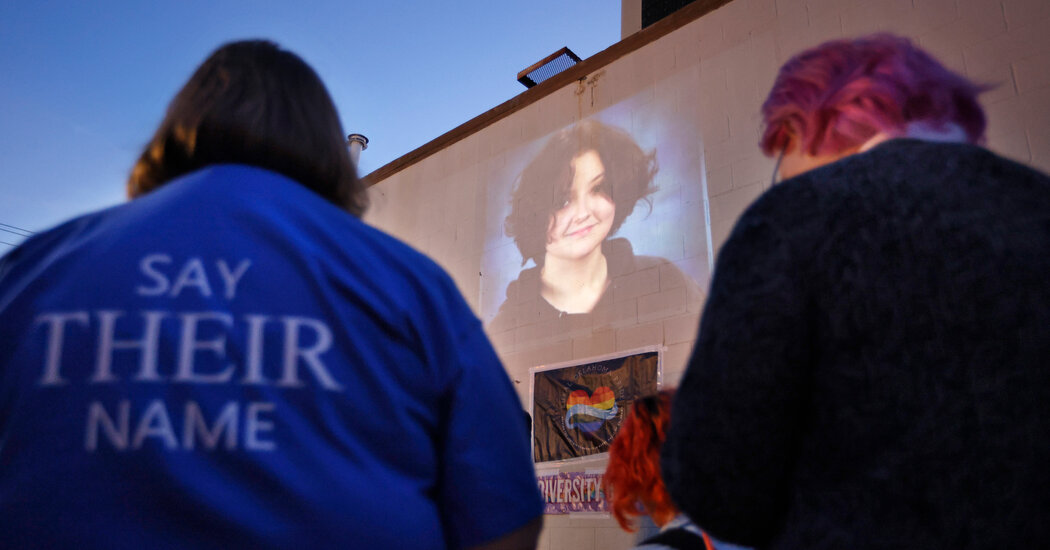
Have you been following the news about Nex Benedict, a 16-year-old nonbinary student who died one day after an altercation in a high school girls’ bathroom in Oklahoma? If so, what have been your reactions?
If you don’t know much about the story, the article “What We Know About the Death of a Nonbinary Student in Oklahoma” lays out some of the facts:
Nex Benedict, who often used the pronouns they and them and told relatives that they did not see themselves as strictly male or female, died in early February, one day after the altercation with three girls at Owasso High School. Details over what happened and what exactly caused Nex’s death were unclear, but in a police interview video released Feb. 24, Nex said they had “blacked out” while being beaten on the bathroom floor.
The police said the case was still under investigation.
Nex’s death and the circumstances around it have put school officials and law enforcement under scrutiny. There has been an outpouring of grief across the country, particularly from the L.G.B.T.Q. community, and a renewed focus on the proliferation of policies that restrict gay and transgender rights.
The piece continues:
Among the key questions that remain unanswered is how exactly Nex died.
On Feb. 21, the police said preliminary autopsy results found that Nex “did not die as a result of trauma.” The state medical examiner’s office has not yet made public its report on the autopsy and toxicology results.
It is also unclear whether Nex was beaten because of their gender identity. Advocates for nonbinary and transgender students have said that Oklahoma’s policies on gender had led to more reports of confrontations in schools.
In a related guest essay for the Opinion section headlined “Of All the Wrenching Details of Nex Benedict’s Death, This One Broke My Heart,” the columnist Margaret Renkl acknowledges that “there’s much we don’t know” about why Nex died. But, she writes, “there are some things we do know, and all of them add up to tragedy”:
We know that 16-year-old Nex, who often went by they/them pronouns with peers, was bullied at school. According to Sue Benedict, their biological grandmother and guardian, the bullying started in earnest last year. We know that Nex didn’t report the recent encounters to teachers or school officials. “I didn’t really see the point in it,” they are seen telling a police officer in a body-cam video released by the Owasso Police Department. “I told my mom, though.”
We don’t know definitively why these students were bullying Nex, but we know that they targeted at least one other gender-nonconforming student, and we know that Nex did not personally know their tormentors. When the police officer asked why the students were harassing them, Nex says, “because of the way that we dress.” Later they add that the girls didn’t like the way they and their friends laugh.
We know that Nex responded to the harassment by pouring water on the students, but we also know the bathroom fight didn’t appear to be an even match. “I got jumped at school. 3 on 1, had to go to the ER,” Nex texted a family member after the fight. The family’s attorney stated that the teen was “attacked and assaulted in a bathroom by a group of other students.” Nex collapsed at home the next day.
We also know there’s a new law requiring students in Oklahoma to use the bathroom that corresponds to the gender they were assigned at birth, and we know that the law has spawned a kind of vigilante justice. “That policy and the messaging around it has led to a lot more policing of bathrooms by students,” Nicole McAfee, the executive director of Freedom Oklahoma, told The Times. “There is a sense of, ‘Do you belong in here?’”
Students, read both pieces and then tell us:
What have you heard about this news? Have you discussed it with family or friends, or at school? What have been your reactions? What have been the reactions of those around you?
Oklahoma has several laws that restrict transgender rights, including one that prohibits students from using bathrooms that do not align with their sex at birth. Another law explicitly bans gender-neutral markers on birth certificates. Oklahoma also bars minors from receiving gender-transition care. What laws or policies concerning gender expression does your state or school have? What do you think of them? Have they affected you or anyone you know?
How comfortable do you think students at your school feel in expressing their gender identities? How are gender nonconforming people treated?
As these articles explain, the state superintendent of Oklahoma schools, Ryan Walters, is known for his hostility to transgender rights. In his first interview since Nex’s death, Mr. Walters told The New York Times that he does not believe nonbinary or transgender people exist. Transgender students say that classmates see rhetoric like this as permission to harass and bully them, and Ms. Renkl writes that “hateful talk, especially from people in power, can at the very least tacitly permit hateful acts.” Do you agree? Do you think that when leaders or influential figures publicly dehumanize or demonize people in marginalized groups, it can inspire others to do the same?
Americans are deeply split over whether gender identity should be taught in school. How does your school handle this topic? Have you had instruction in class or programs, or had access to materials about gender identity? If or when the subject has come up, how have your teachers responded? What about your fellow students?
What do you think? How should schools handle the topic of gender identity? Why?
In her guest essay, Ms. Renkl writes that Nex’s grandmother “wasn’t condemning a child she didn’t understand. She was listening. She was learning. She was trying to understand. Don’t we all owe it to our children to listen? Don’t we owe it to all the young people in our care — in our families and in our communities — to try to understand the world as they are experiencing it?” What is your reaction to that? Do you feel that the adults in your life — in your family, at your school, at your place of worship or elsewhere in your community — are listening to you and others your age? Are they trying to understand the world you are experiencing? If so, how?
Students 13 and older in the United States and Britain, and 16 and older elsewhere, are invited to comment. All comments are moderated by the Learning Network staff, but please keep in mind that once your comment is accepted, it will be made public and may appear in print.
Find more Student Opinion questions here. Teachers, check out this guide to learn how you can incorporate these prompts into your classroom.

