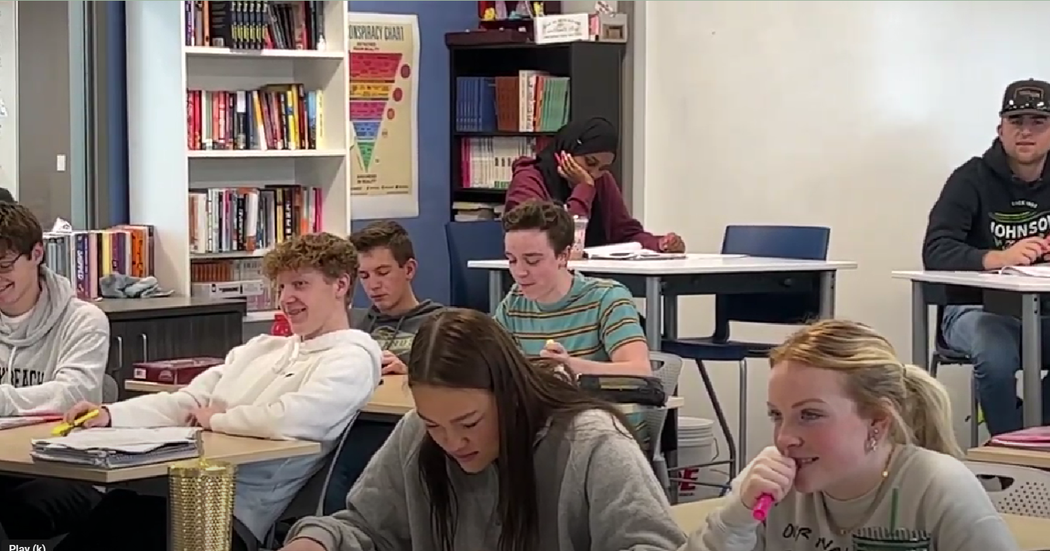
This idea was submitted by Peggy Dimock, who teaches English at St. Peter High School in St. Peter, Minn. The three speaking activities were written by Aaron Dimock, Ms. Dimock’s brother-in-law, who teaches speech at the same school.
Do you teach with The Times? Tell us about it here or browse our full collection of reader ideas.
Reading and responding to The Learning Network is a regular part of the routines in our English and speech classes. But when we want to change it up, we use these 11 tried-and-true strategies to engage students in a fun, but still academically rigorous, way.
In my English classroom, I, Peggy, turn to The Learning Network’s daily writing prompts because they pose thought-provoking questions and surface student-friendly articles from across The New York Times. I value the range of topics (school life, politics, fun) they address. And I know whatever I find in The Times will be well written, thoroughly researched and balanced. For the writing exercises below, that means students will have models of excellent writing to follow. And for the discussion exercises, it means that, even in today’s polarized world, students can have evidence-based conversations that are timely and relevant without being contentious.
In his speech classes, Aaron uses the always engaging images and graphs from The Learning Network’s What’s Going On in This Picture? and What’s Going On in This Graph? series to help students practice verbal communication skills in a low-stakes way.
Below, we share how we employ these strategies in our own classrooms. We’ve included links to Times articles and provided teaching materials — including work sheets and student writing samples — when available.
Discussion Strategy
Silent Conversation
This activity, also known as Big Paper, involves students having a “silent conversation” about a text by writing out their responses to the article and one another. The purpose is to engage 100 percent of the students in the article discussion and allow for the quieter students to participate fully.
Setup and Materials
Choose an article. A longer piece that can be divided into topics, as opposed to being read chronologically, works best. My class has used this article about a video-gaming school from the Learning Network writing prompt How Can Schools Engage Students Who Are at Risk of Dropping Out?
Physically cut out sections of the article by topic or argument.
Tape the paragraphs on larger pieces of paper or a poster board (make sure there’s a lot of open space to write around the text) and set them up throughout the room, creating stations.
Activity
Step 1: Students split up, going to different stations. Everyone should have something to write with. While at their station, students should:
Silently read the material and write their responses in the open space, initialing their responses.
Read and respond to peers’ comments (again, adding their initials).
After seven to 10 minutes, rotate to the next station.
Step 2: Continue until all students have gone to each station.
Step 3: Students can do a gallery walk and read responses to their writings, giving themselves time to process the information and their understanding of the conversation.
A Socratic seminar is a structured, student-led classroom activity to discuss, not debate, the issues, the values and the ideas in an article. Students should be articulating their own points of view and be encouraged to explain how they understand and are affected by the issue. It shouldn’t be about who is right and wrong, but rather about articulating and expressing what they think and why.
Socratic seminars can take a couple of different forms:
A large circle of chairs wherein every student is involved in the discussion.
A “fishbowl” wherein a smaller circle of students discusses while a larger circle of students observes the process and takes notes. Then, they switch roles.
Setup and Materials
Select a prompt and a text for students to discuss. Look for an article or a question that is thought-provoking and has the potential for multiple interpretations or ideas (articles that have plans of action work well). For example, I have used the prompt Should Teachers Provide Trigger Warnings for ‘Traumatic Content’? about university administrators who rejected a student proposal requiring instructors to provide warnings for upsetting materials. You can find more argumentative prompts here.
Give students time to read and annotate the article, making notes, underlining and so on.
Give them this preparation sheet and have them fill out the left-hand column.
Set up the classroom in a circle (or two concentric circles for a fishbowl).
Activity
Step 1: Establish ground rules for respectful and productive discussion. Consider rules like “three before me” (three people speak before you can speak again) and “step forward/step back” (where students encourage one another to make space and engage) and practices such as using “I language” instead of “you language,” listening actively, referring to the text only and avoiding ad hominem attacks.
Step 2: As the teacher, start by asking for any questions about the article — fact-based information students need to know before discussing larger issues.
Step 3: Have one student start the discussion by asking one of the open-ended questions he or she came up with (see preparation sheet). Students share their thoughts, ideas and interpretations of the text. It’s important for participants to refer back to the text and provide specific examples to support their viewpoints.
Have students take notes during the discussion on the right-hand side of the preparation sheet.
Step 4: After discussion, have students reflect on the seminar as a whole and on their participation and thinking in particular. What did they learn from the discussion? How did their opinions evolve? What challenges did they face during the seminar? Have students evaluate and grade their contribution to the seminar.
Discussion Strategy
Doubters and Believers
In this activity, students adopt a role — either a doubter or a believer — and read the text from that point of view. The purpose of this game, which comes from Peter Elbow’s book “Writing Without Teachers,” is to have students work on perspective. As believers, they learn to empathize with people with whom they may disagree. As doubters, they learn to read a text critically. In the end, they are able to deepen their understanding of an argument and better formulate their own positions.
Setup and Materials
Activity
Step 1: Students should read the text from the perspective of their assigned role:
Doubters: What doesn’t work in this text? Where does the writer’s logic or reasoning fail? What doesn’t make sense?
Believers: What is reasonable and good in this text? What makes sense? How would this idea improve lives?
Step 2: As a group of doubters or believers, students should develop their argument using at least three examples from the text.
Step 3: Each group presents its argument to the class.
Step 4: After the presentations, discuss what the students realized as they read the text from each mind-set. For example, what evidence became more or less convincing? Which arguments held up, and which fell flat in the face of criticism?
Step 5: You might end with them formulating their own position on the subject, taking into account what they heard.
For this activity, students write a poem in response to an article. The objective is to encourage them to engage critically with a text and creatively express their thoughts and emotions through poetry.
Other versions of this activity include a found poem, a lifted line poem and a blackout poem.
Setup and Materials
Activity
Step 1: Read and analyze.
Instruct students to read the article carefully, highlighting or noting lines, phrases or quotations that resonate with them or evoke strong emotions.
Discuss the article briefly as a class, focusing on key themes, ideas and emotions.
Step 2: Brainstorm.
Encourage students to reflect on their emotional response to the article and the lines they highlighted.
Have students jot down the thoughts, the feelings and the ideas they want to incorporate into their poem.
Step 3: Craft the poem.
Explain the concept of using lines or phrases from the original article in their poems.
Instruct students to start writing their poems, integrating the lines or phrases they selected from the article. Most of the poem should be their original work (unlike in a found poem).
Remind students to focus on creativity, expression and the emotional impact of their poems.
Step 4: Share and reflect.
Give students the opportunity to share their poems with a partner, in small groups or with the whole class.
After each reading, encourage listeners to provide feedback and discuss how the lines from the article were used effectively in the poems.
Step 5: Finalize the poems.
Writing Strategy
3-2-1
The purpose of the 3-2-1 activity is to have students identify specific elements of a piece, which can change depending on what you’re working on in class.
In this example, I have students find the elements of an argument or position in an argumentative text, but you could also have them focus on grammar and diction in a literary text or write about their takeaways and questions for an informational text.
This activity works well as an “exit ticket” at the end of the class period.
Setup and Materials
Select a text: Choose a thought-provoking article or essay that has a clearly developed argument. This article on online learning, which comes from the Learning Network prompt Is Online Learning Effective?, works well because it is full of research and many of the claims are clear in the subheads.
Activity
Step 1: Have students read the article.
Step 2: Have students write three claims the author makes, two pieces of evidence that support the points and one main idea.
(Note: You can change up the 3-2-1 to whatever you like depending on what you’re working on in class. For example, in a lesson on grammar and diction, you could ask for three vivid verbs, two adjectives and one complex sentence.)
Writing Strategy
Playing With Genre
In this activity, students are challenged to creatively adapt an existing New York Times article into a different genre while preserving the essential information and elements of the original work. By exploring various genres, students will deepen their understanding of writing styles.
Setup and Materials
Activity
Step 1: Instruct students to read the article thoroughly and identify its main ideas, key details and important quotations.
Step 2: Introduce the list of diverse writing genres (e.g., letter, short story, diary entry, poem, dialogue, script, travel brochure and so on).
Discuss each genre briefly, explaining its conventions, style and purpose.
Instruct students to select a genre from the list that they would like to adapt the article into OR add to the article. Each student or group must choose a different genre.
Step 3: Explain that students need to retain the main ideas, as well as some key details and people from the original article, while reimagining it in the chosen genre.
Step 4: Have each student or group share their genre piece on a class Google Slides presentation. Students will present their new genre to the class, explaining its essential components (form, writing style, word choices and so on) and their new writing.
Writing Strategy
Change the Tone
In this activity, students will change the existing tone of an article. The purpose is to explore how changes in language, word choice and sentence structure can alter the tone of a piece. By experimenting with different tones, they will gain a deeper understanding of the role of language in shaping the overall message of a text.
Setup and Materials
Activity
Step 1: Have students read the article individually, paying close attention to the author’s word choice, sentence structure and overall tone. What emotions or attitudes does the article convey? How would you describe its tone? Make notes of specific language elements that contribute to the tone.
Step 2: With their partners, students should identify and agree upon the tone of the article. Is it informative, formal, casual, critical, optimistic or skeptical? The list of tone words can help.
Step 3: Now comes the creative part. Tell students to change the tone of the article. Select a new tone that is different from the original one. For example, if the original tone is formal, try changing it to a more casual or conversational one. Use the same content and main ideas, but rewrite the article’s sentences, paragraphs and headings to reflect the new tone.
Step 4: Select a few pairs of students and have them share the identified tone and the adjusted versions with new tones. Ask them to explain the reasoning behind the changes they made.
Writing Strategy
Ethos, Pathos, Logos and Citations
The purpose of this activity is to analyze the use of ethos, pathos and logos in an article and to practice embedding a quotation from that article to support their analysis. This will help students develop their skills in critically assessing persuasive techniques and effectively incorporating evidence into their writing.
Setup and Materials
Activity
Step 1: Explain the concepts of ethos, pathos and logos:
Ethos: Shows the credibility and the authority of the author or the source.
Pathos: Appeals to emotions, evoking feelings in the audience.
Logos: Appeals to logic and reason using facts, evidence and reasoning.
Step 2: Instruct students to read the article and identify examples of each persuasive technique. Encourage students to jot down notes about their findings in the worksheet.
Step 3: Review guidelines for effective quotation embedding, including:
Introducing the quotation with context.
Using appropriate signal phrases and “says” verbs: argues, asserts, claims, concludes, contends, discusses, emphasizes, examines, explores, focuses on, has determined that, highlights the fact that, maintains, mentions, notes, points out that, recommends, reports, states, suggests. …
Integrating the quotation smoothly into the sentence and citing the source. Choose passages where the author’s exact wording is uniquely powerful or necessary for accuracy or context. Quote “scintillating phrases,” not entire sentences.
Explaining why this quotation is important to your argument.
Example: In the article “The Threat of Terrorism Is Being Reduced,” John Ashcroft, the U.S. attorney general, claims that “terrorism is relatively inexpensive to conduct and devilishly difficult to counter” (Viewpoint 27). This point is troublesome. America is spending billions of dollars on the war on terror and using its military might to fight an elusive enemy.
Step 4: Have students select a compelling quotation from the article that demonstrates one of the persuasive techniques (ethos, pathos or logos). Instruct them to practice embedding the chosen quotation.
Step 5: Ask several students to share their embedded quotation with the class.
Step 6: Conclude by asking students to reflect on what they’ve learned about analyzing and incorporating persuasive elements into their own writing.
Speaking Strategy
Telling a Story
In this activity, students will make up a story inspired by an image from The Learning Network’s What’s Going On in This Picture? series and then share it in an oral presentation.
The purpose of this activity is to get students to tell a coherent story verbally. To do this, students should have a basic understanding of story elements (e.g. plot, characters, conflict and scene).
Setup and Materials
Select at least three engaging and varied images from the What’s Going On in This Picture? column. Prepare a slide show with the images, putting each photo on its own slide.
Break students into pairs or small groups.
Give the students index cards to write on and use during their speech.
Activity
Step 1: Determine your speaker order; I like to draw names from a hat.
Step 2: When it is their turn, students should choose one of the three images from the slides.
Step 3: Give students three to five minutes to construct a brief short story that explains or captures what is going on in their chosen picture.
Their story can be silly but needs to make sense: Characters should be doing something for some reason by some means while in some place.
Stories should incorporate specific details from their selected image.
Students should take notes on their index cards.
Step 4: Give each group one to two minutes to present their stories to the class.
Each member of the group should contribute.
Students should be encouraged to explain the information in the images that support their stories.
Optional: Audience members may ask questions about the image that encourage the presenters to add additional details to their stories.
Step 5: To wrap up, have groups complete a quick self-reflection about what worked well in their story and those of other groups. For instance, a 3-2-1 reflection might include:
Three things their group did well.
Two ways they can use these skills in their next presentation.
One group (other than their own) that did an excellent job and why.
Speaking Strategy
In Other News
This is another activity that invites students to make up a story using images from The Learning Network’s What’s Going On in This Picture? series, but with a twist that tests their on-the-spot speaking skills. Students will choose an image and present a fictional news story related to it. Then, they will draw another random image and have to integrate it into their newscast in some way.
Setup and Materials
Print a large collection of images (approximately three per student) from the What’s Going On in This Picture? column.
Break students into pairs or small teams; one person or group should be “in the studio” while the other is “on location.”
Activity
Step 1: Have students randomly select two images from the collection. They can choose one to use as the visual for their newscast and discard the rejected image back into the pile.
Step 2: Give students three to five minutes to prepare brief (one to two minute) stories to present as newscasts explaining the events related to their image.
Step 3: At the end of their presentation, give the students a second image — breaking news! — that they will need to integrate into their newscast.
Step 4: To wrap up, discuss with students what they learned about the skills they need to present effectively when they have little time to prepare. For example:
Identify situations where these skills are important, such as interviews, business and committee meetings and class discussions.
Consider skills to use to stay organized, such as breaking down information into small chunks, asking and answering comprehension questions or telling a narrative (with a beginning, middle and end).
Consider skills for processing new information quickly, such as relating it to past information on a topic, identifying main ideas rather than focusing on details and asking themselves audience-centered questions (what will listeners wonder, need to know or be confused about?).
Speaking Strategy
What’s Going On in This Graph?
In this activity, students are challenged to communicate the information in a graph, a chart or a table to an audience who cannot see it. The purpose of this assignment is to develop students’ ability to verbally explain information and data in a succinct and clear manner.
Set Up and Materials
Activity
Step 1: Put students in groups of four or five. Assign each student a different graph to analyze.
Step 2: Give students time to develop their own understanding of the data in their graph or chart. Once they are confident they understand the information, they should have a few minutes to prepare and make notes.
Step 3: Each student will have one to two minutes to present the information in their graph to their group members. Students should work to use effective presentation skills (focusing on the audience, directing attention to specific information on the graph and explaining concepts in a clear and organized manner).
Step 4: At the conclusion of each speech, audience members should have a chance to ask questions and assess how well the information was communicated by the speaker.