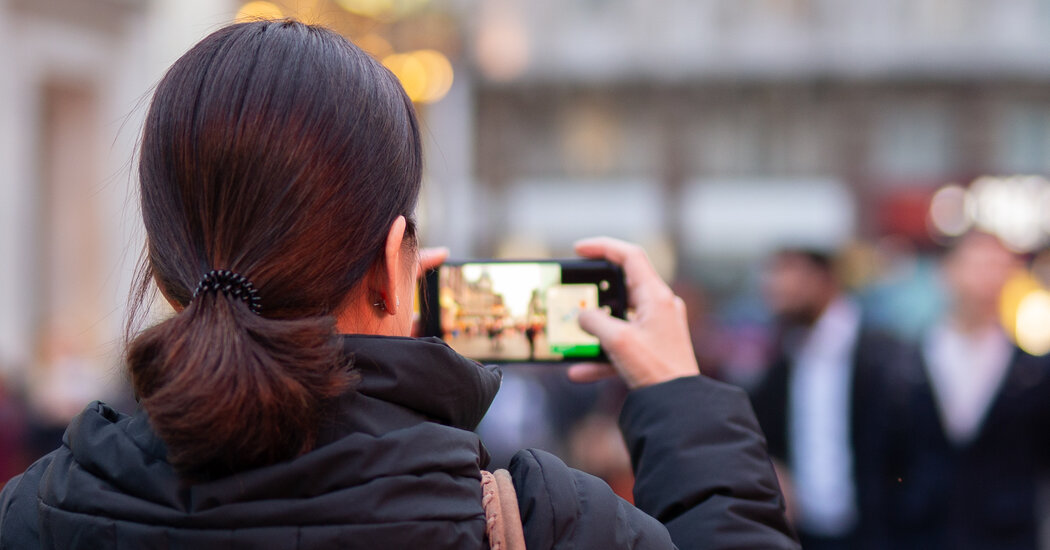
A person stops a stranger on the street to ask a question. Another performs an act of kindness. Another plays a prank. Another makes fun of someone without the person knowing. All of these interactions are recorded and then posted online, without the consent of the subject.
Have you ever come across a video like this online? Do you think it is wrong for people to take and post videos, photographs or audio recordings of strangers online? Or, are they harmless fun?
In “Beware the TikTok Eavesdroppers,” an edition of the It Happened Online newsletter, Madison Malone Kircher argues that strangers should not be content:
Close your eyes and imagine the last gossipy conversation you had with a friend in a public setting. Maybe you were complaining about your spouse over a cappuccino in your neighborhood coffee shop. Or loudly talking over the din of the subway about your boss. You love your spouse, and genuinely like your boss, but you just needed to vent a little. Who among us, right?
The next day, you open up TikTok to find somebody recapping your conversation in excruciating detail — including the location and your shirt color. Enough detail that your boss or spouse would easily be able to ID you.
This week, I watched an influencer do just that on TikTok. (I’m not going to link in the interest of mercy, but the creator has over 150,000 followers and the video has been viewed nearly 2 million times.) The video’s creator describes overhearing a group of bridesmaids speaking ill of a bride. The creator describes the bridesmaids’ hairstyles, the dresses they wore and even a specific drink that was served at the event — all details she gleaned from eavesdropping. If this video was about your wedding, you’d know immediately.
My immediate reaction: I hope the bride never sees this. Followed by: There’s no way she isn’t going to see this.
That’s the way algorithms work, after all. TikTok’s secret sauce is serving up hyper-specific content based on what it thinks you’ll want to watch. In many cases it knows your contacts and location and interests. The “You” in For You Page is very literal.
Turning unsuspecting strangers into social media content is not a new thing. Perhaps you remember the 2018 saga of #PlaneBae, where a woman live-tweeted the interactions — including photos, though she blurred their faces — of a man and a woman sitting in front of her on a plane, dramatizing a meet cute for hundreds of thousands of people watching live online.
By the time the #PlaneBae news cycle ended, the consensus was that the whole mess was creepy and an invasion of privacy — a lesson we clearly still haven’t learned. And how could we, when the drama of strangers, real or imagined, is ripe for content. It’s free. It’s happening right in front of you. It’s a proven virality gold mine.
Students, read the entire article and then tell us:
In your opinion, is it ethical to record, film or photograph strangers and then post them online without their permission? And is it ethical, as in the examples in this newsletter, to share the contents of someone’s conversations? Why or why not?
If you don’t think posting strangers or their conversations online is acceptable, can you think of any cases when it would be justified? If so, what are they? If not, why not?
Have you ever filmed, recorded or photographed someone and posted them online without their consent? Does this article make you rethink that decision at all? Why or why not?
Has someone ever posted an image, video or recording of you online without your consent? If so, how did it affect you? If not, what do you think that experience would be like? How do you think you would feel?
Ms. Kirchner writes, “As the reach and distribution capabilities of platforms, like TikTok, get even more efficient and far-reaching, we’ve got to reassess the rules of engagement.” What “rules of engagement” do you think we should live by when it comes to posting strangers online?
Your generation is the first to grow up in an age where nearly everyone has a recording device in the pockets. How often do you think about the possibility that you could be filmed, photographed or recorded when you’re out in public, or that others may be eavesdropping and sharing your conversations online? How does that affect you? How do you think that might affect your generation as a whole?
Students 13 and older in the United States and Britain, and 16 and older elsewhere, are invited to comment. All comments are moderated by the Learning Network staff, but please keep in mind that once your comment is accepted, it will be made public and may appear in print.
Find more Student Opinion questions here. Teachers, check out this guide to learn how you can incorporate these prompts into your classroom.