
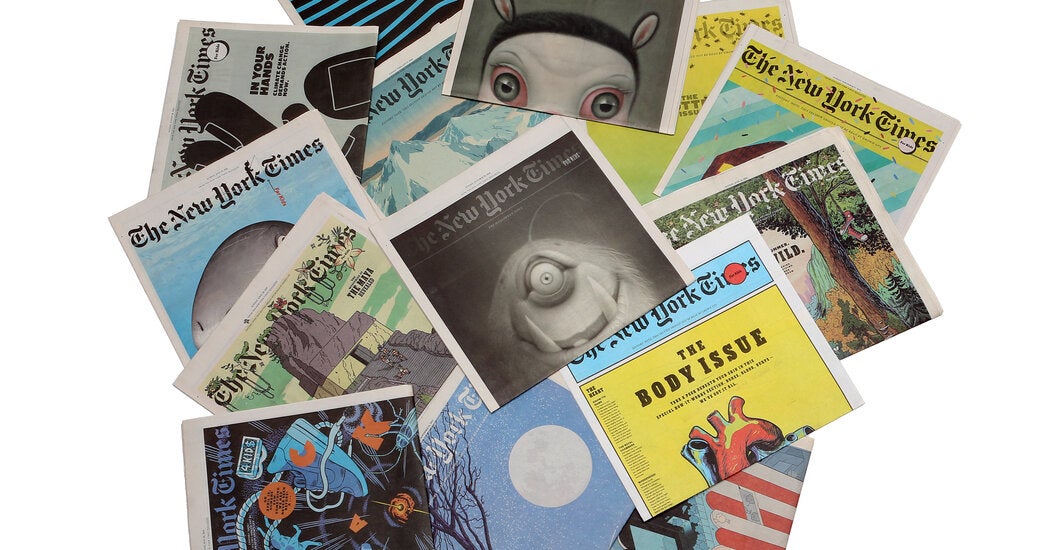
Welcome to Ask a Journalist! This school year, we’re hosting monthly discussions about teen-relevant journalism topics with New York Times reporters and editors.
In November we invite you to talk with Fernanda Didini, an art director, about communicating with images. Whether you’re planning to participate in our current Coming of Age in 2026 Contest where we invite teenagers to submit visual works telling us what it’s like to be a teen today, or just a fan of art and design, we know you’ll have a lot to learn from someone who is an expert in visual storytelling.
Here’s how to participate:
Part 1: Explore the topic on your own and with other students by looking at one or more of the pieces below and discussing them in class. Post your thoughts and questions for Ms. Didini and for other students in the comments section by Nov. 16.
Part 2: Ms. Didini will respond to a selection of student comments, and you’ll receive an email letting you know if yours is one of them. On Nov. 30, come back to read highlights from the conversation and some of our favorite student responses.
Meet Our Journalist
Fernanda Didini is an information designer and art director at The New York Times. She spent several years as a senior designer for The New York Times for Kids, a special section for The Times’s youngest readers which ran from 2017-2025.
What does an art director do? They are the people responsible for the images and style you see in the pages of The New York Times. They work with photographers and illustrators to create images that, as this Times Insider article explains, provide “a visual metaphor or narrative that helps readers better understand the topics that will be explored in an article.”
Explore This Month’s Topic: Communicating With Images
What is the purpose of including images in a news or opinion article? How do they work together with the words on the page to communicate information or tell a story? And how can you make them inviting and compelling to look at?
We hope you can learn about all of this and more from Ms. Didini who works with illustrators and photographers to design pages like the one you see above.
Before you talk to her, look closely at one or more of the following pages from The New York Times for Kids section, for which Ms. Didini was on the design team. As you do, annotate and take notes about everything you see on the page — the photos, the illustrations, the text (if you can read it; we know it’s small!), and the layout as a whole:
Post a Comment
Now, share your thoughts and questions in the comments:
Introduce yourself. Share anything that feels both comfortable for you and relevant to the discussion, such as your first name, general location, grade, background, interests or anything else.
Tell us what you think. What stood out to you in pages you looked at? What challenged you? What connections did you make? What do you think is missing from the conversation around this topic? What do you want the journalist to know about a teen’s perspective on the subject?
Ask a question. Ask the journalist about the pages you viewed or her work in general. (Not sure what to ask? Check out this list of more than 20 ideas — but don’t feel that you have to stick to them!)
Post your comments and questions by the end of the day on Monday, Nov. 16. Then Ms. Didini will respond and you’ll receive an email if she replies to you.
Come back on Nov. 30 to read highlights from the conversation and some of our favorite student comments.
Students 13 and older in the United States and Britain, and 16 and older elsewhere, are invited to comment. All comments are moderated by the Learning Network staff, but please keep in mind that once your comment is accepted, it will be made public and may appear in print.
Are you a teacher or student who has feedback on this new feature or would like to suggest a Times piece for future discussion? Please post a comment here.

