
What can you do for others this holiday season?
Word of the Day: florid
This word has appeared in 30 articles on NYTimes.com in the past year. Can you use it in a sentence?
How I Went From Product Owner to Front-End Engineer at Adidas in 15 Months


Learning to code so that you can land a job in tech can feel daunting. That’s why we’re sharing inspiring stories from Codecademy’s community — to show how people like you (yes, you!) can embark on a learning journey and end up with a totally new career. We hope these stories serve as a reminder that there’s no single path to a more fulfilling work life.
Today’s story is from Serena Isone, a 35-year-old Software Developer at Adidas, living in Schiedam, South Holland, Netherlands. Read more stories from Codecademy learners here — and be sure to share your story here.
Why I chose to learn to code
“I was a Product Owner for 10 years, and that’s how I discovered how cool coding was. A Product Owner is the business side of an Agile team; they are responsible for prioritizing a backlog of features that will be developed and shipped onto the website, according to the priorities of the company and the preference of the consumer.
In August 2019, I subscribed to the ‘aspiring engineer’ program at Adidas, and I used Codecademy as a way for me to learn a little bit more JavaScript, because JavaScript was one of the languages that we needed to learn in order to apply for this program internally at Adidas.
Before the pandemic brought us all into a lockdown, my mind was set that I wanted to learn coding, and then the pandemic just happened to give me free time to actually focus on it.”
How I made time to learn
“In 2019, when we were working from the office 8 hours a day and also had our social lives, it was actually quite tough. I was studying in my free time on the weekends, because that’s just the way it is when you still have to work a full-time job.
If I wanted to do this, I needed to do it during my free time. Unfortunately, I couldn’t make time to learn at work because I worked in two different departments: I belonged to the business department, and I was trying to get ready to move into tech. Only studying on the weekends was not enough with the learning curve. I would study for a few hours in the evenings during the week, but there are also other things that you need to do — like going to the gym or meeting friends.”
How I got in the door
“Adidas has an internal program that promotes job fluidity. People who want to try to do some other job can do a short-term assignment in a different department. If they like it, they can get prepared in what we call an ‘individual development plan.’ At the end of your development plan, if you are ready for it, then you can apply for the job.
So the ‘aspiring engineer’ program will give you an idea of what the life of a Software Developer is like on a daily basis. In your individual development plan, you set a goal saying, like, ‘I’m going to become a Software Developer within six months.’ A mentor will be assigned to you in order to guide you to what you have to learn in order to apply for a Software Engineer position.”
How I saved up money to switch careers
“Anytime that people talk about coding and software engineering jobs, they think that there is a salary bonus or a little benefit with it. In my case, it was the other way around. I was a Senior Product Owner and I had a very comfortable salary, but felt limited because I wasn’t learning that much anymore.
For me, investing in learning actually means investing money. I am getting a much lower salary, because now I’m a Junior Engineer, and I am also not getting as much in bonuses as before. It’s like I’m paying money for new skills, but the way I’m paying is with a salary cut. Overall, I am enjoying what I’m learning, so it was worth it. Ultimately, if you already are above a certain salary, earning more will not make you happier if your job doesn’t fulfill you.”
How long it took me to land a job
“I had a plan with my mentor, who was a Senior Software Engineer, to learn HTML, CSS, JavaScript, and React. After I learned all of that, I started to prepare for technical interviews. I studied data structure and algorithms, which are the questions where they ask you to solve a coding problem on the spot during the interview.
After doing that for five months, the Head of Software Engineering literally asked me, ‘When are you going to apply? Your mentor says that you’re ready.’ I still felt very frightened about being asked to solve a problem in an interview, and I wanted to be 100% sure that I was ready.
The Head of Software Engineering just said, ‘It’s better to go into an interview and find out if you’re ready for a job than wait a long time. Who cares if you fail? We’re going to tell you why you failed, how to fill the knowledge gaps you’re missing, and you’re going to take that feedback and incorporate it into the development plan.’”
How I nailed the interview
“From a human perspective, the interview process was actually really nice. They weren’t trying to make me fail; they were trying to give me a chance and they made me feel at home.
The interview process was very structured, and similar to how people would apply externally. They interviewed me on the theory, like, What is JavaScript? What is React? What’s the principle of React without React hooks? The second part of the interview was the coding challenge, where they give you a problem and you have to try to solve it with code. The third part was more about the soft skills.
The scariest part of the interview was the coding challenge, because it’s live, on the spot, and you need to take care of so many different things. I thought, Even if I cannot solve the challenge, I want them to know how I structured my way of solving it.”
How I evaluated the offer
“Adidas is a great company. Our motto is, ‘Change is a team sport,’ and that reflects on everything. Moving from being a Product Owner in a business position to a Software Developer position in tech was a team effort, if you think about it: I had my mentor, there was a whole organization that was promoting this type of process, and together we achieved something.
The company overall has a very healthy culture, and that’s what I really appreciate about Adidas — they literally helped me to change my career path, and keep on learning, which is what I wanted to begin with.”
How day one & beyond went
“The first day was cool, and it felt really exciting. I finally got to see the code and everything that developers would talk about when I was a Product Owner, like all the limitations and opportunities that we had. Seeing firsthand what my developers were talking about really felt empowering, because now I had direct insights on our code base.
There was a period where I was really frustrated, because obviously when you’re new to a code base, there’s so many things that you need to take into account. I always say to the people who write to me on my Instagram page, ‘Be prepared, because this path is not easy.’ There are going to be times where you’re going to feel down and times where you’re going to wonder if you’re made for this job or not. You always need to remember, I’m enthusiastic about this. I really love this. I’m going to keep going.”
What I wish I knew before I started learning
“I wish that people would have warned me more about how difficult it would be from a psychological perspective. I had to start from scratch, and I thought it was going to be a lot easier to be good and have all the answers.
Even Software Engineers that have been doing this for years and years told me, ‘You are never going to feel like you know everything. You will always have to learn.’ Yet I overestimated myself. There’s a lot of expectations that I put on myself, and I thought I could do better with this feeling of failure that’s very common in this job. I had to learn how to cope with being a junior.”
Learn like Serena
See the courses and languages that helped her most.
Not sure where to start? Check out our personality quiz! We’ll help you find the best programming language to learn based on your strengths and interests.
Want to share your Codecademy learner story? Drop us a line here. And don’t forget to join the discussions in our community.
JavaScript Courses & Tutorials | Codecademy
The JavaScript programming language is fun and flexible. It’s one of the core technologies of web development and can be used on both the front-end and the back-end.
Would You Like to Work Among Robots Someday?
A company is trying to introduce robots into the corporate workplace. Does this sound like an exciting future or a dystopian nightmare to you?
Lesson Plan: ‘26.2 Miles Is Easy. Getting Around New York City Is Not.’
In this lesson, students will learn why it’s easier for one athlete to win a marathon in New York than to navigate the city in a wheelchair. Then, students will evaluate the accessibility of public spaces where they live.
Word of the Day: obsolete
This word has appeared in 184 articles on NYTimes.com in the past year. Can you use it in a sentence?
The No-Code Movement

Nowadays, you can do AMAZING things without codes, having the power to start a business just by yourself. Limitless. Important disclaimer, with this, we’re not saying that codes are not needed in it at all. Of course, we require them, but if you’re a one-show man trying to push your start-up business, there are many tools that can help you to have a “soft begging” as an entrepreneur.
The website www.entrepreneur.com explains the No-Code concept in a beautiful way: “The no-code movement empowers anyone to create and enables those without technical skills to bring ideas to life. No-code uses visual drag-and-drop interfaces to create websites and apps without writing a line of code. Webflow, Bubble, and Airtable are some of the most popular no-code tools”.

Source: https://uxdesign.cc/
“Products or startups that are developed using no-code platforms are called no-code startups. These are called no-code startups because they are developed without writing even a single line of code manually. The most common benefits of no-code startups are higher speed-to-market and lower development costs.
The classic example of a no-code platform is to help citizen developers build simple applications, such as a business analytics dashboard without any coding knowledge. Example of no-code app is Job Board App, OKR Tracking, Simple Delivery app, etc”, continue the article.
Even if you don’t know it, it’s very possible that you’re actually using no-codes tools. Grammarly for better writing. Zapier for Automation. Canva for nice Graphic design.
As you can see, it’s possible to start a one-person online business with the help of all these tools. Here you have a list of 7 great No-Code Platforms, according to some specialist sites:
DuploCloud a no-code/low-code cloud infrastructure automation platform that can reduce configuration and deployment times from six months to a handful of weeks.
Betty Blocks combines a drag-and-drop interface with a block store, allowing citizen developers to build the applications they need rapidly.
Adalo enables creatives, business owners, and founders to create custom web & mobile applications without code.
Wix the platform that gives you the freedom to create, design, manage and develop your web presence exactly the way you want
Caspio enables companies to create custom web forms, searchable databases, multi-user portals, interactive dashboards, automated workflows, and much more — in a fraction of the time compared to traditional development.
BuildBox provides a development environment that allows non-coders to drag and drop assets and game logic to build their games from scratch. Budding designers can get started with a handful of templates that can be further customized with bespoke animation and event scripting to make games truly unique. Create 2D or 3D games with homemade art assets or purchase assets from the BuildBox Shop to speed up development time.
Shopify features professionally-designed templates and built-in integration with over 100 payment gateways, allowing businesses to quickly get their inventory online and easily available to the public.
These above are just a few examples of what is developed so far.
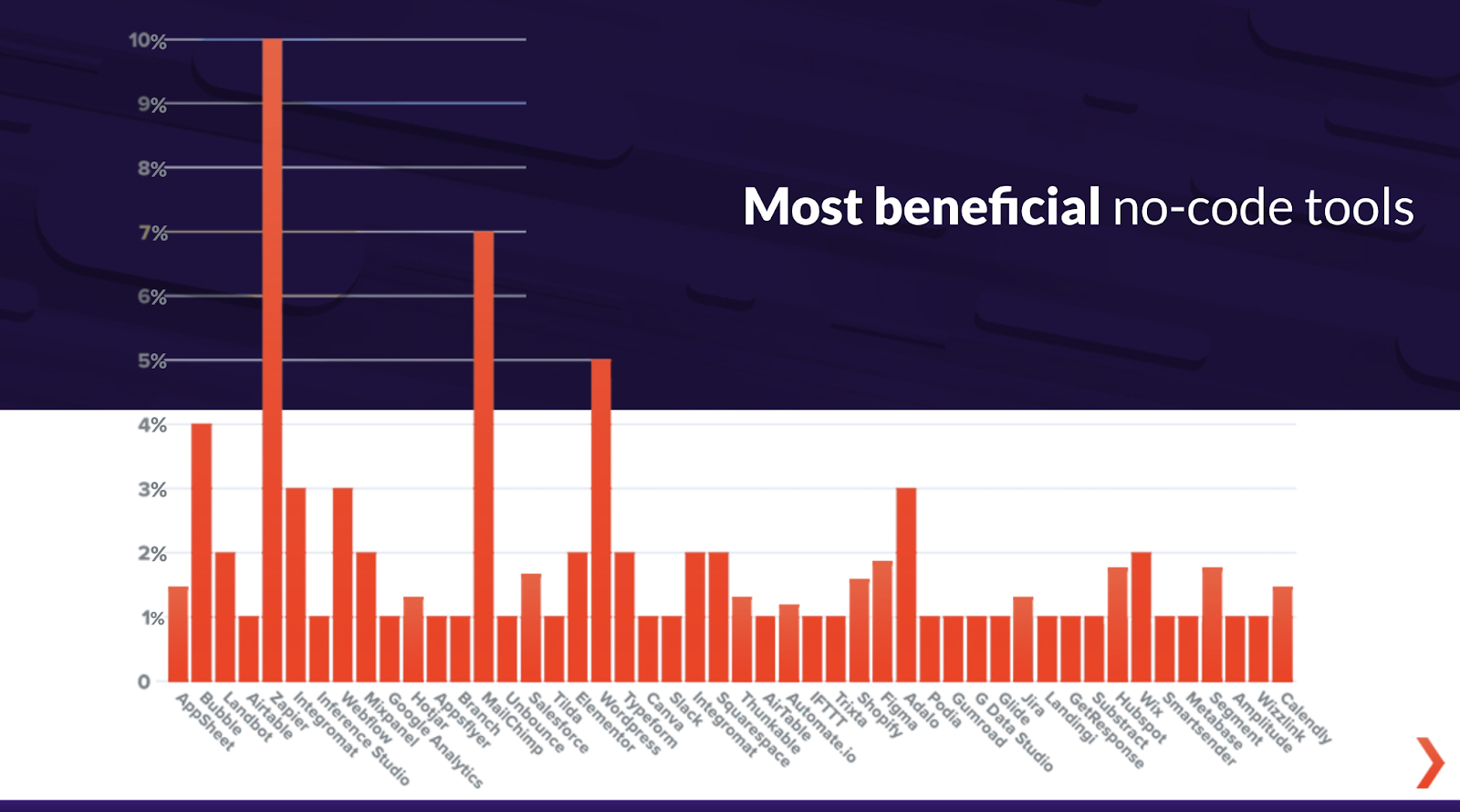
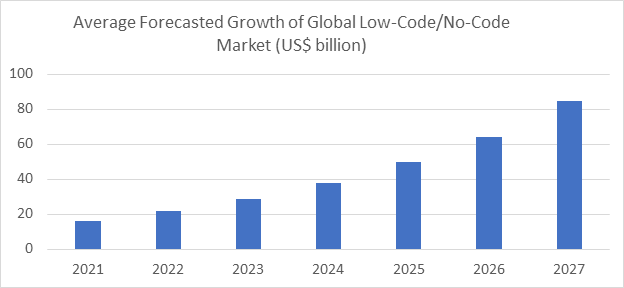
The No-Code, a market growing
Source: https://userguiding.com/
An excellent example of What is a No-Code development is explained by KissFlow:
“A no-code development is a programming platform that uses a visual development interface to enable non-technical users to build applications by dragging and dropping software applications to create a full app. Users don’t need any previous coding experience to build applications using no-code”.
In this video, you can learn more about No Code:

No code tools, just for startups?
No Code tools are not just for startups, as the website quixy, explains in its article: “Top 55+ No-Code Low-Code Citizen Development Statistics, Facts, and Trends you cannot miss in 2023”: “No-code app development enables users to create their solutions without coding. This helps both ways. As for users, they no longer have to wait for months to get solutions from the IT department. And for software developers, it frees up their headspace to focus more on business-critical tasks”.
Besides, this article explains in a very simple way the difference between No-code and Low-code: “No-code platforms allow users to create applications and solutions wholly based on visual interface and drag-and-drop. Low code, on the other hand, uses a bit of coding, and both types of platforms make the making of software and solutions for users simple. No-code citizen development can be done by business users with no coding skills. On the other hand, developers with good coding skills are needed to build solutions on low-code platforms”.
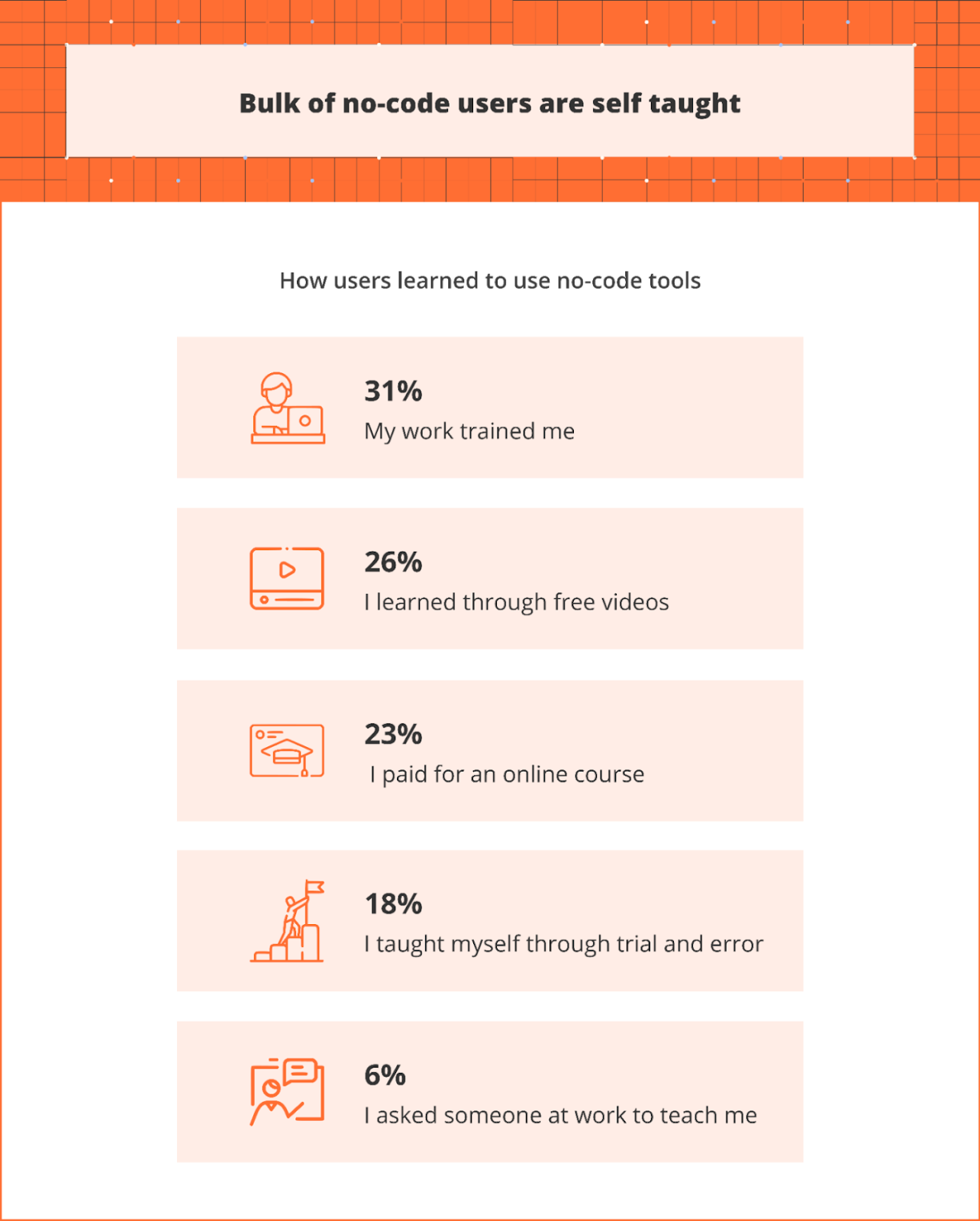
Source: https://zapier.com/
As a conclusion, we can take an abstract of the Forbes article: “The No-Code Movement: From Technopreneur To Entrepreneur” that states: “The emergence of nontechnical founders is inevitable as more startups depend less on developers. That doesn’t mean developers are going to lose their jobs. Experienced developers can now start their own companies and build meaningful products to support nontechnical founders, instead of creating BI dashboards for different departments or fixing API connections. With the variety of backgrounds of nontechnical founders, these founders can now focus on solutions to the problems in their industries”.
Looking for more information? Here you have some links that will be helpful:
What’s Going On in This Picture? | Nov. 28, 2022
Look closely at this image, stripped of its caption, and join the moderated conversation about what you and other students see.
Industry Corner: Project Management

Work in a company long enough and you’re bound to hear, “teamwork makes the dream work” at the water cooler, during coffee breaks, over lunches, and definitely in meetings. It’s an often-said cliche, but there is truth to it. For any project, big or small, its success depends on each member of the team doing their part. At the helm of this, the project manager. This individual is crucial to the success of the task and making sure the team and company meets (and exceeds) its deliverables, on time and within budget. To get a bigger picture of this role, we dove into the Project Management Industry Corner and spoke to Morgan Raad, who heads up a team at an international financial institution.
Introduction
Tell us a bit about your background.
Post-graduation I worked for various companies, in various roles, in the financial services industry. For the last nine years, I have been working at a software company, specialising in the financial services industry.
How did you get into project management?
One of my previous roles was an account manager. Before we formalised our delivery process, we used to run various activities on board and take clients live. I enjoyed the aspect of engaging with a client and planning a delivery process.
Is there a distinction between project management across industries?
The principles of project management, irrespective of the industry, remain the same. On a high level these are:
- Defining deliverables
- Defining roles, expectations and objectives
- Identify and address any roadblocks
- Monitoring the project
- Managing activities to ensure deliverables are met
What’s the hardest part of your job?
Ensuring I have enough information to formulate a plan and tracking of deliverables against timelines
What do you enjoy most about your job as a project manager?
For me it is twofold:
- Seeing the project being delivered and the client being able to use soothing that you, as part of a greater team delivered, is pretty awesome.
- Irrespective of the role, being part of the financial services industry and allowing people to be well advised about their financial wellbeing.
Project Management
What exactly is project management?
It is a set of processes and tools to plan (based on time, costs and risks) and manage a deliverable.
What are the qualifications you need to become a project manager?
The internet offers a wide array of information and courses. Some range from just introductory courses, providing certification of attendance to more formal qualifications that could lead to a degree
What essential skills every project manager should have?
There are a number of essential skills required by a project manager. I’ll rank them in accordance with what I believe:
- Communication to get the message across
- Organisation to help you stay focused
- Time management to ensure that no part of a project takes longer than it should
- Problem solving and being able to find ways to overcome challenges
- Risk management for those times when projects do not go according to plan
What qualities/traits do you need to succeed in this career?
- Being accountable for your decisions and actions
- Being fully vested in success
- Focused on stakeholder needs, delivering best performance, regardless of personal bias
- Embraces change and allow for elements of uncertainty to be part of their project plans
What are the roles and responsibilities of a project manager?
For me there are two main points, namely, to plan and to manage.
- Planning to realise the scope, keep to a time schedule within a restricted budget and finally be able to plan for any unforeseen risks.
- In addition to above a project manager needs to manage the project status, forecast performance, be able to communicate the plan and make adjustments where required.
What are the steps one should take to become a project manager?
Do not underestimate small beginnings. Start setting up a project for something small at work or at home and work your way up from there. Yes, even as simple as rearranging your room. What are the risks or blockers? What/who would you require to assist? Within what timeframe? How would you go about – first move out everything and gradually move everything back or even possibly phase it in?
As you finish one project your confidence will grow and you will start taking on larger, more complex projects
For a formal qualification, reach out to your local institute or attempt doing an online course. There are many platforms who offer various online courses, some which require interactions such as an exam and others that merely provide courses by way of introduction.
A day in the life of a project manager
What’s a typical day in the life of a project manager look like?
Really no typical day, but if I should summarise:
- The week normally starts with a review of my calendar for the week and if required a check in with various key team members.
- Have a clear agenda for the week. What do you want to have achieved by the end of the week and how will you go about working towards it? If there are any blockers or risks that you are aware of then how do you want to manage it?
- Prioritise activities in accordance with importance. Do not procrastinate.
What is the biggest misconception about project management/project managers?
Here are some of the sayings I come across frequently:
- Formal qualification required to plan and manage a project
- Project management is only for large projects
- Project managers only focus on the activities and risks and not on the people
- Project managers only sit and manage processes
What is the best tool/s for project management?
Most of the planning and management can be done using Google sheets (free online tool) or an Excel spreadsheet. I personally prefer building a Gantt chart (https://www.gantt.com/) in sheets, but you can easily define your risks, actions, issues and deliverables in a spreadsheet.
What are the three key drivers of project management?
The triple constraint, which is the fundamental relationship between the project scope, schedule and budget.
- Time
- Costs. These are the direct costs which can consist of variable costs or fixed costs and the indirect costs which normally are difficult to track on an individual level.
- Risks
What should everyone know about project management?
I think in the simplest term it is the process of initiating, planning, executing and monitoring a project.
What are the top three things every project manager should know/remember?
- Communicate on every level
- Create a common goal
- Review success continuously
Why is project management so important to an organisation?
A project manager aims to break a project into manageable tasks and milestones.
What are the three most critical elements of effective project management?
- To define the scope
- Develop a plan within the time schedule
- Manage costs
How do you measure the success of a project?
There are a number of key elements against which the successful delivery of a project can be determined, namely:
- Project delivered within budgeted cost
- Project delivered within allocated time frame
- Client requirements met
- Business objectives achieved
- Client satisfaction achieved
Career path of a project manager
What makes a good project manager?
A project manager needs to have a good understanding of the market and the industry they operate in and understand the project that needs to be delivered
What are the career paths one can look forward to?
Being able to understand the market and industry, combined to be able to deliver on items could allow a successful career path leading to senior project management, directorship or possibly vice president or executive.
What words of encouragement can you give someone looking to pursue a career in project management?
A career in project management can be exciting and bring fulfilment. There are multiple great career prospects.
Interested in pursuing a career in project management and not sure if you’ve got the skills and qualities to make it in the field? Take our Workplace Personality Assessment below to test your strengths and weaknesses. Our list of recommended courses will guide you through on your new career path towards becoming a project manager.

Thank You to Our 2022 Community!

Thank you to our workshop and talk sponsors and attendees! Thank you for inviting us into your space and giving us the opportunity to share evidence-based practices with others. We appreciate your invitation, generosity as hosts, and the excellent conversations and questions from attendees.
Thank YOU, our readers! Your interest in, and passion for, learning is what keeps this community going and why the Learning Scientists exists. Despite the many challenges that life throws at us, we are truly grateful for your curiosity, kind words, and commitment to learning.
