

Here are the news topics students had the most to say about this school year.
Megaconstellations: ‘Stars’ You Don’t Want to See in the Sky

This essay, by Katherine Shao, age 16, from Mercer Island High School in Mercer Island, Wash., is one of the Top 11 winners of The Learning Network’s Ninth Annual Student Editorial Contest, for which we received 16,664 entries.
We are publishing the work of all the winners and runners-up over the next week, and you can find them here as they post.
Megaconstellations: ‘Stars’ You Don’t Want to See in the Sky
During hot summer nights, my neighbors and I would peer eagerly through our telescope, eyepieces whizzing from blurry stars to the luminescent moon. Like generations before me, I dreamed of galactic battles, Martian populations and meeting Hans Solo. For thousands of years, the seemingly untouchable space has captivated the collective human imagination.
Now, vast networks of satellites that form “megaconstellations” are changing the game. Space has become the lucrative new frontier for the corporate world, with operations like SpaceX’s Starlink and Amazon’s Project Kuiper taking center stage in an effort to provide a global broadband internet service.
The Union of Concerned Scientists reports there are currently over 4,000 satellites in lower Earth orbit, with over tens of thousands to come. Scientists are becoming increasingly concerned with the problem of satellites “photobombing” astronomical observations. As the satellites orbit around Earth’s view, vast captures of distant stars are marred by bright streaks. Polluted images must be thrown out, potentially costing millions of dollars and devastating astronomical observations.
But the problems don’t end there. Miscalculations and the harsh space environment make the satellites especially prone to collisions and degradation, breaking into debris and “space junk.” Thousands of pieces of debris float around the atmosphere, triggering the Kessler Syndrome, where debris causes collisions, causing more debris, and increasing exponentially. As Professors Aaron Boley and Michael Byers of the University of British Columbia report, a “single major fragmentation event from one satellite could affect all operations” in lower Earth orbit. Like a catastrophic domino chain, megaconstellations may eventually render space inaccessible.
While faster internet is undoubtedly a convenience, it shouldn’t come at the cost of keeping our celestial space pristine. Ironically, the current hustle to monetize space closely resembles our own planet’s environmental predicament. When faced with new frontiers, our society tends to adopt an attitude of over-accumulation, especially in competitive markets. This spatial fix ultimately hinders our ability to benefit from these precious environments, as we focus too much on extraction, too little on preservation.
Our collective inheritance of space also means we must act as responsible stewards. Instead of scrambling to fix an irreparably damaged environment, it’s critical to take action now. One proposed buffer explained by The New York Times is a robust international regulatory regime to guide and manage the appropriation of outer space. While it’s unrealistic and ultimately stifling to halt innovation in space, modeling a convention similar to the Air Convention would enable us to harness benefits while ensuring sustainable use.
7 Questions With a Bold Innovator Featuring Adarsh Lathika
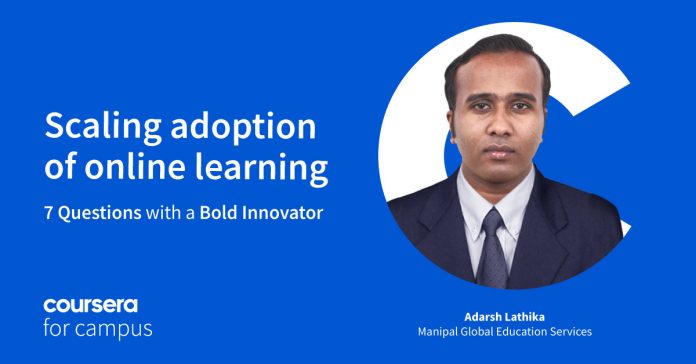

In recent years, committed, innovative educators have explored incorporating online learning into their existing curricula.
Adarsh Lathika is one of these changemakers. His passion for engineering and management has guided his work as part of the Manipal Global Education Services (MaGE) core team for over a decade. In this role, he has partnered with university leaders to implement various strategic programs—including Coursera for Campus.
With Adarsh’s leadership, the universities under the Manipal Education Framework (Manipal) saw course enrollments on Coursera increase over threefold from 71,000 to more than 250,000 in just two years. To get more students excited about Coursera, Adarsh and his team launched the Coursera for Campus Ambassador Program that engaged students as agents of change.
In this first installment of Coursera’s Bold Innovators blog post series, we talked to Adarsh about launching the program and his team’s plans for the future.
Q1. Welcome, Adarsh – Our readers would love to learn more about your journey with Coursera and how you encouraged student adoption of online learning.
From the start, we knew that getting more students excited about online learning would require fresh approaches. To create a culture of transdisciplinary learning, we partnered with Coursera to offer a broad-based learning experience.
When we started with Coursera for Campus, we needed students to feel excited about the program. With internal champions, we could personally encourage students to explore the full benefits of Coursera’s content. Assembling our internal champions meant aligning students, faculty members, and the university’s leadership. Deep, cross-functional collaboration was the foundation of our Coursera for Campus Ambassador Program.
Searching for our dynamic campus ambassadors, we conducted written tests and phone interviews to find candidates with strong communication skills. Ultimately, we recruited 99 campus ambassadors with the talent and drive to create awareness about the benefits Coursera brings to learners.
Peer-to-peer engagement is vital, but we also wanted faculty champions to support students’ onboarding into the program, so we reached out to Deans and department heads to promote Coursera. With students, faculty, and departmental leadership fully excited about Coursera, we saw strong results right from its first year. Manipal’s Coursera for Campus program is among Coursera’s top three programs globally in terms of enrollments and learning hours.
Q2. With a program that involved multiple stakeholders, how did you navigate the complex cycle of change management?
We’re proud to be the first university to adopt Coursera for Campus back in 2018. But we know that any big change, however positive, comes with challenges. Just as any successful journey starts one step at a time, we designed the Manipal – Coursera Campus Ambassador Program in phases. Our first step in change management involved boosting Coursera usage rates among students.
Phase 1: Creating Awareness
In our first year, we focused on enrollment. Each ambassador knew our core goal: Every student should be able to enroll in the program easily and complete at least one course. We empowered our ambassadors with clear descriptions of their tasks and well-articulated KPIs, as they worked with communities of around 150 to 200 learners. Ambassadors were tasked with sharing the advantages of Coursera in their classes, freshmen introduction sessions, webinars, and student clubs. We gauged ‘ambassadors’ success by measuring KPIs against various milestones in the online dashboard, and made updates as we discovered new effective approaches.
To build momentum as enrollments started increasing, we began the #LearnASkill campaign. Though we launched the campaign during summer break, it sparked massive engagement. We maintained a #LearnASkill leaderboard and offered prizes and certificates to inspire healthy competition among participating students – some students completed up to 100 courses.
Phase 2: Making Coursera a Learning Habit
Energized by the success of Phase 1, we moved the Coursera for Campus Ambassador Program into Phase 2. Here, we worked to sustain our learners’ enthusiasm for the program.
We understood that students would want to know about the benefits of continuing with more courses after completing the initial requirements. Encouraging students to reach the next level with their learning prompted us to start the #ShowYourSkill competition. #ShowYourSkill went one step beyond course completions, compelling learners to show off their newly acquired skills.
As we analyzed students’ learning patterns, we worked with Coursera to curate specific course recommendations. Through our campus ambassadors and student clubs, we shared these course curations to make learning a habit.
To help students understand how these courses would fast-track their careers, we connected them with alumni who were Coursera learners. After hearing the personal experiences of the alumni, students deepened their investments in learning through Coursera.
We also invited faculty to discover the possibilities through Coursera via online sessions and emails. As more faculty adopted Coursera, we saw a significant spike in student engagement. With student interest on the rise, we streamlined the campus ambassador program to 30 team members.

Q3. What processes did you put into place to ensure the long-term success of Coursera for Campus at Manipal?
To keep ourselves organized, we created a dashboard to track our activities as we developed the program:
- Email IDs of participants
- License status
- Number of courses completed
- Percentage of courses completed
- Number of people who completed the course, and several other details
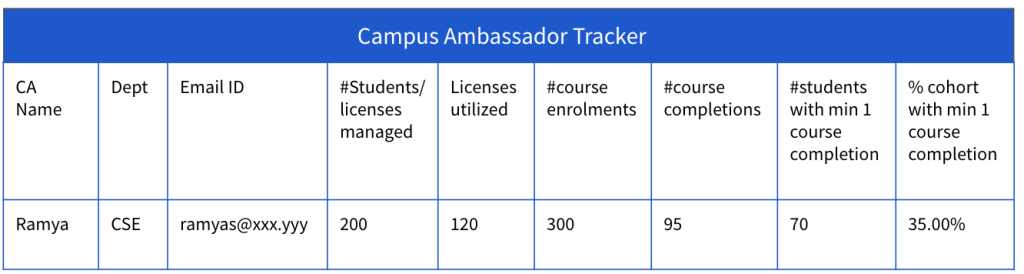
Initially, we saw around 20-25% of students complete courses. Soon, that rate reached 60%. As the team leader, I shared this data monthly with the campus ambassadors. Over two years, we also onboarded faculty champions in disciplines ranging from IT to Pharmacy, driving further adoption among students.
Q4. Can you share any anecdotes or stories that convey the impact of the Campus Ambassador Program?
Our students and faculty have heartwarming stories about their success with Coursera. One story from a learner, Urvashi Pathak, particularly stands out:
Coursera was a great help during the pandemic in 2020. I took the opportunity to enroll in several courses to upskill and improve my knowledge base. I am currently working for an IoT and Automation company. The courses I took from Coursera were related to my job and provided me with a very detailed understanding of the IoT domain, which further enabled me to apply this knowledge in my workplace.
Ramaprasad Poojary, a faculty member at SOEIT MAHE Dubai, also has high praise for Coursera:
In my opinion, Coursera is one of the best initiatives by Manipal Global. As a faculty member of SOEIT MAHE Dubai, it helped me update my technical skills in machine learning. It also helped me guide students during their project work and other courses. I have subscribed for three consecutive years and recently completed a specialization in ML using TensorFlow on Google Cloud. All five courses under this specialization were well designed.
These powerful testimonies emphasize how Coursera empowers our students and faculty.
Q5. The Campus Ambassador program was undoubtedly a tremendous success. What have been some of your personal learnings from the program, and how do you envision the growth of the program from here?
Through the Coursera for Campus Ambassador Program, we discovered so much about the minds of our young learners. Using informal platforms, such as WhatsApp groups, we gained answers to essential questions: How are our students learning? Why are they learning? What do they need to improve their learning?
With our new knowledge, we could better answer platform- and course-related queries, which increased exponentially toward the end of a semester. Some of our insights contributed to new Coursera product features, such as adding course ID in grade reports, including certificate URLs in usage reports, and removing share options for peer assignments.
The Coursera for Campus Ambassador Program is now an integrated part of Manipal’s action plan, which is highly outcome-driven.
Q6. Do you have any recommendations for fellow educators trying to promote the adoption of Coursera at their universities?
As educators, we’re usually asking our students questions to help them learn and grow. When we implemented Coursera for Campus at Manipal, we posed some fundamental questions to ourselves. These questions are highly relevant to all institutions:
- What are you trying to achieve with Coursera?
- What will be the benefits for your learners? What problems are you trying to address?
- Which metrics will you track, and how often will you review them?
- How can stakeholders such as students, alumni, and faculty serve as driving forces in this program? How can you customize your approach to meet each stakeholder’s unique needs?
Reflecting on these questions can help educators create successful roadmaps for developing learner programs through Coursera for Campus.
Q7. Based on your experience, how do online courses and platforms like Coursera help prepare students for their professional life?
Technology has been changing how we live for the last 25 years, and the pace of change has accelerated with the advent of smart technologies. In the job market, new graduates will compete not only against their classmates but also with graduates from the rest of the world. The skills and competencies they need will continue to change throughout their careers. In such a fluid state, the fundamentals remain important. Along with soft skills, an understanding of how to learn continuously, and the ability to work with those from other cultures.
Ensuring our learners have the skills and competencies to compete in the global workforce is our responsibility as educators. With Coursera, we’ve given our learners access to knowledge that prepares them to succeed in a world where evolving technology changes the ways we live every day.
Online learning through Coursera for Campus helps students learn from content developed by the brightest minds in industry and academia, and empowers them to be future leaders and innovators in the global workforce.
Alison: Changing Lives Through eLearning in Kenya
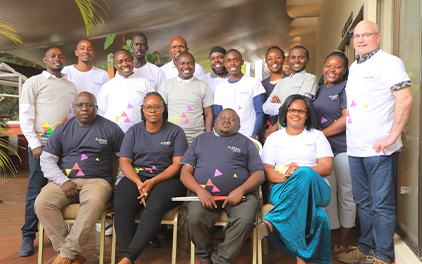
It’s been said that the more you know, the more you will grow. As you grow, so will the opportunities available to you begin to open. Free education, through Alison’s platform, is one way to encourage and empower individuals from all walks of life to change their lives and their future. Recently, Alison joined hundreds of delegates at the annual eLearning Africa Conference to discuss how education can impact the lives of ordinary people throughout Africa. One of the stops the Alison team made on their journey across east Africa was in Kenya. Here, we met some of Alison’s graduates and heard how Alison is changing their lives through eLearning. Let’s meet some of our amazing learners from Kenya.
Bonfice Kibisu – Alison courses “are very educational and very helpful to both careers and effectiveness of the worker…”
Bonfice works in the Safety Department in the aviation industry and has completed a and courses with Alison which have both been key in his career growth. These not only added to his resume but also improved his effectiveness at work.
Kelvin Kamau Jedida
Peter Mwangi – “Alison…it’s a great platform. It’s free.”
Peter is an ICT student but is a passionate hotelier at heart. To fuel his passion for the industry, he completed a course in and feels one step closer to achieving his dream of working as a hotelier.
Florence Riaga – “I’ve seen a lot of impact in my short courses with Alison.”
Florence is a nurse working in the TB/HIV Department. She came to learn about Alison in 2015 when she was searching for eLearning courses in her field to help her in her career and . Her studies have greatly improved her skills which she’s now able to apply to her job.
Sharlene Mbori – “…you are really missing out if you are not on Alison.”
Sharlene’s mother introduced her to Alison after completing her high school education and felt indecisive about what she wanted to do. Through the many courses available on our platform, she found her passion for and is proud to have her certificate.
Gilbert Namutali
We met many students, all studying various courses like photo Wilden Ratemo who used our variety of courses to that tell a story.
Advantages of eLearning With Alison
- Free courses, certificates, and diplomas
- Suits all learning styles
- Study anywhere and anytime
- Accredited courses
- Acquired skills sets you up for career growth
- Flexible study solutions
Alison’s platform has various products to help you take the next step in your career. From those newly entering the job market, those looking to make a career change or simply upskill their skillset, and improving the CV, we have the tools you need to get you there.
Alison Tools To Enhance Your Studies
The workplace is not always easy to navigate. We help you discover your strengths and weaknesses, your working styles and more and recommend several courses that will help you improve, enhance, and grow in the various areas.
Your mental wellbeing is an important factor in ensuring you’re the best version of yourself at home, work, and at play. Sometimes it all gets too much and can be overwhelming to cope with it all. This tool helps assess where you are and offers ways and means to help you get better.
Like our graduates in Kenya, you too can take advantage of Alison’s eLearning platform to grow and catapult you to success. So, whether you want to earn and learn with our , learn a new hobby, or equip yourself with the skills and knowledge to make that career switch, you can.
How I Went From Working As A Security Guard To Web Developer


Learning to code so that you can land a job in tech can feel daunting. That’s why we’re sharing inspiring stories from Codecademy’s community — to show how people like you (yes, you!) can embark on a learning journey and end up with a totally new career. We hope these stories serve as a reminder that there’s no single path to a more fulfilling work life.
Today’s story is from Casper Tollefsen, a 28-year-old Web Developer at Telenor living in Fornebu, Norway. Read more stories from Codecademy learners here — and be sure to share your story here.
Why I chose to learn to code
“I did just HTML and CSS on and off for years. I tried my hand at university, and I did one year of mathematics. And then I switched to IT studies, but they would only teach us C. I guess that is a great way to start for system architecture, but I was fairly certain that I wanted to go into web development. So that’s when I decided to quit school. I already had the book HTML and CSS: Design and Build Websites’ by Jon Duckett. And so for Christmas 2020, I put his other book, JavaScript and JQuery: Interactive Front-End Web Development, on my wishlist.”
How I made time to learn
“I became a security guard, but I knew I still wanted to work in programming. I’m an efficient learner, and I knew I could learn this myself. So I made sure that while I was working my shifts, I listened to audiobooks on an earbud. If I had quiet shifts, where I could just sit and keep an eye on things, I’d bring a book and read up on game design and programming in general. I started learning HTML and CSS shortly after Codecademy was launched 10 years ago. I’ve been in and out of courses for many years, but got Codecademy Pro through work last year when I started learning JavaScript. Then I took courses on React, TypeScript, Redux, Node, Express, and others on the Front-End and Full-Stack Career Paths.”
How I saved up enough money to switch careers
“I worked as a security guard while I studied coding. Then I was eventually noticed by Mobit, a B2B sales company in the telecommunications space. That’s where I started to do web development and got proficient at it and started to make websites and applications for companies here in Tromsø. But I was still just working on my own as the sole developer. I realized that I knew enough to make these applications and set up the systems, but I was getting to a point where, if I kept going on my own and didn’t learn from other professionals, I might get set in my ways. So that’s when I started to apply for other companies and web developer or front-end positions. And that’s how I eventually ended up in Telenor, which is one of the biggest technology companies in Norway.”
How long it took me to land a job
“Two years from when I started learning.”
How I got in the door
“I applied like anyone else, and I was interviewing with other companies. I let Telenor know that it would be a dream to work for them, because they’re the biggest company I could ever get my foot in the door with. I mean, you could stay at this company for the rest of your life, and still have challenges all along the way. So I just let them know that I am in the process with other companies too. And so they just rushed the process a little more. They got a good first impression of me from the video interviews, and they wanted to see what I could do. Over four weeks, we did all the four steps of interviews, coding tests, the personnel checks, the background checks and signing everything. Within four weeks, the whole process was complete.”
How I nailed the interview
“I tried to stay well aware of the fact that I am self-taught. They asked me leading questions that gave me the impression that a lot of the people they’d been interviewing were kind of set in their ways and had already decided that their way of doing stuff is the best way. So I just tried to stay humble to the fact that, yeah, I’ve accomplished a lot of great stuff, but I am at the bottom of the ladder. This will still be an entry-level position, which will give me a lot of room to grow. And that’s why I’m there. I want to become this resource. And I want to develop my skills with them to be able to work in huge systems eventually. And not just the small, isolated, contained websites that I make myself.”
How I evaluated the offer
“The company is based in Fornebu, which is kind of like the Silicon Valley of Norway. That’s where the biggest companies are based. Like, the other dream would be to actually go to California, and work at one of the big ones. But what’s been holding me back from actually applying abroad is that a lot of these companies have so many thousands of employees that are all really talented tech people. So how could I stand out? How could I ever be the one that is actually working on the flagship products?
Telenor is a company comparable to T-Mobile or AT&T; they build the infrastructure for communications. But they’ve recently, like in the last 10 years, started to invest more into development of applications, website builders, and stuff for other companies.
So what I’m thinking is, I will be able to work at Telenor, at this huge campus that has a lot of places to eat, a gym, laundry service — all of these things you only hear about from the Facebook campus. The standards of living in Norway are pretty great. We don’t have this huge financial gap between classes. Norway is a country where we have a lot of happiness; we always score really high on these evaluations.
I know the working conditions in a lot of countries give employers the power to just fire you outright, if they’re downsizing or whatever. You can’t really do that in Norway that easily, because of the unions. So having then compared Telenor to these other big companies, but taking into account that Telenor is still in Norway, and they’re never going to move their headquarters to another country because they are responsible for critical infrastructure in Norway, I’m pretty sure this is the closest I’m going to get to the ‘Silicon Valley dream.’”
How day one & beyond went
“I start in June — TBD!”
What I wish I knew before I started learning
“I struggled for a long time with the uncertainty of my own abilities. Codecademy gives you the opportunity to join their communities and talk to other people and kind of get more of an evaluation on your skills. When I started to talk to other developers, they looked at my projects, and they were like, ‘How did you manage to set this up by yourself with no prior knowledge? You learned everything!’ That’s kind of when I started to get the picture that my spending at least three hours every single day for the past two years just learning programming and staying dedicated and disciplined did pay off.
You have to set yourself a goal. And it’s gonna be tough, especially if you’re completely self-taught and you’re not in the industry. If this is your dream, then it’s not a high price to pay. That one or two hours you spend every single day will net you the career that you’re looking for, as long as you stay persistent.
A more unconventional tip I would give, is to start listening to the industry leaders in your field. Like Bill Gates! He says that he reads at least three books every month. And it doesn’t have to be technology books. It’s just to expand your mind; you read these books, and they expand your vocabulary and your impressions of the world. That’s what I started to do, especially with a lot of these self-help books written by actual healthcare professionals and not influencers.
So like Atomic Habits by James Clear, Unfu*k Yourself by Gary John Bishop, Talking to Strangers by Malcolm Gladwell, and Thinking, Fast and Slow by Daniel Kahneman, for example. These books give you the tools for thinking and for keeping the right mindset.”
Learn like Casper
See the courses and languages that helped them most.
Not sure where to start? Check out our personality quiz! We’ll help you find the best programming language to learn based on your strengths and interests.
Want to share your Codecademy learner story? Drop us a line here. And don’t forget to join the discussions in our community.
Web Development Courses & Tutorials | Codecademy
Web Development is the practice of developing websites and web apps that live on the internet. Whether you’re interested in front-end, back-end, or going full-stack, the content in our Web Development domain will help you get there.
Summer Reading Contest Winner Week 2: On ‘Why Strangers Are Good for Us’

Winner
Sophene Avedissian, from Los Angeles, chose an article from the Opinion section headlined “Why Strangers Are Good for Us” and wrote:
I distinctly remember looking at my mom in awe as she casually chatted with the grocery store cashier. When most would answer with a few dismissive words, she seamlessly instigated an entire conversation from the cashier’s simple question of “How’s your day?” As we made our way out of the store, I turned back and noticed the corners of the cashier’s lips rise into a grin. I wondered, How can my mom so effortlessly impact someone’s day from one small, yet meaningful interaction?
As my mother seeks out these moments to connect, I avoid them. In elementary school, I hid behind my mom at gatherings as she spoke to others. In middle school, I often replied “no” to invitations to avoid the awkwardness of meeting new people. Now, in high school, I hope that by wearing my pair of rose-gold headphones, others feel discouraged to talk to me.
In “Why Strangers Are Good for Us,” David Sax identifies that engaging with strangers “connect[s] us to the community, teach[es] us empathy, build[s] civility and [is] full of surprise and potentially wonder.” Sax explains when we disregard strangers, we weaken what is at the “core of our social contract.” The technological evolution combined with the pandemic has forced “our world [to grow even more] inward and suspicions.”
I take a deep breath, slip off my headphones, and start talking to the person next to me as we both wait for our takeout order.
It’s a start.
_________
Runners-Up
In alphabetical order by the writer’s first name.
Eriene (Zhiyan) on “Yaren and the Sun”
Nishna Makala on “‘Scared and Tired’: Thousands Across the U.S. Rally Against Gun Violence”
Shaun Wong on “Zelensky Answers Hamlet”
Xuanjian on “How Nike Won the Cultural Marathon”
Yanshou (Prince) on “Stephen Curry Is More Human, and Brilliant, Than Ever”
________
Honorable Mentions
Ava Dong on “How Many Languages Could a Child Speak?”
Darya on “To Enjoy Life More, Embrace Anticipation”
Elaine on “The Future Isn’t Female Anymore”
Grace on “Odesa Opera House Reopens, Defying Putin’s Barbarism”
Scaling Adoption of Online Learning: 7 Questions With a Bold Innovator
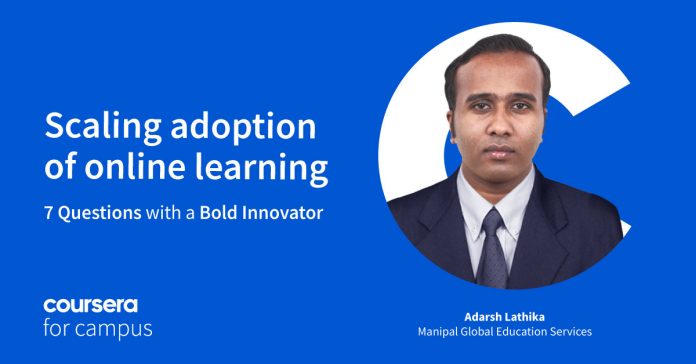
In recent years, committed, innovative educators have explored incorporating online learning into their existing curricula.
Adarsh Lathika is one of these changemakers. His passion for engineering and management has guided his work as part of the Manipal Global Education Services (MaGE) core team for over a decade. In this role, he has partnered with university leaders to implement various strategic programs—including Coursera for Campus.
With Adarsh’s leadership, the universities under the Manipal Education Framework (Manipal) saw course enrollments on Coursera increase over threefold from 71,000 to more than 250,000 in just two years. To get more students excited about Coursera, Adarsh and his team launched the Coursera for Campus Ambassador Program that engaged students as agents of change.
In this first installment of Coursera’s Bold Innovators blog post series, we talked to Adarsh about launching the program and his team’s plans for the future.
Q. Welcome Adarsh – Our readers would love to learn more about your journey with Coursera and how you encouraged student adoption of online learning.
From the start, we knew that getting more students excited about online learning would require fresh approaches. To create a culture of transdisciplinary learning, we partnered with Coursera to offer a broad-based learning experience.
When we started with Coursera for Campus, we needed students to feel excited about the program. With internal champions, we could personally encourage students to explore the full benefits of Coursera’s content. Assembling our internal champions meant aligning students, faculty members, and the university’s leadership. Deep, cross-functional collaboration was the foundation of our Coursera for Campus Ambassador Program.
Searching for our dynamic campus ambassadors, we conducted written tests and phone interviews to find candidates with strong communication skills. Ultimately, we recruited 99 campus ambassadors with the talent and drive to create awareness about the benefits Coursera brings to learners.
Peer-to-peer engagement is vital, but we also wanted faculty champions to support students’ onboarding into the program, so we reached out to Deans and department heads to promote Coursera. With students, faculty, and departmental leadership fully excited about Coursera, we saw strong results right from its first year. Manipal’s Coursera for Campus program is among Coursera’s top three programs globally in terms of enrollments and learning hours.
Q. With a program that involved multiple stakeholders, how did you navigate the complex cycle of change management?
We’re proud to be the first university to adopt Coursera for Campus back in 2018. But we know that any big change, however positive, comes with challenges. Just as any successful journey starts one step at a time, we designed the Manipal – Coursera Campus Ambassador Program in phases. Our first step in change management involved boosting Coursera usage rates among students.
Phase 1: Creating Awareness
In our first year, we focused on enrollment. Each ambassador knew our core goal: Every student should be able to enroll in the program easily and complete at least one course. We empowered our ambassadors with clear descriptions of their tasks and well-articulated KPIs, as they worked with communities of around 150 to 200 learners. Ambassadors were tasked with sharing the advantages of Coursera in their classes, freshmen introduction sessions, webinars, and student clubs. We gauged ‘ambassadors’ success by measuring KPIs against various milestones in the online dashboard, and made updates as we discovered new effective approaches.
To build momentum as enrollments started increasing, we began the #LearnASkill campaign. Though we launched the campaign during summer break, it sparked massive engagement. We maintained a #LearnASkill leaderboard and offered prizes and certificates to inspire healthy competition among participating students – some students completed up to 100 courses.
Phase 2: Making Coursera a Learning Habit
Energized by the success of Phase 1, we moved the Coursera for Campus Ambassador Program into Phase 2. Here, we worked to sustain our learners’ enthusiasm for the program.
We understood that students would want to know about the benefits of continuing with more courses after completing the initial requirements. Encouraging students to reach the next level with their learning prompted us to start the #ShowYourSkill competition. #ShowYourSkill went one step beyond course completions, compelling learners to show off their newly acquired skills.
As we analyzed students’ learning patterns, we worked with Coursera to curate specific course recommendations. Through our campus ambassadors and student clubs, we shared these course curations to make learning a habit.
To help students understand how these courses would fast-track their careers, we connected them with alumni who were Coursera learners. After hearing the personal experiences of the alumni, students deepened their investments in learning through Coursera.
We also invited faculty to discover the possibilities through Coursera via online sessions and emails. As more faculty adopted Coursera, we saw a significant spike in student engagement. With student interest on the rise, we streamlined the campus ambassador program to 30 team members.

Q. What processes did you put into place to ensure the long-term success of Coursera for Campus at Manipal?
To keep ourselves organized, we created a dashboard to track our activities as we developed the program:
- Email IDs of participants
- License status
- Number of courses completed
- Percentage of courses completed
- Number of people who completed the course, and several other details
Initially, we saw around 20-25% of students complete courses. Soon, that rate reached 60%. As the team leader, I shared this data monthly with the campus ambassadors. Over two years, we also onboarded faculty champions in disciplines ranging from IT to Pharmacy, driving further adoption among students.
Q. Can you share any anecdotes or stories that convey the impact of the Campus Ambassador Program?
Our students and faculty have heartwarming stories about their success with Coursera. One story from a learner, Urvashi Pathak, particularly stands out:
Coursera was a great help during the pandemic in 2020. I took the opportunity to enroll in several courses to upskill and improve my knowledge base. I am currently working for an IoT and Automation company. The courses I took from Coursera were related to my job and provided me with a very detailed understanding of the IoT domain, which further enabled me to apply this knowledge in my workplace.
Ramaprasad Poojary, a faculty member at SOEIT MAHE Dubai, also has high praise for Coursera:
In my opinion, Coursera is one of the best initiatives by Manipal Global. As a faculty member of SOEIT MAHE Dubai, it helped me update my technical skills in machine learning. It also helped me guide students during their project work and other courses. I have subscribed for three consecutive years and recently completed a specialization in ML using TensorFlow on Google Cloud. All five courses under this specialization were well designed.
These powerful testimonies emphasize how Coursera empowers our students and faculty.
Q. The Campus Ambassador program was undoubtedly a tremendous success. What have been some of your personal learnings from the program, and how do you envision the growth of the program from here?
Through the Coursera for Campus Ambassador Program, we discovered so much about the minds of our young learners. Using informal platforms, such as WhatsApp groups, we gained answers to essential questions: How are our students learning? Why are they learning? What do they need to improve their learning?
With our new knowledge, we could better answer platform- and course-related queries, which increased exponentially toward the end of a semester. Some of our insights contributed to new Coursera product features, such as adding course ID in grade reports, including certificate URLs in usage reports, and removing share options for peer assignments.
The Coursera for Campus Ambassador Program is now an integrated part of Manipal’s action plan, which is highly outcome-driven.
Q. Do you have any recommendations for fellow educators trying to promote adoption of Coursera at their universities?
As educators, we’re usually asking our students questions to help them learn and grow. When we implemented Coursera for Campus at Manipal, we posed some fundamental questions to ourselves. These questions are highly relevant to all institutions:
- What are you trying to achieve with Coursera?
- What will be the benefits for your learners? What problems are you trying to address?
- Which metrics will you track, and how often will you review them?
- How can stakeholders such as students, alumni, and faculty serve as driving forces in this program? How can you customize your approach to meet each ‘ ‘stakeholder’s unique needs?
Reflecting on these questions can help educators create successful roadmaps for developing learner programs through Coursera for Campus.
Q. Based on your experience, how do online courses and platforms like Coursera help prepare students for their professional life?
Technology has been changing how we live for the last 25 years, and the pace of change has accelerated with the advent of smart technologies. In the job market, new graduates will compete not only against their classmates but also with graduates from the rest of the world. The skills and competencies they need will continue to change throughout their careers. In such a fluid state, the fundamentals remain important. Along with soft skills, an understanding of how to learn continuously, and the ability to work with those from other cultures.
Ensuring our learners have the skills and competencies to compete in the global workforce is our responsibility as educators. With Coursera, we’ve given our learners access to knowledge that prepares them to succeed in a world where evolving technology changes the ways we live every day.
Online learning through Coursera for Campus helps students learn from content developed by the brightest minds in industry and academia, and empowers them to be future leaders and innovators in the global workforce.
How Much Do Network Engineers Make?


Maybe you’ve seen a job posting recently for a Network Engineer and wondered what they do, and just as importantly, how much they make. Network Engineers are specialized professionals who function as the backbone of many organizations, keeping computer systems, networks, and databases running. If you’ve taken a few programming courses, you might even already have some of these skills.
Ahead, we’ll take a look at what exactly it is that Network Engineers do, what you can expect to make as a Network Engineer, and the training required to get into this line of work. The job title might sound intimidating, but it’s actually a relatively attainable career path if you practice your coding skills.
What does a Network Engineer do?
Network Engineers are responsible for the design, maintenance, and operation of communication networks. These networks could include local area networks (LANs), wide area networks (WANs), company intranet, phone systems, wireless networks, extranet, and even cybersecurity measures to keep information on these networks safe.
On a more granular level, Network Engineers perform many tasks that keep businesses running on a day-to-day basis. Each day could bring a new challenge and a new set of problems to solve, like:
- Upgrading hardware (e.g., routers, hard drives, etc.)
- Recommending new platforms, systems, and processes
- Designing and improving networks
- Troubleshooting issues
- Managing wireless networks
- Implementing new firewalls and network security
- Monitoring and analyzing network traffic
At first glance, you might be thinking that this sounds a lot like a Back-End Engineer, but there are key differences between these professionals. Network Engineers deal heavily in hardware and the specifics of networks, while Back-End Engineers are a type of Software Developer that create and maintain the systems, applications, and databases needed to run programs. So Network Engineers are a little more invested in specific hardware and communication systems, though they still know programming languages in order to integrate with the back-end systems.
In a sense, Network Engineers build, optimize, and maintain the highways that the other Software Engineers need to travel on every day. But in addition to that, they can provide the communication networks that every employee at a company requires, like their phone system, internal network, and file transfer programs. In that sense, they are essential to keeping teams connected to business data and one another every day.
How much do Network Engineers make?
Network Engineers fall into the category that the U.S. Bureau of Labor Statistics calls Computer Network Architects. On average, Network Engineers make $120,520 per year. Because these engineers are in high demand with a particular skill set, the occupation can expect to see a 5% salary growth over the next decade, which is higher than the overall average in the U.S.
Keep in mind that this number is an average, so if you are just starting out, you might make less than six figures. But as you gain experience in the field, you can increase your pay through raises and bonuses. Plus, depending on the state or industry you’re in, some companies will pay more for a Network Engineer than others.
Because this is a more specialized job title than, say, a Back-End Engineer, the data on salaries from state to state are sparse. But you can likely expect that salaries in tech hubs will be in the higher five figures to six figure range, because the competition for top talent is high. If you have a degree in the field under your belt or online certificates of relevant courses completed, these could also help to bump up your starting salary — so don’t forget to include your training on your technical resume.
What skills are needed to become a Network Engineer?
As you may have gathered, the specific jobs that a Network Engineer does can vary drastically from industry to industry. You might be specializing in phone network systems, or you might be dreaming up the next networking standard to be pitched to a management team. Careers in programming can lead to just about any industry you’re interested in, so do your research and whittle down your top companies and job descriptions. Then, you’ll be able to hone in on the exact skills you’ll require for the career path you want.
Programming
Network Engineers need to be problem-solvers, big-picture thinkers, and yet still be meticulous in their work, from properly setting up a wireless network in a business to coding the latest version of security into the network. You’ll need to know how to program in at least one language, such as Python, Ruby, or Java. Each of these will allow you to learn the essential concepts of programming; and then if your new job requires additional languages, you’ll be able to transfer over the conceptual basics.
Practical training
Don’t be discouraged if some jobs require practical training. You can learn the basics in our online courses. But the learning you’ll do on the job will be targeted to your chosen industry, and you’ll get to accelerate the process by being immersed in your daily duties. Each company will also have its own coding standards, styles, and individual tech stack that you’ll have to get used to. Anticipate the learning curve when you first get hired, and you’ll be in a growth mindset and ready to absorb what you need to understand.
Computer science skills
Network Engineers require a foundation in computer science. If you’re just starting out on your learning journey, check out our Computer Science Career Path, which will teach you the coding skills you’ll need. If you already have experience in programming, consider leveling up some of your skills or adding on new specialties, like cybersecurity or computer architecture. Retaking a course is also a great way to refresh your memory and practice your programming before you apply for a new position.
Staying nimble
The technology landscape changes rapidly and constantly, so just know that your learning journey doesn’t end when you land a job. Becoming a Network Engineer means staying on top of industry trends, continuing to optimize your networks, and taking additional courses in the future in order to do your job even better. There’s nothing stagnant about a career in coding, and choosing to pursue network engineering is a great way to keep things exciting at work.
Cybersecurity Courses & Tutorials | Codecademy
Cybersecurity is a fast-growing field that addresses the security risks of our increasingly connected digital world. Learn cybersecurity, and you will learn how users, companies, and even governments protect themselves and recover from cyber threats and attacks. Start defending yourself or your orga…
Top 10 Fun & Fresh Summer Fonts You Will Love


Make a splash in your design choices this summer with these fun fresh fonts perfect for adding some summer style to your office prints, barbecue invites, and newsletters.
10 Fun & Fresh Summer Fonts
Summer is the best time for some quick and colorful crafts and trying out some new crazy fonts. To give you some fresh ideas we have put together a list of the top 10 fonts we recommend this summer. You will find here everything from funny shapes to classic brush-stroke scripts.
Click on the font cover or name to see its Creative Market page.
Pin me for later!
If you are browsing this post at work or just do not feel crafty right now, we have something for you too! All the fonts collected in one please on easy to pin graphic so you can save those inspirations for later.

Show us your works!
I would love to see what you create using those fun & fresh fonts. Make sure to let us know in the comments, or share your creation on social media and tag Designer Blogs.
Don’t forget to let us know which font is your favorite. Do you like script fonts, or would you rather see a compilation of classic serif or sans-serif fonts?
Still looking for a perfect font? Check the list of 20 Best Free Holiday Fonts.
P.S This post includes affiliate links so by clicking them you are supporting us. Thanks!
The Broken Dream – LXP

Bees. Wasps. Crows. They seem so different (besides scaring the beejeebees out of some folks). Two are insects. One is a bird. Yet, they all three have something in common (excluding fear phobias). Each of them can remember a human face. This means if they see the same human face multiple times, they will remember it. Not just that day, but way past that (far more than some humans I have met). Crows can remember too. Faces. People. Even actions – i.e. garbage truck shows up on this day and on this road.
Pretty amazing for two species that we (those of us who are not Ornithologists and Entomologists) would never assume could exist due to a couple of factors. Lack of awareness, misconception, and misperception. Even now knowing, would you change your behavior upon seeing them (assuming you can’t suffer death or serious injury if a bee or wasp stings you)?
Change is another tenant, not with the above example, but rather with humans. Anyone who has ever provided training at a company or place, where the employees do not fully buy into it, has experienced it first hand. HR folks experience it when they ask a potential hiree how they handle or can they accept rapid change. If you want to get past the first cut, you say yes. Look today, at the number of folks who still hang onto ILT. They so buy into it, as the best way to learn X or Y, that there is a movement to add synchronous-based learning, back in the day, we referred to SBL as sticking the classroom teaching method online. That is definitely not changing.
What does the above have to do with an LXP, err the LXP sector, well, each of the four tenants presented above is the same four tenets that the LXP space failed to recognize. It was their folly if you will. Yes, LXPs exist today and will exist tomorrow. Yes, there will be many that will refer to themselves as such, and yes, their will be other learning systems that note that they have an LXP in their system. However, it does not mean that the LXP type (in the learning system space) is the same hot commodity it once was.
A Failed Premise
When the LXP market made its official appearance it was supposed to be the game-changer, the learning changer that the learning system was waiting for, the much-needed ooomph to empower learning and create a new existing way to gain learning knowledge. The acronym stood for Learning Experience Platform.
But what exactly was an LXP? What made it so different than anything else existing in the market at that moment? It was clear that buyers didn’t know – which lead to the growth obviously of the space. It was clear that not even LXP vendors (as a whole) knew – which explained why they targeted L&D, ignoring the other monster in the room, training.
On top of all that, the LXP vendors (as a whole) pushed a false pretense that the LXP was vastly different than say an LMS. Was it though really so different?
History Lesson
There were (and still are) LXPs who require the learner to complete the content, course, etc – yet, the whole value and reason for WBT (web-based training, now referred to as e-learning) were to identify what people knew and did not know – by observing virtually (thru analytics/metrics) gaps in their knowledge, and yes, skills. WBT design concept was simple – allow people to choose what they want to learn, whenever and wherever. Eliminate the inherent problems with ILT, which includes people afraid to ask questions, the session driven by the instructor, a step by step even if the learner/trainee has zero interest OR already knows and wants to know a specific section. All of these items are eliminated via asynchronous based learning (which was then and still is the prominent method of learning/training in the corporate market).
Lack of Awareness
The LXP market ignored the industry, not from a hubris standpoint, but rather not studying the history of the learning system space and recognizing pre-existing capabilities that were readily available for decades.
- Formal vs Informal. LXP vendors loved to push the notion that LMSs (the dominant learning system type) only provided formal learning. The problem? It wasn’t true. First, as every vendor knows, it is how the client uses the system, and not the system itself driving the whole approach. Secondly, many systems in the early 2000s offered groups, chat, discussion boards/forums and other capabilities that are social in nature. They offered informal learning. If you wanted assigned learning, yes, they offered that, but nobody was forced to select only that option. If you wanted self-paced learning, congrats they offered it as well. One of my favorite early vendors was GeoLearning. The system I purchased, had five levels, that could be skinned with my logo, even the carpeting (yes one view, had a virtual appearance). I had a bookstore (aka library) where folks could view, and download courses or other types of content. Chat room? Yes. Groups? Yes. Discussion board/forum? Yes. A museum type of look, whereas we could add sponsors (it was an association), and folks could click the logo and go to the web site of said sponsor. It was a full and robust system, and yes, an LMS.
- Learner-Centric. Did I mention that learners could select their own courses in a catalog if the client (i.e. buyer) wanted to go that way? And that if the client said folks didn’t have to complete the courses or required to, then uh, that is learner-centric.
- Premise that LMSs were created for compliance and regulatory only. 100% FALSE. This was a big one for LXP vendors to miss, yet, many pushed this narrative. LMSs were created because people didn’t know what their employees, customers, members, students, hamsters (could be), didn’t know. You chose the courses (i.e. the client). If you wanted the LMS to only offer compliance courses and regulatory, that was/and still is, your choice. There was one, 100% LMS that was only compliance and nothing else. That’s it. One – Cobent. One out of a 500 plus by 2012.
- Marketplace (i.e. e-learning marketplace or repository for 3rd party content/courses) – they existed back in the early days. As far back as 2000. The difference? You, the person overseeing training or L&D or whatever, had to talk to the salesperson and tell them you needed courses (now often referred to as content) in specific subjects. The vendor may have a partnership already with certain 3rd party publishers and thus, once you purchased, the vendor would just upload the courses, often via a CD or DVD (as technology advanced). Next, you as the buyer could do what you wanted with said courses. If you wanted to purchase 3rd party courses, and eliminate the middle-person i.e. the vendor, you would contact the 3rd party publisher, purchase the courses and seats (you could buy as few or as many as you want) and then the publisher would enable you to download the courses and then you, uploaded them. Hence the benefit of having batch uploading in your learning system.
The first vendor to offer a visual marketplace, by the way, was Docebo. Far before the LXP market ever appeared, let alone existed as a type. With Docebo, you viewed the course, decided if you wanted it, bought it right there without having to talk to the salesperson, clicked and it was in your system. Yes, they were the first.
- Skills capabilities – Skill gaps have existed in the learning system space since well, the first online LMS ever appeared. And yes for those who used an LMS during the WAN or LAN days, there as well. The difference was that the person overseeing the system -i.e the head of training or L&D or whatever, had to view the metrics – which with some systems could be very segmented and detailed (more so than most systems today) and identify those gaps. You, the buyer would create courses that could focus on one specific topic or skill if you so desired.
- Micro-Learning. Not a new concept. I was offering this in my learning system in 2002. We didn’t call it micro, we just called it short or mini-modules. Plus, duration is a misnomer. What takes you three minutes, could take me an hour, to retain the information and synthesize it. Duration sounds good because it is the way you learn in school.
- Lots of content/course options, free and paid. Surprise, that existed in 2002. Again, not visible from a buyer perspective, but you could add free courses/content, and links to sites, in your system, just as you could add your own courses (regardless if you built it yourself OR hired a 3rd party) and could purchase courses to go into your system.
When taken as a whole, it leads to being unaware of the industry, and the market you are going to enter.
What an LXP did offer which was unique was taking all those other bits that already existed and shoving them into one platform. However, there were systems doing all the above, prior. Was it as strong as say an LXP? Well, it depended on the vendor themselves. Skill ratings? Degreed was the first. However, the LXP market as a whole did not roll out with skill ratings.
Playlists – recommended, trending, skill-specific, etc – LXPs rolled them out, again, though not every vendor in the LXP space had all of them at the same time. One could argue that a vendor, a learning platform vendor, LinkedIn Learning was the first to have all those playlist options, just as you could say Degreed too. Very close on either side. The UI/UX Netflix angle wasn’t across the board with the LXP market, and yes, there were learning platforms and LMSs that went GRID too. If you want to look at who really tapped into the Netflix angle first, it was VLPs – Video Learning Platforms. MediaCore’s look was similar to YouTube.
LXPs were not the first with mobile, nor the idea of learner-centric, nor advanced let alone metrics that really told the story of your learning or training. They were not the first to gather the whole spin of learning experiences – that my friend was an LMS in the EdTech space, Blackboard. A learning experience sounds all cool and hip, but it has existed since the first classrooms when you experienced a form of learning on whatever topic. Heck, you could pin it to thousands of years ago, the moment a Human tossed a rock at a Wooly Mammoth and said Mammoth gored them. Then, others in the pack, said you know, a rock isn’t a good idea, let’s go with sharp sticks. Tada – learning experience.
LXPs were not the first to take social to new levels, heck even today it is a mixed bag. Upside Learning’s group look was very similar to LinkedIn. That was again, far before the LXP space.
Misperception and Misconception
There is some weird fascination with people who decide to run with the bulls. The perception perhaps is that this will be a wonderful experience and in some manner of strength. The reality is you could get injured, even severely, or that the animals themselves think this is a rotten idea and see you for what you are, a human bouncy toy.
Misconception, which yes, I know is not the same as misperception could equally apply here because LXPs wrongly assumed that the other learning systems in the market wouldn’t adapt as quickly, let alone adapt in such a manner that it would impact the industry, far greater than one would assume.
From the misconception standpoint, if one understands the whole premise of an LXP, how they sought to differentiate themselves, beyond what was presented earlier, the flaws of what they could be, and now are clear.
The LXPs rolled out, seeing themselves as a bolt-on, i.e. add-on to an existing learning system (most pointed to the LMS). While privately, several acknowledged they wanted to be a standalone for learning, in this instance – a moment of time, they recognized that they were so new, that this add-on was a logical step in the industry.
The misconception for them, started early though, in that they focused solely on the L&D community. The system was tailored for it, so they thought. They perceived that the demand was so great for not just the present, but long-term, that L&D folks would see the pluses compared to say an LMS, and ditch the LMS. The misperception tapped into the whole learner-centric narrative (which has disappeared in marketing for some LXP vendors).
Part of their perception was that their system was tailor-made for very large enterprises. That all of these large enterprises already had at least LMS, if not two. That all of these large enterprises wanted a different way to learn, compared to what they were doing today. However, all of these presumptions were mistaken.
The client drives the system or systems in this case, resulting in a vastly different outcome. Yes, there are a lot of very large enterprises that have multiple systems. But it doesn’t mean that they are using them in the same way, i.e. using the LXP angle of compliance only. An L&D exec I met from a large global bank is a perfect example. They had/have assigned learning. They have compliance courses. And they also have, non-compliance, whereas folks can pick and choose what they want, with zero requirements of completion.
Another L&D exec I know has two systems. One for employees, and yes, one for customers. They are an outlier in the L&D space because overwhelmingly, L&D execs usually do not provide/nor oversee customer education.
There is a misperception that Nostradamus saw the future with his quatrains. The reason for this premise is that those who are strong supporters of the notion, fit the quatrain into their box, sort of a square in a circle attempt succeeding by shoving the square in such a way that it fits the circle.
There are strong supporters still to this day for the LXPs. This post won’t change that. However, when looking at and understanding the initial premise, the focus on the L&D segment only, and an overall lack of specific metrics, one can start to see a different picture if they truly look.
Change
Many moons ago, I had an employee that was a so-so employee. I inherited them when I went to work at a company, and despite numerous offerings to assist, to offer and provide additional training, and then having to start the process of warnings, etc. – they didn’t change. Well, let me say, they changed, but only for a short period of time. The change was great, they started to really excel, but a pattern quickly emerged. Warning – star employee. A few months later, back to their old self.
The workplace is full of such stories, and many of you, again, have first-hand experience with this, and in some instances, not just once. The idea that you can change someone is still IMO debatable because it is never just one change, it involves multiple variables, both seen and unseen. You can coach a player following the exact same processes and methods, and that player may start off well, but at some point, they will either return to their old ways, OR they will excel.
LXPs focused solely on the L&D area. The LXPs (at least the ones I spoke with) never fully understood what the term OD meant and how it was applicable to the way folks in L&D think and perceive. They never really grasp that there is a difference between training and L&D, assuming L&D was it. Nor did they fully get that people have habits, they prefer the same habit, and approach, over and over again, with some buying into “change” and others, not – but saying they can and are.
Excluding outliers in the L&D exec community, the OD background influences (as a whole) the decision-making process. If you as an L&D exec are using your existing learning system (let’s say LMS), heavily around assigned learning, what makes someone believe that by introducing a new type, i.e. LXP, that change to the methodology will exist, long-term? If you focus solely on compliance training content in your other learning system, what makes someone believe that you wouldn’t seek that in this new type of learning system?
If you go solo with an LXP, but believe in assigned learning as the main factor and way you want your employees to learn, what makes someone, assume you will adapt and change to a different way, i.e. self-paced, learner-centric? If you have certain features in your other learning system that you like, but add an LXP, because it is “different and new”, what makes someone believe that you eventually won’t seek out to have those same features or nearly the same for the LXP?
All of these tap into “change” or more specifically the lack thereof.
And it is what I saw early on, that told me, that the LXP was flawed was the moment the LXP industry as a whole added “assigned learning”. It was at that exact moment (okay, shortly thereafter) that the “learner-centric” premise started to disappear at least privately, and in short order for some LXPs publicly – in their marketing.
Take a look some time at the 3rd party content/courses that any LXP offers. How many sell compliance specific-content/courses? Now, if they sell it, and it is offered in the LXP (once you buy it), shouldn’t that tell you, that clearly there is a market for it, and thus, someone, clearly many is buying it? If you see something different, i.e. anti-compliance content, then the system shouldn’t offer any 3rd party publishers that sell it, regardless if it is the entire library or a few courses. But, that isn’t how it works. Because a client, again, a client drives the system. Not the other way around.
If you oversee L&D but want to offer only a pick and choose zero compliance courses, you can. With any learning system, not just an LXP.
A misconception rolled in here, with the notion that other learning systems wouldn’t start adding their own LXP. Thus, it is LXP solo and no one else. Again, flawed. I see quite a few learning systems that say they have an LXP (whether it is an add-on) or part of the system. The problem there is that many of them, have no clue really what constitutes an LXP, so they just say “hey we have a Grid look” and a playlist. Tada! LXP.
Next, you have a consumer market, that still today, generally speaking (again, not everyone) isn’t fully clear on what constitutes an LXP, and what doesn’t.
Take a look at an LRS. The LRS was created initially for the Dept of Defense (USA). Its initial premise, rollout to the learning technology community and thus learning systems is far different than what vendors use it today. The power of it is around content and learner specifically engagement. Tapping into metrics that tell part of the story, that you will want. An LRS is not a BI tool. Yet, as a whole, the consumer market isn’t fully aware, and thus, even if a system offers it, will never mention having an interest in.
What causes that? Well, lack of awareness for one. And secondly, lack of change. If you are happy with what you have in the past, then why change? Even if it offers way more benefit to your learners, and even with your job.
Bottom Line
Perhaps you continue to use pencils. In your drawer somewhere you have a pencil sharpener. They still sell them, and the ones I have seen (thank you, Amazon) are ones you wouldn’t necessarily use in a classroom.
The market is still there. The demand, whatever is left of it, is still there.
You may have been someone who tried out a pen because others went to the pen side. However, for whatever reasons (always variables, and not just one), you returned to your beloved pencil.
John Updike typed all his manuscripts with a typewriter, even though computers were readily available. That was his preference. He knew those computers were there, heck even word processors, but he stayed with the typewriter.
Change is hard to do, and when combined with misperception, misconception, and lack of awareness, will lead any company to flawed results and in some cases, catastrophic failure.
Polaroid learned this. Xerox learned this. And sadly, Digital Equipment Corporation learned it with severe results.
It can happen even with a specific product line or product.
Coca-Cola learned this, with their New Coke fiasco. All four tenants are in play.
There will be LXPs. Today. Tomorrow. Next Year and for the foreseeable future.
At some point, some may refer to themselves as something else, even though privately they may still see themselves as an LXP.
This isn’t a nightmare that the LXP market created for itself. Nor should anyone see it as such.
It is a dream.
Just one,
That didn’t recognize
The four tenants of human nature.
Misperception. Lack of Awareness. Change – lack thereof. Misconception.
E-Learning 24/7
