Have you ever gotten so overwhelmed by texts, emails, direct messages on social media and chatter in Discord servers and group chats that you just … stopped responding?
When do you think it is OK to ignore texts and other forms of online communication? When do you think it is rude to do so?
It was a Tuesday night. In my apartment, I was doing three things at once — packing for a short business trip, trying to get dinner on the table for my family and taking turns with my husband to calm a crying baby. Behind me, one work Slack alert after another dinged from my laptop. I ignored them all. During dinner, a text popped up on my phone. “Where are u????” asked my colleague.
I wanted to scream. Instead, I didn’t reply to the text. This wasn’t the first time I’d ignored a digital summons, and it wouldn’t be the last. I didn’t mean to be disrespectful or malicious — but at the same time I knew what I wanted my silence to communicate: This is not a priority for me right now. You are not my priority.
Ignoring messages is frowned upon in these always-on times. At its most egregious, dropping out of communication is condemned as “ghosting,” which, in the years since the term became widespread, has become a deadly sin of digital communications.
It’s often used in dating and friendship contexts — and indeed, in research published in 2018, 21.7 percent of participants of one study admitted to ghosting a romantic partner, and almost one in three participants in another study said they had ghosted a friend. But as anyone working in a digital environment can attest, ghosting in work contexts is also rampant — among co-workers, during professional networking and in the hiring process, even among those trying to get a job. An Indeed survey published last year found that 46 percent of job seekers did not show up for a scheduled interview with a prospective employer, and 77 percent of job seekers said they had been ghosted by a prospective employer since the beginning of the pandemic.
We can all agree that suddenly cutting off contact with a romantic partner or professional colleague, never to be heard from again, is rude and should happen much less than it currently does. But what about the other, less egregious ways we might blow off each other’s messages, especially at work? In these exhausting times, when so many are overburdened with family responsibilities, stress, grief and anxiety, perhaps we should let go of the outdated, demanding requirement to participate in ceaseless back-and-forth conversations.
Do you ever ignore text messages, emails or other forms of digital communication? Why or why not? If so, do you ever worry about being rude by not responding?
What factors do you take into account when deciding how quickly to respond to a message? Do certain people or topics elicit a prompt response? Why do you think that is?
Mr. Newport suggests that some people may find it harder to respond to messages when they are overburdened or stressed. Has this been your experience? Are there any other conditions in which you struggle to return messages?
How quickly do you expect others to respond to your messages? How do you feel when someone else ignores a text from you?
Do you believe that “ghosting” is “a deadly sin of digital communications,” as Ms. Dhawan writes? Have you ever been ghosted, or ghosted someone else? Why do you think ghosting happens?
Do you think our societal expectations for responding to digital messages are appropriate? Or do you agree with Ms. Dhawan that we should “let go of the outdated, demanding requirement to participate in ceaseless back-and-forth conversations”?
Want more writing prompts? You can find all of our questions in our Student Opinion column. Teachers, check out this guide to learn how you can incorporate them into your classroom.
Students 13 and older in the United States and Britain, and 16 and older elsewhere, are invited to comment. All comments are moderated by the Learning Network staff, but please keep in mind that once your comment is accepted, it will be made public.
President Biden on Friday said he would nominate Judge Ketanji Brown Jackson to the Supreme Court to replace Justice Stephen G. Breyer, who announced last month that he would retire at the end of the current term this summer. If confirmed, Judge Jackson, a well-regarded federal appeals court judge, would make history by becoming the first Black woman to serve as a justice.
In this lesson, you’ll read about how Judge Jackson’s high school debate team shaped her dream of becoming a judge and prepared her for a career in law. Then, we invite you to write about how school or extracurricular activities are setting you up to accomplish your future goals, or to share what Judge Jackson’s nomination means to you.
Warm-Up
What do you know about the Supreme Court and its role in American society?
“Equal Justice Under Law” — These words, written above the main entrance to the Supreme Court Building, express the ultimate responsibility of the Supreme Court of the United States. The Court is the highest tribunal in the Nation for all cases and controversies arising under the Constitution or the laws of the United States. As the final arbiter of the law, the Court is charged with ensuring the American people the promise of equal justice under law and, thereby, also functions as guardian and interpreter of the Constitution.
The Supreme Court is made up of nine justices, who are nominated by the president of the United States and confirmed by a majority vote in the Senate. Justices serve on the court for life or until they chose to retire.
What do you think are the most important qualities of a Supreme Court justice? Make a list as long as you can. Then, share your list with a partner. Which characteristics do you agree on? Which do you disagree on? Discuss your responses and explain your thinking.
1. Judge Ketanji Brown Jackson, President Biden’s Supreme Court pick, attended Miami Palmetto Senior High School. The school has an impressive reputation. What is it known for?
2. Judge Jackson has said that being on the school’s debate team “was the one activity that best prepared me for future success in law and in life.” What skills did she learn from debate that might be useful for her as a judge and, potentially, a Supreme Court justice?
3. Why do you think the author included an anecdote about Judge Jackson’s experience with prejudice at her high school? What does it tell us about the judge?
4. Why do you think the author mentioned the résumés of other debaters at the school? What point might she be trying to make about the team and about Judge Jackson?
5. What do past and present debaters at Palmetto High say they have gotten out of the debate team? Write about how one of these things might help young people navigate both school and life beyond the classroom.
6. Based on what you’ve learned about Judge Jackson, and the qualities you listed in the warm-up activity, do you think she would make a good Supreme Court justice? Give at least two reasons to support your opinion. What else would you like to know about her to be able to answer that question?
Going Further
Option 1: How is school preparing you for your future?
Judge Jackson has spoken often about how much her high school experience has meant to her and how it has prepared her for her life in law.
What are your goals, whether for a career or some other life experience? How do you think school is helping you to achieve them?
Spend a few minutes reflecting on the experiences you have had in school or extracurricular activities and then write about how you think they might prepare you for your future. Here are some prompts that can get you started:
What has your school experience been like? What have been the best and worst parts of it for you?
What skills have you learned that you think might be useful for a career or life experience you want to have?
What relationships have you formed that have helped you navigate school? Do you think any of them will last into adulthood?
What challenges have you encountered? How did you face them? What did you learn from the experience?
Option 2: Measuring Judge Jackson’s impact
If confirmed, Judge Jackson would be the first Black woman to serve on the Supreme Court in its 233-year history. How significant do you think her nomination is?
To answer this question, you might spend several minutes doing your own research or exploring some of the following resources from The Times and beyond:
Read more about Judge Jackson’s career and why President Biden chose her as his nominee in this article. Do you think she would make a good Supreme Court justice?
Read an Opinion piece by Charles M. Blow, an Opinion columnist for The Times, who argues that “Nominating Supreme Court justices has always been about identity and politics. It’s just that for nearly the first two centuries of the court’s existence, the only people considered for inclusion were white men.” Do you agree?
After you’ve learned more about Judge Jackson and the context of the Court, discuss the following questions with your classmates:
The New York Times has called Judge Jackson’s nomination “groundbreaking.” Do you agree? Why or why not?
What would it mean to the country to have a Black woman serve as a Supreme Court justice? What would it mean to you, personally?
How important do you think it is for a president to take into account a Supreme Court nominee’s identity?
Would you like to see Judge Jackson confirmed? Why or why not? What qualities does she have, or lack, that you think make for an effective Supreme Court justice?
Want more Lessons of the Day? You can find them all here.
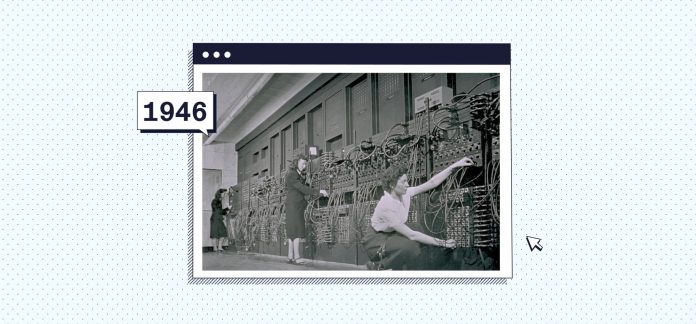
The Electronic Numerical Integrator and Computer was programmed by a group of six women.
It’s an assignment that any developer today would be thrilled to take on: Program the world’s first modern computer — completely from scratch.
In 1943, six women were recruited to figure out how to program the Electronic Numerical Integrator and Computer, a.k.a. “the ENIAC,” a massive computing machine commissioned by the U.S. Army that was used to calculate ballistic missile trajectories during World War II.
The women — Betty Holberton, Jean Jennings Bartik, Kay McNulty, Marlyn Wescoff Meltzer, Ruth Lichterman, and Frances Bilas Spence — worked as “computers,” a clerical job that involved solving complex equations that would be used to build firing tables for guns. (Yes, their job title was literally “computer.”)
Keep in mind, this was long before the hundreds of programming languages that we use today even existed. And it was certainly before a time when you didn’t need to know math to code. Though these women were highly trained mathematicians, they had no blueprint to follow when it came to ENIAC. They were given wiring and logical diagrams of the massive machine, and told to figure it out.
“When the request was made for people to volunteer to work on the ENIAC, I didn’t know what it was,” Bartik, one of the programmers (who died in 2011), recalled in a 1973 interview with the National Museum of American History. “But I had enough confidence in my own ability that if I could get on the ground floor in some area that I could do very well.”
When the ENIAC was finally unveiled to the public in 1946, there was no mention of the women who made it run and effectively invented modern programming. A 1946 New York Times article announcing the “amazing machine,” only credits the male inventors John Mauchly and J. Presper Eckert.
While figures like Ada Lovelace and Grace Hopper are widely recognized as pioneers of computer science, the ENIAC Six (as the women who programmed the ENIAC became known) were almost erased from history. So in honor of Women’s History Month, here’s what you need to know about the oft forgotten legacies of some of the most influential women in programming, plus how their contributions laid the foundation for future innovations.
Programming a computer with zero instructions
With the ultra-sleek computers and razor-thin mobile phones most of us use today, it’s tough to comprehend the sheer size of the ENIAC. Housed at the University of Pennsylvania Moore School of Electrical Engineering in Philadelphia, the ENIAC was 8 feet tall and 80 feet long, and weighed 30 tons.
The ENIAC contained 40 panels that were each about the size of a commercial refrigerator, lined up in a U-shape, with 18,000 vacuum tubes each. “We knew we were supposed to run the machine and set up problems for the machine, but no one had any techniques or anything,” Bartik said in the 1973 interview.
At its core, the ENIAC was a very advanced series of calculators that were wired together to flow information from one machine to another.
Not only did the women have to translate their calculations into steps that the ENIAC could handle, but they also had to literally wire the machine, said Kathy Kleiman, historian, author, and founder of the ENIAC Programmers Project, in a 2018 TEDx Talk. “They had to track each piece of data, wire it into a panel, such as a multiplier or a ‘square rooter,’ and then move the result — physically by wire — to another panel for storage,” she said.
The women kept track of the steps and diagrams for the wires manually on what they called “pedaling sheets.” As Bartik described it: “ENIAC was a son of a b— to program,” she said in the documentary “The Computers.”
But the tedious work it took to operate ENIAC was nothing compared to what “computers” had to do by hand. A single differential calculus equation could take 40 hours to complete using a mechanical desktop calculator, but the ENIAC could complete it in minutes.
Honoring a lost legacy
The ENIAC is “the great-great-grandfather of everything on your smartphones and in our laptops,” Kleinman said in the TEDx Talk. The ENIAC was the precursor to the ENAC, which ultimately led to the development of the UNIVAC, the first commercially-produced computer.
More than 75 years after the ENIAC was released, historians agree that the ENIAC Six didn’t get credit for all that they did for computer science with their work on ENIAC and beyond. Here are some of their post-ENIAC accomplishments:
Jean Bartik joined the teams that programmed the Binary Automatic Computer (BINAC), and then was in charge of logical design for the UNIVAC.
Betty Holberton ran the committee that created the programming languages COBOL and FORTRAN.
Kay McNulty was involved in early research that was testing the possibility of a hydrogen bomb.
Ruth Teitelbaum taught programming on the ENIAC when it was relocated to the Aberdeen Proving Ground in Maryland.
One explanation for why the ENIAC Six faded into obscurity? At the time, their work was “viewed as not interesting, because nobody understood programming,” says Mitch Marcus, an ENIAC historian and emeritus professor at the University of Pennsylvania. While people marveled at the engineers who built the ENIAC, they simply couldn’t appreciate the undertaking that the ENIAC Six took on to get it to actually work.
Today, their impact is clear: “They invented the idea that you could write programs,” Marcus says. Next time you write a line of code, run a complicated program, or find a bug, know that it’s in part thanks to the six women who were given the massive responsibility to program the ENIAC more than 75 years ago. At the very least, be grateful you didn’t have to do 40 hours of calculus before you could even start programming.
Landing a job in tech can be a thrill — but it can also feel intimidating, like you’re asking to join an exclusive club or sit at the cool kids’ table. If you identify as a woman or a non-binary person, this experience is heightened, because you may not see people like you represented in the industry very often. Fortunately, there are organizations around the world working hard to address gender disparities in tech.
Even better, there are lots of ways to get involved, whether you’re new to tech and looking for mentorship or you’re more established in your career and want to pay it forward. In honor of Women’s History Month, we’ve rounded up a few awesome organizations helping girls, women, and non-binary folks break into tech, foster relationships and community, and ultimately build successful careers.
Who they’re for: Women hoping to rise the ranks in their careers and increase their financial literacy
What they do: Ladies Get Paid is a network of 100,000+ women where people join to take online courses, attend events, and connect with peers and mentors — all in service of growing “your career and your bank account.” As founder Claire Wasserman puts it in an interview with the Get Together podcast, “It just blows me away how amazing these women are. But I think the success of all of this is that they feed each other.”
How you can get involved: You can either get a free membership, which includes access to the community platform, or pay for a membership that will give you access to their video library, virtual events, and coaching with Wasserman.
Who they’re for: Girls and non-binary students in elementary and middle school all the way through college
What they do: Girls Who Code offers a range of courses, from after-school and summer clubs to college programs, that teach participants core computer science and programming skills. They also provide workshops where students can build websites and applications that help address issues in their communities, like climate change and cyberbullying. Reshma Saujani founded Girls Who Code in 2012 to help nurture the next generation of leaders:
“Young girls are change agents,” she tells “The Daily Show.” “When they have technology, they’re looking at their community, they’re looking at the world, and they’re saying, ‘How can I use technology to make it better?'”
How you can get involved: Want to sign up for a Girls Who Code program? Click here to find the right one for you. Or, if you’d prefer to help support Girls Who Code, you can start an after-school club, form a corporate partnership, fundraise, and/or campaign. (The organization also has a great Instagram, full of coding memes and profiles of interesting women in tech.)
Who they’re for: Youth and adults of marginalized genders, including non-binary, gender nonconforming, and female-identifying, with an emphasis on racial and ethnic minorities, LGBTQIA+ people, and those from low-income communities
What they do: ChickTech provides learning opportunities and technical education in 15 countries around the world.
Their high school and college programs offer skill-building workshops and help connect participants to professional networks with formal and informal mentorships. Plus, their signature adult program, Advancing the Careers of Technical Women (ACT-W), helps professionals develop their technical and leadership skills with career coaching and national conferences.
Janice Levenhagen-Seely, founder and former CEO of ChickTeck, explains how she formed the organization to help welcome girls and women into the tech industry:
“I started ChickTech to give girls and women the support and sense of belonging that I didn’t have when I was a Computer Engineer. We focus on high school girls because so many of them are still not encouraged to be engineers and programmers, and they rarely even know what a career in tech would look like.”
How you can get involved: If you’re a high school student looking to break into tech (or want to nominate someone who is), click here to register for their virtual high school program. Or if you’re further along in your career and want to use your expertise to mentor students, reach out to your local ChickTech community and inquire about leading a workshop. You can also speak at one of their ACT-W events or even become a member of ACT-W+.
Who they’re for: Girls and women of all ages, from kindergarteners to established professionals, “at the intersections of race/ethnicity, class, age, gender identity, sexual orientation, disability status, and other historically marginalized identities”
What they do: NCWIT’s AspireIT program provides technical education and scholarships for girls in elementary, middle, and high school. Their Aspirations in Computing (AiC) program rewards women who showcase strong leadership and entrepreneurial skills with scholarships, internships, and other professional opportunities.
NCWIT also helps illustrate the impact and successes of women from marginalized groups with their Color of Our Future programs, which include their Modern Figures and TECHNOLOchicas podcasts that feature notable professionals in STEM.
“For young people, there’s often this voice inside of them saying, ‘Oh no, I’m not good enough; I can’t do this; this isn’t me; they’re going to find me out.’ The most important advice is to go for it. Listen to that voice and say, ‘OK, but I’m going to go for it anyway.'”
How you can get involved: Check out NCWIT’s programs to find the right one for you. You can also participate or sign up to be a guest speaker in one of NCWIT’s workshops, volunteer to review award applications virtually, and take part in the organization’s annual celebrations.
Who they’re for: Women in business and technology
What they do: WITI is a network of over 3 million professionals who seek to create a more inclusive and innovative workplace. They offer networking events, professional coaching, career fairs, courses, and webinars that teach participants how to advance in their careers.
“As women, we need to be more proactive to help male (and female) leaders of companies understand the business value for incorporating women at every level of the organization,” Carolyn Leighton, founder of WITI, tells The Huffington Post.
How you can get involved: Explore WITI’s upcoming virtual events and register for whichever one catches your eye. You can also become a member of the WITI community to lead webinars and classes, present at events, and even take on a mentor to contribute first-hand to their professional development.
Who they’re for: Women and gender-expansive adults, particularly racial and ethnic minorities, LGBTQIA+ people, and those from low-income communities
What they do: Named after famed programmer Ada Lovelace, ADA offers a unique, immersive experience for women looking to break into tech. Their free, 6-month training program teaches participants the core skills they’ll need to launch careers in software development, like the fundamentals of computer science and programming with languages including Python, JavaScript, and SQL.
“We aim to reduce the economic barriers to a career in software development by making education and career preparation as accessible as possible,” explains Elise Worthy, co-founder of ADA. “Because many of our students are switching careers and already carrying student loan debt, it would be untenable to expect them to assume an even greater financial burden while taking a year off from earning a full-time salary to pursue a whole new career.”
How you can get involved: ADA asks that aspiring students complete their preparatory curriculum before applying to their program.You can also volunteer with ADA to help promote the growth of new technologists as a private tutor, teaching assistant, industry mentor, mock interviewer, or admissions volunteer.
Who they’re for: People who identify as women who “champion innovation in their work”
What they do: Women in Innovation is a network of over 4000 professionals in cities including New York, San Francisco, and London. Their workshops cover everything from leadership and entrepreneurship to professional growth and development. And they also host less structured, more intimate dinners where women in executive roles discuss the intricacies of their fields.
“Our goal is to close the gender gap in business and thought leadership in the innovation industry,” Alfia Ilicheva, Co-Founder of WIN, explains in an interview with Forbes. “We recognize that women add fundamentally different and unique and a very powerful contribution to creating new ideas, new products, new services.”How you can get involved: Join the WIN Hub — for free! You can also sign up for their mailing list or even become a partner to host or sponsor an event.
It’s no secret that women are underrepresented in tech: Women made up only 26.7% of the technical workforce in 2021, according to a survey from AnitaB.org, a global organization for women technologists.
But social media tells a different story. Women programmers dominate TikTok “for you” pages or Instagram feeds, often sharing everything from career advice and job interview strategies to hands-on coding advice and desk set-ups.
In honor of Women’s History Month, here are some of the best women programmers to follow on social media, whether you’re seeking career advice or just want to lol about life as a woman in tech.
Ijemma Onwuzulike
Ijemma Onwuzulike is a front-end software engineer at Squarespace who makes YouTube tutorials about JavaScript and front-end development.
Why you should follow: Ijemma’s bite-sized videos are useful if you need someone to clearly walk you through how to do something in JavaScript, like how to delete object properties with one command or how to create a Promise. Ijemma also has an inspiring side hustle: In 2021, she launched Nkọwa okwu, a free and open-source Igbo-English dictionary, and she often makes videos about the process of launching an app.
Bukola Ayodele is a software developer advocate at Google who hosts a popular YouTube channel called “The Come Up,” where she shares advice for people entering the tech industry.
Why you should follow: From vlogs about a week in the life of someone working at Google to tips for knowing your worth and negotiating, Bukola pulls back the curtain on what it’s like to work at a FAANG company. Bukola often interviews other folks who work at FAANG companies, like a software engineer at Netflix and a recruiter at Google.
Femke started making instructional YouTube videos about product design and user research while working at Uber, because she was inspired to teach “the next generation of designers,” she says on her website. These days, she’s a senior product designer at Wealthsimple.
Why you should follow: Femke’s friendly videos touch on common pain points that designers might experience during the job application process, like how to talk about the impact of your designs in interviews and how to make your portfolio stand out. She also offers one-on-one mentoring sessions, community events, and even has a job board for product designers.
Come to Cassidy Williams’ feeds for the software jokes and memes, stay for the practical developer advice. Cassidy also has a newsletter called Rendezvous with Cassidoo, which includes a weekly interview question for you to practice your skills.
Why you should follow: Cassidy is a wealth of knowledge and consistently amplifies other developers’ voices on her feed. She hosts regular co-working Twitch streams and often speaks on podcasts or other events. (Plus, she’s hilarious.)
Mattaniah Aytensfu’s jaw-dropping artwork — like a painting that she coded into a musical instrument or an immersive LED installation — is impossible to scroll past on your TikTok “for you” page. The 24-year-old artist and engineer’s day job is as a UX engineer at YouTube.
Why you should follow: Mattaniah is STEAM in action, and her work will open your mind to the magic that happens when coding and the arts combine.
This software engineer at Microsoft has an inspiring and non-traditional path to coding: Katia was a full-time baker who went to a bootcamp before getting a job as a software developer, and then eventually becoming a software engineer — and she did it without a college degree. She recently built a smart beauty mirror called Alura. Also, if you’re wading into Web3, she created a Notion guide for developers.
Why you should follow: People who are entering the tech industry for the first time will really appreciate Katia’s candid advice. Not to mention, she has an enviable desk set-up that she frequently posts about.
You might know full-stack developer Laura Medalia as “coder girl” on Instagram.
Laura’s advice for women in tech: “Something that’s really important is to understand that it’s okay to fail along the way and make mistakes. It’s common,” she said in an interview with Blueprint. “We all have to face a bug or have had a problem that stumped us. It’s about taking time to be thoughtful and understanding the processes that help you solve the problem and just learning from it. You can learn from bugs and it doesn’t mean that you don’t belong. Make them a learning opportunity!”
Why you should follow: You’ll feel validated by her extremely on-point Reels, like this one about relying on Stack Overflow whenever you start a new project.
When the pandemic hit, Naya was about to graduate from college with a degree in finance and decided on a whim to learn how to code. That small decision paid off: Naya fell in love with coding and six months later got a job as a software engineer. Naya goes by the moniker “The BlackFemale Engineer,” and her mission is “to grow the number of minority groups in software engineering and other technical positions.”
Why you should follow: Coding newbies and career-switchers, Naya is here for you because she’s been there. For example, peep her video about dealing with imposter syndrome when starting her first job in commerce cloud development for some affirmation and sage wisdom.
Ivy Barley is the co-founder of Developers In Vogue, an organization that provides training, mentorship, job placement, and business incubation for African women in tech. Her day job is working at Microsoft as a technical program manager and data scientist.
Why you should follow: Ivy hosts Twitter Spaces, where you can tune in to listen to her talk through common job search issues, like coping with rejection or tech interview tips.
This Tuesday, we’re going to be sharing CV tips, best practices for application tracking systems, and advice for job seekers.
As the lead technical recruiter at The New York Times, Farah has some job search tips up her sleeves, which she generously doles out on TikTok. Before joining The Times, she worked in Silicon Valley (at Google, TikTok, Uber, and Lyft) for over a decade.
Why you should follow: Watching Farah’s videos will make you feel like you have the cheat codes for job interviews.
Sasha Tran is a web developer and UI/UX engineer based in Las Vegas, who’s into gaming, NFTs, and mechanical keyboards.
Why you should follow: If you like aesthetically-pleasing desk setups (complete with color-coordinated LED lights) and mechanical keyboard reviews, you’ll appreciate Sasha’s Insta feed. Beyond the pretty photos, Sasha doesn’t sugar-coat the realities of being a developer, like dealing with a creative block or anxiety.
Maya Bello makes relatable and motivating videos about maintaining work-life balance, drawing boundaries, and learning to code. Plus, she shares details about how she landed her job as a full-stack engineer at Slack.
Why you should follow: Let’s just say you’re going to want to hear the multi-part story about what happened when Maya threw up during a job interview (spoiler alert: she got the job).
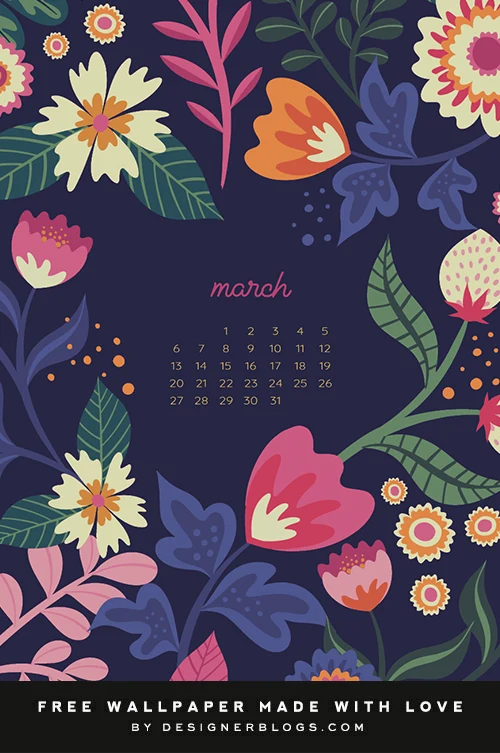
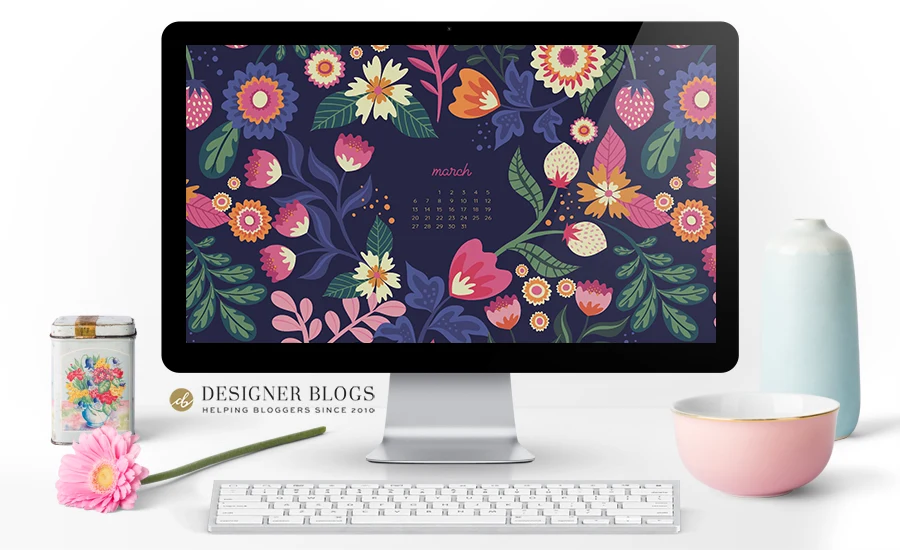
Spring is almost here! Invite it to your home with colorful flowers on your screen. This month’s wallpaper is all about the colors and various flower shapes. I hope you will love it as much as I do!
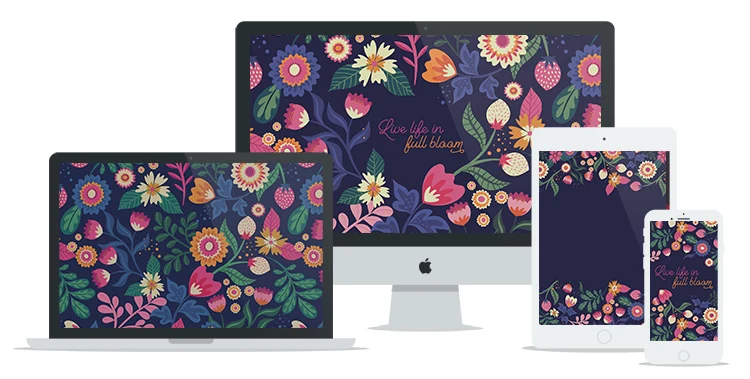
Each wallpaper download from March 2022 include:
Desktop wallpaper x3 (plain, with the calendar, and with a quote)
Phone wallpaper x2 (plain and with a quote)
Tablet wallpaper
Instagram ready quote
As always, our March’s free wallpaper comes with two different mobile phone layouts. They are great to use at once – the simple version for your phone background and the one with a quote for the lock screen.
Quote for March 2022
I was planning to go with a simple ‘Hello Spring’, but I know that lots of you like posting our monthly quotes on their social media. So here it is! Perfect spring quote that will motivate you every day.
Live life in full bloom
P.S the square image is also included in the download package below! Feel free to post it on your Instagram.
The free download includes three desktop options – one with the calendar and one without the calendar, and one with a quote. There is also a wallpaper for tablets and two options for the phone. We have also included an Instagram-ready square with the weekly quote.
FOR PERSONAL USE ONLY.
NOTE: this template is available as a free download through March 31, 2022 only. After that, a $5 download fee applies.
What font is it?
If you are curious what font has been used this month, let me help! This month, I’m again using Cosmopolitan, which is my all-time fav! It comes with a few different font styles and lots of extras so it is perfect for all types of design.
If you have your favorite quotes and would like them to appear on the next free wallpaper, make sure to post them in the comments below or send us your ideas via email.
Enjoy!
P.S This post includes affiliate links so by clicking them you are supporting us. Thanks!
The team recently delivered a 22-2 thumping to its opponents, the Felines, for another triumph in a season that has made the Little Devils a national sensation, for not only their style of play but also who they are: a group of Indigenous women from a traditional community that once discouraged women from pursuing sports, which were seen as the province of men.
And the Little Devils now have company, the Yaxunah Amazonas, who also play shoeless and in traditional attire and have helped upend sports culture in the Yucatán.
“Here a woman serves the home and is not supposed to go out and play sports,” said Fabiola May Chulim, the team captain and manager of the Little Devils, known here as Las Diablillas, their name in Spanish. “When a woman marries, she’s supposed to do chores and attend to her husband and kids. We decided a few years ago that’s not going to impede us anymore from playing a sport when we want.”
Daily Word Challenge
Can you correctly use the word impede in a sentence?
Based on the definition and example provided, write a sentence using today’s Word of the Day and share it as a comment on this article. It is most important that your sentence makes sense and demonstrates that you understand the word’s definition, but we also encourage you to be creative and have fun.
Then, read some of the other sentences students have submitted and use the “Recommend” button to vote for two original sentences that stand out to you.
If you want a better idea of how impede can be used in a sentence, read these usage examples on Vocabulary.com.
Students ages 13 and older in the United States and the United Kingdom, and 16 and older elsewhere, can comment. All comments are moderated by the Learning Network staff.
Landmarks in New York City like the World Trade Center and the Empire State Building were lit up in recent days in blue and yellow lights. So were other famous landmarks around the world, including the Eiffel Tower, the London Eye, the Colosseum in Rome and the Brandenburg Gate in Berlin.
What do you think these displays are saying? How do they relate to or comment on current events? What do you think of the message they are sending? Why?
Tell us in the comments, then read the related article to learn more.
Want more Picture Prompts? Find them all in this column.
Students 13 and older in the United States and Britain, and 16 and older elsewhere, are invited to comment. All comments are moderated by the Learning Network staff, but please keep in mind that once your comment is accepted, it will be made public.
Dave Ramirez squeezed the frozen bottle with both hands, watching the golden goop come out like toothpaste. Then, he took a big sticky bite.
“I’m not going to lie,” he said in a TikTok video. “That was pretty refreshing.”
Thus, the frozen honey trend was born.
The trend on TikTok has garnered about 900 million views, with creators uploading videos that show them putting honey in an empty water bottle, placing it in a freezer and then, hours later, squeezing viscous chunks into their mouth, sometimes in agony and often in delight.
Daily Word Challenge
Can you correctly use the word viscous in a sentence?
Based on the definition and example provided, write a sentence using today’s Word of the Day and share it as a comment on this article. It is most important that your sentence makes sense and demonstrates that you understand the word’s definition, but we also encourage you to be creative and have fun.
Then, read some of the other sentences students have submitted and use the “Recommend” button to vote for two original sentences that stand out to you.
If you want a better idea of how viscous can be used in a sentence, read these usage examples on Vocabulary.com.
Students ages 13 and older in the United States and the United Kingdom, and 16 and older elsewhere, can comment. All comments are moderated by the Learning Network staff.