

Melting ice sheets, rampant wildfires, devastating floods. Climate change is a global emergency. The food system? It causes as much as a third of global greenhouse gas emissions, and unless we make major adjustments to the food we eat and how we produce it, we’re cooked. One of those dietary changes we need to consider might even make you a little squeamish. “And we’re going to finish it off with some whole grasshoppers.” Yeah, we’re talking about insects, specifically eating them. We know what you’re feeling: Repulsion, right? For most Americans, insects are signifiers of filth that need to be exterminated, not consumed. Our supermarkets, rather than promoting insect-eating, devote a significant amount of shelf space to products that eradicate them. Fortunately, tastes can change. Foods that were once deemed disgusting are now ordinary fare, even a luxury. We’ll come back to these guys later. But the problem is way bigger than just taste, it’s existential. A growing number of chefs, researchers, and entrepreneurs are urgently working toward a common goal: getting us to eat more bugs. “I don’t think there’s an insect I wouldn’t eat.” Here’s the problem. A growing middle class around the world is driving up the demand for meat, milk and eggs, and that will mean more livestock farming leading to more deforestation and other environmental harm and an increase in greenhouse gas emissions. “The paradox today is that our planet, on the one hand, is rapidly growing in both population and appetite. At the same time, it is shrinking in critical resources required to produce food. And unless this paradox is resolved, we are heading on a very concerning collision course.” And that’s where edible insects come in. They offer a sensible alternative to animals we typically eat. To understand this, we paid a visit to — “Entomo Farms is North America’s largest cricket producer.” — a cricket farm in Norwood, Ontario. “A lot of crickets.” This is Darren Goldin, who founded Entomo with his brothers. “I don’t think that there is a single, silver-bullet solution to the crises facing our planet, but I think insects are a very important piece of the solution.” Research into edible insects is still in its infancy, but the early evidence of their environmental advantages is very promising. Pound for pound, some species of insects produce far fewer greenhouse gas emissions and require far less water and land to raise than some conventional livestock. Insects are also very efficient at converting what they eat into body mass. That is high-quality food for us. They’re also really good for us. “Crickets are fantastic because of their nutritional makeup. The protein is very digestible by the human body. The mineral and vitamin content is super high. The chitin, which is the exoskeleton of the cricket, is a super beneficial fiber.” That’s some good eating. Too much too soon? Well, here’s a little secret. If you live in the United States, you’re chowing down on bug all the time. You just don’t know it. The Food and Drug Administration permits limited quantities of insect parts to slip into foods during the manufacturing process. What that means is — “There are going to be beetle parts in your flour or processed grains.” Do you drink coffee, eat chocolate, how about potato chips? They might all contain bug, but not everyone finds this gross. The United Nations estimates that some two billion people around the world have traditional diets that include insects. “Termites. Grasshoppers. Crickets.” By some accounts, more than 2,000 species of them. “Locusts. Bamboo worms. Cicada. Bee pollen.” [INTERPOSING VOICES] “Mealworms. Scorpions.” Insect eating has historically been more common in tropical countries where bugs are generally larger and more abundant, thus, they supply more protein and are easier to hunt. But that doesn’t fully explain our disgust. “When you’re wanting to understand why we have strong aversion to the idea of eating insects, you have to look at cultural explanations.” This is Julie Lesnik, an associate professor of anthropology at Wayne State University in Detroit. Her research has focused on the evolution of the human diet. “So if we look at the Age of Discovery, if we think of Columbus and other explorers leaving Europe in the 1400s, when they travel to the tropics and encounter people eating insects, what we see in their journals, in their letters is that they describe these people as beast-like. And so we have this association of eating insects as being this animalistic behavior, and that’s been used against the peoples around the world that have had insects as parts of their diets.” The point is, culture, not taste, often defines what’s edible, but that doesn’t mean we can’t change. Remember this guy? The lobster offers a fabulous lesson in rebranding. During the colonial era, lobsters were reviled by some as bottom feeders, suitable only for indentured servants and prisoners. Farmers ground them up to fertilize fields. Fishermen used their meat to bait more profitable catch like mackerel. According to one account, indentured servants in colonial Massachusetts took their masters to court because they were so repulsed by the amount of lobster they were fed. They won. The result? They only had to suffer three lobster servings a week, but by the late 19th century, the lobster’s makeover was well underway. It spread aided, in part, by improvements in refrigeration and by vacationers to New England who acquired a passion for it. A century later, the $30 lobster roll. Still not convinced? Until a few decades ago, sushi was not common outside of Japan. Now, of course, it’s a worldwide delicacy. Shrimp are cousins of locusts and grasshoppers. In fact, bug-eating advocates refer to these as land shrimp and these as sea crickets. But while shrimp are widely eaten in the West, locusts and grasshoppers are despised. See the double standard? It’s all in your head, not in your mouth. Venture capital and government funding is now surging into the edible insect sector. Startups like Entomo are transforming crickets and other bugs into a wide range of products for humans, pets and livestock. But if many insect farms have looked a lot like, well, farms, things are about to get pretty high-tech. In London, Ontario, the Aspire Food Group is building a state-of-the-art cricket breeding facility. “We have invested well over $40 million U.S. on research and development, both looking at the biological aspects of farming and running hundreds of experiments in different trials in different conditions.” Mohammed Ashour is pretty far from a traditional farmer. He’s the C.E.O. of Aspire. “We are expected to generate approximately 27 million data points on a daily basis on everything from temperature, to humidity, to certain types of gases and certain types of sounds to really understand the various parameters that affect and govern the growth of crickets.” In other words, they’re building an 11-story computer that will be raising billions of insects at a time. “Upon completion, it will be one of the most formidable and sustainable and scalable protein-production systems on the planet.” While saving the planet and ourselves are pretty solid rationales for eating more insects, that argument on its own may not carry the day. “Ultimately, what it’s really going to come down to, it’s got to taste delicious. Red peppers, shallots, sweet potatoes, corn, locust, Korean gochu peppers, little lime. Delicious, nutrient-dense and sustainable.’” Joseph Yoon is a chef based in New York City who has dedicated himself to the culinary exploration of edible insects. “’This is a delicious locust succotash, Brood X cicadas, flamed with sake. This cicada nymph kimchi just perfectly complements this egg. Oh, the fennel is popping as well. So you could have everything from lemony, citrusy black ants, nutty crickets, cheesy super worms, the minerality of the vespula flaviceps, or the vegetable nature of the cicadas. What does it taste like when boiled or roasted or fried? How does it taste in American food or in Asian food? Sauteed or fermented? All you need is a little imagination.” “We are now a lot closer to bridging the gap between the promise of crickets and how it translates commercially in the market as a better-for-you, highly affordable protein source.” “We don’t need to cut down any more forests. We don’t need to destroy any more natural ecosystems. We have what we need, not only to feed current population, but to feed the growing population into the future.” “What we need to do as adults is rein in our disgust response so that the kids around us can grow up with this as a viable food source for them.” “I have no doubt that insect protein will be integrated globally in just a matter of time. I mean, it’s inevitable. It’s smart. It’s efficient. It’s delicious.” Because remember, what’s loathed today might be loved tomorrow. Just ask the lobster. “Bug appetit.”
Vocabulary in Context: Halftime Show

Dr. Dre opened up the performance behind a mock mixing board, a nod to the root of his celebrity: the ability to mastermind sound. For the next 12 minutes, vivid and thumping hits followed, including “The Next Episode,” a wiry between Dr. Dre and Snoop Dogg, wearing a blue bandanna-themed sweatsuit; “California Love” (mercifully, delivered without a hologram of Tupac Shakur, as some had rumored); Eminem’s stadium-shaking “Lose Yourself”; Lamar’s pugnacious and proud “Alright”; and a pair of songs from Mary J. Blige, the lone singer on the bill.
Lesson of the Day: ‘How Bad Is the Western Drought? Worst in 12 Centuries, Study Finds.’

Lesson Overview
Featured Article: “How Bad Is the Western Drought? Worst in 12 Centuries, Study Finds.” by Henry Fountain
Drought is gripping the American West, which includes California, Nevada, Arizona, New Mexico, Utah, Oregon, Washington, Idaho and Montana. Climate change has fueled a drought that began in 2000, making the past two decades the driest since 800 A.D., according to a new study. That was 1,200 years ago!
In this lesson, you will learn how this megadrought is affecting the Western United States and when it might end. Then, as a choice of Going Further activities, we invite you to make connections between this news and your own community; learn more about the reach and consequences of megadrought; or find ways to inform others about the situation.
Warm-Up
Before reading, look at the maps below from the Times interactive “How Severe Is the Western Drought? See For Yourself.” Published in June 2021, these maps visualize the drought crisis in the Western United States since 2000. Then, respond by answering the same questions we ask weekly in our What’s Going On in This Graph? feature:
Finally, make a prediction: Based on the series of maps, do you think the drought will continue to grow in severity? How long do you think it might last?
Questions for Writing and Discussion
Read the featured article, then answer the following questions:
1. What is a megadrought? How did climate scientists determine that the current megadrought in the American Southwest is the worst in 12 centuries?
2. What factors lead to severe drought? What role has human-caused climate change played, according to the new study?
3. What are three ways the drought has affected people and communities?
4. How long do scientists believe the drought will last and why? What do projections show about the future?
5. Why didn’t last year’s monsoon rains in the desert Southwest or the heavy rain and snow in California end the drought?
6. The article concludes with a quote from Samantha Stevenson, a climate modeler at the University of California, Santa Barbara:
We’re sort of shifting into basically unprecedented times relative to anything we’ve seen in the last several hundred years.
What is your reaction to the article and to these “unprecedented times”? What does it make you think and feel? Do you think that learning about the extreme drought conditions gripping the West will cause you and other Americans to take the climate change crisis more seriously? Why or why not? What questions do you still have about drought or climate change?
Going Further
Option 1: Discuss the effect of the drought, and extreme weather, on you.
Do you live in a state that is experiencing drought? If so, how is it affecting you, your family and your community? What would you like others to know? What’s missing from the news coverage you have read, heard or seen?
If your state is not in the middle of a drought, have you experienced extreme weather such as wildfires, heat waves, hurricanes, floods or anything else where you live? If so, what was it like? How has it affected your life and the lives of those in your community?
How do you feel about the increase in frequency of extreme weather around the world and the intensifying effects of climate change? Is this something you discuss with your classmates, friends or parents? Why or why not?
What questions do you still have about climate change and its impact on your community and the world?
If you are interested in joining a conversation with other teenagers about extreme weather conditions and climate change, please share your thoughts in the comments section of our related Student Opinion question. You can also read what other students have posted and respond to them. Did you learn anything from others’ responses that you didn’t already know?
Option 2: Learn more about the human impact of the megadrought.
The intense drought is affecting people and communities across America. For example, in New Mexico, farmers along the Rio Grande have been urged not to plant this year; the level of Lake Mead, the huge reservoir on the Colorado River, is so low that Arizona, Nevada and other states will most likely face cutbacks in supplies; and in North Dakota, ranchers are trucking water and supplemental feed for their livestock because the rangelands are so dry and the vegetation is stunted.
Choose one of the recent articles from The Times below to learn more about the human impact of the extreme drought. Then, respond to the following prompts in writing or through discussion with a partner or small group: What new information did you learn about the drought and how it is affecting people and communities? What was most interesting, surprising or memorable? What questions do you still have?
Option 3: Inform others.
Using the information you learned in the warm-up activity and the featured article, create something to help educate others about the drought in the American West. Here are some options:
Teach a fifth grader about the conditions in the West. In five minutes or fewer, help someone younger than you understand the situation. You might want to use maps, statistics and images — or colorful paper, pencils and pens — to help communicate the information.
Design a one-pager to share what you learned with another student or an adult in your life. Using images or maps from the articles, key words and quotes, design a visually compelling summary of the drought conditions in America.
Create a concept map to illustrate the situation. Generate a list of key words, phrases, numbers and statistics. Then create a map to show how they are related to one another.
Want more Lessons of the Day? You can find them all here.
Do You Support Affirmative Action in College Admissions?

Natasha Warikoo, a professor of sociology at Tufts University, believes affirmative action is worth saving, and we should find ways to reframe it:
I think it’s incredibly important to be thinking about race when we think about college applications. And I’ll just state three reasons why I think that’s true. I think the first is that race plays a role in the opportunity structure in the United States today. You know, we know that there are racial disparities in terms of what neighborhoods families live in. And so what schools children have access to in terms of ability to pay for private schools, extracurricular activities.
And we know that even in terms of families with the same income, they have different levels of wealth. So even Black, upper middle class families compared to white upper middle class families have a lot less wealth accumulation that happens over generations. And this shapes you know, again, the resources available. We know that there’s discrimination. So I think the main reason to me is that there are ways in which race plays a role in the opportunity structure. That is not just about a coincidence of class. That’s a remnant of past discrimination.
And the second reason is that it plays a role in the education of everyone on campus. White and Asian American students as well benefit from going to a college campus where there is a quorum of underrepresented minority students. And so they hear different perspectives in the classroom, in their discussions. And the research suggests that that makes for growth for everyone. And the third one is that if we want a diverse leadership, we want diversity in our C.E.O.s, in our Congress, in our Supreme Court, we need to create a pipeline. And part of that means affirmative action because of the underrepresentation that otherwise exists. And so I think those are the main reasons, and we know that it works. So absolutely, yes.
Ian Rowe, the former chief executive of Public Prep, a nonprofit charter school network, believes that race-based affirmative action needs to be retired in favor of class-based solutions:
Well, Natasha, I will respectfully disagree. Race-based affirmative action has certainly had value, and it is “worked” to some degree. But I would shift our focus now to economic disadvantage because, you know, if we want to create a more equitable society, I think if we focused on giving those who are economically disadvantaged of all races, then we’d be allowing more and more young people to get on the rung you know, on the economic ladder. I’m someone who runs a network of public charter schools, and my schools serve almost exclusively low income Black and Hispanic kids.
And so this idea of relying on race-based affirmative action that this sort of back-end Band-Aid will solve the problem, I think does a disservice. We need to strengthen the preparation of kids so that they can perform at the highest level. We’re not running our schools based on whether or not affirmative action is going to exist. They’ve got to be able to compete at the highest level. And when you look at the actual data of Black kids getting into elite colleges, what is very interesting is that the vast majority, something like two-thirds or 70 percent are Black kids from economically advantaged backgrounds.
So what that’s indicating is that even in the effort of trying to achieve more Black acceptance, the kids that are getting in, I don’t think are the ones that originally affirmative action by race was intended to serve. And unfortunately, the way that affirmative action has worked by race, it has tended to help create that perception because the idea is that, oh, well, if you’re Black maybe the reason you’re here is because of affirmative action, as opposed to your own merit. And those are some of the unintended consequences I think that have been built over time.
Students, read the entire article, listen to the podcast, or both, then tell us:
Do we still need affirmative action in higher education? Should colleges and universities consider race or ethnicity when making decisions about student admissions?
Did anything in the pieces above change your original thinking about this issue? Which arguments for or against affirmative action expressed in either the article or the podcast do you find most persuasive? Do you agree with Ms. Warikoo that affirmative action is needed to address the ways that “race plays a role in the opportunity structure” in our society? Or, are you more swayed by Mr. Rowe’s argument that while race-based affirmative action may have had a value in the past, we should “shift our focus now to economic disadvantage … if we want to create a more equitable society”?
How important an issue is affirmative action for you? Do you ever discuss the topic with friends or family? What is your reaction to the Harvard and North Carolina cases now before the Supreme Court?
Edward Blum, whose group Students for Fair Admissions brought both of the affirmative action cases before the Supreme Court, said: “Every college applicant should be judged as a unique individual, not as some representative of a racial or ethnic group.” However, Damon Hewitt, the president of the Lawyers’ Committee for Civil Rights Under the Law, counters that “race-conscious admissions policies are a critical tool that ensures students of color are not overlooked in a process that does not typically value their determination, accomplishments and immense talents.” Do you think race should ever be used as a consideration in admissions for college applications? What about in other facets of society like in workplace hiring, in government and elsewhere?
What should be done about what some call “affirmative action” for rich white students like legacy admissions and geographic diversity? Ms. Warikoo points out that there are many kinds of benefits white people receive in the admissions process:
There are a lot of other factors that seem to advantage white students over all students of color, including Asian Americans, such as representation from all 50 states. And so when you’re looking for that student from Nebraska or Iowa, probably, it’s going to be a white student. Like athletic recruiting, again, you might think of athletic recruiting is like football players and basketball players, but there’s so many sports like squash, like crew, water polo. So athletic recruiting benefits whites over, again, all students of color..
How can we make the college admissions process more fair or equitable? If you were the head of college admissions at a college or university, what criteria would you use for judging applicants?
How do you think the Supreme Court will rule? What impact do you think these rulings will have on the future of affirmative action?
Word of the Day: vice versa

The term vice versa has appeared in 204 articles on NYTimes.com in the past year, including on Nov. 15 in “Why Don’t We Have a Covid Vaccine for Pets?” by Emily Anthes:
In February 2020, a woman in Hong Kong was diagnosed with Covid-19. Two other people in her home soon tested positive for the virus, as did one unexpected member of the household: an elderly Pomeranian. The 17-year-old dog was the first pet known to catch the virus.
But not the last. A German shepherd in Hong Kong soon tested positive, too, as did cats in Hong Kong, Belgium and New York. The cases were exceedingly mild — the animals had few or no symptoms — and experts concluded that humans had spread the virus to the pets, rather than vice versa.
“To date, there hasn’t been any documented cases of dogs or cats spreading the virus to people,” Dr. Lennon said.
Daily Word Challenge
Can you correctly use the word vice versa in a sentence?
Based on the definition and example provided, write a sentence using today’s Word of the Day and share it as a comment on this article. It is most important that your sentence makes sense and demonstrates that you understand the word’s definition, but we also encourage you to be creative and have fun.
Then, read some of the other sentences students have submitted and use the “Recommend” button to vote for two original sentences that stand out to you.
If you want a better idea of how vice versa can be used in a sentence, read these usage examples on Vocabulary.com.
If you enjoy this daily challenge, try one of our monthly vocabulary challenges.
Students ages 13 and older in the United States and the United Kingdom, and 16 and older elsewhere, can comment. All comments are moderated by the Learning Network staff.
Latest in the Learning System Space

I admit I’m giddy. Not just for this post, but for my beloved Los Angeles Rams winning the Super Bowl. It’s easy if you are a die-hard fan to just savor the moment. Attending the Super Bowl showed me a lot of interesting tidbits.
The game was awesome, of course, but I’m talking about a few other factoids.
- Pricing to attend this Super Bowl was the highest ever. It was bonkers to be quite honest. If you wanted to sit at the very top of the stadium, pricing was running initially around 7.5K per seat. It dropped down to around 3K by game time. It was if the NFL was unaware we are facing all these issues with the economy (tied to supply chain BTW, but I won’t go into that).
- The famed Super Bowl souvenir cup was non existent. Okay, it was the size of a kiddie cup, and cost $7. Plus it was hard to even see that it came from the SB.
- This was mobile ticket app only, so no hard ticket. Everyone I spoke with thought that you would get one. Nope. Oh, you could for $99 on HSN.
The point here is that people paid a lot and received nearly okay, nothing in return – for them to really get a benefit from the game, beyond attending the game.
In a way, that is what is occurring in the learning system space today. No, they are not offering Super Bowl tickets, nor promotional items for free to thank you for your purchase, but what they are doing in some angles, is saying “We appreciate you, but…”.
Let’s Dive In
Pricing
I would love to tell you that nobody is paying outrageous fees for the privilege of buying a learning system. The reality, of course, is they, err you are. The industry as a whole continues to increase seat fees. Ignore the whole “active user only ” aspect because the number that you should be focusing on is the total price number, which in many cases says, “up to”. With the exception of a vendor like Eurekos, who actually bills you per month based on usage, the majority of vendors require payment upfront. Ask yourself this, if they require payment or significant payment upfront, how can they know how many active users I really have?
I digress.
The seat numbers are going up. Last year, overall, they were the highest ever. In the early months of 2022, many vendors are surpassing that. I see the infamous yearly increase approach, as though the cost of living or supply chain plays a role here. Setup fees (for those who charge) are moving upward. Yet what you get is the same thing as you did before. Back to cost per seat. I feel bad for any business that has less than 500 end users. I say this because of the avg. cost per seat is sitting around $48 to $60 range. That is taking the cost per seat/per month and multiplying by 12.
Bands are changing too. A band for most vendors was 1,000 to 5,000 end users for example, now? 1,000 to 10,000. It may not seem like a big deal, but when you are running cost per seat, per user, it can be. I’ve seen vendors find other ways to boost the numbers. Want white-label? You pay. What an API? Even if it is in their marketplace.
Nobody should have to pay to have their system rebranded with their name on it, and not have the vendor’s name anywhere on it. Yet, more and more vendors are jumping on this, with the usual verbiage of “well most clients do not ask us to remove”, which I guess means if you don’t ask, you do not get. Oh, you want it? Pay us.
Coaching and Mentoring
This is starting to boost in the industry, but as with most things – regarding capabilities, it is all over the map. There are vendors who are offering end-users the ability to view “experts” and select the one(s) they want to be their coach/mentor. Others assign people. Some provide specific information around said expert, including their skill(s) forte, experience, and job role. That’s nice, but where are the ratings for these folks (from other learners who have selected them)? Wouldn’t it be great to also know what courses/content these folks are taking or have taken? I see trends and pluses here – yet, surprise, so far it is very rare. Honestly, who cares whether Sally is from San Diego? (Yes, I’ve seen location) I want to know what level of expertise Sally is with marketing analytics.
And that level of detail is right now is nearly non-existent.
Many vendors who offer coaching/mentoring are still in the text-based mode, which is pretty much reactive. There are vendors who are adding a webcam capability or recording yourself, which are big pluses, but again, so few are tapping into role-playing scenarios – which are available for the administrator to select from (actually, none when it comes to built-in scenarios, but yes there are those who offer scenario-based learning).
Analytics
Courses and content are commodities and trust me, you need them in your system. What drives your learning and training though, are metrics. Especially the right metrics – data. The whole “views” metric is about as beneficial, as the local amusement park promising that you won’t puke on the Octopus ride. It sounds good, but what does it really tell me? Learning-wise, nothing. Preventive puking-wise, still nothing. I mean, I just ate five Vegan hot dogs.
I want to show you a vendor’s metrics that provide really strong information and data. I will get to what trend in a second, that is happening in the space.

The engaged users are worthwhile. If I could drill down even further, by clicking on it, again, segmentation is huge. Popular subjects. Skill IQ (their term), but see the assessment (I prefer validation) tied to the specific skill they are trying to learn – in this case, Python. Avg skill growth – says to me, okay, who, what skills in particular, trend lines, and so on. (The screen is from Pluralsight).
Metrics tell a story about the impact of your learning and training. Even for those who do not have a background in either, something like “popular” subjects, offers me something that tells me a story.
Here is another data screen (From Fuse)

Look at the data. It tells me a story. I see trend lines. I see percentages. I can read what the data means – thus even if I do not have a background in Training or L&D, I can get the gist of it. And for those who have a background in L&D or Training, again, the overall story is presented. Want to segment further? Fully doable.
What’s the early trend?
Vendors I have spoken with, are pushing into more metrics – especially around folks who have a BI tool and want to tap into the learning with it. They want to combine the business data with the learning data.
Vendors are also starting to add, albeit slowly, what they refer to as “advanced analytics”, targeting more of an add-on fee. I saw this on many a roadmap, and today there are more vendors who offer it than not.
On the flip side, LRS built into the system is still in snail mode. The vendors who offer it, as a whole, do not turn it on unless you ask for it. Again, this makes about as much sense as the NFL offering souvenir cups that are tiny for nonbeer purchases, but larger for beer (but no markings saying it is from the SB). Unless you ask, you have no idea. (I did ask and was told because it is for beer. Nice messaging)
An LRS captures everything. And can push out a lot of great data – if you choose to leverage it for your learning and training – i.e. can extract the keys – which are visible. The systems that have an LRS, as a whole, do not charge extra for it. If your system doesn’t offer it, you can go third party and have it fully integrated. My personal favorite is Watershed, but there are others.
For all those vendors adding advanced, and an equal number is streamlining to simple and frankly underwhelming data. It’s odd because as a whole, most systems are capturing far more data.
This will continue – either going full steam with advanced or going basic, that shows and tells – which is great if you are in Kindergarten.
Workforce Development
I prefer this term, but the legacy terms are performance/talent management.
I have no issue with some items under Workforce development – tied to courses/content, specifically learning and training aspects. The vendors punching this hard are adding job roles, and even opportunities /availabilities tied around content too. The job roles tied to skills tied to content are fair and acceptable, and some vendors note this under skill capabilities.
What early trend is showing through, are vendors who are trying to turn their learning into a combination sliding more towards employee development with more of an HR edge, than a learning focus. Learning plays a role, but it is not the key here. The folks they are targeting? HR people. L&D is secondary, Training? Forget it.
This is a very dangerous and slippery slope.
Once you go down this road, getting back to learning as the core, is nearly impossible. How do you message L&D for example, when the system brings in career development, opportunities, and borders without crossing into internal recruiting?
I can tell you that once you go this approach, nobody who oversees training, will eye you as a system. I wouldn’t. And I wouldn’t recommend it.
If HR is your core focus for your learning system, you are moving towards that slope. And there are vendors going that way.
Skills
Skills capabilities continue to dominate this early cycle. Skill ratings are appearing in more systems than before. What will be the biggest trend in 2022? Skills Plus Content – intertwined more so than before.
Fade Away?
It was a big trend in 2019, the increase in vendors offering a built-in authoring tool. Early data is pointing to this flatlining, as vendors now gear quite a bit towards the other King Kong Entry – A.I. tied around content, and no surprise skills.
Top 10 Learning Systems – A brief Commercial – Puppies not visible.
If you haven’t purchased the 2022 Top 10 Learning Systems Report, now is the time. It goes much deeper than the blog post. 100% of the proceeds go to three animal shelters. Purchase the Report, today.
One additional note, Pluralsight is now on FindAnLMS – which means that every system in the top 10 can be found on the one platform where you can compare each system using various filters.
The Fine Print
I noticed this trend starting in late 2021, but it was too early to know if it would continue or phase out. Depending on your perspective, it is continuing. The trend? Vendors (as a whole) focus on clients with a minimum of 1,000 end-users.
This trend opens up the door for so many vendors who are ideal for the under 1,000 employees size, even the 500 or less size.
Now there are vendors who will gladly accept 500 end-users, and still eye their ideal at 1,000. The question is whether their messaging aligns with either group or just the larger size.
The reasoning on why a lot of vendors focus on higher numbers is the premise that a larger user base means higher budgets. Yet, I know of F500 companies whose training budgets were very low, and companies with less than 1,000 that were in the six-figure range.
Bottom Line
Yes. It is early.
February to be exact.
But if you remove all the pageantry, the hype and recognize that vendors are already pushing specific capabilities, and pricing in one way,
you are left with one thing,
And it is not a hard copy
Super Bowl Ticket.
E-Learning 24/7
Trending online courses in business, data science, health, and tech


With more world-class content launching every week, there are always new topics to explore, new skills to learn, and new ways to achieve your goals. These latest courses, Specializations, and Professional Certificate programs cover everything from digital marketing and psychology to computer science and AI product management. What will you learn next?
Business
Facebook Marketing Analytics Professional Certificate by Facebook
Ready to advance a career in digital marketing? The skills to analyze marketing data and make data-informed marketing decisions are in high demand. Now, you can learn these skills in Facebook’s new entry-level Marketing Analytics Professional Certificate program. Upon earning your certificate, you can join the Facebook Certification Career Network to connect with top employers looking to hire Facebook-certified professionals. No previous experience is required to enroll.
The Materiality of ESG Factors Specialization by the University of Pennsylvania
In this new Specialization from the University of Pennsylvania, you’ll gain an understanding of the fundamentals and history of ESG investing, and examine investment approaches informed by environmental, social, and governance factors. You’ll review private environmental governance, explore the active role that private companies are playing in combating climate change, and assess the parallels between the public and private sectors. By the end of this Specialization, you’ll know the best practices for creating a solid risk management plan. You’ll have analyzed the complex indexing and measurement techniques employed in the ESG space, examined climate disclosures and implementation of climate solutions, and gained insight into how social activism affects the corporate world in the 21st century.
Decentralized Finance (DeFi): The Future of Finance Specialization by Duke University
This program is ideal if you want to explore one of the latest and most important technological innovations in finance. Decentralized Finance (DeFi) is a new technology whereby users interact as peers with algorithms or smart contracts rather than through traditional intermediaries such as banks, brokerages, or insurance companies. DeFi solves key problems in traditional finance such as lack of inclusion, inefficiency, opacity, centralized control, and lack of interoperability. In this new Specialization, you’ll focus on the historical evolution of decentralized finance as well as the problems this new technology can solve. You’ll gain an understanding of the mechanics of DeFi, supply and ownership, and loans and swaps. Lastly, you’ll explore the leading protocols, including MakerDAO, Compound, Aave, Uniswap, and dYdX.
Digital Consumer Search and Marketing Specialization by Queen Mary University of London
In this program, you’ll learn how to optimize marketing efforts across digital channels. You’ll develop your understanding of the fundamentals of digital marketing, explore how to implement a digital marketing strategy, and learn strategies for measuring its effectiveness through marketing analytics. In your Applied Learning Project, you’ll analyze how real-world companies implement their digital marketing strategies and then apply your knowledge in a practical context through reflective tasks, case studies, and the creation of your own digital marketing plan.
Banking and Financial Institutions course by the University of Illinois at Urbana-Champaign
This new course offers an excellent opportunity to explore the connections between money, the financial system, and the broader macroeconomy. You’ll learn the economics of modern financial institutions, including how they are organized, the products and financial services they offer, the risks they take, why and how they are regulated, and how this has all evolved over time. You’ll also examine how financial regulations—as well as innovations in finance such as securitization, fintech, and cryptocurrencies—may influence the macroeconomic, financial, and business environment.
Data Science
Creating Business Value with Data and Looker Specialization by Google Cloud
Are you interested in becoming a Looker Developer? Learn the skills needed to do data exploration and analysis in Looker to empower your organization to solve business needs. Throughout this Specialization, you’ll gain an understanding of how data is managed in the cloud and how it can be used to create value for an organization. You’ll get hands-on experience working with dimensions, measures, filters, and pivots to query, select, and visualize data in Looker.
IBM Data Warehouse Engineer Professional Certificate by IBM
In this new program from IBM, you’ll develop job-ready skills for an entry-level role in data warehousing and earn a valuable Professional Certificate. You can build your portfolio and get hands-on experience in your labs by designing, implementing, configuring, and maintaining numerous databases and creating data pipelines using real-world tools and data repositories. No prior programming or data engineering background is required to enroll.
Data Science for Investment Professionals Specialization by CFA Institute
This Specialization is uniquely tailored to the needs of investment professionals or those with investment industry knowledge who want to develop a basic, practical understanding of machine learning techniques and how they are used in the investment process. You will learn techniques for presenting data and the importance of the “data story.” You’ll produce data visualizations using Python, assess and apply probability concepts to investing scenarios, compare simple time-series models and understand their limitations, discover how machine learning applications can address investment problems, and understand how to apply the CFA Institute Ethical Decision-Making Framework to machine learning challenges.
Splunk Search Expert Specialization by Splunk Inc.
If your goal is to become a search expert, then this new Specialization from the big data experts at Splunk should be ideal for you. You’ll learn to write efficient searches, perform correlations, create visualizations, and leverage sub-searches and lookups. As you grow your ability to navigate Splunk, you’ll gain tips and tricks to improve search performance using accelerations, and you’ll also get started using your machine data to provide actionable reports and dashboards for your organization.
Tech
AI Product Management Specialization by Duke University
Enrolling in this Specialization from Duke University is a great way to gain a foundational understanding of how machine learning works and when and how it can be applied to solve problems. You’ll build skills in applying the data science process and learn industry best practices to lead machine learning projects, and develop competency in designing human-centered AI products which ensure privacy and ethical standards. Professionals and aspiring professionals from a diverse range of industries and functions—including product managers and product owners, engineering team leaders, executives, and analysts—should find this program very valuable.
Building No-Code Apps with AppSheet: Foundations Course by Google Cloud
In this new course from Google Cloud, you’ll get an overview of the AppSheet no-code app development platform and its capabilities. You’ll learn how to create an app with data from spreadsheets, create the app’s user experience using AppSheet views, and publish the app to end-users.
Exam Prep: AWS Certified Solutions Architect – Associate course by Amazon Web Services
This program is designed for individuals who have completed training on architecting on AWS and have at least one year of hands-on experience with designing cloud application architectures, especially on AWS. This course will help to prepare you for the AWS Certified Solutions Architect – Associate exam. You will review sample certification questions in each domain, practice skills with hands-on exercises, test your knowledge with practice question sets, and learn strategies for identifying incorrect responses by interpreting the concepts that are being tested in the exam.
Oracle Cloud Infrastructure Foundations Course by Oracle
In this new course from Oracle, you can advance your cloud journey with a strong foundation in core concepts, architecture, and features of Oracle Cloud Infrastructure (OCI). This course is an ideal starting point to get prepared for the Oracle Cloud Infrastructure Foundations Associate Certification.
C# Programming for Unity Game Development Specialization by the University of Colorado System
You can take this new Specialization to learn how to develop video games using the C# programming language and the Unity game engine on Windows or Mac. You’ll learn core programming concepts that apply to a wide array of programming languages and explore different ways to apply those concepts when you develop games.
Exam Prep: AWS Certified Cloud Practitioner Foundations course by Amazon Web Services
This new foundational-level course from Amazon Web Services (AWS) is designed to help you assess your preparedness for the AWS Certified Cloud Practitioner certification exam. You will learn how to prepare for the exam by exploring the exam’s topic areas and how they map to both AWS Cloud practitioner roles and to specific areas of study. You’ll review sample certification questions in each domain, practice skills with hands-on exercises, test your knowledge with practice question sets, and learn strategies for identifying incorrect responses by interpreting the concepts that are being tested in the exam.
Collections
Explore this collection and prepare to check off essential business skills with popular new business courses from Facebook, Duke University, Google, Salesforce, and more. Create exciting, data-driven campaigns with digital marketing skills, develop plans, manage budgets, and analyze risks with financial skills. With the in-demand skills you’ll gain, you can become a global commerce expert.
Whether you’re interested in psychology and well-being or biology and public health, there is an abundance of world-class courses on Coursera you can choose from. Explore these popular health courses and learn about everything from psychology and stress management to how biology impacts everyday life. You may even find new purpose and meaning in your own life and career!
Prepare for your next technical interview and get ready to grow your career with this collection of computer science courses. You can learn cybersecurity skills from the University of Maryland, or Python skills from Amazon Web Services. You can earn a Professional Certificate from Google as you learn how to develop, deploy, and maintain cloud applications using new DevOps skills, or protect the digital world from cyberattacks with cybersecurity skills, or optimize workflows and plan sprints with Agile development and Scrum skills. If you want to advance a career in tech, there’s a course here for you.
Ready to advance your career in data science? You can learn from experts at Google Cloud, IBM, the University of Michigan, and more. Choose from popular courses in machine learning, data engineering, Python programming, and even sports analytics. You’ll learn in-demand job skills from world-class companies and universities, and enhance your resume with a valuable career credential.
Whether you’re at the beginning of your career journey or looking to enhance your skillset to make a mid-career transition, you’ll find ample opportunities to gain new knowledge across these new offerings. Depending on your life and career goals, you can choose from a range of learning experiences to find the courses and programs that are right for you.
Practice These Entry-level PHP Interview Questions And Nail Your Next Interview


If you’re looking for a job in tech, PHP isn’t a bad place to start. PHP powers platforms like Facebook, WordPress, Yahoo, and Wikipedia. Since it’s one of the most commonly used programming languages, companies regularly need to hire PHP developers, from entry-level to advanced.
If you’re new to PHP and preparing to interview for a job that will require you to know how to use it, here are seven questions that you might be asked during your interview — and some possible answers to help you prep.
1. What is PHP? And how does it work?
You may not directly be asked this one, but it’s something you should know if you’ll be expected to use PHP in the role you’re interviewing for. PHP (or PHP: Hypertext Preprocessor) is a general-purpose scripting language popular for developing dynamic web pages. Developers primarily program with PHP to work on the server-side of web programs. However, command-line scripting or writing desktop applications is also possible.
People use PHP to create the back-end of web-based applications. PHP mode in HTML documents allows the embedding of PHP script to perform tasks like collecting form data, generating dynamic page content, and working with cookies.
Even if you’re not asked to explain PHP, you can show your knowledge of PHP by explaining what you’ve personally used PHP for. Have you been involved in building a PHP-driven online community? Tell your interviewer about this. What about building an e-commerce website? Explain how you used PHP for that.
2. What types of functions are commonly used in PHP?
PHP allows for both user-defined functions, as well as internal (built-in) functions. Popular examples of a built-in function are ‘echo’ and ‘print,’ which are commonly used. Other internal functions include image, string, and variable functions.
User-defined functions are simply functions that are not built-in. They are written by the user. Examples of such functions are conditional functions, functions within functions, and recursive functions. Below is an example of pseudocode that defines a user’s function:
3. Have you used PEAR? If so, what is it?
Assuming you’ve used PEAR, here’s how you could answer this question:
PEAR stands for PHP Extension and Application Repository and is a PHP framework and distribution system for reusable PHP components. It’s a leading promoter of PHP syntax standards and is definitely good to know for any PHP developer.
Even if you haven’t used PEAR, you can still answer this question with the above. And just say you haven’t used PEAR yet, but you’re looking forward to using it on an upcoming project. Remember: You’re not expected to know everything during an interview, and it’s okay to say when you don’t know something.
4. What are the different types of variables present in PHP?
There are eight different types of PHP variables. They are Integers, Doubles, Booleans, NULL, Arrays, Strings, Resources, and Objects.
Note: If you’re asked this question, the interviewer probably doesn’t expect you to explain all eight variables. They might not even expect you to name all eight, but if you can, go for it. They’re probably looking for you to explain a few of them and how you would use them. Here are three options:
- Arrays: An array is a variable that can hold more than one value. Example: $colors = array(“red”, “yellow”, “blue”);
- Strings: A string is a sequence of characters. Ex: “Hello Codecademy!”
- NULL: NULL is used when a variable does not have a value. When no value is assigned to a variable, you can assign it with NULL.
5. What are the three types of Arrays in PHP? And what are they used for?
Indexed or Numeric Array: One type of array is an Indexed or Numeric Array, in which a list of ordered, stored data composites a data structure. Each element in an array is known as the index location. They are used to store, access, and manipulate data.
Associative Array: In PHP, associative arrays are map-like data structures where meaningful keys are assigned to values. Let’s look at an example (below), where the key “num” points to value “2”, and the key “material” points to the value “egg.”
$chicken = [“num” => 2, “material” => “egg”];Multidimensional Array: The third type of array is the multidimensional array, which can contain an array at each index instead of elements. These types of arrays are used for organizing data, as well as simply storing more information
6. What is your experience with using loops in PHP?
This is a question where you should weave in details about your own work while also answering the original question. But each type of loop is used for a different purpose, so it’s good to have a solid understanding of when to use each one. Here’s a refresher on loops if you need it.
Also, don’t shy away from getting technical with your answers. Explain how you would use the `break` keyword to terminate loops early and the `continue` keyword to pick up where you left off.
7. What databases have you used with PHP?
PHP supports several databases. Some that you might have experience with are MySQL, PostgreSQL, Oracle, MongoDB, and Sybase.
The interviewer might ask you this question because learning how to use a supported database can be very beneficial to a web developer. It also shows that you know how to work with large sets of data with recognized software.
More interview prep
Along with PHP-related questions, you can expect a range of other technical and behavioral questions during your interview. You can use our guide on technical interviews to continue preparing for the interview process.
Need some extra coding practice before your interview? Code challenges are a great way to practice your skills and gain confidence before heading into an interview. Here are 10 PHP code challenges that are specifically designed for beginners.
Learn more about PHP
If you need to brush up on a skill or if you’re looking to take your PHP skills to the next level, our online courses can help. Here are a few to consider:
PHP Courses & Tutorials | Codecademy
PHP is a general-purpose scripting language widely used as a server-side language for creating dynamic web pages. Though its reputation is mixed, PHP is still extremely popular and is used in over 75% of all websites where the server-side programming language is known.

Everything You Need To Know About Website Design Costs


Recently I stumbled upon an article that claimed that getting a website design is an expensive and lengthy process. As a person who has worked in this business for over ten years now, I think it is a really harmful statement that prevents many people from getting the website they dream of. Many factors influence website design costs, but it does not need to be expensive to look stunning.
Website Design Costs
We put together three essential questions to help you find out how much you will need to pay for a website design. They cover elements that have the most significant influence on the price. Answering them will help you prepare the correct budget.
We are now offering free website design planning consultations! Contact us for a price check and solutions tailored especially for you!
1. How would you like the site to look?
It is great to have some links to sites you like. It helps in finding the style and layout that will suit you best. Don’t worry if you can’t really tell what you want. At this stage, even a few sentences or one link is enough to get everything started.
The style and layout of the homepage can change the price of your website from $50 to $5000! So it is the most significant factor. We broke design styles into four simplified categories to help you estimate possible expenses.
Simple Blogs (budget $15-$150)
If you plan to have a personal blog, our recommendation is the Blogger platform. With our premade designs, you can get it done for as low as $15! Even if you add a design color change and installation support, you are still way under $100. So it is the most affordable option for a very simple but stylish website or blog.


Small Business Website (budget $150-$250)
If you need a professional-looking website for your business, you do not need to spend a fortune on it! Start with one of our WordPress premade designs, and it will be more than enough. All the designs are just $99 each and come with installation and set-up included!
The only technical thing you will need to sort out on your own is getting a WordPress. However, we got you covered here too! Follow our easy 4 step guide and get a WordPress set-up in a few minutes.


Semi-Custom Website Design (budget $250-$1500)
If you are looking for something more unique, the best option for a lower-budget project is a WordPress premade design expanded with a design color change and a custom logo. Such projects are quoted for each customer separately but usually fall somewhere between $250 to $800. Contact us for free consultation and price check.
NEW: We have recently launched an Etsy store with premade logo designs. Combine them with one of our premade designs to create a semi-custom for the lowest possible price.
Custom Website Design (budget $1500+)
It is definitely the ultimate option if you are looking for one of a kind design that will look exactly like you imagined! We build each custom website from scratches, and because of that, the price can be significantly different for different projects. We believe that you should not pay for things you do not need or will not use, so we always discuss the essential aspects before quoting. Contact us for free consultation & price check.
If you would like to see some past custom design stories, make sure to browse our portfolio.
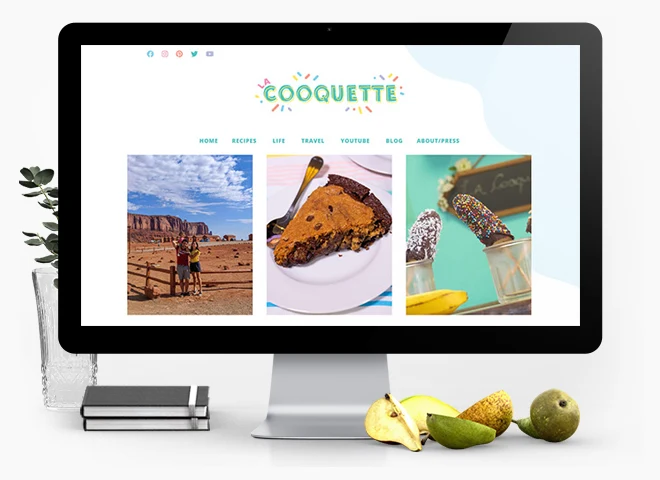

2. Do you need any custom pages?
By default, website design includes a styled homepage, blank pages, and blog-related elements (blog homepage, posts etc). Sometimes you may get an extra ‘Contact’ or ‘About’ page. If there are any other pages you already know you need, make sure to communicate it with a designer or check if premade designs you buy have them.
Some of our WordPress premade designs have included pages like Recipe Index or Galerry. All of the Custom designs come with the basic pages (‘Contact’, ‘About’ etc) but we are more than happy to add any other pages you need since the custom pages are tailored for each customer separately.
3. Are you looking for any specific features?
Options like Shop, Portfolio, or Recipe Index can increase website design costs.
In most cases, you can add them later if your starting budget is low. So do not stress about getting everything done at once. However, it is good to mention that you consider any specific feature when talking with someone about your design. This way, you will make sure that they can be added later, and you can get a price check to prepare your wallet for your website upgrade.
Still not sure how much your website may cost? Contact us for a price check and free consultation!
Additional Website Design Costs
Remember that you should always look for any additional or hidden costs when it comes to a website design.
We do our best to be as transparent as possible with all the prices, but I can not guarantee that about other shops. The most common practice is an additional installation and set-up fee for a design. Even though installation isn’t usually very hard or time-consuming, we have many customers who bought designs somewhere else and could not get them to work!
It is why all our premade and custom designs have the installation & set-up included in the design price.
Let us know in the comments if you still have any questions about website design costs!
Weekly Accessible Learning Activities: Truck Drivers, Basketball Heroes and Love

Each Wednesday we shine a spotlight on five student activities that support a broad range of learners. In this week’s roundup of accessible activities, we invite students to write a love poem, learn about truck drivers, watch a film about the “Queen of Basketball,” look closely at an intriguing photo and write an original story.
Note: To learn more about this new weekly feature, read our introductory post. Please share your thoughts in the comments section or by emailing us at LNFeedback@nytimes.com.
1. Write a love poem.
In this Student Opinion, students read a short poem about love by Gabrielle Calvocoressi, and then reflect on the different kinds of love they have experienced — romantic, platonic or familial. We invite students to share a small motion, or gesture, of love that someone has done for them in our comments section — or even write their own love poem.
2. Learn about truck drivers in America.
In this Lesson of the Day, students ride alongside a trucker on a 1,000-mile journey from Missouri to Texas to find out what the job is really like. Then they interview someone in their family or community whose job they think is very difficult and who deserves more appreciation.
3. Watch a film about the “Queen of Basketball.”
In this week’s Film Club, students watch “The Queen of Basketball,” a 22-minute Oscar-nominated film that tells the story of Lusia “Lucy” Harris Stewart, one of women’s basketball’s most accomplished players. Then they reflect on what we can learn from the life of one of basketball’s unsung heroes.
4. Make observations about a photograph.
What’s Going On in This Picture invites students to look closely at a photograph published in The Times, and try to figure out what is happening in the image. Students can read what other students have noticed in the image, as well as moderator responses, in the comments section.
5. Tell a story inspired by an image.
In this Picture Prompt we encourage students to use their imagination to write the opening of a short story or poem inspired by this photo — or, tell us about a memory from their own life that this image makes them think of.
