A marathon is 26.2 miles. Many people who enter these races feel that simply crossing the finish line is an accomplishment, though others try to get there as fast as they can without risking injury.
Even training for a marathon is grueling. For example, The Times offers a training plan for first-time marathoners that lasts six months.
If you don’t want to run a marathon, is there some other test of dedication and determination that you’d like to take on? (Keep in mind that it doesn’t have to be athletic but can be a personal goal of any kind!)
The Los Angeles Marathon is often overshadowed by larger and more storied marathons.
That may be especially true this year, when the race takes place on Nov. 7, the same day as the New York City Marathon, after the Los Angeles race was postponed from March because of the pandemic.
But the Los Angeles race, which travels from Dodger Stadium to Century City, has accomplished something the major marathons have never attempted.
Over the past three decades, more than 50,000 middle school and high school students, most of them from underserved communities, have trained for and completed the race as part of the organization Students Run L.A.
Their accomplishment is remarkable, and their participation could help answer two questions that educators, coaches and doctors have long pondered: Can teenage bodies handle the load of long-distance running, and, if so, can distance running improve academic performance?
Anecdotal evidence to support the relationship between running and academic performance is easy to find around the Los Angeles Marathon. Consider Lupe Conde, a recent graduate of Aspire Ollin University Preparatory Academy in Huntington Park, Calif., who will be running in her fourth Los Angeles Marathon this year.
Conde said she got into marathon running after seeing older girls in the school with marathon medals. She wanted one. So in ninth grade she joined the dozen or so students who train each year with a teacher in the school.
It took her eight hours to complete that first marathon. She said she would never do it again. But the race was too hard to resist.
“I used running as a way to cope and keep me going, not just physically but also mentally,” Conde, 18, said in a recent interview. “With all the work, and the A.P. classes, I used it to help with my mental health. It taught me grit and perseverance.”
Then there is Assael Mendez, a high school soccer player who graduated from Lawndale High School this year. He said attending U.C.L.A. had always been his dream, but he started to doubt himself in the grind of his sophomore and junior years at Lawndale.
That changed when Mendez, 18, trained for the marathon for the first time in his junior year. When he wanted to stop on his long training runs, he would ask himself why he thought he could go to U.C.L.A. and succeed there if he couldn’t keep running.
“I would go home and I would think, ‘If I can run 13 miles, then I can finish this homework,’” he said.
Mendez is now in his freshman year at U.C.L.A.
Want more writing prompts? You can find all of our questions in our Student Opinion column. Teachers, check out this guide to learn how you can incorporate them into your classroom.
Students 13 and older in the United States and Britain, and 16 and older elsewhere, are invited to comment. All comments are moderated by the Learning Network staff, but please keep in mind that once your comment is accepted, it will be made public.
Your resume is your chance to show the hiring manager your full set of skills, including soft skills like your ability to collaborate and effectively communicate with coworkers. You can also use your resume to connect your previous experience to the position you’re applying for to further highlight how you’re a good match for the role.
With skills to build web applications from end-to-end, Full-Stack Developers are highly sought after employees. But, that also means the industry is competitive. To help increase your chances of landing an interview for your next role, you’ll want your resume in top shape.
Below, you’ll find what to include on a Full-Stack Developer resume to grab the attention of the hiring manager and boost your chances of landing your next job.
What to include on a Full-Stack Developer resume
Here are a few key sections to include on your resume.
Contact information
Your contact information should be easy to find so the hiring manager can find it quickly once they’re ready to contact you. Consider putting it in the top right-hand corner or directly under your name at the top of the page. Along with your name, phone number, and professional email address, you can also consider including links to your portfolio and LinkedIn profile.
Summary or objective
The next section of your resume is typically a summary or objective. A summary is a brief description of your experience. It can also include an achievement you’re especially proud of.
While it might seem like a summary is only for experienced professionals, that’s not the case. If you’ve just completed an online program, graduated from a traditional college, or are a self-taught developer, you can still highlight your achievements in this section.
An objective focuses on your career goals. You can mention the position you’re applying for, two or three key skills, and what you hope to accomplish in the position.
Full-Stack Developer skills
You’ll also want to dedicate a section of your resume to your skills. This section can come right after your summary or after your work experience, depending on which layout you decide to go with. In your skills section, you’ll want to highlight both hard skills and soft skills.
As a Full-Stack Developer, you’ve likely learned multiple programming languages, databases, content management systems, and frameworks. These are all examples of hard skills. Depending on how you format your resume, you could group your skills into categories, like “programming languages,”“front-end stack,” and “back-end stack.” Here are some categories and technical skills to consider highlighting:
Content management systems: WordPress, Squarespace, Wix, and Ghost
Design: UI/UX design, Photoshop, Illustrator, and Sketch
Cloud computing: If you’re familiar with cloud technologies and platforms, like AWS, include these.
Soft skills are harder-to-quantify skills that employers look for like problem solving, collaboration, written communication, innovation, time management, leadership, and creativity. You can also highlight your soft skills as you discuss your prior work experience.
Experience
The next section of your resume discusses your work experience. List this in reverse chronological order — start with the most recent job and work your way backward.
In each listing, include your job title, the company you worked for, where the position was located (city and state), and what you did. You’ll want to do more than just list your tasks, though. You want to highlight what you accomplished in quantifiable terms.
This applies even if the work experience isn’t directly related to full-stack development. For example, if one of your previous positions was in retail management, discuss how you increased sales or improved employee productivity. This shows employers that you can take initiative and improve your workplace for the better.
Courses and education
You’ll also want a section for your courses and education. Include any degrees you’ve earned, even if they’re not directly related to being a Full-Stack Developer. You should also include any courses you’ve taken or certificates you’ve earned. List your degrees first and in reverse chronological order if you attended multiple schools.
Tips for getting your resume noticed
What can you do to make your resume stand out? Here are a few tips:
Attractive formatting. There’s a lot of information to include on a resume. Consider formatting your resume with columns to make the most of the space. Use a readable font type and size. You can easily find templates online to help you format your resume.
Save as a PDF. Unless the employer has a preference, save and upload your resume as a PDF. That way, the formatting that you worked so hard on is preserved, and it’ll look the same on any device.
Write your summary or objective last. It’ll be easier to write your summary or objective once you’ve completed the rest of your resume. That way, it aligns with the experience you’ve highlighted throughout your resume.
Start each entry in your work experience descriptions with a verb. A verb puts the focus on what you accomplished at each position. Words like “wrote,” “developed,” “created,” or “led,” will show hiring managers what you can do.
Tailor every resume: While a lot of your resume will stay the same, take the time to adjust each one to incorporate the qualifications mentioned in the job description in your resume. For example, if the posting mentions specific technical skills that you have, make sure those are listed in your skills section.
What if this is your first Full-Stack Developer job?
If you’re applying for your first Full-Stack Developer job, your approach depends on whether you have previous experience in IT. If you have experience in front-end or back-end development, you’ll want to highlight that experience along with the skills you’ve learned that make you a good candidate for the position.
If this is your first job in IT, you’ll want to move your education section up to or near the top of your resume. It should either follow your objective or your skills section.
In your work experience, highlight your transferable skills like problem-solving, leadership, creativity, and persistence. These skills are just as important as your technical skills, if not more.
How to get ready for your Full-Stack Developer interview
Leading the launch of a new product or offering is a complicated task that requires organizational skills and practice. Often, it also requires technical knowledge.
Even if their job doesn’t involve coding, many Product Managers still choose to learn a few programming languages. Not only does this deepen their understanding of the development process, but it also allows for better communication with developers and other stakeholders.
Below, we’ll explore some of the most popular languages for Product Managers, their uses, and how to learn them.
Choosing the best programming language to learn as a Product Manager
After deciding to learn a programming language, you’ll have to figure out which one is best for you. There are many languages out there, and each has its own market and user base.
While some languages were developed for a specific purpose, many have evolved over time to encompass more uses than before. Some are used to build websites, while others are used to analyze data or create systems that make daily tasks easier.
Ultimately, the best language for you depends on your goals and career path. As Richie Wu, one of our Senior Product Managers, explains:
“As a Product Manager, you don’t necessarily need to know how to program — but you do need to understand the ins and outs of how your product works. So, the best programming language to learn would be the one that your product is built in.”
Richie goes on to explain how many Product Managers also choose to learn SQL to better understand how user data is accessed and stored.
Now that you understand how to select the right language, let’s explore the ones commonly used by Product Managers.
1. Javascript
JavaScript’s versatility is one of the biggest reasons behind its popularity. While it was originally designed for web development, developers quickly extended its use into other areas.
JavaScript’s popularity across industries makes it a great first language for Product Managers. If this feels like the right language for you, get familiar with its basics in our introduction to JavaScript.
2. Python
Python is another great choice for Product Managers who are new to code. Many people find that it’s easier to get the hang of than other languages, with a syntax that’s similar to English and contains fewer symbols than other languages.
Python is commonly used for data science and machine learning, so it could be the ideal language for you to learn if you work with development teams in scientific fields. Still, its wide range of associated libraries extends its use into many other fields. To learn more, check out our article on what Python is used for.
Ready to get started with Python? Take your first steps with the language in our Learn Python 3 course.
3. SQL
SQL (Structured Query Language) is one of the most popular programming languages worldwide because it allows users to retrieve data from databases quickly and easily. Product Managers and Marketers love SQL because it allows them to extract the data they need without waiting for developers to do it for them.
If you find yourself working with large amounts of data, SQL could be the right language for you. To get started, check out our Learn SQL course.
Once you’ve figured out which language is best for you, take a look through our programming courses to find one the fits your needs. For example, if you’re already familiar with the basics of SQL and want to learn more about its utility, try learning intermediate SQL for Marketers and Product Managers.
Or, if you decided to learn Python, you could take courses like:
Many people hesitate before learning how to code, whether because they think they lack the required skills or simply don’t have the time. But, coding is for everyone, and with online courses, you can tailor your training to your schedule.
Use your imagination to write the opening of a short story or poem inspired by this photo — or, tell us about a memory from your own life that this image makes you think of.
Post it in the comments, then read the related article to learn more.
Want more Picture Prompts? Find them all in this column.
Students 13 and older in the United States and Britain, and 16 and older elsewhere, are invited to comment. All comments are moderated by the Learning Network staff, but please keep in mind that once your comment is accepted, it will be made public.
1. the doctrine that government should not interfere in commercial affairs
2. an attitude or policy of ignoring or overlooking the actions of others
_________
The word laissez-faire has appeared in 64 articles on NYTimes.com in the past year, including on May 21 in “San Francisco’s Shoplifting Surge” by Thomas Fuller:
We talked about the thefts we had witnessed in the city and the sidewalk thieves’ markets where steaks, bicycles and other stolen goods are fenced. Safaí said he had recently stopped to inspect one of these markets at 24th and Mission.
“Half of Walgreens was on the sidewalk. I’m not kidding,” Safaí said. “I was blown away. I’ve never seen anything like it in this city.”
He talked about what he called a laissez-faire attitude in San Francisco.
“It has become part of the landscape,” he said of thefts. “People say, ‘Oh, well, that just happens.’”
Thieves “are obviously choosing locales based on what the consequences are,” Safaí said. “If there are no consequences for their actions, then you invite the behavior. Over and over.”
Daily Word Challenge
Can you correctly use the word laissez-faire in a sentence?
Based on the definition and example provided, write a sentence using today’s Word of the Day and share it as a comment on this article. It is most important that your sentence makes sense and demonstrates that you understand the word’s definition, but we also encourage you to be creative and have fun.
Then, read some of the other sentences students have submitted and use the “Recommend” button to vote for two original sentences that stand out to you.
If you want a better idea of how laissez-faire can be used in a sentence, read these usage examples on Vocabulary.com.
Students ages 13 and older in the United States and the United Kingdom, and 16 and older elsewhere, can comment. All comments are moderated by the Learning Network staff.
Today, Ms. Sialuk Jacobsen uses historical documents, artifacts and the Qilakitsoq mummies — several of which are now on display at the Greenland National Museum — to research traditional Inuit tattoo designs. Then she hand pokes or stitches the patterns onto the faces and bodies of Inuit women, and occasionally men, helping them connect with their ancestors and a part of their culture.
“I take great pride in tattooing a woman,” she said. “When she meets her foremothers in the next world, it will be like looking in a mirror.”
Here is the October edition of Teenagers in The Times, a roundup of the news and feature stories about young people that have recently appeared across sections of NYTimes.com. We publish a new edition on the first Thursday of each month.
For ideas about how to use Teenagers in The Times with your students, please see our lesson plan and special activity sheet, both of which can be used with this or any other edition.
Despite some turmoil, a vast majority of students have been in classrooms full-time and mostly uninterrupted this fall. Now, educators debate what’s next.
Hundreds of students, parents and residents in York County, Pa., protested limits on books told from the perspective of gay, Black and Latino children.
The mayor unveiled a plan to replace the highly selective program, which has become a glaring symbol of segregation in New York City public schools, for incoming students. It will be up to his successor to implement it.
A University of Florida study includes data from roughly 350,000 games and practices in more than 30 states. Headgear for girls has been mandated in Florida since 2015, and remains hotly debated.
The 18-year-old returns to the court at the BNP Paribas Open in Indian Wells, Calif., as a headliner, richer and more famous. She still needed a wild card.
Over the past two years, nine states have enacted laws to bar transgender girls and women from competing in girls’ and women’s sports. Another relied on an executive order for a ban.
What is unique about Gen Z? What are some of the qualities — good and bad — that define your generation? Have you found older generations accepting of those qualities?
As a millennial with a habit of lurking on TikTok, Jessica Fain understood that skinny jeans and side parts were on the steady march toward extinction. But when Ms. Fain, who works as a product manager at a large tech company, heard that some of her favorite emojis might also be confronting retirement — namely that laughing-sobbing face — she decided to seek the counsel of her junior colleagues.
“I heard that using this emoji isn’t cool anymore,” Ms. Fain, 34, said she wrote in a water-cooler-type Slack channel.
“Yeah I only use that emoji at work for professionalism,” she recalled a younger employee replying. “H8 2 break it to 2 u Jess.”
Ms. Fain is old enough to remember when millennials determined what was in vogue: rompers, rose pink, craft beer, Netflix and chill. Now, she gets the foreboding sense from colleagues that her AARP card awaits. Subtly yet undeniably, as generational shifts tend to go, there’s a new crop of employees determining the norms and styles of the workplace. And they have no qualms about questioning not just emoji use but all the antiquated ways of their slightly older managers, from their views on politics in the office to their very obsession with work.
The article continues:
It’s a fault line that crisscrosses industries and issues. At a retail business based in New York, managers were distressed to encounter young employees who wanted paid time off when coping with anxiety or period cramps. At a supplement company, a Gen Z worker questioned why she would be expected to clock in for a standard eight-hour day when she might get through her to-do list by the afternoon. At a biotech venture, entry-level staff members delegated tasks to the founder. And spanning sectors and start-ups, the youngest members of the work force have demanded what they see as a long overdue shift away from corporate neutrality toward a more open expression of values, whether through executives displaying their pronouns on Slack or putting out statements in support of the protests for Black Lives Matter.
“These younger generations are cracking the code and they’re like, ‘Hey guys turns out we don’t have to do it like these old people tell us we have to do it,’” said Colin Guinn, 41, co-founder of the robotics company Hangar Technology. “‘We can actually do whatever we want and be just as successful.’ And us old people are like, ‘What is going on?’”
Twenty-somethings rolling their eyes at the habits of their elders is a trend as old as Xerox, Kodak and classic rock, but many employers said there’s a new boldness in the way Gen Z dictates taste. And some members of Gen Z, defined as the 72 million people born between 1997 and 2012, or simply as anyone too young to remember Sept. 11, are quick to affirm this characterization.
What is your reaction to the article? Did any of the examples of Gen Z perspectives, ideas or actions — whether about work, political activism or anything else — resonate with your beliefs or experiences? Why or why not?
How do you feel about older generations characterizing Gen Z? Is it flattering to hear their views on your generation? Are their views frustrating or reductive?
In your opinion, what are the most important things that older generations, and even future generations, could learn from yours? What valuable things have you learned from older generations?
Describe a moment from your life that illustrates a generational difference. It could be a time when you helped someone older understand an important issue in a new way, or when you felt misunderstood because of stereotypes about your generation. Describe the situation, how you felt and why it matters.
What do you think this article is missing, if anything, about Gen Z? Are there perspectives or conclusions that you believe the writer misunderstood or misinterpreted? What else do you think she, and readers of the article, should know about people your age? (You might scan the 2,800-plus reader comments on the piece. This article prompted a lot of conversation!)
At Alison, we believe that our commitment to fighting climate change goes hand-in-hand with our devotion to empowerment through education. Our project of bringing top quality education and training to anyone, anywhere, at any time, is not limited to workplace and professional skills. We believe that every individual on the planet should have access to the information necessary to save it.
We have always been committed to promoting accurate and up-to-date information on the challenges facing our global family of learners, from coronavirus to climate change. As the situation evolves, we will continue to produce vital courses outlining how individuals and companies can affect changes that can reduce emissions and protect the planet.
Central to our mission is our alignment with the United Nations’ Sustainable Development Goals, the UN’s “blueprint to achieve a better and more sustainable future for all people and the world by 2030”. The idea of sustainability is woven into the fabric of what we do.
Alison is a remote company, which means that our team is not centralised in a single building but rather is based in a variety of locations around the world. This allows us to reduce our carbon footprint by slashing office energy usage and also elimates the fuel consumption of commuting. As a digital only enterprise, we also operate with zero paper waste.
At the heart of our project is our belief in the endless potential for good that comes from leveraging technology for online learning. Through our online platform, and more recently through the Alison App, we allow millions of Learners around the world to gain a quality education without any of the environmental costs that are inherent in bricks and mortar schooling. Our model means no paper waste, no schoolbus fumes, no lights left on in the school overnight. Our Learners are taking part not just in an educational revolution, but an environmental one.
To mark the 2021 United Nations’ Climate Change Conference, we reached out to our employees around the world and asked them what action they took to play their part in the fight against climate change. We were inundated with tips and advice and from their suggestions we’ve put together ten recommendations for leading a more sustainable life.
By germinating and growing fruit tree seedlings, you can distribute them to friends in order to increase the number of trees to absorb carbon. When working in your garden, be conscious of planting more water-wise plants and plants that help to reduce the amount of carbon dioxide in the air. You can also recycle much of your kitchen waste for compost, which both benefits the garden and saves you money on fertiliser.
3. Food shopping
When shopping, select fruit and vegetables which are not wrapped in plastic and which are locally grown when possible. Use canvas, rather than plastic, bags and if you do happen to get plastic bags, make sure to reuse them as much as possible. Avoid buying single use plastics and buy food that comes in glass, cardboard or tin as much as possible.
4. Diet
Follow a vegan diet for 5 days a week and a vegetarian one for the other 2, as these diets have far lower carbon footprints than meat-heavy diets. You should also try and eat food that’s in season.
5. Toiletries
Buy toiletries from whole sale or refill shops where you can buy them by the litre and bring your own reusable containers. Many sustainable, water-saving and environmentally friendly personal care products are now very easy to source, such as bamboo toothbrushes, organic loofahs, reusable make-up remover pads, shampoo bars and bamboo cotton buds.
6. Transport
Limit your fuel emissions by walking and cycling as much as possible and using public transport when you can.
7. Water Conservation
Catch cold water from the shower in a bucket to use in the toilet and garden or to wash floors, rather than let it go down the drain.
8. Education
Learn about the science behind climate change in order to be better informed about how you can implement the most effective changes in your own daily routines.
9. Paper Waste Reduction
Use recycled toilet paper and, instead of using kitchen role/paper towel, use reusable cloths. Invest in a reusable coffee cup and straw to reduce cardboard waste.
10. Clothes Shopping
Shop from charity shops as much as possible and don’t buy new clothes or shoes until the old ones are worn out. Limit your new clothing purchases to local and ethically sourced materials, and learn to repair clothes that can be fixed.
What connections can you make between this film and your own life or experience? Why? Does this film remind you of anything else you’ve read or seen? If so, how and why?
3. An additional challenge | Respond to the essential question at the top of this post: What gives you hope in the fight against climate change?
4. Next, join the conversation by clicking on the comment button and posting in the box that opens on the right. (Students 13 and older are invited to comment, although teachers of younger students are welcome to post what their students have to say.)
5. After you have posted, try reading back to see what others have said, then respond to someone else by posting another comment. Use the “Reply” button or the @ symbol to address that student directly.
6. To learn more, read “This Is the World Being Left to Us by Adults.” a Guest Opinion Essay published in August by Greta Thunberg along with Adriana Calderón, Farzana Faruk Jhumu and Eric Njuguna, who areyouth climate activists from Mexico, Bangladesh and Kenya:
Last week, some of the world’s leading climate change scientists confirmed that humans are making irreversible changes to our planet and extreme weather will only become more severe. This news is a “code red for humanity,” said the United Nations secretary general.
It is — but young people like us have been sounding this alarm for years. You just haven’t listened.
On Aug. 20, 2018, one child staged a lone protest outside the Swedish Parliament, expecting to stay for three weeks. Tomorrow we will mark three years since Greta Thunberg’s strike. Even earlier, brave young people from around the world spoke out about the climate crisis in their communities. And today, millions of children and young people have united in a movement with one voice, demanding that decision makers do the work necessary to save our planet from the unprecedented heat waves, massive floods and vast wildfires we are increasingly witnessing. Our protest will not end until the inaction does.
For children and young people, climate change is the single greatest threat to our futures. We are the ones who will have to clean up the mess you adults have made, and we are the ones who are more likely to suffer now. Children are more vulnerable than adults to the dangerous weather events, diseases and other harms caused by climate change, which is why a new analysis released Friday by UNICEF is so important.
The Children’s Climate Risk Indexprovides the first comprehensive view of where and how this crisis affects children. It ranks countries based on children’s exposure to climate and environmental shocks, as well as their underlying vulnerability to those shocks.
It finds that virtually every child on the planet is exposed to at least one climate or environmental hazard right now. A staggering 850 million, about a third of all the world’s children, are exposed to four or more climate or environmental hazards, including heat waves, cyclones, air pollution, flooding or water scarcity. A billion children, nearly half the children in the world, live in “extremely high risk” countries, the UNICEF researchers report.
This is the world being left to us. But there is still time to change our climate future. Around the world, our movement of young activists continues to grow.












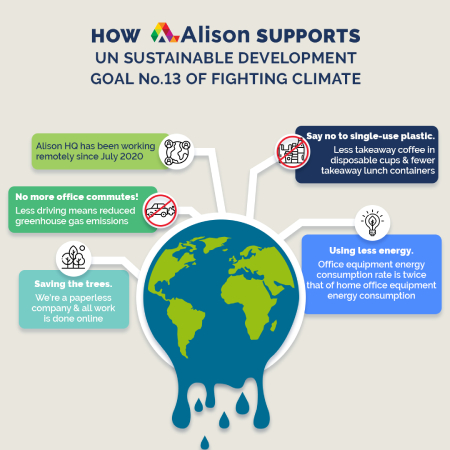 Alison is a remote company, which means that our team is not centralised in a single building but rather is based in a variety of locations around the world. This allows us to reduce our carbon footprint by slashing office energy usage and also elimates the fuel consumption of commuting. As a digital only enterprise, we also operate with zero paper waste.