Online courses are a great place to learn the foundations of code. But it’s when you put things into practice that you cement the concepts into your brain.
Figuring out how to solve problems and conquer coding challenges can be truly rewarding (and fun!). Stephanie, a Software Developer from Baltimore, shares why practice (including code challenges) is key to mastering a programming language:
“Codecademy is a great starting point for learning different programming languages and introducing concepts, but there’s only so much you can cover in a course. A good chunk of mastering a language is learning through experience.”
In this article, we’ll describe 10 short beginner JavaScript code challenges that you can tackle. Try selecting one each day and see how you do. We’ll also share how you can continue challenging yourself and your JavaScript skills after completing our suggested list.
Top 10 JavaScript code challenges for beginners
Each of these challenges is suitable for beginners, but you may find that having a base-level knowledge of JavaScript is helpful. Or, if you have a little bit of experience, you might benefit from refreshing your knowledge with our introductory course on JavaScript.
While we don’t specify here, you can use whatever coding environment suits you best. You can use what you’re comfortable with on your local machine, or you can use the environments you’re familiar with in online JavaScript courses. Don’t forget that Google can also help if you find yourself stuck on a coding problem, but try to see if you can create a solution before heading to the search engine.
1. Print all even numbers from 0 – 10
Try to make the solution to this problem as efficiently as possible. Consider using loops that would allow you to type the fewest characters/commands. While you could simply print the even numbers, get creative and see how you could output them in a way that would work up to 10 or even up to 10,000 with little extra effort.
2. Print a table containing multiplication tables
Let’s start with the tables that many of us had to memorize in school. Can you print a table that contains all the answers to the multiplication tables from 1 through 10?
Like Challenge #1, can you create an efficient solution that you could easily expand should you need the 12 times table?
3. Create a length converter function
Creating a function is a skill that’ll be useful in many settings, and as you progress, you’ll be working on much more complicated functions than this one. But a function that converts units of measure can be pretty handy in multiple professions and industries.
Let’s start with a conversion from kilometers to miles. The function should include the input in kilometers and return the answer in miles.
4. Calculate the sum of numbers within an array
You can create your own array of numbers but consider trying this problem with a few different sets to verify your solution. Have one array with negative and positive numbers and another with integers and decimals.
You could also try using arrays of different lengths. If you’re feeling comfortable with this, try the slightly more challenging bonus challenge below.
Bonus intermediate challenge: Create a function that can return the sum of a particular column or row number in a table.
5. Create a function that reverses an array
This challenge is particularly helpful if you’re planning to become a Data Scientist. Manipulating data is a significant part of the role, and building the foundations now will help you later down the road when you’re working with large databases.
Start small here and work your way up. Begin with an array of 5 numbers, and then try your program with a larger array to verify its success.
6. Sort an array from lowest to highest
You could create a function for this solution as well, but be sure to try your program with varying lengths and types of arrays. Try one with all integers, another with negative numbers, and another with decimals.
7. Create a function that filters out negative numbers
In this challenge, you’ll have a function that takes an array as an input and returns an array. But if all goes according to plan, it’ll remove the negative numbers. This is another example of a task that’ll be useful when combing through data and looking for clever ways to eliminate “bad data.”
8. Remove the spaces found in a string
Yet another way to clean up data is to remove any errors or unnecessary spaces. This function will take in a string and then return it with all spaces removed. Think about if you were tasked with cleaning up customer data at your job. You could scale this function to clean up specific fields of data, such as zip codes.
9. Return a Boolean if a number is divisible by 10
Here, you’ll create a function that’ll give you a “true” or “false” Boolean as its output. The inputted number should only return a “true” if it’s divisible by 10. Otherwise, your program should return a “false” answer.
10. Return the number of vowels in a string
Create a function that’ll return an integer of the number of vowels found in a string. This is a great way to practice determining the features of a dataset. If you use JavaScript later in your career, you’ll be well-prepared to determine what datasets (or just strings) consist of. If you feel like an extra challenge, consider returning the number of characters.
Brush up on your JavaScript with courses and challenges
If you enjoyed putting your JavaScript skills to the test with these challenges, then consider signing up for more by downloading the Codecademy Go app. Participating in our daily or weekly challenges is an excellent way to keep your skills fresh and continue learning to solve problems.
We recently celebrated our 10th anniversary! For the past decade, our learners have used our courses to transform their lives — gaining new skills and finding new opportunities in the world of code.
As we reflected on their success, we wanted to explore the courses they found most valuable, so we created a list of our 10 most popular courses.Below, we’ll walk you through what each course entails, what you’ll learn, and how to decide if it’s right for you.
1. Learn Python 3
Learn Python 3’s popularity comes as no surprise. Developers of all kinds love Python, both for its wide range of applications and ease of use.
In Learn Python 3, we walk you through the latest version of the Python programming language, laying the foundation for you to take the language in whichever direction you desire. As a general-purpose language, you can use Python for everything from software development to machine learning and data science. Plus, it’s super easy to read — making it the perfect language for beginners.
2. Learn HTML
Even if you’re completely new to code, you’ve probably heard of HTML. This is probably one of the reasons why Learn HTML is so popular.
In this course, learners use HTML’s basic tags to build and structure their first web pages. As GeeMcDee illustrates in our forums, many learners use Learn HTML to take their first steps into web development before branching into other languages:
3. Learn JavaScript
Learn JavaScript covers the basics of programming and JavaScript’s syntax, providing learners with everything they’ll need to use the language in any environment. JavaScript is commonly used for front-end development to build interactive and dynamic web applications. But, with various third-party libraries extending its use into the back end, it’s the perfect language for anyone looking to become a Full-Stack Developer.
But it’s not just aspiring Web Developers who want to learn JavaScript. It’s also the first step for learners who are interested in game development. Others are drawn to its potential for creativity, looking to dive into creative coding with tools like Phaser.js.
4. Learn Java
In Learn Java, you’ll learn the language’s basic syntax and the fundamentals of object-oriented programming. Then, you’ll use your new knowledge to build 7 projects that’ll help cement your skills.
Java is many developers’ favorite language, and its applications range from software development to large systems development. It can even be used for mobile development, as it lies at the heart of many Android apps. Our data shows that many learners move on from Learn Java to courses like Build Basic Android Apps with Java.
5. Learn SQL
Learn SQL teaches learners how to manage relational databases and query and manipulate data. Learners of all kinds have used this course to achieve their goals.
It goes without saying that, as the standard language for data management, SQL appeals to those considering a career as a Data Scientist or Data Analyst. But, non-technical professionals are flocking to the course, too.
Marketers, Product Managers, sales teams, and more rely on data-driven insights to boost their efficiency. By learning how to manage data yourself, you open the door to many opportunities.
6. Learn C++
While Learn SQL can be very helpful for non-technical roles, Learn C++ lies on the opposite end of the spectrum. Like many of the languages listed above, C++ can be used for game and software development — but it can also be used for robotics and scientific computing.
Learn C++ is great for learners looking for a powerful programming language found in everything from operating systems to web browsers and microcontrollers. This course teaches you the essentials of C++ programming, including variables, vectors, classes, objects, and more. Along the way, you’ll use your new coding skills to create various projects — including a Harry Potter Sorting Hat.
7. Code Foundations
Code Foundations is our introductory Skill Path for learners who are new to code and still in the information-gathering stages of their learning journeys. In this Path, you’ll learn the basics of programming as you explore various career paths in tech. These paths include web development, computer science, data science, and more — and you’ll even get insights from established professionals in these fields.
Hundreds of thousands of learners have used Code Foundations to take their first steps into the world of programming. Still considering if the field is right for you? This Skill Path will help you figure it out.
8. Learn CSS
After completing Learn HTML, many learners go on to Learn CSS. As you might assume, the course shows you how to use the language to add stylistic elements to web pages — including background images, colors, and attractive layouts.
But CSS does more than just adding colors to web pages. You can also use it to add animations (even without JavaScript) and make your website more mobile-friendly. Plus, it also allows you to customize content management systems like WordPress — making it a great tool for everyone from Web Developers and Designers to Content and Project Managers.
9. Full-Stack Engineer Career Path
Our Full-Stack Engineer Career Path is the most popular of our Career Paths. In it, you’ll learn many of the languages listed above, including HTML, JavaScript, SQL, and more. In other words, it’s perfect if you want to learn everything you need to know to launch your career in web development at once.
Our Full-Stack Engineer Career Path teaches you how to build complete web apps, including both front-end and back-end components. Along with the languages above, you’ll also learn how to use popular libraries like Express.js and React. You’ll even learn how to create your own APIs. Plus, as a Career Path, it also includes projects that you can include in your portfolio to help you stand out in your job search.
10. Learn How to Code
The last course on our list, Learn How to Code, is language-agnostic. Instead of covering a specific language, it introduces you to fundamental coding concepts like variables, functions, and control flow. Learners use this course to test the waters before jumping into a full programming language.
The courses listed above have been the most popular among our learners over the past decade. Still, they’re just the tip of the iceberg. Our full catalog of programming courses includes over 1000 lessons on various languages, libraries, and frameworks. Plus, we’re constantly coming up with new courses to ensure you’re well-equipped with the skills you’ll need to succeed in your tech career. Ready to get started? Sign up for free today!
HSE’s new Master of Computer Vision program on Coursera aims to train the next generation of computer vision talent online.
As we approach the application deadline for HSE University’s groundbreaking new Master of Computer Vision program on Coursera, we are excited to share some highlights from our recent conversation with Andrey Savchenko, Academic Supervisor for the program. Among the many subjects we discuss are the rapidly emerging career opportunities in the field of computer vision, the experts who helped create the curriculum, and the specific structure of the program itself.
The Master of Computer Vision program is organized by the Faculty of Informatics, Mathematics, and Computer Science at HSE Nizhny Novgorod—a globally recognized leader in the development of computer vision technologies, and HSE University was recently recognized by Forbes Magazine as the #1 university in Russia. In 2008, Andrey Savchenko was a doctoral student at HSE Nizhny Novgorod, researching ways to improve the computational efficiency of image classification. Today, he leads a program designed by leading experts at companies such as Huawei, Itseez3D, Intel, Harman, and Experience AI.
Professor Savchenko, thank you so much for taking the time to speak with us. To get started, can you give us a brief overview of the new program?
Of course. The Master of Computer Vision is a new master’s program created in collaboration with leading experts in the field of computer vision. It has been designed to prepare students for work in the field and provide them with a solid foundation in computer science, engineering, IT, and mathematics.
It’s wonderful that the program is so focused on preparing students for career success through the acquisition of foundational skills. What types of students can really benefit from enrolling in the Master of Computer Vision program?
I believe a wide range of individuals can benefit. The program is ideal for everyone from practicing engineers, programmers, and IT specialists to developers and AI experts. Essentially, anyone interested in launching and advancing a career working with images. I would say, too, that young professionals and graduates in IT and mathematics who are looking to take a new direction with their careers and learn new skills are also well suited to the program.
How is the program structured?
It’s a two-year program, which is divided into four semesters comprising four courses each. Students will study two courses at a time, with each course scheduled to last 6–7 weeks.
Can you walk us through focus areas and approaches for each of the semesters?
In the first semester, we’re really focused on ensuring that all students have the required knowledge, so we include bridging courses in mathematics and object-oriented programming in Python and C++. Mathematics courses are led by HSE University’s tenured professor Valeriy Kalyagin. In addition to Professor Kalyagin, we have engineers from Intel and Xperience AI, who focus on explaining traditional image processing techniques using the OpenCV library.
The caliber of expertise is very high—that’s a real value for learners in the program.
Yes, and as an additional feature during the first semester, we also have specialists from EPAM and Huawei running a course on the machine-learning methods used widely in computer vision systems.
The program features contributions from academic, industry, and research experts—can you give us an example of what this balance looks like in terms of the actual learner experience?
The second semester provides an excellent example of this balance. Over the course of the semester, researchers from the LATNA laboratory explain modern optimization techniques integral to training deep neural networks, while engineers from RoundU provide detailed instruction on the deep-learning methods used in applied image recognition, object detection, and semantic segmentation. The semester then concludes with an applied project led by specialists from Xperience AI.
What happens as students in the program move into their second year?
Courses in the second year delve deeper into complex computer vision techniques such as 3D reconstruction, image generation, and the creation of software that utilizes AI and image processing for mobile devices and other platforms. The program concludes with a thesis project where students will have the opportunity to gain real-world experience working in the field of computer vision alongside leading experts from the program’s corporate partners.
Let’s pivot a bit and talk about the current state of computer vision. Is there a demand for people with these skills?
Today, research into computer vision is going stronger than ever, and new apps for processing images and videos are appearing all the time. More and more companies around the world are setting up AI divisions and hiring computer vision experts. So yes, there is definitely growing demand. However, there is still a shortage of qualified talent, so companies are often forced to hire graduates from other tech disciplines and then try to train them in computer vision techniques on the job. Our program aims to meet the high demand by training dedicated computer vision specialists.
What can you tell us about the career prospects of a graduate from this program?
Graduates of the program will be well prepared for professional success in the field of computer vision. Over the course of their studies, students will gain valuable experience working on real projects with industry experts. They’ll gain the knowledge and tools needed for careers in computer vision software engineering, perception engineering, 3D perception/computer vision algorithm engineering, computer vision test engineering, computer vision science, and more. We believe that demand for trained professionals in these areas will remain high for decades to come, so career prospects are very strong.
Is there a path into this field you’d recommend for learners who may not yet be prepared or qualified to enroll in the master’s program?
Yes, absolutely. Professor Kalyagin teaches the Basics in Computer Vision Specialization on Coursera, where learners experience the content and format of the Master of Computer Vision program while also gaining the mathematical and programming skills necessary for the development of algorithms in the field of computer vision. They will also learn how to use the OpenCV library for analyzing two-dimensional images, which is an essential applied skill for computer vision professionals. Upon completing the Specialization, students will earn a certificate. Plus, they can potentially leverage their completed work should they enroll in the full master’s program.
Thank you, Professor Savchenko, for sharing your thoughts and insights with our community! We’re thrilled about the new program and excited for all the students who are currently enrolling.
Alison is delighted to announce that our free online courses have been named among Intelligent.com’s Best Online Courses for 2021. Intelligent.com is a trusted online resource that helps students to plan their higher education by bringing together the latest research, tips and techniques championed by today’s leading experts in education. Intelligent.com has featured 12 Alison courses in its guide of the Best Online Courses for 2021, across 8 different categories.
The guide has been put together to increase awareness about quality educational experiences and to highlight the most trusted solutions on the web. Intelligent.com chosen the best courses based on a rigorous set of criteria that took in reviews, enrollment levels, course flexibility, real-world skill takeaway and popularity.
To celebrate this recognition, we’ve brought all of our award-winning courses together so you can sample some of the best online learning the web has to offer!
Our Human Nutrition: Introduction to Macronutrients course was named the Most Mobile-Friendly nutrition course. The Alison App means that all Alison courses are now as easy to learn on the go as they are from a laptop or desktop! Human Nutrition: Introduction to Micronutrients was chosen as the course with the Best Focus on Science. All Alison courses are created by qualified subject-matter experts so it’s no surprise that this course came top of the class!
In the Web Design Category, How to Create Your First Website won Best for Basic Web Design. This incredibly popular course has helped thousands of entrepreneurs take their first steps into the online marketplace by teaching them how to create engaging websites that attract traffic and drive profits. Given our commitment to providing our Learners with real world skills, this is an award we’re really proud of!
Over 100,000 students have taken our Diploma in E-Business which won Most Affordable Marketing Course. Alison is dedicated to making high quality education readily available to everyone on the planet for free. Awards like this show that our commitment to free education doesn’t come at the expense of the quality of the courses we publish. This course, produced by Google, also shows the calibre of the stakeholders who are committed to our project of free education.
Intelligent.com chose English Grammar: Comparisons and Word Order (Intermediate) as the Best Intermediate Course for learning English. At Alison, we create courses aimed at Learners of all abilities and levels. From beginners courses to intermediate and on to advanced learning, we have something for everyone. Our English for Career Development course also won Most Affordable Course in the Learning English category. This course has proved crucial for Learners around the world seeking to empower themselves by gaining access to anglophone markets.
Given the events of the last 18 months, we’re delighted that our Managing Health and Safety in Healthcare course won Best for Safety Management. Safety management is more vital than ever for protecting front line workers and patients in healthcare settings and so we’re extremely proud that this course has received this recognition.
Diploma In Project Management is one of our all-time most popular courses with over half a million students having taken it. Regardless of industry, this course has the potential to help students upskill to become manager material and increase their chances of promotion. By winning Most Affordable Course in the Project Management category, it’s clear that this course is as accessible as it is successful.
Perhaps the award that means the most to us is winning the Most Affordable Course in the Education category. Alison is a social entreprise dedicated to spreading education for free and so for our expertise to be recognised on both of these fronts is special. Our Diploma in Teaching Skills for Educators allows us to “teach teaching for free” and expand access to education globally.
Given the rise in tech jobs, with a projected 531,200 expected to be added by 2029, there will be plenty of need for Product Managers for years to come. Product Managers are both the brains behind an operation and the glue that holds everything together. They’re responsible for ensuring a product is conceived, designed, and executed in a way that meets their organizations’ objectives.
Your salary as a Product Manager will vary based on where you are and the company you work for. Below, we’ll explore the salary expectations for Product Managers, how they vary by location, the role’s responsibilities, and more.
How much do Product Managers make?
On average, a Product Manager in the United States makes around $87,600 a year. Still, your salary largely depends on what type of Product Manager you are. For example, an IT Product Manager can expect an average of $102,469, while a Senior Product Manager averages $117,805.
As we said earlier, your salary as a Product Manager will also vary based on the company you work for. For example, a Product Manager at Infosys earns $102,562 a year, and if you work at Cognizant Technology Solutions, you may make a similar figure of $100,000.
Generally, your salary as a Product Manager can range from $74,102 at companies like Epic to $131,074 at companies like Cisco. This variance in pay is likely due to several factors, such as:
The scope of your responsibilities
The market value of the products you work on
Other benefits and compensation factors like bonuses and stock options
How much do Product Managers make in the Northeast?
The salary for Product Managers is higher than average in the Northeast, which makes sense given the thriving business centers and tech companies that call that area of the country home. For example, in New York City, the average Product Manager makes $93,816 a year.
How much do Product Managers make on the West Coast?
Salaries are also well above average on the West Coast. In California, for example, the average salary for Product Managers is $105,500 — almost $18,000 more than the national average.
How much do Product Managers make in the Midwest?
The pay drops a little in the Midwest, most likely due to lower living expenses and fewer tech giants than you’d find on the left and right sides of the nation. For instance, a Product Manager in Ohio makes an average of $80,000 a year, and in Wisconsin, you can expect to earn about $79,000.
The salary for Product Managers in Michigan jumps back up to near the national average at $84,500, likely due to Michigan tech companies like THiNC.technology and car manufacturers, such as Ford Motor Company and General Motors. These companies have a steady need for software development.
What does a Product Manager do?
A Product Manager is in charge of ensuring a solution and its execution meet the high-level objectives provided by management. One of the first things they do is meet with executives and other stakeholders to understand what they’re looking to achieve.
As a Product Manager, you may also meet with IT admins and developers before beginning a project to ensure you have the technology and processes in place to develop a solution efficiently and on time.
Once the groundwork has been laid, a Product Manager earns their pay by ensuring each phase of the development process runs smoothly. This involves working with different workflow management processes, people, and technologies.
Working within an agile framework
Characterized by their flexibility, agile frameworks have become one of the most popular workflow management processes. You’re probably already familiar with the “waterfall” approach, which is typically more linear and structured as each step of the development process needs to be completed before moving onto the next. Within agile frameworks, Product Managers regularly gather feedback from their teams and adjust plans along the way.
Agile frameworks can also involve more collaboration between departments. For example, a Product Manager may meet with various stakeholders, from Designers to Security and Network Admins, to ensure their solutions are aligned with their goals.
As you can see, Product Managers can expect a decent income regardless of location. Their competitive salaries stem from their crucial role in the development process, keeping their teams aligned and ensuring everything runs smoothly.
Still, as a Product Manager, you’ll need to know how the tools of the trade are used to create solutions. Because product management can encompass several disciplines, it’s best to have a diverse body of knowledge. A good place to start is in some of the following courses, all of which can help you gain the skills and background knowledge you’ll need to manage teams that depend on the tools you’ll learn about:
While learning how to use the tools above, you’ll also gain a better understanding of how developers work and think, allowing you to find new ways to motivate and collaborate with your teams. We’ll also give you the chance to build and bolster your professional portfolio, positioning you to bring in a great salary, regardless of where or for which company you work. You can get started for free by signing up today.
Some questions to reflect on after watching the video:
What stood out to you? Why?
What questions do you have?
What are the three priorities that Ms. Shah identifies? Do you share any of these priorities in your teaching?
In the middle of the video, Ms. Shah and her students talk about various “writer’s moves” that they practice with Student Opinion questions. Which of these writer’s moves do you want your students to practice?
At the end of the video, Ms. Shah and her students talk about engaging in authentic conversations. In what ways do you have your students build conversational skills, as well as develop and deliver their opinions?
Feel free to share your reflections in the comments section of this post.
Examples From Other Teachers Ms. Shah’s approach is just one of many ways that we see teachers using Student Opinion questions in the classroom. Here are some additional examples of ways teachers have used this feature across different grade levels and subject areas:
I use this every week, with every class. Students respond first to me via Google Docs, then after spell check they copy and paste their response into the comments. My students are extremely eager every week to see if anyone was published in the What Students Are Saying About feature. The Student Opinion response has literally become part of the fabric or culture in my class. — Donna Cubbage, middle school English teacher
I use it every Friday. I create a Nearpod lesson with collaboration boards, polls and embed videos, and use the draw-it feature for guided reading before the students write their opinions. — Debbie Domingues-Murphy, high school librarian
Students love using this as a warm-up, then having a Philosophical Chairs style debate. They have also used these topics as a starting place for further research. — Tiffany Mathes, high school English teacher
I like to use it when I want students to really think about their “position” before launching into a unit. A great way to work current events into my lessons and get students to see connections with literature from “long ago” and issues that are relevant today. — Amy Chappuis, high school E.L.L. teacher
Carla Cefalo, a health teacher, explains in this post how she uses our prompts — on topics like relationship building, mental health, self-care, bullying and social media — to discuss a range of social-emotional issues and engage students in discussions around healthy choices.
And Steve Weisblatt, a community college instructor, explains in this post how he uses our Student Opinion questions as prompts for English-language learners to practice writing and critical thinking skills in preparation for his college’s English-proficiency test.
Try It Out in Your Classroom
So far, you’ve tried out a Student Opinion prompt yourself, learned more about the feature and explored ways that teachers have used it in their classrooms. Now we encourage you to try this out in your own classroom.
In the fall of 2021, the first enrollees in the Master of Business Analytics program from HSE will commence their studies on the Coursera platform. Students in this groundbreaking program will develop innovative new skills uniquely relevant to a rapidly evolving global business and financial landscape.
The program’s approach— implemented in cooperation with international professional networks such as ACCA, AICPA-CIMA, and IMA— is rooted in three core principles about the role of finance and business analytics:
Finance should provide the measures for intellectual capital generated and accumulated by non-financial stakeholders.
Finance should offer the pricing models for new risk drivers derived from companies’ intellectual and natural capital.
Finance should play the role of integrator between non-financial and financial capitals and provide the models to secure the connectivity between non-financial capitals and future financial performance.
As the global market economy continues to be reshaped by new challenges, HSE recognizes that exciting new career opportunities are emerging in the wake of these disruptions. The program is structured in such a way that you can learn the most essential skills for success in these new roles. The program offers two specializations: Value-Based Business Analytics and Strategic Business Reporting. As you progress through the program, you’ll take a balance of compulsory and elective courses, engage in interactive Virtual Labs, and participate in project workshops where you’ll complete two real-world projects under the supervision of industry experts. Upon earning your degree, you’ll learn the skills needed to succeed in a range of positions. These include financial management roles, roles at investment banks or investment funds, positions within accounting departments, and consultancy roles.
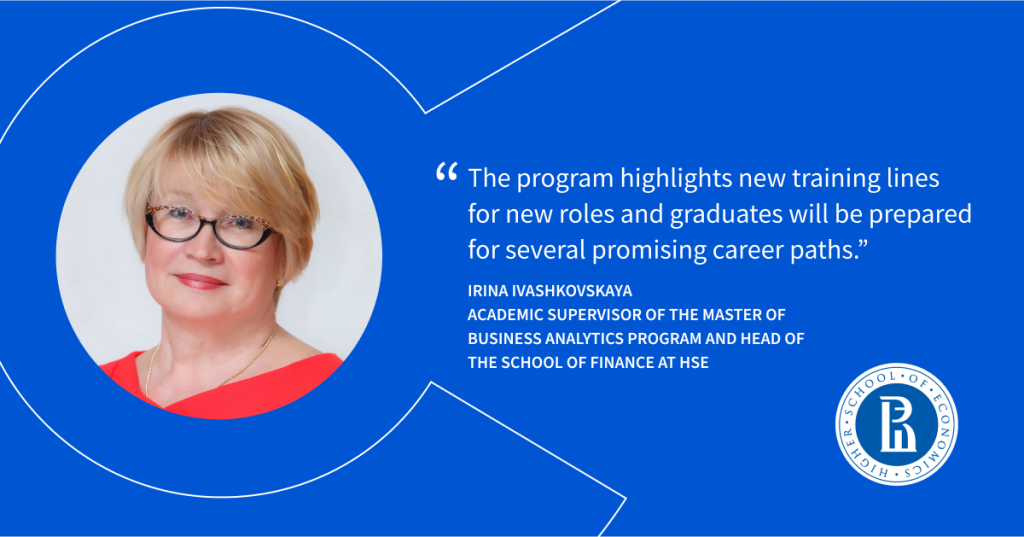
We spoke recently with Professor Irina Ivashkovskaya, Head of the School of Finance at HSE and Academic Supervisor of the new Master of Business Analytics program. Over the course of our discussion, she offered her insights into the program’s focus, the new career opportunities she sees emerging in the fields of finance and business analytics, and the value of innovative new learning tools like Virtual Labs.
Professor Ivashkovskaya, thank you so much for taking the time to talk with us about this exciting new program. Let’s start with the basics; can you tell us a little bit about the focus of the program?
The Master of Business Analytics program is centered around developing new competencies for integrated thinking in analysis and decision-making, and connecting the measurement and evaluation of financial forms of capital (debt and equity) and non-financial capitals. Today, this kind of integration is becoming a core competence requirement for those who set out to join top management or boards of directors of companies, banks, or consultancy companies. It is no longer realistically possible to become successful in business and grow professionally without focusing on the integration of financial and multiple forms of non-financial capital. This entails the interests and benefits of not only investors and owners, but also non-financial stakeholders.
Given the program’s future-facing nature, what do you see as the points of connection between the “new” and the “old” in terms of how people should pursue career advancement?
Well, this master’s program is aimed at new groups of competencies in areas which, at first glance, actually do belong to traditional professional tracks, such as financial management, accounting, and reporting. The key difference is that the program highlights new training lines for new roles that correspond to new international practices. The result is that graduates will be prepared for several promising career paths.
Can you give us a specific example of one of these new career paths?
Let’s take financial management as an example. With financial management, the central challenge is to have a methodology for analysis that integrates financial and non-financial capital and aims to add value to the business, taking into account the interests of different stakeholder groups over the long term. In the near future, this will become the work of the Chief Value Officer (CVO)—a role that will ultimately replace the Chief Financial Officer (CFO). This professional trend will also require a new approach to budgeting and modeling in order to achieve sustainable company value in the long run.
You mentioned the transformation from CFO to CVO; are there other new roles you see emerging?
Yes, absolutely. Another new position that is taking shape is that of the ESG Director (Environmental, Social, and Governance). This is someone who can provide a new quality of management for the company’s different capitals to achieve specific environmental, social development, and board role targets.
If financial management is one of the main professional tracks where you’re seeing evolution and innovation, are there others?
Yes, I’d say a second area of change is related to accounting and reporting. Different forms of non-financial reporting are developing rapidly. It is not just a matter of adding more sections to a company’s current reporting. It’s about a new quality of reporting. Reporting needs to become holistic, integrating non-financial capitals, their risks, and their impact on financial results—both current and future.
A third area of change is innovation in risk management. New integrated risk management concepts and tools are being developed and modeling can now take into account risk factors hidden in non-financial capitals.
A final area where we see change is in compliance. Compliance is transforming from a static function of fixing right and wrong practices into a function of maximizing value for both investors and other stakeholders through best ethical business practices that meet ESG criteria. Compliance needs to focus not just on a company’s risks, but on long-term business value growth. It is a field that is increasingly connected to financial knowledge and skills.
We’ve talked at length about the changing landscape of finance and business analytics and the emerging professional tracks that students can pursue. Let’s switch our focus a bit and talk about the program itself. Specifically, can you tell us a little bit about Virtual Labs? What are they, and how do students benefit?
Virtual Labs are a new format that we created with international experts from Europe, the United States, and Asia. In live dialogues with students, these international experts can share their perspectives on emerging trends and provide insight into how they’re solving new business analytics challenges. We have also introduced project-based seminars in which international business experts representing the latest professional tracks in finance lead live virtual workshops. These experiences become tools that teams can use to organize their creative work on project topics within specializations.
It’s a great example of how an online learning platform can make new kinds of experiences possible.
Yes, the modern world is dictating new formats for delivering education. In an environment of uncertainty and multitasking, online education is becoming increasingly important. Fortunately, thanks to the “learn from anywhere with a flexible schedule” format and the well-established set of digital tools that Coursera offers, we’re able to provide students with innovative, world-class content via a platform that aligns with their lifestyles and goals. Just as the professional trends we’ve discussed represent the new mainstream for finance and business analytics, online is swiftly becoming an important tool for professional degree-level learning.
~
We’d like to thank Professor Irina Ivashkovskaya for sharing her perspectives and insights! Enrollment is now open for the Master of Business Analytics program from HSE University. HSE has long been one of the most prestigious universities in Russia, and in 2020, HSE earned the first place spot on Forbes’ Best Russian Universities list. Learn more today!
Online streaming services mean that it’s never been simpler to listen to music. Whether you’re at home, at work or on the go, all of your favourite songs are available at the click of a button. But it’s not just listening to music that has become easier than ever before. Thanks to Alison’s free online courses, learning an instrument has also never been more accessible.
You can use the same device you use to listen to your favourite bands – whether it’s your phone, tablet or laptop – to learn a new musical skill by trying out one of these great courses. We’ve got all musical topics covered, from the theory needed to be a great songwriter to hands-on practical courses taught by world class musicians. Whatever your musical taste, we know that you’ll love these musical offerings, which include the first courses from Alison’s new World Music Project!
Traditional Irish Guitar
The guitar is an incredibly diverse instrument that can showcase a wide variety of musical styles, from blues to jazz to an endless range of traditional musical idioms. Alison’s Traditional Irish Guitar | Beginner 1 course will introduce you to the vibrant world of Irish music by teaching you the basics of traditional guitar playing. The guitar is a well-established element of Irish musical culture, usually in an accompanying role. This course will open up countless opportunities for playing music by making you welcome in any “trad session” you come across!
Melody and Harmony
Ever wonder why some songs are just so catchy? What is the secret behind making a song that listeners simply can’t get out of their heads? While writing the perfect song isn’t an exact science, there’s a lot more objective knowledge on the subject than you might think. Alison’s Music Theory: Melody and Harmony course will provide you with the dos and the don’ts of songwriting by revealing the secrets behind creating a catchy melody.
Sean-nós Singing
Traditional Irish Sean-nós singing is an ancient and respected musical tradition, with a heritage going back hundreds of years. Taught by award-winning sean-nós singer Nell Ní Chróinín, the Traditional Irish Sean-nós Singing | Beginner 1 course will initiate you into the rich culture of traditional unaccompanied singing. Nell’s expert advise will guide you from being a complete beginner to being able to perform a sean-nós song with confidence.
Musical Theory
With an emphasis on classical music, the Diploma in Music Theory covers a broad range of topics, including instruments, rhythm, melody, harmony, and musical form. It also looks at standard techniques of classical performance and the ways in which classical music influences other genres of music. This is a great course to take in conjunction with a traditional Irish course as it will allow you to see how different musical genres interact and play off each other.
Traditional Irish Fiddle
Alison’s Traditional Irish Fiddle | Beginner 1 is taught by Doireann Ní Ghlacáin, an expert not just in the instrument itself but in the history and culture of Irish traditional music. Her courses are full of her love and passion for this unique genre of music, which she has been dedicated to since she was a child. By taking this course in traditional fiddle playing you won’t just be gaining a new skill, you’ll be learning a fascinating cultural history.
The amount of data that are generated every day has been growing exponentially for years. On average, each of us creates at least 1.7 megabytes of data every second. A lot of this data is collected by businesses, playing a central role in their decision-making and strategic planning.
But, without the right tools, data goes unused and just takes up space. That’s where data analytics tools come in. They allow Data Scientists and Data Analysts to collect and analyze data to turn it into useful insights for a business.
There are a wide variety of data analytics tools available. Some are programming languages, which are the favorites of Data Scientists because they’re easy to use and good at parsing data. Some are libraries for these programming languages that make data analytics simpler. And some are self-contained applications that either run on the desktop or in a web browser.
Before selecting a data analytics tool, there are several questions to consider, such as:
What kind of data are you analyzing? Is it simple numerical data stored in spreadsheets and databases or open-ended qualitative data like social media conversations that will need analysis by machine learning models to create insights?
How much data are you analyzing? If the data you need to analyze is limited, just about any tool will do the job. But, if the dataset fits in the big data category, you’ll have to use specific tools for your analysis.
How much technical knowledge is needed to perform the analysis? If you know a programming language, like Python, R, Java, or SQL (or are willing to learn one), then you have many options when it comes to choosing a data analytics tool. And if you’re non-technical or not interested in learning a language, you also have several options as there are no-code tools available for you to use.
What format do you want the results in? Do you want to see your results in a table format or would you rather generate graphics to display them?
Once you’ve answered these questions, you’re ready to start learning about all the different analytics tools and eventually picking the one that’s best for your needs. Here are 15 popular data analytics tools for you to consider.
1. Python
Python is one of the most widely used programming languages for data analytics. It’s an interpreted, general-purpose, high-level language that can be used for procedural, functional, and object-oriented programming.
This flexibility is one reason why Python is popular with many types of programmers. Plus, its simple syntax that’s almost like a natural language makes it a favorite language for beginning developers.
But, what makes Python a great language for data analytics is all the third-party libraries you can add to your project for free. Many of these libraries, like Matplotlib, PyTorch, and Pandas, are designed for handling data, which means you have to write less code to perform data analysis.
To get started learning Python, check out our Learn Python course. Then, once you know the basics of the language, our Analyze Data with Python Skill Path will teach you the fundamentals of using Python as a data analytics tool.
2. Matplotlib
Matplotlib is a Python library that makes data visualization and graphical plotting easy. You can easily install it on any operating system that supports Python, including Mac, Windows, and Linux.
Once you have it installed, you can convert long lists of numbers into easy-to-understand pie charts, heat maps, histograms, and other types of visualizations that are ready to be used in reports or published online. Matplotlib can also generate a user interface for your graphics with a menu you can use to customize the graphic without writing extra code.
To learn both the basics of the Python programming language and how to use this powerful data visualization tool, check out our Visualize Data with Python course.
3. PyTorch
PyTorch is an open-source Python library used to build, train, and run deep machine learning models. It uses array-like tensors to encode the inputs, outputs, and parameters of models. A tensor is a container for data that can represent that data in any number of dimensions, making it a very flexible tool for data analytics.
Another advantage of PyTorch is it can run machine learning models using a computer GPU rather than the CPU. This means that a PyTorch machine learning model can provide you with insights 4-5 times faster than other data analytics tools that only use CPU processing.
4. pandas
pandas is another Python library, and it’s the Swiss Army knife of data manipulation. With pandas, you can turn unstructured data from multiple sources into an in-memory 2D object called a DataFrame.
Once you have your data in a DataFrame, you can filter, query, segment, and segregate it quickly. You can also merge and join two different DataFrames.
Jupyter Notebook is an open-source web application where you can run Python, R, and other programming languages in an interactive environment. Because it’s a web application, it enables interactive collaboration between users.
It’s called a “notebook” because it not only allows Data Analysts to store and execute code in the browser, but also adds explanatory text, images, and other supporting information.
Jupyter Notebooks serve as a computation record between collaborators, and the records that are created can be stored as JSON files. These files can then be used to keep track of every step of the process.
6. R
R, also known as R statistics, was designed specifically for machine learning, data visualization, data mining, and statistical analysis. It’s not just a simple programming language with the ability to write loops, conditionals, and recursive functions.
R is a suite of tools for manipulating data, making calculations, and generating graphics. It comes with powerful data handling and storage capabilities, as well as a flexible graphical toolset for generating charts and graphs that are ready to publish in reports.
You can’t go wrong if you choose R as your data analytics tool, especially since, it was built from the ground up to do just that. Our Learn R course will teach you the basics of the language. After that, you can take Analyze Data with R to delve deeper into data analytics.
7. SQL
SQL, which stands for Structured Query Language, is a programming language that was created to interact with relational databases. Because of this, and the fact that businesses store the majority of their data in databases, SQL is a core tool that Data Scientists and Data Analysts use to gather insights.
SQL is also a simple language to learn. The queries you write in it are almost like English sentences. And just about every other programming language has SQL libraries you can use to interact with databases, which makes the language really powerful for data analytics.
To get started with SQL, check out our Learn SQL course, and to learn how to use it as a data analytics tool, check out Analyze Data with SQL. For the ultimate data analytics course that combines both SQL and Python, look into our Data Analyst Career Path.
8. Java
While Python and R are both known as top tools for data analytics, when it comes to big data, Java is king. Many of the tools used for processing and analyzing massive datasets are written in Java, including Spark, Hadoop, Cassandra, Knime, Storm, Talend, and Elasticsearch.
Also, Java is an object-oriented programming language that’s been around for over 30 years. One of its primary benefits is its portability, which means the Java code you write for one operating system can run on any other platform that supports the Java Virtual Machine. Plus, as a general-purpose language, you can develop software that integrates data analysis with other features of the language.
To learn more about Java, check out our Learn Java course.
9. Apache Spark
If you’ll be working with big data, Apache Spark could be the best option for you. It’s an open-source data processing and analytics engine that can handle petabytes (1,000 terabytes) of data. Spark’s ability to quickly process large amounts of data is one of the main reasons it’s become of the most popular big data analytics tools.
Spark is also used in continuous machine learning applications where it can process data with almost real-time speed. Plus, it’s used as a general-purpose distributed processing engine where it can extract and transform data in SQL batch jobs. One of Spark’s claims to fame is that it can process data faster than Hadoop’s MapReduce, which held the title for fastest data processing for years.
10. JavaScript
Just a few years ago, you probably wouldn’t find JavaScript in a list of top data analytics tools. Back then, it was used mainly for creating dynamic effects on web pages. But JavaScript has come a long way.
Since JavaScript is the language of the web, it runs everywhere, and its applications can be accessed by anyone with a web browser or a mobile phone. Javascript enables users to explore datasets and visualizations, do live analyses, and manipulate machine learning models with just a few clicks. Data analytics tools written in JavaScript allow just about anyone to perform data analysis.
D3.js is an open-source JavaScript library for creating custom visualizations in a web browser. Along with JavaScript, it uses HTML, Scalable Vector Graphics, and CSS, which makes it easy for Web Developers to perform data analytics without learning a new language.
D3 lets developers bind data to HTML documents using the Document Object Model (DOM), and then transform the document based on the data it uses. D3 also supports interaction, animation, annotation, and quantitative analysis. While the technology D3 uses is easy to learn, it comes with over 30 modules and 1,000 visualization methods, which may take time to master.
Our Learn D3 course will teach you the basics and start you on the path to becoming a data analytics and visualization expert.
12. MATLAB
MATLAB uses a high-level programming language for mathematical modeling, numerical computing, and data visualization. Its name is an abbreviation for “matrix laboratory” because it’s a matrix-based language. Mathematical matrices are data structures that can solve many technical computing problems more efficiently than other scalar-based programming languages.
You can use MATLAB for a variety of different tasks, like plotting data, developing algorithms, creating machine learning models, interacting with programs written in different languages, and analyzing datasets. Because of its advanced mathematical features, there are many technical roles that use MATLAB, including Software Engineers and Data Analysts.
13. TensorFlow
TensorFlow is an open-source machine learning and data analytics framework created by the Google Brain team. It’s used for numerical computation and implementing deep learning neural networks. The code for TensorFlow is written in C++, but it provides an API that can be accessed with many other programming languages, including Python, Go, Java, R, JavaScript, and more.
TensorFlow can train and run machine learning models for image recognition, handwritten digit classification, word embeddings, recurrent neural networks, language translation, natural language processing, and simulation. And instead of having to deal with the details of creating custom algorithms, you can build your own models with TensorFlow.
Tableau is a data analytics tool used to create quality data visualizations for business intelligence. It can extract data from many sources, including Microsoft Excel, PDF files, various types of databases, or even files stored on Amazon Web Services.
Once the data is extracted, it can be accessed by the Tableau Desktop application. Then, you can use it to generate dashboards and visualizations in the software. These dashboards can be shared with team members and the visualizations can be exported for reports. The data can also be published to Tableau Server where it can be accessed from any location, including mobile devices. And you can do all this without writing any code.
15. Excel
Excel has been used widely in the industry for years now. While it’s commonly used for simple tabular data, it’s actually a powerful data analytics tool.
Excel provides built-in pivot tables that allow you to summarize data in creative ways and produce valuable insights from diverse data. Also, Excel formulas can aggregate data into meaningful reports. The combination of pivot charts and slicers can be useful for visualizing data and creating interactive dashboards.
You can also enable and configure the powerful Data Analysis Toolpak that comes with Excel to develop complex statistical analysis. Excel may be ubiquitous, but there’s a lot of power hidden in the tool.
Conclusion
Data analytics tools will help you draw insights from data and discover trends and patterns that will help you make better decisions. There’s a wide variety of tools available, from complex programming languages to applications that require very little technical knowledge.
We offer several courses to get you started in data analytics. Here are courses on the programming languages mentioned in this article:
Once you know the basics, you can learn how to analyze data with these courses:
You can also use our Data Analyst Career Path to learn not only Python and SQL but also top data analysis tools including Pandas, NumPy, Matplotlib, Seaborn, and SciPy. You’ll even earn a certificate when you finish the course, which you can add to your resume.
Don’t you just want to crawl right inside this inviting teal and orange color palette? Teal and orange fall opposite of each other on the color wheel which makes them the perfect color pair in any blog design. Teal blue recharges the spirit, alleviates stress, and is always a showstopper in blog design. Orange radiates happiness and warmth and is psychologically known to help us look on the bright side of life.
Orange Teal Color Palette
Below I have created for you a simple mood board featuring today’s color combination. It is in perfect Pinterest format, so feel free to pin it for later.
See our collection of other gorgeous color palettes by visiting our color palette section.
What do you think about our orange & teal color palette? Do you like this combination? Pairing shades of orange and teal in blog design will create an inviting and relaxing design your visitors won’t want to leave. You can’t go wrong with this bold color duo.
We would love to hear your thoughts, so make sure to share them in the comments below.
Lastly, learn about the power of color in blog design in our blog post to see how important colors are in all the projects you create.
If you like this color palette, make sure to check this bright template which can be found in our Blogger Templates shop.
There is simply no shortage of blog design possibilities when it comes to bringing this pretty color palette to life.