fbpx
Home Blog Page 1257

Summer Reading Contest Winner, Week 2: On ‘Vincent Lionti, Violist and Youth Orchestra Conductor, Dies at 60’

0
Summer Reading Contest Winner, Week 2: On ‘Vincent Lionti, Violist and Youth Orchestra Conductor, Dies at 60’

Zachary Hommel, 17, from Cornwall Central High School in New Windsor, N.Y. chose the obituary, “Vincent Lionti, Violist and Youth Orchestra Conductor, Dies at 60” from a series about those who have died from the coronavirus pandemic, and wrote:

It was an evening in early March, following the end of our Youth Symphony rehearsal. I went to Mr. Lionti, my conductor, and shared with him some exciting news about a summer music program. With a proud handshake, he said, “You’re well on your way!”

Then, COVID-19 happened.

Those were some of the last words he said to me, and I never completely understood what he meant until I read about him. According to the article, Mr. Lionti had degrees from Juilliard, gained recognition from Isaac Stern, was a substitute for the New York Phil, and eventually joined the Met Orchestra. I’m ashamed to say I had to read his obituary to find all of that out. To me, he was just an enthusiastic, lighthearted conductor. But, perhaps that speaks to his greatest accomplishment of all—impacting others. With the Youth Symphony, he achieved “one of the most moving experiences in his musical career,” when he performed at the New York School for the Deaf.

Now, I realize how much of a compliment it was to say I was well on my way—I can only hope to do half of what he did.

But Mr. Lionti wasn’t just another statistic. To pass off each grim milestone as a number on paper is to separate our perception from reality. The perception is that each victim is a tally mark on a chart—no more, no less. The reality is that each victim had a background—a family, loving friends, a lasting legacy.

“121,000 dead” doesn’t do it justice.

In alphabetical order by the writer’s first name.

Ashton on “Summer Solstice 2020 and the Search for Life in the Galaxy

Chiara on “What We Look Like

Ethan Chiang on “What Will Greetings Look Like in a Post-Coronavirus World?

Francisco Choi on “How to Manage the Emotional Impact of Getting Laid Off

Joey Bejjani on “To Make Sense of Lebanon’s Protests, Follow the Garbage

Lauren on “How to Hug During a Pandemic

Lily on “Harry Potter Fans Reimagine Their World Without Its Creator

Maddy on “Aunt Jemima Is Gone. Can We Finally End All Racist Branding?

Samantha on “TikTok Teens and K-Pop Stans Say They Sank Trump Rally

Meet Jon Russell of saVRee

0
Meet Jon Russell of saVRee

How to Think Like an Engineer would be the course I’d like to do the most. I know that doesn’t sound like an exciting course to a lot of people, but there’s a lot of people out there and they learn only by repetition and I find that quite sad. In the past we had people like Isambard Kingdom Brunel or Robert Stevenson, they didn’t have huge teams of people to design bridges and ships and tunnels. They did it all themselves using back of the envelope equations. If you take Brunel, he designed the first iron-hulled, coal-fired ship to cross the Atlantic. If he can do all that with that knowledge that he had over a hundred years ago, basic engineering mathematical scientific principles, then surely we can teach people in a course how to do that today.

Meet Shaik Rahaman Aroof, our Telugu translator!

0
Meet Shaik Rahaman Aroof, our Telugu translator!


To help the world combat the Covid-19 pandemic, Alison launched the course Coronavirus – What you need to knowIn order to make sure that no one was excluded from accessing possibly life-saving information, Alison committed to translating the course into as many languages as possible. To achieve this ambitious goal, Alison reached out to its community of Learners, seeking volunteers willing to use their language skills to help translate the course and spread important information on coronavirus. Shaik Rahaman Aroof translated the course into Telugu and played his part in spreading free learning that has helped save lives.


Shaik, tell us a bit about yourself and your background.

My name is Shaik Rahaman Aroof. I am 28 years old and I live in Sullurpeta, India. I graduated with a degree in Electronics and Communications and I was offered a fleet analyst position for a ship management company that I had interned with. I have five years experience as an analyst and I am currently working as an IT engineer.

How did you learn that Alison was looking for translators for its coronavirus course?

I am very interested in learning new skills. When I was searching for online courses to improve my skills, my first choice was to take Alison’s easy to understand courses. They were the best courses on offer. When the pandemic started, I was very enthusiastic to gain knowledge about  it. While visiting Alison to complete a course, I noticed Alison offered a coronavirus course. I took this course to gain knowledge. After completing the course, I got an email saying that Alison was looking for volunteers to translate the course into various languages. I enrolled in order to make my contribution by translating.

What was your experience of Alison before volunteering to translate? Had you studied with Alison before?

Yes, I regularly take courses on Alison to upgrade my skills as I believe it’s the best platform for learning new skills.

Why did you offer to translate our coronavirus course?

I wanted a way to contribute to raising public awareness about this virus so I decided to translate the coronavirus course.

Why is it important that everyone has access to important information on coronavirus?

Everybody needs to be aware of this coronavirus in order to protect themselves. By gaining knowledge, people can learn how to protect themselves.


Tell us a little about your method when translating.

Most of the work was done manually. I made a tracker list so that I could make sure to cover every word while translating.

Why is free learning so important and why is it important to translate it into many languages?

Free learning offers everyone the first step towards success. Translating allows everybody to be able to share their knowledge.

Have you been learning through Alison during the pandemic? How has the lockdown been for you?

Yes, during this pandemic period I’m learning a new course with Alison. I am very eager to learn because this platform offers the best courses. Lockdown is a new experience and my daily lifestyle as changed. During the lockdown, I was pleasantly surprised to see how little we need to go on reasonably comfortably with our daily lives. 

What would you say to people who might be interested in translating for Alison?

I would invite them to do this type of work because it allows them to take on additional responsibilities within their societies.

If you’d like to play your part in overcoming the coronavirus pandemic by helping Alison give people access to the information necessary to keep themselves and their loved ones safe, please get in touch.

Behold Vermont, From Above

0
Behold Vermont, From Above

At the onset of the coronavirus pandemic, with travel restrictions in place worldwide, we launched a new series — The World Through a Lens — in which photojournalists help transport you, virtually, to some of our planet’s most beautiful and intriguing places. This week, Caleb Kenna shares a collection of drone photographs from Vermont.


Ever since I was young, I’ve loved gazing out the oval windows of airplanes and daydreaming about the abstract geometric patterns below.

Planes transport us from place to place, from country to country, from ground level to a bird’s-eye view. From the air, familiar landscapes take on conceptual qualities; we gain fresh perspectives by viewing hidden patterns.

I have worked as a freelance photographer for more than twenty years, traveling Vermont’s back roads, making portraits and capturing the state’s iconic landscapes.

Perspective — alongside light, color and timing — is a fundamental building block of photography, and I’m always looking for new ways to alter mine. Until a few years ago, I hired airplanes — and hoped for good weather and a helpful pilot — to climb skyward and create aerial pictures. Nowadays I use a drone.

There are trade-offs, of course. Looking down at the ground virtually — through a remote-controlled lens — isn’t a substitute, experientially, for actually taking to the skies. But it makes me less reliant on others and is much more environmentally friendly. (It’s also a lot more convenient; I can set up and launch my drone, a DJI Mavic 2 Pro, in about five minutes.)

Using a drone is a natural evolution for a still photographer. On dull and cloudy days, I can rise above the world and create elevated photographs full of vibrant colors. On days with great light, I can capture the long shadows cast in farm fields by lone trees.

I often look to Alfred Stieglitz’s “Equivalents” photographs as a source of inspiration. The series of abstract cloud studies shot in the 1920s and 30s transcends representations of the physical world and offers a world of abstraction and metaphor. I’m also influenced by the subsequent work of Minor White, a photographer who adopted and expanded on some of Stieglitz’s principles.

Most of my drone photographs were made around my home in Vermont’s Champlain Valley. (The area is known as the land of milk and honey because of its many farms and apiaries.) But sometimes I venture farther afield.

There is a soaring sense of excitement and discovery when ascending over familiar landscapes. And while the terrain where I fly is often well-known to me, I can rarely predict what kinds of compositions I’ll walk away with.

Nor do I always know what my subjects will be. Once, while driving through the Mettawee Valley, a bucolic setting dotted with small towns and dairy farms, I pulled off the road next to a corn field and launched my drone — only to spot a beautiful old barn with a slate roof, completely hidden from my view on the ground.

Finding ongoing sources of creative inspiration is a challenge for any artist, and aerial photography has helped broaden the scope of my work. More than anything, though, making drone photographs has become a daily practice for me — one that often feels like a form of visual meditation.


Caleb Kenna is a photographer and F.A.A.-certified drone pilot based in Middlebury, Vt. You can follow his work on Instagram and Facebook.

Two Steps for L&D to Drive Digital Transformation Post-COVID

0
Two Steps for L&D to Drive Digital Transformation Post-COVID

By Vinod Bakthavachalam, Senior Data Scientist and Adam Lewis, Skills Transformation Consultant

With the COVID-19 pandemic forcing companies to transition to remote work, employees are adapting to new realities. Trying to balance work with life responsibilities during shelter-in-place has led to a decline in productivity for many and uncertainty about the future. Anxiety has risen, days have become longer, and existing operations have been disrupted.

In such a difficult environment, how can organizations best support their employees while keeping an eye on oncoming digital transformation?

Data suggests that companies have a real opportunity to jump on the demand for learning opportunities today to accomplish both of these goals. Individuals are migrating to online learning faster than ever. At Coursera, we have seen a more than 15-fold increase in new enrollments platform-wide and across every industry. Companies can take advantage of this with a simple two-step process: first, they should focus on employee well-being by providing targeted personal development training; second, they should create skill development paths to give people the chance to drive their company’s digital agenda.

Currently, five of the top ten skills on the Coursera platform are focused on personal development skills like mindfulness, happiness, and positive psychology—compared to none before the pandemic hit—and enrollments in personal development have surged more than 1,500% since March. This demand provides a great opportunity for companies to increase engagement in their learning programs by first providing learners with access to these personal development courses. 

Customers like Capgemini and Novartis, which have made courses on well-being and the science behind COVID-19 accessible to all employees, have seen enrollments in their learning programs increase by 270% on average, compared to an average of 44% for other customers that have not added content around these topics. Many of these additional learners have not only engaged with timely support skills but have taken the opportunity to acquire key digital skills, as well.

After helping employees to build personal development skills, organizations should ensure their teams are prepared for digital transformation.

COVID has fast-tracked this transformation in many companies—supply chains have been disrupted and in-person stores have shut down, forcing companies to migrate to digital products and services. Employees need the skills to be able to drive this agenda. Two skills that were already essential for digital transformation have only become more important during the crisis.

Data science has been critical to almost all of the strategic decisions we’ve seen during COVID. From tracking the pandemic to coordinating the production of health supplies, big data and real-time analytics have been core to decision making. It is no longer viable to make decisions by manually combining various data sources in overworked Excel spreadsheets. Employees need the ability to manage large datasets and integrate insights into their decision-making quickly and on an ongoing basis.

Similarly, cloud computing has come to the fore during the pandemic. Companies like Netflix, Zoom, and Microsoft, are at the frontier of cloud technology and were able to seamlessly scale their services to support triple-digit growth in a matter of days, taking advantage of new business opportunities while maintaining the quality of existing services. If businesses want to remain agile in an increasingly volatile environment, cloud computing skills are a must to enable technological adaptability.

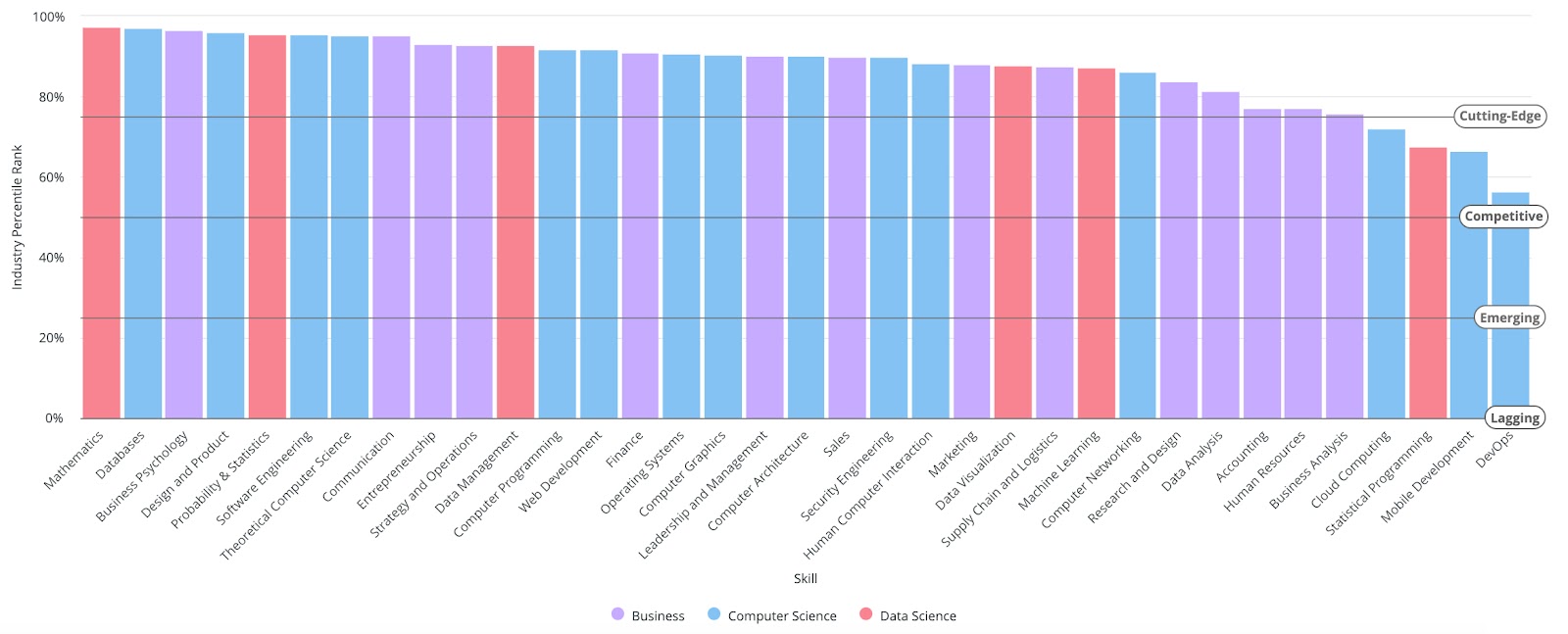
On Coursera, learner behavior is matching the external emphasis on cloud computing and data science. Between 2018 and 2019, monthly average enrollments in cloud computing grew by 265% and in data science by 50% (vs. 30% on average in other skills). Since the start of this year, monthly average enrollments in cloud computing have grown 179% and in data science by an additional 166%.

To develop these digital skills, organizations are increasingly adopting digital academies that contain curated upskilling opportunities and career paths for every employee to easily follow. One of Coursera’s financial services customers currently has thousands of employees going through a cloud academy to drive new and innovative cloud-based products. Similarly, a leading energy provider adopted a data science academy and has realized data-driven efficiencies of $3M across its energy network in less than two years.

These digital academies have three essential components: a core set of skills to learn, a set of skill development paths tailored to the various teams and functions in an organization, and an understanding of how these functions can work together to take advantage of new technology.

For example, building a data-first marketing team means having marketers that can work together with data scientists to make personalized product recommendations to customers. Obviously, data scientists need to understand the latest machine learning techniques, but marketers will also need to increase their data skills to maximize the value gained. Marketers will need to understand how to translate their business intuitions into defining the exact problems to solve, and how to turn their insights into data science features. In addition to upskilling data scientist talent, a well-designed academy will provide marketers the opportunity to learn the basics of predictive modeling, how to communicate with data scientists, and how to make data-driven decisions based on analysis.

When properly executed, academies can provide clarity on the development options available to employees, the value of the skills being developed, and the career paths they open up, allowing companies to reap the benefits at scale across the organization. 

COVID-19 has injected urgency into digitizing operations, upending the day-to-day, but it can also create a parallel opportunity to accelerate the development of digital skills. As people look for support and guidance, it is up to company leaders and the learning community to provide them.


To learn more about how to continue your L&D efforts amid the pandemic, register for our on-demand webinar, Build an L&D Action Plan for COVID-19 based on Insights from 50M Learners, hosted by Coursera’s Adam Lewis, Head of Skills Transformation, EMEA.


Eurika Thabile Mogane: our Zulu language translator

0
Eurika Thabile Mogane: our Zulu language translator

To help the world combat the Covid-19 pandemic, Alison launched the course Coronavirus – What you need to knowIn order to make sure that no one was excluded from accessing possibly life-saving information, Alison committed to translating the course into as many languages as possible. To achieve this ambitious goal, Alison reached out to its community of Learners, seeking volunteers willing to use their language skills to help translate the course and spread important information on coronavirus. Eurika Thabile Mogane translated the course into Zulu and played her part in spreading free learning that has helped save lives.


Eurika, tell us a bit about yourself and your background.

My name is Eurika and I’m from South Africa. I have a degree in Medical Science and I specialised in Neuroscience. As a medical scientist with a passion for neuroscience, I want to continue changing lives with the information that we as medical specialists have at our disposal. I enjoy doing research and supplying information and medical advise to many. My focus is on offering free consultations to those who are from destitute spaces. 

How did you learn that Alison was looking for translators for its coronavirus course?

I took the coronavirus course that Alison offered at the beginning of the year. Afterwards, I saw a notification outlining that Alison was looking for translators for the course. I was excited because that is something I already do locally. 

What was your experience of Alison before volunteering to translate? Had you studied with Alison before?

I have studied a number of courses through Alison which have helped in enhancing my passion for the medical industry. Before completing my qualification, I had to drop out from university in 2012 because of finances. However, when I found out about Alison, I realised that my passion could still be exercised. I enrolled and acquired certificates which added value to the volunteering work I was doing at various organisations, such as the Cancer Association of South Africa. 

Why did you offer to translate our coronavirus course?

I offered to translate because I believe in sharing information with our people. After completing the course, I noted how efficient and also very easy to follow it was. I knew that once translated, even those who are not from a medical background would be able to benefit from it. We believe in Ubuntu here in South Africa – that unity is built through offering help and guidance to others. I believe it is that nature, instilled in us from a young age, that encouraged me to volunteer. 

Why is it important that everyone has access to important information on coronavirus?

As the saying goes, “It is far better to be forewarned than forearmed!”. Information goes a long way, especially when it comes to health. If people know what they need to do to reduce the risks of infection, the better it will be for us all. Africa already has a very stretched health system, the least we can do is come together through quality information and ensure that everyone is safe from the get go – so that we are not faced with a similar situation as with ebola. 


Tell us a little about your method when translating.

My method of translating was to review and edit the translated content on the Alison draft. Then I did my own separate translation directly from English and compared this translation to the Alison one to see what differences there were. This way I could ensure that I used the right idioms and phrases that placed emphasis on the key words.

Why is free learning so important and why is it important to translate it into many languages?

Free learning is very important, because an informed nation becomes a compassionate nation. Free education also gives the learner a sense of satisfaction and confidence. I referred the coronavirus course to others and the fact that they received a certificate in the end made it more worthwhile for them. People want the honor of having a certificate and knowing that they have completed something that can help save lives. Translating information to many languages ensures that we reach even unreachable and destitute places. It is an honor to know that, through translations, we have covered more ground and offered quality content to those who need it the most. In English, we see daily posts, adverts, etc. But for those who aren’t fluent in English, that data is lost. 

Have you been learning through Alison during the pandemic? How has the lockdown been for you?

I am currently enrolled in a course in nutrition. The lockdown has been good and also a wake up call. Because of my profession, I have had to be readily available at all times to offer community health support wherever needs arise. 

What would you say to people who might be interested in translating for Alison?

I would quote my life motto which is “If the pen can convey the intended message, then don’t let the ink run out!”. If your time and efforts in translating the content can bring about change that is needed, then please commit to it. There is no honour in keeping information that could have saved many in your community to yourself. Through this platform, you will be able to add value to lives you may never meet and live with this fulfillment for the rest of your life. What will you say to future generations when they ask, “What role did you play during the 2020 pandemic?”.

If you’d like to play your part in overcoming the coronavirus pandemic by helping Alison give people access to the information necessary to keep themselves and their loved ones safe, please get in touch.

How to stay motivated and not give up when learning to code

0
How to stay motivated and not give up when learning to code

When it comes to learning to code, one of the hardest parts can be finding the motivation to keep going when you feel stuck or frustrated. In fact, motivation is one of the most popular discussion topics in the Codecademy Facebook Community, as well as in the Codecademy forums.

One community member, Brendan P., says, “I am having the hardest time staying motivated to learn. I feel like I am just failing left and right,” in a thread called How do you stay motivated?

In our Facebook community, Terrel J. says, “I have hit a roadblock and it’s mentally draining trying to learn how to code.”

7 tips for staying motivated while learning to code

If you’re having a hard time staying motivated while learning to code, know that you’re aren’t alone in feeling this way — we’ve all been there. And many of our community members have shared helpful tips based on their own experiences with finding motivation when they’re stuck or in a slump. We’ve compiled these tips into a list of seven ways to stay motivated and not give up.

Here’s to finding your motivation!

Tip #1: Take the time to practice

Many learners get stuck when they move too quickly through lessons without taking the time to practice. Spending time with a new concept is important so you can retain what you’ve learned and apply it as you move on to more advanced concepts.

In the “How do you stay motivated?” thread mentioned above, community member Jeff S. stresses the importance of practice. “Sometimes it takes a lot of practice with these more difficult concepts until you gain fluency.”

He equates learning to code to learning a language like Spanish or Italian. “It can be frustrating getting over the basics when all you want to do is communicate. That can be even more frustrating when you are surrounded by people who seem to speak Italian fluently.” But the more you speak, the more fluent you’ll become. The same holds true for learning to code — the more you practice, the more fluent you’ll become.

On a separate thread about learning to code, Shaylin also recommends practice. “I find it helpful to practice what you learn on your own. Make a small project that focuses on a single concept.”

Tip #2: Look back at all you’ve accomplished

When you get stuck, it can be easy to fixate on all that you still have to learn and to lose sight of everything you’ve already learned. The next time you’re feeling overwhelmed and down on yourself, take some time to reflect on how far you’ve come.

In his thread on motivation, Brendan P. says, “I guess I need to take a step back and look at what I’ve done. In 6 months my GitHub is full of programs that I wrote in half a dozen languages. I should use it as an example of my progress instead of how far I have left to go.”

Tip #3: Remind yourself why you started learning to code

A recent thread in our Facebook community dove into how to stay motivated during quarantine. Sunjay A. shared the following advice:

“In those days you feel without motivation, take a deep breath and find ways to rest. Next… try to remember the goal you had when you first began this journey. What motivated you then? If you had no specific goal, set one today and work toward that.”

Remembering why you started can be a nice way to rediscover what inspired you in the first place, reinvigorate your desire to learn, and help you find the motivation to keep going.

Paulina D. shares similar advice in the Codecademy forum. “Perhaps asking yourself what the skills you’re learning could help you achieve in the future would be a nice start. What would you like to do that would require those skills?”

Tip #4: Embrace the learning process

Community member Regina G. shared a blog post about her experience with reprogramming her mindset to learn to code in our Facebook group. “In the past, I used to get really upset at myself if I wasn’t good at something right away.”

Programming isn’t easy — and learning to program will likely require you to think in ways you’ve never thought before. It may take you some time to be okay with the fact that coding isn’t second nature and that you’ll make mistakes along the way.

If you’re feeling stuck or frustrated, understand that it’s all part of the learning process. Embrace it! Through getting unstuck, you’ll not only internalize the skills you’re learning, but you may find personal growth as well.

Tip #5: Do a small amount each day

In a thread in our Facebook community, Crystal H. says, “It might help to set a timer for a short amount of time. Code for 10 – 15 minutes a day.”

Dan J. shares similar advice. “Don’t feel like you need to do loads every day. Just set yourself a small achievable goal. It might be half an hour, it might be 15 minutes. You may even find when you start you get on a roll and want to go longer. Some days I just use the Codecademy Go app to practice and then end up turning my PC on to continue a lesson because I get into it.”

Tip #6: Take a break

Sometimes when you’re feeling stuck you just need to take a little bit of a break to clear your head.

In response to a question in our Facebook group about what to do when you’ve hit a roadblock, Hamza Z. says, “That’s when you need to take a break and do other things that you like.” Gavin A. adds, “It can get that way sometimes. That’s the moment you need to go do something else and take your mind off it. You’ll come back reinvigorated and with a solution mindset.”

Daniel Z. shares similar advice. “We’ve all been through this situation. No worries. Just take a break — a walk, some good music, and come back. Guarantee it will seem easier than you thought.”

Tip #7: Shift your focus

An alternative to taking a break to go for a walk, listen to music, or focus on a different activity you enjoy, is taking a break to focus on a different coding task.

Adam L. explains how he overcomes loss of motivation in a thread in our Facebook community:

“What helps me gain motivation is that I lower the bar for myself and I try to build something easy to start with that I will enjoy. And then gradually, I try to improve. I get so much joy out of just learning the smallest function day by day. I shift focus from getting somewhere and instead lower the bar and build a project that makes me happy, no matter how small it may seem.”

If you’re feeling stuck, we hope these tips will help you find the motivation to continue on your learning journey. How do you stay motivated when learning to code? Let us know in the comments!

The best paying jobs in the Philippines

0
The best paying jobs in the Philippines

The best-paying jobs in the Philippines cover a broad range of industries. Although you’ll find many that are in the finance, healthcare, and IT sectors, there are plenty of other high-paying roles in other areas. We take a look at a range of positions that provide a high salary. We also outline some courses and learning areas that might help for each role. 

Of course, there are plenty of other factors aside from money to consider when you’re choosing a career. As well as how much a job pays, you should also consider whether it’s a good fit for you. Work environment, work-life balance, and your own passions and interests should all play a part. 

Aircraft pilot

What is an aircraft pilot?

Aircraft pilots are responsible for the operation, navigation, and overall safety of aircraft. It’s about more than just sitting at the controls – they take information about the route, weather, and passengers/cargo to make a flight plan. They also have to brief the cabin crew and communicate with air traffic control during the flight. It’s a role with a lot of responsibility, and as such is one of the best-paying jobs in the Philippines.

How do you become an aircraft pilot?

To become a pilot, you’ll need to work towards a license and certificate from the Civil Aviation Authority of the Philippines (CAAP). You’ll also have to pass the Aviation Training Organization (ATO) requirements. To reach this level, you’ll first have to become a licensed private pilot. 

How much do aircraft pilots make?

The average salary for an airline pilot in the Philippines is ₱2,365,574.

Join our ABC of Flight Mechanics: How Do Planes Fly? Course

Financial Broker

What is a financial broker?

A finance broker is a professional that arranges transactions between buyers and sellers. They act as a go-between for the two parties, facilitating large-scale financial transactions. Financial brokers often work with stocks, but there are other fields too. Mortgages, insurance, and currency are also the remit of brokers. 

How do you become a financial broker? 

To get into a career as a financial broker, you’ll need to understand how markets work, as well as how to navigate them. A good place to start is with a degree in a subject related to finance. From there, an internship or experience with a firm is the next step. Although it can be a long journey to the top, it’s one of the best-paying jobs in the Philippines. 

How much do financial brokers make? 

The average salary for a stockbroker in the Philippines is ₱350,000. 

Find a Finance and Accounting Course

Civil Engineer 

What is a civil engineer?

Civil engineering is one of the six main branches of engineering. Professionals in this field deal with the design, construction, and maintenance of infrastructure projects and systems. Whether for the public or private sector, civil engineers focus on projects such as roads, tunnels, bridges, and other similar projects.  

How do you become a civil engineer? 

If you want to become a licenced civil engineer in the Philippines, you’ll first need to pass the five-year Bachelor of Science in Civil Engineering. From there, you’ll have to pass the Civil Engineering Licensure Examination, which you can take after some on-the-job training. 

How much do civil engineers make? 

The average salary for a civil engineer in the Philippines is ₱256,815.

Find an Engineering Course

Actuary

What is an actuary? 

Actuaries work in finance to evaluate, manage, and give advice on risk. Using their knowledge of businesses and financial markets, they use statistics and probability to provide financial advice and predict future trends. Actuaries work in various areas of finance, including banking, investment, and pensions. It’s one of the best-paying jobs in the Philippines thanks to the demand for skilled professionals. 

How do you become an actuary? 

You’ll want to start with a bachelor’s degree in either accountancy or mathematics. A relevant postgraduate qualification may also be beneficial. You’ll then need to pass qualifications to become a member of the Actuarial Society of the Philippines.  

How much do actuaries make?

The average salary for an actuary in the Philippines is ₱364,503. 

Join our Survival Statistics: Secrets for Demystifying Numbers Course

Computer Programmer

What is a computer programmer? 

A computer programmer (also known as a software developer or software engineer) develops new technologies using their knowledge of maths, science and computers. They write code and design programs, as well as using their knowledge to find solutions to complex problems. It’s one of the best-paying jobs in the Philippines as well as other countries around the world. 

How do you become a computer programmer? 

If you want to work as a computer programmer, you’ll first need a detailed and extensive knowledge of a range of IT systems. As such, you’ll need a degree in an IT-related field, such as computer science. Once you have your qualifications, you’ll need to build up as much experience as possible to find a role in this industry. 

How much do computer programmers make? 

The average salary for a computer programmer in the Philippines is ₱200,219. 

Find a Programming Course

Accountant

What is an accountant? 

Accountants are professionals who specialise in keeping and understanding finances. Both individuals and organisations employ these experts to help them get a deeper insight into their financial records. Accountants also take on a variety of tasks related to the management of money. Often, they’ll specialise in one particular area, such as tax or auditing. 

How do you become an accountant?

To become an accountant in the Philippines, you’ll need to first complete a five-year Bachelor of Science in Accountancy. After your studies, you’ll need to take the Certified Public Accountant’s Licensure Examination. Given how valuable this position is and how long it takes to qualify, this is one of the best-paying jobs in the Philippines. 

How much do accountants make? 

The average salary for an accountant in the Philippines is ₱300,666.

Join our Introduction to Financial Accounting Course

Statistician 

What is a statistician? 

Statisticians are data experts. They focus their efforts on collecting, analysing and interpreting quantitative information. Unlike actuaries who work mainly in finance, statisticians work across all kinds of industries. Education, health, sports, and other sectors can all make use of these professionals. They specialise in collecting data and making decisions based on their findings. 

How do you become a statistician? 

Due to the depth of knowledge needed, you’ll have to start with an undergraduate degree in a subject related to statistics or mathematics. From there, a master’s degree in a field of specialisation can help when looking for a suitable job role. 

How much do statisticians make?

The average salary for a statistician in the Philippines is ₱265,248. 

Join our Statistical Shape Modelling Course

System analyst

What is a system analyst? 

System analysts are an essential part of modern businesses. They use their computer skills to design, modify, and adapt IT systems. They help organisations become more efficient and productive by analysing existing systems and making improvements. The role of system analyst interacts with just about every area of a business. 

How do you become a system analyst? 

Most entry-level system analyst roles require a degree in an IT-related field. In addition, you’ll need a detailed understanding of business structures and the technology they use. Often, employers require experience working in IT and business roles.

How much do system analysts make? 

The average salary for a systems analyst in the Philippines is ₱481,392. 

Join our Business Problems and Software Solutions Course

Category Job Market, FutureLearn International

The best paying jobs in Singapore

0
The best paying jobs in Singapore

If you’re looking to learn about some of the best-paying jobs in Singapore, you’ve come to the right place. We’ve picked out some of the roles that pay the most at the moment. In this post, we look at the details of what each job entails, how much they make on average, and how you can work towards a career in these industries. 

Whether you’re looking to change careers or are just starting out, we’ve included some links to courses that can help you get started. They can help you build your knowledge and get a feel for whether the field is right for you. Remember – money isn’t everything. It’s also vital that your job gives you satisfaction and a good work-life balance. 

Anaesthesiologists

What is an anesthesiologist?

An anesthesiologist is a doctor who specialises in anaesthetics (putting patients ‘to sleep’ before medical procedures). They are responsible for patient care before operations, as well as developing anaesthetic plans and delivering anaesthetics. Their role is to prevent the pain and distress a patient would otherwise experience during surgery. 

How do you become an anesthesiologist?

As one of the best-paying jobs in Singapore, it should come as no surprise that training to become an anesthesiologist takes a long time. You’ll need to start with at least five years’ of study at medical school, usually followed by a one-year internship and then a residency of several years. 

How much do anesthesiologists make?

The average salary for an anesthesiologist in Singapore is S$81,951.

Find Healthcare Courses


Broker

What is a broker?

A broker is a professional (or entire firm) who arranges transactions. They act as a go-between for the buyer and a seller. In Singapore, one of the world’s biggest financial centres, brokers facilitate the trade of vast sums of money. There are many kinds of brokers, whether it’s for stocks, insurance, mortgages, loans or foreign currency. 

How do you become a broker? 

Two of the key things needed to become a broker are industry knowledge and experience. You might want to start with a degree in a related field and then aim for a training scheme with a financial firm. It’s often a long journey, but it can result in one of the best-paying jobs in Singapore. 

How much do brokers make? 

The average salary for a broker in Singapore is S$110,000.

Find Finance & Accounting Courses

HR Manager

What is an HR manager?

Human resources are the heart of any business, and HR managers oversee the smooth running of many related aspects. They must implement HR procedures, plan and manage budgets, and develop hiring strategies. They must communicate with all areas of a business, ensuring needs are being met across the organisation. 

How do you become an HR manager? 

There are many skills that you need to become an HR manager. You’ll need to demonstrate leadership, management, and administration. However, experience is perhaps the biggest asset when it comes to a career in HR management. You’ll want to work your way through the ranks in HR, showing your communication and people skills. 

How much do HR managers make? 

The average salary for an HR manager in Singapore is S$71,187. 

Join our Introduction to International Human Resources Management Course 

Fund Manager

What is a fund manager? 

A fund manager (also known as an investment manager) is a finance professional responsible for developing and implementing investment strategies for funds. They also manage the trading activities of financial portfolios. They use their knowledge of the markets to make informed decisions about where to invest money. It’s a job with a lot of responsibility, which makes it one of the best-paying jobs in Singapore. 

How do you become a fund manager? 

Fund managers often start out as financial analysts specialising in stocks and securities. You’ll generally need at least a bachelor’s degree in a topic such as finance, economics, or statistics. In many instances, companies also require you to have an MBA. 

How much do fund managers make?

The average salary for an investment manager in Singapore is S$91,765. 

Join our Finance Fundamentals: Investment Theory and Practice Course

Lawyer

What is a lawyer? 

In Singapore, the term ‘lawyer’ is used to describe a legal professional who can act as both a solicitor and an advocate. A solicitor is someone who can advise clients on legal matters. An advocate is someone who prepares cases and represents their clients in court. It’s a role where professionals must protect the legal rights of their clients while upholding the law, in an active or advisory role. 

How do you become a lawyer? 

To get one of these best-paying jobs in Singapore, you’ll need to start by completing a Bachelor of Law program from a university. Alternatively, a Juris Doctor postgraduate program will suffice. After that, you’ll have to gain experience and pass a variety of Bar exams to become fully qualified.   

How much do lawyers make? 

The average salary for a lawyer in Singapore is S$72,000. 

Find a Law Course

Project Manager

What is a project manager? 

You’ll find project managers in just about every industry. They’re the professionals responsible for things like planning, risk assessment, managing resources, and other factors of projects. Ultimately, they’re responsible for a smooth delivery of whatever a company is working on. In fields such as engineering and IT, the role of project manager is one of the best-paying jobs in Singapore. 

How do you become a project manager?

Project managers need a wide variety of skills, and there are several routes you can take to becoming one. Firstly, you’ll need a degree in a field such as business or project management. You’ll also want to consider a qualification related to the industry you hope to enter. 

How much do project managers make? 

The average salary for an IT project manager in Singapore is S$84,948. 

Find a Project Management Course

UX / UI Lead

What is a UX / UI Lead? 

UX (user experience) and UI (user interface) are fields of design that are closely linked. Both relate to how products are designed and developed with the end-user in mind. They are fields most commonly found in digital industries and focus on creating products that are easy-to-use and intuitive. UX/UI leads are those who head up teams and make decisions in these areas. 

How do you become a UX / UI Lead? 

Whether you specialise in UX or UI, you’ll need a range of digital skills to work in this field. A bachelor’s degree is a good place to start, with relevant subjects including computer science, digital design, and media technology. You’ll then need some hands-on experience working in UX and UI, as well as a portfolio of work. 

How much do UX / UI Leads make?

The average salary for a UX manager in Singapore is S$73,200. 

Join our Introduction to UX and Accessible Design Course

Risk analyst

What is a risk analyst? 

Financial risk analysts specialise in identifying and analysing risks to areas of finance such as assets, earning capacity, and organisations. Not only do they examine current risks, but they also predict future changes and trends, as well as forecasting costs. Often, risk analysts specialise in one particular area of finance. 

How do you become a risk analyst? 

You’ll need a strong set of academic credentials to get a job in risk analysis. As one of the best-paying jobs in Singapore, you’ll usually need a master’s degree in a finance-related subject. Internships and experience are also essential, although you could start off in an adjacent role and move across. 

How much do risk analysts make? 

The average salary for a risk analyst in Singapore is S$53,310. 

Join our Risk Management in the Global Economy Course

Category Job Market, FutureLearn Singapore

Learn Four Techniques to Help You Prepare for the Unexpected

0
Learn Four Techniques to Help You Prepare for the Unexpected

By Jane McGonigal, PhD, Director of Game Research and Development at the Institute for the Future and lead instructor of the Futures Thinking Specialization

If the year 2020 has shown us anything so far, it’s that we all need to get better at expecting the unexpected. 

The COVID-19 pandemic has changed the way we work, learn, and live in ways that seemed unthinkable and unimaginable until they actually happened. All of these changes happened faster, and at a more global scale, than nearly anyone thought possible. 

But what if you’d started imagining how you would adapt to a pandemic earlier? What if you’d had three months, six months, or even a year to prepare for the reality we’re all living through now? 

What would you have done with that extra time to prepare for the future? Whom could you have helped sooner?

These aren’t hypothetical questions. The first 10,000 students in the Institute for the Future’s new Futures Thinking Specialization (a collection of skills-building courses I teach on Coursera) were given exactly this kind of “get prepared early” opportunity. Last summer, months before anyone had diagnosed the first case of the new coronavirus, the Institute for the Future launched the course Simulation Skills: This is Your Brain on the Future. In Simulation Skills, students learn why the brain has a hard time accurately predicting the future, and they practice habits that increase their ability to anticipate and prepare for surprising events. As part of the course, students tackled this assignment: 

“Imagine that we are facing a global respiratory pandemic. What changes would you make in your daily behavior? And how could you use your unique skills and talents to help others?” 

At the time we launched Simulation Skills, no one knew we would be living this possible “future” so soon. Pandemics are just one of the urgent futures—alongside climate change, mass migration, automation of work, and deepfake technologies – that the Institute for the Future has been researching for years and helping learners prepare for. It just so happens this one particular future actually happened almost exactly as we forecasted it would. 

This is why, months before the global lockdowns and stay-at-home orders, Coursera students were pre-thinking how their lives would change during a pandemic. By starting to practice futures thinking, they were preparing to take action. So when the reality of COVID-19 caught up to our “possible future,” our students were faster to adapt and less prone to getting stuck in old ways of doing things. Since early January, I’ve been receiving messages from Coursera students who participated in the pandemic simulation. They’ve said things like, “I’m not freaking out, because I already worked through the panic and anxiety when we imagined it in the class,” and “I’m starting to prepare for this now, I remember what it was like when we simulated it.” 

The basic skills of futures thinking can help you prepare for whatever comes after COVID-19. It’s not just this pandemic—it’s all the rapid technological, social and climate changes that are coming faster than we realize. 

Here are four simple futures thinking techniques anyone can practice. I teach all of these skills, and more, in the Simulation Skills course that is part of the five-course Futures Thinking Specialization available on Coursera.

1. Look for the decisive moments in the past that changed the course of the future. How would your reality be different if you had made a different choice in the past? This is called counterfactual thinking. You can learn about three counterfactual thinking techniques in this video: The Future is Dark, and That’s a Good Thing.

2. Practice hard empathy. It’s a cognitive skill that allows us to imagine what it would feel like to experience something we have no firsthand experience with. Here’s how it works: Find a news story about what is happening with COVID-19, protests, or climate change, somewhere else in the world that is further along the curve than your region. What if YOU were experiencing that reality, where you live today? Try to imagine it as vividly as possible. I explain more about this technique in this quick article: How to Think Like a Futurist.

3. Get comfortable with the idea that anything can be different in the future—and by the future, we mean next month, next week, or even tomorrow. I created a game that will challenge your assumptions about what can and can’t be different, and show you 100 ways life-as-you-know-it could be transformed sooner than you think. You can get the rules and tips for playing in this PDF: 100 Ways Anything Can Be Different in the Future.

4. Pre-feel the future. You can learn a scientifically validated cognitive intervention called “Specificity Training” that is designed to help you vividly imagine the “unimaginable” as if it were already a memory you could look back on. This will help make your brain believe that “unthinkable” change can, in fact, be real. Learn the technique and its history here: Fill in the Blanks, and Train Your Brain to See Clearly What Isn’t There (Yet).If you start practicing these skills now, they can help you prepare for whatever else comes—the pandemics, social upheavals, climate change consequences, or other “unthinkable” possibilities that may unfold over the next decade and beyond.