fbpx
Home Blog Page 1273

June Events

0


  • You can watch Simon Nelson, CEO, FutureLearn on a panel talking about The World of Education is Changing: A session with edtech leaders shaping the future, at the online CogX The Global Leadership Summit, at 2-2:45pm BST on 10 June. Get 50% off all CogX festival passes by using code: SPCXD50 or this link


  • On 18 June, watch Justin Cooke, Chief Content & Partnerships Officer, FutureLearn join a panel at the Learnit online event. The panel, Alt-HE and the future of universities, starts at 4pm BST. 


  • Join us at the FutureLearn Festival of Learning from 22-26 June, a one-week event celebrating the vital role of educators and learners of all ages. Over this week we will look at how education will evolve in a post-COVID world, how we can all collaborate to achieve great things in the wake of upheaval, and why learning together is now more important than ever.


  • THE Awards 2020 are open for entries and close on 10 June 2020. The ‘University of the Year’ category is open to UK higher education institutions who have demonstrated exceptional performance during the 2018-19 academic year. You can find more information regarding the criteria here.

The post June Events appeared first on FutureLearn.

A memo Coursera CEO and executives sent to employees earlier today reaffirming Coursera’s actions to address racial injustice through learning

0
A memo Coursera CEO and executives sent to employees earlier today reaffirming Coursera’s actions to address racial injustice through learning

Team,

We are all hurt and outraged by the tragic deaths of Ahmaud Arbery, Breonna Taylor, and George Floyd, and by the bigotry that Christian Cooper experienced in New York City. These racist acts bring to the forefront the fears and injustices that Black Americans have faced every day for generations.

As I shared with everyone when we gathered last week, this is not the world I want to live in. That is why I am at Coursera, and I think that is a big reason why most of us are here as well. Learning is the source of human progress and a force to promote empathy and understanding. It is gratifying to see the quadrupling in daily enrollments over the last week in Professor Anderson’s course, Race and Cultural Diversity in American Life and History, offered by the University of Illinois. In these times of growing divisions, learning about our history and racial inequality is more important than ever. 

It’s also important that we redouble our efforts with respect to social impact and diversity, inclusion, and belonging. We are grateful to April Soler, Matt Klein, and volunteers from all corners of the company who have created programs to serve refugees, underserved high schoolers, veterans, and formerly incarcerated people. We are well ahead of our 2020 company goal of providing learning to more than 20,000 learners through these social impact initiatives. Given the legacies of racism in the US, we know that many of these issues disproportionately impact people of color. Last year, we committed to grow the scope and resourcing of our social impact initiatives and are actively searching for a program manager to drive this work full time. And we continue to implement our Diversity, Inclusion, and Belonging strategy.  

But there is always more we can do to address the underlying, systemic issues which give rise to social injustice. Some of the actions we are considering include:

  • Creating a collection of courses already on Coursera that help broaden an understanding of racism, bias, and social justice. 
  • Pledging to provide financial support to our partners to create new courses that can amplify the voices of faculty who have researched racial discrimination and social justice for decades and who are recognized thought leaders. Hosting these courses on Coursera will allow millions of people to learn and be inspired to transform their communities. 
  • Sourcing and promoting content and credentials from authors from underrepresented groups. 
  • Sourcing and promoting content and credentials with the goal of better meeting the needs of Black learners and small business owners.
  • Continuing to engage with and encourage HBCUs to become Coursera Partners.

We don’t presume to have all the answers, but we know that there is more that we can do — especially being Coursera — to address these issues. We want to include Courserians with a wide range of experiences and perspectives in our decision-making process to determine what will have the most impact and what additional contributions we can make to solving these issues. We plan to reflect actions in our Q3 OKRs.

We’re hosting an open forum for Courserians to connect on Thursday, June 4 at 2 pm PT. Details are on the company calendar. We are Coursera, and we are in a unique position to make a difference and transform the world through learning.

Thank you,

Jeff, Anne, Betty, Ken, Kim, Leah, Rich, Richard, Shravan, and Xueyan

3

May’s industry round-ups

0

Opinion: 10 Predictions for Higher Education’s Future 

Inside Higher Ed, 26 May

This piece claims that post-COVID, American colleges will maintain an online presence and many institutions will seek to transform many of their degree programs into permanent online offerings. It also predicts that there will be massive online competition and in five years, there will be more than 50 major online universities, many of them powered by partnerships with major corporations. It also puts forward that tech companies will dominate the education market and universities will increasingly partner with brands such as Google. 


Editorial reporting: Little role for universities in Australian recovery plans

THE, 26 May

Australia’s government has made vocational training a centrepiece of its efforts to reboot the post-pandemic economy. The “JobMaker agenda”, heralded by prime minister Scott Morrison on 26 May, aims to ensure Australians are “better trained for the jobs businesses are looking to create”. Morrison also claimed that businesses will be given more say in helping shape educational courses. A major aspect of the plan involves enacting unrealised skills reforms recommended in a 2019 report by Steven Joyce, a former New Zealand tertiary education minister.


Editorial reporting: Cambridge University moves lectures online until next year

Study International, 22 May

Cambridge has become the first UK university to set out measures for the full 2020-21 academic year, announcing that it will move all “face-to-face lectures” online for the duration. The university will also be developing plans for smaller teaching groups to take place in person, if it “conforms to social-distancing requirements”. 


Editorial reporting:Young workers most likely to have lost jobs during Covid-19 crisis

The Guardian, 19 May

A new report from the Resolution Foundation has found that under 25s have been hit hardest by the COVID-19 economic fall out. The report found that 23% of employees aged 18-24 had been furloughed and a further 9% had lost their jobs completely. By comparison, among the least affected age group – 15% of those aged between 35 and 44 had been furloughed or lost their jobs. Young people were also the most likely to have had their pay cut, with 35% earning less than they did at the start of the crisis and 9% earning more. The UK Government is now coming under pressure to provide back-to-work support for young people. 


Opinion piece: eLearning is (still) the best and safest option for closing the digital divide

Ed Technology, 19 May

This piece argues that there is a newfound urgency for IT training and workforce development in digital skills as more professionals and businesses are working from home. It suggests that online training and skills development can allow people – no matter what their role or organisation – to keep up with the most critical areas of their job or area of study and ensure that they have the right skill-level to participate competently in the (virtual) workforce. It suggests that the IT skills gap will not just disappear because of this pandemic, but in fact, it may widen due to widespread opportunity loss. It claims that online training, whether self- or instructor-led, has always been a powerful tool for upskilling and helping people develop their skills.


Editorial reporting: UK: Russell Group lays out roadmap for international success 

The PIE News,19 May

The UK Government is being urged to fast track the UK post study work visa into law and extend it by six months, in order for the country to maintain its competitive edge in the international student market. Representing 24 UK universities, the Russell Group is calling for continued student visa reform and a joint international marketing campaign to promote study in the country. Universities UK International has also called for an increased budget for the country’s ‘Study UK‘ marketing campaign.


Opinion piece: Why 2020 will be online education’s biggest year 

Forbes, 19 May

In this piece, Enrique Dans lays out some of the most important things to consider in order to successfully transition to online learning. Firstly, he talks about the necessity of teaching the teachers: because ‘while online teaching tools are relatively simple to use, not all teachers are motivated enough to make the effort to adapt their classes to the new environment.’ He goes on to speak about infrastructure: highlighting that teaching online ‘is not something that can be done with a bad connection or a computer balanced on your knees.’ He also stresses the importance of conceptualizing the teaching model: ‘teaching online is not simply reenacting a classroom session in front of a webcam. It requires rethinking teaching methods by understanding and taking advantage of the possibilities of certain tools.’


New research: Landmark report on the last decade of UK postgraduate education provides an indication of what is to come after Covid-19

HEPI, 14 May 

According to a landmark report by The Higher Education Policy Institute, postgraduate education has risen 16% since the recession. The analysis considers how postgraduate education was affected by the great recession of 2008, when many people sought to gain more education in the face of economic challenges and when those who already had postgraduate qualifications fared better than others in the labour market. Key findings include: 65% of new postgraduates are studying for Master’s degrees, Business & Administrative Studies is the most popular discipline (20%), and 60% of new postgraduate students at UK institutions come from the UK.


Category Research insights

EdTechX Summit: Lessons learned for higher education during COVID-19

0
EdTechX Summit: Lessons learned for higher education during COVID-19

Author: Holly Shiflett PhD, Partnerships Director, North America 

I’ve always wondered when and if we’d ever reach a point when online education would be considered business as usual, rather than an extension or alternate approach.  I think that time is now.  The pandemic has forced us to adopt EdTech in new ways and it’s great to see online formats as an expected part of the new normal. I recently participated in the EdTechX Summit Europe.  It was hosted from everywhere and when I say “recently, ”I just participated last weekend.  The conference actually ran in it’s live online form on May 12 and 13 but one of the many benefits of a “Virtual” conference is that you can access it anytime!

To be honest, I’ve watched recorded sessions from face-to-face conferences, and I’ve participated in short webinars but this was my first fully virtual conference event. Accessing from a safe social distance in San Diego, California, the virtual conference format allowed me to dip in and out and also come back later.  As well, it’s quite interesting to be invited into the living rooms or offices of the speakers from locations around the world.  I should also say that I found virtual networking was a great way to meet and interact with a global cohort of EdTech experts both during the conference and afterwards.  For me, mostly afterwards as I’m still following up with the many contacts from the session.

The conference was organized around 3 very appropriate themes:

  • Lessons Learned – Covering the immediate effects of the COVID-19 outbreak – highlighting actions taken and lessons learned
  • Second Wave – Understanding how COVID-19 will affect education and work for the next 6-18 months and how the industry can prepare
  • Beyond COVID-19 – Looking ahead to see what future trends will arise due to the outbreak

For this first blog, in the series of 3, I will investigate the topic of Lesson’s Learned.

Lessons Learned was an interesting track as I think we’ll be learning lessons for some time to come.  Online education has always provided access and flexibility which are two of its strengths. The COVID19 pandemic highlighted these benefits with new urgency as every college and university quickly moved everyone off campus and adopted a virtual approach.  Businesses too moved employees off site and into virtual office arrangements. Some employees may never return to the office. Twitter will allow employees to work from home forever, Shopify and many others will support future work at home, as well. With social distancing requirements, office capacities will be limited forcing many work at home arrangements to continue.

Thinking about “Lessons Learned” I thought I’d check out the session from Harvard Business School Online.  I shared time with Patrick Mullane, Executive Director of Harvard Business School Online and Srikant M. Darar, Arthur Lowes Dickinson Professor of Business Administration and Senior Associate & Dean for University Affairs at Harvard Business School. Professor Darar informed us that their approach was to be adaptive and creative. “It was clear” he said, “that the change had to happen fast and at scale.”  Universities, all universities, were required to set up infrastructures, training and support for learners, staff, and faculty members and they had to do it quickly. At Havard 1,900 MBA and doctoral students went online and 125 faculty members were trained to go online, with many of the faculty members being first timers to online education. Key elements for success were running practice sessions, contingency planning, and staffing to respond to technical issues. But perhaps most importantly was the understanding that these were unique circumstances. Harvard’s mantra was “Keep it simple, 80% is good enough, be patient, be forgiving, be resourceful and be adaptive.” 

Very good advice.  Keep an eye out for post 2 of 3 on the Second Wave – Understanding how COVID-19 will affect education and work for the next 6-18 months and how the industry can prepare. 


Category Research insights

Wonkhe @ Home: The New Normal – What will it look like and how will universities get there?

0
Wonkhe @ Home: The New Normal – What will it look like and how will universities get there?

Author: David Avery, Partnership Manager at FutureLearn

With September rapidly approaching and the world in the midst of the coronavirus pandemic, I attended Wonkhe’s remote session on what ‘the new normal’ may look like for universities from next term. What will the student experience look like for those who decide to keep their places? How far will universities be able to meet student expectations while keeping everyone safe? And how will decisions get made in the context of the rapidly changing global pandemic? Don’t expect easy answers to any of these questions.

The event took the format of a presentation by Jim Dickinson, Associate Editor at Wonkhe, followed by a panel discussion with Mary Stuart, Vice Chancellor of the University of Lincoln and Jonathan Grant, Vice President of King’s College London.

Student Experience

If you’re a graduate, try to cast your mind back to the decision making process you went through before deciding to go to university and why you chose one institution in particular. What questions did you ask yourself? What were your hopes and aspirations for your university experience? What impact did you hope it would make on your life? How did you balance the importance of learning with the quality of the student union, the vibrance of the local nightlife and the chance to make lifelong friends and colleagues? Would university change or even help define your identity? It was probably hard to balance these sometimes competing motivations. Imagine having to make those decisions now. The way in which you answer, may give some clues as to what’s going to happen this September and beyond, when students face their first big choice about how they will approach their education in a post-covid world.


Jim Dickinson raised this as a central question in the challenge to find a new normal. When students invest in a university course, the value proposition goes far beyond teaching, learning and assessment and ultimately a qualification. They also pay for facilities and services that, when combined with tuition and the social experience, lead to the broadest but least tangible (and measurable) benefits of identity, social capital and life changing experiences. For different universities, the value of each ring of the concentric circle is different. Students at The Open University, for example, will have a different conception of university value compared to those attending a campus university.

But regardless of model, it will be hard for universities to claim students will be getting much beyond the core functions of teaching, assessment and a qualification this autumn. Panel members, Mary Stuart and Jonathan Grant, were in agreement that for universities to survive the pandemic, they need to move beyond metrics, become much more empathetic to the needs of students and to take their real feelings into account when designing university experiences for the post covid-19 world. And they need to have a true understanding of the diversity of experiences, motivations and challenges faced by the student population. A second year, full time, well funded 19 year old will have a completely different set of challenges from those of an overseas student with travel restrictions, competing life priorities and access to adequate IT equipment.

As Jim highlighted, while furlough schemes are in place, the economic impact of the pandemic has not yet been fully felt. We don’t know who will still be able to afford to go to university, we don’t know what drop out rates will be, we don’t know the impact of immigration and travel restrictions and we don’t yet know which programmes might be more impacted by these changes than others. Just as important as teaching and assessment, it’s what students will do with their other 120 weekly waking hours that might come to define the future of higher education. If they will be spending them inside cramped halls of residence, unable to leave and take advantage of university facilities, fully online degrees might look more attractive.

Online

Universities have had to rapidly shift their teaching, learning and assessment online. For many this is an acceleration of digital transformation programmes already running, for others it’s more of a rude awakening in the value of digital education. Something that may have been seen previously as an interesting experiment on the side is now core business, essential to the maintenance of any level of student experience. It’s worth reflecting for a moment on the fact that EdTech has reached a level of ubiquity that has largely enabled the continuation of learning for most students in this unprecedented crisis but also recognising monumental efforts of the academic and technology teams that have converted hours of teaching so rapidly.

However, speed can lead to tradeoffs in quality. There are clearly large differences in the provision of online learning to date. Jim referenced a recent survey that indicates student satisfaction with the online alternatives during lockdown can be as low as 33%. In contrast, FutureLearn’s average satisfaction currently stands at over 90%. As we move from “emergency response” to “the new normal”, the quality of the online offer provided by universities is going to become one of the defining factors of their success in the post-covid world.

Decision making and constant change

As Jim explained from the outset of his presentation, universities need to undergo a radical shift in their decision making processes to tackle the coronavirus problem. It’s not a ‘tame’ problem and universities won’t be able to solve it using their usual structures. It’s a ‘wicked’ problem, as complex as they come, and decision making will have to become a lot more agile to make decisions and take actions quickly – and change them if they aren’t working or the shape of the pandemic changes.

He also highlighted the need to be honest with ourselves and students and to avoid making false promises based on optimism alone. Otherwise UK higher education could walk the path of the ill-fated, now notorious Fyre Festival. This will likely mean negotiations with government about accountability and autonomy, where universities have freedom to define policy and where they must respond to policy.

How do we get to the new normal? Jim gives a clue to the principles that could be followed in his article here. We’re a long way from knowing what the ‘new normal’ is but based on this event, there are some watchwords that will help universities tread the path: safety, empathy, radical shifts in decision making and constant change. For some time to come, the new normal may be indefinable.


Category Research insights

April’s industry round-ups

0

Opinion: Universities must create opportunities for the people coronavirus will harm most
The Guardian, 16 April
This article argues that we must use the pandemic to reimagine a more equal and just society. It points out that as engines of social mobility, universities have a crucial part to play in teaching the skills that people who have lost their jobs need to move on with their lives. The piece challenges universities to use this time to step up to their efforts to improve social mobility through working closely with hard-to-reach schools.


Editorial: THE Impact Rankings 2020: Results Announced
Times Higher Education, 22 April 
Universities in Australasia have topped the second edition of Times Higher Education’s Impact Rankings, which assess the social and economic impact of universities, using metrics based on the United Nations’ Sustainable Development Goals. New Zealand’s University of Auckland once again leads the overall THE Impact Rankings, despite an additional 299 institutions joining the table this year, while Australia’s University of Sydney, Western Sydney University and La Trobe University complete the top four. Last year, no Australian universities featured in the top 10. The overall ranking includes 766 universities from 85 nations/regions.


Opinion: What students are doing is remote learning, not online learning. There’s a difference.
EdSurge, 2 April 
This opinion piece argues that the media is touting an online learning “revolution”, and claims that students are currently adapting to remote learning, not online learning. It argues that what students are experiencing on Zoom and other conferencing platforms is not online learning, but rather remote learning. It suggests that the two can be distinguished as remote learning is a “quick, ad hoc, low-fidelity mitigation strategy” in contrast to “well-considered, durable online learning”. 


New research: Students more anxious than excited about starting their careers despite confidence they will find work
HEPI, 28 April
The Higher Education Policy Institute has published new research about students’ views on starting their careers, Open for business? Students’ views on entering the labour market (Policy Note 22). The survey of over 1,000 full-time UK undergraduate students, undertaken for HEPI and JobTeaser in partnership with the polling company YouthSight, found that three-quarters (79%) of graduates feel confident of getting a graduate level job once they graduate. However, when asked about their feelings towards entering the labour market, most (28%) cite anxiety as their number one feeling, ahead of confidence (23%), uncertain (16%) and feeling overwhelmed by the prospect (16%). Only 14% selected excitement as their primary emotion, leaving 3% feeling relaxed. Around one-third (29%) said that the Coronavirus pandemic has altered these feelings.


Editorial: Universities are expecting 230,000 fewer students – that’s serious financial pain
The Guardian, 23 April 
New analysis suggests that over 230,000 fewer students will enter higher education in 2020 as a result of the COVID-19 crisis, over half of which are international students. That fall in student numbers would translate into a drop in income of around £1.51bn from non-EU students, £350 million from EU students and £612 million from UK students opting to stay away. The report from London Economics for the University and College Union lays bare how vulnerable some of the most renowned universities are to falls in international demand, but also how widespread the financial pain might be. All 125 universities in the report would suffer substantial falls in income, leaving 91 (almost three-quarters) in a critical financial position where income only just covers expenditure.


Opinion: Digital can’t replace face to face when it comes to widening participation
WONKHE, 14 April 
In this article, Hugh Rayment-Pickard talks about the limitations of online learning when it comes to widening participation. He argues that ‘Covid-19 has illuminated the depth of the digital gulf between well-off families where every child has a study-bedroom kitted out with a high spec laptop, and free school meal pupils in overcrowded homes, with shared bedrooms and inadequate IT.’ He points to research from Teach First which found that teachers in the poorest communities believe that at least a fifth of their pupils do not have adequate access to a device for online learning at home.


New research: How Teaching Changed in the (Forced) Shift to Remote Learning
Inside Higher Ed, 23 April
A US survey offers insights into the transition colleges have made to online learning as campuses shut across the country. It found that 90% of institutions engaged in some form of emergency distance education and 76% reported they had moved their courses online to complete the term. Respondents were also asked about the level of experience they had with remote teaching and 50% said their institutions had some faculty members with online teaching experience to ease the transition. Additionally, almost two-thirds said they changed “the kinds of assignments or exams” they gave to students, and nearly half said they lowered their expectations for the amount of work students would be able to do.


Category Research insights

Helping college and university students regain control of their learning amid the pandemic with free access to Coursera

0
Helping college and university students regain control of their learning amid the pandemic with free access to Coursera

By Shravan Goli, Chief Product Officer, Coursera  

Nearly 70% of the world’s students remain impacted by campus closures due to the coronavirus. Among them are hundreds of millions of students in colleges and universities around the world. Uncertain of when they will be able to fully return to campus, and with many summer internships canceled, students are anxious about the impact of a prolonged disruption on their ability to launch into successful careers. While on-campus education is interrupted, learning must continue. With more than 1 million higher ed students already turning to Coursera during this difficult time, we are humbled by the role we can play in mitigating the impact.  

Starting today, college and university students around the world can learn and earn certificates on Coursera for free. Current undergraduate, graduate, or recently graduated students with a verified school email can sign up to get free access to over 3,800 courses, 150 Guided Projects, 400 Specializations, and 11 Professional Certificates. They can enroll in programs for free until July 31 — no credit card required. Once enrolled, they will have until Sept. 30, 2020, to complete the programs. 

During this period, students will be able to learn from some of the best instructors in the world and earn credentials from the world’s top universities, including the University of Michigan, Yale University, and Duke University. Professional Certificates from leading industry educators like Google and SAS will help students become job-ready with in-demand skills. 

After Sept. 30, 2020, students will continue to have free access to Guided Projects — a hands-on learning experience that develops job-relevant skills like data analysis with Plotly and Python, app development in Android Studio with Java, and social media marketing with Canva. With an interactive experience, students can learn a new skill in under two hours with step-by-step guidance from a subject matter expert. 

Coursera was founded with a mission to serve the world through learning. At a time when the future of students everywhere is at stake, we, along with our community of partners, want to do everything possible to help them continue learning off campus. We hope students around the world can benefit from high-quality learning on Coursera — at this time, and beyond. 

To learn more, please visit https://www.coursera.org/for-university-and-college-students.  

32

Friendship and Love

0
Friendship and Love

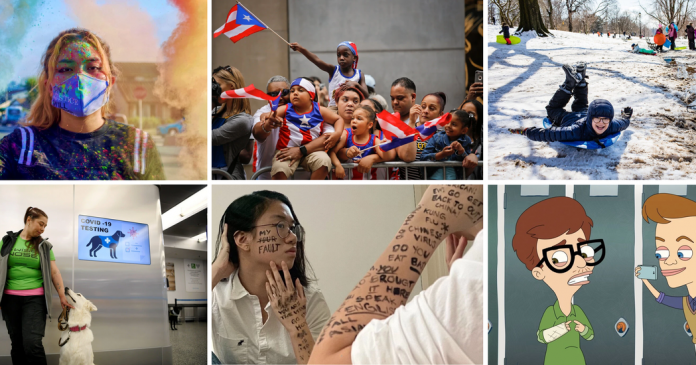
The images above illustrated a recent edition of the Modern Love column’s “Tiny Stories,” which is “Modern Love in miniature, featuring reader-submitted stories of no more than 100 words.”

What short story of love, friendship, family or any other kind of bonding can you tell? Our comment field gives you nearly 300 words, so you can make yours that long if you like. Tell us about a real relationship, or make up a story, using the images above for inspiration if you like.

Post your tale in the comments, then read the related Tiny Love Stories piece.


Find many more ways to use our Picture Prompt feature in this lesson plan. You can find all our Picture Prompts in this column.

Draw a Self-Portrait

0
Draw a Self-Portrait

There is truly no time like the present to give drawing a shot, and a self-portrait is an excellent place to start. The template provided here can help you figure out how to draw a human face — how much space there is between all of its parts and what goes where. Some of the best portraits in the world don’t follow these rules and you don’t always have to either, but it’s helpful to know them.

Other than the above template, you’ll need a pencil, an eraser and a mirror. Set up the mirror so that you can see your head, neck and shoulders. Look straight into it so that you have a symmetrical view of your face and be mindful, once you have begun to draw, not to move much.

The horizontal line that bisects the oval is where your eyes go — right in the middle of your face. The three circles indicate the width of the eyes. The middle one helps with the spacing. (There is, give or take, about an eye’s width between your eyes.) Take a good look in the mirror at your own eyes. What shape are your eyes? Round? Almond-shaped? What do the creases made by your eyelids look like? Are your eyelashes light or dark? Long or short? What about your eyebrows? Are they thick or thin? Straight or arched? Neat or unruly? Look closely and sketch your eyes in the two outer circles, then add your eyebrows above them.

Next, draw your nose. The bottom of your nose is roughly at the middle line on the template. Often the outer edges of the nose align with the inner corners of the eyes. Your nose may be wider or narrower than this. Is it long? Crooked? Turned up or turned down? Can you see your nostrils? Is the bridge of your nose much narrower than the bottom or are they a similar width?

The lowest line indicates where your mouth should go. It fits in the area between the two outer vertical lines and the horizontal line is where your lips part. Look closely: Are your lips thin or full? Is one lip fuller than the other? What is the shape of the line that separates your upper and lower lips? What shape does your upper lip make? Is it like an arch? Like the letter M? Something in between?

Your ears will go between the top and middle lines. They should roughly span the area between your eyes and nose. Can you see them or are they covered by your hair? Do they stick out or are they barely visible? What kind of lines do the folds of your earlobes make?

At long last, it’s time to draw your hair. Can you see your hairline? Does your hair hang down like curtains? Does it make a straight line right across your forehead? Is it long or short? Curly, wavy or straight? Drawing hair is an opportunity to experiment with different kinds of lines and mark-making. How can you use your pencil to indicate its texture?

Now take a good look at the shape of your face. Is it round? Pointy? Square? Draw the line of your chin and the sides of your head if they’re not covered by your hair. Finish up by drawing your clothes and adding any important details that make your face look like yours: glasses, freckles, moles, wrinkles. Are the irises of your eyes light or dark? Can you see little flecks or shapes in them? What other lines can you see? Is there a crease above your chin? What does the divot under your nose look like?

There you go. You have drawn a self-portrait. Excellent work. Now that you know how, you can do it again tomorrow.

Student Ability, Self-Regulated Spaced Practice, and Performance In Online Learning

0
Student Ability, Self-Regulated Spaced Practice, and Performance In Online Learning

Recording authentic student study behavior

A recently published study by Carvalho, Sana, and Yan (1) contributes to the evidence base supporting spaced practice by approaching the question about the benefits of spaced practice differently: They recorded the authentic study behavior of students enrolled in an online course. The online course consisted of 12 units and required students to complete readings, watch video lectures, and engage in activities. Each week concluded with a unit quiz and students took a final exam covering the entire material after the last unit. The researchers used data that was recorded in the online course platform to analyze student behavior (i.e., learning analytics): number of times students logged in and engaged with tasks (i.e., number of sessions), intervals between interacting with tasks, total time spent on activities, activity completion rate, and so on. As indicator for spacing they used the number of sessions students took to complete a unit – with more sessions translating to more spacing. What is neat about this approach is that it allows capturing natural student learning behavior in an authentic learning environment. Study behavior data of 639 students was analyzed.

Relationship between student ability, self-regulated spaced practice, and performance

Three main outcomes emerged from this study:

  1. More spacing was associated with higher performance on quizzes – independent of the total time spent on a unit or student performance on a pretest (i.e., student ability). Put differently, when students used more spacing when interacting with the unit material they performed better on the quizzes.

  2. More able students tended to space their study sessions more than less able students. However, and this is intriguing, less able students benefitted much more from spacing than more able students: For low ability students, more spacing was clearly associated with higher quiz performance, whereas, for high ability students, quiz performance was not associated with spacing – they performed well independent of spacing.

  3. Student engagement with the activities in the course moderated the relationship between spacing and quiz performance. When students completed less activities in the online course, spacing was more strongly associated with higher quiz performance. The authors explain that “spacing out study appears to buffer students against the negative effects of otherwise passive learning”. Put differently, students who are less motivated to complete learning tasks may be able to make up for this by spacing their study sessions.