“My name is Konstantinos Vichoudis. I am 42 years old and I live in Thessaloniki, Greece. I have a masters in Project Management and I’ve worked as a civil engineer for 14 years. I am also a certified adult educator, with certification from both the National Organisation for the Certification of Qualifications & Vocational Guidance and the National Center of Public Administration & Local Government. I’m also a tango teacher and I have the ECDL Expert qualification.”
What was your first course on Alison, and why did you choose it?
The first course I took on Alison was the Diploma in Teaching Skills for Educators. I chose it because, besides my primary job, I also work as an educator and I wanted to learn more about teaching.
How have Alison courses affected your career?
I’ve just recently discovered Alison and I have enrolled in 27 courses already. I also want to enroll in the Project Management Learning Path. Because I have just started, I can’t yet say what effect they have had on my career. However, with Alison, I feel readier for the challenges I encounter at work. For example, I was asked to teach a seminar on building insulation at a vocational center and we will use Zoom there. So I started the Online Zoom Course – Beginner to Advanced.
What’s your favourite way to relax from studying?
My favourite way to relax from studying is to be with my girlfriend, to be outside with my friends or to watch a comedy movie
Where are you working now?
I am working as a civil engineer in the public sector and I also teach general construction in a vocational school. I’ve recently started teaching a seminar on building insulation at a vocational center.
What’s next for you, in terms of education or work?
Next for me, in terms or education, is to complete the 27 courses I have started with Alison, as well as beginning the Project Management Learning Path. In terms of work, I will continue to teach in vocational schools and centers. I would also very much like to become an Alison Publisher and publish some courses that Alison doesn’t already have, although Alison does already provide over 2000 high quality courses.
If you could learn absolutely anything in the world from an Alison course, what would it be?
What would you say to someone if they asked you about Alison? Would you recommend it and why?
There are many reasons, why I recommend Alison but mostly it’s because of their mission. Innovation, inclusivity, knowledge, empowerment.In terms of innovation, Alison was one of the first free online education platforms. As for inclusivity, Alison is inspired and motivated by the United Nations Declaration that “Everyone is entitled to a free education”. When it comes to knowledge, Alison’s 18 million learners prove the quality of the knowledge Alison provides. And as for empowerment, free education and skills training helps to change people’s lives, particularly in parts of the world without easy access to education. Anyone can learn new skills or improve their existing ones, without to having attend to live lessons, which work and family responsibilities can make difficult. So yes, I definitely would recommend Alison, and I have already started to share Alison courses on social media.
Register for the live webinar on March 4 at 4 p.m. Eastern time.
Our students are living through history, from the protests following the killing of George Floyd while in police custody to the insurrection at the Capitol, all while dealing with a deadly pandemic that has disproportionately affected Black and brown communities. Though stories of police brutality and racial inequality are not new, the events of the last year have amplified the call to educators to create safe spaces for students to have critical conversations about race and racism. Navigating these conversations can be challenging. If you are struggling with where to start, or where to go next, you are not alone.
During this webinar, educators will share their experiences and advice on talking about race and racism in the classroom and discuss why these conversations matter. We will provide guidance on how to use authentic sources, from The New York Times and elsewhere, to make meaningful connections by grounding conversations in historical and current events, as well as students’ experiences. We hope you will walk away with practical strategies to prepare yourself and your students to engage critically with issues that are important to them and to the future of our society.
CTLE credit is available for New York educators. All participants will receive a certificate of completion.
Register now to join our live webinar or to receive a link to view the on-demand recording.
The Dodgers summarily pounded the Atlanta Braves, 15-3, in Game 3 of the National League Championship Series at Globe Life Field, the home of the Texas Rangers, in a trouncing that established a catalog of records.
The Dodgers scored the most runs and hit the most home runs they ever had in a postseason game — and they accomplished all of that in just the first three innings.
Have you discovered a corner of the internet that speaks to your interests or your sense of humor? Do you take part in any virtual communities that allow you to connect with others who share your passions? Perhaps it’s a group on TikTok, an online gaming community or something else.
If so, which online groups are you involved with, and what do you enjoy about them? If not, would you like to be a member of a digital community? Why or why not?
“How am I supposed to feel confident in myself when these are the ballet body standards?” begins a TikTok video by user @hardcorpsballet. The question stopped this former dancer mid-scroll. An honest conversation about ballet’s cult of thinness? Yes, please.
Then came the slide show: not a parade of waiflike bodies, but instead the well-padded Bear from Boston Ballet’s “Nutcracker,” and the furred and feathered creatures of Frederick Ashton’s “Tales of Beatrix Potter.”
Reader, I giggled.
I had entered ballet TikTok, where a rule-bound art form meets unruly creativity. Casual, confessional and playful, TikTok offers a release for ballet dancers, particularly students, who spend their days chasing impossible perfection. TikTok is a place to laugh about the impossibility, rather than obsess over perfection.
As more and more stuck-at-home dancers join TikTok, it has also become a place to dissect some of the problems and clichés that dog ballet. Users make darkly funny memes about body dysmorphia, eating disorders, abusive teachers, misogyny and homophobia. They are the same issues that dance films and TV shows mine for drama and melodrama. But the wounded whimsy of ballet TikTok reflects what it actually feels like to be a ballet dancer — the frustrations and joys of a demanding, problematic, beautiful art.
“A lot of people who don’t do ballet have a very specific view of what it is: Everybody’s very serious, very thin, very talented and probably very rich,” said Jennifer McCloskey, 24, the amateur dancer behind @hardcorpsballet. “But ballet can exist in so many different ways. My approach on TikTok is to be as real about it as possible.”
Though a few professional dancers have built followings on the app, teenage students form the heart of ballet TikTok. A virtual dressing room, it allows them to talk to each other without worrying about who’s watching. While Instagram seem to prefer polish — elevating implausibly pliable dancers with impeccable technique — ballet TikTok feels more democratic, with popularity tied to sensibility, not physicality. “On TikTok, rather than your technique going viral, you could have your ideas about ballet go viral,” the dancer and writer Minnie Lane (@minnielane) said in an interview.
And TikTok culture promotes candor, encouraging young dancers to examine sensitive subjects. “Regular TikTok creators, not just dance creators, talk about their personal struggles, and that makes me feel comfortable doing the same thing about dance,” Yazmine Akamine (@hasssminee), a 19-year-old trainee with Sacramento Ballet, said in an interview.
Tell us about an online community that is deeply important to you. How did you find this community? What was the moment when you knew you had found “your people”? What unites you? What part of yourself are you able to express when you’re around them?
In what ways are the digital communities you participate in similar to or different from ballet TikTok? Do members share jokes or memes? Do they talk about their personal struggles or offer critiques of your shared interest? How do you typically spend your time in this space?
Ms. Fuhrer writes that ballet TikTok allows teenagers to “talk to each other without worrying who’s watching.” Is this how you feel in the online groups you participate in? Do you feel that you are able to be more honest, authentic and candid there? Why do you think it might be easier to be a truer, less polished version of yourself in these virtual spaces?
Have you turned to digital communities during the pandemic? What have these spaces offered you during this challenging and socially isolating time?
Are there any dangers or downsides to online friendships like these? Have you ever taken part in groups that seemed harmful, destructive or toxic? What limitations are there to connecting through digital communities like those on TikTok?
Students 13 and older in the United States and the United Kingdom, and 16 and older elsewhere, are invited to comment. All comments are moderated by the Learning Network staff, but please keep in mind that once your comment is accepted, it will be made public.
Above is an image related to one of the news stories we followed over the past week. Do you know what it shows? At the bottom of this quiz, you’ll find the answer.
Have you been paying attention to the news recently? See how many of these 10 questions you can get right.
Note: Our next Weekly News Quiz for Students will publish on Feb. 23, 2021.
By Shwetabh Mittal, Senior Director, Product Management
This article was originally published in Campus Tech, January 2021.
When the pandemic led to the initial shutdown of university campuses in early February, Duke Kunshan University in Kunshan, China, was among the first to move all its courses to an online format. By April, at the height of the crisis, up to 1.6 billion students worldwide were affected by school closures, including more than 200 million in higher education. Following suit, colleges and universities around the world also began quickly transitioning to emergency remote teaching, moving online to deliver lectures, administer tests and even hold graduation ceremonies.
What started as a short-term response to the COVID-19 crisis will result in an enduring digital transformation of higher education. While the move off campus won’t be permanent for all undergraduate students, higher education as we know it will evolve.
The past year has been a catalyst for universities to make online learning core to their student experience, and best practices for this “new normal” have started to emerge. Here are three steps you might consider taking to future-proof your university for next semester and beyond.
1) Embrace New Models of Blended Learning
Several remote teaching models arose amid the pandemic, and nine months after the initial shift online, it has become clear that not all methods are equally engaging. Many institutions defaulted to fully synchronous instruction during the emergency remote teaching phase, in which faculty move their lectures online through videoconference tools. This model can lead to burnout for both students and instructors, and is often associated with consternation surrounding student attention.
Many institutions are deploying fully asynchronous teaching, and some are supplementing their degree offerings with ready-made, for-credit courses on online learning platforms. Professors can curate courses to fill curriculum gaps and ensure new content is aligned with their department’s goals. This supplemental option is student-friendly because it is flexible and self-paced, and it allows them to easily explore new interests outside their major.
Blended learning, parts asynchronous and synchronous, has also emerged as a popular path for universities. In this “flipped classroom” model, students gain knowledge and skills from online courses, either ready-made or privately authored by their instructors. The course acts as a textbook, only it’s chunked into bite-sized segments and reflects the modern digital experience young people expect. Students then come together with instructors in a virtual classroom to discuss ideas and apply skills with hands-on projects and assessments.
Blended learning marries the best of on-campus and online learning practices, fostering community and ensuring high engagement. Its pioneers include Covenant University in Nigeria, which is using online courses to enrich its degree programs with international knowledge and perspective for over 6,000 students.
2) Prepare Students for the Jobs of the Future
The pandemic caused widespread unemployment and accelerated digital transformation and automation, impacting millions of workers globally. In the United States, already-high unemployment rates for young workers ages 16-24 almost tripled from spring 2019 to 2020. Rates are even higher among young Black, Hispanic, and Asian and Pacific Islander workers.
While four in five students report accelerating or sustaining their job search priority due to the pandemic, only two in five students feel confident they will find a job or internship by summer 2021. As more jobs require digital skills, we expect students and employers will increasingly look to universities to prepare students for this new competitive labor market. Future jobs are expected to be highly digital, so universities must build curricula that teach skills across cybersecurity, data science and cloud computing. Universities can also supplement degree programs with courses taught by leading industry educators like Google, Amazon and Facebook, whose tools are often used on-the-job.
In North Carolina, Johnson C. Smith University built a Data Science program to enhance students’ job-ready technology skills with online courses from Google, IBM, and John Hopkins University. Other universities have integrated corporate apprenticeship programs to give students experience solving real-world problems.
Hands-on projects are emerging as an impactful form of vocational training, meant for the digital world. These assignments, which help students apply skills in short-form, real-world scenarios, can drive higher rates of skill development, in addition to gains in satisfaction and career outcomes.
3) Collaborate with Peer Instructors and Institutions
One of the most inspiring practices we’ve seen during the pandemic is a collaboration among instructors and institutions. Professors and university leaders worldwide are readily sharing tips and resources to help each other teach more effectively and even upskill amid an unprecedented crisis.
At the innovative University of Szeged in Hungary, for example, faculty members and senior-level students reported using online courses taught by international experts to build their expertise and grow their research, whether by accessing a new library, providing new study materials to students, or authoring their own digital content. Meanwhile, Doctoral students are leveraging research and teaching-centric online courses to future-proof their skillsets.
Renowned institutions and long-time online educators like Duke University, Imperial College of London, and University of Michigan offer strategies on designing engaging online courses, delivering labs remotely, and fostering inclusive and equitable online learning environments. Continued knowledge-sharing, be it teaching strategies or cutting-edge course content, will be vital to building resilient university teaching models at scale, now and for years to come.
The university experience is no longer limited to the walls of the campus. Around the world, faculty are teaching and students are learning virtually everywhere — bedrooms, dining tables, backyards, you name it. We expect that while the move off campus won’t be permanent, the pandemic’s impact on higher education will be. To stay competitive now and in the long-term, universities will likely need to adapt and pave the way for a new normal.
To learn more about how Coursera for Campus is transforming the higher education experience for students around the world, contact us today.
February is Black History Month in the United States — a month we honor the important contributions of the Black community throughout history.
We’re grateful for the contributions of Black pioneers that have broken barriers and paved the way for more inclusivity and diversity in the tech industry. We’ve come a long way — but there’s still a long way to go. That’s why this year, in honor of Black History Month, the Codecademy Team is celebrating Black leaders that are continuing to build a more inclusive, more welcoming, and more diverse tech industry.
The inspiring programmers and technologists on this list were nominated by members of the Codecademy team. Their work inspires and motivates us, and we hope they’ll inspire you too.
Kimberly Bryant
Kimberly Bryant founded Black Girls CODE in 2011 to empower girls of color ages 7 to 17 to become innovators in STEM fields. Black Girls CODE hosts after school programs, community outreach programs, workshops, hackathons, and more, dedicated to introducing coding to a new generation of coders.
“Imagine the impact that these curious, creative minds could have on the world with the guidance and encouragement others take for granted,” writes Kimberly on the Black Girls CODE website.
Jovanay, an associate recruiter here at Codecademy shares, “I grew up understanding that programming was for men in the dark staring at their computers all day. I had no idea it was this world of imagination and exploration and I only wish that the message of ‘Imagine. Build. Create.’ was shared with me at such an impressionable age.”
Find out more about how you can support Black Girls CODE here.
Bria Sullivan is an entrepreneur and software engineer at Google. She’s also the CEO and founder of Tech Stack’d. The mission of Tech Stack’d is to help underrepresented software developers and non-technical entrepreneurs advance their careers in tech through workshops, courses, and a supportive community. “By recognizing common pitfalls, Tech Stack’d fills in the gaps that cause many underrepresented people to fail when trying to break into tech.”
“It’s a community for underrepresented people who are trying to break into tech. They didn’t necessarily go to college. They maybe did a boot camp, or they’re self-taught. It’s a place where they can go where they can have a community. I also provide workshops on resumes and interviews and also plug them with different people and just webinars with other experts. It’s also for nontechnical start-up founders so that they can all grow their careers and tech together.”
And Bria managed to create Tech Stack’d all while working as a full-time software engineer at Google. “Bria is such an inspiration to all who want to create the change they want to see in the tech industry,” says Roger, a Codecademy software engineer.
Michael Berhane is the founder of POCIT (People of Color in Tech), a resource dedicated to telling the stories of people of color in tech, and host of the Techish podcast. In addition to articles and interviews from individuals in the tech industry, POCIT also hosts a recruitment platform, pocitjobs.com, that helps connect people of color with tech jobs.
Michael shared the inspiration behind POCIT with Forbes: “I wanted to switch up the narrative around the type of faces we usually expect to be a ‘techie’ or work in tech. Partly to place some overdue spotlight on those fantastic individuals, but also to inspire the next generation coming up behind.”
Saron Yitbarek built an inclusive, supportive developer community, CodeNewbie, from scratch. Acquired by the DEV Community last year, CodeNewbie offers a wide range of resources, including a Twitter chat, an annual conference, podcasts, and more.
Today Saron is building Disco, making technology more accessible through audio courses on subjects like machine learning, cryptocurrency, and ethics in AI.
“As a tech educator, I’m completely in awe of all that Saron has accomplished (and continues to accomplish),” shares Codecademy curriculum developer Mariel. “She offers so much to so many people, breaking down concepts as easily as she breaks down barriers for newcomers.”
Tony Effik is a managing director at Google, an adjunct professor at Columbia University’s engineering school, and the co-founder of Black and Brilliant, an organization he founded with his wife Perky Noah-Effik last June. Black and Brilliant is an advocacy network dedicated to upskilling talented people of color and indigenous people.
“There’s a need to help people break through the glass ceiling in a time of digital transformation,” Tony shared during a U.N. webinar on Youth Engagement for Global Action: Digital Skills and the Power of 3P in October 2020. Black and Brilliant is dedicated to this mission.
Here at Codecademy, we’re inspired by Tony’s mission too, which is why we’re excited to announce that we’ve partnered with Black and Brilliant on an upcoming accelerated course in Applied Artificial Intelligence.
Sofia Ongele is a 20-year-old student, coder, and activist. She not only uses her platform to educate, but also builds tools that provide access for people to engage and take action towards important social issues. For instance, Sofia built an award-winning app, ReDawn, to help survivors of sexual and domestic abuse and their loved ones find support.
In an interview with KTLA5 last year, Sofia spoke about how coding can be a catalyst for change. “Coding has a really unique ability to be able to impact so many people with just a few keystrokes,” she shared. “Without having a diversity of thought and diversity of opinion, we’re losing on so many incredible inventions and innovations that can impact a lot of people.”
The Codecademy team has found inspiration in seeing how Sofia has created actionable and accessible solutions to make and inspire real change. She’s not only teaching, but she’s pushing those around her to think more critically and conscientiously.
Timnit Gebru is a computer scientist, advocate for diversity in tech, and co-founder of Black in AI, an initiative geared towards increasing the presence of Black people in the field of artificial intelligence. Black in AI provides mentorship, academic programs, advocacy, events, and community building.
“Tech — especially cutting edge tech — is often imagined to be this rising tide that lifts all boats. Gebru correctly identified that, however well-intentioned technologists may be, the products they create tend to carry and, in the worst cases, magnify the biases they hold,” shared Devin, an associate product designer here at Codecademy. “Her work has made and continues to make a case for the critical importance of diversity in fields like AI, and exposes the limits of the kinds of technological progress that don’t consider the lived experiences of marginalized people.”
Rebecca, a senior software engineer on our team says, “I’m inspired by her perseverance in fighting for a higher standard for ethics in AI, standing up for what’s right, and lifting up other underrepresented voices in the tech industry.”
Find out more about how you can support Black in AI here.
Hadiyah Mujhid is the Founder and CEO of HBCUvc, a nonprofit dedicated to racial equity in venture capital and technology. HBCUvc supports students from Historically Black Colleges and Universities (HBCUs) and Hispanic-Serving Institutions (HSIs), teaching venture capital and providing funding, mentorship, culturally-affirming curriculum, and access to paid internships at tech and venture capital companies.
“HBCUvc envisions a global economy where Black, Indigenous, and Latinx innovators can boldly create, fail, invest, and thrive. Our origins are rooted in Blackness and the legacy of Historically Black Colleges and Universities (HBCUs), which forged education opportunities for us in a time when our country would not,” Hadiyah wrote in a Medium post last year.
In the post, Hadiyah shared ways to get involved with HBCUvc and to advance racial equity in VC and tech. “Advancing racial equity means making space in your networks for more teams and leaders that look like us. It means listening to our expertise and providing long-standing and unwavering financial support for the necessary work.”
Learn more about how to get involved with HBCUvc here.
Tope Awotona
Tope Awotona is the CEO of Calendly. He launched Calendly using funds from his 401(k), and has been outspoken about the difficulty he faced in raising VC funding. He shared in an interview with Inc., “I had a working product, and customers using it, and everyone said no… The only thing I could attribute it to was that I was black.”
Tope grew up in Nigeria and says, “Where I grew up, everyone looked like me – all of our leaders were black, so color didn’t set any limits to my dreaming. But I have learned that growing up black in America is very different. There are not nearly enough examples of people who look like us in positions of power or who have a lot of success in the tech field. Unfortunately, that limits people and can hinder the idea that they can do whatever they want.”
Tope’s story is an inspiring one of overcoming the odds to build a business worth over $50 million in annual revenue without funding. But it also serves as an important example in the case for making venture funding more equitable.
Stacy Brown-Philpot is the former CEO of TaskRabbit and was one of the few Black women CEOs in Silicon Valley. In a 2019 interview with Know Your Value, Stacy shared, “I’m focusing on changing the face of technology by creating a diverse company where people feel they can bring their whole selves to work.”
At TaskRabbit, she succeeded in creating a diverse and inclusive workplace — and her work didn’t start there. Before TaskRabbit, Stacy was at Google, where she also worked towards a more diverse and inclusive workplace. While she was at Google, she founded the Black Googler Network, an employee resource group.
In an interview with The New York Times, she shares, “There’s been so much momentum in terms of creating gender equity in tech. We have a long way to go with minorities. We have a long way to go with making sure we have more black people represented in tech.”
Stacy is currently helping to run the SoftBank Opportunity Fund as a founding member. The SoftBank Opportunity Fund is a $100 million venture fund supporting Black, Latinx, and Native American founders.
Dr. Gladys West is a STEM pioneer whose work is the basis for the Global Positioning Systems we now take for granted. Her programming work on the IBM 7030 STRETCH (the fastest computer of its time) and data analysis resulted in the ability to develop a highly accurate model of the earth, serving as the groundwork for the GPS systems in use today.
After a 42 year career working for the Department of the Navy and Department of the Air Force, she completed a PhD when she was 70 and was inducted into the Air Force Hall of Fame in 2018.
Koma, the VP of Curriculum here at Codecademy shares, “In an era when both women and people of color were underrepresented and/or absent in STEM fields, Dr. West’s relentless pursuit of and commitment to education, perseverance in a field where few women or Black people were present, and pursuit of excellence contributed to her groundbreaking work.”
Kaya Thomas is an iOS developer, writer, and public speaker. In 2014 she launched We Read Too, an app for discovering books for young readers written by and about people of color.
“High school was when I started to realize that none of the characters were ever black girls,” she shared in an interview with Apple’s Developer. This was the inspiration for We Read Too.
Jovanay from our recruiting team met Kaya when they were in school together at Dartmouth. Jovanay worked as a campus hair stylist for hair braiding for Black women and had the opportunity to speak with Kaya about her computer science experience while she worked.
“Kaya was the first person that I’d met that made computer science sound so accessible and so easily available, yet she was able to make such a huge impact in the tech world!”
“We Read Too is super necessary. Seeing a black woman in tech create products for black youth to read more books written by black authors so incredibly demonstrates the power of what could happen if we created more spaces for black creators to be heard and valued.”
Khalil (Army) Armstead and Giovannie Hernandez
Army and Giovannie are both founding members of Emergent Works (formerly Code Cooperative), a non-profit that disrupts the prison cycle by providing technology education and mentorship to formerly incarcerated individuals. Participants strengthen their skills in web development and computer science, make industry connections, and create pathways into high-paying careers.
One Codecademy Team member shared, “The entire organization has inspired me by setting an example of how people in our industries can help others on an individual level, in order to make an impact at a systemic level. There is so much discourse to be had surrounding ethics, systems, and politics in technology that create what seems like an impossible (and widening) barrier for the marginalized and disenfranchised.”
Lyndsey Scott
Lyndsey Scott is an actress, model, app developer, and advocate for women and minorities in tech. In a recent interview on The Step, a podcast hosted by author Luvvie Ajayi Jones, Lyndsey speaks about the issues women of color face in tech, plus talks about the work she’s doing to advance women and minorities in the engineering space.
In the interview, Luvvie Ajayi Jones asks Lyndsey how she’s seen her visibility impact young women that want to enter computer science fields. Lyndsey shares:
“It’s actually incredible that so many young girls and women come up to me and say that because of my story they decided to learn more about computer science and eventually pursue a career in computer science.”
“I wish that there were more women and people of color who were in technology when I was growing up, but I think that the more of us there are now, the more we can encourage the non-traditional tech types to enter the world too.”
Harvey Sanders is the Engineering Lead for the in-house dev-shop at Operation Spark, a non-profit coding bootcamp founded and operating in New Orleans. During the company’s 7-year history, so many people of color have been able to find careers in tech through Operation Spark and Harvey has been an enormous part of the company’s success.
Before joining Operation Spark, Harvey worked for another local non-profit, the Youth Empowerment Project (YEP). Harvey was integral in launching YEP’s bike shop to provide underserved youth with real job experience, and served as the Assistant Director of the Work and Learn Program where he taught young people in New Orleans the basics of front-end web development. He went on to attend an Operation Spark bootcamp in one of the first cohorts. After graduating, he joined Operation Spark as a software engineer, building the company’s proprietary content-delivery system and then teaching as an instructor.
Ben, a curriculum developer here at Codecademy, began working at Operation Spark in 2017. “I could immediately see how impactful Harvey was to the company’s success. His enthusiasm and joy around technology is contagious to those around him, which I think is what makes him a great teacher and coworker. His students frequently praise his ability to teach with a special combination of confidence, approachability, and humor.”
Find out how to get involved with Operation Spark here.
Stephanie Dinkins
Stephanie Dinkins is a transmedia artist and professor. She describes her work in an interview with Eyebeam: “I am an artist who is interested in creating platforms for ongoing dialog about artificial intelligence as it intersects race, gender, aging, the proliferation of knowledge(s) and our future histories.”
Stephanie’s most recent project, Secret Garden, illuminates “the power and resilience in Black women’s stories shared across space and time.”
Sheena Allen
Sheena Allen is founder and CEO of CapWay, a banking app dedicated to creating financial access and opportunities for everyone. “The whole point of building this company was to build a full ecosystem for people who have been left on the outside of traditional banking,” Sheena shares in an interview with Essence.
Sheena recognized a problem: there’s not adequate access to banking in marginalized communities. In 2016 she decided to build CapWay as a way to provide opportunity for underserved millennials and Gen Z.
The Codecademy team has found inspiration in the way Sheena has taken her skills and experience and turned it into something that is making real change in the world, bettering the financial prosperity of underprivileged communities.
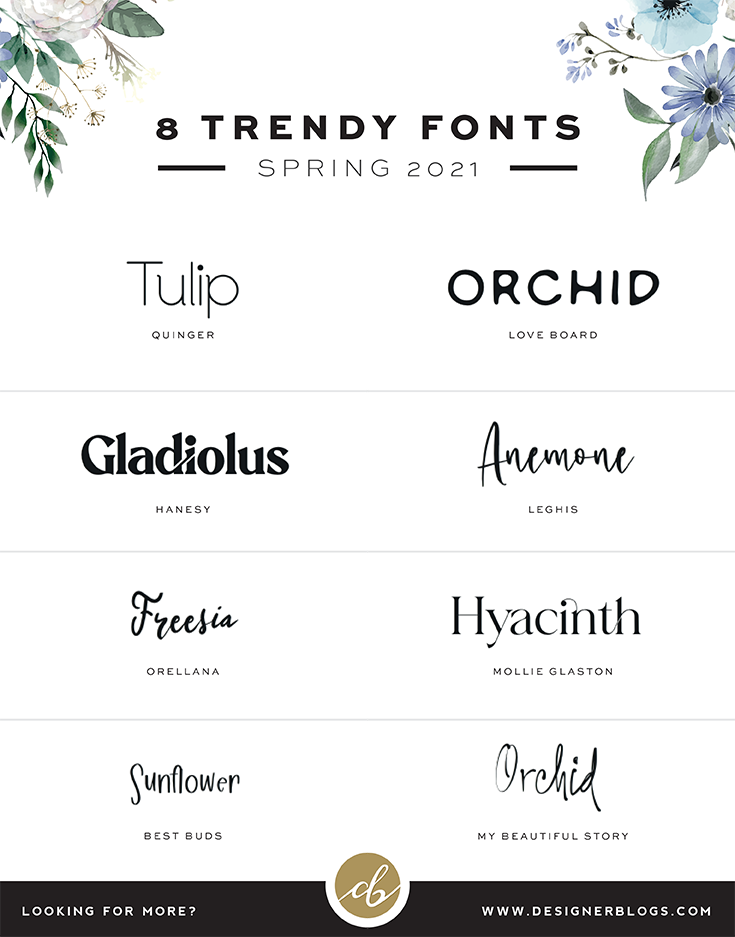
I don’t know about you, but I go through a phase a few times a year when I start perusing font sites to freshen up my collection. While I use plenty of the lovely free fonts that are out there, I don’t necessarily believe in using all free fonts. To give your brand credibility, you need to use well-formed fonts that are clean and easy to read. If you are just starting to build your font library, I have collected for you 8 best trendy fonts perfect for 2021.
8 Best Trendy Fonts For 2021
For this post I did my best to find something for everyone, so you will find here both script lettering and modern shapes. I have noticed that fonts like Mollie Glaston with fancy connections between letters like s and t are now really trendy. Make sure to give it a try.
All the fonts were added to Creative Market at the end of January 2021. Below you will find my 8 picks with links to their pages.
Pin me for later!
If you are browsing this post at work or just do not feel crafty right now, we have something for you too! All the fonts collected in one please on easy to pin graphic so you can save those inspirations for later.
Show us your works!
I would love to see what you will create using those best trendy fonts from 2021. Make sure to let us know in the comments, or share your creation on social media and tag Designer Blogs.
Don’t forget to let us know which font is your favorite. Do you like graphic fonts, or would you rather see a compilation of classic fonts?
What is this image saying? How does it relate to or comment on society or current events? Can you relate to it personally? What is your opinion of its message?
Tell us in the comments, then read the related article to learn more.
Students 13 and older in the United States and the United Kingdom, and 16 and older elsewhere, are invited to comment. All comments are moderated by the Learning Network staff, but please keep in mind that once your comment is accepted, it will be made public.
The word resplendent has appeared in 42 articles on NYTimes.com in the past year, including on June 27 in the Opinion essay “I Was in Love With a Tree That Swallowed the Sky” by Laura Hillenbrand:
On an autumn day, I finally arrived. One of the first things to arrest me was the Norway maple in the backyard. It was an exuberant explosion of a tree, its foliage so full that the branches kissed the ground. Each summer, the tree bounded outward in all directions, growing perhaps two feet; each fall, its torrent of huge orange leaves whirled through the air like laughter. The tree was so in love with life that it swallowed the sky.
… Last summer, a neighbor stopped me. He said the tree was overawing his yard, devouring his arbor and eclipsing the rivers and mountain. People live here for this view. I knew I had no right to deprive him of it. Heartsick, I asked if I could give the tree one more season. He said yes.
An arborist suggested felling the tree, but I couldn’t do it. He said he could cut it far back. It wouldn’t look good, he said, but it would survive.
He came on a sultry morning four weeks ago. I stood on the deck and whispered my apology to the tree. It was especially resplendent that morning, the leaves glittering and scattering light, casting shade on the sweat-shining men gathered beside it.