Make the Road New York, an immigrant advocacy group, says that more than 60 percent of its members lost their jobs and at least 50 members have died since the coronavirus pandemic started. This is the climate that many Latino immigrants are navigating: a pandemic that is twice as deadly for Latinos as for white people and a lack of work opportunities. Some immigrants — particularly those who are undocumented — have started working as street vendors in an attempt to make ends meet and to support their families back home.
In this lesson, you will see these New Yorkers in their daily lives and hear their stories. Then you will make past-to-present connections as you compare the experiences of street vendors in New York City today with those from a hundred years ago.
Warm Up
Where do you — or your family members — buy most of your groceries? Do you ever shop for fruits or vegetables at a stall on the street or at a local farmers market?
The featured article shares the stories of immigrants who work as street vendors in New York City and the difficulties they face during the pandemic. However, there is a long history of immigrant-run street markets in New York and other cities.
Compare the two photographs below: The first image is from 1923 and the second is from 2020. As you look closely, respond to questions adapted from our What’s Going On in This Picture feature:
1. What are some of the ways the pandemic has affected Cristina Sanchez and the other people profiled in the article?
2. How have undocumented immigrants been uniquely affected by the pandemic?
3. What does it mean that Jackson Heights was part of the “epicenter of the epicenter” of the pandemic in New York? Use examples from the article to explain what that means.
4. Alyshia Gálvez, a professor and founding director of the Mexican Studies Institute at Lehman College, said, “This is the kind of creative resiliency that immigrant communities have always engaged in.” What are some examples of this “creative resiliency” in the article?
5. What are the goals of the Street Vendor Project? How might its efforts, and other similar initiatives, help someone like Sabina Morales, a veteran street vendor?
6. How have the New York City government and the Police Department made it difficult for street vendors to operate their businesses?
Going Further
Option 1: The One-Pager
The featured article relies heavily on photographs, videos and the words of the interviewees to tell the story. Reflect on what you read, how it made you feel and what you are left thinking about by creating a one-pager.
You can start by using this worksheet and including a photograph from the article (or a drawing), a quotation that you found particularly meaningful and one question you are left with after reading the article.
If you would like to expand on your one-pager or prefer to do a free-form artistic interpretation, you can start on a blank sheet of paper and add these elements:
One word that feels representative of the article or a key theme. This word can be written repeatedly around the perimeter of the paper to create a border.
A visual symbol that represents a main idea from the article.
One feeling word that you are left with after reading the article.
A second quotation, image or question.
Once you have created your one-pager, you can go on a gallery walk in person or virtually by spending about one minute with each one-pager in your class and writing down what you notice and wonder about the creation. After that, you can debrief as a class about recurring themes you noticed and elements of different one-pagers that you found particularly effective.
Option 2: Past-to-Present Connections
You started this lesson by looking at two photographs: one from 1923, which featured a predominantly Eastern and Southern European immigrant neighborhood, and the other from the featured article in 2020. You compared what was visually similar and different between the photographs. Now consider what might be similar or different about experiences working as a street vendor across history and attitudes that the city had toward street vendors.
Declaring that pushcart peddlers are a menace to traffic, health and sanitation, Mayor La Guardia yesterday appealed to civic organizations to join a drive to eliminate them from the streets. He said he had asked the City Council to give prompt consideration to the problems created by the “6,000 peddlers roaming the streets without licenses.”
The article continues with an excerpt from Mayor La Guardia’s letter to several merchant and commerce organizations:
“The open pushcart market is not only antiquated and unnecessary, but also, in many instances, unsanitary. In almost every instance these peddlers are a danger to themselves and to others by creating traffic congestion. It is my policy, where a market is necessary, to build a proper covered market so that these same peddlers may be permanently placed in such market under proper and wholesome sanitary conditions. … ”
After reading the excerpts, respond in discussion or in writing to the following reflection questions:
What is your reaction to Mayor La Guardia’s resistance and disgust with pushcart markets?
How is the city’s attitude toward street vendors and the struggles faced by the vendors themselves in 1938 similar to and different from the situation in New York today?
What do you think the city’s policy should be toward street vendors? Should it restrict the number of vendors using permits and licenses? Should it relax restrictions during the pandemic? Why or why not?
If you want to learn more, The Times cataloged articles from the archive about street vendors in this 2014 article, “New York City vs. Street Peddlers, a Brief History.” It starts with an article from 1903, “War on Fish Peddlers,” and ends with a 2004 article about new laws to regulate street vendors. You can create a timeline and observe how attitudes changed and remained the same over time.
About Lesson of the Day
• Find all our Lessons of the Day in this column. • Teachers, watch our on-demand webinar to learn how to use this feature in your classroom.’
What story does this image inspire for you? Use your imagination to write the opening of a short story or poem inspired by this illustration — or tell us about a memory from your own life that this image makes you think of.
Tell us in the comments, then read the related article to learn more.
Students 13 and older in the United States and the United Kingdom, and 16 and older elsewhere, are invited to comment. All comments are moderated by the Learning Network staff, but please keep in mind that once your comment is accepted, it will be made public.
In the 110-year history of the American film industry, never has so much upheaval arrived so quickly and on so many fronts, writes Brooks Barnes, a media reporter for The New York Times.
Even when the coronavirus pandemic ends, the movie business won’t quickly — or maybe ever — return to the old normal. And a new era of Hollywood seems to be emerging — with streaming at the center.
WarnerMedia will release the much-anticipated big-budget “Wonder Woman 1984” simultaneously in theaters and on the streaming service HBO Max on Christmas Day, and Warner Bros., one of the top movie studios, announced recently that it would debut its entire slate of 2021 movies on HBO Max the same day that they enter U.S. theaters.
In this lesson, you will learn about the challenges taking place in Hollywood and their impact on the future of film as we know it. In Going Further activities you will explore your experiences with the silver screen and write a review of your favorite movie of 2020 or of all time.
Warm Up
Are you a movie lover?
When you hear the word Hollywood or see a picture of the Hollywood sign atop the hills of Los Angeles, what comes to mind? Glamour? Movie stars? Summer blockbusters? Popcorn?
Take a few minutes to write about or discuss with a partner your experiences with Hollywood and the silver screen. Use the following prompts as a guide:
How big a movie fan are you? Do you mark upcoming movie releases on your calendar? Have you ever stood in long lines to see a film on its opening night?
Do you prefer watching movies in a theater on the big screen to watching at home on your couch? How has the pandemic changed your viewing habits? Do you think you will go to the movies again after the pandemic?
What is your most memorable moviegoing experience? Do you remember the first film you saw in a theater?
1. The article starts with a comment that David O. Selznick, the golden era movie producer, made in 1951: “Hollywood’s like Egypt: full of crumbled pyramids. It’ll never come back. It’ll just keep on crumbling until finally the wind blows the last studio prop across the sands.” Why do you think the author began this way? What does the quotation say about the health of Hollywood, past, present and future?
2. What are some of the biggest challenges the movie industry has faced over its 110-year history? How serious is the current one posed by digital streaming? How has the pandemic deepened the crisis confronting Hollywood — particularly for multiplex theater chains like Regal Cinemas?
3. Why does the writer, director and producer Ava DuVernay see this moment as a “time of opportunity” for Hollywood? How is she working to remake the movie industry? Do you agree with her that “normal wasn’t good enough”?
4. Not all news out of Hollywood is bad news: Why do some industry experts believe that multiplexes may get a postpandemic bump? Which of next summer’s long pushed back theatrical releases, such as “Black Widow,” “Fast & Furious 9,” “Ghostbusters: Afterlife” and “Minions: The Rise of Gru,” are you most looking forward to?
5. Why are the viewing habits of Generation Z critical to the future health of Hollywood, according to the author? How might the pandemic forever change how your generation thinks of movies?
6. J.J. Abrams, the Bad Robot Productions chairman and director of movies like “Star Wars: Episode IX — The Rise of Skywalker,” is optimistic about the future of Hollywood:
“There’s a reason that the Roaring Twenties followed the 1918 pandemic. We have a pent-up, desperate need to see each other — to socialize and have communal experiences. And there is nothing that I can think of that is more exciting than being in a theater with people you don’t know, who don’t necessarily like the same sports teams or pray to the same god or eat the same food. But you’re screaming together, laughing together, crying together. It’s a social necessity.”
Do you agree? Do you think people will return to movie theaters after the pandemic? Will you? In your opinion, is experiencing movies in a theater a social necessity? Or is streaming the future?
Going Further
Option 1: Share Your Experiences and Opinions.
Choose one or more of the following writing prompts:
What is your reaction to the article? What was most interesting, provocative or memorable? How worried should we be about the future of Hollywood? Do you think its latest obituary is premature?
“Without appearing on big screens, are movies even movies?” Mr. Barnes asks in the article. How would you answer that question? What is the unique value of seeing a film in movie theaters to you?
In response to Warner Bros. announcement on Dec. 3 that it would debut its entire slate of 2021 movies directly on its streaming service, filmmaker Christopher Nolan, director of “The Dark Knight” and “Dunkirk,” said in a statement to The Hollywood Reporter:
Some of our industry’s biggest filmmakers and most important movie stars went to bed the night before thinking they were working for the greatest movie studio and woke up to find out they were working for the worst streaming service … Warner Bros. had an incredible machine for getting a filmmaker’s work out everywhere, both in theaters and in the home, and they are dismantling it as we speak.
Do you agree with Mr. Nolan? Will releasing films directly via streaming services diminish the power of movies and movie making? Can streaming services and movie theaters coexist? Do you think the changes to Hollywood brought about by streaming are a good thing — for audiences, filmmakers and the quality of cinematic work? Why or why not?
If you were advising Hollywood executives, what advice would you give to revitalize the industry and to enhance the movie experience for audiences — in theaters or via streaming — especially for young viewers?
Imagine you are a critic for The New York Times. Write a review of a film that is meaningful to you.
Your review should:
Express an opinion. Explain to the audience what about the film or performances moved, thrilled, surprised or touched you.
Include relevant and descriptive details from the work itself that support your opinion. The more specific you can be, the better.
Bring readers into the experience with you by using sensory images. Metaphors, similes, descriptive adjectives, strong verbs, vivid imagery that draws on all five senses — these are the difference between a good review and a great one.
It’s that time of the year. Awards coming out from analyst firms, sites, and anywhere and everywhere. It’s like Granny’s potluck. Some are delicious and inviting. Others are inviting but ensure that you can make it to the facilities in the fastest amount of time possible.
And yes, others that make sense. Seems scrumptious, after all, your favorite aunt made it from scratch. It has won all types of awards, best in the British Cake Cook-off. Best, in the Coventry Fair. Tops in the WebWorld recipe contest.
You feel thrilled. Oh, this is going to really be swell.
And initially it is.
Then three hours later, you are cursing your aunt.
Awards should be based on numerous factors, numerous variables to consider. The person or organization who is presenting the awards should know the industry inside and out. If an application is requested for submission, there shouldn’t be a fee to be considered.
That said, though with all the data and variables, there are intangibles to consider. How is their support? How forward thinking are they? Where do you see them going (from an analyst perspective or whoever is presenting the award)? Have they bought any body recently, and will this play a role in their future (regardless of what they might pitch to the public)? What is going on internally? Are they generating sales or losing? Gaining clients or stagnating? What was/is the impact of COVID-19 in their business model and sales approaches?
These all have to play a role in consideration.
Top 10
After the top 10, I dive into some greater details about the LXP market, where I see it going, what caused this, and what you need to recognize.
And Yes they are in order (feel free to disagree, after all, your aunt swears by her casserole)
By far the most feature-rich LXP on the market by a wide margin. Can compete with any learning system out there, by the way. Extension bookmarklet is fantastic, the block widgets that appear on the top of the search engines (including Google) showing the content that aligns to what you are seeking is quite nice. You have to login to use the extension capability (but you need to do that with any system that offers an extension). Content marketplace is quite extensive, they even offer a search for Instructor option, although I found it to be heavily ILT.
Spark is their key system here, and will work for nearly everyone. Playlists which they call channels is abundant and so are the recommended content from their machine learning algorithm that offers a nice variety of content based on what the learner is taking (they are not required to complete it). In my LXP template, they have over 98% of the feature sets. Extraordinary.
They are one of only a few learning systems that when you are in Microsoft Teams it mimics what you see in the EdCast platform. The benefit? Your learner never has to leave Teams to take content, share, etc. – the data gets pushed back to the system behind the scenes.
Mobile mimics as well, a big thank you on that.
Metrics on Spark will be fine for most, although personally I wish they were a tad more robust, for any size of customer. If you are large enterprise (25,000 plus) you get a couple of additional features, not enough to scream yowsa, but you do have the ability to buy the add-on domo which is a BI tool. And you can do a mass configuration with your system. Not common in the LXP market.
The whole mapping thing for job roles is a bit on the funky side for me – its an extra cost, and again targeted more so for large enterprise.
E-commerce exists in EdCast. Classroom management and event management as well. They continue to add features that go across the board into the LMS space, which isn’t a bad thing.
Leader in the NexGen Grid Tier 4.
A dominant player in the industry. System can be found in findanlms.com – great resource for feature exploration, comparisons, etc.
#2 Learn Amp – Another system that is very feature rich and continues to improve. They should not be underestimated in the industry. Calls themselves a People Development Platform, although they are a learning platform with some LMS functionality. For folks seeking B2B/B2C they can handle it. Employees of course the same. Has an MS Teams integration, and are working on the mimic aspect, although it is not yet available. Bookmarklet extension is really great. Metrics continue to improve, and based on what they have coming out in the next two quarters, will take it up a notch.
They lack a mobile app, something I constantly get on them about, but their playlist capabilities, including the ability to add podcasts is very cool. All the features you would expect in an LXP, plus much more.
What I really like is that they aren’t trying to be focused solely on the large enterprise space, which too many vendors across the industry see as the “mighty”. Rather small biz (5-500), small enterprise (501-999), Enterprise (1,000-10,000) are their strong spots.
Definite a player to come. And worthy of #2. NexGen Grid “On the Rise”. Top five learning system for 2021. System can be found in findanlms.com – great resource for feature exploration, comparisons, etc.
#3 – Degreed – Extremely well-known, and a very solid system. Feature wise they are quite strong, but at this time, not someone to consider if you are into the B2B/B2C space or an association for that matter. Bookmarklet extension is good, and was for a time, the first vendor in the LXP market to have one, it has fallen behind the two leaders. Mobile app is good. Content marketplace is massive, with some free stuff of course, like TED. Despite the mass size of the marketplace, there are only a few 3rd party providers that really are the ones folks are buying.
Metrics is a bit of a mix. One side is very slick, nice data visualization, top tier. The other side, where it tracks articles (just how many you went to see on the web, not how long you were on it, per se) is outdated. Something that I have noted to them numerous times, that needs an overhaul.
They were the first vendor in LXP space to have skill ratings, again, others now do as well, but they continue to add functionality around skills, especially tied to job roles. The pick what you want for learners is still available, but assigned learning plays a bigger role than I would like to see in the system, especially when they play the we do not believe in the formal learning card.
Opportunities is an add-on and personally, I have mixed feelings about it. Look it is very slick and it identifies for example not just specific jobs at a company (i.e. client internal), but also say to be a project manager. It identifies the skills they learner has, and what they are missing to do that role/job. So, let’s say you have six of the skills, but the pm job requires 15.
It then identifies content that you will need.
The problem with systems like this, and including Degreed is that to a learner it could give a false impression, that if they have all these skills they are more likely to get that job or role. There are as you know always other factors involved, and subjectivity exists. It isn’t made clear that you having all these skills means you are more likely to get the gig, and I say this, because you can integrate with the Degreed system to an HRIS or HCM platform, so in theory, you could apply for say a job.
Degreed to me, is the vendor who is close to going more of a talent development system. In fact, I’d be surprised if this doesn’t occur by the end of 2021. Again, that’s their choice, and they have a right to fully disagree. But, there is just too much there to say otherwise. System can be found in findanlms.com – great resource for feature exploration, comparisons, etc.
Not recommended for B2B/B2C space.
#4 Instilled LXP – Sort of a video learning platform that also supports SCORM content, PDFs, etc. Video editing is really good, from bookmarking capabilities to transcript output where you can search and select words to where the video goes directly to. Comes with Watershed LRS built-in, the best LRS on the market. They do not fully turn it on to capture everything, which an LRS can do, but there is more than enough for the majority of clients.
Metrics wise, wow. I love that you can drill down within a video, so that with a TOC (you can create one in the system), you can track how often, how many times, and where the learner goes within the video. That type of data is really invaluable when it comes to what other types of video content you can create that align best to meet the needs of your learners.
For folks into product training, Instilled is an ideal fit. Yes on the SCORM and xAPI content of course, but I feel its real power is video. Screen record (available in the system) with a tutorial on how to do this or that, TOC it, and then push it out to your customers, or clients, employees whomever. System can be found in findanlms.com – great resource for feature exploration, comparisons, etc.
5. Stream LXP – Very good LXP, Learning Locker an LRS is available to be used in the system. Lots of capabilities and feature sets. Someone to watch in 2021. System can be found in findanlms.com – great resource for feature exploration, comparisons, etc.
6. CK Connect– Really has upped its game since my review. I am a huge fan of the pre-assessment personality test thing, and the output of content that aligns to well, your personality. Metrics are far better than in the past, continues to get better. See Review. Not recommended for B2B/B2C , but could be a nice plus for an association, especially a professional one. System can be found in findanlms.com – great resource for feature exploration, comparisons, etc.
7. THRIVE– Good LXP. Always liked them. Features are good, missing some items, seemed to bounce personally, as in they were ready to go places, seemed to slip a bit, and now has rebounded nicely on that path. Not recommended for B2B/B2C. Depending on the association might work. More along the lines of a trade association, for example. System can be found in findanlms.com – great resource for feature exploration, comparisons, etc.
8. Juno Journey – Another solid pick. Features are very good, still missing a few items to really take them to the next level. But more than enough, to be in the top 10. System can be found in findanlms.com – great resource for feature exploration, comparisons, etc.
9. Origin Fractal – Feature wise is good. Seemed lost for a few months earlier this year, not sold on the whole angle they are pushing towards. But still a top 10 system. Not recommended for B2B/B2C or association space.
10. Disprz– Everything is tied around skills. Feature wise is good, but another vendor who seems stuck on the job role angle a bit too much. Metrics are good. Not recommended for B2B/B2C or association space. System can be found in findanlms.com – great resource for feature exploration, comparisons, etc.
Something to Realize
The LXP market is changing dramatically, vendors who were in the LXP market are starting to re-list themselves as something else – learning platform, people development platform, Learning Experience, upskilling system, and so forth. This is where the LXP space is heading. Sure there will be vendors who will never re-state their category, but when you look at the features they are adding, you may start to wonder, are they really what they say they are? It’s one thing to say it externally, it’s another thing to say it internally.
As such, this will be the last year for specific LXP awards. Many of them are becoming ubiquitous to other systems, especially an LMS. And for the record, there isn’t anything wrong with that. An LMS nowadays (depending on the vendor) can do everything an LXP can do, and even do some things far better, and have features you may want in your LXP, that just doesn’t exist, because the LXP market really never embraced it.
For those who wonder what makes an LXP, well an LXP, here are the standards you tend to find across the board in the space. This will give you an idea, but again, this is the vast majority.
Why do I believe the LXP market is heading where it is.
Personally, they ignored that Training departments, and training exists. They focused solely on L&D. Many though, if you ask them or tell them that L&D isn’t the only game in town, seemed stunned. Tell them that L&D folks have a background or knowledge of OD, and they will say yes they know it, then ask you what it means. L&D is heavily in the employee side of the house, I surmise that less than 2% are providing B2B/B2C, especially if revenue generation plays a role. L&D and Training are different modalities, but vendors as a whole, are unaware, thus the problem.
Because every LXP wants the B2B/B2C space – at least they say it privately – but when you angle your industry with L&D only, that slides by the wayside.
LXPs were created to be a bolt-on or add-on to another learning system, usually an LMS. They were targeting folks in L&D that were using the LMS strictly for compliance, regulatory and required learning.
Thus the angle learner-centric came into play as a key – in fact – main reason to having an LXP. The whole “informal here, and not formal like an LMS there” existed. The angle that personal and professional development content was the reason for the LXP, after all, with an LMS, it’s all the other, equally played hard.
Even though it just wasn’t true. What you as a client want to use your LMS or whatever learning system you are using, is up to you. I always had personal and professional development courses in my LMS. And I wasn’t an outlier.
But, I digress.
When LXPs decided L&D only, they never in my opinion, really understood the inner thinking and workings of folks in L&D (as a whole). As a result, certain features started to appear in LXPs across the board, including assigned learning – that’s right – formal learning. You can say internally you are learner-centric, but if your algorithm for machine learning plays heavily with assigned learning, that isn’t going to fly.
If you push your system around only skills tied to a job role, please explain to me, how a learner who has an interest in something not related to their job role, have an opportunity to take it?
This is where the LXP industry is heading, and they are not alone, the learning system space is going this way to (exceptions in B2B/B2C and association market exist). It’s a trend that should be a wake-up call across the board.
Interests and Skills to me, are two different entities. I have a huge interest in British history, it has nothing to do with my job, zero to do with my analysis, it is just an interest I have. Let’s say though, I worked at a company, and worked in engineering.
And I as the employee have interests in topics that have absolutely nothing to do with my job role. Shouldn’t I be offered the opportunity to take this content? Wouldn’t this make me a more happy employee because it aligns with my interests? What if I want to learn a skill, that has nothing to do with my job role?
Can I or not?
When systems push everything around the job role, without giving the administrator the option to change that, then it becomes a problem.
And there are vendors in the LXP space who see their systems as performance support. Another real concern I have. When you go to the library or buy e-books, do you see that as performance support, especially if it is skills you want to learn?
When you go and fix your dishwasher and use YouTube to find out how, is that performance support?
There are performance support systems, they exist and have for two decades. That isn’t new.
But let’s not confuse learning and training with performance support. Because they are not the same.
And when a vendor spins the whole performance support, they can forget about B2B/B2C and the association space, what it says to me is that they are on the border of being a talent development system. Not just there yet, but close enough.
There is one system in my Top 10, who I see as potentially crossing the border in 2021. They have started already with a feature capability (that is an add-on) and with a messaging that really angles that way. Plus, with the buy of an HR system, they didn’t do it for its AI only, nor to leverage a part as the “opportunities” angle only.
Final Points
Many learning systems today, offer a content marketplace, whereas the client – you, not the end-user, can buy courses/content from 3rd party providers to put into your learning system. LXPs by the way, were not the first ones to offer it, LMSs were, they just did it via the phone/e-mail, you reaching out and asking for blah blah.
The first LMS vendor to show it off visually for the client, was Docebo. But they were not the first to do it the other way.
Bottom Line
Two of the top ten are in my top five for 2021, learning systems (to be published in January).
All of the above are worthy for your consideration, though. But, in the end, when purchasing an LXP or whatever category they now slide in, always ask
What 3rd party content do I want and/or need for my learners? Can I buy it through their marketplace?
How many integrations do I need or want?
What makes it different compared to ZYX that isn’t in the LXP or learning platform for example, space?
Is it truly nexgen or is that just marketing? Most of the time it is marketing, there are of course, a couple of truly Nexgen LXPs based on my Tier 4 feature set analysis.
Am I pigeon holing me so much, i.e. fitting a square into a circle, because someone said to me, an LXP can do this and another type of learning system can’t? Yeah, I want these items, they do not have it, but you know, they seem like the “new thing”.
This graph shows the results of an online survey conducted in March 2020 by The New York Times’s research-and-analytics department. It reflects the opinions of 2,250 participating subscribers. The graph appeared in The New York Times Sunday magazine.
By Friday morning, Dec. 18, we will reveal additional background and questions, shout-outs for great student headlines, and Stat Nuggets.
After looking closely at the graph above (or at this full-size image), answer these four questions:
What do you notice?
What do you wonder?
The questions are intended to build on one another, so try to answer them in order.
2. Next, join the conversation online by clicking on the comment button and posting in the box. (Teachers of students younger than 13 are welcome to post their students’ responses.)
3. Below the response box, there is an option for students to click on “Email me when my comment is published.” This sends the link to their response which they can share with their teacher.
4. After you have posted, read what others have said, then respond to someone else by posting a comment. Use the “Reply” button to address that student directly.
On Wednesday, Dec. 16, teachers from our collaborator, the American Statistical Association, will facilitate this discussion from 9 a.m. to 2 p.m. Eastern time.
5. By Friday morning, Dec. 18, we will reveal more information about the graph, including a free link to the article that included this graph, at the bottom of this post. We encourage you to post additional comments based on the article, possibly using statistical terms defined in the Stat Nuggets.
• Learn more about the “Notice and Wonder” teaching strategy and how and why other teachers are using this feature from our on-demand webinar.
• Sign up for our free weekly Learning Network newsletter so you never miss a graph. Graphs are always released by the Friday before the Wednesday live-moderation to give teachers time to plan ahead.
Students 13 and older in the United States and the United Kingdom, and 16 and older elsewhere, are invited to comment. All comments are moderated by the Learning Network staff, but please keep in mind that once your comment is accepted, it will be made public.
Imagine that you are a member of the expert class — the kind of person invited to pontificate on television news programs. Under normal circumstances, your expertise might be signaled to the public by a gaudy photograph of skyscrapers superimposed behind your head. But now the formalities of the broadcast studio are a distant memory, and the only tools to convey that you truly belong on television are the objects within your own home. There’s only one move: You talk in front of a bookcase.
… The credibility bookcase, with its towering, idiosyncratic array of worn volumes, is itself an affectation. The expert could choose to speak in front of his art prints or his television or his blank white walls, but he chooses to be framed by his books. It is the most insidious of aesthetic trends: one that masquerades as pure intellectual exercise.
What message do you think this image is trying to convey? How does it relate to or comment on society or current events? Can you relate to it personally? What is your opinion of its message?
Students 13 and older in the United States and the United Kingdom, and 16 and older elsewhere, are invited to comment. All comments are moderated by the Learning Network staff, but please keep in mind that once your comment is accepted, it will be made public.
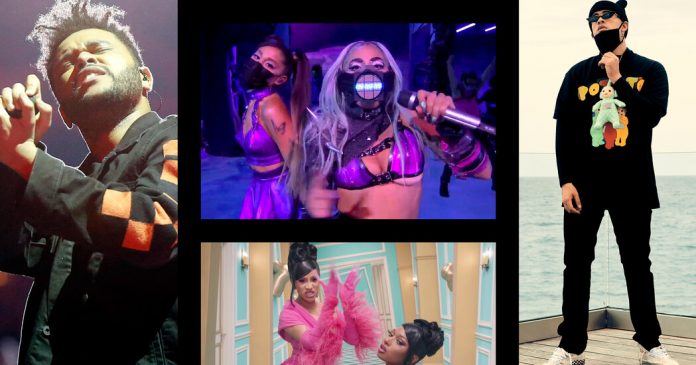
For example, in the “Best Songs of 2020,” Jon Pareles, Jon Caramanica and Lindsay Zoladz featured Bad Bunny’s “Yo Perreo Sola,” Taylor Swift’s “Betty” and Jamila Woods’s “Sula (Paperback).” Ms. Zoladz’s first pick was the “Savage (Remix)” by Megan Thee Stallion featuring Beyoncé:
With all due respect to the other member of the Carters, there’s something about collaborating with another strong woman that brings out the best in Beyoncé, especially when she’s rapping. (It was, after all, her first team-up with Nicki Minaj that educated us about what goes down when it’s a billion dollars on an elevator.) Megan Thee Stallion’s solo cut of “Savage” was universally beloved enough to start a TikTok craze, but Beyoncé’s supremely dialed-in remix elevated it to an all-out anthem. But of course, the Queen is really here for a coronating co-sign of Megan Thee Stallion — the defining artist of a year that seemed a never-ending showcase for her bravado, poise and finely calibrated fury. “Savage” is so much more than a meme, an Instagram caption, a TikTok dance: It is a joyous assertion of Black female personhood in a world that needed it as desperately as water.
In the list of best video games, Stephen Totilo reviewed Demon’s Souls Remastered:
On its face, it’s just another single-player video game that lets players control a knight, a magician or another protagonist, and fight men and monsters while looking out for deadly traps. More subtly, it’s a game of low-key multiplayer assistance and treachery from a lead creator who was inspired when strangers wordlessly helped him during a snowstorm. As a result, Demon’s Souls is designed to be a brutally difficult game whose hardships are leavened by the ability to leave helpful messages and warnings of dangers for other players. On the flip side, players can also invade each other’s games and wreak havoc.
And in “The 10 Best Books of 2020,” The Times had this to say about Brit Bennett’s “The Vanishing Half”:
Beneath the polished surface and enthralling plotlines of Bennett’s second novel, after her much admired “The Mothers,” lies a provocative meditation on the possibilities and limits of self-definition. Alternating sections recount the separate fates of Stella and Desiree, twin sisters from a Black Louisiana town during Jim Crow, whose residents pride themselves on their light skin. When Stella decides to pass for white, the sisters’ lives diverge, only to intersect unexpectedly, years later. Bennett has constructed her novel with great care, populating it with characters, including a trans man and an actress, who invite us to consider how identity is both chosen and imposed, and the degree to which “passing” may describe a phenomenon more common than we think.
Students, choose one of the “Best of 2020” articles to read, then tell us:
What was your reaction to the article you read? Were you familiar with the selections that the reviewer made? Were you persuaded by the way the reviewer described the work? What would you change if you were to write a “best of” list for that category?
In his introduction to “Best Performances of 2020,” Wesley Morris writes: “One day, we’ll look back on this year and bawl. But we should also remember that there were professionals out there who dared to bring joy to our screens.” How have the events of 2020 affected how you consume culture and media? Has culture felt more important to you this year? Or have you not had the mental space to consume culture in the same way?
Make a list of 10 favorite things you watched, read or listened to in 2020. You can include newspaper articles, sports and TikTok videos along with books, movies and TV shows. What made each thing special, funny, touching or surprising to you?
Using the excerpts above as a guideline, choose one of your favorite things from 2020 and write a review about it. Start by identifying your argument: Why is this thing so great? Then, analyze it closely: What parts of its structure, design, appearance or experience make it so enjoyable? Finally, explain why it is meaningful or interesting to you, and why others should care about it.
If you feel excited about what you’re writing, you can develop and revise your review to submit it to our Review Contest. The contest runs from Dec. 8, 2020, to Jan. 26, 2021, and your review must be 450 words or fewer. Just be sure that whatever you’ve selected is new to you and something you experienced personally. You should also read all of the rules before submitting.
Earlier this year we started something new here at Codecademy — Chapters! Codecademy Chapters are community-led local groups designed to help you stay motivated, get support on your learning journey, and connect with other learners near you, in-person or virtually.
We launched Codecademy Chapters in August and are so inspired by what we’ve seen so far. As of the publication of this blog post, we have 69 chapters representing 16 countries across 6 continents — everywhere except Antarctica! And there’ve already been 104 meetups scheduled by our Chapter leaders around the world.
How do Chapters work?
Chapters are community-led, which means that they are led by other Codecademy learners, rather than the Codecademy team. Each Chapter has a leader (or multiple leaders) who’s in charge of determining the mission and topic for the Chapter, in addition to scheduling virtual meetups.
See what our Chapters have been up to
Curious about the types of meetups and activities that different Chapters have been hosting? Meetups have included everything from study groups and focus sessions to fireside chats and meet and greets, how-tos diving into topics like web development or specific languages, group project brainstorms, hackathons, and more.
We recently spoke with Isabel Abonitalla, one of the leaders of Codecademy’s CUNY Tech Chapter, a Chapter made up of the schools in the City University of New York school system. Isabel told us: “It’s been a lot of fun growing my chapter. We’re at nearly 200 members now, and we’re working towards getting more students from all 25 schools in CUNY to join us.” The CUNY Tech Chapter has been hosting weekly study hours for students to bring their projects and recently participated in MLH’s Local Hack Day.
Chapters have been started all around the globe. The University of South Africa recently started a Chapter with an inspiring mission:
“Our goal is to provide women in Africa with programming training and encourage more women and men to learn code. Our coding programs are designed to educate, equip, and inspire girls with the computing skills they’ll need to pursue 21st century opportunities. Our target is African women but of course, our programs are open to anyone interested.”
And in addition to hosting virtual events for other learners in their geographical areas, our Chapter Leaders also have the opportunity to get to know one another and share ideas and experiences. Here’s a look at a recent virtual session, featuring Alyssa and Mike from the Codecademy Community Team, along with Chapter leaders Elizabeth from Washington DC, Chloe from Toronto, David from Drexel University, and Dharma from “Focus Bytes” in India!
To find out more about what Codecademy Chapters are up to, head over to view the full calendar.
Get involved
There are a couple ways you can get involved with Chapters — you can join a local chapter in your area or you can start your own!
Join a local Chapter
To find a local Chapter in your area and join, simply head over to our community page. You can browse local Chapters by region to find the one closest to you. Some of our existing Chapters are for students at specific universities while others are open to anyone interested in joining.
Start your own Chapter
If you’re interested in starting your own Chapter, you can learn more and apply here. Starting your own Chapter can be a rewarding experience — and a great way to build leadership skills, meet new people, and grow your network.. Your Chapter could be the support system that gets you or someone else to reach a life goal! And members of the Codecademy Community Team will be there to help you every step of the way in a private group in Discord.
Whether you’re starting your own Chapter or joining an existing one, Chapters are an amazing way to collaborate with fellow learners, get support, and dive deeper into what you’re learning about. We hope you’ll join us!