

Can you find Eritrea on a map? What else do you know about this African country with about five million people.
Codecademy Chapters: Learn together, stay connected, and get involved


Earlier this year we started something new here at Codecademy — Chapters! Codecademy Chapters are community-led local groups designed to help you stay motivated, get support on your learning journey, and connect with other learners near you, in-person or virtually.
We launched Codecademy Chapters in August and are so inspired by what we’ve seen so far. As of the publication of this blog post, we have 69 chapters representing 16 countries across 6 continents — everywhere except Antarctica! And there’ve already been 104 meetups scheduled by our Chapter leaders around the world.
How do Chapters work?
Chapters are community-led, which means that they are led by other Codecademy learners, rather than the Codecademy team. Each Chapter has a leader (or multiple leaders) who’s in charge of determining the mission and topic for the Chapter, in addition to scheduling virtual meetups.
See what our Chapters have been up to
Curious about the types of meetups and activities that different Chapters have been hosting? Meetups have included everything from study groups and focus sessions to fireside chats and meet and greets, how-tos diving into topics like web development or specific languages, group project brainstorms, hackathons, and more.
We recently spoke with Isabel Abonitalla, one of the leaders of Codecademy’s CUNY Tech Chapter, a Chapter made up of the schools in the City University of New York school system. Isabel told us: “It’s been a lot of fun growing my chapter. We’re at nearly 200 members now, and we’re working towards getting more students from all 25 schools in CUNY to join us.” The CUNY Tech Chapter has been hosting weekly study hours for students to bring their projects and recently participated in MLH’s Local Hack Day.
Chapters have been started all around the globe. The University of South Africa recently started a Chapter with an inspiring mission:
“Our goal is to provide women in Africa with programming training and encourage more women and men to learn code. Our coding programs are designed to educate, equip, and inspire girls with the computing skills they’ll need to pursue 21st century opportunities. Our target is African women but of course, our programs are open to anyone interested.”
And in addition to hosting virtual events for other learners in their geographical areas, our Chapter Leaders also have the opportunity to get to know one another and share ideas and experiences. Here’s a look at a recent virtual session, featuring Alyssa and Mike from the Codecademy Community Team, along with Chapter leaders Elizabeth from Washington DC, Chloe from Toronto, David from Drexel University, and Dharma from “Focus Bytes” in India!

To find out more about what Codecademy Chapters are up to, head over to view the full calendar.
Get involved
There are a couple ways you can get involved with Chapters — you can join a local chapter in your area or you can start your own!
Join a local Chapter
To find a local Chapter in your area and join, simply head over to our community page. You can browse local Chapters by region to find the one closest to you. Some of our existing Chapters are for students at specific universities while others are open to anyone interested in joining.

Start your own Chapter
If you’re interested in starting your own Chapter, you can learn more and apply here. Starting your own Chapter can be a rewarding experience — and a great way to build leadership skills, meet new people, and grow your network.. Your Chapter could be the support system that gets you or someone else to reach a life goal! And members of the Codecademy Community Team will be there to help you every step of the way in a private group in Discord.
Whether you’re starting your own Chapter or joining an existing one, Chapters are an amazing way to collaborate with fellow learners, get support, and dive deeper into what you’re learning about. We hope you’ll join us!
Word + Quiz: aerie

aerie ˈer-ē , ˈir-ē , ˈā-(ə-)rē noun
1. the lofty nest of a bird of prey (such as a hawk or eagle)
2. any habitation at a high altitude
_________
The word aerie has appeared in 19 articles on NYTimes.com in the past year, including on Sept. 28 in “‘We’re at War’: New York City Faces a Financial Abyss” by Dana Rubinstein:
The Empire State Building has become a potent symbol of how the coronavirus pandemic has derailed the city’s economy.
From its brand-new observatory on the 102nd floor, breathtaking views of New York City abound, but visitors are few: On a recent weekday afternoon, the aerie was strangely abandoned, save for a lone, masked building worker.
_________
Word + Quiz: potable

potable ˈpō-tə-bəl adjective and noun
adjective: suitable for drinking
noun: any liquid suitable for drinking
_________
The word potable has appeared in 18 articles on NYTimes.com in the past year, including on Dec. 4 in “2 Hurricanes Devastated Central America. Will the Ruin Spur a Migration Wave?” by Natalie Kitroeff:
With hundreds of thousands of people still crowded into shelters in Guatemala, the risk of coronavirus spread is high. Aid workers have found widespread disease in remote communities hammered by the twin storms, including fungal infections, gastritis and flulike sicknesses.
“We are facing an imminent health crisis,” said Sofía Letona, the director of Antigua to the Rescue, an aid group, “Not just because of Eta and Iota, but also because these communities are completely unprotected from a second wave of Covid.”
Just as pressing are the illnesses brought on by a lack of food, potable water and shelter from continuing rain.
_________
Soul of the Community

Students in U.S. high schools can get free digital access to The New York Times until Sept. 1, 2021.
Locals in the tiny English village of West Oxfordshire are scrambling to raise money to prevent the town pub, the White Horse Tavern, from closing its doors.
The article explains:
It’s not just that the two-story stone-and-brick building has been serving beer since 1853 — the year the Crimean War started, for some perspective — and the setting for thousands of parties, benders, receptions and Sunday roasts. It is also the last pub in Stonesfield, population 1,500. Without it, the village would lose its social core, as well as an important selling point to the rest of the world.
What special or unique public places do you have in your community? Does your neighborhood have its own “social core,” a place of great value to the people living there? Have the events of the past year created a new space that wasn’t there before?
Tell us in the comments, then read the related article to learn more.
About Picture Prompts
• Find all our Picture Prompts in this column.
• Have an idea for a Picture Prompt? Tell us about it.
• Teachers, discover more ways to teach with our Picture Prompts and learn how to use our free daily writing prompts for remote learning.
Students 13 and older in the United States and the United Kingdom, and 16 and older elsewhere, are invited to comment. All comments are moderated by the Learning Network staff, but please keep in mind that once your comment is accepted, it will be made public.
Lesson of the Day: ‘The College Athletes Who Are Allowed to Make Big Bucks: Cheerleaders’

Students in U.S. high schools can get free digital access to The New York Times until Sept. 1, 2021.
Lesson Overview
Featured Article: “The College Athletes Who Are Allowed to Make Big Bucks: Cheerleaders” by Tess DeMeyer
The National Collegiate Athletic Association has rules that prevent college athletes from using their fame to make money. But because cheerleading is not governed by the N.C.A.A., its participants can sign lucrative endorsement deals that would lead to punishment for players of other sports. Indeed, some cheerleaders have made thousands of dollars through social media ads and brand partnerships.
Do you think this is fair? In this lesson, you’ll read more about the ways college cheerleaders have profited from their fame and then weigh in on the debate.
Warm Up
Read the following statement:
College cheerleaders should be able to make money through things like endorsement deals, brand partnerships and sponsored social media posts.
To what extent do you agree with this claim? Decide where you stand on the continuum below:
Then write a few sentences explaining your position. Share your response with a partner or a small group and listen to their ideas with an open mind. If, after hearing what your classmates have to say, you want to change your mind, move your position on the continuum and explain why you moved.
Note to teachers: If you are in a classroom context, you can conduct this as a Barometer activity, having students line up based on their position. If you are teaching remotely, see these tips for translating the activity online from our friends at Facing History and Ourselves.
Questions for Writing and Discussion
Read the article, then answer the following questions:
1. The author opens by listing the events Jamie Andries has cheered at, as well as her sponsorship deals. Why do you think the author begins this way? What point is she trying to make?
2. Why can cheerleaders earn money while other college athletes cannot?
3. How have some college cheerleaders turned their fame into moneymaking opportunities? Give at least one example from the article.
4. Cheerleading does not qualify as a sport in the eyes of the N.C.A.A., but cheerleaders still enjoy some of the same benefits as other college athletes. Do you think that cheerleading should be governed by the same rules as other N.C.A.A. sports? Why or why not? What evidence in the article supports your stance?
5. What are some of the reasons brands have turned to college cheerleaders to market their products?
6. At the end of the article, the author quotes Ms. Andries:
She said she had realized in college that she got “the best of both worlds” at Oklahoma.
“I was like, ‘Wow I get to cheer and I get to have this sort of side job that I get to focus on,’” she said, “‘and I get to make some money that I can save up for myself to use after college.’”
Do you think cheerleaders should be able to make money from endorsement deals while they are in school? Should other college athletes? Why or why not? Use evidence from the article to support your position.
Going Further
Option 1: Return to the Barometer.
Return to the activity you did in the warm-up. Where do you fall on the barometer now that you have more information?
Did your position change after reading the article? Write about or discuss with your classmates where you stand now and why. Be sure to cite evidence from the article to back up your opinion.
Option 2: Weigh-In: Should All College Athletes Be Paid?
Do you think football players, gymnasts, runners and other N.C.A.A. athletes should be able to make money the way cheerleaders can?
Take a look at some of the arguments for and against allowing college competitors to profit from their renown in these Times articles:
Then weigh in on our Student Opinion question from 2019: Should College Athletes Be Paid? Or engage in a class-wide debate or write your own Op-Ed essay to stake your claim.
About Lesson of the Day
• Find all our Lessons of the Day in this column.
• Teachers, watch our on-demand webinar to learn how to use this feature in your classroom.
Lesson of the Day: ‘Pantyhose and Trash Bags: How Music Programs Are Surviving in the Pandemic’
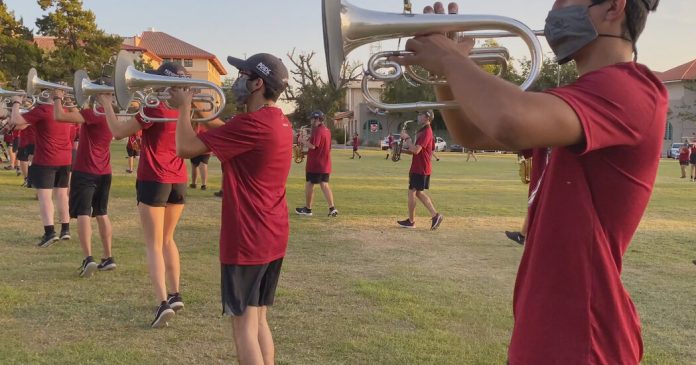
5. What do you think about the innovative ways that student music groups are using to perform together safely? What is your reaction to the article?
Going Further
Option 1: What role do arts and extracurricular activities play in your life?
Are you a musician? Do you play an instrument or sing? How important is practicing and performing in your life? In what ways, if any, has the pandemic forced you to change how you practice and perform?
If you are not a musician, consider the role that other arts or extracurricular activities play in your life — and how the pandemic has disrupted those habits.
How have you adjusted over the past several months? What new habits or routines have you had to create? If you want, you can share your thoughts and ideas in the comments of our related Student Opinion question: What Habits Have You Started or Left Behind in 2020?
Option 2: What role does practicing and performing together with others play in your life?
The article states:
The Northern Virginia Community College campus in Annandale, Va., is home to a thriving symphony orchestra, open to students and members of the community. Despite having fewer resources and a smaller music department than most universities, it has the support of Reunion Music Society, a local nonprofit group that helped it reach record enrollment this year.
“This orchestra would not exist without community involvement,” said Ralph Brooker, president of Reunion Music Society and principal cellist in the orchestra.
This fall, the conductor, Christopher Johnston, has been organizing about 50 active orchestra members, who include older musicians, into small groups. Some rehearse six feet apart in carports and church parking lots, but most use JamKazam, a video chat platform that allows musicians to see and hear each other in real time.
The technology is imperfect. At a jazz group meeting, JamKazam kept booting Mr. Johnston off the call. The musicians turned to Zoom, where audio lag caused the individual parts of “My Funny Valentine” to trip drunkenly over each other. The song was barely recognizable, but the musicians grinned in their little onscreen boxes — the thrill of playing together had not been dampened.
“There is therapy in getting together with other musicians.” Mr. Johnston said. “It’s helping us cope with all of the negative byproducts of this time, one of which is loneliness.”
Respond to the quote at the end of the excerpt: “There is therapy in getting together with other musicians.” Why is it important for many musicians — and for young people in general — to practice and perform together?
Have you found ways to participate in your favorite extracurricular activities — whether they are artistic, athletic, academic or social — with other people during the pandemic? What activities? And what measures are being taken to make sure participants are staying safe?
About Lesson of the Day
• Find all our Lessons of the Day in this column.
• Teachers, watch our on-demand webinar to learn how to use this feature in your classroom.
Universidad de Palermo Announces First Spanish-Language MBA on Coursera


By Betty Vandenbosch, Chief Content Officer at Coursera
Read this post in Spanish.
As COVID-19 accelerates digital transformation, there is a growing global demand for technology-driven business professionals. In Latin America, specifically, there is a critical need for business leaders. For example, the International Labor Organization found entrepreneurial talent one of the most valuable, yet scarce, skills in Latin America.
Today, we’re excited to announce the Master of Business Administration from Universidad de Palermo (UP), one of the top MBA programs in Latin America and ranked No. 1 in Argentina. Because of its focus on in-demand skills, UP Business School has been recognized as the best in Latin America for MBA students interested in a career in finance, technology, and marketing. Available online on Coursera, this Spanish-language degree prepares business professionals for high-level management positions and entrepreneurial endeavors.
Leading UP faculty members teach leadership skills alongside techniques needed to drive digital transformation. The program covers topics such as digital marketing, digital product development, and business analytics. Students develop soft skills through role-play simulations while honing business acumen by working on real-world business projects and companies.
“We are very excited to launch the UP MBA online with Coursera. This partnership reaffirms our commitment to high-quality business education. UP’s MBA program is one of the most innovative master’s degrees in the region, educating leaders and entrepreneurs who make a real impact in their communities. Coursera will allow us to enhance our capabilities, incorporate the best educational technology available, and reach a broader universe of students from around the world,” said Gabriel Foglia, Dean of the UP Business School.
Designed to be completed entirely online, this engaging program will include live sessions so that students can interact with professors in real-time. Students can even combine their online coursework with in-person classes at the Buenos Aires campus. UP also plans to introduce MasterTrack™ Certificates that can count as credit toward the MBA upon acceptance into the degree program.
Globally recognized for the quality of its online education programs, UP has been named the QS-Wharton Reimagine Education Gold Winner, Latin America. It is also Latin America’s most popular university among international students, many of whom can now access this top-quality education from anywhere. We’re honored to partner with UP to enable Spanish-speaking learners across the globe to become business leaders and entrepreneurs.
Applications for the MBA are now open, with the first cohort beginning in May 2021. To learn more, please visit https://www.coursera.org/degrees/mba-palermo.
La Universidad de Palermo anuncia el primer MBA online y en español en Coursera


Por Betty Vandenbosch, Vicepresidente Ejecutiva de Contenido y Credenciales de Coursera
A medida que el COVID-19 acelera la transformación digital, existe una creciente demanda mundial para de profesionales empresariales impulsados por la tecnología. En América Latina, específicamente, existe una necesidad crítica para líderes de negocios. Por ejemplo, la Organización Internacional del Trabajo reconoció que el talento empresarial es una de las habilidades más valiosas, aunque escasa, en la región.
Hoy, estamos orgullosos de anunciar el Máster en Administración de Empresas de la Universidad de Palermo (UP), uno de los mejores programas de MBA en América Latina, que ocupa el puesto número 1 en Argentina. Debido a su enfoque en las habilidades demandadas actualmente, la Facultad de Negocios de la UP fue distinguida como la mejor de América Latina para estudiantes de MBA que desean desarrollar su carrera en Finanzas, Tecnología y Marketing. Disponible online en Coursera, este título en español prepara a los profesionales de negocios para puestos gerenciales de alto nivel y esfuerzos empresariales.
La UP enseña habilidades de liderazgo junto con las técnicas necesarias para impulsar la transformación digital. El programa cubre temáticas tales como Marketing digital, desarrollo de productos digitales y business analytics. Los alumnos desarrollan habilidades blandas a través de simulaciones y role playing mientras perfeccionan su visión de negocios al trabajar en proyectos y empresas comerciales del mundo real.
“Estamos encantados de anunciar el lanzamiento del MBA online de la Universidad de Palermo con Coursera. Esta alianza reafirma nuestro compromiso con la educación en negocios de alta calidad. La Maestría en Dirección de Empresas de la UP se ha consolidado como una de las más innovadoras de la región, formando líderes de negocios y empresariales que generan un impacto real en sus comunidades y una diferencia la sociedad. Coursera nos permitirá potenciar nuestras capacidades, incorporar la mejor tecnología educativa existente y llegar a un universo amplio de estudiantes de todo el mundo” afirma Gabriel Foglia, decano de la Facultad de Negocios de la Universidad de Palermo.
Diseñado para completarse 100% online, este atractivo programa incluye clases en vivo para que los estudiantes puedan interactuar con los profesores y compañeros en tiempo real., e incluso pueden combinarlas con clases presenciales en el campus de Buenos Aires. La UP también planea introducir Certificados MasterTrack™ que pueden contar como crédito para el MBA al ser aceptado en el programa de estudios.
Globalmente reconocida por la calidad de sus programas en educación online, la UP ha sido distinguida como QS-Wharton Reimagine Education Gold Winner- Latin America. También es la Universidad más conocida de América Latina entre los estudiantes internacionales, muchos de los cuales ahora podrán acceder a esta educación de alta calidad desde cualquier lugar.
Además, la Universidad de Palermo es líder en América Latina para estudiantes internacionales, muchos de los cuales ahora podrán acceder a esta educación de alta calidad desde cualquier lugar. Estamos orgullosos de generar esta alianza con la UP que permitirá que estudiantes de habla hispana de todo el mundo se conviertan en líderes y emprendedores de negocios.
Las aplicaciones para el MBA ya están abiertas, con la primera cursada comenzando en mayo del 2021. Para conocer más, por favor visite https://www.coursera.org/degrees/mba-palermo.
Ireland Reaching Out – Connecting people overseas and across time
Ireland Reaching Out (IrelandXO) is a non-profit organisation that has been helping people of Irish descent to reconnect with their ancestors’ place of origin since 2010. The organisation is founded on a vast network of local volunteers, representing the 32 counties, who have a wealth of knowledge with regard to local records and who provide local genealogical expertise. Ireland Reaching Out is delighted to launch its first course with Alison, Introduction to Irish Genealogy.
Tell us a little about the ideas behind Ireland Reaching Out.
Genealogy is one of the top hobbies in the world and Irish genealogy in particular is very popular as more than 70 million people worldwide are estimated to have Irish ancestry. Ireland Reaching Out has built up a robust reputation for helping people navigate the vast amount of family history information online and in doing so has developed a large body of expert advice for those interested in finding out more about their Irish ancestry.
How did you come across Alison, and why did you choose to publish with Alison?
Ireland Reaching Out have relied on Alison to upskill and train staff members in various Microsoft products, such as Excel. Alison is such an intuitive platform, and has such a wide variety of topics, we felt that it was the perfect platform for sharing our genealogy knowledge with a wider audience, and also providing a repository of guidance for our established members, should they feel the need to brush up on their family history skills.
What is the benefit of working with Alison?
Alison allows you to build a course with the content you have already developed, rather than have to create new content specifically for the purposes of online learning. Working with Alison also brings awareness of our IrelandXO.com platform to a wider audience, as well as providing our content for free, which is in keeping with our non-profit and volunteer-led policy of helping as many people as possible to reconnect with their Irish place of origin.
What advice do you have for prospective publishers on Alison?
Do a few Alison courses first. Each is unique and you may find a style that fits your particular type of content, which you can then learn from.
What advice do you have for Alison’s learners?
Focus on the individual topics and not the whole course. Each journey starts with a single step so enjoy the process and celebrate every new piece of knowledge and how it enables you to go further.
Tell us a bit about your new course, Introduction to Irish Genealogy.
Our content has been developed hand-in-hand with some of the top genealogy practitioners in Ireland. The course is designed to introduce key concepts and also to teach research strategies, so you can not only understand what to do but become hands on while you are completing the course. Ireland Reaching Out will assume that our learners know little or nothing about Irish family history, which is why we explain key concepts such as ‘parish’ and ‘townland’, which can often be overlooked by other genealogical learning sources. Not only does this course teach you the fundamentals about Irish family history, it also enables you to create and share profiles of your ancestors online, as well as providing you with a completely free forum for asking questions of the IrelandXO community.
Why was providing the course for free through Alison so important?
The more people who are skilled in researching their Irish family history, the more people within the diaspora can reconnect with their place of origin in Ireland and the community living there today.
