fbpx
Home Blog Page 1390

Lesson of the Day: ‘How the Space Station Became a Base to Launch Humanity’s Future’

0
Lesson of the Day: ‘How the Space Station Became a Base to Launch Humanity’s Future’

5. Mr. Chang writes that the space station has “turned into the linchpin for spurring capitalism in space.” What evidence does he provide to support that claim?

6. What is the future of the International Space Station? What will happen when it is retired? What role will private companies play?

7. The article concludes with the reflections of Michael T. Suffredini, who served as NASA’s space station program manager for a decade, from 2005 to 2015:

Mr. Suffredini said the current trajectory of life in orbit followed the path of previous exploration of new territories. “In any government exploration in the history of mankind, you send out a few people that are government funded to go do a relatively risky thing, just to see what’s there,” he said.

If there’s anything of value, the pioneers follow and eventually the settlers. “In order to establish low-Earth orbit,” Mr. Suffredini said, “we need to get to the pioneering stage, which is what we’re really doing.”

What does Mr. Suffredini mean by “pioneers” and “settlers”? How do you think the experiences at the International Space Station will help the future of space exploration and colonization? What do you think is the legacy of the I.S.S.?

Option 1: Share Your Thoughts.

  • What’s your reaction to the article? What was the most fascinating, intriguing or surprising thing you read? Does it make you more excited about the International Space Station or space travel and exploration in general?

  • In a 2018 Opinion essay, “Don’t Give Up on the International Space Station,” Mark Kelly, a former astronaut who has lived on the space station and the twin brother of Scott Kelly, writes:

It was the United States that led the international coalition of 16 nations to build the space station. Constructing this outpost in outer space took dozens of missions spanning well over a decade to complete, and considerable money. It is clearly one of the more complicated engineering projects humans have undertaken.

It’s not perfect and it’s not designed to last forever, but what the International Space Station offers humans and nations is remarkable: an important opportunity to collaborate on shared scientific goals, mostly free from politics and almost entirely free from the influences of our planet …

But all of this will come to a screeching halt (though you won’t hear the “screech” in the vacuum of space) if the Trump administration ends funding for the International Space Station program beyond 2024, a step it is considering. The reasons are unclear, though President Trump has said that he wants to prioritize human travel to the moon.

Whatever the priorities, this sort of trade-off is shortsighted. Cutting funding for the station, now between $3 billion and $4 billion a year, would be a step backward for the space agency and certainly not in the best interest of the country.

Should the United States government continue to fund the International Space Station? Or is it better to have private companies build and maintain this and new ones? What is the benefit of the International Space Station to humanity and our future?

  • Would you want to visit or spend time on the International Space Station? What do you think you would enjoy most? What do you think would be the hardest part of living there?

  • Make some predictions: Do you think ordinary people (those who are not astronauts) will be living on space stations like the International Space Station in the next 20 years? Do you think you will ever live in outer space in your lifetime?

Option 2: Write a Letter Home — From Aboard the International Space Station!

Imagine you live on the International Space Station: Write a letter home telling friends and loved ones about your life aboard an outpost 250 miles above the earth.

Describe your daily life and routines, such as sleeping, eating and exercising as you float weightlessly in a microgravity environment, the challenges you face, as well the discoveries, joys and beauty you are seeing and experiencing.

For help with your letter, you might start by taking a visual tour of the International Space Station in the Times photo essay “Home Sweet Home in Orbit.” Or, peruse the collection of reflections and thoughts by Times science writers to mark the anniversary in “The International Space Station: 20 Years of Promise, Peril and Fun.” You might also visit the NASA website for more details on the space station and its missions.

Nurture Your Plants and Your Kid’s Curiosity

0
Nurture Your Plants and Your Kid’s Curiosity

Here is a sampling of the week’s events and how to tune in (all times are Eastern). Note that events are subject to change after publication.


Tune in to a concert celebrating art and art museums by the children’s performer Laurie Berkner, who is often called the ‘queen of Kindie rock.’ Dancing is encouraged, as is donating to the Children’s Cancer Research Fund.

When 11 a.m.
Where laurieberkner.com/concerts

Learn to care for your plants during “Making a Home for Houseplants,” a weekly virtual seminar led by the gardener Jocelyn Perez Blanco and hosted by the New York-based Society X.

Experience the “serendipitous discovery” of the X-ray and attend the virtual lecture, “X-rays at 125 Years,” hosted by the Mütter Museum in Philadelphia. The German physicist and engineer Wilhelm Conrad Röntgen first observed the X-rayon Nov. 8, 1895 — he scanned his wife’s hand, among other objects — making Sunday the 125th anniversary. David J. Ballard, an expert in radiation technology, will also take audience questions.

When 5:30 p.m.
Where muttermuseum.org/events


Join in the adventures of The Super Secret Hive podcast with your child. The Hive features six episodes, each focused on a different part of the world around us. Your child will learn about immune systems, the role honeybees have in pollinating, and more. The episode posts include recommendations for further learning and printable activities.

When Anytime
Where kidsavetheworld.com/thesupersecrethive


Hear the “99% Invisible” podcast hosts Roman Mars and Kurt Kohlstedt during a live-streamed interview at the Portland Book Festival. Mr. Mars and Mr. Kohlstedt will discuss their new book, “The 99% Invisible City: A Field Guide to the Hidden World of Everyday Design,” with the writer Elena Passarello and the radio host Luke Burbank; the poet Shayla Lawson will also talk about a new essay collection.

When 2:30 p.m.
Where literary-arts.org/event


Be swept away by the San Francisco Symphony with the premiere of Nico Muhly’s “Throughline,” which was commissioned specifically as a virtual production. Filmed in locations around the world, the show includes solos from eight collaborators. The production, which Mr. Muhly described to The Times as “meaty” and “toothsome,” also happens to be Esa-Pekka Salonen’s debut presentation as the symphony’s music director. The show will remain on the orchestra’s site for on-demand viewing after the premiere.

When 10 p.m.
Where sfsymphony.org


Make a Sunday dinner to rival those of nonnas everywhere with the Gnocchi Quattro Modi cooking class. Laura Scheck, chef and founder of the Brooklyn-based Teaching Table, which offers cooking classes and workshops, guides you and your family on how to make the fluffy pasta with whatever produce you have — sweet and regular potatoes, squash and broccoli stems are all excellent options. No fancy equipment needed, but Ms. Scheck recommends baking or roasting the vegetables before the class begins. The class is $25 per household; registration required and the class costs $25 per household.

When 10:30 a.m.
Where teachingtable.net

An interview with Isabel Abonitalla: Chapter leader, student, and entrepreneur

0
An interview with Isabel Abonitalla: Chapter leader, student, and entrepreneur

We couldn’t be more excited to introduce you to Isabel Abonitalla — a computer science and biology student, programmer, entrepreneur, and one of the leaders of Codecademy’s CUNY Tech chapter. CUNY Tech is the Codecademy Community chapter made up of the schools in the City University of New York school system, led by Isabel and a team of 4 other students.

In addition to helping to lead the CUNY Tech chapter, Isabel is active in various tech communities, and also the co-founder and Executive Director of HackGuild, a nonprofit that aims to increase access to tech education. We interviewed Isabel to learn more about her nonprofit, the CUNY Tech chapter — and the importance of community in general!

Check out the interview below and, if you’re inspired, head over to find a Codecademy Chapter in your area — or start your own!

Tell us about yourself!

I’m a junior studying computer science and biology at CUNY Hunter College. Outside of academics, I am very active in my community. I also run a nonprofit that aims to increase access to tech education. I am also a mentor to high school students, for technical projects, college applications, and general professional development. I am also a gamer and an anime fan. My favorite game is Breath of the Wild, and my favorite anime is Fullmetal Alchemist: Brotherhood!

Tell us about HackGuild!

I founded HackGuild, a nonprofit that aims to increase access to tech education. We plan on doing that by hosting hackathons, workshops, speaker series, and other events as well as providing 1:1 mentorship to high school students, especially those from underrepresented minorities and low-income communities.

We are currently a team of 20 high school and college students, and even though we’re fairly new (we officially started in May!) we’re all doing our best because we believe in our cause and enjoy working with our team.

We’re actually in the middle of a fundraiser to gain nonprofit status and tax exemption, as well as provide financial aid to our event organizers. You can learn more here.

What interested you about computer science?

My career interests actually started in biomedical research, but my second research internship involved data science so this introduced me to the world of technology. I was fascinated with the applications of tech in other industries and how much it was capable of doing. I was able to create graphs and build machine learning models within a few lines of code and that was exhilarating! Since then, I have been exploring the different tracks I could take within technology, particularly data science, front-end development, and product management.

What’s your favorite thing about coding?

I enjoy creating projects that solve real-world problems, and I have done that through my 21 hackathon experiences. I like knowing that what I create can make an actual difference. Coding itself is very rewarding, especially getting it to compile or render correctly after working at it for so long. It is such a satisfying feeling! I also love the fact that I can get results so quickly; I write the code and it can reflect changes almost instantaneously (in the case of React’s hot reloading).

What has your experience been with tech communities?

I am both a leader and a member of various communities. I am the founder and president of Hunter College’s Google Developer Student Club, the vice president of the Open Source Club, and the lead of the CUNY-wide Codecademy chapter. I also created a discord server of over a thousand students geared towards professional development. Even my nonprofit has a discord server for its students. I am also a member of the Purple Hydrangea Project, a nonprofit and community that aims to increase awareness of mental health in youths, Rewriting the Code, #BUILTBYGIRLS, NCWIT, Becoming Businesswomen, The Loop, as well as my school’s ACM, WiCS, and E-sports and Game Design clubs.

Communities are so important because they provide a safe space for people to connect with like-minded individuals, get support and guidance, and bond over shared interests. My communities have been so helpful to me in terms of my professional growth, but also just to have people to talk to despite being in isolation.

What has the CUNY Tech chapter been up to?

So far, we’ve been having weekly study hours for students to bring their projects, or Leetcode problems, or even just their homework, and we can work through them together in what counts as a social setting in this new normal.

We also had a blast during MLH’s Local Hack Day. We participated as one Guild and got really close to Top 10, going toe to toe against significantly larger and more technical schools. It brought out our competitive spirit, while still giving us a chance to learn a lot from the workshops offered at Local Hack Day: Learn. My chapter and I learned a lot from that week, and we grew closer as a chapter because of the activities that we participated in.

People coming into the chapter can look forward to a vibrant community, where we welcome all skill levels and tech interests. While our main focus is our collegiate audience, we welcome anyone who wants to join our community, regardless of educational background. You can expect that we are more than just our events, but we are a community that prioritizes your learning experience while socializing or sharing resources and memes.

Brands That ‘Spread Joy’

0
Brands That ‘Spread Joy’

Students in U.S. high schools can get free digital access to The New York Times until Sept. 1, 2021.

Did you know that there is a fleet of Oscar Mayer Wienermobiles — automobiles that look like 27-foot-long frankfurters — that have been driving across America since 1987 to spread “brand awareness”?

Have you ever seen one? Do you think if you did it would make you smile — and associate those good feelings with the Oscar Mayer brand?

In your view, which other brands do a good job of bringing “surprise and joy” to customers? How do they do it? Is it their social media presence? Live events? Funny ads? Something else?

Tell us in the comments, then read the related article to learn more about today’s Wienermobiles.


About Picture Prompts

• Find all our Picture Prompts in this column.
• Have an idea for a Picture Prompt? Tell us about it.
• Teachers, discover more ways to teach with our Picture Prompts and learn how to use our free daily writing prompts for remote learning.

Students 13 and older in the United States and the United Kingdom, and 16 and older elsewhere, are invited to comment. All comments are moderated by the Learning Network staff, but please keep in mind that once your comment is accepted, it will be made public.

Word + Quiz: rarefied

0
Word + Quiz: rarefied

1. of high moral or intellectual value; elevated in nature or style

2. having low density

_________

The word rarefied has appeared in 99 articles on NYTimes.com in the past year, including on Oct. 27 in the book review “Shifting the Focus From Sylvia Plath’s Tragic Death to Her Brilliant Life” by Daphne Merkin:

What becomes a legend most? As suggested by the old black-and-white Blackglama fur ads, featuring Lena Horne, Diana Vreeland and Cher, among others, legends are people who have soared beyond fame or celebrity into a more rarefied, inaccessible stratosphere.

Today’s media-fixated, Kardashian-dominated world is filled with all sorts of legends, from the elevated to the base, but I can think of few poets who fit into this category. The exception is Sylvia Plath, who, with her perfect blond pageboy, wide smile and cinched-waist dresses, looked less like a proper poet and more like Doris Day.

_________

Lesson of the Day: ‘How Poland’s New Abortion Law Became a Flash Point’

0
Lesson of the Day: ‘How Poland’s New Abortion Law Became a Flash Point’

Option 1: Learn more.

After reading the featured article, reflect in your journal:

  • What is your reaction to the protests happening in Poland? Do you feel surprised? Encouraged? Upset?

  • Do you support the protesters? Why?

  • Do the events in Poland remind you of anything else happening in the world today or in the past?

On Wednesday, Poland’s government delayed putting the new ruling into effect. In “Poland Delays a Near-Total Ban on Abortion,” Monika Pronczuk writes:

But on Tuesday, the government indefinitely delayed the publication of the court’s ruling, which prevents it from going into legal force, in an apparent response to the protests. For the change to take effect, the government would have had to publish the ruling by Nov. 2.

The government could still publish the ruling at any time, as it has done with other controversial rulings, even though legal experts say that to do so would violate the Constitution.

“A discussion is ongoing,” said Michal Dworczyk, the head of the prime minister’s office. “In this situation, which is difficult and causes a lot of emotions, it is good to give ourselves a bit of time for dialogue and for working out a new position.”

To learn more about what’s now happening in Poland, read the entire article. Here are additional questions to respond to in your journal:

  • What is your reaction to the government’s delay in imposing the ruling?

  • How much of a role do you think the protests played in the government’s decision?

  • What do you think will happen next? Why?

Option 2: Share your opinion.

The recent addition of Justice Amy Coney Barrett to the Supreme Court has increased the chances that Roe v. Wade, the landmark 1973 ruling that established a woman’s right to an abortion, will be weakened or overturned.

After reading the featured article and considering abortion laws in Poland, read these two excerpts from The New York Times Opinion section, written by people in the United States with different views on abortion.

In a 2019 Op-Ed, “I Am Pro-Life. Don’t Call Me Anti-Abortion.,” Charles C. Camosy, a board member of Democrats for Life of America, writes:

The New York Times editorial board, for instance, recently used the phrase “clusters of cells that have not yet developed into viable human beings,” in a discussion of rights being extended to a fetus in the womb, or what I call a prenatal child.

Language like this ignores the fact that each of us once existed as “clusters of cells that have not yet developed into viable human beings.” It seeks to hide the fact that by the time most surgical abortions take place, a prenatal child has electrical activity in the brain and a beating heart.

Other words and phrases used in the discussion about abortion seek to obscure this reality as well: “tissue,” “part of the mother,” “parasite,” “potential life.” Even the term “fetus” is dehumanizing.

Outside of an abortion context, an obstetrician-gynecologist doesn’t generally speak to a mother about her fetus. She talks to her about her baby. Family and friends organize baby showers, not fetus showers. A mother-to-be has a baby bump, not a fetus bump. She is “with child,” not “with fetus.” It is not unusual for major news outlets, such as the BBC, to use the phrase “unborn babies” when they report on new prenatal surgical techniques.

We have shifted our language in ways that hide the dignity of the vulnerable, in this instance and on issues far from the abortion debate as well. This is part of what Pope Francis calls “throwaway culture.”

Mr. Camosy’s Op-Ed continues:

A genuine concern for justice for the most vulnerable — one directed at something other than advancing a particular political agenda — must resist throwaway culture across issues that transcend our crumbling right-left politics. People who are committed to justice for the most vulnerable will be on the alert for dehumanizing language intended to confirm biases and serve the interests of those who hold power over the weak.

Doing so is particularly important at this moment. We are likely to see a newly intense debate over abortion at our newly constituted Supreme Court. If we are to avoid the hopelessly stale culture-war debates of the 1970s, then we must refuse the false choice between supporting vulnerable women and protecting vulnerable prenatal children. It will mean genuinely wrestling with the complexity of doing both. And it will mean engaging the arguments of our perceived opponents in good faith.

Next, read an excerpt from the Op-Ed “I’ll Never Be Ashamed of My Abortion,” written in January by Ylonda Gault, an executive at Planned Parenthood:

If our constitutional right to safe, legal abortion is not upheld, more than 25 million Americans of reproductive age could lose the freedom to decide when and if to have a child. What I took for granted — the freedom to have agency over my body and life choices — is a right my daughters and their daughters may well be denied.

Roe has never been perfect. The right to safe, legal abortion didn’t mean equal access to it. In communities where people have low incomes and in many areas where Black and brown people live, the cost of abortion often makes it out of reach.

So this anniversary should be about protecting and expanding the health and freedom of all people — regardless of their race, income, gender identity, sexual orientation, abilities or immigration status.

In a new short documentary film, “Ours to Tell,” which will be shown at the Sundance Film Festival next week, we see how access to abortion should play out. The movie depicts four people: myself, another Black woman, a nonbinary trans person and a Latina. It celebrates the full and empowered lives each of us is now able to live because we had agency.

This is not complicated or political. When you have bodily autonomy and the freedom to get the health care you want, need and deserve, your whole world changes and you are able to thrive.

Nearly 15 years after my abortion, I am at peace. I now have three children, ages 12 to 20. The most important gift I can give them is the best me I can be. My daughters and my son know I had an abortion just as they know I have a mole on one side of my face, and dimples.

My abortion is a part of me, my story. And I have no shame that I made the best decision for myself, my family and our future.

Whether they yell it from the rooftops or not, many other people have experiences like mine. Research shows the most common post-abortion feeling is relief. Ninety-five percent of us do not regret our decision.

After reading both excerpts, or the two Op-Eds in their entirety, reflect on the following questions in writing or in class discussion:

  • What is your reaction to the two excerpts that you read? Do you connect with one opinion more than the other? Why?

  • How do you think your identity — including your race, gender, class, sexuality, religion — affects what you think and believe about the issue of abortion?

  • What do you know about abortion laws in your country? If you live in the United States, what are the laws in your particular state? If you don’t know the laws in your state, you can look at this chart created by the Guttmacher Institute.

  • To what extent do you think the law in your state or country should protect a woman’s access to abortion? What evidence can you use to support your opinion?

Divided

0
Divided

Students in U.S. high schools can get free digital access to The New York Times until Sept. 1, 2021.

What message do you think this image is trying to convey? How does it relate to or comment on society or current events? Can you relate to it personally? What is your opinion of its message?

Tell us in the comments, then read the related article to learn more.


About Picture Prompts

• Find all our Picture Prompts in this column.
• Have an idea for a Picture Prompt? Tell us about it.
• Teachers, discover more ways to teach with our Picture Prompts and learn how to use our free daily writing prompts for remote learning.

Students 13 and older in the United States and the United Kingdom, and 16 and older elsewhere, are invited to comment. All comments are moderated by the Learning Network staff, but please keep in mind that once your comment is accepted, it will be made public.

Oladapo Onasanya: “I recommend Alison because I got a job thanks to one of my Alison certificates.”

0
Oladapo Onasanya: “I recommend Alison because I got a job thanks to one of my Alison certificates.”

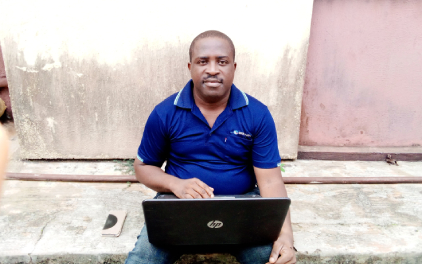
“My name is Oladapo Onasanya and I am from Ogun State in Nigeria. I am a Mathematical Sciences graduate from the Federal University of Agriculture. I am the youngest of a family of five and I am married with kids. I love reading, writing, traveling and meeting people.”

How did you learn about Alison.com?

Seven years ago, a friend posted a link to Alison in a group we both belonged to.


What was your first course in Alison.com and why did you choose it?

My first course on Alison was in Customer Service. I chose the course because of where I was working back then. I was working as a customer care agent with Tech Mahindra Business Group. I needed certification to accompany my practical skills.

How has Alison courses affected your career?

I completed the Customer Service training and then proceeded to do the Diploma in Customer Service. The two courses really helped me on the job as I was able to apply the knowledge gained from both courses and be more professional. I was able to attend to clients over the phone and help them to resolve their issues quickly. I was then promoted from the general inbound call center to the high profile customers section where I was able to handle their calls and meet their needs satisfactorily as well. I have taken several courses on Alison and I still have other courses pending. I take courses when I have to change jobs or when I have to complete a business project and have to update my knowledge and acquire more skills to be able to do it properly. I have over twelve years experience in a variety of roles – customer care, training manager, assistant investment manager, research and monitoring officer – and I am currently working as a business development manager. I have taken Alison courses in Business Management, Operations Management, Sales Management and Project Management, to name a few.

What is your favorite way to relax from studying?

I watch movies, listen to music, play games, go for a walk, or chat with loved ones.


Where are you working and what are you studying now? 

I work with Rockgarden Homecare Agency as the business development manager and I am currently studying the Diploma in Web Business Development and Marketing.

What is next for you, in terms of education or work?

I will continue to learn at my own pace and complete my study of Web Business Development and Marketing. These days, I prefer to work from home due to the unpredictable nature of the unrest in Nigeria, coupled with the fact that my place of work is in another state. I prefer to work from home and be with my family, and only travel to work when it’s extremely necessary.

What will you say to someone if they asked you about Alison? Would you recommend it and why? 

Alison is a high quality online school that gives you the opportunity to learn at your own pace and receive a globally recognized certificate that you can use to get your dream job or get promoted at your current job. I recommend Alison because I got a job thanks to one of my Alison certificates, and I also got promoted to another job because of my Alison certification. Alison has high quality course content. It is very rich in both text and video material and the assessment exams in between and at the end of each course will really test your understanding of the course. You feel fulfilled at the completion of the course and you will add value to any organization.

How to remember everything when learning to code

0
How to remember everything when learning to code

One of the most common questions we hear from Codecademy learners is, how do I remember everything I’m learning? When you’re just starting to learn to code, it can feel a little overwhelming. But rest assured, you don’t have to memorize everything all at once.

8 tips for remembering everything you’re learning

We’ve put together eight learning tips to help you retain as much information as possible and learn quickly and easily.

1. Focus on understanding concepts and ideas

When it comes to learning spoken languages, you need to do more than just memorize the words. You need to understand how the language works in practice. Similarly, when you’re learning how to code you need to understand the overarching concepts and ideas — not just memorize the programming language.

The basic concepts and algorithms of all programming languages are important to understand so that you can make connections across your learning. Once you have a handle on those building blocks, you’ll not only know when to use them, but you’ll also be able to apply those concepts to multiple languages.

For example, if you memorized a standard “if … else” statement in JavaScript, but didn’t understand the overarching concept of conditional statements — or how or why to use them — it wouldn’t do you much good.

2. Apply what you’re learning

We may think we need to memorize code, but that’s not a natural way to learn things. Memorization alone doesn’t do the trick. Application of the new concepts you’re learning is key. It helps build connections in your brain, leading to muscle memory — a much easier way to remember and use new information and skills.

As we mentioned above, if it was easy to learn from memorization, we’d be able to pick up a new language by simply reading the dictionary. But we learn new languages by putting our skills into practice by working on projects. So, don’t get wrapped up in remembering all the language details. Focus on learning new ideas and putting them to use. This is when you start to see how all the concepts you’ve learned come together.

Have you ever struggled to figure out what went wrong in a project? Maybe you were working on a simple piece of code and it took you hours to find that missing semicolon or a capital letter was typed instead of a lowercase letter, throwing off your entire program. It’s those experiences that help you learn and get better — and once you’ve solved them you’ll have an advantage the next time you run into the same problem!

3. View other people’s code

Another way you can learn about how to apply code on different projects is by viewing other people’s projects and codebase. You can use websites like Google Chrome Development Tools and GitHub to view another developer’s projects and code.

By taking some time to see how other people approach a similar project, we can pick up how to apply the concepts and ideas we learned in new and exciting ways. You can download repositories from GitHub to view the code in your text editor and even use the code in one of your projects.

Another method of increasing your knowledge is to be part of a community that will give you feedback on your projects. You can share your code and view feedback on other members’ code. Be open to feedback whether it’s good or bad because it’s all an opportunity to learn and improve. Don’t be afraid to give feedback on other people’s code too, because you can learn a great deal by understanding how someone else approaches a project.

Join the community in the Codecademy Forums to ask questions, discuss topics, and provide answers for others. You can also look for an existing Codecademy Chapter, or start your own, to connect with learners in your local area.

5. Know where to find answers to your questions

Searching for answers to your specific questions is another way to increase your retention. Just like we mentioned above, applying your knowledge will help form pathways in your brain to remember key concepts. You’ll never memorize everything, but you can always perform a quick search online.

There are a number of places you can go to search for answers and help online, starting with communities you’re a part of. Search the Codecademy Forums or, if a post on the topic doesn’t already exist, start a conversation.

You can also perform a search on Google to find answers. For example, you could type: html5 variable examples GitHub. Your search will then direct you to a trusted site (in this case GitHub) for your answers.

6. Compile good resources

When you come across a great resource in the searches you performed above or when you are learning new concepts, store them in a spot for safekeeping and easy access. You can have a file folder on your computer titled “Code Resources” where you can save all the PDFs and documents or repositories that have been most useful, or a collection of bookmarked links, articles, and blogs in your browser.

While you’ll be maximizing the amount of knowledge retention with these tips, you may need to refresh yourself on some concepts and ideas in the future. So, keep these files or links in a spot you can continue to come back to.

7. Take notes

You may have heard this in the past among other learning tips passed down by teachers and fellow learners. Taking notes helps you learn because it turns you from a passive listener into an active learner. When you’re taking notes, you’re focused on what you’re learning, and you won’t be as tempted to zone out or check your phone during a lesson.

Note-taking also helps you to clarify the concepts you’re learning and forces you to write down the most important concepts in your own words. The act of writing things down also helps you to remember things more easily.

8. Practice!

We saved the most important of the eight learning tips for last. As the old saying goes, practice makes perfect. We aren’t aiming for perfection, but if you commit to practicing your skills for just a few hours a week, you’ll be surprised by how much progress you’ll make.

If you take all these tips on your learning journey, you’ll retain so much more, and you’ll enjoy the process. It’s way more fun to work on a project than to memorize code. And joining a supportive community that helps you improve is more enjoyable than doing it alone.

Remember, learning is a life-long journey, so don’t put too much pressure on yourself in the short term. Use these tips to retain as much as possible, but know that there will always be something new to learn. Don’t forget to pat yourself on the back every time you solve a problem or successfully complete a project. You should be proud of all you’ve learned and accomplished.

What does a front-end developer do?

0
What does a front-end developer do?

Thinking about a career in front-end development? We spoke with John Pham, a front-end developer at Smartsheet and formerly at Microsoft, to find out more about his day to day and what he works on in his front-end role. John was a subject matter expert on our brand new Front-End Engineer Career Path.

John got hooked into programming when he participated in a hackathon in college. He was creating art assets for a game and had to learn how to program the art assets into the game. He describes front-end development as “a great combination of being artistic and being able to program.” In our interview, John defines front-end development, talks about how he got started on his path as a front-end engineer, and shares some tips for aspiring front-end developers who are just starting out.

If you’re interested in becoming a front-end developer, the Front-End Engineer Career Path is designed to prepare you with everything you need to get an entry-level job in front-end development.

What does a front-end engineer do?

In the world of web development, there’s front-end and back-end work. On the back end, programmers do the hidden work and processes that run behind the scenes, that the end user doesn’t see.

Front-end development, on the other hand, deals with the parts of a website or application that the end user actually sees and interacts with. As a front end developer, you’ll be working to make websites beautiful, functional, and accessible. A common thing you’ll do as a front-end engineer, says John, is “working with program managers and designers and customers to figure out what’s the best way to implement a solution for a customer problem.”

Is front-end development right for you?

When it comes to deciding between a career in front-end development or back-end development, the creative and visual nature of front-end is often a determining factor. Back-end development relies a lot on problem solving, but you don’t always get the opportunity to see your work, since you’re focused on the processes that happen behind the scenes.

Front-end development, on the other hand, focuses a lot more on creating a beautiful and engaging user experience. Do you view yourself as a creative person and enjoy bringing things to life visually? “A front-end engineer is someone that likes being at the intersection of art and logic,” says John. “So if you like programming, but also like the artistic side of design and working with customers, being a front-end engineer is the perfect role for you.”

Front-end developers are also very involved in the user experience, and oftentimes work closely with designers and customers to help create the best solutions for customers. “My favorite part about being a front-end engineer is being able to work directly with customers and designers to figure out all of the fine details that end up creating the best user experience,” John says. “That’s one of the most rewarding aspects of being a front-end engineer.”

Advice for aspiring front-end developers

Interested in pursuing a career in front-end development? Start with learning the basics — HTML. CSS, and JavaScript. Then, put what you’re learning into action by building real projects.

“One easy way to get started is just to build your own personal website,” says John. “Your website can be an expression of who you are or what you want to do.” As you work on building your website you’ll learn by doing and gain confidence through experience. Once you’ve built the website, says John, “That’s an awesome way to start marketing yourself.” It’s an example of your work and shows potential clients or hiring managers what type of work you can do for them.

Getting started

If you’re ready to begin your journey towards becoming a front-end developer, our Front-End Engineer Career Path is the path for you. This Path will take you through everything you need to know, from how to build and deploy static web pages to design skills to make your webpages beautiful and usable. You’ll also learn interview techniques and build your portfolio so you can start applying for front-end development jobs. Get started here.