Where do you start? How do you explain why these three vendors were selected, how the process for analysis was conducted, and what are the results?
How do you provide enough information, without writing the next War and Peace?
Here is how.
What is this?
It is a first for me. Well, not the first time conducting an analysis such as this, rather the first time it has been conducted specifically for a blog post, and the first time, three vendors are in one blog with comparison and assessment as the key cornerstones.
Why these three vendors?
Simply due that when a consumer is looking at an LXP, or say Degreed or EdCast or Fuse, the other two vendors are part of the final process. I hear this from readers. From the vendors themselves and even in conducting my own research into vendor comparisons.
I see it in FindAnLMS too.
Key Terms to know here – as it relates to NexGen Tier 4 and presented in a few sections on the post.
Video Assessment – A video assessment is based on speech patterns/words used when practicing a scenario, sales training techniques, customer service techniques to the coach/mentor/manager. A VA component will always include a listing of overused words, words that are difficult to understand, a transcript with highlighted words (so the learner knows), and a form of metrics visual via data visualization on the learner screen.
vILT – The instructor/presenter/trainer appears via a web conferencing tool through the system, or on some other virtual tool/system, and conducts the session online. It is a new term in the e-learning space.
UI – The term refers to user interface which is not a new term, but as it relates to NexGen Expands the capabilities, every vendor will tell you they have a modern UI, the latest capabilities with UI in T4, will explicitly tell you, how true that statement really is.
Weaknesses
No system is perfect, and every system has a weakness, some of those will eventually change (due to the feature being on the roadmap), others won’t.
Among these three vendors, despite the hype, here are there weaknesses
Fuse
Skills development features are nearly non-existent. Of the nine I specifically looked at (NexGen Tier 3/4), Fuse had only one.
We are not talking about skill items that are so out of the ballpark that vendors wouldn’t have them, already. Sure, a couple make sense on the roadmap, but others?
Skill Features that Fuse does not have (they are all on “the roadmap”)
- Match a skill or a series of skills to a piece of content/a playlist
- Track skills by content
- Learner can rate their own skill(s)
- Ability for a pre-assessment to identify skill strengths and areas to improve
- Administrator can create, edit, delete skill rating(s)
- Manager can create, edit or delete skill ratings for their own team
- System can generate a playlist based on skill rating, skill level or any other skill related variable (achieved via machine learning)
- Skills tied to job roles/job profiles, which can be used to submit to jobs within the company (if applicable/available as part of the system)
It should be noted, that the above would exist if the system has the job application capability or along those lines in the system. Overwhemingly, the latter is not common, albeit, the ability to tie Skills to job roles and job profiles is on the upswing as a feature.
Degreed offers the entire Skills tied to job roles/profiles which can be used to submit thing, but it is an additional cost – known as Career Mobility (aka as Opportunities). EdCast is similar, an additional cost known as Career Mobility.
The skill feature that Fuse does have?
- Allow managers to assess an employee’s existing skills – available via Observations.
When comparing Fuse to Degreed and EdCast, and the skill management (of which skills development exists within), Degreed and EdCast scored far better.
Degreed lacks only the following
- Administrator can create, edit, delete skill rating(s) – It is on their roadmap.
EdCast
- Administrator can create, edit, delete skill rating(s) – Also on their roadmap
- Manager can create, edit or delete skill ratings for their own team – On their roadmap
The “Administrator can create, edit, delete skill ratings” – is a high tier 4 feature, so the majority of vendors lack it. Some can edit the skill rating – the administrator that is, but the other items, still a work in progress, expect that to change by mid-2021.
Fuse Weakness(es)
- E-commerce – Because Fuse is not an LXP, but rather a learning ecosystem, not having this feature set is baffling. If I was considering Fuse for customer education/partner training, or for an association, and I needed e-commerce, I’d look elsewhere.
- vILT – As in virtual instructor led training, with the exception of a connector to Zoom, and the ability to schedule vILT sessions, this section is very poor.
- Video Assessment – Below Avg.
Degreed Weakness(es)
Four areas stand out.
- MS Teams feature sets – Zero or as they say “not at this time”.
- vILT – Nearly zero. This is for virtual ILT.
- Video assessment – Pretty much not there. Okay, none of it is there.
- E-Commerce – The majority is a no. I am aware that Degreed can state that they are not an LMS and thus, why should they have this, but you can’t say we are a vendor to consider for customer training/education and not have this offering. I should note, that you can have it with Degreed if you use an e-commerce capability either in another LMS or learning system and want to connect/integration route OR if you have an e-comm capability in some other solution and wish to integrate or connect.
EdCast Weakness(es)
Video Assessment is seriously lacking, with “on the roadmap” common. Video management has a few “on the roadmap” as well.
The Video Assessment section is a higher level Tier 4 NexGen feature set, so it is not surprising that it lacks across the board with all the systems. Very few systems in the entire industry (globally, learning systems) offer it, but that will change by the end of 2021, where I am projecting at least 15% offering it. That may not seem like a lot, but right now we are around .01%, for a market that is more than 1300 systems worldwide. Those that do offer it, will clearly have an advantage in the entire learning system space, it is that important.
Comparision Time.
Best way to show is well, show via a table. I picked out a couple of specific areas.
The first column is the features under a specific category, the next column is EdCast, then Degreed in the third column and Fuse in the fourth column.
| Learning Environment | EdCast | Degreed | Fuse |
| Ability for development paths or curriculum/learning paths to have contents placed in a specific order/hierarchy of learning | Yes | Yes | Yes |
| Individualized learning plan (including required courses and optional courses selected), to-do list or similar appear on the same screen | Yes | Yes | On Roadmap |
| Customizable homepage that is a different look/appearance/theme based on the learner who logged into the system | On Roadmap | Yes | Yes |
| Ability to search by TAG and/or Click a TAG to see other/similar content with that TAG | Yes | Yes | On Roadmap |
Big Pluses are the TAG feature in the learning environment, and the ILP features. The ILP capability is a must, and the TAG is something each system in the industry should strive for, as it makes a huge difference, after all “Search” isn’t utilized as most people think.
The customizable home page is a nice plus, but none of the vendors have the “Theme” option”, which to me, is the key, and allows the end-user to have a different and personal theme if you will (the system has pre-set templates with colors, hence theme). When you think about people who want a system now and do not want to wait months, a theme is a plus.
Development paths is a must feature.
Playlists/Channels – Systems today, should offer this type of UI/UX capability.
| Playlists/Channels | EdCast | Degreed | Fuse |
| Assigned learning playlist | Yes | Yes | No |
| Learners can add Podcasts to their playlist | Yes | Yes | Yes |
| Learning System vendor creates curation content playlists | Yes | Yes | On Roadmap |
| Learner can create their own content playlist and share it with others (who may subscribe depending on system) | Yes | Yes | Yes |
| Learner can create multiple playlists | Yes | Yes | No |
| Manager can create playlists for their direct reports | Yes | Yes | Yes |
| System can use job roles and/or skills to identify and present recommended or suggested content (constantly updated) | Yes | Yes | Yes |
Every system does extremely well here. The Podcasts is a sweet offering to have, plus in my book. For skill development, all are pluses. Personally I am not a fan of assigned learning in the LXP market, which is why many vendors are ditching the term, after all, you can’t be learner driven (a pitch often used in the LXP early days), and then offer assigned learning.
Content Curation
All the rage, and every vendor offers it, but in the table below, please note this is the next evolution of CC in learning systems, again, NexGen Tier 4. One area to watch by the way with CC is the demand from the market for learners to become content builders/creators if you will. This will be a hot feature in 2021, and when you are creating your own content, uh, content curation is an important component.
| Content Curation | EdCast | Degreed | Fuse |
| System offers contextual actions | Yes | Yes | Yes |
| System can generate recommended content via the machine learning algorithm | Yes | Yes | Yes |
| Client can create their own courses (via system or 3rd party) and sell them on vendor’s course marketplace – to other clients in the vendor’s system | Yes | Sort Of | No |
| Content excluding courses can be listed in the trending/Most Popular and/or Recommended | Yes | Sort Of | Yes |
Degreed and “Sort of”
To deliver the capability of the client being able to create their own courses and sell them on the vendor’s marketplace, you have to be an Extended Enterprise (aka as customer training/education, partner training, and in some cases an association), and it will require a custom integration with a third party provider.
For the “content” excluding courses can be listed in the trending/most popular and or recommendation, with the Degreed system, the administrator achieves this via custom links available only for appearance on the home page.
Machine learning often referred to as A.I. or AI in the learning system industry continues to improve. The feature sets below are NexGen Tier4, and I’d recommend that you want your system to either have any of the following on their roadmap or in existence. In 2021, you can expect to see many of these showing up in more and more systems.
| Machine Learning | EdCast | Degreed | Fuse |
| AI in system can scan documents, courses, content, audio and video files and produce text results in a transcript or similar items | Yes | No | Sort Of |
| Recommends courses/content based on job role, skill and/or additional variables | Yes | Yes | Yes |
| Can create a learning path based upon recommendations using algorithm over a period of time | On Roadmap | Yes | No |
| Recommends content/documents/videos/etc. based on in progress/completed courses or content | On Roadmap | Yes | Sort Of |
| Ability to include other items to enhance recommendation of courses/content | Yes | Yes | On Roadmap |
The AI scan is one of the most popular filters in FindAnLMS by consumers. It is also a capability that is already showing in quite a few learning systems, and one that you want to tell your vendor you want. Trust me, on this.
Skills recommendation for machine learning is a must as well, and each vendor above offers it.
Anyone in L&D, training, even HR ideally wants to have more and more automation, well, the ability to create a learning path based on recommendations using the algorithim is a huge plus in this direction. That said, as with anything there are “caveats” here.
- Recommended shouldn’t be based solely on someone having to complete the content. WBT i.e. online learning was designed for the learner to not have to complete the content, rather focus on what they want/need to learn – which drives interest and retention. As I always say, if I only want to learn how to do labels in Excel, why do I have to learn how to open a file? Degreed requires you to complete the content, which is achievable simply by clicking “mark complete”.
- Assigned learning can skew the recommendation engine. If you are assiging the same content to 50,000 learners, and the learners are picking their own content too, what do you think is going to show up in the recommendations? Can you say content based on the assigned?
Fuse Sort Of
- For the AI scan – Available only with videos. The system though will generate a text transcript for the video content.
- Fuse’s system plays heavily around “communities”, so you need to be a member of at least one community.
- Regarding the “recommendations”, Fuse’s is based only on “popularity” and what they deem “freshness”, which one can surmise is tied to how new it is.
Microsoft Teams Integration and Capabilities within MS Teams
If there was any one item that took off in 2020, it is Microsoft Teams and from the learning system standpoint, what features/capabilities could someone do, if they stay in Microsoft Teams and work/access learning without having to leave to go to the learning system itself.
| Microsoft Teams | EdCast | Degreed | Fuse |
| Connector to Microsoft Teams (client only needs to know their username and password for access into MS Teams) | Yes | On Roadmap | No |
| View content by end-users (any type) | Yes | No | No |
| Mimics the learning system, within the end-user appearance on MS Teams. Example: (shows playlists, etc.) | Yes | No | No |
| Ability to stay in MS teams, take/complete any type of content, surveys, assessments, and never have to login to the learning system (Data is automatically pushed into the learning system) | Yes | No | No |
| Learner Data is captured and tracked from MS Teams into Learning System. Ability for administrator to view MS Teams metrics. | Yes | No | No |
| Manager capabilities that mimic what is seen in the learning system (never has to login to the learning system) (data is automatically pushed into the learning system) | Yes | No | No |
| Instructor capabilities that mimic what is seen in the learning system (never has to login to the learning system) (data automatically pulled into learning system) | Yes | No | No |
| Ability to connect MS Teams learner data into any 3rd party HCM/HRIS/Talent Mgt (Push data in, pull data from these systems back into MS Teams) | Yes | No | No |
| Ability to mimic learning system through the MS Teams mobile app | Yes | No | No |
The EdCast capabilities within MS Teams mobile app is the most impressive capabilities I’ve seen so far in the entire learning system space. It looks fresh, easy to navigate around, and offers the exact same UX that you would see in the EdCast platform.
Microsoft Teams is going to continue on the upswing. This not going to be a blip on the radar here.
Virtual ILT (vILT) is a necessity in today’s new business environment. The days of attending a physical ILT F2F session are gone. Even after companies offer employees to come back into the office, the majority won’t, highly unlikely in 2021, and even thereafter not the masses by any stretch.
Remote workers are tapping into vILT, and as a company, if your learning isn’t using or leveraging vILT, then I ask you, what are you doing instead?
Please note these are all Tier4 NexGen feature sets, but are ones you will want in your system definitely before mid 2021.
| vILT | EdCast | Degreed | Fuse |
| Schedule Virtual Learning Training Sessions | Yes | On Roadmap | Yes |
| Can limit number of learners/attendees to session | Yes | No | No |
| Instructor can generate surveys/polls while session is live | Yes | No | No |
| Instructor can verify learners in attendance, and those who did not login | Yes | No | No |
| System allows for pay or free options to attend the session | Yes | Yes | No |
| Schedule multiple sessions ahead of time (day, week, month) | Yes | On Roadmap | No |
| Built-in video conferencing solution (not through API) | Yes | No | No |
| Show Content (PPT, Video, other) during session | Yes | No | No |
| Learning Paths can be tied to vILT sessions | Yes | No | No |
| Learners can share content with other learners (P2P), during or after the session | Yes | No | No |
| Session is automatically recorded and stored in the system for future access as content that is viewable to learners | Yes | No | No |
| Ability to track a set of data related to attendees and view (Admin, Instructor, Manager) as a report either on-screen or download | On Roadmap | On Roadmap | No |
| Ability to push data from web conferencing solution (via API) back into the learning system | Yes | No | No |
Other Takeaways
A comparision analysis can be quite extensive, so rather than pin point every single item, here are few that stood out.
Analytics and Segmentation
Each of the systems offer BI tool integration and EdCast and Fuse offer a very nice set of analytics and data visualization with segementation. Fuse’s metrics, analytics and robust segmentation is due to the GoodData BI integration that exists as the back-end in this area for Fuse. It is included at no charge in the system, and so when you select analytics/metrics/reporting you will see it. Here is a screen shot. Again, this is in the system, no charge. Fuse refers to it as Universal Analytics.
Fuse
Overview

Content Consumption

The system is setup for a tad over 100 metrics for you to choose from, although there are more than 300 metrics that are doable (you just need Fuse to turn them on).
EdCast has a nice analytics page for the clients, and if you want a BI capability, you can get it – for an additional cost, and the solution is Domo. It is quite popular with EdCast’s large enterprise customers.
EdCast Analytics – That comes with the system (i.e. included at no-charge). EdCast includes a very nice and detailed Skill Graph, listing by skills and users – however, I did not add a screen here, simply because with the demo I was using, I didn’t have enough data to present.
Analytics Home Page
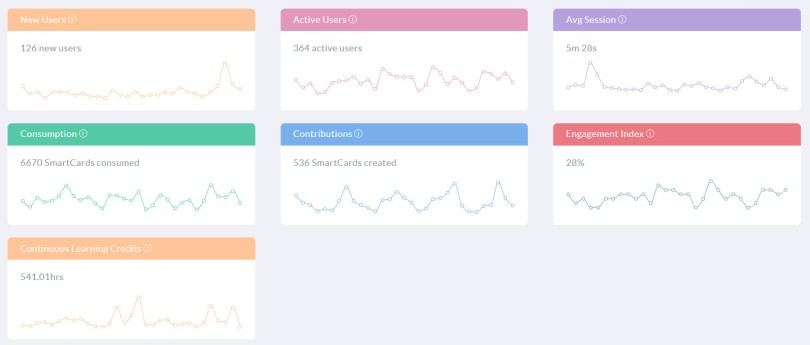
Analytics Options you can choose from
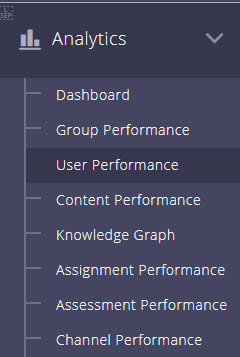
My personal favs were knowledge graph tied to topics of interest/expertise (for everyone, by subject) and/or you can search by end-user and see their specific knowlege topics/expertise
User Performance – I left out the name of the folks and their email address, which appear on the screen.

For those Large Enterprise customers who want to the EdCast Analytics through Domo (it appears within the EdCast platform), here are two screens, one of many I should add.
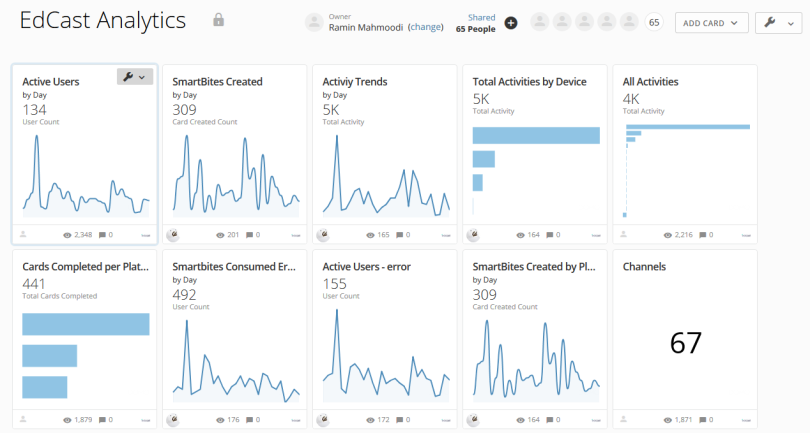
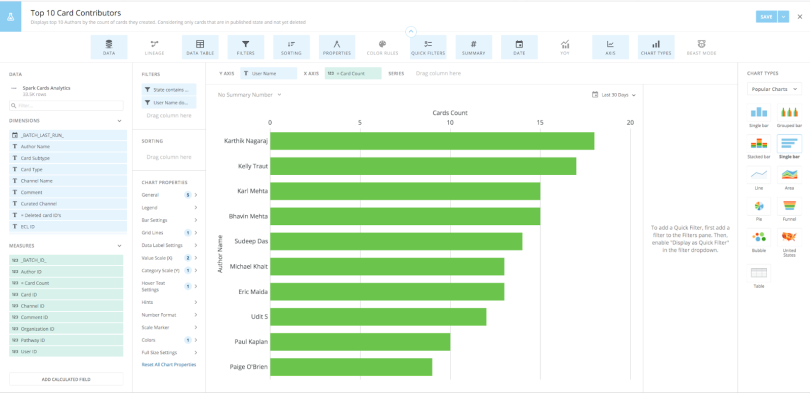
Degreed Analytics
The Learning side – is the section that needs a mass overhaul. Bar charts reign surpreme here, including this one:

The nice pluses are the Top 10 data on the Learning side, but even then – update design please.

Now, the Skills area in “Insights” which is Degreed’s analytics, has gone through an revamp and is really nice. Other charts include Skills growth. Ignore the dark grey you see with each screen, that is due to my capture tool. The view is a white background.

Learner Homepage (the main page)
EdCast uses what is called Smart Cards, Pathways, Journeys and Groups. I found it to be very easy to use and nav friendly. You can create your own content – whether it is through the “Create Content” button in the system OR via MyGuide extension – i.e. known as Content Creator. The extension is an additional cost to use – downloadable in Chrome and will work in Edge too, and is for Enterprise and Extended Enterprise clients only, i.e. if you are using Spark, it is not doable. However, I found the “Create Content” button more than enough to offset the extension.
MyGuide is extremely robust you can create guides following a “how to”, “show me”, “let me do it” angle – for any site that is on net, regardless if you use it for EdCast or not. I liked using it with EdCast personally. The other part of the extension, once added is that regardless of the browser you are using, content recommendations/suggestions will appear on the top of the browser page – all tied to what you are searching for. I really loved that. Then you select it and bam – goes right into the EdCast platform. By far, that was my favorite part.
Degreed’s home page which has gone through a nice update, is very UX friendly as well. If you purchase “Career Mobility”, you will see “Opportunities” as part of your screen, with the skills you have compared to the total skills you need. For example, Project Manager would be skills 6 of 21, which means you have six of the skills needed, but are missing 15.
Degreed’s bookmarklet extension, available in Chrome as well, allows you capture a lot of content off whatever web site you are looking at. Once it “captures” the content – which is really the article or web page or whatever you are looking at, it goes back into the system.
Fuse does not offer a bookmarklet extension, however their home page is very fluid and UX is solid. It has some nice pieces to it, but I felt that an update is needed to keep pace with the overall design in general.
Administration Side
EdCast dominates here, with Fuse and Degreed close behind. Degreed has done a nice job with their updates, but the analytics page needs a mass overhaul, as it doesn’t provide enough information IMO, especially with segmentation of data visualization. At this time, Degreed does not have an LRS, which is a shame. EdCast and Fuse do.
Skill UI/UX for Degreed and EdCast are different in many ways, regardless they both worked for me. Fuse lacks (as noted earlier).
The Latest
Degreed – a couple of new product lines are in the works, okay let’s go with a new branding for the product lines.
Degreed will remain the name of the system, but you will have three product lines under the main name.
- Degreed Learning Experience – This is the name of the learning system. You get quite a bit here, and really it is the Degreed LXP or as they refer to it as “life-long learning platform”
- Career Mobility – An add-on, and thus additional cost. This is the opportunities component, and offers some very nice feature sets all tied around skill requirements, and job roles (new ones actually, that an employee may want to go for at your business). By saying, you need this skill or skills, the employee can start to learn them, etc.
- Skill Analytics – Another add-on, additional cost, that provides a stronger set of analytics, metrics with better segmentation, and data visualization. The analytics that exist in the Degreed LE will still be there, but for Large size enterprises, skill analytics aligns more with a BI experience, which many are seeking.
As of today (August 2020), DLE will be launched the branding of product – by later this month. Skill Analytics is in early access mode, with the plan to go further in November, and a projected launch to everyone in Q1 2021. Career Mobility is in a second phase of access for a select group of clients, with a possible launch for everyone either in November 2020, or Q1 2021.
Premium BI connectors will also be available when SA is launched.
EdCast
The system comes with nearly everything you will need. If you want their career mobility, it is available today, but is an extra cost. Domo the BI tool is also available as well. EdCast sees themselves as a talent experience platform, but do not be scared off, if you think this is talent management focused, it isn’t. Learning/Training is still the king of the system, but there is a trend among very large enterprises to seek a TXP, thing all in one angle.
This trend is not appearing in SMB, mid-market, although it is a mixed bag with the 5,000 to 10,000 employee crowd. I will talk about this trend and others in a future post (in case you are wondering).
The EdCast platform also comes with something called EdCampaigns another very cool feature. Any one who is in L&D and many in Training too, are not known as marketers, let alone have the skill sets of marketing that so many of us need, to attract an audience of learners and have them use the system in some fashion. Hence EdCampaigns.
With EdCast user data and event data, EdCast customers can configure and enable very personalized and targeted campaigns to drive engagement. I like that, a need in the industry.
On the BI tool side, if you are an EdCast customer, you can choose any of the following
- EdCast platform – the main system here with the analytics early noted.
- Premium BI Tools – This is for clients who already use a BI tool and want to connect or integrate it with EdCast’s system. Integration fees apply.
- Domo BI Tool – An additional cost, add-on only available to Enterprise customers
Fuse
Extensive set of connectors are available for you to use, somewhere around 100 or so. The content marketplace (where the client purchases premium content) is solid, but could use a few more providers. The real power of this system is with the communities area, and there is a lot to like here, engagement is the driver and using the community angle brings about higher utilization of the system.
Calling your Remote Workforce
With so many people working from home, knowing the minimum requirements from a browser standpoint, bandwidth (what is the min. net speed you need for video content, and other content for example) is crucial and yet it is rarely, okay beyond rarely, asked in any RFP/RFIs.
Internet bandwidth speed
EdCast and Fuse both say 10mbs is sufficient for video content viewing including streaming. Degreed does not have any specific numbers at this time.
Browsers (Minimum version you need)
People ignore this, even before COVID which really was a bad idea. Because if your browser didn’t support or work with the system, then regardless how wonderful the system is, your employee(s) couldn’t access it.
With remote workers in the new business environment, and with so many browsers out there, knowing this information is crucial.
Fuse
- IE 11, Chrome 71, FireFox 60, Edge – all versions, Safari 12
EdCast
- IE11, Chrome, Firefox, Safari – all versions up to the last three years are supported, Edge all versions are supported.
Degreed
- IE11, Edge 17, Firefox 70, Opera 67, Chrome 77 (Windows 10)
- For MacOS – Chrome 77, Safari 12.1
To update your browser –click this link – it will provide you with the latest browser versions of Edge, Chrome, Firefox, Safari and Opera. IE ended with version 11, so if you are a die-hard IE fan, upgrade to Edge, you will thank me for it.
Bottom Line
Edcast offers Spark, which is suited for SMB, and is quick to setup and go. A little configuration, skinning, branding, included. The EdCast platform allows you to go two routes, either a basic config with skinning, branding, and then any add-ons you may wish OR heavily configurable – which takes a lot longer to build, but it is by far in the learning system space, massively configurable – and not at any additional cost. This way, you may start right to go and then decide you want to go extreme with configurability, OR you can say, I want it this way, then add that way, and then etc.
Degreed is what I refer to as pre-packaged. Nothing wrong with that, but if you are seeking configuration beyond what any other system offers as well (the basics as we call them), it will not be happening with Degreed. Unless of course, you choose to buy the any of the add-ons, and even then, it is an add-on, not mass configuarable.
Fuse is similar is a hybrid, with some configuration going beyond what you can get out of the gate, but by no means at the level of configuration you can do with EdCast.
If I was to publish my 2021 rankings today (as of August, 2020), EdCast would be #1 in the entire industry, Degreed would be #4 and Fuse would slide in at #8.
E-Learning 24/7
Downloadable publication will be available on Monday (see please check back to this post, as the link for DL will be listed, as well as a link out on Twitter, Facebook, and LinkedIn.