fbpx
Home Blog Page 1482

How to help your college access Coursera for free during COVID-19

0
How to help your college access Coursera for free during COVID-19

Bring Coursera for Campus to your college or university by having a professor, department head, or university leader sign up by July 31, 2020.

As of early April, colleges and universities are closed in more than 175 countries, and more than 220 million college students have had their studies ended or disrupted by the COVID-19 pandemic. If you’re a student at a college or university impacted by the coronavirus outbreak, Coursera and our partners want to help you keep learning.

As we continue to roll out new initiatives to support learners across the globe during this crisis, we want to make you aware of two key steps you can take today, starting with helping your school get access to Coursera for Campus.


Coursera for Campus

Coursera for Campus empowers any university to offer high-quality, job-relevant online education to its students. From now through July 31, 2020, this program is available globally at no cost to any university impacted by COVID-19, and provides access to over 3,800 courses from leading universities and companies.


Here’s how to help your university gain free access to Coursera for Campus

To bring Coursera for Campus to your college or university, use this message to ask a professor, department head, or university leader to sign up by July 31, 2020.

The Coursera for Campus learning experience

Once your university signs up, you’ll have access to 3,800 courses, Specializations and Professional Certificates that empower you to: 

  • Learn from leading universities and companies: Stream on-demand video lectures from top instructors in subjects like business, computer science, data science, language learning, & more.
  • Get career-ready: Build in-demand skills in IT, data science, AI, and more with self-paced quizzes and hands-on projects.
  • Explore any interest: Try everything from computer science to creative writing and more with no risk to your GPA.
  • Earn unlimited certificates: Demonstrate your new skills with shareable Course, Specialization, and Professional Certificates for every program you complete.

“Coursera for Campus helped Duke Kunshan University make a quick online pivot when the campus was closed due to the coronavirus epidemic. Faculty benefited from access to a high-quality library of courseware from hundreds of Coursera partners. Students dove right into learning new skills on their own—some finishing four courses in just the first few days.”

—Matthew Rascoff, Associate Vice Provost, Digital Education & Innovation, Duke Learning Innovation


Explore free courses you can start today 

In addition to helping your institution get access to Coursera for Campus, you can also start learning independently today with free courses for college students or other free learning resources that we’re sharing with our community during this time. We also invite you to connect with learners around the world in the Coursera Community, and share your questions, ideas, and comments about how our community can continue to support and learn from each other.

 

Helping governments respond to the unemployment crisis caused by the coronavirus

0
Helping governments respond to the unemployment crisis caused by the coronavirus

By Leah Belsky, Chief Enterprise Officer and Kevin Mills, Head of Government Partnerships

As businesses across sectors lay off workers due to an abrupt economic slowdown, the world faces the biggest unemployment crisis in the modern era. The pandemic has affected the livelihoods of 2.7 billion workers globally. In the U.S. alone, jobless claims have surpassed 26 million.

Today, we are proud to announce the Coursera Workforce Recovery Initiative to help governments worldwide provide unemployed workers with free access to 3,800 online courses. The initiative’s goal is to help impacted workers develop the knowledge and skills to become re-employed. Federal, state, and local governments can sign up until September 30, 2020, and those enrolled by then can learn until the end of the year. The U.S. states of Illinois, Arizona, and Oklahoma, as well as the governments of Colombia, Costa Rica, Greece, Malaysia, Panama, Ukraine, and Uzbekistan will be the first to make the initiative available. Over the next few weeks, more U.S. states and countries around the world will announce the initiative to their people.

Through the Coursera Workforce Recovery Initiative, governments will be able to provide unemployed workers, many of whom lack financial resources, with job-relevant online learning. The 3,800 courses on Coursera, covering critical business, technology, and data science skills, are taught by some of the world’s leading universities like the University of Illinois at Urbana-Champaign, Duke University, University of Michigan, Yale University, and more. The initiative also includes Professional Certificates from industry educators like the Google IT Support Professional Certificate, designed specifically to train people for high-demand jobs. The workforce initiative is part of the Coursera for Government offering, which was launched in 2017 to equip government employees and citizens with in-demand skills.

In an important step towards public and private sector partnerships, various government leaders have made the initiative available to their respective states and countries.

“The State of Illinois is dedicated to supporting the thousands of Illinois workers who have lost their jobs and livelihoods due to the pandemic,” said Governor JB Pritzker. “I am proud to see Illinois join this initiative with Coursera, a company with strong ties to the University of Illinois, to make job-relevant online learning available to help impacted workers re-enter the workforce.”

“The partnership with Coursera, OESC, and OU will help currently unemployed Oklahomans further their career paths and ready them to re-enter the workforce with new, valuable skills,” said Oklahoma Lt. Governor Matt Pinnell. “As we work to revive our economy from the COVID-19 pandemic, partnerships like this will help diversify our economy and create innovative opportunities for businesses and employees alike.”

“The well-being of Costa Ricans and our resilience relies on our focus to prepare for the jobs of tomorrow, which given this situation, are becoming more so the jobs of today,” said President of Costa Rica Carlos Alvarado Quesada. “I am excited to announce that with Coursera, we now have the opportunity to provide our citizens with the technical skills they need to find new, well-paying jobs.”

“We are excited to join this initiative to make online learning widely available to Colombians who have lost their jobs due to the pandemic,” said President of Colombia Ivan Duque. “With access to courses teaching high-demand digital skills, our citizens will be better prepared to return into new jobs and careers.”

Coursera, along with our community of partners, is ready to serve the millions of workers who have lost their jobs and are going to have a hard time returning in a slow economy. We are honored to help governments around the world in their efforts to alleviate the impact on communities hardest hit by the pandemic.

For more information, please visit https://www.coursera.org/workforce-recovery.

8

Teachers and Students Describe a Remote-Learning Life

0
Teachers and Students Describe a Remote-Learning Life

This article is part of our latest Learning special report, which focuses on the challenges of online education during the coronavirus outbreak.

We asked teachers and college students about their experiences with the change to online instruction. The Learning Network, a site about teaching and learning with content from The New York Times, asked students in grades K through 12 how they have been coping with remote learning. The following comments have been edited and condensed.

So much of what we do in classrooms are driven by student responses and reactions. I’d give anything to watch their faces light up, their hands in the air, their smiles and fist pumps when they share a new learning or big idea with me. – Meg Burke, teaches grades 3 through 8, Doylestown, Pa.

Here I am, at 66, within a year of full retirement, having to learn how to use Google Classroom with 35 first graders at various places in their learning. I feel as though I am attempting to drive on a road that I am simultaneously paving while also following a paper map. – Janet Kass, teaches first grade, Bloomingburg, N.Y.

Over 80 percent of the students at my school come from low-income families, and only a quarter of my students have a computer at home. For economically disadvantaged students, this outbreak means they will fall even further behind their wealthier peers. – Kaitlin Barnes, teaches fourth grade, Baltimore

Dear Parents: I promise you that we have your child’s best interest at heart. We worry about them, we miss them, we want more than anything to be back in the classroom. We don’t teach because we like figuring out how to work Zoom, we don’t teach to stare at a screen all day, we don’t teach to field an onslaught of emails each day. We teach because we love your children. – Kara Conceison, teaches sixth grade, Watertown, Mass.

I work with continuation high school students (where I have been for 23 years) who have a deep connection to our school, and I know we all feel lost, lost without the daily hugs, fist bumps and dose of reality we try to provide to each other. – Gregg Witkin, teaches grades 10 through 12, San Jose, Calif.

I miss getting to celebrate with them, cry with them, laugh with them. These are memories with my seniors that I will never get back. That is what hurts the most. – Stacey Travis, teaches high school math, Maryville, Tenn.

I miss real conversations with my students, about anything, but particularly about their writing. It doesn’t seem like students have any motivation to participate in things outside of school. – Matthew Ebersole, teaches eighth grade, Gloucester, Va.

Teaching involves human connection, and I feel like that’s been taken away from me. – Mathew Kennedy, teaches grades 7 and 8, New Orleans

My students are eighth graders. They may not be learning as much history as my former students, or writing as many essays, but they are LIVING history right now. But they’re learning so much — resilience, time management and how to be responsible for their own learning. – Lauren Brown, teaches eighth grade, Oak Park, Ill.

I believe that this distance learning has enhanced portions of my teaching. I am now allowed to utilize technology that perhaps I haven’t had time to before. I’ve also noticed that my students who struggled academically in class are excelling online. – Jodi Ramos, teaches sixth grade, San Antonio

No amount of online instruction can replace the power and potential of student-teacher relationships and the learning that happens in that context. Both teachers and students are the lesser for that. – Joshua Fleming, teaches ninth grade, Redmond, Wash.

I attempted a Zoom discussion about the end of “A Midsummer Night’s Dream” with my eighth graders. In response to my questions, I heard two or three strong ideas and a parent asking about chores. It made me a little sad, since the play is always a favorite of ours, and our study of it ended in such an anticlimactic way. – Pauline Brew, teaches grades 6-8, Columbus, Ohio

I have had more free time, but I feel less productive, taking more time to complete each assignment (however this hasn’t necessarily led to better results). I very much miss the social aspect of school. – Ariana Oppenheimer, 15, The Pennington School, Lawrenceville, N.J.

I believe that I have it very lucky and I know that some of my peers are struggling a lot. I know that my school is trying very hard to help the kids, like providing food for children that relied on school lunches and having a curbside pickup for laptop rentals. – Morgan Sharp, 15, Anna High School, Anna, Texas

Me and my friends often have to work for quite a long time, like at least 5 hours on all the assignments. It’s really boring to read the lesson info by yourself and then apply it to your assignments. I feel like this is the hard part. The good thing however, is that we don’t have to wake up at a certain time, so we are at least now getting enough sleep. – Danny Peng, 13, William Alexander Middle School, Brooklyn

Remote learning has introduced a new classroom dynamic, in which the inability to see one’s classmates/students causes classmates to begin speaking at the same time (and consequently stop speaking) and teachers to move on to the next subject despite a student’s hurried attempt to type their question into the chat box. – Cindy Li, 16, Glenda Dawson High School, Pearland, Texas

I have committed to college, school has been canceled (any student’s dream), and ice cream can be eaten for breakfast, lunch, and dinner. So why do I still wish that I was back in school? – Ethan Turkewitz, 17, New Rochelle High School, New Rochelle, N.Y.

There are some distractions when learning at home. Since everyone is required to do remote learning, it can be really loud if there are people in your house who are also doing the same thing. – Alvin L., 14, William Alexander Middle School, Brooklyn

Since my school has started online class it’s been harder to motivate myself to work and pay attention. I also miss my art elective. We had our first online art class today and it was only 20 minutes long which was strange because it’s usually two hours. – Alexis Jennings, 16, School of the Woods High School, Houston, Texas

It can become very stressful to completely shift our schedules and our academic plans. Due to this, the one day at a time method has become extremely helpful for me. – Valeria Casas, 17, Glenbard West High School, Glen Ellyn, Ill.

At the beginning I was so confused and didn’t know how to work anything and set up my Google classroom for different classes, and keep track of all the homework. But I’m getting the hang of it. Hopefully things can go back to normal, because I miss going to school. – Mia Mohamed, 13, Middle School 51 William Alexander, Brooklyn

Online school has been a stressful process for many of my friends and me. I live in an area where internet access and Wi-Fi are hard to get and, as a result, I’m not only stressed about school but I’m often anxious that I will not be able to join and maintain access to online classes and assignments. – Kitty Evans, 16, The Pennington School, Stockton, N.J.

Remote learning has been difficult for me. I have encountered obstacles such as slow internet, procrastination, and feelings of isolation from my friends and family. While technology does allow us to interact with each other somewhat effectively, it should not replace face to face interactions. – Argelina Jeune, 15, Valley Stream North High School, Valley Stream, N.Y.

I wake up every morning and do homework all day long. I thought having all my classes online would make my life easier because I’d be able to work ahead, but I’m actually falling behind. – Laney McDermott, 17, Williams High School, Burlington, N.C.

I was studying abroad in Buenos Aires and was sent home after 17 days. I am now living at home, taking classes in Spanish about Argentina online and struggling to get a refund for room and board from my study abroad program. However, all in all I have been incredibly lucky as no one in my family is sick, and I’m not worried about where my next meal or paycheck is coming from. – Pearl Sullivan, Atlanta, Elon University

I’m an international student, so I had to go home. The time difference is nine hours, so all my classes are at night and extend into the early morning. I’m studying at desks I share with my brother and dad. My campus bookstore is offering to ship my textbooks for free, but it’ll take months for them to reach me. – Amina Elmasry, Dubai, United Arab Emirates, Northwestern University

My schooling was online already. The difference is now being faced with food and financial insecurity and still being expected to turn in all homework, study topics that are all pretty disturbing (for social work master’s degree) and get projects done on time. – Sonya Davis, San Diego, Rutgers University

My attention span at home is a lot shorter than it is at school since my house was not created to be a school environment. Every time I have a class or I want to get some homework done, there’s always some kind of distraction. – EJ Onah, Ithaca, N.Y., SUNY Albany

I would so much rather be back in class. Online courses are more work that the normal classes. It’s also harder to get feedback on you work. The professors and T.A.s are doing the best they can to support “office” hours, but it’s just not the same. I can’t wait to be back in class. – Howard Lukk, Los Angeles, University of California, Santa Barbara

I am a biology student with the intention of going into medicine after graduation. One of the most important parts of our undergrad education are science labs, which give us practical experience and application of the difficult concepts we learn in our lecture courses. Due to the outbreak, my organic chemistry lab has had to go online, which is essentially an impossible undertaking. All of us are missing out on this essential process of synthesizing our own reagents and running a chemical reaction, replaced by this poor substitute of watching videos and doing worksheets. – Andrei Robu, Greenville, S.C., University of South Carolina, Columbia

My university gave me three days to move out of my dorm. With my parents living 10 hours away, it was terrible circumstances. I had no car to put everything I owned. My boyfriend’s family came in a clutch and helped me move out and let me stay in a spare bedroom of theirs. If not for his family, I would have had no where to stay. The day after I moved my stuff out, Whitmer announced a shelter in place order to start the next day at midnight. I called my parents, and my dad drove 20 hours round trip to get me home. – Karen Larss, Iron Mountain, Mich., Western Michigan University

I am a 55-year-old man who takes two classes per semester after work towards a TESL degree: teaching English as a second language. I enjoy the classroom experience. It is how I effectively learn. Listening to live lectures, asking questions, and speaking with other students about assignments and concepts. Both my classes went online, and I knew immediately that I would have to drop one of them as I was having trouble with the material in a normal classroom setting. I knew that I would not be successful sitting in my living room with all the distractions of home around me while trying to focus on a tough subject. – Kent Shimizu, Santa Clarita, Calif., California State University, Northridge

I do enjoy being able to wake up later because now I just have to log in to a class rather than get ready for an entire day. I can also sleep more, but I still miss the in-person interactions going to class on campus provides. I’m also worried how moving online is going to impact classes that require sequential learning or classes that assume I acquired skills already learned in a prior class. – Kate Carniol, Great Falls, Va., Syracuse University

As a senior, transitioning to online learning has been nothing but difficult. Sometimes I’m not even motivated to do my work. I am a good student, I have a 3.5 gpa but everything is on you now. – Casey Malone, Milford, Conn., Westfield State University

Being at college, I was able to forget the sometimes-traumatizing moments I lived through as a teenager. But now, every part of my childhood home reminds me of the past I’ve tried very hard to move on from. I know I should be grateful simply to have a roof over my head and relative financial security at a time like this, but it’s hard not to let myself get sucked down the rabbit hole of my high school mental health challenges that seemed so far gone while I was living on my own at college. – Kelsey Bonham, Washington, Colgate University

As a theater major, the online curriculum poses particular challenges for my classmates and I, since much of our learning is highly kinesthetic. In my Presentational Styles acting class, we’re performing Shakespeare’s Macbeth via Zoom, and the project certainly loses much of its excitement and immediacy when we aren’t all performing in a room together. Despite these setbacks, I remain impressed by how adaptable and positive my professors have been in approaching them. – Sydney Cahill, New Providence, N.J., Providence College

Our academic advisers are going beyond and above to make sure all students are comfortable with this change. Online tutoring has been implemented for the success of the students. We meet with the president of the school weekly via Instagram live along with our academic advisers via Zoom. I’m a hands-on type of person, and as a member of the Quinnite Nation I am proud to say through these trying times we are an uplifted community. – Pakedra D. McCoy, Dallas, Paul Quinn College

Things are much more self-managed. My emotions toward school range from feeling unmotivated to writing shadow letters to my professors apologizing for my lack of focus. I have always loved school, but this doesn’t feel like learning. My professors try to create normalcy, but there is none. – Alexsis Tarte, Fairfax, Va., George Mason University

I’m a junior, and my anxiety is at an all-time high. More recently, my exams, assignments, discussion boards and document submissions have been piling up. I work at a noncorporate, family-owned, restaurant drive-through full time and go to school full time. With Shreveport and Louisiana becoming a hot spot, I fear I might attract the virus by working, but going to work is my escape from school and general life. – Jacob Pickett, Stonewall, La., Louisiana State University, Shreveport

Going to school filled me to the brim with nirvana, that is, until we switched to online instruction. Now, my education is no longer an escape into “me time” — it is midnight after a long day, dry-eyed and exhausted, staring blankly at my laptop screen searching for motivation. As a new mother of a 4-month-old, in-person classes held the irreplaceable value of “me time.” Even the hourlong commutes, with raging drivers and construction detours, were enjoyable because of the break it gave me to just do something for myself. – Alexis Coates, Ridley Park, Penn., West Chester University of Pennsylvania

What’s Going On in This Graph? | April 29, 2020

0
What’s Going On in This Graph? | April 29, 2020

This graph above and map below, both showing the global temperatures since 1880 as compared to the average global temperature for the mid-20th century years of 1951 – 1980, appeared elsewhere on NYTimes.com. All temperatures are in degrees Celsius.

By Friday morning, May 1, we will provide the “Reveal” — the graph and map’s free online link, additional background and questions, shout outs highlighting student comments and headlines, and Stat Nuggets.

After looking closely at the graph and map above, think about these three questions:

  • What do you notice? If you make a claim, tell us what you noticed that supports your claim.

  • What do you wonder? What are you curious about that comes from what you notice in the graph and map?

The questions are intended to build on one another, so try to answer them in order. Start with “I notice,” then “I wonder,” and end with a catchy headline.

2. Next, join the conversation by clicking on the comment button and posting in the box that opens on the right. (Students 13 and older are invited to comment online. Teachers of younger students are welcome to post what their students say.)

3. Below the response box, there is an option for students to click on “Email me when my comment is published.” This sends the link to their response which they can share with their teacher.

4. After you have posted, read what others have said, then respond to someone else by posting a comment. Use the “Reply” button or the @ symbol to address that student directly.

On Wednesday, April 29, our collaborator, the American Statistical Association, will facilitate this discussion from 9 a.m. to 2 p.m. Eastern time to help students’ understanding go deeper. You might use their responses as models for your own.

5. By Friday morning, May 1, we will reveal more information about the graph and map at the bottom of this post. Students, we encourage you to post an additional comment after reading the reveal. How does the original article and the moderators’ comments help you see the graph and map differently? Try to incorporate the statistical terms defined in the Stat Nuggets in your response.

Across Divides

0
Across Divides

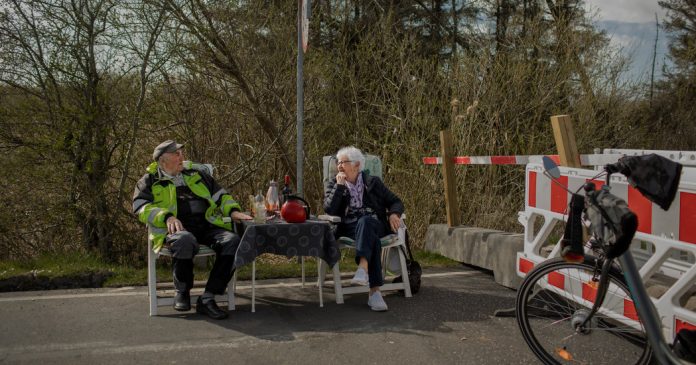
This couple, who are in their eighties, are separated during this pandemic by national borders. He lives in Germany, and she lives in Denmark. But every day they meet, and sit a few feet across the border from each other, chat, joke and share a drink.

Who would you most like to see in person right now if you could? Why? Is that person separated from you because of the coronavirus, or for other reasons? What do you think you would talk about? Where, ideally, would you meet?

Tell us in the comments, then read the related article to learn more about this couple and their daily ritual.

Word + Quiz: philatelist

0
Word + Quiz: philatelist

: a collector and student of postage stamps

_________

The word philatelist has appeared in four articles on NYTimes.com in the past year, including on Jan. 10 in the obituary “Harold Burson, a Giant in Public Relations, Dies at 98” by Robert D. McFadden:

Mr. Burson collected stamps and looked like an old-world philatelist: contemplative, analytical. He was a small man with a gentle face, appraising eyes behind improbably oversize glasses and a bald pate with a fringe of gray touching the ears. The voice was soft, patient. To a question, he would think a bit, and then have something to say.

_________

What Does Your Accent Say About Who You Are?

0
What Does Your Accent Say About Who You Are?

What about slang? Do you use slang that is specific to your school or community?

In “How Does a New Yawker Tawk?,” Jon Caramanica writes about the #BestNYAccent challenge on Instagram and features videos compiled by Noah Throop and Shane O’Neill:

What we think of as the distinctive New York accent is really a pool of accents, a stew that draws liberally from various communities: Italian, Jewish, Jamaican, Puerto Rican, Dominican, Irish and many more. Slang might come from Yiddish, or it might come from hip-hop.

But what was most striking watching the videos en masse — from every borough, from children and senior citizens, from dozens of ethnic and racial backgrounds — was just how much of what we think of as the New York accent is not about sonic specifics at all.

The New York accent, as it were, is both music and ideology, instantly recognizable as sound and almost physically palpable, too. It’s about the delivery, usually offered by someone leaning in to the conversation, some combination of excitement and bristly attitude. Sometimes it’s about the liberal sprinkling of sounds and catchphrases, the salt and pepper on a conversation that actually becomes the dominant flavor. Sometimes it’s the fluent cursing.

Mr. Caramanica shares some background about the contest:

The #BestNYAccent challenge was initiated by Nicolas Heller, a director of short films and a sort of unofficial liaison to New York City’s ample pool of eccentrics. In January, he posted on Instagram a list of the 100 best New York accents of all time, a mix of the legitimately famous and around-the-way favorites: Nas, Rhea Perlman, Cardi B, Luis Guzmán and so on. While recently sidelined with Covid-19-like symptoms, Heller decided to turn his preoccupation with the sound of New York into a social media challenge.

The contest received several hundred submissions and was viewed hundreds of thousands of times. Celebrities, trapped at home like everyone else, tapped in: Debi Mazar, Chazz Palminteri, The Kid Mero, Kathrine Narducci, John Joseph from the Cro-Mags and more. (No Rosie Perez, sadly.) Notionally, there was a winner: Charlie da Wolf, a foulmouthed septuagenarian from Williamsburg. But the robustness of the entries as a whole was revivifying.

The article continues:

It would be impolitic to say that the New York accent is the signature American accent. You could argue, though, that the New York accent is the accent of the current crisis. It’s there in the burly roundness of the words coming out of Gov. Andrew Cuomo’s mouth, or the acidity in the tone of Dr. Anthony Fauci, or the way President Trump scrapes all of his syllables together. (Senator Bernie Sanders’s howling woof counts here, too.)

For New Yorkers, that’s made the conversation around the coronavirus feel as local as the pandemic’s actual impact. Watching the news can feel like watching quarrels between grouchy neighbors.

Students, read the entire article, then tell us:

  • Do you think you have an accent? Do other people think you do?

  • How does your accent use tone, rhythm, tempo, slang and language? How much is your accent connected to your identity? Do you ever shift your accent, or way of speaking, based on who you are talking to or the setting you are in? What determines how much of yourself you show through your accent?

  • What regional expressions do you use when speaking? Do you think your way of expressing joy, anger or frustration is unique to the part of the country or world you come from? How does that show up in the way you speak?

  • This article focuses on pride about having an accent, but sometimes people are made fun of or discriminated against for having an accent. How have you seen accents honored and revered? Have you also seen accents mimicked or used to make fun of someone? Do you think it is OK for someone to mimic someone else’s accent?

  • In 2013, Josh Katz and Wilson Andrews created the “How Y’all, Youse and You Guys Talk” quiz, which produces a dialect map based on a participant’s responses. If you have the time, answer the 25 questions and examine the dialect map generated for you. How accurate is your dialect map to where you live, where you grew up and where your family comes from? Are you able to trace the influences that show why you speak the way you do?


Students 13 and older are invited to comment. All comments are moderated by the Learning Network staff, but please keep in mind that once your comment is accepted, it will be made public.

Protesting

0
Protesting

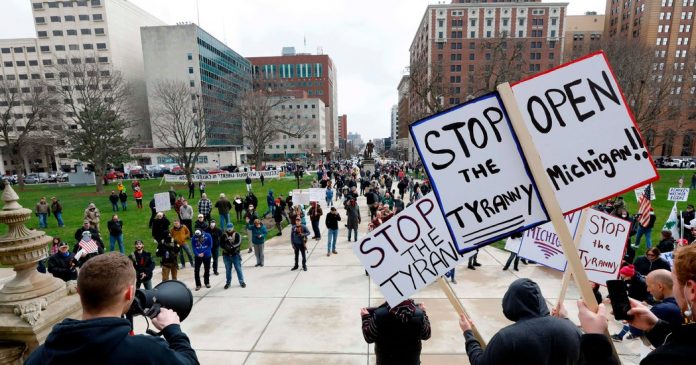
What is this image saying? How does it relate to or comment on society or current events? What is your opinion of its message?

Word + Quiz: flak

0
Word + Quiz: flak

1. artillery designed to shoot upward at airplanes

2. a slick spokesperson who can turn any criticism to the advantage of their employer

3. intense adverse criticism

_________

The word flak has appeared in 49 articles on NYTimes.com in the past year, including on April 14 in the Opinion essay “When Coronavirus Lockdowns Go Too Far” by Ross Douthat:

… The mayor of Louisville, Ky., earned a lot of well-deserved flak, and a slap-down in court, for trying to prevent churches from holding drive-in services — not something I’m quite sold on liturgically, but still a creatively adaptive way to achieve semi-normalcy on Sunday morning.

But some religious authorities, too, have acted with anti-adaptive zeal. In my own Catholicism, the diocese of Raleigh, N.C., didn’t just cancel Masses and close churches; it forbade its priests to attempt experiments like drive-through confessions that might make social distancing and the sacraments compatible.

_________

How Can You Tell a Story About Your Life Right Now Through a Few Simple Numbers?

0
How Can You Tell a Story About Your Life Right Now Through a Few Simple Numbers?

Think about as many aspects of your daily life as you can — positive, negative and neutral — then try to tell the story in numbers, the way The Times does in “11 Numbers That Show How the Coronavirus Has Changed NYC.” Here are some examples:

New York City has never looked so unlike itself. Deserted streets and vacant stores. Essential workers taking to lonely subways. Mandatory face coverings.

But beyond the changes we can see outright are other lifestyle shifts that reflect the struggles and needs that have emerged within the last month.

Our altered city, by the numbers, is just as complex as the one we remember.

2,637%

Increase in unemployment claims

During the week of March 22, nearly 144,000 unemployment claims were made in New York City. That constituted a 2,637 percent increase from last year, when the same time frame yielded about 5,300 claims.

And there’s still many who have yet to file as the state’s system was overwhelmed.

7%

Decrease in trash collection in Manhattan

March data from the city’s Department of Sanitation shows the amount of refuse collected from Manhattan residences shrank by nearly 7 percent compared to the borough average for that month over the last five years.

The decrease is most likely a reflection of New Yorkers who had the means to relocate.

Greenwich Village, the Upper West Side and the Upper East Side, neighborhoods with some of the highest median incomes in the city, led the way with 11, 10 and 8 percent declines.

The rest of the city saw little change, although Staten Island logged the biggest increase, producing over 7 percent more refuse than usual.

3,000

Number of applications to foster dogs

Interest in fostering pets has surged in the city, as many New Yorkers find themselves looking for companionship and having more time at home to care for a pet.

Foster Dogs, a nonprofit that works with about 30 shelters and rescue organizations in the New York City area, fielded more than 3,000 applications for fostering in March. Traffic to its website increased 250 percent.

In comparison, Foster Dogs received an average of 140 applications a month in 2019.

“It was more interest than we’ve ever seen before,” said Sarah Brasky, who founded the organization.

42%

Increase in complaints about loud televisions

New Yorkers’ patience with noisy neighbors has run thin, particularly when it comes to blaring televisions, which prompted a 42 percent increase in 311 complaints in March compared to last year, according to NYC Open Data.

Students 13 and older are invited to comment. All comments are moderated by the Learning Network staff, but please keep in mind that once your comment is accepted, it will be made public.