fbpx
Home Blog Page 1487

Word + Quiz: filigree

0
Word + Quiz: filigree

noun: delicate and intricate ornamentation (usually in gold or silver or other fine twisted wire)

noun: a pattern of delicate and intricate design

verb: make filigree, as with a precious metal

_________

The word filigree has appeared in 23 articles on NYTimes.com in the past year, including on March 23 in “Lil Uzi Vert, a Hip-Hop Star Beyond Gatekeepers” by Jon Caramanica:

His most invigorating rapping comes during the first few songs of “Eternal Atake,” one blown-speaker tremor after the next: “Lo Mein,” then “Silly Watch,” and then “Pop,” a kind of free-associative narrative of excess with a casually blunt rhyme scheme. This is Uzi rapping at his most sturdy, using pacing and cadence as much as melody.

But that sort of orderliness isn’t an essential part of his arsenal — the typical Uzi song is one filigree after the next, lace not denim. He creates his own funhouse-mirror reality.

_________

How Much Do You Know About Zambia?

0
How Much Do You Know About Zambia?

Can you find Zambia on a map? What else do you know about this African nation with a population of about 17 million people?

Lesson of the Day: ‘Here’s How Those Hot Jigsaw Puzzles Are Made’

0
Lesson of the Day: ‘Here’s How Those Hot Jigsaw Puzzles Are Made’

Find all of our Lessons of the Day here.

Featured Article: “Here’s How Those Hot Jigsaw Puzzles Are Made”

The coronavirus has sent puzzle businesses racing as demand surges past levels seen at Christmas.

In this lesson, you will learn how jigsaw puzzles are made and why companies that create them see the sudden surge in interest in their products as a “double-edged sword.”

How are you spending your time at home these days? What new hobbies have you discovered? What familiar pastimes have you found yourself pursuing now that you have more time?

Have you worked on or completed a jigsaw puzzle in the past several weeks? If so, where did you find the puzzle?

Read the article, then answer the following questions:

1. What are three steps in the manufacturing process that make the creation of jigsaw puzzles time-consuming? How do you think social distance measures at the factory may also slow down the process of making enough puzzles to meet the current demand?

2. Thomas Kaeppeler, president of Ravensburger, a German puzzle maker, in North America, is quoted as saying that the company strives for “an immersive image” when choosing what to use on its puzzles. What is an immersive image? Give a few examples of images that might fit the criteria.

3. Why are so many people working on puzzles these days? What are some of the benefits of this pastime? How likely are the people who discovered, or rediscovered, a love of jigsaw puzzles to become lifelong puzzle solvers? Why do you say that?

4. One employee at a puzzle company described the sudden surge in demand as a “double-edged sword.” What does he mean by this? What are the potential benefits and detriments for jigsaw puzzle companies, in the near and slightly more distant future, of more people wanting to purchase their products?

5. Suppose a person cannot find a jigsaw puzzle but wants a similar experience. What other activities do you think come close to replicating what it is like to work on a puzzle? How are they similar? How are they different?

Take a look at the offerings in the related article “16 Aesthetically Pleasing Puzzles and Games to Play at Home.” Which of the jigsaw puzzles featured in the article appeals to you the most? Why? What about the card games? And the other games?

Which of the puzzles or games seem designed for more than one person to participate? How might they help people who are sheltering together feel more connected? Which offerings might be appealing to people who are living alone during this time? Why do you say that?

Word + Quiz: salacious

0
Word + Quiz: salacious

1. suggestive of or tending to moral looseness

2. characterized by lust

Released less than two weeks ago, the series is already a sensation, immersing viewers in the lives and rivalries of vivid subjects like Bhagavan Antle, known as Doc, the bombastic proprietor of an animal preserve and safari tour in Myrtle Beach, S.C., and Carole Baskin, an animal activist and sanctuary owner in Tampa, Fla., whose former husband disappeared in 1997.

And then, of course, there’s the Tiger King himself, Joseph Maldonado-Passage, better known as Joe Exotic, a flamboyant Oklahoma zookeeper, political candidate and aspiring celebrity who was sentenced in January to 22 years in prison for his involvement in a failed plot to kill Baskin and for killing five tiger cubs.

Goode, who directed “Tiger King” with Rebecca Chaiklin, said that he had been reasonably confident the series would be successful. “How can you not be fascinated with polygamy, drugs, cults, tigers, potential murder?” Goode said in an interview on Tuesday. “It had all the ingredients that one finds salacious. So we knew that there would be an appetite for it.”

_________

Lesson of the Day: ‘Meet Your Meme Lords’

0
Lesson of the Day: ‘Meet Your Meme Lords’

Find all our Lessons of the Day here.

Featured Article: “Meet Your Meme Lords” by Steven Kurutz

A small team at the Library of Congress is archiving internet culture as fast as it can. Already the library has amassed more than 2.129 petabytes of data — or put another way, 18 billion digital documents. And that’s just a sliver of the internet.

In this lesson, you will learn about the herculean task to preserve internet culture for future generations. In a Going Further activity, you make the case for a meme to be included in the Library of Congress web archive.

Imagine the internet was shutting down, forever. And you have just minutes to save and archive internet culture for posterity.

What digital material — websites, blogs, digital chat rooms, web comics, tweets, memes, GIFs — would you preserve and why?

Include at least three examples and explain what would be lost to future generations if they were gone forever.

Read the article, then answer the following questions:

1. Why is the Library of Congress saving internet culture for future generations?

2. Give three examples of internet culture being preserved by the Library of Congress. Which do you find to be most significant? Which is most surprising?

3. Choose one of the four memes created by Library of Congress digital archivists to explain their work and the challenges they face, and describe its meaning in your own words. Would you want to join the web archive team?

4. How has the task of archiving internet culture changed in the project’s twenty years? What criteria does the web archiving team use to select what to save? How does it compare to the criteria you used in the warm-up activity?

5. Who is the web archive intended for? Why is it underutilized by the general public and scholars, according to the article? Do you think you will use the web archive after reading this article?

6. What was most interesting, provocative or memorable in the article? Do you think the Library of Congress web archive is worth the effort? The digital material chosen by the web archivists like the LOLCat Bible Translation Project and popular memes will live alongside the rough draft of the Declaration of Independence, “Moby Dick” and other sacrosanct print holdings. Do you think our current internet culture is as important as these historic artifacts? Why or why not?

Choose one or both of the following activities:

1) Choose a meme and make the case for why it should be included in the Library of Congress web archive.

What is the meaning and significance of the meme? Why should it be included in the Library of Congress web archive? What could future generations learn about humans and internet culture in 2020 from your chosen meme?

2) Create your own meme to express your own insightful or funny take on the meaning or value of internet culture.

What does internet culture mean to you? Is it valuable? Informative? A waste of time? Give us your unique take in an original meme.

You might want to use a free meme generator, rework a well-known meme or just start from scratch to make your commentary.

Join Us for Learn From Home Day

0
Join Us for Learn From Home Day

Let’s learn from home together! Join us tomorrow, April 10th, for Learn from Home Day, a global online event to promote togetherness and self-betterment through learning online. We’ll be going live over Zoom starting at 10am EDT, offering a lineup of live talks and interactive sessions.

To reserve your spot, head to our registration page. You can also register for individual breakout sessions on Friday at the links below. Feel free to mix and match or stick to a single track.

What you’ll learn

Throughout the day, you’ll be able to join a variety of breakout sessions with the Codecademy team. We’ll work on projects, answer your questions, run group discussions, and help you understand best practices for learning from home.

The day will start with a welcome from Codecademy CEO and co-founder Zach Sims. Then, we’ll have two tracks of breakout sessions — a “Building Websites” track and a “Languages and Usage” track.

Find more information about the individual tracks and sessions below. Please register for all breakout sessions you wish to attend. We hope you’ll join us!

TimeSessionRegistration Link
10:00amWelcome!
Codecademy CEO and co-founder Zach Sims will open Learn From Home Day with a keynote.
Register
10:30am[Track 1] Build Websites: Learn HTML
Learn the backbone of the internet as we know it today: HTML. Sonny and Nick will walk you through Learn HTML, one of Codecademy’s most popular courses and build some basic websites along the way!
Register
10:30am[Track 2] Languages and Usage: Creative Coding with JavaScript
Interested in coding and want to dive right in? With p5.js, we have a JavaScript library that helps guide your thinking by creating interactive elements on the webpage. We’ll see exactly how the computer is interpreting our code and how to translate some of our thought into a language that computers understand.
Register
12:00pm[Track 1] Build Websites: Learn CSS
Have you ever wondered why websites look the way they do? Why are some so plain and others so extravagant? In this session, we’ll acquaint ourselves with CSS (or Cascading Style Sheets), the language responsible for decorating the web!
Register
12:00pm[Track 2] Languages and Usage: Learn Swift
Learn and explore a powerful, modern programming language that is the backbone of many Apple applications: Swift! Join authors Galina and Alex as they navigate through Codecademy’s Learn Swift course and build some awesome projects along the way.
Register
1:30pm[Track 1] Build Websites: Intro to JavaScript
We’ll walk through the fundamentals of JavaScript—the language of the internet! If you’re looking for a language to dip your toes into the world of coding, look no further. JavaScript has a wide range of applications and usages to help you start your coding journey.
Register1:30pm[Track 2] Languages and Usage: Forecasting Google Trends Data With R
Learn how to analyze historical trend data and make predictions about the future! Camelia and Ian will walk you through how to use R, a programming language designed for data analysis, to forecast the popularity of different programming languages.
Register3:00pmWrap up the day!
Join us for a curtain call! We will recap the day and provide next steps to attendees so you can capitalize on all the progress you made today. We’ll highlight some things to come with Codecademy, and take Q&A. See you there!
Register

Book Review: How Learning Happens (Kirschner & Hendrick)

0
Book Review: How Learning Happens (Kirschner & Hendrick)

By Carolina Kuepper-Tetzel

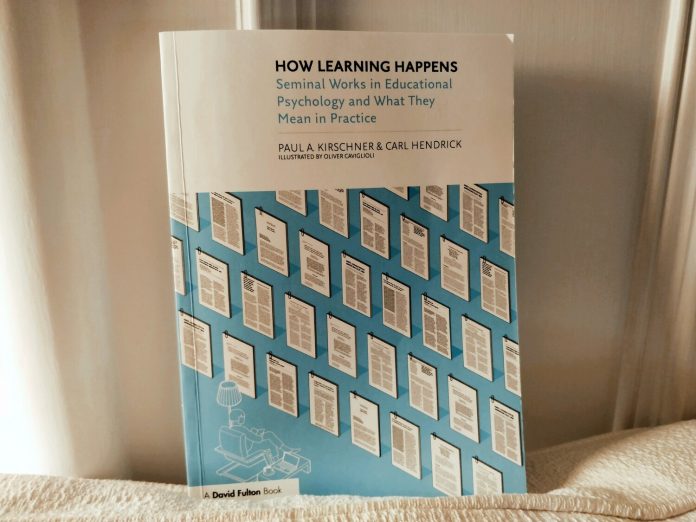
A few weeks ago, Paul Kirschner contacted us and said that he co-wrote a new book with Carl Hendrick and wondered whether we would be interested in reviewing it in form of a blog post. So, here I am now, sitting in my living room: laptop on my lap, book by my side, and ready to do this.

“How Learning Happens: Seminal Works in Educational Psychology and What They Mean in Practice” is the title of the book and the authors collaborated with Oliver Caviglioli who provided his wonderful illustrations. The book covers all important science of learning topics in a unique way. Instead of going from chapter to chapter and introducing the topics as you would in a textbook, this book uses published papers as anchors for each chapter. Each chapter reviews one representative paper on the topic and explains why you should read this article, provides an abstract of the article, summarizes the article in an accessible way (this part is often supported by helpful illustrations), discusses implications for educational practice, offers ideas on how to use the work in your teaching, and concludes with the most important take home messages. I really enjoyed this very structured approach of how the chapters are designed. Each chapter offers a range of suggested readings and useful links in the end – many of them can be easily accessed by scanning a QR code. Brilliant for the tech savvy who want to get their fingers on the additional resources as fast as possible.

Lesson of the Day: “‘What Rhymes With Purell?’ Franglais Rappers Push Language Boundaries in Quebec”

0
Lesson of the Day: “‘What Rhymes With Purell?’ Franglais Rappers Push Language Boundaries in Quebec”

Find all our Lessons of the Day here.

Featured Article: “‘What Rhymes With Purell?’ Franglais Rappers Push Language Boundaries in Quebec” by Dan Bilefsky

Rappers in Montreal, Quebec are playing with the use of language in the music they are creating; however, bilingual wordplay is not embraced by all people in Quebec. Some Quebecois think it is more important to preserve the French language and fear that Franglais, or “Frenglish,” could threaten that.

In this lesson, you will learn about the debates in Montreal around language and hip-hop. Then, you will either analyze multiple perspectives from the article, or study a bilingual song in a language you know or are learning.

Is there an official language in your country? If not, such as in the United States, what are the dominant languages in your neighborhood or community? Do you ever hear people around you, or the government, talk about the importance of preserving language?

Watch this video of teens talking about their experiences growing up multilingual in Quebec. The video references Quebec’s Bill 101, which officially made French the language of the government, business and the courts, throughout the province.

  • What did you find interesting or surprising in what the teenagers in the video shared?

  • Do you relate to any of their experiences with preserving a language at home, or learning a new language at school?

The featured article focuses on rap, but it also connects more broadly to the importance of French language preservation in Quebec. As you read the article, keep these teenagers’ experiences in mind and see if anything they talked about resonates with themes discussed in the article.

Read the article, then answer the following questions.

1. What are the layers of culture that young Quebec hip-hop artists, like Dead Obies, are playing with and exploring in their music?

2. Why are some in Quebec critical of the music that the Dead Obies, and other younger artists, are creating? What is your reaction to what Mathieu Bock-Côté, a sociologist and columnist, said about Franglais: “Without French, Montreal would be Pittsburgh”? Do you believe the preservation of language is “fragile,” as Mr. Bock-Coté said?

3. The author of the article, Dan Bilefsky, highlighted some of Quebec’s history and recent language-related incidents. How does that information change or enhance your understanding of the dynamics around language that are discussed throughout the article?

4. How does Gregory Beaudin, a member of the Dead Obies, describe his process of using both French and English in the songs he writes? How does he talk about identity and discrimination in relation to music and some of the criticism that he and the Dead Obies have faced?

5. What have the financial implications been of the Dead Obies rapping in Franglais?

Option 1: Analyze Multiple Points of View

The featured article presented the opinions and perspectives of artists, journalists and everyday people. Choose four of those perspectives to analyze using this Multiple Points of View worksheet.

If you have more time, you can write in greater detail about the different perspectives in the article, and then share your own. What is your opinion about bilingual songs, such as the ones featured in the article? Should the focus of art in Quebec be on preserving the French language, or should there be space for multilingual lyrics and creations? Respond to some of the perspectives from the article as you make your point.

Option 2: Analyze a Bilingual Song

What is your experience with multilingual music? Do you listen to any artists who sing or rap in more than one language? How important is it that you are able to understand both languages?

If you are in a class in which you are learning a new language, choose a bilingual song that features either two languages you know, or one language you know well and a second that you are learning.

For example, if you are learning French, you could choose to listen to any of the artists mentioned in the article, such as the Dead Obies, Loud and FouKi, or you could listen to Christine and the Queens. If you’re looking for a song in Spanish and English, you could choose “I Like It” by Cardi B, Bad Bunny & J Balvin or “Mi Gente” by J Balvin, Willy William featuring Beyoncé. The artist Manu Chao writes songs in English, French, Spanish, Portuguese and many more languages.

Once you have selected a song, listen three times and follow these instructions to guide your listening experience:

1. As you listen for the first time, appreciate the song as a whole. What do you notice about the rhythm, tempo and lyrics? Are there any words, lyrics or parts of the song that stand out to you?

2. The second time you listen, check for comprehension and pause the song when you do not understand a word. If you need assistance, you can see if the lyrics are available online, or you can sound out the word to the best of your ability.

3. After your third listen, reflect on the overall structure and meaning of the song. Think specifically about the role that language played in the song. Were you distracted by the multiple languages that were used in the song? What was added to the song by there being a second language? Did you feel that the second language took away from the meaning or value of the song in anyway? How might it feel to hear the song if you only spoke one of the two languages?

Endless Conversation

0
Endless Conversation

What story does this image inspire for you?

Use your imagination to write the opening of a short story of poem inspired by this illustration — or tell us about a memory from your own life that this picture makes you think of.

Post it in the comments, then read the related article to find out what this image is about.


Find many more ways to use our Picture Prompt feature in this lesson plan. You can find all our Picture Prompts in this column.

Word + Quiz: dowel

0
Word + Quiz: dowel

1. a fastener that is inserted into holes in two adjacent pieces and holds them together

2. a round stick or rod that can be used as such a fastener

Amy Eacock, a graduate student in Dr. Saccheri’s lab at the time of the study, and another of the paper’s authors, decided to investigate. First, she tested the caterpillars’ eyes for light-sensitive proteins called opsins. “We did the skin as kind of a negative control,” said Dr. Eacock, who is now at the Max Planck Institute for Chemical Ecology in Germany. “But then we found they were expressed in the skin as highly as they were in the head.”

That’s when she suggested blindfolding the caterpillars. The researchers could cover their eyes, place them on different-colored dowels, and see if they still changed to match.

But Dr. Eacock persisted, eventually testing more than 300 caterpillars. First, they tried green and brown dowels. For later groups, the researchers used black and white dowels. Over and over again, the blindfolded caterpillars successfully changed color to blend in. In photographs, they look chic, as if modeling different clothing hues in a shop window display.

The team even placed some caterpillars on striped dowels, and “they did go stripey,” Dr. Eacock said, although the sample size for that experiment was too small to include in the published work.