fbpx
Home Blog Page 1495

Novartis Extends Coursera to Friends and Family in Response to COVID-19

0
Novartis Extends Coursera to Friends and Family in Response to COVID-19

By Leah Belsky, Chief Enterprise Officer, Coursera

The spread of coronavirus (COVID-19) has profoundly affected the way companies operate. In a matter of days, organizations around the globe have transitioned millions of employees to remote working to keep their community safe. The well-being of employees remains the utmost priority, and ensuring employees stay engaged while working remotely is a key consideration. 

Novartis, a learning and development pioneer in many respects, is taking a unique approach. In addition to providing relief efforts for the pandemic, the global medicines company is setting an example for engagement and empowerment of employees and communities during this time. Understanding that friends and families may be directly or indirectly affected by COVID-19, Novartis is also enabling each employee to extend free access to Coursera to two friends or family members. 

Novartis continues to redefine what it means to “go big on learning” with Coursera. Our strategic partnership began in 2019 to offer Coursera to all 108,000 employees worldwide, focusing on critical data science, digital and soft skills to drive medical innovation. Soon thereafter, Novartis began offering employees access to top master’s degrees for mastery level learning. With the new friends and family offering, we’re driving a culture of learning both for Novartis employees and their communities.

We are humbled to support global companies like Novartis during these unprecedented times, and commend Novartis’ leadership team for proactively using learning to support employees in a remote environment. As more companies lean on learning as a resource, Coursera will continue promoting dialogue and sharing best practices among our enterprise community. 

The COVID-19 outbreak has introduced a heightened level of uncertainty in our lives, from our personal health and safety to the state of our livelihoods and the economy. If anything, learning can be a catalyst for hope, adaptability, and action in the face of uncertainty – a way for employees and their families to feel empowered and continue investing in their futures. 

Coursera for Business provides a world-class learning platform for companies that need to upskill, reskill, and deepskill their talent. With topics ranging from digital transformation and data science to software development and leadership, over 2,300 institutions trust the Coursera for Business enterprise platform to transform their talent.

1

GUEST POST: Learning from Video

0
GUEST POST: Learning from Video

Modeling

As children mature from toddler to adolescent, they often value peer model more than parent model. However, they still look to others to guide their behaviors. Learning from positive peer behavior and interactions is one of the strongest arguments for inclusion and heterogeneous grouping in classes.  Strouse et al.’s (2018) study indicates that no significant learning occurred when the parents did not provide appropriate social cues such as modeling responses to the prompts, how and what to gaze at, and attention points.  Yet schools don’t take always these factors into consideration when grouping students into classes.  Schools often prefer grouping students homogeneously as it decreases the demands for teachers to create different lessons to meet the needs of a variety of academic levels within the same class.  However, the toddlers in the study benefited from an additional individual modeling thinking-processes and behaviors along with the teacher’s instruction.  In the same way, providing the struggling student with peers who model appropriate communication, critical thinking, and self-regulation allows the struggling student opportunities to imitate those behaviors that will make them better students. 

Of course, one difficulty in implementing this model is finding the right combination of high performing, average, and struggling students in one class.  Another challenge is determining if value added from peer interaction outweighs the loss of a teacher providing targeted instruction.  In other words, because of the challenge of individualizing instruction for a variety of academic levels within the same class, a teacher will often develop instruction aimed at reaching the average, or worse, to the lowest achievement level.

Application to Supervisor Relationships

Effective techniques used by the co-viewing parent and teacher in the study are surprisingly similar to those strategies that are effective between administrators and adult learners during mandatory professional development.  To successfully launch new mandatory initiatives, I have found that a supervisor must be present to provide context.  That is, the supervisor must introduce and emphasize that the information being presented is important (i.e. set up the learning environment).  He or she must provide social cues such as modeling attention and interest. The supervisor should also provide verbal cognitive support such as asking participants questions and giving them positive feedback in order to maintain adult interest. 

Perhaps the intent of Strouse et al.’s (2018) study did not have anything to do with adult learning. However, I found many similarities between my actions as a teacher, principal, and coach and the actions performed by the co-viewing parent.  Perhaps when adults are not driving their own learning experience and are not authentically engaged in learning (as is often the case with mandatory professional development), they require the same learning supports toddlers do.

Bottom Line:

·       All learners can benefit from an online environment that includes opportunities for the learner to be guided and questions to be answered in real-time.  This can be accomplished by setting up collaborative sessions using applications such as Facetime or Zoom.

·       Students need positive modeling of best practices; peers can be the best models. Teachers embarking on the on-line learning platform can benefit from learning from more proficient peers, too.

·       Learning outcomes improve for both adults and adolescent learners when there is a guiding presence that informs the learner that a topic is important and provides guiding questions regarding focus points. 

Word + Quiz: flounce

0
Word + Quiz: flounce

noun: the act of walking with exaggerated jerky motions

noun: a strip of pleated material used as a decoration or a trim

verb: walk emphatically

_________

The word flounce has appeared in five articles on NYTimes.com in the past year, including on Feb. 11 in the fashion review “Party People and Twisted Sisters” by Vanessa Friedman:

Disorientation is the new normal. Where’s the fashion that makes sense of that state? Or at least acknowledges it is happening.

Not, as is turned out, at Herrera, where the designer Wes Gordon has been touting words like “optimism” and “fun” since he took over from the founder two years ago. This time ’round he added “one grand gesture” (that’s what he called the collection) — a fluted sleeve! A baby doll flounce! — in saturated Crayola-box shades: sky blue, emerald, cherry, aquamarine. One-shouldered tunics sloped off in a ruffle over skinny trousers, and floral fil coupé gowns swept the floor. They had a lush clarity, but no urgency.

Once upon a time — back in the early ’80s when Mrs. Herrera founded her house, when there was a big chunk of New York that gathered in ballrooms and salons and needed such fancy frocks — that was enough. Not any more. That world is disappearing under a tide of disruption and dystopianism. Ignore it and risk irrelevancy. No matter how many lovely flounces you put on top.

_________

How Do You Think the Primaries and 2020 Presidential Election Should Proceed?

0
How Do You Think the Primaries and 2020 Presidential Election Should Proceed?

Find all our Student Opinion questions here.

The featured article asks the question: “So, what happens when immovable dates become negotiable — when everything does — in the throes of a pandemic? What must hold firm when nothing seems to?”

Between the Olympics being postponed, school being moved online, and sports events, weddings and graduations canceled, many people are wondering what will go on, and how?

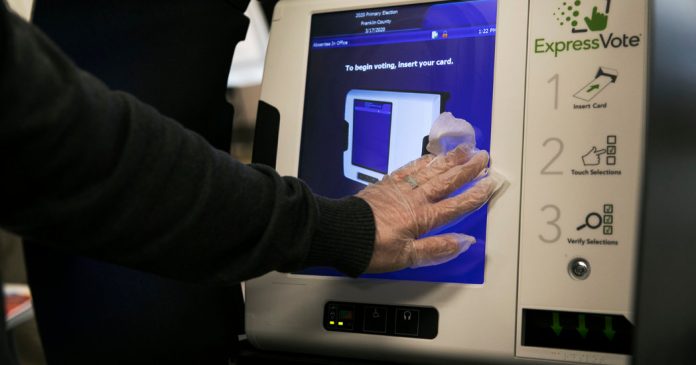
How do you view the role of democracy and the constitutional right to vote in the midst of a pandemic? Should democratic procedures be relaxed or suspended, or is it more important to find ways to preserve them during a crisis?

In “Is All of 2020 Postponed?,” Matt Flegenheimer writes about the overall resistance to postponing the primaries and the 2020 presidential election:

“We voted in the middle of a Civil War,” Joseph R. Biden Jr., the heavy favorite for the Democratic nomination, told supporters at a tele-fund-raiser on Sunday. “We voted in the middle of World War I and II. And so, the idea of postponing the electoral process is just — seems to me, out of the question.”

And yet for weeks, the moment has delivered one reminder after the next of all that the crisis has made wobbly, all that seemed certain before certainty went into quarantine.

Dates exist in stone until they don’t. Younger people are spared the worst of the virus’s ravages until they aren’t. American ideals, in 2020, leave no room for the concession of mass death, surely. But then here is a White House now suggesting that the cure (stifling business for a period to encourage social distancing) cannot become worse than the disease (the disease).

The article continues:

Already, meaningful electoral proceedings have been delayed or recast. Many states have pushed their primaries into June in the hopes of waiting out the worst of the virus. Pennsylvania, slated for April 28, is likely to be next. Senator Bernie Sanders, Mr. Biden’s chief rival, has effectively converted his campaign into a pandemic policy shop and vessel for progressive activism as he confronts a significant delegate deficit. Planners for the Democratic National Convention said this week that they were assessing “contingency options” in case the July gathering cannot go on as planned.

But the general election is another matter. No one in a position of relevant authority has proposed moving it, though the subject has instantly become a cause of angst for President Trump’s critics. These fears seem to owe more to Mr. Trump’s attacks on democratic norms and institutions during his time in office than anything the president has said of late.

So far, Mr. Trump has appeared inclined to defy the guidance of public health experts by suggesting Americans return to their workplaces and public engagements well before the coronavirus has been tamed.

Even if he wished to delay the November election, the decision would appear to be out of his hands. Any change to the date would require federal legislation, passed by Congress, to say nothing of challenges in the court system.

You may be wondering more about the possibility of voting by mail. Read the following two excerpts from “Voting by Mail Is the Hot New Idea. Is There Time to Make It Work?” by Nick Corasaniti and Stephanie Saul to learn about some of the options that individual states and Congress are exploring:

The next three nominating contests in the Democratic primary race — Hawaii, Wyoming and Alaska — are all run by the state Democratic Party, not the state government. All three have had extensive vote-by-mail operations in place for months; Wyoming even canceled its in-person caucuses and went to a full vote-by-mail system.

But given the decentralized structure of American elections, which are governed by states, counties and even municipalities, shifting to a federally mandated, completely vote-by-mail system for the general election could be impossible both logistically and legislatively.

Charles Stewart III, a professor of political science at the Massachusetts Institute of Technology, expressed optimism that states could gear up to expand mail and absentee voting for the coming primary elections, which tend to have relatively low turnout.

The November general election will be another matter, he said.

“I think that once people take a deep breath and consider what’s going to be done in November, they’re going to realize that the big lift necessary to expand the amount of mail voting by a factor of four, five or six in some states is going to be disruptive,” said Mr. Stewart, who studies both voting technology and election administration.

Under normal circumstances, states gradually transition to mail voting.

Mr. Stewart said he worried that states’ lack of experience holding big elections without in-person voting could have negative consequences.

The article discusses a bill by Senator Ron Wyden of Oregon and Senator Amy Klobuchar of Minnesota that would require states to offer a mail-in or drop-off paper ballot option if 25 percent of states declare a state of emergency related to the coronavirus pandemic.

The bill would call for all states to send prepaid, self-sealing envelopes, as well as ballot-tracking markers, to make sure that voters incurred no personal cost that would act as a barrier to voting, and to minimize any spread of the coronavirus through licking envelopes.

Though the bill does not specify a price tag, a previous iteration under Mr. Wyden estimated a cost of roughly $500 million. But the bill would provide only the opportunity of vote-by-mail expansion, not fully transition the country to voting by mail.

“We’re not saying to get rid of all polling places by any means,” Ms. Klobuchar said. “It’s just that the more people we can get to vote this way, the better off this is.”

Students, read the entire article “Is All of 2020 Postponed?” If you have additional time, you can also read “Voting by Mail Is the Hot New Idea. Is There Time to Make It Work?” Then respond to the questions:

  • Do you believe there are some things that, even in the midst of a pandemic, should not be postponed or canceled? If yes, what?

  • How do you think individual states and the Democratic National Committee should balance the need to hold presidential primaries while also protecting people’s health and safety? Should the primaries continue as planned, or be postponed or even canceled? Do you think there are safety measures that states and polling places should take when preparing for the primaries if they happen in person?

  • One larger concern discussed in the article is the potential of a postponed 2020 general election. Do you think this is something that should be considered? Or do you think alternate voting options should be explored? As you respond, be sure to consider some of the limitations of voting by mail, as discussed in Mr. Corasaniti and Ms. Saul’s article.


Students 13 and older are invited to comment. All comments are moderated by the Learning Network staff, but please keep in mind that once your comment is accepted, it will be made public.

Helpers

0
Helpers

Fred Rogers — known to generations simply as “Mr. Rogers” — famously said he was always comforted by something his mother would tell him during times of disaster: “Look for the helpers. You can always find people who are helping.”

People all over the world are pitching in to help during the coronavirus pandemic, like the army of homebound Americans who are crafting thousands upon thousands of face masks to help shield doctors, nurses and many others from the coronavirus.

Who are the helpers who have impressed you during this pandemic, whether because they are doing something heroic or because they help in your own life or community in some way?

Tell us in the comments, then read the related article to find out more about how ordinary people are lending their sewing skills to help hospitals.

The Winners of Our 2020 Vocabulary Video Contest for Middle Schoolers

0
The Winners of Our 2020 Vocabulary Video Contest for Middle Schoolers

One of the top three winners of our middle school contest: cartographer by Soobin Lee.


This is the first year we have been experimenting with offering our contests, which have long been open to students 13 years old and up, to younger students. And so far, we have not been disappointed with the results.

Last month, we honored nine middle school students whose reviews of art and culture blew us away. And now, we’re excited to announce the winners of our first ever Vocabulary Video Contest for middle schoolers. (You can see the winners of the high school contest here.)

We received nearly 350 entries from students ages 10-14 taking us up on our challenge to define one of our Words of the Day in just 15 seconds. Of those entries, we selected 15 finalists — three winners, five runners-up and seven honorable mentions — whose work we’re featuring above and below. We chose these videos for their originality and how well they showed an understanding of the word they chose. And, of course, they had to follow our rules.

Not to sound too cliché, but we hope you’ll find these 15 videos a balm for your worry in these uncertain times. We know they have been for us.

Teachers and students, if you enjoyed this contest, check out our Editorial Contest, going on now, and our Podcast Contest, beginning April 9, both open to middle school students.

Thank you to everyone who participated!


cartographer by Soobin Lee (See top of this post.)

macabre by Xhaiden D’Souza

mishap by Paul Slawson IV and Raina Lath

accessory by Aurelia Viner

anticlimax by Natalie Lankford, Jacqueline Myers, Audrey Norris and Karen

arsenal by Keira Kawada, Shaan Sidhu, Josh Spooner and Liam Wills

balm by Emma Hirsch

gawk by Marion Cook and Robin Linden

hypocritical by Celeste Roselli and Ismini Vasiloglou

pessimism by Ava-Joan Osuagwu and Omera Wahid

Welcoming Dr. Betty Vandenbosch as our new Chief Content Officer

0
Welcoming Dr. Betty Vandenbosch as our new Chief Content Officer

By Jeff Maggioncalda, CEO Coursera

Coursera reached an important milestone of 50 million registered learners this month. These learners come to Coursera from around the world to access a vast catalog of top-quality and stackable learning content from leading university and industry partners. We are also humbled by how thousands of learners are leaning on courses such as Science Matters: Let’s Talk About COVID-19 from Imperial College London and The Science of Well-Being from Yale to find clarity and comfort during the ongoing coronavirus crisis.

As the world faces unprecedented change and moves more rapidly online to learn, I’m excited to welcome Dr. Betty Vandenbosch as our new Chief Content Officer, effective April 13, 2020.

Betty brings more than 25 years of academic leadership, research, and teaching experience to Coursera. Most recently she was chancellor of Purdue University Global, an institution resulting from Purdue University’s 2018 acquisition of Kaplan University. 

At Purdue, Betty oversaw academics for nearly 30,000 students — most of whom earned their degrees online. Before that, Betty held a number of leadership positions at Kaplan University and served as associate dean and associate professor at the Weatherhead School of Management at Case Western Reserve University. Throughout her career, Betty has won several awards in teaching and research. Betty earned her PhD in Management Information Systems and an MBA from Western University in Ontario, Canada. 

At Coursera, Betty will be responsible for further deepening our ties with the partner community, working closely with them to advance content and credential innovations in line with learner demands and labor market signals. 

I’d also like to take this time to thank Dil Sidhu for his contributions as Chief Content Officer. Dil has decided to head back to the UK to be closer to family. We’re thankful for his work and impact developing our team and growing our content offerings — working closely with our partners to launch new degree programs, MasterTrack™ Certificates, Professional Certificates, and other credentials. 

Betty has an immense passion for Coursera’s mission that we so deeply share with our partners. I look forward to the leadership she’ll bring in our efforts to serve learners around the world. Please join me in welcoming her to the community and wishing Dil success with his future endeavors.

3

Word + Quiz: sedulous

0
Word + Quiz: sedulous

: marked by care and persistent effort

The word sedulous has appeared in one article on NYTimes.com in the past year, on Nov. 12 in the book review “For Lydia Davis, Language Is Character” by Brian Dillon:

… She recommends unstinting regard for language and sedulous habits of self-revision; then she throws in, like an afterthought, an extra moral dimension: “Work on your character.”

Perhaps for Davis language, or a painstaking attitude to language, is character. It’s a matter first of judgment, then of invention. In an essay on “Revising One Sentence,” she describes the fixes, cuts and inclusions required to compose this poised sentence: “She walks around the house balancing on the balls of her feet, sometimes whistling and singing, sometimes talking to herself, sometimes stopping dead in a fencing position.” (A sentence, by the way, that Davis may never even use in a story — it exists for its own sake as a notebook flourish.) In “A Note on the Word ‘Gubernatorial,’” which Davis contributed to the Oxford American Writer’s Thesaurus, she enjoys the word’s sound, “incorporating two voiced plosives and the word ‘goober.’” More important: Knowing why “gubernatorial” conceals its “softer, silkier, cousin, ‘govern,’” means that you, fretful thesaurus user, will deploy these and other words with more lively precision from now on. Abstract words, Davis tells her students, almost always conceal a real thing, such as a herd, a seed, a rodent, a goat. “Know what that concrete thing is.”

How Are You Staying Healthy and Fit?

0
How Are You Staying Healthy and Fit?

Find all our Student Opinion questions here.

In “Tears and Disbelief as Coronavirus Cancels Youth Sports,” Joe Drape and David W. Chen write:

Little League baseball has shut down. Youth lacrosse and soccer clubs have suspended their seasons. Travel teams across all sports have been grounded. The coronavirus pandemic has done what generations of overbearing parents and coaches have failed to do: send millions of boys and girls to the sideline.

The impact of the emerging health crisis was felt immediately at the high school level as state championships in basketball, ice hockey and wrestling were canceled from Montana to New Jersey.

Hearts were broken. Tears were shed.

At the youth level, an indefinite pause in practices, games and tournaments promises to upset the rhythms of countless families and deal a significant blow to the youth sports economy.

Does this account resonate with your own experience? How has the coronavirus affected your sports and fitness activities and routines? What are you doing to stay fit in a time of social distancing? Are you struggling to find ways to be physically active each day?

Anna Goldfarb provides practical advice in “You Can Take Care of Yourself in Coronavirus Quarantine or Isolation, Starting Right Now.”

“Trying to preserve some sense of normalcy is really important for people’s well-being,” said Dr. Russell G. Buhr, a pulmonologist at U.C.L.A. Health. Maintaining a routine, he said, like getting up and getting dressed and doing what you usually do, can positively affect mental health.

“And good mental health promotes good physical health,” he added.

But there’s more to do. Dani Johnson, a physical therapist at the Mayo Clinic Healthy Living Program, encourages people who are staying home to get creative. “Every little bit of movement counts,” she said. “So when we’re confined to our home, move, move, move.”

You don’t need fancy equipment or a lot of time; you just need to weave exercise into your schedule.

Here are four practical suggestions from the article for maintaining your physical and mental health:

Right now, start bringing movement into tiny moments

Next time you watch a TV show, get up and do some squats during the commercials, Ms. Johnson said. Do heel raises when you’re washing dishes. Do side lunges when you’re throwing clothes in the dryer.

Knock out some push-ups when you’re waiting for a pot of water to boil. Dancing is also a great way to move your body. Turn on some music and boogie.

The article continues:

Get your heart rate up, multiple times a day

“Stairs can be your cardiovascular best friend,” Ms. Johnson said. If you have access to stairs in your home or apartment, going up and down those stairs is a great way to get your blood pumping.

For a great full-body home workout, you can do an entire circuit sequence for up to 30 to 45 minutes. If you are working movement into your daily tasks, she also suggests creating more activity while doing things you already need to get done. For example, if you’re carrying laundry upstairs, take an extra lap or two up and down the stairs to work in extra steps. “Every little bit counts toward a healthier you,” Ms. Johnson said.

Dr. I-Min Lee, a professor of medicine at Harvard Medical School, recommends simple fitness exercises like marching in place, doing jumping jacks or jogging in place with high knees.

Get out and walk, even for just 15 minutes

“As long as the public health practitioners haven’t suggested a total lockdown, as long as you’re able to maintain a reasonable amount of distance and you’re being good about hand hygiene and especially if you’re staying completely home if you’re having any signs of illness, then getting outside for a walk is good,” Dr. Buhr said. “It clears your mind, and it keeps you active.”

Everyone should all aim for 150 minutes of physical activity every week, he said, but the amount of time you walk each day can vary. What counts is that you’re moving your body.

Many people want to keep fit, but have concerns about what is safe and what is not. In “Exercising During Coronavirus: Can I Jog? Is That Water Fountain Safe?” Gretchen Reynolds answers questions about staying in shape during the pandemic. Here are excerpts from four:

If I live in a community that is under a shelter-in-place order, can I run or walk outside?

This answer is easy: yes. The San Francisco County health department’s order, which is likely to be a model for similar announcements, says that people may leave their homes “to engage in outdoor activity, provided the individuals comply with social distancing requirements as defined in this section, such as, by way of example and without limitation, walking, hiking, or running.” So, as long as you remain six feet away from other people (not counting those in your household), you can exercise outside.

Can I use drinking fountains along my route?

“We don’t have any data about how long the virus remains infectious on water fountains,” says Angela Rasmussen, a virologist with the Center for Infection and Immunity at Columbia University. “But, given their proximity to other people’s mouths and noses, I would say you should not.”

If I am running the prescribed six feet behind someone on the path and they cough, will I jog right through their germs?

The science about how long the novel virus remains in the air is still unsettled. (You can read about a new study of that issue here.) But it is conceivable that droplets containing the virus could linger long enough for you to breathe them in, Dr. Iwasaki says, if you closely follow someone who is ill and the wind does not disperse the germs first. This precise scenario remains unlikely but not impossible, so look for the “least-crowded paths” available, she says, and perhaps swerve aside if someone coughs or spits ahead of you.

Should I take my shoes off before going in the house?

“This is a good rule of thumb,” says Saskia Popescu, a senior infection-prevention epidemiologist at HonorHealth in Arizona. No one knows if the coronavirus sticks to shoes, she says, “but they carry a lot of gunk in general, so leave them at the door.”

Additionally, The Times also offers free workouts. The Scientific 7-Minute Workout is here and its six-minute variations here. And if you have a jump rope and reasonable coordination, you might try this half-hour routine.

Students, read ONE of the articles above in its entirety, then tell us:

  • How has the coronavirus affected your physical routines and activities? Do you participate in youth sports? If so, how did you react to the news that they had been canceled?

  • How important to you is being physically active and fit? Dr. Russell G. Buhr says that maintaining a routine can positively affect mental health. Do you agree? What are the benefits to regular physical activity in your own life?

  • What are you doing to stay fit in a time of social distancing? Dancing? Stretching? Using a fitness app? How successful are your new routines?

  • Are you struggling to find ways to keep physically active each day? Which of the recommended physical activities described in the articles will work best for you? Do you have any exercise hacks to recommend to others?

  • What questions do you still have about exercise and the coronavirus?


Students 13 and older are invited to comment. All comments are moderated by the Learning Network staff, but please keep in mind that once your comment is accepted, it will be made public.

Lesson of the Day: ‘Welcome to the Virosphere’

0
Lesson of the Day: ‘Welcome to the Virosphere’

Find all our Lessons of the Day here.

Featured Article: “Welcome to the Virosphere” by Carl Zimmer

SARS-CoV-2, also known as the coronavirus that causes Covid-19, was isolated and identified by Chinese virologists in January. However, it is only one of 6,828 named species of virus, among thousands, or even trillions, that have yet to be named.

In this lesson you will learn about the history of identifying viruses and how virologists identify and classify viruses today. Then you will participate in a citizen scientist project that involves identifying the different stages of a virus.

What do you know about the structure and transmission of the coronavirus?

Look at the images below from left to right. The first image shows the coronavirus and the second image illustrates what happens as the virus enters a vulnerable cell.

Can you label the rest of the images? Here are some key words you will need to use: viral RNA, viral protein and viral copies.

Hint: The fifth image illustrates a close-up version of the fourth image.

Once you have labeled the images to the best of your ability, check your answers using the original article, “How Coronavirus Hijacks Your Cells.”

As you read the featured article, apply your knowledge of the coronavirus to understand and visualize how other viruses can be identified.

Read the article, then answer the following questions:

1. How do virologists search for new viruses? How do today’s approaches differ from earlier methods of researching viruses?

2. What does the research of Matthew Sullivan, a virologist at Ohio State University, demonstrate about the diversity of viruses in the sea?

3. How did Chinese researchers and virologists isolate and identify the virus that causes Covid-19 earlier this year? How did the International Committee on Taxonomy of Viruses name the virus?

4. How do viruses infect and affect humans compared to other species?

5. Why is it so hard for virologists to classify viruses?

6. Why did Jens H. Kuhn, the lead virologist at the Integrated Research Facility at Fort Detrick in Maryland, and his colleagues create the “megataxonomy”? How have other researchers responded to his creation?

Now that you know about the process that virologists undertake to identify and classify viruses, you are going to participate in a citizen scientist project to identify the stages of a virus.

Diamond Light Source is the United Kingdom’s national synchrotron. The synchrotron produces bright light that scientists can use to study anything from fossils to jet engines to viruses and vaccines. In 2019, Diamond Light Source began a virus factory and enlisted the participation of the public, as citizen scientists. The first stage of this research is complete; however, you can still participate in the work of citizen scientists to study reoviruses.

According to Diamond Light Source’s Science Scribbler:

Reoviruses belong to a large family of viruses that infect a wide range of animals and plants. Some members of the family cause widespread disease, notably Rotaviruses, which are responsible for serious gastroenteritis. In contrast, reoviruses themselves, whilst they pervasively infect humans, do not typically produce symptoms, indeed they are being trialled as possible anti-cancer agents, since they specifically replicate in many cancer cells activated for division. They are therefore a good starting point to try to understand the life-cycle of this family of viruses.

Now you will identify and classify the four stages of the virus, following the instructions provided. Once you have completed several tasks, you can look at some of the other biology and science-related citizen scientist projects on Zooniverse and try another.