Use your imagination to write the opening of a short story or poem inspired by what you see. Or, tell us about a memory from your own life that this illustration makes you think of.
Tell us in the comments, then read the related article to find out what it’s all about.
Find many more ways to use our Picture Prompt feature in this lesson plan. You can find all our Picture Prompts in this column.
noun: an embellishment consisting of a decorative representation of a string of flowers suspended between two points; used on pottery or in architectural work
noun: a curtain of fabric draped and bound at intervals to form graceful curves
noun: flower chains suspended in curves between points as a decoration
_________
The word festoon has appeared in three articles on NYTimes.com in the past year, including on Jan. 31 in “36 Hours in St. Moritz” by Laura Rysman:
For snacks and hot chocolate, stop by the Kulm Country Club, a storied chalet recently remodeled by Norman Foster, a part-time St. Moritz resident who also designed the timber-shingled blob that is the Chesa Futura private residence (the most arrestingly contemporary architecture in town). The club overlooks the plein-air ice-skating rink in the Olympic Park, which offers skate rentals for 22 Swiss francs. It’s filled with contemporary furnishings and vintage relics of local sports: Wooden bobsleds line the ceiling, old ski poles mark the doors and black-and-white photos of St. Moritz’s Olympic competitions festoon the walls.
5. After you have posted, try reading back to see what others have said, then respond to someone else by posting another comment. Use the “Reply” button or the @ symbol to address that student directly.
Some of Sergeant Wright’s family members did not realize he was in potential danger at all. He had told his maternal grandmother he was in Africa doing “paperwork.” Some now ask who, and what, the sergeant — their sergeant — was sent to fight.
“Are we protecting the United States? Who knows?” asked Ginger Russell, one of Sergeant Wright’s aunts. “You don’t think of your military in Africa. You’re talking to people who didn’t even know how to pronounce ‘Niger.’ We had to look it up on the map to see exactly where it happened.”
The Wright family is well aware of how the military works. It can trace its lineage in the armed forces to the War of 1812. Sergeant Wright’s father, Arnold, had been a soldier, and his mother, Terri, had been in the military, too.
But in a family of military men and women stretching back more than 200 years, Sergeant Wright was the only one who didn’t make it home, the family says.
Now one of Sergeant Wright’s older brothers, Will, who served in the Army and was deployed to Afghanistan, is considering joining the military again. The idea pains their father.
• Read our list of practical teaching ideas, along with responses from students and teachers, for how you can use these documentaries in the classroom.
• Want to make sure you never miss a film? Add Film Club to your Google calendarto receive weekly reminders and see our full publishing schedule for the 2019-20 school year.
If you and your students find this new annotation feature useful, please let us know in the comments or by writing to LNFeedback@nytimes.com. We are considering asking other Times journalists to do the same.
“Tiny Tyrannosaur Hints at How T. Rex Became King,” by Nicholas St. Fleur
Image
Tyrannosaurs weren’t always tyrants. For millions of years, the ancestors of the regal T. rex were relegated to second-class predator status while a different dinosaur dynasty ruled over what is now North America: towering allosaurs.
Nicholas St. Fleur: I love having fun with my leads. Tyrannosaurs are known as “tyrant lizards,” so I thought it would be whimsical to flip that on its head in the opening to this story.
T. rex is the king of the dinosaurs. So I wanted to continue with this Mesozoic monarchy theme I had going. I try to be clever with my wordplay, so I used “regal” and “relegated” because they play well with the “rex” in T. rex. I took that idea further by saying the tyrannosaurs were once “second-class predators” as a sort of nod to the term “second-class citizen,” which you might find under a monarchy. Then we deliver the reason tyrannosaurs weren’t always the big baddies: there were even more ferocious dinosaurs roaming around.
I’ll admit that my opening paragraphs are usually my most colorful because I typically spend the most amount of time on them. You really have to grab a reader’s attention with your first few sentences if you want to have them read the entire story. It’s for that reason that my first few paragraphs are often the last part that I write. I’m constantly tinkering with the wordplay.
But the allosaurs went extinct during the late Cretaceous, allowing tyrannosaurs to seize the throne and then evolve into large killing machines like T. rex and Tarbosaurus.
“Seize the throne”: another monarchy reference.
To better understand how and when tyrannosaurs became giants, paleontologists have sought examples of their lineage from when they were small. Their latest discovery is a tiny tyrannosaur that lived in the shadow of larger predators some 96 million years ago.
Called “Moros intrepidus,” the new species is the oldest Cretaceous-period tyrannosaur ever found in North America and among the smallest in the world, measuring only about as big as a deer. Because scientists have previously found large tyrannosaurs in North America that date to 81 million years ago, the newly discovered species helps narrow the window of when tyrannosaurs became huge.
In journalism, we call this portion the “nut” because it tells readers why the information the article imparts is important. You can find a “nut” paragraph or two in nearly every news article you read. This nut is helping readers understand the point of this finding, which is in that last sentence — it lets scientists “narrow down the window when tyrannosaurs became huge.”
Another thing to notice: I made the “big as a deer” comparison because when we write about sizes, we try to make real-world comparisons that will give our readers a better idea of the scale we’re talking about.
“We now know it took less than 15 million years for them to go from these subsidiary secondary players in the environment to top of the food chain,” said Lindsay Zanno, a paleontologist at North Carolina State University. She and her colleagues published their discovery Thursday in the journal Communications Biology.
I try to always place a quote from one of the main scientists involved high up in my story. The more fun and eye-catching the quote, the higher up it typically tends to appear.
Also, we always mention the day and the journal where the new paper was published, and provide links so readers can see the information for themselves. Unfortunately, these papers are often behind paywalls.
In 2012 while Dr. Zanno was fossil hunting in central Utah, she noticed a dinosaur leg bone sticking out from a rocky hillside. The next year she and her team excavated the fossilized remains. Although the bones were poorly preserved, she could tell by how thin they were that they belonged to a theropod, which is the major group of carnivorous dinosaurs that include allosaurs and tyrannosaurs.
I’m a big fan of retelling the moments of discovery. Depending on the word count that I’m allotted, I try to make this part of my story as descriptive as possible. My goal is to pick up the reader and place them right there, as if they were at the field site with the researcher.
Looking back at this part of the story, I would have liked to have been more descriptive of what it was that Dr. Zanno saw. I often get some of my best quotes when I ask a scientist, “What was going through your head at that exact moment when you found that dinosaur bone?”
To me, a story really sings when it shows the scientists’ emotions. In this particular case, I could have done a better job of capturing that moment.
Her colleague Aaron Giterman at the North Carolina Museum of Natural Sciences painstakingly pieced the leg together over the course of a year. After examining the dinosaur’s tiny foot and upper leg, Dr. Zanno determined it belonged to a tyrannosaur. From hip to toe it measured about four feet long and the dinosaur was estimated to weigh about 170 pounds. T. rex, for comparison, strutted around on legs that were about 12 feet long, and weighed more than 10,000 pounds.
Science takes time. Often a lot of time. It can be brutal, tedious work. I try my best not to romanticize it, but rather to describe it as a process that often involves a lot of people working together. And oftentimes their jobs may not be the most exciting.
In this case, Aaron Giterman wasn’t a scientist mentioned on the paper. Dr. Zanno had mentioned to me that they worked with a technician who pieced the leg back together, and I thought it would be important to the story to highlight his work alongside that of the paper’s authors.
Science is very collaborative but not everyone gets to be an author on the paper, so I often ask for the names of people who were involved but not mentioned. Typically this includes citizen scientists or grade school students who stumble upon fossils while walking around the beach or digging in a park. I think stories like these show the readers that people just like them are contributing to science and that they could, too.
Meanwhile, at the end of these paragraphs you’ll see the nitty-gritty numbers that give the reader an idea of how big this dinosaur was. By comparing it to T. rex we see that it was actually pretty minuscule. A “tiny rex” if you will!
The next steps were to find whether the tiny tyrannosaur belonged to a new species or was a juvenile of a known species.
Aurore Canoville, a postdoctoral researcher in Dr. Zanno’s lab, collected small samples from the bones. Using a microscope, she identified growth marks in the bone tissue that provided clues to the dinosaur’s age, like tree rings. Dr. Canoville saw evidence suggesting the tyrannosaur was at least 6 or 7 years old. The growth marks, she said, were also spaced closer and closer together, indicating the tyrannosaur was nearing full maturity when it died.
I also try my best to interview researchers beyond just the first author and the senior scientists. It provides you with a bigger look into what the story really is. Sometimes these conversations give you little anecdotes that you would never get out of the main researchers.
I once spoke with a student who told me that because his work with fossilized butterflies was so delicate, he needed to use the finest brush possible. That meant using a brush tipped with a human nose hair! That became the headline to our story: Finding the Oldest Fossils of Butterflies Using a Human Nose Hair.
I had a longer description of what Dr. Canoville did, but my editor rightfully condensed it to the previous sentence. Sometimes we writers get so excited about the methods that scientists use that we forget that we’re probably going to lose the reader if we talk about things like grounding down epoxy resins. This is why a good editor is so important!
Finally, the comparison to tree rings helps the reader better understand why the scientist had to study the growth marks on the bone.
“When we found out it was actually almost an adult, we could tell that it was a new species of a very small tyrannosaur,” said Dr. Canoville. Their findings also suggested that the dinosaur was most likely an agile hunter.
Here, the researcher says what the ultimate goal of measuring the growth marks was: determining that the tyrannosaur was an adult and a new species. That’s what helped them to make their overall finding.
Thomas Carr, a paleontologist from Carthage College in Wisconsin who was not involved in the study, said the finding “lifts the lid on what the earliest tyrannosaurs in North America really looked like.”
Stephen Brusatte, a paleontologist at the University of Edinburgh in Scotland who was also not involved in the paper, said the discovery pushed the tyrannosaur mystery forward in time.
When we report on new research we always try to reach out to experts to provide context for our readers. That way we aren’t overhyping or underselling a new finding.
Sometimes the outside experts disagree with a finding, at which point we take their concerns to the paper’s authors and ask them for their responses to the criticism. That wasn’t the case for this paper.
I’ve interviewed both Thomas Carr and Stephen Brusatte in the past and I knew they’d be excellent sources to weigh in on this new finding.
Typically, I try to reach out to outside sources early in my reporting process. Often when I sit down to write I distill my interviews with them into a few short paragraphs that capture their overall thoughts on the paper. Even though they usually appear at the bottom of my story, these paragraphs are usually the first ones that I write. It helps me to get “something on the paper” because for many of us writers there is no bigger hurdle to overcome than looking at a blank word document.
“When did these second-tier hunters become the bus-sized bone-crunchers that terrorize our imaginations?” said Dr. Brusatte. “It must have happened sometime between about 90 and 80 million years ago, and we’re going to need new fossils from this time to figure it out.”
Dr. Brusatte in particular is a terrific science communicator who always delivers elegant, yet adrenaline-inducing quotes. You see his name pop up a lot in popular dinosaur articles. And his quote here was just what I needed to end my story.
If you’d like to hear more from Mr. St. Fleur, and from fellow science writer James Gorman, you might be interested in our on-demand webinar, Teaching With The Science Times.
The best entries to the many student contests we run each year grow out of genuine individual interest — topics students choose because they are passionate about them, often because they connect to their own lives in some way.
In this special writing prompt, we hope to inspire you to find a meaningful topic for our latest contest, a STEM writing challenge in which you can explore and explain anything related to science, technology, engineering, math or health that you find fascinating — or, perhaps, troubling.
We invite you to use this writing prompt to brainstorm and publicly post as many ideas as you can. Even if you’re not participating in our writing challenge, we hope you’ll find the exercise fun — and, of course, you can use this prompt as a catalyst to come up with ideas for any kind of STEM inquiry project. And, of course, we also hope students will inspire one another, so the more ideas you share, the better.
Here are some possible ways to start thinking about the question, with examples of Times reporting for each:
Whatever you choose, feel free to elaborate about why it interests you.
Students, brainstorm alone or with friends or classmates, and tell us …
What questions do you have about how the world works? Any topic under the umbrella of STEM (science, technology, engineering and math) can work, as can health, psychology, and other related fields.
What innovations in STEM impress or intrigue you? What problems or issues in STEM fields concern you? Take a look at some of the reporting we’ve linked to above, then take a look around The Times or Science News (our partner for this contest) to see what else you might find.
Another suggestion? Take 24 hours and keep a journal of the STEM-related questions, issues, problems and ideas that occur to you. That rickety bridge you have to cross on the way to school? Maybe it gets you thinking about how bridges get fixed, or how they’re made structurally sound in the first place. Your morning breakfast cereal? Is it as healthy as the box claims? Is breakfast really “the most important meal of the day” — or is that saying outdated? See how many ideas you can come up with in just one day, then think about which intrigue you most.
Please post to our comments as many questions or topics as you can. We hope that your ideas will inspire others, and their ideas will inspire you. And if you see something someone else posted that you find interesting, or that you’d like to elaborate on, don’t be afraid to leave a comment.
We can’t wait to read your ideas and conversations.
Students 13 and older are invited to comment. All comments are moderated by the Learning Network staff, but please keep in mind that once your comment is accepted, it will be made public.
After 20 years of work (and play) in a variety of fields—content strategy, learning, kids, and more—one thing I can say is that anywhere, anytime learning is powerful. “Anywhere, anytime learning” is the notion that learning isn’t confined to the four walls of a classroom. Rather, it is a continuous process fueled by real-life experiences and goals that have intrinsic meaning to the learner.
Picture the baby who has her first brush with physics by pushing her cereal bowl off of her high chair. There’s the high school soccer captain who learns about strong and weak strategy by trying different defense formations on the field. Flash forward to the work world. A machine learning product manager must create a personalization algorithm to serve up flats, tennis shoes, and boots to the most fitting customer cluster. Compare these scenarios with memorizing country capitals in order to pass a test. Neither type of learning goal is inherently better or worse. But, the “anywhere, anytime” scenarios unfold often because there is an immediate utility.
Most of my work and jobs have focused on anywhere, anytime learning. Here are some of the organizations where I’ve worked that have shaped my view:
Coursera (2019–present), offers courses, certificates, and degrees online from world-class universities and companies. Learners can engage with the platform on their own time and at their own pace. Learning on Coursera drives mastery, ensuring employees acquire the skills they need to propel the organization forward. This can take the form of upskilling, reskilling or applying efforts toward starting or finishing a degree.
Netflix (2015–2019), amedia entertainment company that offers one of the most diverse TV and movie catalogs in the world. You can learn about some of the root causes of poverty through documentaries, family dynamics and dysfunction from dramas, or different cultures from foreign films.
Common Sense Media (2009–2015), akids and media nonprofit that offers guidance to parents and teachers on how to choose the best media and technology for their kids. TV and app reviews help parents steer their kids toward enriching choices. A digital citizenship curriculum helps kids think critically about the pluses and minuses of the digital world.
A major reason I appreciate anywhere, anytime learning so much is that I learn best this way myself. I learn best when I’ve defined my own goal, when I feel wedded to this end, and when I can help a team by putting a skill I’ve learned into action.
2. How does Coursera think about content strategy and skills for the future?
In short: A ton of data analysis intermingled with a dose of informed intuition.
My team, the content strategy team, is the forward-looking radar and content innovation hub for the company. We identify content to help learners master skills, get jobs, change jobs, earn credit and degrees. We have an enterprise content lead, Kelly Murphy, who tries to understand the motivations and needs of our enterprise customers and learners. We also have content vertical leads that partner with Kelly. They use data and research to identify content to add to Coursera in the following areas: data science, technology, business, healthcare, and much more.
When conducting research about what topics and skills are in-demand, we take into account 140+ different on-platform and off-platform data signals that our data science team has defined, such as job openings and on-platform search volume. We also draw on existing data and reports from the likes of IDC and Burning Glass, as well as conducting our own trend research. Staying abreast of pop culture and public buzz through podcasts, NPR, TED Talks, McSweeney’s, TV, movies, books, and more helps us identify emerging skills and content trends.
3. What do you find especially exciting about the work you are doing at Coursera?
We have a company-wide all hands once-a-month. It’s chock full of updates about our current initiatives. The tone is usually light and celebratory. But without fail, the end of every meeting makes me tear up. This is because we end the meeting with two learner stories. We watch stories of people whose families didn’t have the money to send them to college but could afford education through Coursera. We see stories of those who were able to upskill at work and get promotions, solve new problems, build new inventions because of skills they learned through Coursera.
I also love some of the new initiatives we are taking to encourage practice, hands-on learning, and work-centered case studies. We’ll share more on that in the coming months.
4. What are some content areas you see Coursera investing in for the near future?
Our strongest performing areas, broadly speaking, are data science, technology, and business. These are domains that “travel” well across the world and can be taught particularly effectively online. Healthcare is a growing vertical for us as well, and I see an uptick in interest in psychology and personal wellness. Here’s a narrow peek into the more specific areas where we expect to see demand, in no particular order.
Data science: Data visualization, AI for different sectors, personalization algorithms
Technology: Cybersecurity, robotics, cloud native development
Business: Sensory marketing, program management, customer centricity
Health: AI for health and medicine, digital drug discovery
Human Skills: Body language, purpose
We have also identified attributes of content that has performed quite well. They are:
“For everyone” contentis inviting. Content that applies to a wide array of people generally does well on Coursera.
Opportunities for practice. Add in many opportunities for the learner to try what they learned again and again, and also real-life case studies so they can see skills in practice.
The instructor matters. Having experts who can also easily break down concepts is key.
Demand for soft skills. We are hearing from employers that new graduates could have improved soft skills, such as communication and resilience.
5. What is one of your favorite Coursera courses and why?
One of my favorite courses is AI for Everyone. It turns a very intimidating subject into something with both a clear and myriad of applications in everyday life.
We’d love to hear from you! Share your feedback on the skills and content areas your organization is focused on, and let us know if you’d be open to a conversation with our content strategy team.
At my school, we do not use hard copy textbooks. If there is ever a textbook need for a class, it is downloaded online. As a student that has dyslexia and has an IEP, I requested and have the right for textbooks, hard copy.
Hardcover textbooks allow students to be more attached to their learning, instead of starting at a screen. The schools say that online books are: lighter, easier to access, and cheaper. Yes, these might be true, but when using online textbooks have to be accessed on a computer or iPad, these divides have distractions built into them. On the other hand textbooks allow you to stay focus and “feel” what you are doing. Textbooks help me get through school, without them school would be nearly impossible. But it seems like every year there are less and less textbooks used in classes.
Personally, I have found that finding and using primary sources of information combined with a textbook is the most engaging form of teaching when it comes to history. I had always been bored by history until one class where we used a lot of our own research and sources other than the textbook, and I came to enjoy it.
Physical textbooks are becoming dinosaurs — mostly due to high cost and an effort to be more environmentally friendly. However, I don’t see textbooks (either electronic or paper versions) disappearing completely. Instead, I think teachers are more often adding other resources like videos, articles, primary sources, and hands-on learning to the classroom.
These other resources can help address bias in textbooks or make the subject more relevant. For example, in Civics and Economics, our teacher didn’t just teach about the market economies, she had us research industries in our state by looking at an economic development site run by the state government. We didn’t just learn about gerrymandering. We learned about the dispute about our state’s districts in the Supreme Court by reading the case and briefs to see both sides of the argument.
I think that some classes shouldn’t need textbooks because it is easier to learn the subject from experience or actually looking at someone doing something. For example I personally find math easier if I watch someone solve the problem and explain what they are doing. Even in my automotive technology class we read textbooks but, I find it easier to understand when I’m hands on and actually working on a car.
As a public school student, I have used many outdated textbooks. I find that most of them contain biased information that could be perceived as ignorant toward certain groups of people throughout history. For example, in some history textbooks, Christopher Columbus was a hero who “discovered” the Americas and was an ally to the Native Americans. In other cases, the mistreatment of slaves is wildly unexaggerated. Slaves are said to have been “often harmed by their masters.” The brutal violence and sexual abuse that slaves endured is seldom mentioned. The founding fathers are praised, and the fact that they were slave owners seems to be forgotten. All in all, textbooks often deny that the worst parts of history even happened.
@CalliopeBeatty I agree, textbooks used with our public education system always seem to be so outdated and biased. I think that being biased with this type of history causes many issues especially for students who are trying to shape their own political views but are being forced to read someone else’s opinions. It can be confusing to students who are always told they have the freedom to believe what they want but at the same time the government wants you to learn a specific thing a specific way.
Throughout school, I always loved reading my colorful textbook. Whenever I was bored in class, I would flip through its entertaining pictures and devour the stories of world history. I was astounded by the vast unique cultures and their way of life. I learned everything from nomads and gatherers to the French Revolution and Ming dynasty. The only problem I’ve ever had with it was its heavy weight in my backpack. But now that I’m older, I’ve realized the textbooks I had read as a kid might’ve been censored. If I’m being honest, I’m sort of glad that the actual history of the world wasn’t revealed to me as a kid. I would’ve had a different view of the nation if I’d known about the crimes of raping, lynching, and enslaving my ancestors committed when I was in elementary school. I understand that it might be wrong to tell half truths to the next generation, but, come on, they’re still kids. As humans, we can all agree that the world we live in is corrupt and nowhere near perfect. But should kids know about our imperfection so soon?
@Nakia Spore I agree with you on sheltering elementary kids on the harsh realities of our country but it’s like they’re trying to shelter the high schoolers too and I think that’s wrong. I think in high school we should get the truth about the history of our country so we can be properly informed.
In this 55-minute webinar, recorded live in Oct. 2017, we show you how to use Times reporting and multimedia in STEM classrooms.
From following the path of the eclipse to debating medical ethics to demonstrating physics principles with the movement of ants, the Times reporters James Gorman and Nicholas St. Fleur explain how they research and write about scientific questions in the world around us — and how citizen science often plays a role.
The Learning Network editors along with Sara Rust, a high school teacher, then show you features from Times science and health reporting — including reporting from Trilobites and Well, videos from ScienceTake, infographics from The Upshot, and virtual reality experiences from our climate team — that can be easily woven into your curriculum.
Finally, we invite you to submit your own lesson plans to our popular Reader Ideas column.
Webinar Resources
Resource List: In this PDF you can find links to all the resources we discuss in this webinar.
Original Webinar: You can watch the original, unedited webinar here and download a professional development certificate at the end. The webinar is free, but registration is required.
Mr. St. Fleur is a science reporter for The New York Times who writes about archaeology, paleontology, space and other types of interesting research, regularly for the desk’s Trilobites column.
He joined The New York Times in 2015. Before that, he was an assistant editor at The Atlantic covering science, health and technology. He has also worked for Science Magazine, NPR and Scientific American.
Mr. St. Fleur graduated from the University of California, Santa Cruz Science Communication Program and completed his undergraduate degree at Cornell University, where he studied biology.
James Gorman, Science Reporter, The New York Times
Mr. Gorman is a science writer at large for The New York Times and the host and writer of the video feature ScienceTake. He has been at the Times since 1993, as an editor on The New York Times Magazine, deputy science editor, editor of a personal technology section, outdoors columnist, science columnist and editor of Science Times.
Over the course of his career at The Times and elsewhere, Mr. Gorman has written about everything from the invention of flea collars to the nature of consciousness. Recently he has covered neuroscience and the lives of animals in and out of scientific research.
Before joining The Times, Mr. Gorman wrote books on penguins, dinosaurs, the Southern Ocean and hypochondria. His most recent book is “How to Build a Dinosaur,” 2009, written with the paleontologist Jack Horner.
He also writes humor, which he has contributed to The New Yorker, The Atlantic, The New York Times Magazine and other publications.
He has taught science writing at New York University, Fordham University and online in Stanford University’s Continuing Studies program. In the fall of 2011, he was the McGraw Visiting Professor of Writing at Princeton University.
Mr. Gorman graduated from Princeton in 1971 with a bachelor’s degree in English literature.
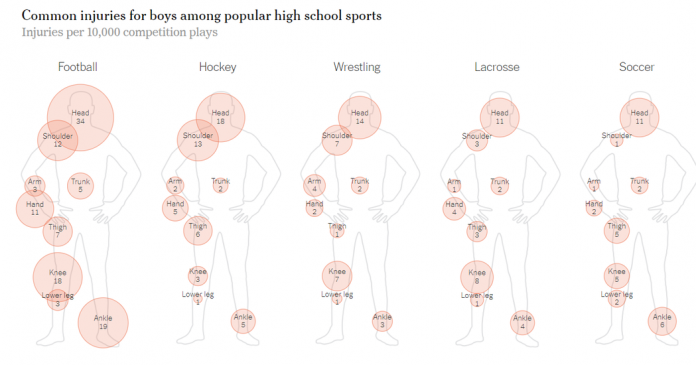
These infographics which show the number of sports injuries per 10,000 competition plays by high school boys appeared elsewhere on NYTimes.com.
By Friday morning, Jan. 31, we will provide the “Reveal” — the infographic’s free online link, additional background and questions, shout outs highlighting student comments and headlines, and Stat Nuggets.
After looking closely at the graph above (or at this full-size image), think about these three questions:
What do you notice? If you make a claim, tell us what you noticed that supports your claim.
What do you wonder? What are you curious about that comes from what you notice in the graph?
The questions are intended to build on one another, so try to answer them in order. Start with “I notice,” then “I wonder,” and end with a catchy headline.
2. Next, join the conversation by clicking on the comment button and posting in the box that opens on the right. (Students 13 and older are invited to comment online. Teachers of younger students are welcome to post what their students say.)
3. After you have posted, read what others have said, then respond to someone else by posting a comment. Use the “Reply” button or the @ symbol to address that student directly.
On Wednesday, Jan. 29, our collaborator, the American Statistical Association, will facilitate this discussion from 9 a.m. to 2 p.m. Eastern time to help students’ understanding go deeper. You might use their responses as models for your own.
4. By Friday morning, Jan. 31, we will reveal more information about the graph at the bottom of this post. Students, we encourage you to post an additional comment after reading the reveal. How do the original article and the moderators’ comments help you see the graph differently? Try to incorporate the statistical terms defined in the Stat Nuggets in your response.
More?
Read our 2019-20 introductory post, which includes the archives of past releases by topic and graph type.
Learn more about the “Notice and Wonder” teaching strategy and how and why other teachers are using this feature from our on-demand webinar.
Sign up for our free weekly newsletter so you never miss a graph, and add our 2019-20 “What’s Going On in This Graph?” live-moderated discussion Wednesdays to your Google calendar (1/29, 2/5, 2/12, 2/26, 3/4, 3/11, 3/18, 3/25, 4/1, 4/8).Graphs are always released by the Friday before to give teachers time to plan ahead.
Go to the A.S.A. K-12 website, which includes This is Statistics, resources, professional development, student competitions, curriculum, courses and careers.
Nico Mannion, Josh Green and Zeke Nnaji are as good as any other freshman triumvirate in the sport. Arizona’s veterans aren’t bad either. Max Hazzard, a graduate transfer from U.C. Irvine, and Jemarl Baker, a transfer from Kentucky who received a waiver to play immediately, give Arizona Coach Sean Miller the perimeter depth necessary to be a factor in March.