fbpx
Home Blog Page 1540

NexGen Learning Systems T-Grid 2019-20

0
NexGen Learning Systems T-Grid 2019-20

Nowadays every learning system vendor out there will tell you their system is Next Generation or some nuanced spin that goes towards NexGen. The problem is that for most of the systems, it just isn’t the case.  This is due to a couple of key factors:

  • They do not know what constitutes a system to be NexGen
  • They think the features they have, because they haven’t seen anything like it anywhere else (mainly because they only look at a few systems), is NexGen
  • They are brand new to the market, so they must be NexGen

While that all sounds good and likely works for marketing purposes, for me, it just doesn’t fly, because there has to be a set of functionality, etc. to be listed as NexGen, and then various tiers too.  I mean NexGen of 2017 is not the same as a system that is NexGen 2019, or at least you hope it is not the same.

In the past, I went with a single grid with four quadrants – see the 2018 listing here.

For 2019, I decided to go a different route by creating what I called a T-Quad, but its better name is a T-Grid.  T representing three.

This post will break down as follows (for fans of Work Instructions, enjoy!)

a. The T-Grid entire view – With all the details tied to it, including what you are looking at, how it was calculated, etc.

b.  Breakdown of each Grid – Leaders, Risers, Steady – and each vendor that is in that grid.

c.  What I consider Tier 3 NexGen which uh, played the key role here.  A system should ideally have all these features, albeit some were missing a piece here and there, hence you will see shortly what that means.

d. Download the PDF version of the T-Grid. 

e.  An FYI that every system in this year’s grid can be found in FindAnLMS, so I strongly recommend you checking them out for further details on each of them, pricing, etc.

The 2019-2020  NexGen T-Grid
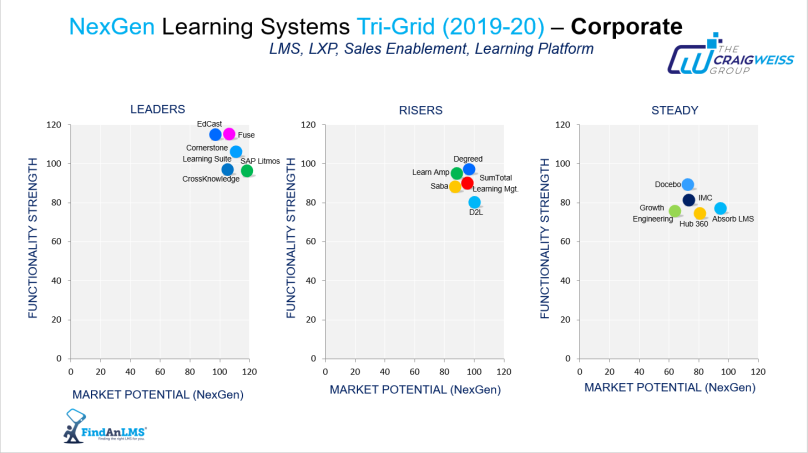
NexGenLSGrid

How to Read The Grid

Very carefully. Zam!  Okay, in all seriousness, there are three grids in the T-Grid (remember T stands for three). 

Leaders – The Systems that are NexGen to the max (Tier 3 at least 95% – now). They are 100% Tier 2, and 100% Tier 1, NexGen.

Risers – Systems that are Tier 3 NexGen at least 92% Tier 3. These are systems to watch, up and coming or potential leaders in 2020-21, depending on where they go from here. 

Steady – Steady as it goes for NexGen.  At least 85% Tier 3.  So, they could be 100% Tier 2, but only 88% Tier 3.  Some could be ones to watch, not yet at Risers, but with a few of this or that, could be, or ones that have hit a wall in terms of NexGen. Just enough to score well, but trend lines pointing that this may be the best they get, even if they continue to add NexGen, they are still behind the curve to rise. 

Grid Specifics

Functionality Strength

Based on what I defined as Tier 3 NexGen functionality (see down the page, under “Criteria Functionality”), the higher the score rating, the higher the level of well, strength.  If you want say, the ultimate NexGen system with Tier 3 functionality, then, a system whose functionality rating is 120 or close to it, will fit the build.

120 is a perfect system. Since, I do not believe that any system is 100% perfect, hitting 120 is not really doable, but the rating scale does go that high, just as it goes as low as 0.  If you are 0, then you are not a learning system. Rather, you are an imaginary friend who thinks he is a server.

Each section of Tier 3 functionality was weighted. Some higher than others, which when you added up the total point scale, you ended up where they were on the grid.

Market Potential Growth (NexGen)

What is the potential that this system will continue on the path of NexGen for 2020, and then 2021? This includes Tier-4 NexGen functionality (to be published in Feb).   A trend line was defined based on previous years of NexGen, i.e. Tier 1, Tier 2.  Track record of success played a role here.  Everything was weighted with points assigned to each Tier, and year of achieving at least 90% of each previous Tier, i.e. Tier 1 and Tier 2, in their respective years.

If the system is brand new but has Tier 1, and Tier 2 when they launched in 2019, then one could extrapolate the likelihood of them continuing to evolve in 2020, since they have a set percentile to slide into “Steady” for Tier-3.  The only vendor that fits this bill is Hub360, which is in Steady.  And a system that is one to watch for 2020, from a NexGen standpoint, especially as a Sales Enablement Platform. 

The Leaders Grid
LeadersGrid

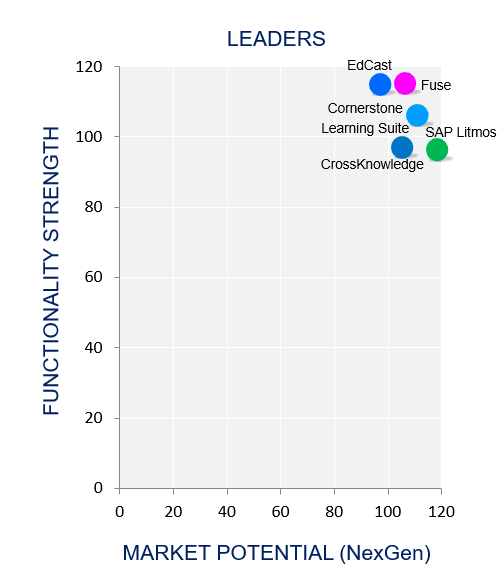
Any of these systems from a NexGen standpoint, would fit the bill.  They are the best of the best in terms of Next Generation functionality, with the minimum scoring 98.5 on the Functionality Strength Scale.  Their market potential to continue to hit NexGen in 2020-21, is at least 99, with the majority going over 100. 

On the Functionality Strength Scale in order of Tier-3 functionality (for those who are fans of rankings)

Tied for 1 – EdCast (LXP) and Fuse (who pitches themselves as an LXP, but I would argue they are more a learning ecosystem and/or an LMS. The points total was less than a point separate, hence to me a tie.  If you want to be one of those folks that says, that small minimal less than a point matters, then Fuse tops in at #1.  

Fuse has the best and most robust analytical data capture and visualization I have seen in the industry. The key reason is that they have Good data, a BI tool built-in to the system (at no additional charge). Good Data can capture over 300 metrics of data, although that is not available or presented in the system itself.  Still what is available is extensive. 

3. Cornerstone Learning Suite – This is the learning suite here, not the entire Cornerstone system. 

4. CrossKnowledge – The LMS, and not their brand new system, CK Connect (review coming in Jan.), CrossKnowledge has the second best data visualization I have seen so far.

5. SAP Litmos –  Last year’s top system for NexGen, still a very strong player, a leader in the space, but the others – those listed above, have more Tier-3 then Litmos. But still, they have at least 95% Tier-3.

Market Potential

SAP Litmos is close to the 120 as you can get.

But, any of the leaders are likely to as well, just the fast track record of previous NexGen indicates that SAP Litmos has a high probability of achieving those results.

Cornerstone Learning Suite is next in line, they were a little slow with Tier 1, but upped their game in Tier 2 and definitely Tier-3. The system needs some tweaks, but from a NexGen standpoint, which is what this grid only focuses on, they show a high trend line to achieve going forward. 

Fuse slides into three if you will, for those focusing on ranking of scale ratings for market potential. CrossKnowledge is slightly behind them, but just barely. 

EdCast, while truly deserving in the leader grid, will definitely have some Tier-4 features, based on previous track record of other tiers, but being an LXP opens them up to whether they continue down the LXP path, or try to be more of a learning ecosystem or an LMS or hodgepodge of something yet to be known.  Since Tier-4 will have certain functionality only for LXPs, versus the rest of the learning system space, a big unknown is based on the route they go, will they hit all of Tier-4 for that area?  Indications say yes, regardless, and they are a NexGen system on the market potential for 2020, but say, 2021? Will they continue to be a leader or will they drop into steady? Right now, I see them clearly as a yes in the leader grid. 

At the end of the day, if you want a robust NexGen system any of the leaders will deliver, regardless if they are an LXP, LMS or Learning ecosystem.

Risers

Risers

These are up and coming, on the rise from the standpoint of Tier-3 NexGen.  They all could say they are NexGen and they would be making an accurate statement.  Two are LXPs for now, the other three are LMSs. 

Functionality Strength

For folks who want systems on the rise from a next generation standpoint, this is the grid for you. The biggest surprise to me is Saba. I was actually stunned to be quite honest, because their track record for Tier-1 was slug level, and Tier-2 was better but by no means elite, so what they were able to do in terms of Tier-3 is quite impressive.  Again, this is in reference to the learning portion of Saba and not the entire platform of talent, etc.

Degreed is the closest at this point to jump to the Leaders Grid, but to achieve that they need to improve on their analytical data metrics and two capabilities within the video management Tier-3 features.

Learn Amp is an outstanding LXP (Top 10) and a top ten learning system for 2019-20.  They continue to push on the NexGen. 

SumTotal.  I have seen the new UI on the admin side that is coming out in Q1 2020, and it is a major upgrade from what they have now.  Strength of NexGen is again on the rise.

D2L is relatively new to the corporate market, and for NexGen that is the market I looked at for them, and not from an HE or education standpoint (for those wondering).  I like where this system is heading, and the levels of achievement for Tier-3 tells me they understand what they need to do in this market, to continue growth. 

Market Potential for NexGen

 Saba is the unknown here, because of their previous track record. I definitely see them hitting quite a bit of Tier-4, but as a system who is more of an HCM, there is always a concern on where the R&D will be heavily pushed to.  I hope it is Learning, but my sense will be the performance more so (as it has in the past).  When that roles into play, the NexGen market potential for 2020 will exist, so you can’t go wrong here, but for 2021- I have to wonder, as they could easily slide into Steady or drop completely.  Still, for the next year at least, I see them as NexGen. 

Degreed is clearly going on the NexGen bent, but I still have doubts on where they see themselves by the end of 2020. If they align more towards a performance or talent mangement platform with learning experiences (yes, a term I despise), then how much of the R&D will be focused on learning, versus the other areas?  And I do see them as different, i.e. talent development/mgt versus learning.  So, yes, NexGen potential for 2020 is definitely there, and strong at that, but 2021, specifically for learning?

Overall in the Risers Grid, each of these systems are not only NexGen for 2019, but will be in 2020 too.  I’d place good high marks on 2021, sans the two exceptions above, which will be dependent on some variables that have yet to be clearly ascertained to a degree (no pun intended) of 100% certainty.

Steady
Steady

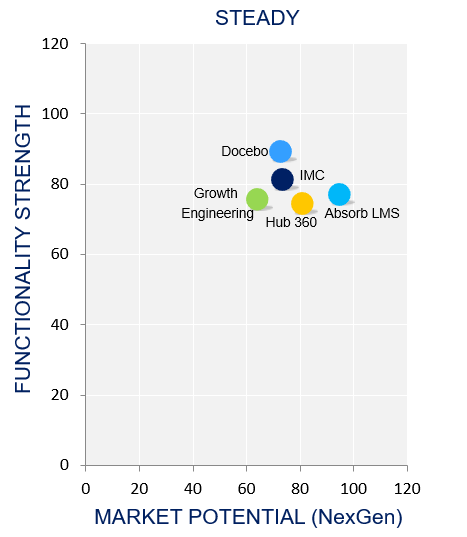
In the Steady group, IMC has the best chance I see as of right now, to move into the “Risers” or even “Leaders” Grid depending on what they do in 2020, from a Tier-4 standpoint.  There is a lot of love in NexGen for their system, but they are missing just enough to keep them from going into Risers.

Absorb LMS is another vendor that with a few of this and that, could jump into Risers, but for now, they are in the Steady category.  Again, this is relating to NexGen only.

Docebo is a wild card here. Some of their NexGen Tier-3 is very good, other is just barely above average, and of course, they are missing a few Tier-3 features.  Analytical data is a weakness in terms of metrics capture, and at one time say in 2017, they were truly a great NexGen system.  In 2018, they slipped a bit, and in 2019, they are in the speed bump area, not hitting a wall, but coming close enough, to make you wonder, where they plan to go from a Next Generation standpoint.

I’ve already talked about Hub360, which includes the NexGen system of Spoke (Tier 1 and Tier 2 with a few Tier 3) as a component of the platform.  Make no mistake, this is a very good sales enablement platform, new to the market, with Tier-3 existing within.

Growth Engineering. If someone would have told me they would be in the Steady category in 2019, I’d be like, “no way”, but here we are in 2019-20, and there they are – in the steady grid.  Growth was slow to Tier-3 functionality, then moved forward to add as much as they could for 2019, but frankly should be higher at this point then where they are, currently.  They have enough to slide them into this grid, but from a market potential for 2020, well if you look at their scale rating for market growth, I think you can ascertain my concern.

Market Potential for NexGen

Each of the vendors in the Steady Grid, I see as more than likely to achieve NexGen Tier-4 at some level (higher for some than others) in 2020 and then into 2021.  As with anything, there is always a wild card, and the one vendor that screams that is Growth Engineering.

They were late to the game with a content marketplace, and although many vendors do not even have one, none of those vendors were in the NexGen Leaders Quadrant in 2018.

Knowledge Arcade which is a very cool mobile app from Growth Engineering is part of this wild card.  I can easily see Knowledge Arcade, which is a standalone app, but you need the Genie authoring tool from Growth Engineering to use it,  turning into the higher percentage of business from them by the end of 2020, and definitely in 2021. As such, it gets back to R&D, and can a system like Growth who has a new admin side UI rolling out, continue to keep the NexGen Tier-4 functionality on track or will they put more into Knowledge Arcade than the system itself?  Thus, the reason behind them scoring slightly above 60 in the market potential scale rating. 

The other four vendors are very likely to achieve NexGen status in 2021, and definitely are NexGen for 2020.

Criteria for Functionality

There is a lot here, so the way it will be presented is by a header followed by bullet points of the features.  For example, Playlists is the header then there will be certain features that qualify as Tier-3.  A vendor may refer to a playlist as a channel or some other term, but when I look at it, I see “Playlist”.  The same with skills management. Some vendors may call it competencies or competency and skills or whatever. I look at it from skills management perspective.

Functionality areas that were weighted the highest

As with anything, there are certain functionality areas that are more geared towards NexGen than others.  I mean ad-hoc reporting is not NexGen it is a standard nowadays in a system.  Nor are course standards, NexGen. 

The areas listed below were weighted the highest (and what Tier-3 features that are contained within them)

  • Machine Learning
  • Playlists
  • Curation
  • Mentoring (some vendors refer to this as Coaching)
  • Video Management
  • Skills Management
  • Metrics – Analytical Data tied to data visualization outputs
  • Connectors
  • Content Marketplace

Connectors refers to the number of systems or platforms, the learning system can connect to, beyond the usual fare of Workday, ADP, Oracle, SAP, Lawson, Salesforce, SharePoint, and any other HRIS or HCM system or SIS for that matter.

Some examples of the connectors that would slide under “Connectors” category would be

  • Slack, Microsoft Teams
  • Dropbox, Google Drive, OneDrive (Microsoft), iCloud, Box.com
  • Zapier (if offered)
  • Office 365 (cloud), Survey Monkey, Constant Contact
  • Github and so forth

Content marketplace are the number of content providers that a client can buy content from that goes into your system. 

Under the Key Areas (Weighted higher) Tier-3 NexGen Features

Machine Learning

  • AI in system can scan documents, courses, content, audio and video files and produce text results in a transcript or similar items
  • Recommends courses/content based on job role, skill and/or additional variables
  • Can create a learning path based upon recommendations using algorithm over a period of time
  • Ability to include other items to enhance recommendation of courses/content
  • Recommends content/documents/videos/etc. based on in progress/completed courses or content

Playlists

  • Learner interests/topics playlist
  • Learner currently taking playlist
  • Assigned learning playlist (for the record, I am not a fan of “assigned learning” in an LXP)
  • Learners can add Podcasts to their playlist
  • Learning System Vendor creates curation content playlists
  • Learner can create their own content playlist and share it with others (who may subscribe depending on system)
  • Learner can create multiple playlists
  • Manager can create playlists for their direct reports

Curation

  • System offers contextual actions
  • System can generate recommended content via the machine learning algorithm
  • Client can create their own courses (via system or 3rd party) and sell them on vendor’s course marketplace – to other clients in the vendor’s system
  • Content excluding courses can be listed in the trending/Most Popular and/or Recommended
  • Learner can add video (regardless if it is uploaded or already on their computer/device), images, content (via the web, including links), content via file (uploaded) to a playlist

Mentoring

  • Learners can add media, content or other deliverables to their responses
  • Learner can share responses to question or questions with other learner or learners or groups, etc.
  • If one person is designated or selected by learner, the learner contacts the “mentor” via some mechanism (to be defined) within the LMS; all information and data is captured on the back end of the LMS (viewable by administrator)
  • Coach/mentor can communicate with the learner via web cam or other solution within the Learning System

Video Management

  • Video content can be extracted as a text transcript seen on the same screen (either below or next to the video)
  • Video text transcript – learner can click on different words or sentences and the video will go to that exact point, enabling the viewer to watch that specific segment
  • Ability to bounce/move to different video points in video without having to go in a linear (straight) approach. Appears as pointers. End user can leave and go back at any time to that exact point in the video

Skills Management

  • Create your own library of skills, including definitions
  • Match a skill or a series of skills to a piece of content/a playlist
  • Track skills by content
  • Skills rating(s) – rated by the learner for each skill they identify as having
  • Administrator can create, edit, delete skill rating(s)
  • Manager can create, edit or delete skill ratings for their own team
  • Skills tied to job roles/job profiles, which can be used to submit to jobs within the company (if applicable/available as part of the system)
  • System can generate a playlist based on skill rating, skill level or any other skill related variable (achieved via machine learning)
  • Allow managers to assess an employee’s existing skills

Metrics

  • Analytics include tracking to web sites  (this is for LXPs, not an LMS)
  • Learner tracking data (by content, learning path, etc.)
  • Built-in business intelligence component or connection to a 3rd party business intelligence tool (included at no additional charge to the client)
  • Create KPIs and report on them
  • Heat maps with correlating data
  • Data Visualization

Other Items

  • Profile can list their skills and/or skill-sets, interests
  • Playlists or channels can be shared via social media
  • Ability to assign multiple certificates to a single course/content
  • Administrator feature – Ability to drill-down on analytics for more information (Example: system shows total number of courses completed, administrator clicks on the graph and can drill down for addl info/data)
  • Administrator feature – Ability to assign courses based upon skills needed/required for job role

Bottom Line

Congratulations to the Systems that have achieved NexGen Status as Leaders, Risers and Steady.

All of these vendors have the right to say they are NexGen, because

they

are.

E-Learning 24/7


See you in 2020!

0
See you in 2020!

We hope you’re enjoying this holiday season, whether you’re celebrating a holiday, the end of the year, or just time away from the typical grind. We’re taking a break to spend some time with family and friends. Our next blog post will be on January 9th!

Upper Left: Carolina and her family

Upper Right: Megan and her husband

Bottom Left: Althea and her husband

Bottom Right: Cindy and her family

Making the Front Page: How All the News Fits in Print

0
Making the Front Page: How All the News Fits in Print

Washington editors, who once weren’t even allowed to speak, now beam in on a giant TV screen, as do editors based overseas. In these meetings, it is routine to hear from sections that rarely have front-page candidates. Nowadays they are looking for “home page” time — an ever-evolving 24-hour formula that allows far more stories to be showcased — and promoted in newsletters and on our social media accounts.

For the most part, the front-page decisions are hashed out throughout the day, never far out of alignment with those being made for the web, though there is a separate front-page meeting at 3 p.m. There the final calls on stories are made (until something new happens and the page has to be remade). But much of the focus of that meeting is on looking at the available photos and designing the page. The design will dictate the size of headlines, leaving editors little room to maneuver — unlike the more flexible, and fluid, procedure for the web. Often the headline on the print story deemed the most important of the day is in a narrow column, allowing only six or seven words — not even half a tweet. (This got us into trouble recently, when the need for a very short front-page print headline resulted in one that lacked sufficient context.)

Though in some ways the front-page decisions have become secondary in today’s 24-hour news cycle, many reporters and editors still measure their success by how many of their stories land there.

It is still a tradition in the newsroom to commemorate a reporter’s first front-page story with a metal plate of the page used by our local plant. (So far, no one seems satisfied with a screen grab.)

The types of stories that appear on the front page have also changed mightily over the years. In the 1980s, government announcements, ceremonial meetings between world leaders and stories based on newly released reports often dominated the page, as did pictures of mayors and businessmen standing behind lecterns.

Since then, the definition of important news has pushed into new areas. Analysis, lifestyle and original reporting began to edge out yearly stories about the Macy’s parade and particularly hot or particularly cold days in New York. (Yes, as a young reporter I wrote countless parade and weather stories.)

The changes were often distressing to the old guard. When I was named National editor in 2005, a retired managing editor who had once taken an interest in my career took me out to lunch to celebrate. But he could not stop talking about what he saw happening at the paper.

Word + Quiz: pergola

0
Word + Quiz: pergola

: a framework that supports climbing plants

_________

The word pergola has appeared in 30 articles on NYTimes.com in the past year, including on June 27 in “How to Host a Relaxed, Italian-Style Late Lunch” by Laura Rysman:

Meals at Arniano are served outside under the grapevine-covered pergola facing the valley or in the kitchen’s open dining room, where the table is always set with linens and decorative objects the family has collected over the years: white jacquard tablecloths, watery blue ceramic plates and a jumble of vases from local flea markets …

_________

Lesson of the Day: ‘Trump Impeached for Abuse of Power and Obstruction of Congress’

0
Lesson of the Day: ‘Trump Impeached for Abuse of Power and Obstruction of Congress’

Find all our Lessons of the Day here.

Featured Article: “Trump Impeached for Abuse of Power and Obstruction of Congress” by Nicholas Fandos and Michael D. Shear.

President Trump became the third president in the history of the United States to be impeached.

In this lesson, students will learn more about the historic vote in the House of Representatives, explore the various arguments for and against the impeachment of Mr. Trump presented by Democrats and Republicans, and consider what the vote will mean for our nation. In a Going Further activity, students will explore their feelings and reactions to the impeachment — and speculate on what will happen in the upcoming Senate trial.

On Wednesday night, the House of Representatives voted to impeach President Trump for abuse of power and obstruction of Congress, making him just the third president in American history to be charged with “high crimes and misdemeanors.”

How much have you read, seen or heard about the House impeachment vote? Have you talked about it at school, or with your friends or family? If so, what are the people you know saying?

The New York Times reporters Nicholas Fandos and Michael D. Shear summarize the historic vote:

The House of Representatives on Wednesday impeached President Trump for abuse of power and obstruction of Congress, making him the third president in history to be charged with committing high crimes and misdemeanors and face removal by the Senate.

On a day of constitutional consequence and raging partisan tension, the votes on the two articles of impeachment fell largely along party lines, after a bitter debate that stretched into the evening and reflected the deep polarization gripping American politics in the Trump era.

Only two Democrats opposed the article on abuse of power, which accused Mr. Trump of corruptly using the levers of government to solicit election assistance from Ukraine in the form of investigations to discredit his Democratic political rivals. Republicans were united in opposition. It passed 230 to 197, with Speaker Nancy Pelosi gaveling the vote to a close from the House rostrum.

On the second charge, obstruction of Congress, a third Democrat joined Republicans in opposition. The vote was 229 to 198.

Next, watch the three-minute video below with highlights from the day. After watching, respond to these three questions:

  • What is one argument Democrats used in favor of the articles of impeachment?

  • What is one argument Republicans used against the articles of impeachment?

  • What is one question you have about the House impeachment vote?

(For more background information, you can read the two articles of impeachment here and how the Constitution defines impeachable here. For more on the impeachment process, you can read this article or watch this video. You can also find key testimony from the House impeachment inquiry here. )

Read the article, then answer the following questions:

1. How did the House impeachment vote reflect the “deep polarization gripping American politics in the Trump era,” according to the article?

2. What does the article of impeachment on abuse of power accuse the president of doing? How are President Trump’s actions toward Ukraine at the center of the “existential threat to Mr. Trump’s presidency,” according to the authors?

3. What does the second article of impeachment — obstruction of justice — accuse the president of doing?

4. During the day of debate on the House floor, many arguments were put forth on whether to support the articles of impeachment. Give at least two for each side.

5. How did President Trump react to the impeachment vote? What does the president mean by his statement that the Democrats have “cheapened the impeachment process”?

6. The authors state that “regardless of the outcome of a Senate trial, the impeachment vote in the House puts an indelible stain on Mr. Trump’s presidency.” What evidence does the article provide to support this claim?

7. What other United States presidents have been impeached? How is the Trump impeachment similar to or different from past examples?

8. What happens next? Why does Mitch McConnell, Republican of Kentucky and Senate majority leader, want a swift Senate trial in January, according to the article?

  • What is your reaction to the impeachment of President Trump? How do you think it will affect him, his presidency and this nation? What do you think it means for you, your family and your community?

  • Do you agree with Republicans like Representative Chris Stewart, who said: “This day is about one thing and one thing only. They hate this president”? Or, do you agree with Democrats like House Speaker Nancy Pelosi, who said, “It is tragic that the president’s reckless actions make impeachment necessary. He gave us no choice”?

  • If you were a member of the House of Representatives, how would you have voted on the two articles of impeachment? What arguments would you have considered to make your decision? Use evidence to explain your reasoning.

  • How much attention did you pay to the impeachment inquiry and the House vote? Have you talked about it at school, or with friends and family? If so, what are the people you know saying?

(For more on the Senate trial, you can read “What’s Next for Trump? A Senate Impeachment Trial, Probably.”)

How Have You Coped With the Death of an Idol?

0
How Have You Coped With the Death of an Idol?

Find all our Student Opinion questions here.

In recent weeks people have been reflecting upon and mourning suicides by K-POP stars and YouTube personalities like Etika. A little over a week ago, the rapper Juice WRLD died, which has made many people think about how painful and personal celebrity deaths can feel because of our proximity to our idols through social media.

Has one of your idols ever died? How did you feel emotionally, psychologically and physically in the days and weeks after? Was there anyone who supported you through your grieving process?

In “How to Help a Teenager Handle the Death of an Idol,” Kelly Glass writes about supporting her son through his process of mourning Juice WRLD. She also interviewed experts, including Jana DeCristofaro, an expert on grieving children and families, who offered advice to parents and adults about how to help teenagers cope with this kind of loss:

For this generation of teenagers, the deaths of their icons are bigger than adults might realize.

“When a star dies who’s around the same age, it can bring up a lot of thoughts about mortality,” Ms. DeCristofaro said. Reminders of these deaths are all over social media, and teens are inundated daily with news and commentary on what happened and why. Ms. DeCristofaro said this might trigger teenagers’ questions about the purpose of their own lives.

Parents also have to keep in mind that fan relationships are different now. The deaths of previous pop idols, like Michael Jackson in 2009 and Prince in 2016, devastated fans all over the world. Many worshiped them and felt emotionally connected to them through their music. But now, with platforms like Snapchat, teens are immersed in the world of their celebrities like never before.

Ms. DeCristofaro said that one of the factors that influences a person’s grieving process is how much the person who died was a part of the day-to-day life of the person grieving. Teens watch their favorite musicians’ Instagram stories, follow their thoughts and musings on Twitter, and see or hear from their favorite celebrities on one social platform or another. This adds to the level of connection teens feel they have with celebrities.

What parents can do differently, she said, is acknowledge how the daily routine of teens whose favorite celebrity just died will change. Treating these deaths like far-removed tragedies is dismissive.

“They feel like they lost a friend,” said Ebony White, director of the addictions counseling program and assistant clinical professor of the counseling and family therapy department at Drexel University. “Sometimes parents and teachers lose teens because we don’t connect with how personal it was for them.”

Students, read the entire article, then tell us:

  • The article asserts that because of social media, the death of a celebrity can feel close and intimate. Do you agree with this? Does it ever feel like the icons you follow are your friends? What gives you that sense of connection?

  • If you’ve experienced the death of an icon, reflect on how friends, family and teachers responded and reacted. Did people around you say or do things that were helpful? Were there things that were less helpful to your grieving process?

  • What do you think about the advice in the article given to adults? In one section, Ebony White, a professor of counseling and family therapy, offers the following advice:

Dr. White recommends that parents start with a simple question: “What do you need from me?” Other well-intentioned questions, such as “Why are you upset?” or “What’s wrong?” can come across as dismissive to grieving teens. Acknowledging the pain they are experiencing without attempting to fix the feelings may help leave the door open for teens to lean on their parents through the process.

To continue the conversation, Ms. DeCristofaro advises that parents be what she calls curious learners. “Show some interest and curiosity in the celebrity,” she said. “‘Could we listen to something together? What do you like about their music?’ Just so you can learn a little about what your child is connecting with.” Such questions help teens put the focus back on the lives of the icons they’ve lost instead of their deaths.

What do you think about Dr. White’s suggestions for parents? Has an adult ever asked you any of those questions? How did you respond?

  • If you were to give the adults in your life advice about how to support teenagers coping with the death of an idol, what would you tell them? Are there other resources you wish you had to help with this kind of loss?

If you, or someone you know, is having thoughts of suicide, call the National Suicide Prevention Lifeline at 1-800-273-8255 (TALK) or text CONNECT to the Crisis Text Line at 741741.


Students 13 and older are invited to comment. All comments are moderated by the Learning Network staff, but please keep in mind that once your comment is accepted, it will be made public.

Baby Yoda

0
Baby Yoda

What are your favorite memes from television or movies? Why do you like them?

In your opinion, what makes a character or a scene meme-worthy?

Tell us in the comments, then read the related article to learn more about why one critic thinks memes like Baby Yoda are the future of television.


Find many more ways to use our Picture Prompt feature in this lesson plan. You can find all our Picture Prompts in this column.

Should All Schools Teach Cursive?

0
Should All Schools Teach Cursive?

Find all our Student Opinion questions here.

Do you know how to write in cursive? If yes, where did you learn this skill? How often do you use it?

Is cursive a valuable skill in 2019? Or is it a relic of the past?

In “A Defense of Cursive, From a 10-Year-Old National Champion,” Tracey Tully writes:

A fifth grader in New Jersey is a master of curlicues and connecting loops. His technique is so good he was named a state and national champion of a dying art: cursive writing, a skill that once seemed destined to go the way of the typewriter.

The boy, Edbert Aquino, who is 10, took home last year’s national trophy, $500 and bragging rights for his Roman Catholic elementary school in Bergen County.

But competition for the prize might just get stiffer in New Jersey.

Assemblywoman Angela McKnight, a Democrat from Jersey City, has introduced legislation that would require public schools to again teach a skill that had been phased out across the country, but is now enjoying something of a revival.

Like many students in New Jersey, Ms. McKnight’s son had never been taught cursive writing. Tasks she considers fundamental were beyond him: autographing a yearbook; endorsing a check; signing an application.

So she bought a workbook and taught him at home. “I wanted him to be able to sign his name,” she said. “It’s a life skill.”

The proliferation of computers and screens, coupled with the advent of rigorous Common Core standards and new demands on teachers, had led to a gradual disappearance of cursive instruction across the nation. In New Jersey, public schools have not been required to teach handwriting since 2010.

To many people who recall being berated for their illegible writing, the disappearance of cursive is nothing to lament.

“As an exercise, writing things by hand is up there with cobbling shoes and shoeing horses,” a columnist, Alexandra Petri, wrote in 2012 in The Washington Post.

The article explores some of the benefits of cursive and handwriting:

“After they got rid of handwriting, now they’re all rediscovering it,” Virginia Berninger, a retired University of Washington professor who has conducted research on the ways children learn when using print or script. “People mistakenly assumed because we had computers, we didn’t need handwriting. We need both.”

Putting a pencil or pen to paper helps form an impression in a child’s brain and is beneficial for early literacy, regardless of whether the letters are printed or written in script, Professor Berninger said. But her studies have shown a connection between the linked letters in cursive writing and improved spelling proficiency.

“We think those connecting strokes help children link the letters into word units, which helps their spelling,” she said. Handwriting, she said, also allows children to write fluidly and quickly, which can lead to longer stories and essays.

Edbert, who was declared a national winner as a third grader, said that when he does use cursive, he is forced to slow down, which allows his ideas to flow more freely and helps with creativity. “If I’m, like, handwriting it, I just tend to write better,” he said.

Still, even Edbert said he would prefer to use a computer (and spell-check) for long assignments. “I can type faster than I can write,” he said.

Students, read the entire article, then tell us:

  • Should all schools teach cursive? Is cursive an important “life skill,” as Angela McKnight, an assemblywoman, believes? Or is it an obsolete craft like “cobbling shoes and shoeing horses,” as Alexandra Petri, a columnist, has written?

  • Do you know how to write in cursive? If yes, how often do you use it? If you don’t write in cursive, is this a skill you wish you had? Why or why not? Do you have a signature that you use when you sign forms or other documents?

  • What are the benefits of cursive? Do you agree with Edbert Aquino that writing in cursive allows “ideas to flow more freely” and helps with creativity? What do you believe are the drawbacks of cursive?

  • Virginia Berninger, the retired professor, says that putting a pencil or pen to paper helps form an impression in a child’s brain and is beneficial for early literacy. Has it been your experience that you learn and process things differently or better when you write by hand? Why or why not?

  • Does reading the article make you want to write by hand more often? Do you think that a hundred years from now, students will still be writing in cursive? Will they be writing by hand?

Artificial Intelligence, Authentic Impact: How Educational AI is Making the Grade

0
Artificial Intelligence, Authentic Impact: How Educational AI is Making the Grade

Adoption of artificial intelligence is on the rise: According to research firm Gartner, 37 percent of organizations have now “implemented AI in some form,” and adoption is up 270 percent over the past four years. 

Schools are following suit: Technavio’s “Artificial Intelligence Market in the US Education Sector 2018-2022” report predicts a nearly 48 percent growth rate for AI tools over the next three years. 

The challenge? Separating market interest from authentic impact. As noted by MIT Technology Review, the rapid development and uptake of AI solutions has created an environment where companies may “obfuscate and oversell” AI abilities even as organizations race to implement new solutions and keep up with the competition.

The key to AI success is specificity. It is crucial to define key needs AI tools can meet and shortcomings it can address. This is especially true for K–12 institutions faced with limited time and budgets.

MORE FROM EDTECH: Check out how K–12 schools have adopted AI in 2019.

5 Roles AI Solutions Have in K–12 Classrooms

There’s no rulebook for deploying artificial intelligence in schools. While solutions such as IBM’s Watson Education and Google’s recently announced Google Cloud Platform storage and AI initiative offers the potential for schools to deliver personalized learning strategies and offer analytics-based performance insight; how K–12 institutions leverage these tools is entirely up to them. 

Some of the most common concerns are around human bias and overall accuracy. As RAND senior policy researcher Robert Murphy notes in a post for Education Week, “maybe 10 percent, 20 percent, 40 percent of the time [the system] will get it wrong,” making AI in schools an excellent supplemental tool, but no replacement for teachers. 

As noted by Education Technology, the increasing use of AI in schools also brings ethical questions to the fore. Organizations must now consider what type of data is being collected, how this information is being used and what controls are in place to safeguard student privacy. In addition, administrators are worried about how increasing AI adoption will impact human staffing.

The best bet for schools adopting AI is to define how these solutions can drive positive outcomes before allowing them access to student data. While individual usage may vary, effective AI in education can be grouped into five general roles:

  1. Automation: The simplest application of AI often provides the most immediate benefit: By automating straightforward tasks such as grading, digital asset categorization or timetable scheduling, educators can increase the amount of time they spend actively engaging with students.

  2. Integration: AI solutions can integrate with other IT initiatives such as smart technology and IoT-driven networks to provide personalized learning solutions for students.

  3. Acclimation: Technology is now an integral part of both educational and business environments. Recent Pew Research data shows that 95 percent of teens have access to a smartphone and 45 percent are online “almost constantly.” AI in schools can help acclimate students to the pace of technological change.

  4. Delineation: Students’ needs and curriculum priorities are constantly shifting, making it difficult for educators to ensure the content they deliver remains relevant and actionable. AI-driven analytics in education can help spot critical trends and delineate key markers to help teachers design the most effective classroom experience and drive digital transformation.

  5. Identification: Data analytics informed by adaptative AI solutions can help identify critical areas for student and teacher performance. Combined with robust security and access controls, AI can help spot and remedy potential problems in their formative stages.

Author : Linda Collazo
Degree : Bachelors
Major : Healthcare Administration
Country : United States
Language : English

View Author Profile
Visit Atlantic International University

What Students Are Saying About How to Improve American Education

0
What Students Are Saying About How to Improve American Education

Teachers will revolve their whole days on teaching a student how to do well on a standardized test, one that could potentially impact the final score a student receives. That is not learning. That is learning how to memorize and become a robot that regurgitates answers instead of explaining “Why?” or “How?” that answer was found. If we spent more time in school learning the answers to those types of questions, we would become a nation where students are humans instead of a number.

— Carter Osborn, Hoggard High School in Wilmington, NC

In private school, students have smaller class sizes and more resources for field trips, computers, books, and lab equipment. They also get more “hand holding” to guarantee success, because parents who pay tuition expect results. In public school, the learning is up to you. You have to figure stuff out yourself, solve problems, and advocate for yourself. If you fail, nobody cares. It takes grit to do well. None of this is reflected in a standardized test score.

— William Hudson, Hoggard High School in Wilmington, NC

I have always been told “Don’t be a teacher, they don’t get paid hardly anything.” or “How do you expect to live off of a teachers salary, don’t go into that profession.” As a young teen I am being told these things, the future generation of potential teachers are being constantly discouraged because of the money they would be getting paid. Education in Americans problems are very complicated, and there is not one big solution that can fix all of them at once, but little by little we can create a change.

— Lilly Smiley, Hoggard High School

We cannot expect our grades to improve when we give teachers a handicap with poor wages and low supplies. It doesn’t allow teachers to unleash their full potential for educating students. Alas, our government makes teachers work with their hands tied. No wonder so many teachers are quitting their jobs for better careers. Teachers will shape the rest of their students’ lives. But as of now, they can only do the bare minimum.

— Jeffery Austin, Hoggard High School

The answer to solving the American education crisis is simple. We need to put education back in the hands of the teachers. The politicians and the government needs to step back and let the people who actually know what they are doing and have spent a lifetime doing it decide how to teach. We wouldn’t let a lawyer perform heart surgery or construction workers do our taxes, so why let the people who win popularity contests run our education systems?

— Anders Olsen, Hoggard High School, Wilmington NC

I’m someone who struggles when all the teacher does is say, “Go to page X” and asks you to read it. Simply reading something isn’t as effective for me as a teacher making it interactive, maybe giving a project out or something similar. A textbook doesn’t answer all my questions, but a qualified teacher that takes their time does. When I’m challenged by something, I can always ask a good teacher and I can expect an answer that makes sense to me. But having a teacher that just brushes off questions doesn’t help me. I’ve heard of teachers where all they do is show the class movies. At first, that sounds amazing, but you don’t learn anything that can benefit you on a test.

— Michael Huang, JR Masterman

I’ve struggled in many classes, as of right now it’s government. What is making this class difficult is that my teacher doesn’t really teach us anything, all he does is shows us videos and give us papers that we have to look through a textbook to find. The problem with this is that not everyone has this sort of learning style. Then it doesn’t help that the papers we do, we never go over so we don’t even know if the answers are right.

— S Weatherford, Kent Roosevelt, OH