fbpx
Home Blog Page 1570

Comment on Cartoon: The Training Project by Steve Snider

0
Comment on Cartoon: The Training Project by Steve Snider


cartoon-trainingproj

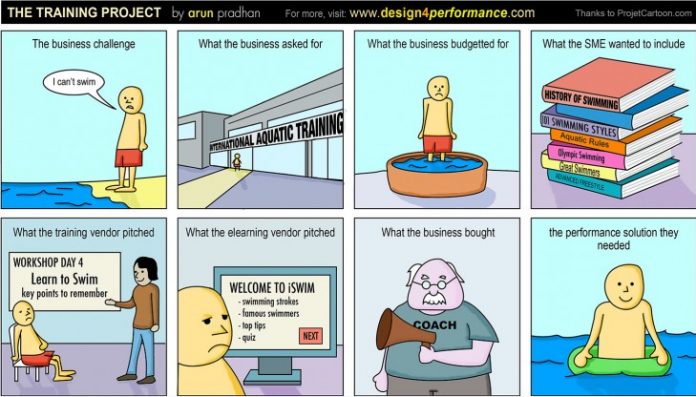
Not an argument against all training, but a reminder to design with performance in mind because, sometimes, there are easier ways to overcome that challenge :)

Quick addition to my original post: I’ve had several requests from people wanting to reprint this cartoon in newsletters/ publications. Im happy for you to do so but please take the following three steps:

  1. . just drop me a quick PM/email to let me know where it’s being used
  2.  where possible please include a live link to my blog www.design4performance.com
  3. if we ever meet in person, drinks are on you 😉

thanks


PLEASE CLICK ON THE IMAGE ABOVE TO VIEW IT AT FULL SIZE.


arun

I’m a Learning & Performance Geek with a passion for helping to empower people and solve challenging problems.
I’ve created an app called Learn2Learn to help people future-proof themselves with the super-skill of learning.
In my day job at DeakinCo, I use design thinking to take the lead creative role delivering 70:20:10 performance solutions for some of Australia’s largest companies.
In my spare time, I’m an award-winning fiction writer and hobbyist multimedia designer. Most importantly, I’m a proud dad to 3 eccentric small individuals who, along with my wonderful wife and life partner, have taught me more than anything else in the world.

If you think we’re on the same wavelength, please be sure to connect with me on Twitter/LinkedIn and use the form above to sign up for my email list.

Comment on Reframing 70:20:10, The Anatomy of Workflow Learning by Di

0

Great article – thank you! I particularly loved the ‘Training Project’ cartoon!
I have no doubt about the value of reflective practice as a bridge between experience, and learning and training, but I do wonder (worry) if people have the capability, capacity and motivation to reflect. Learners tell us that in the reality, complexity and noise of their work, they are simply too ‘busy’ or ‘lack time’ to reflect (excuses I know!).
I think as L&D practitioners, we make the assumption that learners want to reflect and can reflect in a meaningful way. While their workplaces and managers play a big part, I question whether we are we doing enough to build this capability?
I would be interested in thoughts on how we might improve this important element of learning?

Comment on INFOGRAPHIC: Heroic Journeys to High Performance by G Manoj Kumar

0

This is Wonderful Arun

Comment on Design Thinking for Learning Innovation – A Practical Guide by Jeffery Taylor

0

About a year ago, one of the big four Australian banks approached DeakinPrime with a challenge. We were asked to pitch for a compliance training job targeting the bank’s thousands of independent insurance brokers. The initial request was very specific, calling for quotes to build 9 elearning compliance modules.

We’d been exploring design thinking for some time and Simon Hann, DeakinPrime’s CEO, was inspired coming fresh off the plane from Stanford’s dschool, so we decided to go in a different direction.

Our pitch tentatively suggested a few elearning modules combined with some on the job tools however, we proposed to develop a more considered solution via a deeper design process which would examine learner needs and workflows, with the call out that we might end up redefining the problem altogether.

To our delight, our key stakeholders at the bank loved this idea and gave us the go-ahead to embark on a design thinking journey. The resulting co-design approach led us to ditch all 9 elearning modules. Instead, we developed a sales portal that provided just-in-time resources, guided customer interviews, and quick search options to access tools and support.

This solution is now live to over 5,000 people and the best part is that, rather than being trained in compliance, brokers who use the platform to increase their sales are inherently compliant. (Watch this space for a more in-depth case study).

In this instance, design thinking supported us to kill training and build an innovative performance tool directly linked to learner needs. In other jobs, it’s helped co-design learning and change campaigns that span tens of thousands of people.

Using design thinking hasn’t always led to paradigm-shifting solutions though. I’ve previously written about the potential fail points of creating 70:20:10 solutions and, in that context, a design thinking process can be crucial in establishing what not to build, instead revealing simple and realistic elements that can be embedded in the workflow of our audience.

WHAT DESIGN THINKING FOR LEARNING & PERFORMANCE LOOKS LIKE

For me, design thinking is about starting with empathy, designing collaboratively, and failing faster, to create innovative end to end experiences.

I explored the above summary in more detail during a recent presentation to the LearnX Conference. Click on the presentation below for more and for a sneak peak of the three workshop process that we’ve developed at DeakinPrime.

While we use a design thinking mindset & tools in all our jobs, we use this three workshop process for significant learning & performance projects that lend themselves to complex blends, campaigns, or ecosystems.

If the embedded link below doesn’t work try viewing the presentation here.

Please note, it might not make that much sense without my explanation to support it but hopefully, it gives you an idea.

TOP TIPS TO IMPLEMENT DESIGN THINKING FOR LEARNING

Beyond the model I’ve previewed in the presentation above, there are a number of tips to keep in mind:

1. Involve your audience early and often

Don’t work off assumptions or second-hand information. Instead, go to your target audience to observe, interview, and empathise with them. The best technique I’ve found for this is to include them in a co-design workshop and charge that group to interview their peers for further qualitative data.

2. Dig deeper with ‘whys’

The interview process, of asking why multiple times, has been a simple yet powerful change to gaining understanding. For both peer interviews and ones that our team conducts, it’s allowed us to go beyond the obvious pain point and uncover underlying needs

3. Collaborate by being visual

The cliche design thinking workshops involve countless sticky notes and cards up on walls. This is more than a gimmick; it’s an efficient way to sort, theme, and share information collectively. Done correctly, using tools such as card sorts or analysis grids, involves and empowers a group to quickly cut through data and make decisions.

4. Use personas

Even if I only have 2 hours instead of three workshops to design a solution, I still tend to use personas. These simple characters support deeper empathy by getting personal and specific. Each job varies but some key elements tend to include how the person thinks, feels, and does around a particular issue. Their key needs, pain points, elements of their workflow and day, and how they access learning, communication and information. For some reason, I’ve found 3 to be the magic number of personas.

5. Incorporate Action Mapping.

While I use many traditional design thinking techniques, I do incorporate a version of Cathy Moore’s action mapping to further understand personas and the gaps between them and the required actions they must take to reach success. Identifying performance gaps in terms of Knowledge, Skills, Motivation/Mindset or Environment can help inform the latter stages of ideation.

6. ‘Orphan your ideas’

I coined this phrase in one of my first workshops and it’s one that continually resonates with participants. It stems from when I was an elearning designer and had a sign over my desk reminding me that ‘I am not my module‘. Similarly, people need to separate themselves from their ideas. Some ideas will get shot down in an instant, others will evolve and end up being stars, but they are not us, and the quicker we orphan them, and allow  them to go their own way, the faster we can create better ones.

7. Everyone can prototype

Low fidelity prototyping can be extremely simple. At DeakinPrime we often include illustrators into the workshop process to bring ideas to life but, for often it’s enough to have participants drawing a concept model of key content, or a stick figure storyboard of a coaching experience, or a wireframe sketch of a portal including moveable sticky notes. It’s inherently rough and quick, but can provide a preview of an experience to allow us to fail faster.

8. Field testing should focus on empathy, not validation

This was a tweak I’ve only learnt recently. Initially we would engage participants to test low fidelity prototypes with their peers, charging them ’to test ideas we’re working on’. Recently, I experimented with charging them to ‘find out more about our audience group,’ using the prototypes as a conversation starter. This shifted people from defending a solution to asking more probing questions, empathising, and revealing needs.

9. The final journey map should include fail points and dependables

The culmination for the more complex jobs we work on has been a wall to wall journey map. A key swim lane in such a journey map is to consider other touch points and people. While we begin the process unashamedly empathising with our target learners, at this point we really want to empathise with the managers, delivery team, IT or others who will be called upon to play a role in the solution.

10. Draw on resources & tools

It’s great you’ve gotten this far as you’re obviously willing to learn from my mistakes and experiences, and there are countless others out there doing great work for you to continue that process. Sites like Stanford’s dschool and Ideo, while not learning specific, are incredibly generous, with fantastic tools and resources you can download right now.

11. Start small, iterate, and learn

It can be intimidating to get started, so be sure to take things a step at a time. You can begin by making sure you talk directly to learners, involve them in the process, and have the means to quickly test half-baked ideas before investing much into them. Be compassionate with yourself as you make mistakes, learn, and improve.

WANT MORE?

Feel free to check out some of my other work on design thinking and related topics:

Video: Learning Innovation: A Design Thinking Primer for L&D , a presentation I delivered earlier this year. Less nuts & bolts compared to the slides above, but a good starter with some background on the why & how of design thinking in learning.

Infographic: Design Thinking in Learning, now a year old this infographic still captures some key points & my key references.

Article: eLearning Modules will Die and 70:20:10 will hold the Smoking Gun, the premise behind that first case study I cited in the article of shifting from elearning modules to performance solutions.

Go Unlimited for less this October

0
Go Unlimited for less this October

This October, for a limited time, you can buy 12 months of Unlimited for even less.

For one payment of £189 £139, you’ll have full access to hundreds of FutureLearn short courses for an entire year.

Unlimited has countless benefits, but we’ve narrowed it down our top five so you can get stuck into learning sooner ✔️

  1. Get unlimited access to short courses

As an Unlimited learner, you can join as many courses as you like from top universities from around the world. 

Further your career by learning new in-demand skills like UX or Data Visualisation, or broaden your horizons and build creativity with courses like Start Writing Fiction and An Introduction to Victorian Film. 

Plus, if you’re not sure which archaeology course you’ll dig the most, or you’re a bookworm with an appetite for literature, you can pursue new topics easily with hundreds of courses in a huge range of industries and categories.

  1. Learn at your own pace

After surveying over 3,000 FutureLearners, we found that more than 30% of you valued the ability to complete courses at your own pace higher than anything else. 

With Unlimited, you have an entire year to complete your courses, so life won’t get in the way. 

Whether you want to take more time over particularly tricky steps or something happens in your personal or professional life, your courses will stay open for you to finish. 

  1. Prove your achievements

When you achieve something great, it feels pretty good to shout it from the rooftops. When you complete a course, you’ll earn a digital Certificate of Achievement which you can share online or on your CV as proof of your success. 

Research shows that one of the top five considerations for employers when hiring is proof of continuous learning.

A certificate shows your initiative and passion for your craft and is the perfect way to set yourself apart from the competition in your field.

  1. Keep your course content

With Unlimited, there’s no need to cram. You’ll be able to keep the content of all the courses you’ve gained a certificate on beyond the year of your Unlimited learning. 

Whether you have a job interview or exam coming up, or you’re about to attend a hotly-contested pub quiz, access any of the articles, videos and quizzes of your course whenever you need a refresher.

  1. Save time and money

One simple payment means less time at the checkout and more time learning.

Fancy building your skills across one particular field, like business or teaching? Pitch Unlimited to your employer and ask them to invest in your self-development. 

At £139 for one year, you can make the most of your new-found love of learning and invest in a brighter future.

We think you’re worth it.

Making Tests (More) Fun Through Hints Increases Student Uptake Of Self-Testing

0
Making Tests (More) Fun Through Hints Increases Student Uptake Of Self-Testing

As you can see: Students picked the 4-letter option more often than any of the other options. Furthermore, students reported that the 4-letter option was “the most fun” with 71% agreement for that option compared to only 11% agreement for the 6-letter option. Interestingly, the 0-letter option received an agreement score of 0% (the 2-letter option a score of 17%). So, it seems to be the case that pure retrieval practice without hints rules self-testing out as a strategy that students would select. Consequently, providing some hints can make self-testing more enjoyable and make students select it more often when they are given the choice.

They followed up their first experiment with a second one where they only included the two extreme options for participants to choose from: 0-letter versus 6-letter option. They found that students went for the pure restudy (6-letter) option in approximately 80% of the trails versus 20% for the pure retrieval practice option (0-letter). This shows that a self-testing option that offers no hints is perceived as an unattractive option and in such a scenario, students will go for restudying as a strategy.

After establishing student preference for testing with hints, it is important to see if that kind of self-testing is actually beneficial for performance on a final test. In follow-up experiments, the authors showed that indeed all three retrieval practice options – independent of hint level (i.e., 0-, 2-, 4-letter) – increased performance on a final test given two minutes later; more than the pure restudy condition (6-letter). However, one important caveat seems to be to make sure that students actually engage in retrieval processes, i.e., actually retrieve information from memory. If, for instance, the word pairs allowed correct guessing of the target word given the cue word – instead of retrieval – providing more hints led to detrimental effects of performance.

What Students Are Saying About: Extremist Content Online, Rivalries and Reflections

0
What Students Are Saying About: Extremist Content Online, Rivalries and Reflections

Inspired by the many robust conversations we’ve seen taking place in the comments section of our writing prompts lately, we’re posing a challenge for students this coming week:

Reply to a comment of someone you don’t know. Even better, start a conversation and keep it going.

Try to go beyond just saying “agree,” “true,” “same” or “good comment.” Instead, be specific about what you liked about what someone wrote, share an alternate point of view, explain why you disagree with something, make a connection to someone else’s experience, or ask an engaging question to continue the conversation.

(And always do so civilly and respectfully — we won’t accept any comments that violate our moderation standards, like name-calling, personal attacks, vulgarity or profanity.)

We may round up some of the best conversations we read in a future Current Events Conversation.

Need inspiration for what to write? Here are a few great examples of the many responses we got from students at Silverton, Nanaimo District Secondary School and J.R. Masterman this week:

In this exchange on our prompt “Are Some Youth Sports Too Intense?” Karina Malunay from Glenbard West, Glen Ellyn, Ill. wrote:

The reality is, teens are only staying in their sport because of their want to achieve getting a scholarship in college or playing in college at all. Parents and coaches need to show children to play for the love of the game, rather than winning.

Kylee from Silverton3 responded by expanding on Karina’s point:

@Karina Malunay I totally agree with this, it’s so true that kids who play sports spend so much time worrying that they’re not the best or they’re bad. Coaches and parents should learn to show that sports are for fun rather having it just be about winning, yes winning is great thing to have and feel, but having fun is what makes sport an achievable thing.

And in this discussion on our prompt “Have You Ever Encountered Racist or Extremist Content Online?” Ashley NT from California wrote:

I think social media allows children to experience politics at an early age. Social platforms such as Instagram often have accounts dedicated to political parties or feminist groups that express certain standpoints. With that comes racist stereotypes.

Theodor from NDSS pushed back and added on to Ashley’s comment:

@Ashley NT I agree with your comment that children can be exposed to politics and racism and many other subjects, at an early age thanks to social media. But I think that our society needs to educate our children and teenagers on what’s right and wrong on social media. We need to teach them at a certain point on why racism is committed and on why people have racist thoughts about other races.

Finally, in our Picture Prompt “Music Therapy” we saw students sharing their experiences with music. Seinnel Cruz from J.R Masterman wrote:

My taste in music has changed a lot in the past few months. I used to only listen to pop and all the top 100 songs … Now, the majority of my music taste is influenced by the app, TikTok. TikTok is a video making app where you can make a video and put a sound over top of it.

Cyrus Fisher from J. R. Masterman replied:

@Seinnel Cruz I experienced the same transition. I used to only like pop, but TikTok has helped me to discover songs I like outside of the genre. My playlist of TikTok songs is one of my favorites.

Now, you go give it a try!

And, finally, before we get to today’s selections, we want to welcome the many new classes who joined us from all over the country: Fordham Preparatory School, N.Y.; Glenbard West High School, Glen Ellyn, Ill.; Napa, Calif.; Norwood High School, Norwood, Mass.; Quest Forward Academy Santa Rosa; Shaker High School; Silverton, Ore.; and VJMHS, Holland, Penn.

Film Club: ‘‘I’m Worried That I Will Die:’ Hong Kong Protesters Write Final Goodbyes’

0
Film Club: ‘‘I’m Worried That I Will Die:’ Hong Kong Protesters Write Final Goodbyes’

Find all our Film Club films here.

Teachers: Please note that this week’s film includes powerful and disturbing images — including violence between protesters and police. Be sure to review the film before screening with your class.

What are you willing to fight for — even at the risk of being injured, or dying?

“‘I’m Worried That I Will Die:’ Hong Kong Protesters Write Final Goodbyes” is a three-minute film that touches on themes of activism, justice and sacrifice. It profiles young protesters in Hong Kong who are fighting for democratic reforms and freedom from China’s tightening grip on the territory. As violence escalates between demonstrators and the police in Hong Kong, protesters have started writing “last letters” to their loved ones, in case they don’t return. These notes chronicle the mental and emotional state of frontliners coming to terms with risking death for their beliefs.

Students

1. Watch the short film above. While you watch, you might take notes using our Film Club Double-Entry Journal (PDF) to help you remember specific moments.

2. After watching, think about these questions:

  • What questions do you still have?

  • What connections can you make between this film and your own life or experience? Why? Does this film remind you of anything else you’ve read or seen? If so, how and why?

3. An additional challenge | Respond to the essential question at the top of this post: What are you willing to fight for — even at the risk of being injured, or dying?

4. Next, join the conversation by clicking on the comment button and posting in the box that opens on the right. (Students 13 and older are invited to comment, although teachers of younger students are welcome to post what their students have to say.)

5. After you have posted, try reading back to see what others have said, then respond to someone else by posting another comment. Use the “Reply” button or the @ symbol to address that student directly.

6. To learn more, read “In Hong Kong, Gasoline Bombs, Masks and … Goodbye Letters.” Cora Engelbrecht writes:

“When you find this letter, I might have already been arrested or killed.”

This is how a 22-year-old protester in Hong Kong began what he worries could be the last letter to his family. He used the pseudonym “Nobody”; like most of the young people who have been confronting the police on the front lines, he fears arrest or death.

I met “Nobody” and his cohort during a recent Sunday demonstration. After 19 weeks of street battles with the police, the protesters’ roles are well rehearsed: They move swiftly, each to his or her appointed task, using codes and sign language. They assemble barricades in minutes, only to disperse in seconds.

But I came to observe handiwork of a different kind. As the violence intensified over the summer, I learned that young protesters were writing farewell notes to family and friends in the event that they were arrested or killed. They call them “Wai Shu,” or “last letters.” Some carry handwritten copies to the streets in their backpacks or wallets. Others hide them at home, in drawers and under mattresses. Several people read them to me off their phones.

“Nobody” told me he wrote his letter when he was at a protest last month in Causeway Bay, after witnessing an undercover officer fire into a crowd. “Right in front of me, live bullets,” he said. “At that moment, I learned that my life was at stake.”

What’s Going On in This Graph? | Oct. 30, 2019

0
What’s Going On in This Graph? | Oct. 30, 2019

This graph of annual number of tickets sales for three sports — baseball, basketball and football — originally appeared elsewhere on NYTimes.com.

By Friday morning, Nov. 1, we will provide the “Reveal,” the graph’s free online link, additional background and questions, shout outs highlighting student comments and headlines, and Stat Nuggets.

After looking closely at the graph above (or at this full-size image), think about these three questions:

  • What do you notice? If you make a claim, tell us what you noticed that supports your claim.

  • What do you wonder? What are you curious about that comes from what you notice in the graph?

The questions are intended to build on one another, so try to answer them in order. Start with “I notice,” then “I wonder,” and end with a catchy headline.

2. Next, join the conversation by clicking on the comment button and posting in the box that opens on the right. (Students 13 and older are invited to comment online. Teachers of younger students are welcome to post what their students’ comments.)

3. After you have posted, read what others have said, then respond to someone else by posting a comment. Use the “Reply” button or the @ symbol to address that student directly.

On Wednesday, Oct. 30, our collaborator, the American Statistical Association, will facilitate this discussion from 9 a.m. to 2 p.m. Eastern time to help students’ understanding go deeper. You might use their responses as models for your own.

4. By Friday morning, we will reveal more information about the graph at the bottom of this post. Students, we encourage you to post an additional comment after reading the reveal. How does the original article and the moderators’ comments help you see the graph differently? Try to incorporate the statistical terms defined in the Stat Nuggets in your response.


  • Read our 2019-20 introductory post, which includes the archives of past releases by topic and graph type.

  • Learn more about the “Notice and Wonder” teaching strategy and how and why other teachers are using this feature from our on-demand webinar.

  • Sign up for our free weekly newsletter so you never miss a graph, and add our 2019-20 “What’s Going On in This Graph?” live-moderated discussion Wednesdays to your Google calendar (10/30, 11/6, 11/13, 11/20, 12/4, 12/11, 1/8, 1/15, 1/22, 1/29, 2/8, 2/12, 2/26, 3/4, 3/11, 3/18, 3/25, 4/1, 4/8). Graphs are always released by the Friday before to give teachers time to plan ahead.

  • Go to the A.S.A. K-12 website, which includes This is Statistics, resources, professional development, student competitions, curriculum, courses and careers.

Word + Quiz: slovenly

0
Word + Quiz: slovenly

1. negligent of neatness especially in dress and person; habitually dirty and unkempt

2. characterized by carelessness

_________

The word slovenly has appeared in 15 articles on NYTimes.com in the past year, including on Sept. 19 in the obituary “Mark von Hagen, Critic of Times’s Stalin Coverage, Dies at 65” by Sam Roberts:

Four years later, responding to “Stalin’s Apologist” (1990), S.J. Taylor’s critical biography of Mr. Duranty, The Times assigned a member of its editorial board, Karl E. Meyer, to assess Mr. Duranty’s coverage. Mr. Meyer concluded that it amounted to “some of the worst reporting to appear in this newspaper.”

In a letter to the Pulitzer board accompanying Professor von Hagen’s report, Arthur Sulzberger Jr., then the publisher of The Times, wrote that “over the past two decades, The Times has often acknowledged that Duranty’s slovenly work should have been recognized for what it was by his editors and by his Pulitzer judges seven decades ago.”

_________