fbpx
Home Blog Page 1569

Coursera for Business Releases Skills Development Dashboards to Measure Learning Outcomes

0
Coursera for Business Releases Skills Development Dashboards to Measure Learning Outcomes

By Shwetabh Mittal, Director of Enterprise Product

Companies are racing to acquire skills that are fast in motion — 42 percent of the core job skills required today are predicted to change substantially by 2022. Equipping employees with critical skills is now a top-level priority, with the availability of key skills viewed as the top three business threat for CEOs globally. With so much resting on the ability to transform talent, measuring skills development is paramount. L&D leaders are expected to quantify learning outcomes to ensure that their employees are gaining the skills needed to compete and prove overall ROI.

Today, we’re excited to release Skills Development Dashboards, featuring skills-based metrics that enable our customers to report on their learning programs in more detail than ever before. The new dashboards are an expansion of the Skills Benchmarking tool released last year and provide an in-depth snapshot of the skills an organization is learning on Coursera. 

These are some of the highlights:

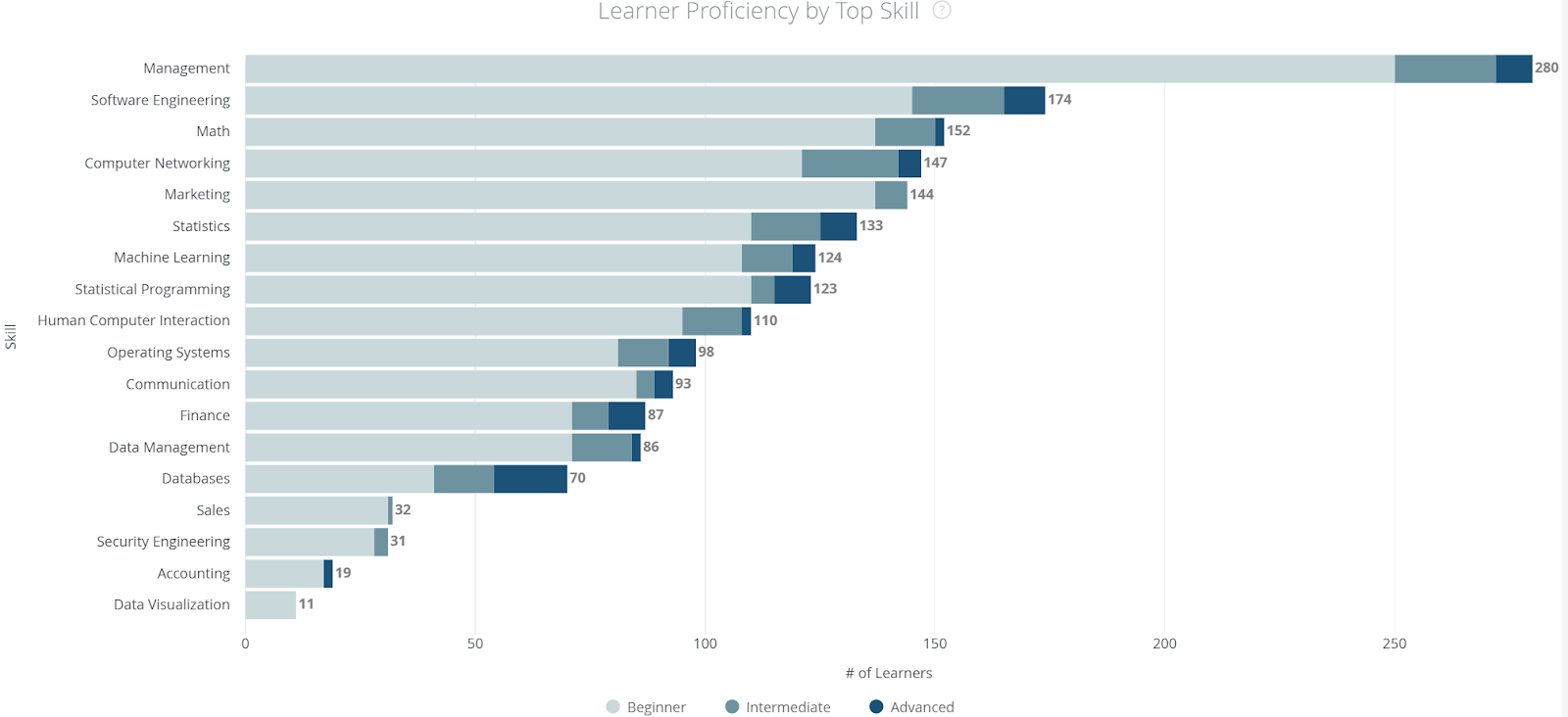
Learner Proficiency by Top Skill: Learner proficiency by skill, shown below, provides an overview of how many learners in an organization are at what level of skill mastery (Beginner, Intermediate, or Advanced) for the most popular skills learned at the company. It’s a powerful ROI snapshot to report out to stakeholders, and it can also be used to better understand what skills or proficiency bands to focus on in training.
Average Hours to Mastery: This dashboard displays the median number of hours it takes for  learners in an organization to get to the next level of skill mastery. With this, learning leaders can understand exactly how much time investment is required for developing a certain skill to a certain level of proficiency. It also enables them to identify skills that are either a quick win or too time-intensive to be ROI-positive for an organization. 

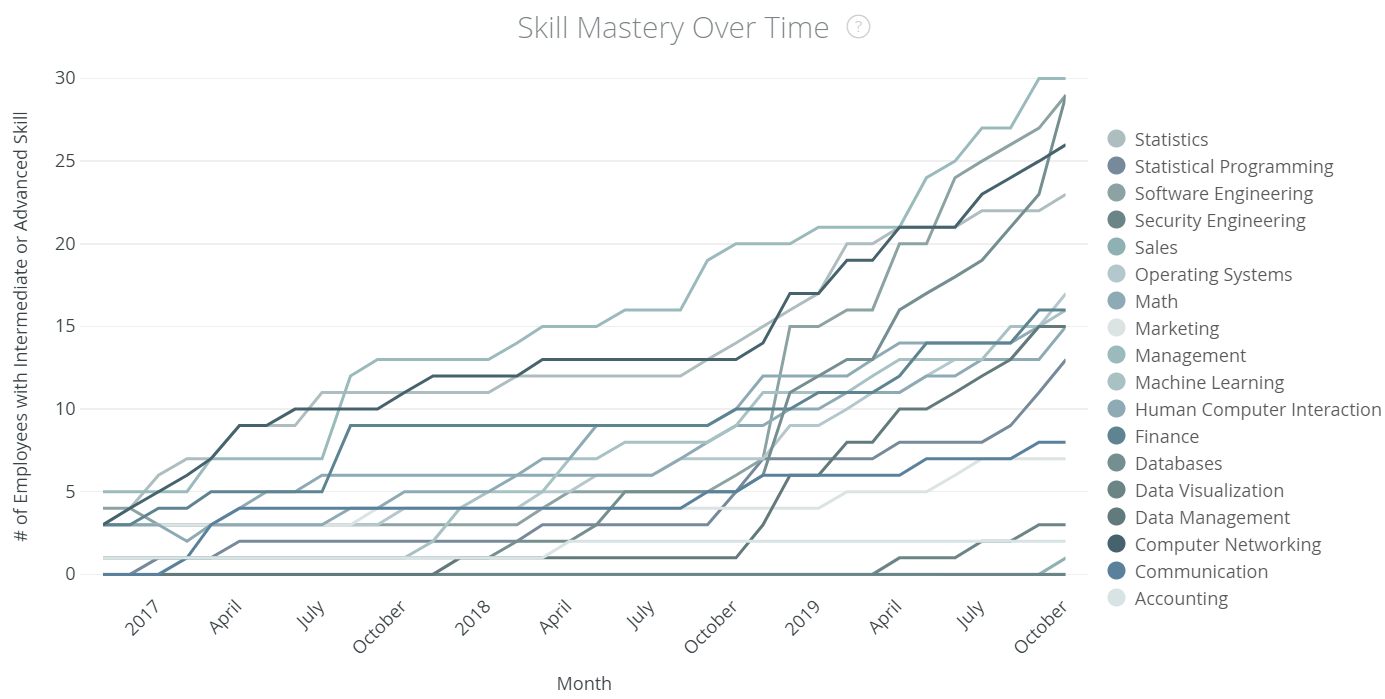
Skill Mastery Over Time: This dashboard, shown below, shows how many learners have reached the Intermediate and Advanced levels of mastery over time, by skill. Using this, learning leaders can identify whether their learners are tracking towards mastering the skills they need, and ultimately whether their learning engagement strategy is effective. 
Most Relevant Courses per Skill Level: This dashboard identifies the most relevant courses an organization is taking to learn a skill, making it easy to identify which content is relevant and popular with learners at intermediate and advanced levels. It’s also helpful for recommending content to learners that are just embarking on their learning program without having to sift through Coursera’s robust catalog of 3,600 courses.

The dashboards are built atop our Skills Graph, which analyzes the performance of millions of learners on graded assessments on the Coursera platform. By layering the Skills Graph with a variant of the Elo chess algorithm, we can estimate learner skill proficiency by viewing learners taking assessments as competitors in a match. When a learner passes or fails an assessment, their skill proficiency estimate increases or decreases, respectively. From there, we can measure learner skill proficiency over time, adjusting for the difficulty of courses taken. 

Companies of all sizes and across industries will benefit from these new dashboards. Over 10 Coursera for Business customers have already participated in the pilot and are excited to apply the insights from the Skills Development dashboards to their own learning organizations.

Want to learn more about how Skills Development Dashboards can inform your L&D strategy? Reach out to us today. 
Coursera for Business provides a world-class learning platform for companies that need to upskill, reskill, and deepskill their talent. With topics ranging from digital transformation and data science to software development and leadership, over 2,000 companies trust the Coursera for Business enterprise platform to transform their talent.


What’s Going On in This Picture? | Oct. 28, 2019

0
What’s Going On in This Picture? | Oct. 28, 2019

Students

1. After looking closely at the image above (or at the full-size image), think about these three questions:

2. Next, join the conversation by clicking on the comment button and posting in the box that opens on the right. (Students 13 and older are invited to comment, although teachers of younger students are welcome to post what their students have to say.)

3. After you have posted, try reading back to see what others have said, then respond to someone else by posting another comment. Use the “Reply” button or the @ symbol to address that student directly.

Each Monday, our collaborator, Visual Thinking Strategies, will facilitate a discussion from 9 a.m. to 2 p.m. Eastern time by paraphrasing comments and linking to responses to help students’ understanding go deeper. You might use their responses as models for your own.

4. On Thursday afternoons, we will reveal at the bottom of this post more information about the photo. How does reading the caption and learning its back story help you see the image differently?

Who Do You Turn To in a Crisis?

0
Who Do You Turn To in a Crisis?

Find all our Student Opinion questions here.

Do you find it easier to share your feelings with teenagers than with adults? What’s the best advice you’ve been given by someone your own age?

In “It Takes a Teenager to Help a Teenager in Crisis,” Catherine Cheney writes about a nonprofit crisis hotline where adolescents receive counsel from their peers. She writes:

After losing his best friend to suicide, Taylor Harrison, then 18, was looking for ways to honor the memory of his friend, deal with his own grief, and help others going through a hard time. He decided to volunteer at Lines for Life, a nonprofit crisis-line organization in Portland, Oregon.

Just a few months into his time there, Mr. Harrison took a call from a teenager who was thinking about walking in front of the next train. “It was really brave of you to reach out,” he told the caller. The teenager eventually decided the library was the safest place for him to go, and Mr. Harrison stayed on the phone with him while he took the bus there.

Mr. Harrison, who is now 23, later joined the staff at YouthLine, a service that Lines for Life offers for those aged 11 to 21. He said he dreams of discovering what that caller went on to accomplish.

Youth suicide is climbing faster than suicide by any other age group, perhaps because of social media, which can cause rising anxiety and depression among teenagers. While peer support has proved effective for adults with mental health challenges, scientific evaluations of teenagers helping one another are difficult to find — even though some limited studies show that teenagers experiencing the stress of adolescence cope better emotionally when they are with their friends than with their parents. YouthLine is one of six youth lines across the country that have demonstrated how teenagers can relate to their peers over the internet or the phone in a way that adults are sometimes unable to do.

These peer-run crisis lines are coming together to bring more young voices to crisis intervention. But to spread this service nationwide, they will have to convince the skeptics that teenagers can do this work.

The Op-Ed continues:

But not everyone thinks teenagers can or should take calls from people in crisis.

Crisis Text Line, a nonprofit that provides crisis intervention by text, decided to steer clear of volunteers under the age of 18 for a few reasons, according to Dr. Shairi Turner, who was the first chief medical officer at the organization. She said she is concerned that conversations with people in crisis “run the risk of vicarious trauma” for teenage volunteers.

Wendy Farmer, the chief executive of Behavioral Health Link in Atlanta, also had reservations about the model, until she visited Lines for Life last August. “The clinician in me said, ‘Wow, it’s a great idea, but I don’t know if we want to expose young people to what happens on a crisis line,’” she said.

Initially, Ms. Farmer traveled to Portland to learn how the adults who run her lines could better relate to teenagers or preteens. But she said she was “really blown away” by the young people she met. Ms. Farmer went through the YouthLine orientation, spent a night on shift and conducted a focus group with some of the volunteers. She said she was struck by how smart the students were — indeed, she said, the 15-year-old she was paired with for an exercise in reflective listening did a better job than she did.

Students, read the entire article, then tell us:

  • Are adults a good source for advice because of their life experience and knowledge? Or do you see them as out of touch, patronizing or judgmental? Do you relate better to your peers, or do you see them as naïve and immature?

  • Would you ever want to work as a teenage counselor? Would you worry about experiencing “vicarious trauma”? Or that you might be ill equipped to intervene if someone came to you with serious issues involving self-harm, for example, or abuse? How important is it for people in crisis to have someone just to listen to them?


Students 13 and older are invited to comment. All comments are moderated by the Learning Network staff, but please keep in mind that once your comment is accepted, it will be made public.

The Guggenheim

0
The Guggenheim

Frank Lloyd Wright’s Solomon R. Guggenheim Museum in New York City turns 60 this month. The Times architecture critic Michael Kimmelman writes that even after all these years, it is “still a shock on Fifth Avenue. The architecture declines to fade into the background or get old … Happy birthday to one of modern architecture’s transcendent achievements!”

Has a building ever inspired strong emotion in you — whether because you are in awe of it, repelled by it, confused by it, or something else? Where is this building and why do you think you have such a strong reaction to it?

Tell us in the comments, then read the related article to see more photos of the Guggenheim and learn about how it was built.


Find many more ways to use our Picture Prompt feature in this lesson plan. You can find all our Picture Prompts in this column.

Strange Cuisine

0
Strange Cuisine

Do you like to get creative in the kitchen or at snack time? Have you ever made a unique food or drink concoction that excites or repulses your friends or family? Is there a food you love that many others can’t stomach?

Tell us in the comments, then read the related article to learn more about the world of “dark cuisine.”


Find many more ways to use our Picture Prompt feature in this lesson plan. You can find all our Picture Prompts in this column.

Word + Quiz: vignette

0
Word + Quiz: vignette

1. a brief literary description

2. a small illustrative sketch, sometimes placed at the beginning of chapters in books

3. a photograph whose edges shade off gradually

_________

The word vignette has appeared in 131 articles on NYTimes.com in the past year, including on Sept. 30 in “Intensive Care: What Makes a ‘Good’ Parent?” by Perri Klass, M.D.:

Last year when Patrick Ishizuka published a parenting study, he set off another round of discussion about what we call good parenting, and who is able to do it.

The study looked at the results of a nationally representative survey in which parents were presented with fictional vignettes about elementary school-aged children; alternate responses suggested two different schools of parenting: “concerted cultivation” and “natural growth.” The parents taking the survey were asked to rate the choices of the parents in the vignettes from poor to excellent.

_________

Lesson of the Day: ‘Occupy Alcatraz: Native American Activism in the Modern Era’

0
Lesson of the Day: ‘Occupy Alcatraz: Native American Activism in the Modern Era’

Fifty years ago, Native American activists occupied Alcatraz Island in San Francisco Bay. This October 14 — Indigenous Peoples’ Day — Native American tribes from across the country and Canada paddled canoes around the island to commemorate the anniversary.

What, if anything, do you already know about the occupation of Alcatraz?

To learn more, read this article from History.com. Or, watch the 25-minute video “We Hold The Rock,” commissioned by the Golden Gate National Recreation Area. (If you are short on time, you can watch from 4:00-8:45 and 18:30-19:30). Then respond to the following questions:

  • Who occupied Alcatraz?

  • What were the goals of the occupation?

  • Why was Alcatraz chosen as the protest site?

  • What was achieved by the 19-month occupation?

Read the article, then answer the following questions:

1. According to the article, what did the occupation of Alcatraz accomplish? How did it change the lives of those who participated in the original occupation, like LaNada War Jack?

2. What is a “canoe journey”? Why was the canoe journey chosen as an important way to honor the occupation’s 50-year anniversary?

3. What are some of the reasons people chose to participate in the canoe journey?

4. What does Cortney Russell mean by her statement, “Despite the attempt to assimilate us through cultural genocide, we the original caretakers of the land, we are still here. We will not be forgotten”? How do the many activities of the day challenge that attempt to assimilate Native Americans and erase their culture?

5. Shannon Morrison, a participant whose parents had taken her to the island during the original occupation as a baby, said:

By dancing, by singing, by canoeing, by these activities, I am showing the value of our communities. I do it for my grandchildren, for the future generation.

Why is it important to celebrate and value one’s history, culture and community? What is lost if these are forgotten?

Is the Impeachment Inquiry a Teachable Moment? Or Should Politics Stay Out of the Classroom?

0
Is the Impeachment Inquiry a Teachable Moment? Or Should Politics Stay Out of the Classroom?

Is the impeachment inquiry underway in the House of Representatives an extraordinary opportunity for civics education, a rare chance to study history unfold before our very eyes and see the Constitution and its framework of checks and balances in action?

Or should politics, especially in this day of hyperpolarization, stay out of the classroom? What do you think?

CHALMETTE, La. — It was impeachment day in Mr. Dier’s world history class at Chalmette High School. Andrew Johnson, the first impeached president, was on the lesson plan. So was Richard M. Nixon, who avoided facing such a fate by resigning. Bill Clinton, who also was impeached but never convicted, was also part of the discussion.

But most of the class was centered on the latest president to face possible removal from office: Donald J. Trump, who is on social media just as much as some of Chris Dier’s students.

At Chalmette High, located in a conservative Louisiana parish, the students in Mr. Dier’s class recently confronted the merits of the case against Mr. Trump, who stands accused of pressuring Ukraine to investigate his chief Democratic rival, Joseph R. Biden Jr. Mr. Dier saw the Democratic-led impeachment inquiry against Mr. Trump as an opportunity: a real-time lesson in civics and political science for his students.

So, for two 90-minute class periods, Mr. Dier’s seniors pretended to be members of Congress, but without the bluster and sniping — dutifully obeying the signs on the walls about how to respectfully agree to disagree.

“We have never studied anything that was unfolding live,” said Grace Bartholomae, one of the students. “This is history.”

To help his students understand the details of the inquiry, Mr. Dier assembled a bit of a crash-course lesson plan, including an excerpt from the whistle-blower complaint about Mr. Trump’s 30-minute phone call with Volodymyr Zelensky, the president of Ukraine, along with a reconstructed transcript of the conversation.

The idea was to try to answer the same questions voters are asking themselves about potential impeachment proceedings against Mr. Trump.

Is Mr. Trump being unfairly cast as corrupt? Has he brazenly weaponized his office for personal gain? Did he seek the aid of a foreign power to interfere in the next election? What are high crimes and misdemeanors anyway?

And is the rarest of constitutional consequences, impeachment by the House and then possible conviction and removal from office by the Senate, worth the trouble a year before the next election — the first in which the students in Mr. Dier’s class, most of whom are 17 years old, will be eligible to vote?

Students 13 and older are invited to comment. All comments are moderated by the Learning Network staff, but please keep in mind that once your comment is accepted, it will be made public.

Scramble

0
Scramble

What story does this image inspire for you?

Tell us about a memory from your own life that this picture makes you think of — or use your imagination to write the opening of a short story or poem inspired by what you see.

Tell us in the comments, then read the related article to learn more.


Find many more ways to use our Picture Prompt feature in this lesson plan. You can find all our Picture Prompts in this column.

Comment on Cartoon: The Training Project by arun

0
Comment on Cartoon: The Training Project by arun


cartoon-trainingproj

Not an argument against all training, but a reminder to design with performance in mind because, sometimes, there are easier ways to overcome that challenge :)

Quick addition to my original post: I’ve had several requests from people wanting to reprint this cartoon in newsletters/ publications. Im happy for you to do so but please take the following three steps:

  1. . just drop me a quick PM/email to let me know where it’s being used
  2.  where possible please include a live link to my blog www.design4performance.com
  3. if we ever meet in person, drinks are on you 😉

thanks


PLEASE CLICK ON THE IMAGE ABOVE TO VIEW IT AT FULL SIZE.


arun

I’m a Learning & Performance Geek with a passion for helping to empower people and solve challenging problems.
I’ve created an app called Learn2Learn to help people future-proof themselves with the super-skill of learning.
In my day job at DeakinCo, I use design thinking to take the lead creative role delivering 70:20:10 performance solutions for some of Australia’s largest companies.
In my spare time, I’m an award-winning fiction writer and hobbyist multimedia designer. Most importantly, I’m a proud dad to 3 eccentric small individuals who, along with my wonderful wife and life partner, have taught me more than anything else in the world.

If you think we’re on the same wavelength, please be sure to connect with me on Twitter/LinkedIn and use the form above to sign up for my email list.