fbpx
Home Blog Page 1586

Lesson of the Day: ‘What Is the United Nations? Its History, Its Goals and Its Relevance’

0
Lesson of the Day: ‘What Is the United Nations? Its History, Its Goals and Its Relevance’

Find all our Lessons of the Day here.

Featured Article: “What Is the United Nations? Its History, Its Goals and Its Relevance”

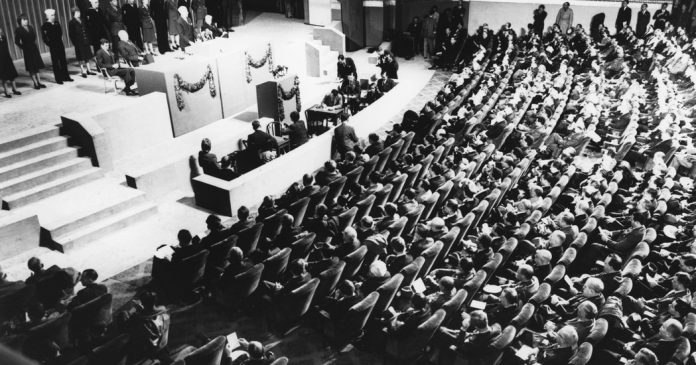
This week, nearly 200 world leaders have converged at the United Nations for the 74th session of its annual General Assembly. Presidents and prime ministers came together for the world’s most prominent diplomatic forum, amid crises ranging from climate change to the looming threat of armed conflict between Iran and the United States.

In this lesson, students will examine the United Nations, its history and its principles, and consider this question: Is this international institution relevant in 2019?

The annual United Nations General Assembly convened this week against a backdrop of crises — from a warming planet to economic uncertainty to flaring conflicts that threaten to further entangle the United States in a volatile Middle East. Nearly 200 leaders, including President Trump, President Recep Tayyip Erdogan of Turkey, President Jair M. Bolsonaro of Brazil and Prime Minister Boris Johnson of Britain, came to the world’s most prominent diplomatic stage for five days of speeches and hundreds of meetings.

At the United Nations Climate Action Summit on Sept. 23, the teenage climate activist Greta Thunberg delivered a speech criticizing world leaders for their inaction on protecting the environment, telling them that “you are failing us.”

If you could speak before the United Nations, what issue would you want to address? If you had the world’s attention, what would you say? What impact would you hope your words could have?

Read the article, then answer the following questions:

1. The United Nations Charter begins, “We the peoples of the United Nations.” Why, according to this article, is this opening statement notable in 2019? What were the primary pledges of the charter? How relevant are they today?

2. How does the Universal Declaration of Human Rights, signed in 1948, remain “aspirational?” Which of the rights enumerated in the declaration are most meaningful to you?

3. What are the structure and purpose of the General Assembly? What does the writer mean by “In principle, nations small and large, rich and poor, have equal voice in the Assembly. But the genuine power resides elsewhere”? Why is the General Assembly “the arena where largely symbolic diplomatic jousts are won and lost”?

4. How does the Security Council differ from the General Assembly? Why is it “powerful” but often “paralyzed”? Why do critics say it is the “most anachronistic part” of the United Nations? Do you agree? What changes to the existing structure would you recommend?

5. Why has it been so challenging for the Security Council to meet its essential mission to maintain international peace? What recent examples demonstrate these challenges?

6. What did you learn about the United Nations from the article? What did you find most interesting, provocative or surprising? To what extent, in your opinion, has the organization succeeded in its mission, as stated in its charter? What do you think has been its greatest success and its greatest failure during its 74-year history?

Does your school have a Model U.N. club? If so, you might interview the teachers and students involved. How well does the club mirror the structures and procedures of the real United Nations? What have students learned from participating? What examples can they give of the types of simulations the club has done?

Or, read a 2013 Times article, “The Dog-Eat-Dog World of Model U.N.” all about college Model United Nations conferences that have turned MUN, as it’s called, into “a full-fledged sport, with all the competitiveness and rowdiness that suggests.”

Finally, to experience Model U.N. yourself, you might take a look at the free MyDiplomat resource offered by the United Nations Association of the United States of America. Via the website or related app, you can do a simulation like the “International Zombie Pandemic,” going through the stages of responding to prompts like “The United Nations has called an emergency session to respond to the rapidly spreading Global Zombie Pandemic. We need your diplomatic leadership to save humanity.”

How Do You Practice Self-Care?

0
How Do You Practice Self-Care?

Find all our Student Opinion questions here.

Have you heard the term self-care? If not, Oxford Dictionaries defines it as the practice of taking action to “preserve or improve one’s own health.”

In a recent article, the Times Style section expanded the definition:

Self-care is for anyone who wants it. It can be as easy — and as free — as taking a walk, or as complex as learning a trade. Self-care can include, but is not limited to: saying no; buying things; refusing to buy things; taking a long walk; helping others; exercising; crafting; stockpiling and organizing things like coins and arranging them meticulously into Ziploc bags; stretching; listening to disco; spending time alone; singing karaoke (sometimes, alone); intending to one day start meditating.

Do you do any of the things listed above? Do you consider them “self-care”? If not, what else do you do to preserve or improve your mental, physical or emotional health? Why?

Here is how some Times employees describe their routines:

Francesca Donner:

When I was growing up, my dad made spaghetti. It wasn’t fancy. It was basic and chunky, a meat sauce spooned over coils of pasta with blocks of butter tossed in.

Not all of my dad’s dinners were good. He had a penchant for celeriac boiled in water and liverwurst with onions. But the spaghetti was always the same, and it was always good.

Nowadays, dad’s spaghetti is my spaghetti: as much therapy as it is dinner. When life starts spinning too fast, I go to the supermarket and get what I need: ground beef, garlic, mushrooms, carrots, flat leaf parsley, canned tomatoes, tomato paste, dried pasta. My world starts to calm just seeing the ingredients collected together in the basket.

Sandra E. Garcia

Using my hands has always brought me back to center. Whether it’s D.I.Y.-ing a nightstand I found on Craigslist for $5, reupholstering furniture or working on my bicycle, taking something apart and putting it back together helps me focus my thoughts and temper the noise of the news cycle. It gives me permission to get out of my head.

Jonah Bromwich

I don’t think I am very good at self-care, but I do like to exercise. It first became part of my routine in ninth grade; my brother and I would go to our high school early in the morning to lift weights before classes started. I was a very gangly, awkward teenager — not exactly what you might call “coordinated.” No one had explained to me that the act of lifting dumbbells above my head would force me to assert more control over my limbs. After a couple of months, standing up straight was less of an effort. I was stronger.

Bonnie Wertheim

I am an introvert, which is to say that I love socializing, but it exhausts me. So I try to do at least one thing alone every day. Most mornings I’ll run a few miles around my quiet neighborhood listening to a sexyish playlist that’s sometimes just “Motivation” by Kelly Rowland on repeat. It keeps my interpersonal-emotional tank full and also reduces the daily number of nagging dysmorphic thoughts that pass through my brain. The days that start this way — with an hour of dedicated, active time to myself — are almost always better.

Students, read the entire article, then tell us:

  • Do you consciously practice self-care? How? Describe your routines in as much detail as you can. Even if you’ve never considered your habits “self-care,” describe what you do to take care of yourself.

  • Some of the answers in this piece are surprising: One person says she hangs upside down like a bat, another rolls coins, and a third likes to go to karaoke bars alone and sing Tammy Wynette or Dolly Parton songs. What are the most interesting or offbeat ways you’ve found to fight stress or make yourself feel happy and healthy?

  • How do you know when you need self-care? Is it most likely triggered by the stress of school or work, by relationships or by something else? How often do you stop and take time for yourself?

  • Are there any ideas in this article you’d like to try out? Why?


Students 13 and older are invited to comment. All comments are moderated by the Learning Network staff, but please keep in mind that once your comment is accepted, it will be made public.

‘They’

0
‘They’

What do you think this image is saying? How does it relate to or comment on society or our world today? Can you relate to it personally? What is your opinion of its message?

Tell us in the comments, then read the related article to learn what this illustration is all about.


Find many more ways to use our Picture Prompt feature in this lesson plan. You can find all our Picture Prompts in this column.

Talking C++: An Interview with Bjarne Stroustrup

0
Talking C++: An Interview with Bjarne Stroustrup

bjarne_stroustrup

Bjarne Stroustrup is a Technical Fellow and Managing Director at Morgan Stanley in New York City and a Visiting Professor at Columbia University. He’s also the creator of C++.

Mariel and I, authors of Codecademy’s Learn C++ course, recently got a chance to catch up with Dr. Stroustrup and chat about upcoming changes, the “golden years” of Bell Labs, and to ask him questions from Stack Overflow. Enjoy.


Let’s rewind a little bit. There are a lot of stories floating around about how you created C++ at Bell Labs in ’79. Can you give us a window to that world—what brought you to Bell Labs? What was life like there?

In the 1970s, 80s, and 90s, Bell Labs Computer Science Research Center was the greatest place on earth for practical computer science—and some theoretical CS also. There was no place like it.

bell-labs

Bell Labs Computing Sciences Research Center, Murray Hill, New Jersey (Source)

Towards the end of my Ph.D. studies in Cambridge, I called someone from Bell Labs who had visited to give a talk and asked if they had any jobs. They didn’t but I was welcome to stop by and present my work. I did and after days of grueling interviewing, it turned out that they had a position after all.

The number of really bright, knowledgeable, and creative people was extraordinary. Many were also extremely patient listeners and helpful in developing new ideas and systems. Whatever you wanted to know about, you’d find an expert nearby.

The building in Murray Hill where the core research was located had about 1000 PhDs in a variety of scientific and engineering fields. Researchers were given a lot of freedom to choose what to work on—much more than was the case in most other places, then and now.

All that was required was that eventually, you produced something great. That sounds cushy, but the ideas of what constituted “great” was quite demanding; to quote the Wikipedia:

“Researchers working at Bell Labs are credited with the development of radio astronomy, the transistor, the laser, the photovoltaic cell, the charge-coupled device (CCD), information theory, the Unix operating system, and the programming languages C, C++, and S. Nine Nobel Prizes have been awarded for work completed at Bell Laboratories.”

Was there an “aha” moment when you realized C++ could be game-changing for the software/hardware industry?

Not really. I was too busy working on C++ and using it.

The closest must have been in 1989 when representatives from IBM and HP turned up in my office at Bell Labs and insisted that “you really would like to” standardize C++ in an ANSI committee.

Or maybe when the ACM History Of Programming Languages (HOPL) conference suggested I write a paper on C++ for their conference. Even then, I think I underestimated the impact of C++ and the programming techniques it enabled.

Bjarne Stroustrup and Sonny Li

If you could go back in time and change one thing about the original implementation of C++, what would it be?

I don’t have a time machine and I shouldn’t try to second-guess 1983-vintage Bjarne—he knew the conditions at the time better than I do now, and any significant change probably wouldn’t have fitted in the 1MB memory I had to work with, and if it had maybe I wouldn’t have been able to port the compiler to an early 640MB Windows machine.

But if I could and if realities of compatibility didn’t get in the way, I’d like to eliminate the implicit narrowing and value-changing conversions. They are logically wrong and major sources of errors. For example:

int x = -2000;

char ch = x;       // bad

unsigned u = x;    // bad

Are there any applications or uses of C++ that you have been especially surprised or excited about?

What amazed me most was the range of applications: from rice cookers to space rockets. It is humbling to realize that just about wherever you look there is C++ involved: cars, movies, games, medicine, finance, computers, farming, etc.

I find it most gratifying that C++ has been used in science: the human genome project, the fundamental physics research at CERN and elsewhere, and the Mars Rovers. It feels great to have made a contribution, however small.

Learn C++ is currently one of the top courses on Codecademy, and the language is still taught in schools and used in industries around the world. From your perspective, why should someone learn C++ in 2020?

C++ is one of the most useful languages there is. That should be a sufficient reason. Someone wanting to be a professional should know a few languages—not just one—and C++ is a good one to know for work that requires performance and reliability.

Another way of looking at it is that C++ is very widely used in finance, games, telecom, electronics, and manufacturing. See JetBrains’ blog post and my “C++ Applications” page and try to guess why a language without marketing is so widely-used.

In my opinion, the best reason for learning C++ is that it gives you insights into a variety of programming and design techniques that are applicable in a wide variety of languages.

What tips would you give to a budding programmer?

Programming can be fun, but it is not all fun and games. Our civilization depends on good software.

Whatever you are interested in, there will be a use for programming: literature, automobile production, history, coffee making, wind and solar energy, movie making, rocket science, farm management, medicine, science, engineering, and so much more.

Bjarne Stroustrup

You might eventually be able to make a significant contribution to whatever field you find important or interesting! To do that you’ll have to know the field and the tools and techniques of software development. Be sure you learn about fundamentals, such as data structures and how machines work.

Don’t get overwhelmed, and don’t think you will be an expert in just a few weeks. Think of how long it takes to learn to speak a natural language, how long it takes to become a good athlete, and how long it takes to learn to play an instrument well enough for someone who isn’t your mother to want to listen to.

Think about how much fun you can have along the way to reach such mastery and how many friends you might make along the way. Some of the nicest people work with software.


Here’s the part that we’ve been waiting for. (🥁…)

We’ve gathered the highest-voted C++ questions on Stack Overflow. The world wants to know your take on them.

🥇 #1. Why is processing a sorted array faster than processing an unsorted array?

Why is processing a sorted array faster than processing an unsorted array?

Note: This question is the #1 highest voted question on Stack Overflow of all time. 😱

That sounds like an interview question. Is it true? How would you know? It is a bad idea to answer questions about efficiency without first doing some measurements, so it is important to know how to measure.

So, I tried with a vector of a million integers and got:

Already sorted  32995 milliseconds
Shuffled        125944 milliseconds

Already sorted  18610 milliseconds
Shuffled        133304 milliseconds

Already sorted  17942 milliseconds
Shuffled        107858 milliseconds

I ran that a few times to be sure. Yes, the phenomenon is real. My key code was:

void run(vector& v, const string& label)
{
    auto t0 = system_clock::now();
    sort(v.begin(), v.end());
    auto t1 = system_clock::now();
    cout << label 
         << duration_cast(t1 — t0).count() 
         << " millisecondsn";
}

void tst()
{
    vector v(1'000'000);
    iota(v.begin(), v.end(), 0);
    run(v, "already sorted ");
    std::shuffle(v.begin(), v.end(), std::mt19937{ std::random_device{}() });
    run(v, "shuffled    ");
}

At least the phenomenon is real with this compiler, standard library, and optimizer settings. Different implementations can and do give different answers. In fact, someone did do a more systematic study (a quick web search will find it) and most implementations show that effect.

One reason is branch prediction: the key operation in the sort algorithm is “if(v[i] < pivot]) …” or equivalent. For a sorted sequence that test is always true whereas, for a random sequence, the branch chosen varies randomly.

Another reason is that when the vector is already sorted, we never need to move elements to their correct position. The effect of these little details is the factor of 5 or 6 that we saw.

Quicksort (and sorting in general) is a complex study that has attracted some of the greatest minds of computer science. A good sort function is a result of both choosing a good algorithm and paying attention to hardware performance in its implementation.

If you want to write efficient code, you need to know a bit about machine architecture.

🥈 #2. What is the “ -->” operator in C++?

What-is-the------operator-in-C---

That’s an old trick question. There is no “-->” operator in C++. Consider:

if (p-->m == 0) f(p);

It certainly looks as if there is a —-> operator and by suitable declaring p and m, you can even get that to compile and run:

int p = 2;
int m = 0;
if (p-->m == 0) f(p);

That means: see if p-- is greater than m (it is), and then compare the result (true) to 0. Well true != 0, so the result is false and f() is not called. In other words:

if ((p--) > m == 0) f(p);

Please don’t waste too much time on such questions. They have been popular for befuddling novices since before C++ was invented.

🥉#3. The Definitive C++ Book Guide and List

The-Definitive-C---Book-Guide-and-List

Unfortunately, there is no definite C++ book list. There can’t be one. Not everyone needs the same information, not everyone has the same background, and C++ best practices are evolving.

I did a search of the web and found a bewildering set of suggestions. Many were seriously outdated and some were bad from the start. A novice looking for a good book without guidance will be very confused!

You do need a book because the techniques that make C++ effective are not easily picked up from a few blogs on specific topics—and of course blogs also suffer from mistakes, being dated, and poor explanations. Often, they also focus on advanced new stuff and ignore the essential fundamentals.

I recommend my Programming: Principles and Practice Using C++ (2nd Edition) for people just beginning to learn to program, and A Tour of C++ (2nd Edition) for people who are already programmers and need to know about modern C++. People with a strong mathematical background can start with Peter Gottschling‘s Discovering Modern C++: An Intensive Course for Scientists, Engineers, and Programmers.

Once you start using C++ for real, you need a set of guidelines to distinguish what can be done and what is good practice. For that, I recommend the C++ Core Guidelines on GitHub.

For good brief explanations of individual language features and standard-library functions, I recommend www.cppreference.com.

#4. What are the differences between a pointer variable and a reference variable in C++?

What-are-the-differences-between-a-pointer-variable-and-a-reference-variable-in-C---

To learn more about references and pointers, check out Learn C++. 😊

Both are represented in memory as a machine address. The difference is in their use.

To initialize a pointer, you give it the address of an object:

int x = 7;
int* p1 = &x;
int* p2 = new int{9};

To read and write through a pointer we use the dereference operator (*):

p1 = 9;       // write through p1
int y = *p2;  // read through p2

When we assign one pointer to another, they will both point to the same object:

p1 = p2;      // now p1 p2 both point to the int with the value 9
p2 = 99;      // write 99 through p2
int z = *p1;  // reading through p1, z becomes 99 (not 9)

Note that a pointer can point to different objects during its lifetime. That’s a major difference from references. A reference is bound to an object when it is created and cannot be made to refer to another.

For references, dereferencing is implicit. You initialize a reference with an object and the reference takes its address.

int x = 7;
int& r1 = x;
int& r2 = *new int{9};

Operator new returns a pointer, so I had to dereference it before assigning using it to initialize the reference.

To read and write through a reference, we just use the reference’s name (no explicit dereferencing):

r1 = 9;        // write through r1
int y = r2;    // read through r2

When we assign one reference to another, the value referred to will be copied

r1 = r2;       // now p1 and p2 both have the value 9
r1 = 99;       // write 99 through r1
int z = r2;    // reading through r2, z becomes 9 (not 99)

Both references and pointers are frequently used as function arguments:

void f(int* p)
{
    if (p == nullptr) return;
    // ...
}

void g(int& r)
{
    // ...
}

int x = 7;
f(&x);
g(x);

A pointer can be the nullptr, so we have to consider whether it points to anything. A reference can be assumed to refer to something.

#5. How do I iterate over the words of a string?

How-do-I-iterate-over-the-words-of-a-string-

Use a stringstream, but how do you define “a word”? Consider “Mary had a little lamb.” Is the last word “lamb” or “lamb.”? If there is no punctuation, it is easy:

vector split(const string& s)
{
    stringstream ss(s);
    vector words;
    for (string w; ss>>w; ) words.push_back(w);
    return words;
}

auto words = split("here is a simple example");  // five words
for (auto& w : words) cout << w << 'n';

or just:

for (auto& w : split("here is a simple example")) cout << w << 'n';

By default, the >> operator skips whitespace. If we want arbitrary sets of delimiters, things get a bit more messy:

template
string get_word(istream& ss, Delim d)
{
    string word;
    for (char ch; ss.get(ch); )  // skip delimiters
        if (!d(ch)) {
            word.push_back(ch);
            break;
        }
    for (char ch; ss.get(ch); )  // collect word
        if (!d(ch))
            word.push_back(ch);
        else
            break;
    return word;
}

The d is an operation telling whether a character is a delimiter and I return "" (the empty string) to indicate that there wasn’t a word to return.

vector split(const string& s, const string& delim)
{
    stringstream ss(s);
    auto del = [&](char ch) { for (auto x : delim) if (x == ch) return true; return false; };

    vector words;
    for (string w; (w = get_word(ss, del))!= ""; ) words.push_back(w);
    return words;
}

auto words = split("Now! Here is something different; or is it? ", "!.,;? ");for (auto& w : words) cout << w << 'n';**

If you have the C++20 Range library, you don’t have to write something like this yourself but can use a split_view.


Big hat tip to Dr. Bjarne Stroustrup for taking on this interview and also giving us ample feedback during the design phase of the Learn C++ course.

It’s been an absolute pleasure and honor working with you, and thank you once again for everything you’ve done for the software and hardware communities.

For more information on C++20: https://isocpp.org.

Favorite Season

0
Favorite Season

What’s your favorite season? Why?

As you answer this question, try to show us what’s so great about this season instead of just telling us about it. That is, describe the specific sensory details that make your favorite season special to you. (If you are participating in our Personal Narrative Essay Contest, you can consider this practice!)

Then, read the related Op-Ed to learn how one writer feels about the seasons.

Find many more ways to use our Picture Prompt feature in this lesson plan. You can find all our Picture Prompts in this column.

Word + Quiz: svelte

0
Word + Quiz: svelte

1. being of delicate or slender build

2. moving and bending with ease

3. showing a high degree of refinement and the assurance that comes from wide social experience

_________

The word svelte has appeared in 23 articles on NYTimes.com in the past year, including on Sept. 10 in “Seeking an Obesity Cure, Researchers Turn to the Gut Microbiome” by Anahad O’Connor:

Scientists have known for some time that the microbiomes of obese and lean people differ in striking ways. Obesity, insulin resistance and fatty liver disease are associated with less microbial diversity and higher levels of a group of organisms called Firmicutes. It is not clear whether the obesity and diseases come first or vice versa. But there are indications that the microbiome plays an important role.

Scientists have found differences in the gut bacteria of children as young as 6 months old that can predict future weight gain. Studies of obese mice show that they harbor gut microbes that are better able to harvest energy from food, and when their microbiota are transplanted into the guts of lean mice, the svelte recipients gain weight.

_________

Have You Ever Read a Book You Weren’t Supposed to Read?

0
Have You Ever Read a Book You Weren’t Supposed to Read?

It’s Banned Books Week in the United States, which, according to the American Library Association, is an annual event that celebrates “the freedom to read” and “spotlights current and historical attempts to censor books in libraries and schools.”

Have your parents, teachers or school administrators ever forbidden you from reading a book because they thought its content or characters were inappropriate for someone your age? If so, did you listen to them? Or did you read that book anyway?

In an essay in The New York Times, the author, Margaret Renkl, writes about why “banning books is about as useless as trying to ban air.”

NASHVILLE — When the Rev. Dan Reehil, a Catholic priest, ordered the removal of all Harry Potter books from the parish school’s library, the St. Edward community demanded an explanation. Father Reehil responded by email, noting that he had “consulted several exorcists, both in the United States and in Rome,” and had been assured that the “curses and spells used in the books are actual curses and spells; which when read by a human being risk conjuring evil spirits into the presence of the person reading the text.”

I read all seven Harry Potter books aloud to all three of my children, one at a time, as they became old enough to understand the books’ complicated plots, so I understand why Father Reehil’s explanation assuaged no parental concerns. Exorcists? Real spells? No wonder the story became international news almost as soon as The Tennessean broke it. Articles about the incident have appeared in outlets as diverse as The Washington Post, CBS News, Entertainment Weekly, The Independent in Britain, and Forbes, among many others.

Before I heard this story, I would not have thought it necessary to point out that Harry Potter is a fictional character and that these books are not spellbooks. They are novels, tales J.K. Rowling made up out of her prodigious imagination.

Harry Potter and his friends don’t exist in real life, but they wrestle with real-life challenges: bullies, rejection, loneliness, fear, grief — and, yes, with clueless adults whose behavior is patently ludicrous. Nashville’s St. Edward School might as well be Harry Potter’s Hogwarts, for the story of Father Rehill sounds very much like the story of Delores Umbridge, a Ministry of Magic bureaucrat-turned-school-inquisitor.

Ms. Rowling may well be a magician, but the magic she conjures is far more wonderful than even the spells in her books: She got kids to read again. And perhaps grown-ups, too — I often found myself reading deep into the night, long after the child beside me had fallen asleep, merely for the pleasure of Ms. Rowling’s translucent prose and extravagant world-building.

There was a time when the Harry Potter titles were routinely targets of a challenge, the American Library Association’s term for an attempt to remove books from a library or school curriculum. The first three volumes were among the most challenged books of the decade that began in 1990, even though they weren’t published in the United States until midway through 1999. By the following decade, the series was at the very top of the list.

According to “Don’t Tell the Grownups,” Alison Lurie’s groundbreaking 1990 exploration of the way classic children’s literature has always undercut convention, “Most of the great works of juvenile literature are subversive in one way or another: they express ideas and emotions not generally approved of or even recognized at the time; they make fun of honored figures and piously held beliefs; and they view social pretenses with cleareyed directness, remarking — as in Andersen’s famous fairy tale — that the emperor has no clothes.”

Little surprise, then, that two decades of efforts to protect children from imaginary spells have made no difference at all. Harry Potter titles have sold more the 500 million copies worldwide.

Students 13 and older are invited to comment. All comments are moderated by the Learning Network staff, but please keep in mind that once your comment is accepted, it will be made public.

Travel

0
Travel

What story does this image inspire for you?

Tell us about a memory from your own life that this picture makes you think of — or use your imagination to write the opening of a short story or poem inspired by what you see.

Tell us in the comments, then read the related article to learn more.


Find many more ways to use our Picture Prompt feature in this lesson plan. You can find all our Picture Prompts in this column.

Word + Quiz: churl

0
Word + Quiz: churl

1. a crude uncouth ill-bred person lacking culture or refinement

2. a bad-tempered person

3. a selfish person who is unwilling to give or spend

_________

The word churl has appeared in three articles on NYTimes.com in the past year, including on Jan. 9 in the Opinion essay “You Should Meditate Every Day” by Farhad Manjoo:

A few years ago, I began to fear that the caustic mechanisms of the internet were eating away at my brain, turning me into an embittered, distracted, reflexively cynical churl. Since then, I’ve done everything I can to detox. I consulted app blockers and screen-time monitors to keep me offline. I even got my news from print newspapers in order to experience a slower, more deliberate presentation of media.

… And so, to survive the brain-dissolving internet, I turned to meditation.

_________

Coursera Introduces Amazon Alexa Skill to Support Learning Goals

0
Coursera Introduces Amazon Alexa Skill to Support Learning Goals

By Alex Sanchez, Product Management, Mobile Experiences and Emerging Technology at Coursera

Today, we’re excited to announce a skill for Amazon Alexa that will help learners keep up in courses and achieve their personal and professional goals. Starting next month, learners can access course assignment and quiz scores, due dates, and progress updates by simply asking Alexa. This is one of the first skills for Amazon Alexa from an online learning platform.

Voice assistants, like Alexa, are being adopted faster than almost any other technology to date. Over a third of American smart speaker owners use their devices to help keep them on track and organized, which includes setting alarms, timers, and scheduling. Recognizing these trends, we designed a skill for Alexa to help learners stay organized with easy-to-access deadlines, grades, and course progress updates. The new tool builds on our current cross-platform compatibilities on desktop, mobile, and tablet. 

In the coming weeks, learners will be able to search for the free Coursera skill in the Amazon Alexa Skills store. Once enabled and linked to Coursera, you’ll be able to simply ask, “Alexa, when is my next assignment due?” or, “Alexa, ask Coursera, am I making progress?” And by the end of the year, “Alexa, what did I get on my computer science quiz?” Responses will provide updates based on the latest information in the learner’s Coursera account. 

Our new Coursera skill for Alexa will be available to all learners with a Coursera account and Amazon Alexa-enabled device in October. By introducing a new tool that helps learners fit education into their daily lives, we’ve taken another exciting step toward our mission of providing transformational learning experiences to anyone, anywhere. 

Not yet a Coursera learner? Sign up and enroll in a course for free today.