
This week we had so many excellent entries, we decided to honor two winners: an essay by William Alexis, 16, and a video by Saanvi Kondoju, 16.
Word of the Day: bivalve
This word has appeared in 25 articles on NYTimes.com in the past year. Can you use it in a sentence?
5 LMS Gamification Lessons Every L&D Leader Must Know

Organisations investing in cutting-edge learning platforms and curated content, only to watch engagement levels lag and enthusiasm wane. This is the reality for countless Learning and Development (L&D) teams today. Despite the surge in digital learning tools, driving true learner participation remains a stubborn challenge.
Why? Traditional LMS platforms typically rely on static, one-size-fits-all modules, leaving learners uninspired, disconnected, and unsure how their progress adds up. Without meaningful motivation, personal relevance, or visible markers of achievement, even the best courses risk being ignored.
The result: low completion rates, disengaged talent, and a return on investment that rarely meets expectations.
What Is All That Buzz About LMS Gamification?
LMS gamification transforms the learning experience by embedding game-like mechanics, such as experience points, badges, leaderboards, and streaks, into your platform. These features stimulate both intrinsic and extrinsic motivation, helping to foster active participation, deeper learning, and habit formation. In short, a gamified LMS turns routine training into a rewarding, performance-driven experience.
In the context of corporate learning gamification, these techniques are especially impactful. They bridge the gap between learning goals and measurable business performance.
Gamified learning impact becomes evident when learners are not only participating but also achieving more and remembering longer.
Alison’s recent six-week beta test with 56K+ learners proves that gamification actually works, even without changing the course content. Below are five key lessons every L&D leader should take from this initiative.
 Lesson 1: Motivation Can Be Engineered With LMS Gamification
Game mechanics give learners a clear reason to return.
Stat: 97% of employees above the age of 45 agree that gamification would help improve their work, while 87% of respondents found it makes them more productive at work.
How gamified learning works: Reward systems (XPs, streaks, leaderboards) tap into learners’ goal-seeking behaviours and trigger dopamine-driven engagement cycles. Over time, this builds sustained momentum, not just initial curiosity.
✅ Action point: Activate XP rewards and streak counters in your LMS to build engagement loops. Recognise and encourage learners whenever they make progress. Highlight achievements, whether big or small, to encourage regular participation and build lasting motivation.
Lesson 2: A Gamified LMS Unlocks Value Without Rewriting Courses
In Alison’s beta test, the course content remained exactly the same. What changed? The experience. Once gamified features were introduced, learner behaviour shifted dramatically, without any updates to the curriculum.
Insight: Engagement isn’t only about what you teach, it’s about how learners interact with it. Gamification boosts motivation and outcomes by making the learning journey more dynamic and personal.
✅ Action point: Apply gamification overlays to your existing LMS. Make learning more engaging by adding fun elements like points, badges, or progress bars to your existing courses. You don’t need to change the content, just focus on making the experience enjoyable and rewarding for learners.
Lesson 3: More Time on a Gamified Platform Leads to Better Retention
Learners in the gamified environment recorded 25.6% more time on task, with higher session frequency and stronger learning streaks.
Supporting data: Research shows gamification increases knowledge retention by up to 40% and boosts productivity by as much as 50%.
Key point: More time in a gamified LMS isn’t wasted. It builds learning habits and supports long-term retention.
✅ Action point: Track and report learning duration. Encourage session streaks and celebrate time milestones (e.g., “You’ve studied 30 minutes today!”) to reinforce focus and build deeper content engagement.
Lesson 4: Habit Loops Are the Key to Lasting Learner Engagement
Gamified platforms encourage repeat usage, which is critical to developing learning habits.
Feature mechanics: Streaks, points, leaderboards and regular feedback create consistent learning loops.
Industry benchmark: Organisations using gamified platforms have seen customer engagement rise by 48%.
Real-world result: Alison’s beta testers cited daily streaks and XP goals as major motivators for returning to the LMS.
✅ Action point: Help learners build a daily habit by showing their streaks and points when they log in. Send friendly reminders if they miss a day, and offer small daily challenges to keep them coming back regularly.
 Lesson 5: LMS Progress Visibility Drives Learning Performance
Learners thrive on feedback. A clear view of progress via XP tracking, completion dashboards, and leaderboard status offers instant, meaningful reinforcement.
Result: Progress visibility boosts learner morale, accountability, and completion rates. It also aligns learners to team and organisational goals.
Culture shift: A gamified LMS fosters an achievement-driven learning environment where progress is public, motivating, and goal-oriented.
✅ Action Point: Make learner dashboards central to your UX. Show cumulative XPs, completed modules, next steps, and leaderboard status in one view to drive focus and ownership.
How To Get Started With LMS Gamification?
You don’t need to rebuild your training programs from scratch. Modern platforms like Alison’s LMS+ come with gamification features already built in, ready to be activated with zero disruption.
Getting started checklist:
- Step 1: Align rewards to real business objectives (sales KPIs, compliance, onboarding).
- Step 2: Promote early wins to encourage buy-in from teams and managers.
- Step 3: Use built-in analytics to track impact and iterate as needed.
See Alison’s Gamified LMS in Action
Ready to take your employee engagement to the next level?
Book a 15-minute live demo to experience LMS gamification in action with Alison’s gamified learning platform. Learn how to increase engagement, drive retention, and turn training into real business value.
How RizePoint Retains Talent & Creates Path for Growth with Codecademy Training

Company background
RizePoint is a quality management software company that has been working to help companies keep their brand promises for almost 25 years. The RizePoint platform allows companies to collect and analyze meaningful data to identify trends and drive improvement. With a strong focus in the food industry, RizePoint helps companies like McDonald’s in safe workplace accountability so they can proactively see issues and take appropriate actions to keep the workplace safe. RizePoint has experienced continued growth and needs to support that with R&D growth and innovation. In an era of scarce technology resources, this requires a focus on internal training and promotion and making learning a critical and celebrated part of their culture.
Key results
98%
retention rate in the engineering team, over the past 2 years, thanks to culture of learning
100%
fulfillment of open technology positions by training and promoting from within
55%
reduction in time to fulfill customer feature requests, thanks to cross-training
Challenge
RizePoint’s CTO of R&D, Darrel Williams, was facing a common problem — business growth during a technology resource shortage. “Trying to hire for software development positions was extremely difficult. The prices were sky-high, and the people that were out there were getting snatched up super quickly.” They needed to find new ways to promote internally and find development efficiencies. Both Williams and his Software Development Manager, Mary Shultz, felt that training was the answer.
Our retention rate for the past few years is in the high nineties. Having Codecademy and our ladder training program excites people and actually shows them that there is a path for them to grow in our organization.
Darrell Williams
CTO of R&D, RizePoint
Unfortunately, according to Williams their existing training solution wasn’t getting the desired results. “The training solution we were using was watching videos, taking notes and assuming that you’re being successful. It’s just not the in-depth learning that we needed to successfully develop our people at RizePoint.” Shultz further explained their frustration, “For people like me, who need hands-on experience coding an application to really learn it, our training solution didn’t provide that for us. And as a manager, we just didn’t have the visibility on actual learning to really help those that needed it.”
RizePoint knew they needed a dynamic learning solution that not only kept pace with emerging programming languages and frameworks, but that also had a more immersive practice environment. They also wanted a high level of visibility and flexibility for managers to tailor programs for their employees.
Solution
Williams and Shultz built an internal career advancement track for technology employees to have a path for career growth. When looking for a training solution that would support this, they turned to Codecademy, which they had both used as individuals to further their knowledge.
Williams loved that Codecademy wasn’t just a training workflow, but provided live feedback. “What stands out to me with Codecademy is the IDE within the tool. You can be typing code, and it’s checking syntax and providing error feedback as soon as you hit ‘Submit.’ That’s incredibly valuable.”
With confidence that Codecademy was the learning solution they had been searching for, Shultz put it into action. “Codecademy helps us gamify and manage our career advancement tracks. I can take those areas that we find, add them to tracks that then can become a path that is a senior software engineer. And as they complete each piece of the syllabus, it checks it off the list for them so that they can get really good feedback about completion. And as a manager I can see the progress and help celebrate their achievements.”
What stands out to me with Codecademy is the IDE within the tool. You can be typing code, and it’s checking syntax and providing error feedback as soon as you hit ‘Submit.’ That’s incredibly valuable.
Darrell Williams
CTO of R&D, Rizepoint
With a robust system in place to support their learning initiatives, RizePoint rolled out various use cases such as employee onboarding and Shultz also applied it to intern onboarding. “Before I let interns into my code base, I need to make sure that they understand enough so they don’t wipe six weeks worth of information accidentally. So, I have a certain set of lessons that they’re required to go through within Codecademy. Being able to see the results of their learning more granularly is really helpful.”

Shultz and Williams also felt that if they could break down some of the knowledge silos across teams, they could improve collaboration while removing some of the need for development resources. Shultz said that cross-training between solutions and implementations teams was a great place to start. “Codecademy helped our implementation team learn basic JavaScript, so they can help with introductory level development tasks without needing to rely on the development team. This significantly reduces the delivery time for client requests.”
Outcomes
Williams asserts that Codecademy has helped fill open positions organically. “To solve the skills gap challenge, we use Codecademy to develop from within. When a customer support employee shows any kind of an inclination towards any technical skill, we can point them into one of those career tracks, which leads to a six-month crossover training program between customer support and IT. If that goes well, they can continue their career without having a degree in that area. It fills open positions and gives our team members a reason to stay with RizePoint.”
Williams and Shultz aren’t just filling positions, they are keeping their IP. Williams stated, “Our retention rate for the past few years is in the high nineties. Having Codecademy and our training program excites people and actually shows them that there is a path for me in this organization, there is a place for me to grow and I’m not going to just be stagnant in a topped-out, specific role for who knows how long. It’s giving a lot of different folks opportunities that they wouldn’t normally see in an organization.”
We found that Codecademy really helps promote accountability as well as the understanding that the organization is also walking in parallel with you and supporting you.
Mary Shultz
Software Development Manager
Shultz added, “We found that Codecademy really helps promote accountability as well as the understanding that the organization is also walking in parallel with you and supporting you. RizePoint is committed to growth as an organization, but also at an individual level. And I think that Codecademy really helps with that.”
RizePoint has been so successful with Codecademy that they are now using it to train non-degreed coders. Shultz explains, “Codecademy gives us this opportunity to take someone who did six to nine months at a code bootcamp, but doesn’t really understand what they want to do and explore their fit while filling in their knowledge gaps. Codecademy is really helpful for blending non-degreed coders into the organization.”
Williams sees the impact of Codecademy beyond just R&D. “Codecademy has helped RizePoint become much more collaborative by helping us cross train employees. We don’t have to worry about those silos that we’ve had in the past that can really just hinder an organization’s movement forward.”
Explore Codecademy Teams for your organization.
Learn Spatial Data Skills & Mapbox in Our New Courses
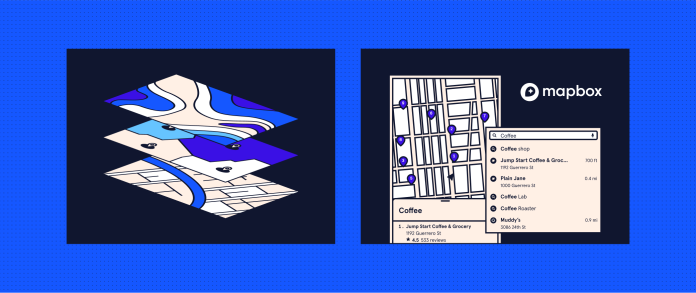
Maps have always told stories. From ancient cartographers sketching coastlines to modern data scientists tracking urban development patterns, geographic visualization transforms raw information into compelling narratives that resonate with human experience. Unlike traditional charts or dashboards that present abstract or theoretical numbers, maps connect data directly to the physical world around us, making insights immediately actionable and understandable.
Our new courses teach you to harness this power. Intro to Geographic Data Mapping covers spatial data fundamentals, while Learn Geographic Storytelling with Mapbox teaches you to use Mapbox — the platform behind location-aware apps and businesses — to create compelling geographic visualizations for the web. Built by industry experts, both courses provide the foundational knowledge and hands-on skills you need to add geographic storytelling to your professional toolkit.
Who these courses are for
These courses are perfect for data analysts, data scientists, and developers looking to enhance their storytelling skills. You don’t need to be a geographic information systems specialist — spatial data techniques help anyone transform abstract data into compelling insights that resonate with all kinds of stakeholders and audiences.
“Maps help us to see data in the context of the physical world, which is really powerful for how we think about problems and solutions,” says Eva Sibinga, Senior Curriculum Developer at Skillsoft (the learning company Codecademy’s part of) who helped make the courses. A web developer, for example, can use geographic data to turn a simple interface into an immersive, location-aware experience.
The free course Intro to Data Mapping requires no prerequisites, making it perfect for beginners who want to jump in and learn about the different ways we visualize geographic data. Learn Geographic Storytelling with Mapbox involves some coding and comfort with data tools. You’ll be using Mapbox GL JS to make web maps, so basic web development skills are a plus, but you don’t need extensive app building experience.
What will you learn from the courses
Intro to Geographic Data Mapping builds your foundation in geographic visualization:
- Learn how digital maps fit into data workflows — from building requirements to publishing options
- Master essential data visualization approaches, including common map types and best practices
- Recognize and apply different data-driven mapping techniques
- Understand how geographic and data layers work together to tell compelling stories
Learn Geographic Storytelling with Mapbox provides hands-on training with industry-standard tools:
- Discover how Mapbox integrates into your digital mapping toolkit
- Master data preparation, hosting, map styling, and interactivity
- Create and customize map styles
- Work confidently with point, line, and polygon data
- Navigate Mapbox Studio’s interface and understand how it fits into broader workflows
- Publish and deploy professional Mapbox maps
Maps help us be action-oriented because they connect data to the world around us. Together, these courses transform you from someone who consumes maps to someone who creates them, giving you both the conceptual understanding and technical skills needed for professional geographic storytelling. A thoughtful map project in your portfolio demonstrates that you can create work with real-world relevance and impact.
Ready to start your geographic storytelling journey? Upgrade to a Codecademy Plus or Pro membership so you can explore both courses to build comprehensive mapping skills.
Word of the Day: coxswain
This word has appeared in three articles on NYTimes.com in the past year. Can you use it in a sentence?
Gamification in the Workplace: Real Results from 56K+ Learners

Employee engagement isn’t just important; it’s vital. In today’s world of fast change and hybrid work, organisations must prioritise engagement to thrive and stay competitive. For Learning & Development (L&D) teams, getting people excited about training has always been tough. But what if one change could increase study time and participation by 25%?
That’s exactly what happened when Alison rolled out gamification in the workplace through its LMS+ platform. A beta test with over 56K+ learners proved that learning doesn’t have to feel like a chore. With gamification, it becomes something people actually want to do.
This article unpacks the tools we used, the psychology behind their success, and practical steps for organisations looking to replicate these results using a gamified LMS platform.
Real Gamification in Action
Gamification is about creating a learning experience that motivates, rewards, and reinforces progress. Here’s how our beta test was designed:
- Leaderboards: Encouraged friendly, anonymous competition, helping learners focus on personal progress and team achievement without stress or rivalry.
- Experience Points (XPs): Learners earned XPs for completing modules, making progress feel visible and rewarding.
- Streaks and consistent rewards: Daily and weekly streaks helped learners build habits, not just tick boxes.
And most importantly: No added admin burden. Alison’s LMS+ comes with gamification tools already embedded. Everything from XPs to leaderboards is automatically tracked, no spreadsheets or manual updates needed.
This gamification case study not only demonstrates the system’s design but also validates how it performs under real-world corporate learning conditions. If you’re thinking of implementing gamification in your LMS, this is a roadmap worth following.
Results: How 56K+ Learners Responded
The impact of a gamified LMS platform in workplaces was immediate and measurable:
- Learning engagement increased by 25.6%
- Sessions per user rose by 21.3%
- Course completions jumped by 12.3%
Even as learner enrolments surged by 44%, it proves that gamified learning doesn’t just engage existing users, it scales effectively across growing teams and drives lifelong learner behaviours.
And this isn’t unique to Alison. A recent study shows that gamification can lead to engagement boosts of up to 48%. PwC and IBM also found increases in knowledge retention, motivation, and performance when using gamification in corporate training.
Psychological Triggers: Why Gamification Works
So, why is gamification in learning so effective? It’s backed by proven behavioural science:
- Progress visibility: When learners can see their own progress through points or bars, they’re more likely to keep going.
- Social proof: Seeing peers succeed (via leaderboards or team rankings) encourages continued effort without triggering unhealthy competition.
- Reinforcement loops: Regular rewards and feedback create habit-forming loops that drive long-term engagement.
- Intrinsic motivation: More than just prizes, gamification appeals to mastery, autonomy, and purpose, key drivers of sustained effort.
These psychological triggers make workplace learning feel meaningful, rewarding, and personally valuable.
How to Get Gamification Right With No Admin Overload?
Effective gamified LMS platforms for workplaces aren’t about throwing points at problems. It’s about designing a learning experience that works for everyone. Here’s what sets Alison’s LMS+ apart:
- Automated overlays: The platform tracks activity, updates leaderboards, and issues rewards automatically.
- Consistent recognition: Learners are recognised for all forms of effort, not just finishing first.
- Healthy culture: With global challenges and anonymised scores, the experience fosters motivation – not anxiety.
Team-Based Comparison: Traditional LMS vs Gamified LMS
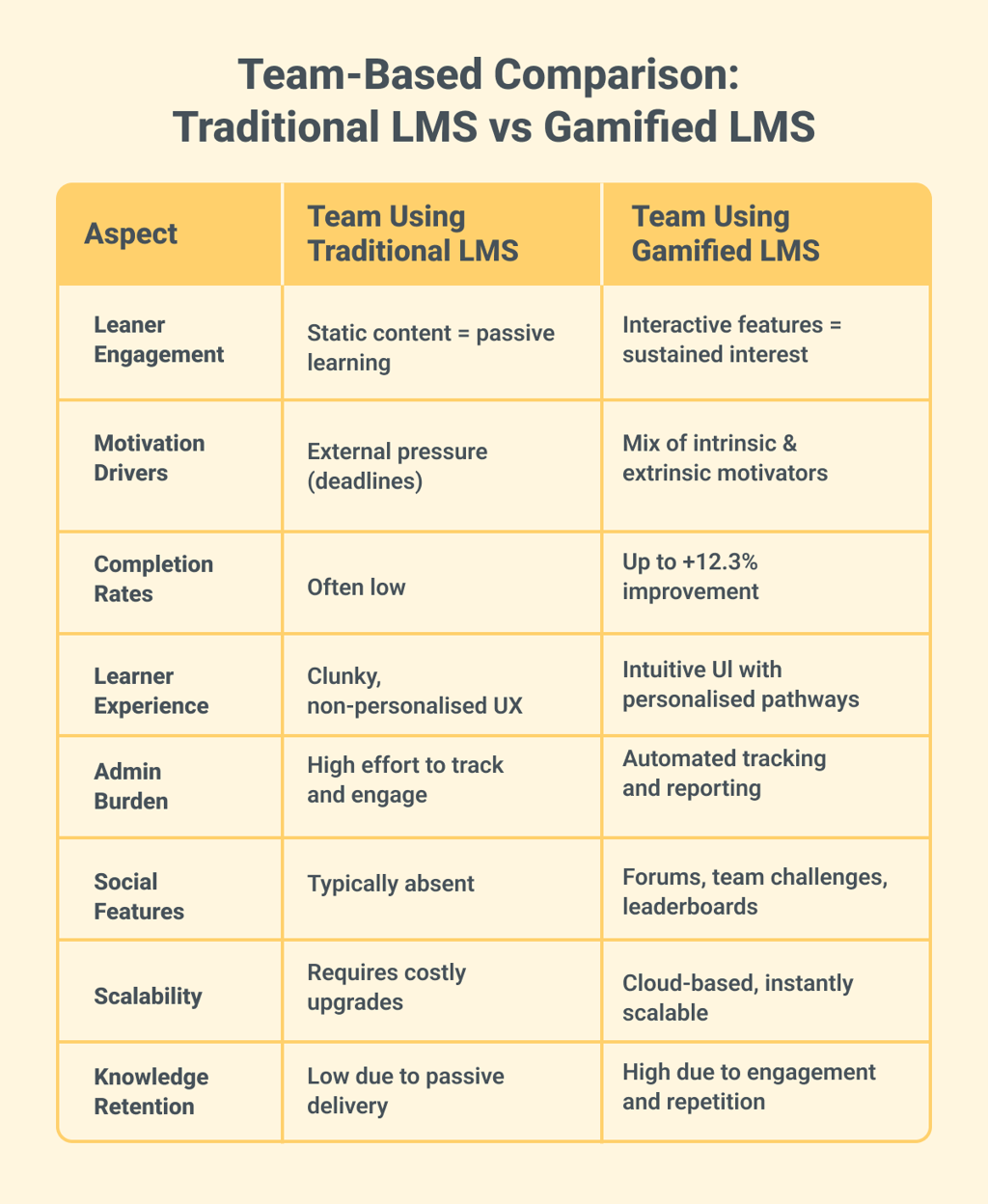
Steps to Transition from a Traditional LMS to a Gamified LMS
Thinking of upgrading your learning system? Here’s how to get started:
1. Assess Your Current LMS Capabilities
Look at where engagement is lagging.
- Do you have leaderboards?
- Streaks?
- Real-time progress indicators?
2. Set Clear Gamification Goals
Do you want to boost completion rates?
- Reduce admin time?
- Improve knowledge retention?
- Choose metrics that matter to your team.
3. Evaluate Alison’s LMS+
Explore Alison’s LMS with automated gamification, including experience points, leaderboards, streaks and automated analytics.
4. Plan Change Management
Communicate benefits to stakeholders.
5. Pilot a Gamified Learning Programme
Start with one department or topic. Gather data on engagement, session frequency, and user feedback.
6. Analyse Results and Optimise
Review analytics via the LMS dashboard. Refine content, pacing, or challenges based on what learners respond to best.
The Real Benefits of Gamification in the Workplace
Gamification doesn’t just improve learning metrics, it transforms workplace culture:
- Encourages collaboration and accountability
- Makes learning visible, inclusive and habit-forming
- Reduces the burden on L&D teams
- Aligns learning progress with real business outcomes
For L&D teams, it’s a scalable way to boost motivation without expanding headcount. For learners, it’s a way to feel valued and rewarded for every step forward.
Ready to See Results Like These?
If you’re looking to:
✅ Improve course completions
✅ Cut down on admin tasks
✅ Make workplace learning engaging again
Then it’s time to explore a gamified LMS for your workplace that actually works.
Let your team experience learning they’ll actually want to return to.
Discover how Alison’s LMS platform can make learning a priority for your team.
Word of the Day: hawkish
This word has appeared in 191 articles on NYTimes.com in the past year. Can you use it in a sentence?
Dartmouth’s Online MEng in Computer Engineering: Beyond Skills, A Philosophy of Learning
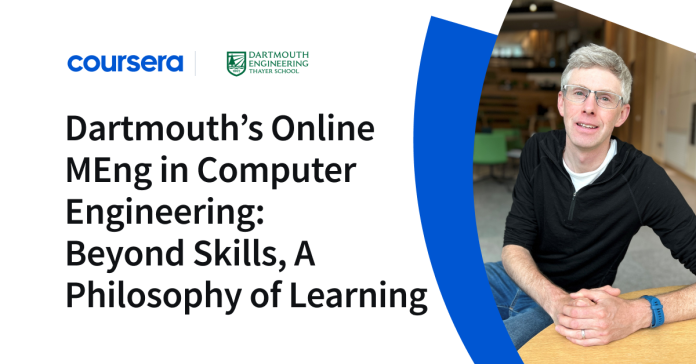

When you enroll in Dartmouth’s online Master of Engineering in Computer Engineering (MEng-CE), you don’t just gain technical expertise; you gain the ability to learn, adapt, and grow as an engineer in any environment. And that’s by design.
Assistant Professor Michael Kokko, who brings nearly a decade of experience as a robotics engineer and senior systems engineer, explains:
“Yes, we want students to graduate with strong technical skills. But more importantly, we want to teach them how to learn, how to pick up new skills quickly, and how to apply them effectively.”
This philosophy runs throughout Dartmouth’s online MEng-CE. Whether you come from a hardware-heavy background or are newer to the field, the MEng program is built for ambitious learners from a range of backgrounds, designed to meet you where you are, then broaden your capabilities.
Real-World Experience, Real Impact in the Classroom
Professor Michael Kokko knows what it takes to solve problems in industry because he’s done it, across roles in robotics, systems engineering, and software.
“I love the DIY process and hacking something together in the garage. But when you’re working with the market and multiple people, it’s helpful to have the oversight, the plan, and the metrics to know you’re moving in the right direction.”
That’s exactly the design philosophy he brings to his course on Distributed Computing, where students learn to write code for robotic agents and tackle real-world system design challenges.
A Hands-On Approach, Even Online
One of Dartmouth’s strengths is translating its in-person, project-based culture into the online environment.
“If you look at the courses in the online MEng program, we try to translate what we do in person to the online platform. The feedback has been that students appreciate how hands-on it has been. They’re working with peers, communicating on Slack, tackling group projects, and focused on building, testing, and designing something together.”
From virtual labs on Coursera (no setup or dependencies required) to real-world robotics projects, students are engaged in the same collaborative, problem-solving curriculum as on-campus learners.
Teaching Students to Learn
The program is intentionally designed to push students out of their comfort zones. In the Distributed Computing course, for example, students work in Go, a programming language most students have never touched before.
“The majority of my students haven’t programmed in Go. There’s some hesitation at first, but the overall learning objective is to become comfortable with the process of learning something new.”
The goal is for students to develop confidence in tackling unfamiliar challenges, which mirrors the realities of industry work.
“We’re trying to get students to say, ‘I need to learn this new task. I don’t know much about it, but I know I’m trying to get from point A to point B, so I’ll learn what I need to in order to make that connection.’”
A Supportive, Small-School Culture
Dartmouth’s smaller engineering school is both a challenge and a strength. The student-to-faculty ratio allows for personalized mentorship and a true sense of community. The care that each professor has for their students is palpable, even online.
“We’re a really dedicated team. You’re not watching videos recorded by faculty years ago. We have faculty on Zoom with students twice a week, outside of office hours, too. We’re here to help students.”
Students come from a variety of backgrounds with a range of skillsets and expertise. The program is designed for all of them. Professor Kokko emphasizes the importance of having diverse fields of thought in the classroom and describes how real-life applications are a core part of his teachings.
“What we do here is teach skills and teach to learn. That’s what students can hope to get out of the program. And the group projects are structured to make sure everyone has a meaningful, connected experience.”
Why Dartmouth’s MEng-CE Stands Out
If you’re looking to advance your career at the intersection of computer engineering and hardware, Dartmouth offers:
- A robust curriculum grounded in real-world projects.
- Faculty with deep industry experience who are active in current research and case studies.
- Small class sizes and high engagement, even online.
- Virtual lab environments that make it easy to jump into coding and design without the headache of setup.
- Hardware for hands-on experience that is shipped to all students in the program and used in multiple courses.
- A philosophy of learning that stays with you long after graduation.
As Professor Kokko says:
“I would encourage anybody who’s interested in furthering their education or career at the intersection of computer engineering and hardware to consider this program. We do our best to say, ‘Have you had an experience where you’ve seen something like this before?’ and ‘How do we connect that to our current topic?’ We want to make this degree something that is going to be approachable for all of our students.”
Ready to take the next step?
If you’re curious, ambitious, and interested in an online engineering degree designed for working professionals, Dartmouth’s online Master of Engineering in Computer Engineering might be your next step. With professors like Michael Kokko leading the way, you won’t just learn, you’ll connect, grow, and thrive.
Take the next step and dive headfirst into the future with a 100% online, hands-on experience from Dartmouth.
Word of the Day: dovish
This word has appeared in 23 articles on NYTimes.com in the past year. Can you use it in a sentence?
