fbpx
Home Blog Page 661

From Exile to Empowerment: How Nejla Gul-Saglam’s Determination Led to a Degree

0
From Exile to Empowerment: How Nejla Gul-Saglam’s Determination Led to a Degree

When Turkish native Nejla Gul-Saglam began her journey in computer programming at Sakarya University back in 2007, she didn’t yet know how many times her dreams would evolve—and be tested. Today, as a full-time employee, mother, and proud 2025 graduate of the Master of Engineering in Engineering Management from CU Boulder, Nejla’s story is one of courage, resilience, and adaptability in her relentless pursuit to further her education.

A Passion for Teaching, Interrupted

Nejla’s career began in tech, but her heart had always been drawn to teaching. Influenced by her grandparents, she first pursued an associate degree in programming, and later enrolled in a Turkish language degree program with the hopes of teaching at a nonprofit school in Turkey. Once her associate’s degree was complete, she fulfilled her dream and began teaching. Soon after, Nejla resumed her education and started working toward her bachelor’s degree. But everything changed before she could finish.

“I only had three courses left before we had to pack up and move to the United States.”

After marrying her New York native husband, Nejla learned she was pregnant. Simultaneously, there was national disruption in her home country of Turkey, causing her and her husband to flee the country, leaving behind her unfinished degree, her job, and the life they’d built.

Starting Over, One Course at a Time

“When we arrived in the U.S., I was heartbroken,” Nejla recalls. “I wanted to get a job, to contribute… but my English was very basic.”

Determined to adapt and thrive, Nejla discovered learning opportunities on Coursera. “I signed up for a lot of classes—maybe more than 200!” she laughs. What started as an effort to improve her English quickly evolved into a deep dive back into the tech world where her education originally began. She took courses in programming, AI, product development, project management, and communication, including prestigious certifications from organizations like IBM.

But challenges persisted. Economic limitations and an incomplete bachelor’s degree made formal education difficult. Her attempts to retrieve her transcript from Turkey dragged on for years. But Nejla, now a new mother and facing obstacles at every turn, continued doing courses with her Coursera Plus membership and pressed forward. Eventually securing a job at Paramount Studios, things would soon turn around. 

“I understood there were a lot of biases when people looked at me. But I still kept going.”

A Turning Point: ChatGPT and a New Path Forward

At her lowest point, Nejla started to question whether university was even an option anymore. “I thought maybe I should just focus on certificate programs. I even ordered over 20 leadership-related books and just started reading.” 

Then she asked ChatGPT a pivotal question: “Is there a university that offers a master’s degree without a bachelor’s?” That search led her to the University of Colorado Boulder’s Master of Engineering in Engineering Management, and its Performance-Based Admissions (PBA) pathway. This was the moment everything changed. Nejla submitted an inquiry and was contacted by Coursera enrollment representative, Carolyn. 

“I was about to cry,” Nejla says. “Carolyn was amazing—she told me, ‘Nejla, you can make it.’ She believed in me.”

Learning Like a Pro

With her manager’s full support, Nejla began the performance-based coursework that would determine her eligibility for the master’s program. She excelled, completing multiple specializations in leadership and project management with top grades.

Even better, with course stackability, Nejla was able to upgrade some of the coursework she’d been doing on Coursera for credit toward her degree once she enrolled. After years of struggle, Nejla was elated to learn this was an option, finally have her hard work pay off, and save time as an enrolled student.

“I broke up the costs, worked with my employer, and just kept going.” By the end of 2024, she had completed several specializations and continued into 2025 with more. 

Nejla notes that one of her favorite aspects of the program was its self-paced format. “It aligned perfectly with my productive morning routines and my hectic schedule as a corporate professional and a mom.” The program’s flexibility also allowed her to juggle all the priorities of her busy life and actually helped solidify her decision to enroll and continue her passion for education.

“As long as I live, I don’t want to stop learning,” Nejla says. “Coming from a different culture, it’s not easy to make our voices heard. But we keep knocking, and eventually, doors open.”

A Proud Graduate

“It’s a huge milestone for me. I now have a recognized diploma in the U.S. I’m one step closer to my dreams—and I’m not stopping.”

Now a 2025 graduate of the program, Nejla’s learning journey has far from stopped. This year, she was accepted into a doctoral program in Strategic Leadership at Liberty University.

Nejla credits her success to a blend of strong inner drive, innovative online learning platforms, and the incredible support of people like her manager and Carolyn from the Coursera enrollment team. “I am one step closer to my dreams,” she says. “And I’ll never forget those who helped me along the way.”

Coursera’s University Partners are Recognized Among Forbes Top 10 List of “New Ivies”

0
Coursera’s University Partners are Recognized Among Forbes Top 10 List of “New Ivies”

For a second year, Forbes has recognized a top ten list of “New Ivies.” These university graduates are said to be “outpacing most Ivy Leaguers in the eyes of employers” with similarly selective admissions processes and rigorous coursework. 

Among the 10 ranked public schools, Coursera proudly partners with the University of Illinois Urbana-Champaign, the University of Michigan, and the University of Pittsburgh to host their degree programs, 100% online. In terms of the top 10 private universities, Coursera partner Georgetown University takes 3rd. 

Employer endorsement

In speaking with over 380 C-suite executives, Forbes deemed that employers might be reconsidering their prior affinity of Ivy League grads. The article notes that out of the executives surveyed, “Forty-two percent said public colleges were doing a better job at preparing entry-level job candidates than they were five years ago.” Egos, groupthink, and lack of job readiness were all cited as rationales for potentially pivoting the hiring pool away from what it might have once been. 

The growing credibility of online degrees

Expanded ways of thinking about talent acquisition don’t start and stop with which university a candidate graduated from. Non-traditional, online learning has also been increasingly accepted by employers, especially post-pandemic. 

Champlain College’s 2023 national survey of 2,000 U.S. adults reported that 84% believe employers are more accepting of online degrees today than before the pandemic and 72% of adults feel an online education is more reputable now than five years ago.

Proving this hypothesis is a 2024 survey by the National Association of Colleges and Employers (NACE) which found 87.4% of employers had hired new graduates with an online degree and 100% of those employers paid online degree hires the same starting salary as traditional graduates​. This indicates near-parity in how online credentials are being treated, namely from universities that made the “New Ivies” list. 

Online degree programs built for Coursera

The University of Illinois Urbana-Champaign, the University of Michigan, the University of Pittsburgh, and Georgetown University partner with Coursera to offer some of their rigorous and career-aligned degrees, 100% online. Though none of these institutions are traditional Ivy Leagues, these esteemed universities are producing graduates that top employers respect. By partnering with Coursera to deliver their online degrees, these universities are able to offer their students high-quality faculty-led instruction with the support of a platform that is working to upskill and reskills millions of learners across the globe. 

We applaud each of our university partners for the Forbes accolades and for continuing to innovate and lead with forward-thinking approaches to delivering their high-quality instruction, online. These opportunities have paved the way for learners around the globe to achieve a top education and turn their ambitions into real-world success.

Read the Forbes article here

Custom Design Feature | Lovoni’s Lark

0
Custom Design Feature | Lovoni’s Lark

It’s fantastic to see a long-term client bloom! Lovoni, who’s been with us for years, decided it was time for a website refresh. We went beyond just a design update, crafting a whole new brand identity – logo, colors, fonts, and a complete website redesign.

It was a joy working closely with her to bring her vision to life. Check out the delicious results below and get inspired by her recipes!

Branding – logo, colors, and other cool stuff

For Lovoni’s branding, we knew she loved teal and wanted to bring in some mystical vibes. After trying out some different color ideas and having some fun with fonts, here’s the final mood board we created:

Website – the main course

We gave Lovoni’s website a complete refresh. You’ll find everything there, including her homepage, recipe index, blog, and lots of other great content. I highly recommend taking a peek at https://lovonislark.com/ to experience the new design firsthand!

Here is a quick before/after of her homepage:

Click the image below to see the full design

Or check close-ups of some of my favorite pages.

I’m really loving the new Recipe Index page on her website. Right away, you see some of her newest recipes featured at the top, plus a super handy search bar.

Do you want to refresh your website?

I’d love to help you bring your dream website to life! Whether you’re just starting out online or feel like your current site could use a little sparkle, I’m here for you.

Let’s chat about your ideas in a free design consultation – no strings attached!

Coursera University Partners are Recognized Among Forbes Top 10 List of “New Ivies”

0
Coursera University Partners are Recognized Among Forbes Top 10 List of “New Ivies”

For a second year, Forbes has recognized a top ten list of “New Ivies.” These university graduates are said to be “outpacing most Ivy Leaguers in the eyes of employers” with similarly selective admissions processes and rigorous coursework. 

Among the 10 ranked public schools, Coursera proudly partners with the University of Illinois Urbana-Champaign, the University of Michigan, and the University of Pittsburgh to host their degree programs, 100% online. In terms of the top 10 private universities, Coursera partner Georgetown University takes 3rd. 

Employer endorsement

In speaking with over 380 C-suite executives, Forbes deemed that employers might be reconsidering their prior affinity of Ivy League grads. The article notes that out of the executives surveyed, “Forty-two percent said public colleges were doing a better job at preparing entry-level job candidates than they were five years ago.” Egos, groupthink, and lack of job readiness were all cited as rationales for potentially pivoting the hiring pool away from what it might have once been. 

The growing credibility of online degrees

Expanded ways of thinking about talent acquisition don’t start and stop with which university a candidate graduated from. Non-traditional, online learning has also been increasingly accepted by employers, especially post-pandemic. 

Champlain College’s 2023 national survey of 2,000 U.S. adults reported that 84% believe employers are more accepting of online degrees today than before the pandemic and 72% of adults feel an online education is more reputable now than five years ago.

Proving this hypothesis is a 2024 survey by the National Association of Colleges and Employers (NACE) which found 87.4% of employers had hired new graduates with an online degree and 100% of those employers paid online degree hires the same starting salary as traditional graduates​. This indicates near-parity in how online credentials are being treated, namely from universities that made the “New Ivies” list. 

Online degree programs built for Coursera

The University of Illinois Urbana-Champaign, the University of Michigan, the University of Pittsburgh, and Georgetown University partner with Coursera to offer some of their rigorous and career-aligned degrees, 100% online. Though none of these institutions are traditional Ivy Leagues, these esteemed universities are producing graduates that top employers respect. By partnering with Coursera to deliver their online degrees, these Universities are able to offer their students high-quality faculty-led instruction with the support of a platform that is working to upskill and reskills millions of learners across the globe. 

We applaud each of our university partners for the Forbes accolades and for continuing to innovate and lead with forward-thinking approaches to delivering their high-quality instruction, online. These opportunities have paved the way for learners around the globe to achieve a top education and turn their ambitions into real-world success.

Read the Full Forbes article here

Sources
Forbes: The New Ivies 2025: 20 Great Colleges Employers Love

JOB OUTLOOK 2024 (National Association of Colleges and Employers)

2023 Survey Shows Online Degrees are More Accepted and Respected Than Ever (Chaplain College Online)

L&D Just Got Easier: Introducing Alison’s Group Functionality

0
L&D Just Got Easier: Introducing Alison’s Group Functionality

The Problem With Traditional L&D

In today’s business world, learning and development (L&D) is no longer a “nice to have”; it’s a catalyst for business success.

But if you’re in L&D, HR, or managing people in any capacity, you already know the hardest part isn’t finding good content – it’s the sheer effort it takes to assign, track, and manage learning for a whole team. You spend hours juggling individual enrolments, chasing completions, and pulling reports, on repeat.

It’s exhausting. And it slows you down from focusing on what actually matters: empowering your team to grow.

That’s exactly why we created Group Functionality for our LMS+.

This new feature allows you to cut through the mess. Within minutes, you can create a group, add everyone from your sales team to new starters and team leads, and assign training to everyone at once. One step. Zero chaos. Total visibility.

It’s a simple yet powerful addition to your existing LMS, but it changes everything.

Let’s break down how it works, why it matters, and how you can use it to drive real results.

What Is Group Functionality?

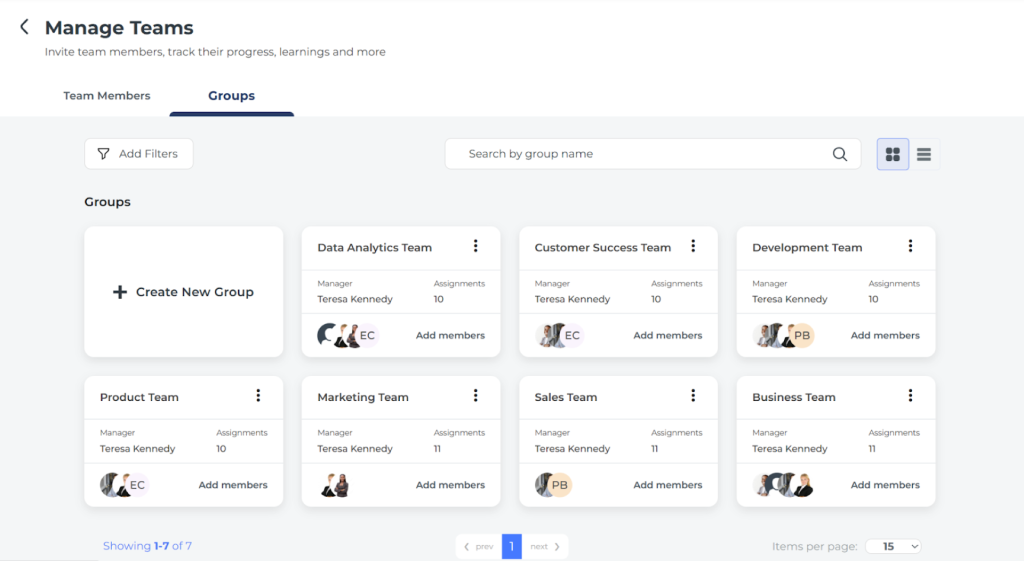
Group Functionality is a feature in Alison’s LMS+ that allows you to assign courses, learning paths, and training materials to team members, instead of manually, individually allocating training to learners who have similar training needs.

Think of it as creating a “classroom” within your LMS. Whether it’s your marketing team, a group of new hires that need to master the same skill for an upcoming project, or at a leadership level, such as all of your regional managers, you can bundle them into a group, assign learning materials, and track their collective progress.

Alison’s Group Functionality will save you time, reduce manual work, and ensure everyone is learning the same thing, at the same time.

Top 7 Benefits of Alison’s Group Functionality

1. Assign Once, Train All

Instead of manually assigning the same course to individual team members, you assign a course to a group, and voilà, all the heavy lifting is done! Whether you’re onboarding 10 new employees or rolling out compliance training to 100 employees, group functionality makes assigning training programmes instant.

Action tip: Use this feature during time-sensitive rollouts (e.g. policy updates with deadlines, in advance of a critical project kick-off, or new software training which requires mass user adoption).

2. Ensure Consistency Across the Board

When teams learn together, there’s no risk of variation in the content or its delivery. This is particularly important for compliance training, internal policy awareness, and skill-building programmes where uniformity is key.

Action tip: Implement a centralised training platform like Alison’s LMS to ensure consistency across all teams. Using a single source for all training materials not only simplifies the management of training content but also significantly enhances the likelihood of meeting and exceeding performance goals, as consistent training is key to achieving these outcomes.

3. Streamline Reporting and Analytics

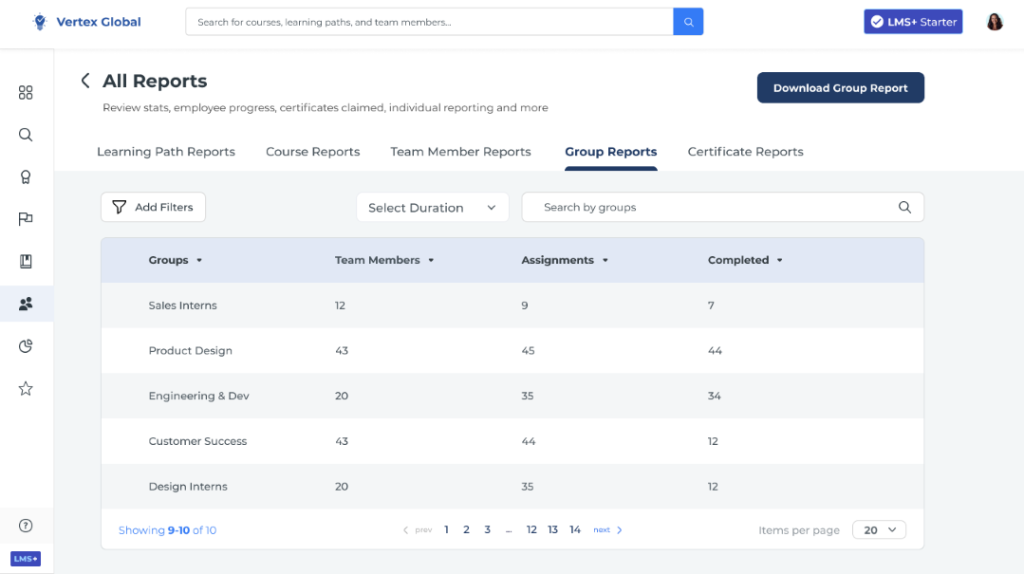
Group Functionality makes it easier to monitor performance at a team level. You can view progress, assessment scores, completion rates, and study time grouped by team, allowing faster insights and better decision-making.

Action tip: Schedule monthly reviews of group-level progress to identify skill gaps or underperforming teams.

4. Encourage Peer Learning and Collaboration

Grouped learning isn’t just about convenience – it also fosters a collaborative environment. When learners move through courses together, they can share ideas, solve problems as a group, and retain information better. Track this in how assignees apply their learnings to their daily work and monitor how performance & productivity improve.

Research insight: Teamwork Statistics stated that about 52% of professionals in the U.S. consider teamwork extremely important.

5. Better Team Cohesion and Morale

Learning together builds camaraderie. When teams take a course together, they can discuss lessons, apply learnings in real time, and hold each other accountable, creating a culture of mutual support and continuous improvement.

Action tip: Use Teams or Slack to create a discussion forum or weekly reflection session for each group to discuss how they’re applying the learning.

6. Identify Group Skill Gaps Quickly

By reviewing group analytics, you can see where teams are struggling, not just individuals. This allows you to address systemic skill gaps (e.g. communication, time management, leadership) with precision.

Industry insight: 64% of L&D pros said reskilling the current workforce to fill skills gaps is more of a priority than ever before (LinkedIn Learning Report).

7. Faster, Smarter Onboarding

Group Functionality is a game-changer for onboarding. Instead of building custom learning paths for every new hire, simply enrol them in a pre-built onboarding group and track their collective progress.

Industry insight: A Glassdoor Study says companies with structured onboarding programmes improve new hire retention by 82% and productivity by over 70%.

Individual Course Assignment:

Individual Course Assignment for corporate training in Alison LMS+

Grouped Assignment:

Grouped Course Assignment for corporate training in Alison LMS+

Now Here’s a Team Prepping to Launch a New Product

They’ve got a new project kicking off in three weeks. It’s a big one, a potential game-changer for their business. But here’s the catch: their team is spread across five regions, working different hours, with varying levels of knowledge. Some are pros, others are newer to this type of project. They know that if even a few of them go into this project unprepared, it could hurt not just revenue but customer trust too.

So, they do what they’ve always done – start prepping the training materials, draft email instructions, chase down who needs what, and hope everyone finishes the learning on time.

But this time, they try something different.

They log into their Alison LMS+, head to the Groups section, and create a new group: “Project Falcon – Q2 2025”.

They add their respective team to it in just a couple of clicks.

Then, instead of assigning courses one-by-one, they attach a structured learning path:

  • Project Management Fundamentals
  • Project Management Skills for Non-Project Managers
  • Agile Project Management
  • Modern Project Management – Working with Clients and Project Teams
  • Modern Project Management – Quality, Risk, Procurement and Project Closeout

They start a Slack channel for the group, and share a short welcome note for the group, “This project is a big one. Let’s stay sharp and finish the training by Friday next week. Share your insights and ideas on this channel as you complete the courses. Let’s smash this together!”

That’s it. They’re done.

Now, as the week goes on, you can check the group dashboard. You see who’s completed what, who’s lagging, and who might need a nudge, all without sending a single follow-up email.

By the time the project begins, every team member has completed the path. They’ve gone through the same content, had time to ask questions, and know how to tackle the project with shared knowledge and confidence.

And you? You can follow their lead.

Don’t waste time chasing completions. Rethink your strategy and prepare your team to win.

That’s the kind of power Group Functionality gives you. Not flashy, it is just deeply effective.

4 Tips to Get the Most Out of Group Functionality

  1. Start small: Choose one pilot group – say, your support team – and test how group functionality works for them before scaling.
  2. Think in paths, not courses: Assign learning paths for a deeper, structured experience, instead of one-off courses.
  3. Encourage peer interaction: Create check-ins or reflection sessions so teams apply what they’ve learned together.
  4. Track & celebrate progress: Use group-level analytics to celebrate milestones, course completions, or the fastest learners if it drives motivation.

Final Thoughts: Why Group Functionality Is the Future of L&D

Whether you’re an L&D Manager at a global corporation or a small startup, the ability to train and track learning at scale is critical. Group Functionality allows you to move fast, stay consistent, and keep your learners motivated without adding more admin to your plate.

Try creating a small pilot group and assign a basic communication path; it’s a great way to try it out and see how smoothly it can run.

It’s convenient for you, engaging for your learners, and pivotal to business growth.

If you are already subscribed to Alison’s LMS+:

  • Log in to your LMS dashboard and explore the Groups menu
  • Schedule a demo to see how it works in action
  • Or reach out to our team for help setting it up

Coursera Launches AI-Dubbed Courses in Spanish, French, Brazilian Portuguese, and German

0
Coursera Launches AI-Dubbed Courses in Spanish, French, Brazilian Portuguese, and German

Language barriers continue to be a major obstacle for learners around the globe, limiting access to education and career advancement opportunities. We took an important step towards bridging that gap by successfully rolling out AI-powered text translations in 2023, which have enabled nearly 3 million learners to take more than 5,000 courses across 25 languages.

Today, we’re excited to announce the launch of AI-dubbed courses in Spanish, French, German, and Brazilian Portuguese. Using Generative AI, we have translated and dubbed video content for more than 100 popular courses from leading institutions, such as IBM, Microsoft, and DeepLearning.AI. Unlike conventional dubbing, our approach captures the original speaker’s voice and speech patterns while perfectly syncing lip movements, making the content look and sound completely natural. Now, learners can experience all aspects of the course in their native language, driving stronger engagement and better outcomes. 

Initially available in four widely-spoken languages, our AI-dubbed courses will support learners across multiple countries representing nearly 800 million native speakers. 

  • Spanish: There are over 450 million native speakers across Latin America and 40 million in Spain. Coursera’s Spanish-translated courses already have more than 1 million enrollments, the highest for any translated language on our platform.
  • French: France is home to around 64 million native French speakers, and Coursera’s French-translated courses have nearly 450,000 enrollments, making it our second-most popular translated language. 
  • Brazilian Portuguese: Spoken by over 200 million native speakers in Brazil, Brazilian Portuguese is Coursera’s third-most popular translated language, with more than 370,000 enrollments to date.
  • German: There are around 80 million native German speakers in Germany, and Coursera’s German-translated courses have already reached more than 125,000 enrollments.

Studies consistently show that learning in your native language can lead to significantly better results. Learners on Coursera complete translated courses at higher rates and nearly 25% faster compared to those offered only in the original language.  Yet nearly 40% of the world’s population still lacks access to education in their first language. Our AI-dubbed content addresses this global challenge by providing over 100 career-focused courses in high-demand fields like AI, Data Science, and Cybersecurity, enabling learners to gain industry-recognized credentials in their preferred language.

Leon Katsnelson, Director and CTO, IBM Advocacy through Skills, said: “At IBM, expanding the reach and accessibility of our courses has always been important to us. By partnering with Coursera and using AI to dub our course content, we’re enabling more learners to access our courses in the language they’re most comfortable with, significantly improving their learning experience. It’s exciting to see how innovations like these can truly change the way people experience online learning worldwide.”

Andreas Ernst, Head of Learning Experience Management, Volkswagen, said: “At Volkswagen, preparing our workforce for the future is a central part of our long-term groups economical and educational strategy. Coursera’s AI-Dubbed courses allow us to deliver important training directly to our employees and ensure they have easy access to high-quality, job-relevant content. This supports our ongoing efforts in digital learning for different internal target groups, enhances collaboration globally, and positions our teams to drive innovation across the company.”

Patricia Pastor, Learning & Development Manager, Belcorp, said: “We know that learning in one’s native language enhances comprehension and engagement with content. That’s why initiatives like AI-dubbing allow us to expand the reach of our training programs, driving higher course adoption and completion rates within our teams. This helps our employees develop their potential and feel more confident when applying new knowledge in their daily work.”

At Coursera, we believe language should never stand in the way of opportunity. With AI-dubbing, we’re continuing to push the boundaries of innovation and ensure anyone, anywhere, can access a world-class education and unlock their full potential.

Click here to learn more and experience our AI-dubbed courses.

From Vision to Venture: Fatima Laher’s Journey through Innovation and Entrepreneurship at HEC Paris

0
From Vision to Venture: Fatima Laher’s Journey through Innovation and Entrepreneurship at HEC Paris

A 2024 graduate of the Executive Track within the HEC Paris Executive MSc & MSc in Innovation and Entrepreneurship online degree program, Fatima Laher has always been drawn to the energy of new ideas, the thrill of solving problems, and the challenge of building something from scratch. Her path has taken her through corporate roles, consulting gigs, and ventures at different stages—but no matter where she’s been, she’s stayed grounded in one mission: create meaningful impact.

A Career Rooted in Curiosity and Change

Over the years, Fatima has worked across industries and geographies, building a career that reflects her adaptability and drive to keep evolving. From corporate roles to consulting projects, she consistently sought out opportunities that challenged her thinking and allowed her to contribute in strategic, high-impact ways. But as her interest in entrepreneurship continued to grow, she reached a turning point: it was time to invest more intentionally in her own ideas.

Why HEC Paris?

The HEC Paris Executive MSc & MSc in Innovation and Entrepreneurship stood out for its combination of academic rigor and practical relevance. The program’s flexible, online structure made it possible for Fatima to pursue her degree while continuing to work—a key factor in choosing the program. Just as important was the opportunity to connect with a diverse, international cohort of learners, each bringing their own perspectives on innovation, leadership, and entrepreneurship.

Admittedly in a “rut” before deciding to enroll, Fatima says, “I was holding back. I needed a perspective switch. But then I started doing short courses on Coursera, and I did a bit of research and saw [the degree program] was fully online. So I went ahead and decided this was something I needed.”

Throughout the program, Fatima developed and tested new business ideas, sharpened her strategic thinking, and gained a deeper understanding of the financial, operational, and human elements of launching and scaling ventures. “It was a wonderful opportunity to touch on different fields in the entrepreneurial space” she noted. Moreover, Fatima appreciated the opportunity for the in-person project that allowed her to take a real concept through the stages of business planning and validation. 

Embracing the Entrepreneurial Mindset

Fatima’s experience in the program helped her refine how she approaches challenges and opportunities. 

“I loved the design thinking, the organizational design, I never had exposure to that previously and it broadened my thinking.” 

She emerged with not just a stronger business toolkit, but also a more entrepreneurial mindset—confident in her ability to take initiative, navigate uncertainty, and lead with clarity and purpose. Having been inspired by the coursework, Fatima noted, “I was immediately having better conversations with not only my clients, but I walked into my own CEO’s office and said look, we have to talk about organizational structure.”

Advice for Future Learners

Fatima’s journey is a powerful example for professionals who are considering their next step—whether they want to launch a startup, lead innovation within an organization, or explore a career pivot. 

Her advice for learners considering a degree emphasizes the impact of knowing your “why.” Fatima says, “Be resolved in yourself as to why you want to do it. What do you want to get out of it? Then, align yourself with the outcome. This will help you put in the time and the hours to get it done.”

Reflecting on the work she spent to get her to graduation, Fatima also notes, “Do the work. I know people use ChatGPT and try to make their life easier. But the depth of the knowledge I gained from reading the material is wonderful. I took the time to read those and I really found the content so interesting and thought-provoking. It expands your worldview.”

For anyone thinking about the HEC Paris program, Fatima’s experience reinforces a few key ideas: it’s never too late to invest in yourself, learning alongside a global community can be transformative, and meaningful entrepreneurship starts with a clear sense of purpose.

Looking Ahead

As she continues her post-graduation journey, Fatima is focused on applying what she’s learned to ventures and initiatives that align with her values. Whether advising, building, or leading, she brings a deep commitment to innovation with impact—and she’s just getting started.

Data Analyst vs. Data Scientist: Which Path is Right For You?

0
Data Analyst vs. Data Scientist: Which Path is Right For You?

You may have heard the phrases “data analytics” and “data science” mentioned before. If you are new to the world of data, you might be wondering what these terms mean — and if you’re interested in a career in data, which is the right path for you?

Though there is a lot of overlap between the two areas (and disagreement about the exact definitions), the main difference is how much they rely on machine learning. In general, data analytics covers everything from collecting data to spotting trends to communicating insights. Data science is a broader field that includes data analytics, and often involves making predictions with tools like machine learning or conducting experiments with data.

Learn something new for free

Companies collect a great deal of data. Almost all of them can benefit from data analytics to help make sense of it. But not as many require building algorithms that predict the future or apply patterns to new information.

Interested in working with data, but not sure where to start? In this article, we’ll explore data analytics and data science in more detail, to help you decide between our Data Scientist: Analytics Specialist career path and our Data Scientist: Machine Learning Specialist career path.

What is data analytics?

Data analytics is all about helping organizations make decisions based on data. Page visits can inform marketing strategies, housing costs can affect policy changes, and patient outcomes can impact a hospital’s operations. Data analytics helps us find patterns and tell stories from the large quantity of data organizations have.

“Every company is collecting some data. And a lot of companies need to leverage their data to make good data-driven decisions. There’s a huge opportunity for Data Analysts to really put that data to work.” says Codecademy Data Science Domain Manager Michelle McSweeney.

Quote Image:

Data science is a broad field that includes data analytics. It also covers making predictions with machine learning, working with big data, and developing artificial intelligence.

“Data science tends to be more specialized than data analytics, because not every company needs to make predictive data decisions, and not every company needs to leverage big data,” Michelle says.

To learn more about data science, check out our blog all about: What is data science?

Data Analyst vs. Data Scientist

The Similarities

At their core, both roles revolve around turning raw data into actionable insights that can inform better business decisions. Whether it’s analyzing trends, identifying patterns, or helping stakeholders understand performance metrics, both data analysts and data scientists share a common goal: making sense of data to drive smarter strategies.

A key similarity lies in the tools and techniques they use. Both roles typically work with programming languages like Python or R. They also leverage SQL for querying databases, and share foundational knowledge in statistics, data wrangling, and exploratory data analysis.

The Differences

While Data Analysts and Data Scientists share overlapping skills, their roles diverge in scope, complexity, and focus.

Data Analysts typically concentrate on taking a business question and translating it into a data question. They answer “what happened?” and “why did it happen?”. To do so, they’re responsible for collecting and reformatting data, analyzing it with statistics and probability, and sharing actionable insights in the form of visuals and reports. Their work is often more structured and driven by specific business queries or performance metrics.

Data Scientists, on the other hand, tend to operate at a more advanced level to answer deeper questions like “what will happen?” or “how can we influence future outcomes?”. They’re tasked with creating algorithms to automate data processes, recognize patterns, and make recommendations based on past behavior. They work on things like forecasting the financial future, creating customer-facing chatbots, detecting tumors in X-ray images, and making suggestions of things you might like.

Data Analysts: Salary and Skills

Salary

According to ZipRecruiter, the average salary for Data Analysts in the U.S. is $82,640 per year. Still, your salary as a Data Analyst will depend on your location. 

Industries with a higher demand for Data Analysts tend to provide higher salaries. For example, Payscale reports that data analysts working for Amazon can get paid up to $101,000 in the U.S. With Meta offering around $146,000, per Indeed. Other high-paying industries include healthcare, finance, insurance, and professional services.

Skills

Here are some of the basic skills required of a Data Analyst:

  • Data collection & cleaning: Gather data from various sources and prepare it for analysis by fixing errors, handling missing values, and organizing it into a usable format.
  • Data analysis: Explore and interpret data to find patterns, relationships, or trends that can help answer specific questions or solve problems.
  • Data visualization: Use BI tools to create visual representations of data — like charts, graphs, and dashboards — making complex information easier to understand and interpret.
  • Data reporting: Summarize and present data findings in a clear, structured format — often through reports or presentations — to inform decision-makers and stakeholders.

Data Scientist: Salary and Skills

Looking at Indeed, Data Scientists make an average salary of $126,833 per year in the U.S. Even with less than a year of experience, Data Scientists earn $101,338 on average. Those with three to five years of experience make $138,080 each year, with a high of $201,230.

Skills

Here are some of the basic skills required of a Data Scientist:

  • Data modeling: Design and organize data structures — like tables, relationships, and schemas — to represent how data is stored and accessed in databases or systems.
  • Machine learning: Create and use algorithms to detect patterns in data and make predictions or decisions without being explicitly programmed for every scenario.
  • Experimentation: Design and execute controlled tests (such as A/B tests) to validate hypotheses with data and optimize performance.

Data Analyst vs. Data Scientist: At A Glance

Data AnalystsData Scientists
FocusUse data to answer “what happened?” and “why did it happen?”Use data to answer “what will happen?” or “how can we influence future outcomes?”
Salary$82,640$126,833
SkillsData collection & cleaning
Data analysis
Data visualization
Data reporting
Data collection & cleaning
Data modeling
Machine learning
Experimentation
LanguagesSQL
Python
R
Statistics
SQL
Python
R
Data Science Languages

Data Analyst Career Paths

Interested in learning more about data analytics? You can dive into our Data Scientist: Analytics Specialist career path to learn everything you need to become a Data Analyst.

Or, our Business Intelligence Data Analyst career path is designed to teach you the essential skills to be job-ready in as little as three months.

If you want to learn a specific Data Analyst skill, check out the following Skill Paths:

Even if your ultimate goal is to become a Data Scientist, gaining a solid foundation in data analytics is a good first step.

Data Scientist Career Paths

Interested in becoming a Data Scientist? Our Data Scientist career paths will teach you everything you need to know to become an entry-level Data Scientist from the ground up.

Regardless of which path you choose, you’ll use your new skills to build unique projects you can use to build a portfolio — and we’ll also help you prepare for the hiring process with interview prep courses and other helpful resources you can find in our Career Center.

This blog was originally published in April 2021 and has been updated to include updated salaries, and new resources.


Dire-Wolf Pups?

0
Dire-Wolf Pups?

Tell us a story, real or made up, about these two pups, which scientists say have dire-wolf genes.

Unlock Learning Insights: How Grouped Data Transforms Your L&D Analytics

0
Unlock Learning Insights: How Grouped Data Transforms Your L&D Analytics

Every learner leaves a digital trail. The challenge is deriving insight from it. Data has become the backbone of every high-performing L&D strategy. But here’s THE PROBLEM: the sheer volume of learning data can be overwhelming. Sifting through spreadsheets, reconciling reports, and trying to piece together progress across hundreds of learners isn’t just time-consuming; it can actually slow down your decision-making.

Instead of looking at learner performance in isolation, what if you could zoom out and assess how whole teams, departments, or cohorts are progressing? This is precisely what grouped data enables you to do. It is the smarter, faster, and more actionable way to track and monitor staff training.

Let’s break down why grouped data is essential for modern L&D.

Track Team Progress Without Spreadsheets

Reporting becomes very simple when your learners are organised into groups, whether by team, role, location, or project.

Grouped data allows you to:

  • View team-level performance metrics at a glance
  • Compare progress across departments
  • Monitor who’s compliant and who isn’t
  • Instantly identify laggard behaviour, and take action

And the best part? You can do all this without manually building reports from scratch.

According to Watershed LRS, 60% of L&D managers now face executive pressure to measure the impact of learning, a significant increase from previous figures. This highlights the growing emphasis on demonstrating the tangible outcomes of L&D efforts in corporate settings.

Pro tip: Use group trends to forecast training needs for the next quarter. Seeing a dip in completion rates for a certain team? Schedule a quick sync with their manager to understand blockers and re-align on priorities. Then, adjust learning paths to stay on track with business goals.

The corporate digital learning sector has experienced significant growth, expanding from $86.78 billion in 2018 to a projected $153.41 billion by 2028, marking a 77% increase. This surge has led to an abundance of learning data, making it challenging for L&D professionals to sift through and derive actionable insights. Traditional methods of analysing individual learner data are often time-consuming and may not provide a holistic view of organisational learning trends.​

(Source: Intuition)

Understanding Grouped Data Analytics

Grouped data analytics involves organising learners into specific cohorts such as teams, departments, or roles and analysing their collective learning behaviors and outcomes. This approach shifts the focus from individual performance to group dynamics, enabling L&D professionals to identify patterns, trends, and areas for improvement more efficiently.

The strategic advantages

  1. Enhanced tracking and reporting: By analysing data at the group level, organisations can monitor progress, completion rates, and engagement metrics more effectively. This streamlined approach reduces the complexity associated with individual data analysis.​
  2. Identifying trends and insights: Grouped data allows you to recognise learning patterns across different teams or departments, facilitating targeted interventions and resource allocation.​
  3. Spotting skill gaps: Analysing group performance can reveal specific skill deficiencies within teams, enabling the development of tailored training programmes to address these gaps.​
  4. Recognising top performers: Group analytics can highlight high-performing teams or individuals within cohorts, providing opportunities for recognition and the sharing of best practices.​
  5. Reducing administrative workload: By focusing on group data, L&D professionals can streamline reporting processes, allowing more time for strategic planning and programme development.

How Organisations Use Grouped Data to Drive Strategic L&D Decisions

Data alone doesn’t create change – insights do. Grouped learning data helps connect the dots between learning outcomes and business performance. When looking at trends by team, department, or region, you can make informed decisions about everything from course design to budget allocation.

Here’s how organisations are using grouped analytics to steer their L&D strategy:

  • Resource planning: See which departments are falling behind on compliance or lagging in soft skills and redirect training efforts accordingly.
  • Budget allocation: Invest more in high-performing groups that show strong learning engagement and ROI, while using insights to rework underperforming programmes.
  • Curriculum adjustments: Spot common drop-off points or low engagement in specific content modules across groups and fine-tune your curriculum design based on real evidence.
  • Leadership development: Use group analytics to identify emerging leaders across teams by combining learning data with performance metrics, then nurture that talent intentionally.

L&D becomes a strategic advisor to the business, seeing the bigger picture. Every team-level data tells a story.

The Dashboard showcasing reports and detailed analytics for comprehensive data analysis.

How To Implement Grouped Data Analytics in Your L&D Strategy

To effectively integrate grouped data analytics into your L&D strategy, consider the following steps:

  1. Define clear objectives: Establish what you aim to achieve with grouped data analytics. Whether it’s improving course completion rates, identifying skill gaps, or enhancing engagement, clear objectives will guide your analysis.​
  2. Organise learners into meaningful groups: Segment your learners based on relevant criteria such as job function, department, location, or experience level. This grouping should align with your organisational structure and learning objectives.​
  3. Utilise advanced analytics tools: Leverage Learning Management Systems (LMS) and analytics platforms that support grouped data analysis. These tools can automate data collection, visualisation, and reporting, making it easier to derive insights.​
  4. Monitor and evaluate group performance: Regularly assess the performance of different groups to identify trends, challenges, and opportunities. This ongoing evaluation enables proactive adjustments to your L&D programmes.​
  5. Foster a culture of continuous improvement: Use the insights gained from grouped data analytics to foster a culture of continuous learning and improvement. Encourage teams to collaborate, share knowledge, and support each other’s development.

Actionable Tips

You’ve got the tools. Now make the most of them. Here are some practical ways L&D leaders are maximising the impact of grouped learning data in their workflows:

  1. Tag your groups smartly: Go beyond department names and create learning groups based on goals (e.g., “Future Managers 2025” or “Client-Facing Teams – APAC”). This allows for more meaningful insights and inspires participants.
  2. Use baseline comparisons: Before launching a new training initiative, capture group-level metrics like average assessment scores or completion rates. Then compare post-training data to measure real impact.
  3. Layer data with qualitative feedback: Group trends are powerful, but pairing them with feedback surveys helps explain the “why” behind the numbers.
  4. Set benchmarks between groups: Establish internal benchmarks like average time to complete a training path or engagement scores so teams can constructively track their performance against others.
  5. Make it visual: Use dashboards and charts to present grouped data in a way that’s easy for stakeholders to understand. A visual overview often sparks faster decisions.
  6. Keep it dynamic: Don’t treat groups as static. Update them as teams change, new projects launch, or skills needs shift. Dynamic grouping keeps your data meaningful.

Grouped Data becomes a powerful lever to optimise learning, prove impact, and influence business outcomes.

Now, Let Your Data Work For You

As someone in L&D, what you need is clarity. Confidence. The ability to say, “Here’s what’s working, here’s what’s not, and here’s what we’re doing next.

That’s what grouped data gives you.

You don’t need to overhaul your entire system to get there. Set up a quick demo to see how Alison LMS and grouped analytics can help you.

If you are already subscribed to Alison’s LMS+,

  • Log in to your LMS dashboard and explore the Groups menu
  • Schedule a demo to see how it works in action
  • Or reach out to our team for help setting it up