

Tell us a story, real or made up, about these two pups, which scientists say have dire-wolf genes.
Unlock Learning Insights: How Grouped Data Transforms Your L&D Analytics

Every learner leaves a digital trail. The challenge is deriving insight from it. Data has become the backbone of every high-performing L&D strategy. But here’s THE PROBLEM: the sheer volume of learning data can be overwhelming. Sifting through spreadsheets, reconciling reports, and trying to piece together progress across hundreds of learners isn’t just time-consuming; it can actually slow down your decision-making.
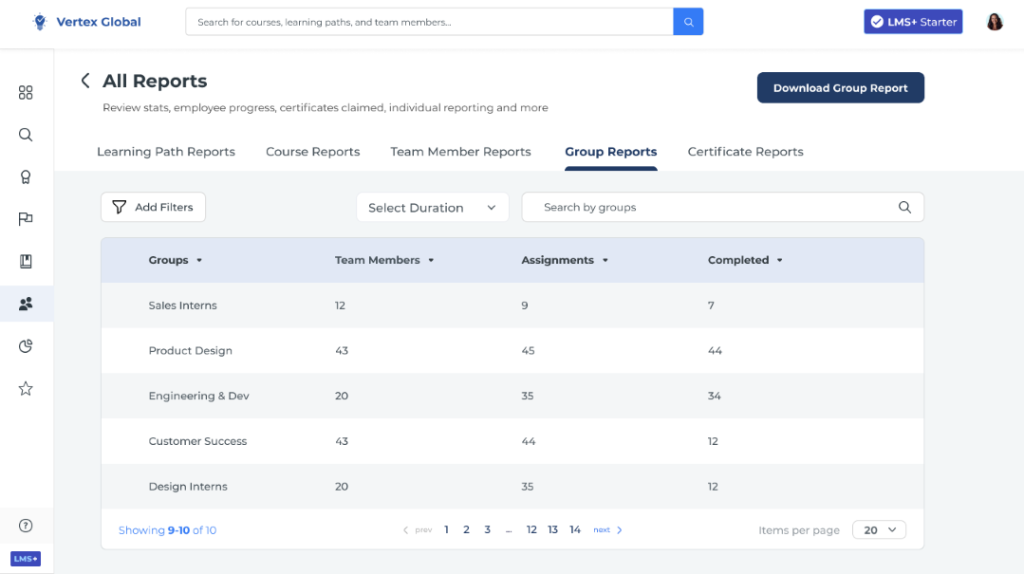
Instead of looking at learner performance in isolation, what if you could zoom out and assess how whole teams, departments, or cohorts are progressing? This is precisely what grouped data enables you to do. It is the smarter, faster, and more actionable way to track and monitor staff training.
Let’s break down why grouped data is essential for modern L&D.
Track Team Progress Without Spreadsheets
Reporting becomes very simple when your learners are organised into groups, whether by team, role, location, or project.
Grouped data allows you to:
- View team-level performance metrics at a glance
- Compare progress across departments
- Monitor who’s compliant and who isn’t
- Instantly identify laggard behaviour, and take action
And the best part? You can do all this without manually building reports from scratch.
According to Watershed LRS, 60% of L&D managers now face executive pressure to measure the impact of learning, a significant increase from previous figures. This highlights the growing emphasis on demonstrating the tangible outcomes of L&D efforts in corporate settings.
Pro tip: Use group trends to forecast training needs for the next quarter. Seeing a dip in completion rates for a certain team? Schedule a quick sync with their manager to understand blockers and re-align on priorities. Then, adjust learning paths to stay on track with business goals.
The corporate digital learning sector has experienced significant growth, expanding from $86.78 billion in 2018 to a projected $153.41 billion by 2028, marking a 77% increase. This surge has led to an abundance of learning data, making it challenging for L&D professionals to sift through and derive actionable insights. Traditional methods of analysing individual learner data are often time-consuming and may not provide a holistic view of organisational learning trends.
(Source: Intuition)
Understanding Grouped Data Analytics
Grouped data analytics involves organising learners into specific cohorts such as teams, departments, or roles and analysing their collective learning behaviors and outcomes. This approach shifts the focus from individual performance to group dynamics, enabling L&D professionals to identify patterns, trends, and areas for improvement more efficiently.
The strategic advantages
- Enhanced tracking and reporting: By analysing data at the group level, organisations can monitor progress, completion rates, and engagement metrics more effectively. This streamlined approach reduces the complexity associated with individual data analysis.
- Identifying trends and insights: Grouped data allows you to recognise learning patterns across different teams or departments, facilitating targeted interventions and resource allocation.
- Spotting skill gaps: Analysing group performance can reveal specific skill deficiencies within teams, enabling the development of tailored training programmes to address these gaps.
- Recognising top performers: Group analytics can highlight high-performing teams or individuals within cohorts, providing opportunities for recognition and the sharing of best practices.
- Reducing administrative workload: By focusing on group data, L&D professionals can streamline reporting processes, allowing more time for strategic planning and programme development.

How Organisations Use Grouped Data to Drive Strategic L&D Decisions
Data alone doesn’t create change – insights do. Grouped learning data helps connect the dots between learning outcomes and business performance. When looking at trends by team, department, or region, you can make informed decisions about everything from course design to budget allocation.
Here’s how organisations are using grouped analytics to steer their L&D strategy:
- Resource planning: See which departments are falling behind on compliance or lagging in soft skills and redirect training efforts accordingly.
- Budget allocation: Invest more in high-performing groups that show strong learning engagement and ROI, while using insights to rework underperforming programmes.
- Curriculum adjustments: Spot common drop-off points or low engagement in specific content modules across groups and fine-tune your curriculum design based on real evidence.
- Leadership development: Use group analytics to identify emerging leaders across teams by combining learning data with performance metrics, then nurture that talent intentionally.
L&D becomes a strategic advisor to the business, seeing the bigger picture. Every team-level data tells a story.
How To Implement Grouped Data Analytics in Your L&D Strategy
To effectively integrate grouped data analytics into your L&D strategy, consider the following steps:
- Define clear objectives: Establish what you aim to achieve with grouped data analytics. Whether it’s improving course completion rates, identifying skill gaps, or enhancing engagement, clear objectives will guide your analysis.
- Organise learners into meaningful groups: Segment your learners based on relevant criteria such as job function, department, location, or experience level. This grouping should align with your organisational structure and learning objectives.
- Utilise advanced analytics tools: Leverage Learning Management Systems (LMS) and analytics platforms that support grouped data analysis. These tools can automate data collection, visualisation, and reporting, making it easier to derive insights.
- Monitor and evaluate group performance: Regularly assess the performance of different groups to identify trends, challenges, and opportunities. This ongoing evaluation enables proactive adjustments to your L&D programmes.
- Foster a culture of continuous improvement: Use the insights gained from grouped data analytics to foster a culture of continuous learning and improvement. Encourage teams to collaborate, share knowledge, and support each other’s development.
Actionable Tips
You’ve got the tools. Now make the most of them. Here are some practical ways L&D leaders are maximising the impact of grouped learning data in their workflows:
- Tag your groups smartly: Go beyond department names and create learning groups based on goals (e.g., “Future Managers 2025” or “Client-Facing Teams – APAC”). This allows for more meaningful insights and inspires participants.
- Use baseline comparisons: Before launching a new training initiative, capture group-level metrics like average assessment scores or completion rates. Then compare post-training data to measure real impact.
- Layer data with qualitative feedback: Group trends are powerful, but pairing them with feedback surveys helps explain the “why” behind the numbers.
- Set benchmarks between groups: Establish internal benchmarks like average time to complete a training path or engagement scores so teams can constructively track their performance against others.
- Make it visual: Use dashboards and charts to present grouped data in a way that’s easy for stakeholders to understand. A visual overview often sparks faster decisions.
- Keep it dynamic: Don’t treat groups as static. Update them as teams change, new projects launch, or skills needs shift. Dynamic grouping keeps your data meaningful.
Grouped Data becomes a powerful lever to optimise learning, prove impact, and influence business outcomes.
Now, Let Your Data Work For You
As someone in L&D, what you need is clarity. Confidence. The ability to say, “Here’s what’s working, here’s what’s not, and here’s what we’re doing next.”
That’s what grouped data gives you.
You don’t need to overhaul your entire system to get there. Set up a quick demo to see how Alison LMS and grouped analytics can help you.
If you are already subscribed to Alison’s LMS+,
- Log in to your LMS dashboard and explore the Groups menu
- Schedule a demo to see how it works in action
- Or reach out to our team for help setting it up
How Concerned Should We Be About the Online ‘Manosphere’?

“Adolescence,” the Netflix mini-series about a 13-year-old boy accused of killing a classmate after consuming hateful, misogynistic content online, has soared in popularity since it was released last month.
Have you seen it, or discussed it with friends or family?
The series has helped draw attention to a disturbing trend: the surge in content that demeans and degrades women on the internet?
What have you been seeing or experiencing on social media? Do you think we should be worried about the growing online ‘manosphere’?
In the guest essay “Don’t Throw Our Boys to the Wolves Online,” Rachel Louise Snyder writes:
Last year, researchers at Dublin City University released a report on a disturbing phenomenon: a surge of male supremacy videos in young men’s social media feeds. It’s the kind of report that should sound an alarm for parents, teachers and administrators. But as the gender divide widens and young men increasingly lean conservative amid Trump-era authoritarianism, it feels less like a future warning and more like a current diagnosis.
In the report, researchers created sock-puppet accounts — fake accounts registered as teenage boys — to determine how quickly misogynistic videos show up in users’ TikTok and YouTube feeds. Alongside a control group, one group used male-coded search terms, such as “gaming” or “gym tips,” while another searched for more extreme anti-feminist, male-supremacist content. The “manosphere,” as it is often referred to, includes videos by Andrew and Tristan Tate, influencers who profit off the insecurities of young men. (The Tate brothers are embroiled in criminal and civil cases in Romania, Britain and the United States. They deny the allegations against them.)
It took under nine minutes for TikTok to offer troubling content to their fake 16-year-old boys, which later included explicitly anti-feminist and anti-L.G.B.T.Q. videos. Much of the content blamed women and trans people for the standing they believe men have lost in the world. More extreme content appeared within 23 minutes. Male supremacy videos intersected with reactionary right-wing punditry within two or three hours.
By the final phase of the experiment, accounts that showed even slight interest in the manosphere — for instance, accounts that watched a video all the way through — resulted in their For You feeds offering more than 78 percent alpha-male and anti-feminist content. Messages included: Feminism has gone too far, men are losing out on jobs to women and women prefer to stay at home rather than work.
Catherine Baker, the lead author of the study, says this messaging resonates because it plays into young men’s insecurities around their bodies — many of the accounts glorify fitness — as well as their future success and their relationships. Young men might believe that in order to be successful, they can’t show vulnerability; they need wealth, six-pack abs and social, political and cultural dominance.
Ms. Louise Snyder addresses “Adolescence” and its implications for society and lawmakers:
The new Netflix mini-series “Adolescence” grapples with this. In it, a 13-year-old boy named Jamie Miller appears to have killed his female classmate. His parents are good people and engaged in their child’s life but are tortured by what they chose to ignore. The father tried to toughen up his son, forcing him to play sports even though Jamie struggled. He ignored his son’s love of drawing and how quickly the internet could turn vile. Jamie’s parents buy him a computer and a headset and believe he is safe because he is at home, in his room.
This is what parents so often think. At home, our children will be safe. Our proximity equals security. It may be fictional, but “Adolescence” nails the naïveté of this rationalization.
There are at least four bills before Congress meant to address transparency in algorithms, limits on social media and similar measures. (Algorithms can serve anyone troubling content.) We regulate any number of things that pose dangers to our children: cars, toys, chemicals, alcohol. Any delay in cleaning up the online ecosystem is congressional malpractice.
Students, read the entire article and then tell us:
What’s your reaction to the essay and to the report by Dublin City University released last year on the surge of male supremacy videos in young men’s social media feeds, such as TikTok and YouTube? Which of the details, findings and statistics stood out to you?
Ms. Snyder says the report should “sound an alarm for parents, teachers and administrators.” Do you agree? How concerned should we be about the online manosphere?
What have you been noticing on social media? Have you ever encountered anti-feminist, male supremacist or misogynistic content online? If so, how did you respond? How did it make you think or feel?
Catherine Baker, the lead author of the study, says this content might lead young men to believe “that in order to be successful, they can’t show vulnerability; they need wealth, six-pack abs and social, political and cultural dominance.” What messages have you gotten about being a boy or girl from social media? Do you think this content has had a positive or negative effect on you or your peers?
Have you watched the Netflix series “Adolescence,” or discussed it with any friends or family? If so, did the show resonate with any of your own experiences, in school, at home or online? What lessons, if any, can we draw from the fictional show for teenagers or their parents?
Cynthia Miller-Idriss, who offers digital literacy guides for administrators, teachers and parents, says, “We just throw our kids to the wolves algorithmically, and expect them to recognize and reject it. But we need to do a better job of helping those kids and parents understand what they’re seeing.” Does your school offer a social media literacy curriculum, workshops or lessons? Do you agree that we are “throwing our kids to the algorithmic wolves,” as Ms. Miller-Idriss says? What do you think of her call to start lessons for understanding online content and messages as early as elementary school?
The essay notes that there are at least four bills before Congress meant to address transparency in algorithms, limits on social media and similar measures. Would you be in favor of such actions? What else could we do to address the issue?
If you are a boy, what would you like adults to understand about growing up male today that they might not see or know? If you are not a boy, what do you think boys need to understand about misogyny and masculinity that they might not see or know?
Students 13 and older in the United States and Britain, and 16 and older elsewhere, are invited to comment. All comments are moderated by the Learning Network staff, but please keep in mind that once your comment is accepted, it will be made public and may appear in print.
Find more Student Opinion questions here. Teachers, check out this guide to learn how you can incorporate these prompts into your classroom.
Dire-Wolf Pups

Dire wolves, made famous by “Game of Thrones,” went extinct some 13,000 years ago. Now, reports The Times, researchers have bred gray-wolf pups that carry genes of their ancient cousins.
Use your imagination to write the opening of a short story or poem inspired by this news or the image of the puppies — or describe a memory from your own life that this image makes you think of.
Post your work in the comments, and then read the related article to learn more.
Students 13 and older in the United States and Britain, and 16 and older elsewhere, are invited to comment. All comments are moderated by the Learning Network staff, but please keep in mind that once your comment is accepted, it will be made public and may appear in print.
Word of the Day: stylus

The word stylus has appeared in eight articles on NYTimes.com in the past year, including on Feb. 24 in “100 Years Ago Recording Studios Got a New Tool: Microphones” by Ludovic Hunter-Tilney:
Thomas Edison invented the phonograph in 1877, and the period until 1925 is known as the acoustical era. A conical recording horn would capture the music being performed; sound waves caused a stylus to cut grooves into a rotating wax disc, marking it with audio information.
Daily Word Challenge
Can you correctly use the word stylus in a sentence?
Based on the definition and example provided, write a sentence using today’s Word of the Day and share it as a comment on this article. It is most important that your sentence makes sense and demonstrates that you understand the word’s definition, but we also encourage you to be creative and have fun.
If you want a better idea of how stylus can be used in a sentence, read these usage examples on Vocabulary.com. You can also visit this guide to learn how to use IPA symbols to show how different words are pronounced.
If you enjoy this daily challenge, try our vocabulary quizzes.
Students ages 13 and older in the United States and the United Kingdom, and 16 and older elsewhere, can comment. All comments are moderated by the Learning Network staff.
The Word of the Day is provided by Vocabulary.com. Learn more and see usage examples across a range of subjects in the Vocabulary.com Dictionary. See every Word of the Day in this column.
Discover the Latest Trends in 2025: Newest Developments

IIn October 2024, I identified what I saw/believed would be the trends to watch in 2025.
However, while the year has not yet been completed, I looked into the crystals I found on the ground.
You are here, I surmise, to find out what those latest trends are, and here they come, just like the unlimited fries at Red Robin (a US chain that charges extra for impossible meat—plant-based).
Trend 1
Who are you?
Clarity from vendors is a trend I consistently advocate for, as it empowers you to make informed decisions.
Who are you?
This asks who the vendor is from the standpoint of what they are trying to say and validate.
If a vendor has to hum and ha about this, they have no idea.
I’ve talked to vendors who show me all these exceptional capabilities and the names of their clients.
Great, but that doesn’t answer my question.
Who are you?
I won’t mention one vendor’s name, but at a trade show, they presented all this marketing stuff and spun an amazing tale, but for the life of me, I couldn’t figure out who they were because it was all jumbled.
A vendor should know – it is as simple as that.
If they can’t answer without a three-minute soliloquy, then trust me; they have no idea, either.
Trend 2
AI Skills mapping
AI skills mapping to either job opportunities (more on that in a second, okay a few seconds), mapping to content tied to skills tied to your learning journey (this one I like).
The skills mapping is a huge pain in, you know what, with you (uh, overseeing L&D or Training or even HR) having to bring in other stakeholders (you do not want to do this) or being pushed over by some other department (another yuck).
Then it is just the time you have to spend to do this.
That is the biggest gripe I hear, and it is valid.
AI can change all that, depending on the prompt.
I think too many systems ignore the prompt window (an important key). By having you select X skills and Y whatever, the AI outputs the skills recommended or required or the person is lacking or has, with the content or playlist or whatever—yep, even career opportunities, if a vendor offers them. The ‘prompt’ here refers to the initial input or query that triggers the AI’s response.
Anyway, the learning journey piece – think learning path – old-school term, is the crux here.
I find vendors lack the three parts—skills mapped to content (the content piece is relevant), to the learning journey (relevant) based on the prompt, and to continued prompts.
Nobody gets it perfect out of the gate unless you are very specific, which many people are not—because they are not familiar with how prompts work with AI.
Trend 3
The performance we can go. The performance we can go.
High Ho, Performance, we are going. (Use the tune from Snow White. I attempted it – probably poorly)
Employee Development – another word for performance management
Training Management – which means a 100% scheduling platform – Training Orchestra is the premium here.
Talent Management—Let’s take this back to the 1990s and early 2000s. You want legacy? Here it is. ‘Legacy’ in this context refers to the traditional or established practices in Talent Management that are still in use today.
Are you unaware of what legacy means?
There’s no need to look it up – it’s dated and old.
Performance Management, on its own, doesn’t tell me the real story.
What am I supposed to do here?
What is the angle, and how does it benefit me, the learner, not you, running L&D?
The key piece, which way too many vendors miss, is the term ‘learning’ in that statement.
Very few vendors include it, yet PM and even Talent Management recognized learning as the cash cow – the giant Dinosaur in the room.
I won’t mention the vendor who pitched in the 2000s. They were an LMS, yet privately admitted to me—when I asked them, “Aren’t you really a performance management system?”—that they said yes.
Did they tell the buyer? Nope.
If you are doing performance management, the word “learning” has to be there. I mean, you can only go so far with skills development for a job or opportunity—i.e., project manager—without having a way to identify those skills, rather than relying on Sarah, who says their skill in project management is a five out of five.
How do you know?
Hence, that learning-content side of the house.
One vendor who does a very good job of mentioning flat out that they are a performance management learning system is Acorn, which has as its product moniker Acorn PLMS.
I’m pretty confident that if I rumble over there, I can figure out what the “L” stands for.
The system matches all desired items in such a performance management learning system.
See how I added learning to the piece rather than just saying performance management?
I see one trend here around the old legacy term PM/TM: the leveraging of mentoring right into it.
Do you want to drop the mic here?
Add it.
Because it takes everything you are doing or want to do, especially if you are angling the jobs/opportunities/career aspect in your system.
Skills development encapsulates mentoring, which taps into career growth and only takes you so far without the mentoring side.
Or you want someone in a leadership development program, which could lead to higher career aspirations.
Skills – Coach – Development – focus on specific skills to be coached on – career growth (in theory).
Learning exists in all places.
Mentoring and coaching aren’t interchangeable, but if you see coaching as the same as mentoring, that’s okay.
Just as folks claimed to see a difference between Pepsi and Coke.
If you can’t tell the difference, get to the doctor ASAP – you have lost your taste buds.
Trend 4
AI and L&D confusion
This is a big one because it involves two sides of the coin.
On the one hand, there are people in L&D, Training, and HR who are still in the dark about the whole AI experience and are, in many ways, not seeing the quick picture, let alone the big picture.
The reality is that AI is going to play a significant role.
It is just the beginning, but it will be a game-changer in a year from now and beyond.
If done correctly, this plays into learning and training – we are just not there yet.
On the other hand, there is some knowledge around AI, which vendors are tapping into by making statements that are either confusing, not fully accurate, or give off a perception that it will align strongly with what you are doing or want to do.
Yes, some vendors get it, but I see many vendors who make claims and statements that are questionable at best.
Another issue I am seeing is that people in L&D, Training, HR, and other departments see the value and relevance of AI for their employees but ignore it for clients, customers, members, and any other external relations.
The latter is a concern.
The former is relevant; however, the information is not being presented and updated to their employees, so the idea that everything AI produces is accurate is false.
I used ChatGPT research to provide information on a topic in a recent test.
The info it presented included cites.
It seemed impressive enough; however, some citations did not exist on the web page it noted.
Equally, there were citations in journal articles that the writer never presented.
Here is part of the angle.
Unless someone goes and checks each citation – highly unlikely, even at the university level, the assumption will be 100% accurate.
On a further test, I added my PDF – thus content seeking to extract and go to key points on another topic.
Result?
85% accurate.
I provide these data points to show that presenting this information to your employees in some course or content is essential.
This is the only time I would ever say that assigning is necessary.
The latest trend shows that less than 1% of vendors who have AI in their system state that it may create fake or false information, and you should verify the information before accepting it.
I recall a vendor who told me that none of their clients said this was inaccurate, and none of their employees told the L&D people it was wrong.
Thus, it is 100% accurate.
Think about that.
Trend 5
Upskilling and Opportunities
If there was a trend in quarter one, it was opportunities.
This appears even in systems not focused on PM, let alone stating talent development.
How it is being seen is similar as a whole.
- The learner has the skill or skills; if they lack them, they can take content to skill up (however, the latter doesn’t appear in every system, as it relates to “content.”
- Learner’s skills match an opportunity (some vendors list a percentage by it or identify the strengths of specific skills)
- The learner sees the opportunities (some vendors list all the opportunities, even if the learner doesn’t have the skill set(s) for them)
- Learner applies for that opportunity.
- Manager reviews the opportunity (This I find is weird because often it is the current manager, not the hiring person. In the current manager reviews the opportunity item, they either accept or deny)
- Assumption opportunity is a go – it goes to the hiring manager (For those systems that do not require the current manager to accept or deny)
- The hiring manager or whomever either accepts the learner to go to the next step or denies it (often, the learner does not see the results. Rather, it is offline)
- The approach angles not to those higher up, seeking opportunities that may align to them, say, director, senior director, VP, and so forth (I haven’t seen this in any of the opportunities, although I assume there has to be at least one system that offers it)
- Some systems use AI in this aspect, ignoring fake or fake information and AI bias – an issue. Equally, some states require specific approaches – i.e., applying for a job, even if it is internal. There are vendors unaware.
How it should work, which, again, I have yet to see.
- Learner’s percentage of skill knowledge – Manager reviews the skill and validates or not (the latter is common, but the rate isn’t)
- The assumption automatically that the learner’s skills or skill is 100% accurate – If I am a manager with 50 people or more under me, am I going to know the skill proficiency of my employees, especially if they are in various job roles on topics I am unfamiliar with?)
- Content recommendation to boost that skill (I have seen this part, but again, even if listed, it doesn’t state the recommendation percentage, and more than standard, it becomes an assigned piece, which shouldn’t be the case. We are talking about learning and training, not you are a robot and here is a widget, so learn it – without any insight into what you already know parts of the widget)
- Interests are often ignored even though systems have them – not all; it isn’t common.
- There is never a skill for empathy, yet in a study I did with CEOs, the most common requirement they sought was empathy.
- A pre-assumption that if someone is perfect for that opportunity, they will either get that opportunity or go to the next step.
I know this is not the case, but nowhere does it state that.
Trend 6
This isn’t so much a trend, but it does present a reality that is vastly being seen with vendors who have a built-in content creator—they often list it under the legacy term of “authoring tool.”
It’s becoming increasingly evident that many course creators lack the fundamental skills required to build a practical and effective course.
Thus, the course/content they publish is, well, bad.
Then, the learner sees it and complains that it is terrible and boring, which leads the person overseeing the department to believe that this is the system’s issue when, in fact, it is theirs—i.e., whoever is creating the content.
It’s imperative that every vendor with a content creator provides the necessary instructional design basics for creating an effective and engaging course.
Or you could use simple skills (hey, something that is listed as upskilling in a system for others) to create content.
Here is my post on how to do this.
However, I will challenge every vendor with a built-in content creator, whether they are using AI – which still requires basic knowledge around effective content development – that is engaging.
The challenge?
Provide this information, and I will post it on a separate page on my blog.
You can link to it on your site – which virtually no vendor does, or create a PDF and have me link to that.
What the person sees when they come to my page is your name and the steps you provide for effective content creation.
Your name and steps.
This will become a PDF on my side, where people can download it for their own use or come back to my page when the vendor sends information due to an update.
It’s that simple.
My prediction is that less than ten vendors will do it.
If a vendor is launching their content creator, then when launched provide the information OR send it before hand, with the launch date.
If the vendor wants to show it as a video, I still ask for some text steps, and the video should be videos.
Text is relevant because some people cannot host them, nor will they watch them.
If you wish, take screenshots with the text, and that will be published.
Let’s truly see who is committed to you when it comes to content
creation.
Bottom Line
Trends.
If you watch, you will see.
If your identify, you will modify.
And learning is really about synthesis.
Knowledge driven not by hypothesis, rather by action.
Action, these trends show
Are here and by recoginizing them,
You can say
Okay.
And decide what you will do next.
It’s always about your choices.
Always.
E-Learning 24/7
Celebrating 1 million global learners of content and credentials from Microsoft


By Marni Baker Stein, Chief Content Officer, Coursera
Today, we are proud to announce that more than 1 million learners have enrolled in courses, Specializations, projects, and Professional Certificates from Microsoft, an industry partner since 2021. Microsoft learners span 195+ countries, with India, the U.S., Canada, Pakistan, and the U.K. rounding out the top five.
Since partnering with us in April 2021, Microsoft has launched 23 Professional Certificates and 14 Specializations (encompassing 170+ courses) as well as 15 standalone courses and two Guided Projects – all in job-relevant topics ranging from cybersecurity and UX design to data analysis and AI. In November, we expanded our partnership with Microsoft with the first Professional Certificates from Xbox on Coursera: Xbox Product Manager and Xbox Graphic Designer.
“When we partnered with Coursera nearly four years ago, our goal was to help ensure everyone has the ability to learn the most in-demand Microsoft cloud and AI skills – including how to use Microsoft technology to augment their careers,” said Geoff Hirsch, Head of Training Services Partner Channel, Microsoft. “I’m thrilled that we’ve inspired more than 1 million learners to enroll in our content and realize their potential.”
Learners have been particularly interested in learning how to use specific Microsoft tools in their day-to-day work. These are the top five Microsoft courses of all time on Coursera:
We are honored to work with such a dedicated partner like Microsoft, who shares our commitment to expanding access to world-class content and credentials. As we mark this incredible milestone of 1 million learners, we look forward to delivering even more courses and certificates that help learners everywhere succeed in an evolving labor market.
Learners can find all of Microsoft’s content on Coursera here.
Weekly Student News Quiz: Global Markets, N.C.A.A. Finals, a Tortoise

Above is an image related to one of the news stories we followed this past week. Do you know what it shows? At the bottom of this quiz, you’ll find the answer.
Have you been paying attention to current events recently? See how many of these 10 questions you can get right.
What Would You Like to Make?

What do you enjoy making by hand? Do you bake, embroider or draw? Create with wood, beads, leather, paper, yarn or metal?
When was the last time you made something, just for the fun of it?
For inspiration, take a look at a Times series called Art of Craft, which takes you inside the work spaces of specialists whose work rises to the level of art.
In the series so far, you can find people who blacksmith, blow glass, and sculpt nails, who make balloon art, piñatas, surfboards, lampshades, tissue paper banners, beadwork, tiny sculptures, cakes, guitars, violins, saddles, quilts, jewelry, embroidery and baskets.
For example, Mei Kawajiri, shown in the video at the top of this post, hand-paints and sculpts custom-designed nails. When she first came to New York City from Japan she was alone and spoke no English, and would walk miles with a portfolio of her designs looking for work. (In fact, she created 3-D croissant nails because she struggled to pronounce the word, and it was easier to just point at her nails when ordering at a cafe!)
Now, however, her nails are in great demand:
For at least a few days most weeks, Mei Kawajiri makes hotel calls to celebrities like Cardi B, Heidi Klum, Ariana Grande and Bad Bunny to whip up viral creations, often shared with her more than 343,000 Instagram followers. Her medium might be even more impressive: extravagant nail art — minutely detailed 3-D pastries, hand-drawn portraits of anime heroines and six-inch acrylics embedded with jewels and bits of lace.
Or, get to know the work of Leleo Kinimaka, who grew up in Hawaii and has carved out a career as a woodworker.
His creations — primarily the intricately designed surfboards known as alaia boards, which have been used by islanders to catch waves for centuries — both reflect his upbringing and celebrate his culture:
“When I make boards incorporating Hawaiian symbols and stories, that’s my absolute favorite,” Kinimaka said, admiring his handiwork. Running his fingers along the surface, he added: “See this curly golden grain here? That represents the god of the sea, Kanaloa. These triangles? They represent shark teeth, a symbol of power. The three diamonds intersecting here? That represents ohana — family.”
Here, you can watch him at work:
Or, read about Roberto Benavidez, who works with a traditional Mexican craft that much of the art world has been slow to recognize as anything but a children’s toy:
The piñata, because it’s made out of humble paper and designed to be obliterated, is not always thought of as art. The Los Angeles-based artist Roberto Benavidez has worked to change that.
“It is just this innocuous kids’ party game to many,” Benavidez said. “The piñata is so much more.”
Benavidez has transformed the traditional piñata into something much more elaborate, emulating birds and mythical creatures straight out of medieval artworks and texts. Inside his studio, there lives a menagerie of creations: A silver giraffe stands watch over a half-dozen exuberantly colored birds hanging from the ceiling. At his desk, Benavidez was busy working on a new addition to the flock: a blue Kingfisher.
Students, scroll through the Art of Craft series, read one or more articles in full, and then tell us:
Which of these stories or crafts interests you most? Why? What is impressive to you about it?
What do you make that brings you joy or satisfaction? If you don’t currently make anything, can you remember a time when you did? What do you get from crafting things with your hands that you may not get from other activities?
Is there a craft that you wish you could focus on so deeply that, like these specialists, your work could rise to the level of art?
What crafting traditions are there in your family? For example, maybe you have a grandparent or aunt or uncle who made furniture or wove blankets or was a metalworker. Is there anyone in your extended family who could teach you a craft of some kind?
What crafting traditions are a part of your ethnic, regional or religious heritage? What do you think those crafts can tell you about the culture that brought them about?
What, if anything, do you think is the difference between work that is considered “art” and work that is considered “craft”? Many of these articles allude to a line between the two. For example, in the story about the Indigenous beadworker Teri Greeves, we learn that even “as her own work is now in the collections of museums such as the Heard Museum in Phoenix, the Brooklyn Museum and the National Museum of the American Indian, Greeves identifies as her grandmother did: as a beadworker, not as an artist.” What, to you, separates art and craft? Why?
“Nails are such a powerful form of expression,” Kawajiri says — yet, like piñatas or beads or balloons, nails are not often thought of as art. What objects do you encounter every day — whether at home, in school, on the street, in stores or in terms of fashion — that strike you as a “powerful form of expression” that more people should notice and celebrate? What makes them interesting to you?
Students 13 and older in the United States and Britain, and 16 and older elsewhere, are invited to comment. All comments are moderated by the Learning Network staff, but please keep in mind that once your comment is accepted, it will be made public and may appear in print.
Find more Student Opinion questions here. Teachers, check out this guide to learn how you can incorporate these prompts into your classroom.
Theme Park

Do you love theme parks? Which are your favorites? Why?
Do you know about Epic Universe, the new $7 billion theme park in Orlando that opens next month? Which of its four areas would you most want to visit? (One is based on “How to Train Your Dragon,” another on Super Nintendo video games, a third on the Harry Potter stories, and a fourth, called “Dark World,” on classic movie monsters.)
In general, what would you hope a new state-of-the-art theme park might offer in 2025 that older parks don’t? Why?
Tell us in the comments, and then read the related article to learn more about the park and what it will offer.
Students 13 and older in the United States and Britain, and 16 and older elsewhere, are invited to comment. All comments are moderated by the Learning Network staff, but please keep in mind that once your comment is accepted, it will be made public and may appear in print.
